
Saudi Arabia Real Estate Investment Guide for 2026
A comprehensive resource for North Americans looking to invest in 2026 in the Middle East’s largest economy during its unprecedented transformation under Vision 2030
Note: This process also applies to investors from 190+ other countries ▼
Quick answers: Top 5 most searched questions ▼
Countries Whose Citizens Can ALSO Invest in Saudi Arabia Real Estate
🇸🇦 GCC Countries (Special Privileges)
UAE, Kuwait, Bahrain, Oman, Qatar
Process: Preferential treatment. GCC nationals can own multiple residential properties in approved areas without a foreign investment license. Holy cities remain restricted.
🇪🇺 European Countries
UK, Germany, France, Netherlands, Italy, Spain, Switzerland
Process: Same framework as North Americans. Eligible to purchase approved residential property under the Foreign Ownership Law (2026) or via Premium Residency for residency-linked benefits.
🌏 Asia-Pacific
India, China, Japan, Singapore, South Korea, Pakistan, Bangladesh
Process: Same as North Americans. Large expatriate populations and investor demand in Riyadh, Jeddah, and major Vision 2030 developments.
🌍 Middle East & Africa
Egypt, Jordan, Lebanon, Morocco, Nigeria, South Africa
Process: Same foreign ownership rules as North Americans. Regional business ties and workforce mobility support long-term demand.
🇧🇷 Latin America
Brazil, Argentina, Mexico, Chile, Colombia
Process: Same as North Americans. Interest driven by mega-project exposure, diversification, and Vision 2030 growth.
🌍 All Other Eligible Countries
Most nationalities worldwide
Process: Saudi Arabia’s Foreign Ownership Law (effective 2026) allows eligible foreign nationals to purchase approved real estate, subject to zoning, use, and regulatory approval.
Important Note: Foreign ownership is permitted in approved areas only. Holy cities (Mecca and Medina) remain restricted, and residency rights require separate qualification under the Premium Residency program.
🔥 Top 5 Most Searched Questions
Based on actual Google search data for Saudi Arabia real estate investment
1. What’s the minimum investment for Saudi Arabia Premium Residency (Real Estate Track) in 2026?
As of January 2026: Saudi Arabia’s Premium Residency (“Green Card”) program includes a dedicated
Real Estate Owner track under Vision 2030 investment reforms.
• Minimum investment: SAR 4 million (≈ US $1.05–1.10M) in completed, mortgage-free residential property.
• Residency type: Valid as long as ownership and eligibility are maintained (spouse and dependent children included).
• Limited-duration option: Renewable paid residency options are available under other Premium Residency tracks.
• Ownership rights: Freehold ownership in approved cities (Riyadh, Jeddah, Dammam, NEOM, KAEC).
Holy cities (Mecca & Medina) remain restricted.
• Process: Property acquisition, holding, leasing, and resale permitted without a local sponsor, subject to regulatory approval via the Premium Residency platform.
Note — Other Premium Residency tracks (investor, entrepreneur, professional talent) exist, but this is the only option directly tied to residential property ownership.
2. Can foreigners buy property freely in Saudi Arabia?
Yes — in approved zones under the Foreign Ownership framework effective 2026. Foreign nationals may purchase residential and commercial property in designated areas such as Riyadh, Jeddah, Dammam, NEOM, and King Abdullah Economic City. The holy cities of Mecca and Medina remain restricted. Purchases must be registered and approved through the relevant authorities.
3. What are typical rental yields in Saudi Arabia in 2026?
Gross residential rental yields typically range from 6% to 9%. Riyadh remains the strongest rental market, followed by Jeddah and the Eastern Province. Demand is driven by population growth, workforce expansion, and Vision 2030 projects, particularly in urban and mixed-use developments.
4. What taxes do foreign property investors pay in Saudi Arabia?
No personal income tax on rental income. Real Estate Transaction Tax (RETT) applies at 5% on property transfers. VAT generally applies to services, while most residential sales and leases are VAT-exempt. Ongoing taxation rules continue to evolve under Vision 2030 reforms.
5. What is Saudi Arabia’s Vision 2030 impact on real estate?
Vision 2030 is reshaping Saudi real estate at scale. Trillions of riyals are being deployed across mega-projects, housing initiatives, and infrastructure upgrades. Targets include higher homeownership rates, major urban expansion, and the creation of new economic cities, driving long-term demand across residential and mixed-use markets.
💡 Need more detailed answers?
Get comprehensive answers to 10+ additional questions below:
→ Jump to Complete FAQ Section📚 New to real estate investing? Master the fundamentals with our professional course Learn more →
1. Saudi Arabia Overview
Market Fundamentals
Saudi Arabia is undergoing an unprecedented economic and social transformation through its ambitious Vision 2030 initiative, creating significant real estate opportunities. The Kingdom is diversifying its economy beyond oil, with real estate development playing a central role in this strategy.
Key economic indicators highlight Saudi Arabia’s investment potential:
- Population: 36.4 million with 84% urban concentration
- GDP: $1.1 trillion USD (2024)
- Inflation Rate: 2.5% (stabilizing after recent fluctuations)
- Currency: Saudi Riyal (SAR) – pegged to USD at 3.75 SAR = 1 USD
- S&P Credit Rating: A (stable outlook)
The Saudi economy is diversifying beyond petroleum into tourism, entertainment, technology, and manufacturing. This diversification is driving demand across all real estate sectors, from residential to commercial, hospitality, and industrial properties.
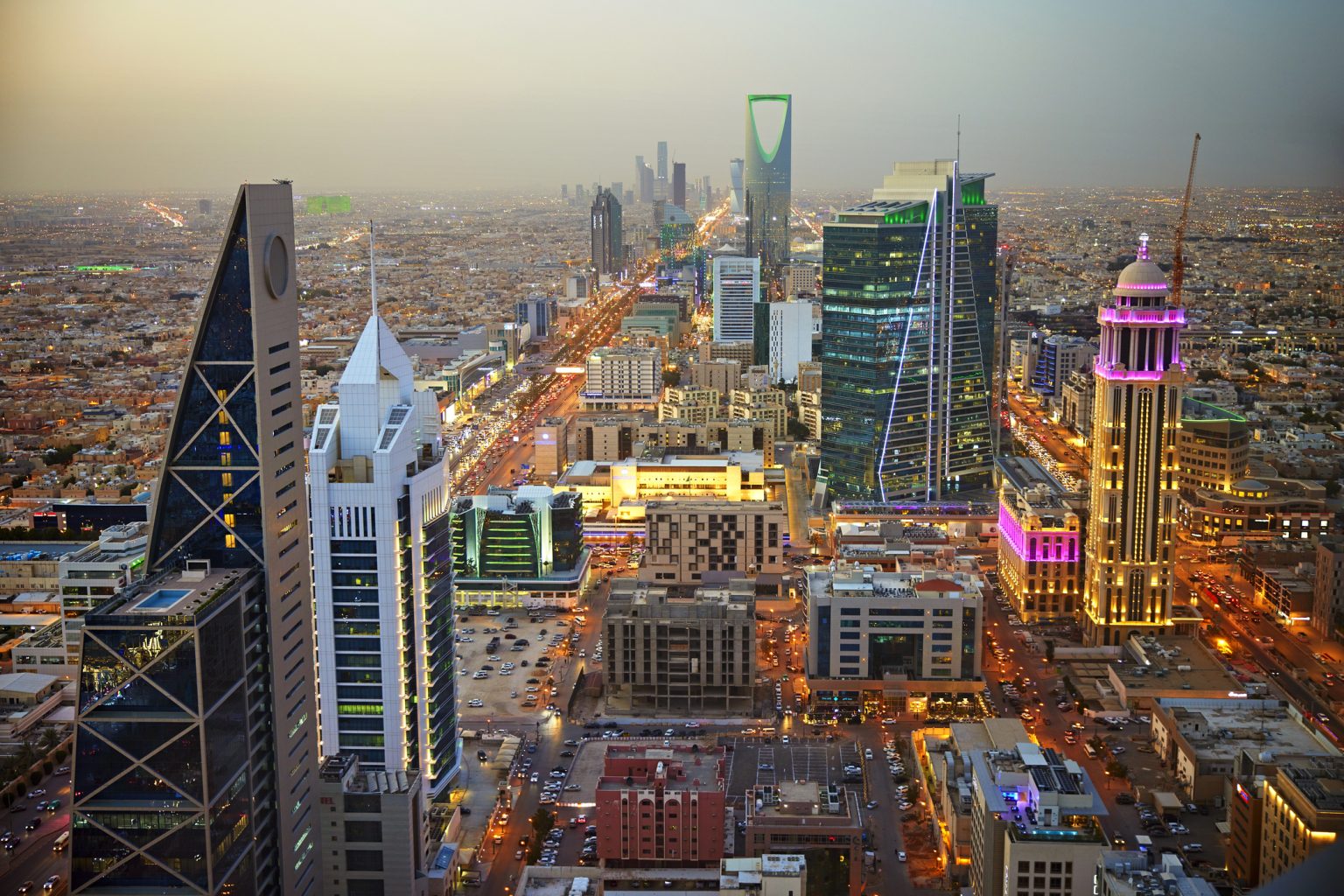
Riyadh’s rapidly evolving skyline showcases Saudi Arabia’s ambitious development plans
Economic Outlook
- Projected GDP growth: 3.5-4.5% annually through 2030
- Strong housing demand driven by young population (median age 31)
- $1.1 trillion committed to giga-projects and infrastructure
- Tourism sector expected to grow to 10% of GDP by 2030
Foreign Investment Climate
Saudi Arabia has transformed its approach to foreign investment in recent years:
- Liberalized investment policies with 100% foreign ownership now permitted in many sectors
- Improved legal framework for foreign investors with specialized commercial courts
- Expanded property rights for non-Saudi individuals and entities in designated areas
- Streamlined business processes through digital transformation initiatives
- New visa programs including Premium Residency and business visas
- Reduced bureaucracy through centralized investment authority (MISA)
While restrictions remain compared to fully open markets, Saudi Arabia has made remarkable progress in welcoming foreign capital. The Kingdom’s new foreign investment law (2022) provides greater protection for investors, transparent dispute resolution, and clearer pathways for market entry.
Historical Performance
The Saudi real estate market has evolved significantly over the past decade:
| Period | Market Characteristics | Average Annual Appreciation |
|---|---|---|
| 2013-2016 | Strong growth followed by oil price drop; market correction | 6-8% then -2% to -5% |
| 2017-2019 | Early Vision 2030 implementation; stabilization | 1-3% |
| 2020-2022 | Pandemic impact followed by recovery; VAT exemption support | 3-6% |
| 2023-Present | Acceleration of Vision 2030 projects; strong growth in major cities | 5-8% |
The Saudi property market has demonstrated resilience through economic cycles, with performance increasingly tied to the government’s Vision 2030 implementation rather than solely to oil prices. The government’s massive investments in infrastructure, residential development, and commercial projects are creating structural demand that supports long-term appreciation despite shorter-term fluctuations.
Key Growth Regions
Riyadh
The capital and largest city is undergoing massive transformation with over $800 billion in planned projects, including the King Salman Park, Sports Boulevard, and Riyadh Metro. Strong demand exists across residential, commercial, and mixed-use developments.
Jeddah
Saudi Arabia’s commercial hub and gateway to Mecca is being revitalized through projects like Jeddah Tower, Jeddah Economic City, and waterfront developments. Strong rental demand from expatriates and young professionals.
Dammam & Eastern Province
The center of Saudi Arabia’s oil industry offers investment opportunities in both residential and industrial properties. The King Salman Energy Park (SPARK) is driving demand for housing and commercial space.
NEOM & The Red Sea Project
These visionary giga-projects represent the future of Saudi development, with NEOM alone receiving $500 billion in investment. Early-stage investment opportunities exist in both residential and commercial properties as these areas develop.
Medina
The second holiest city in Islam offers investment opportunities in hospitality and residential sectors. The expansion of the Prophet’s Mosque and related infrastructure is driving property values in the surrounding areas.
AlUla & Emerging Tourism Hubs
Saudi Arabia is developing previously untapped tourist destinations with significant real estate potential. AlUla, with its ancient archeological sites, is being transformed into a luxury tourism destination.
Emerging investment opportunities also exist in secondary cities like Tabuk (gateway to NEOM), Abha (domestic tourism destination), and Al Khobar (business hub). These markets typically offer 15-30% lower entry points with potentially higher yields than Riyadh or Jeddah, while still benefiting from the nationwide economic transformation programs.
Saudi Arabia Investment Map
Interactive overview of investment opportunities across Saudi Arabia. Green stars indicate top investment hotspots, blue circles show established markets, and orange circles highlight emerging areas with growth potential under Vision 2030.
2. Legal Framework
Foreign Ownership Rules
Saudi Arabia has progressively liberalized its property ownership laws for foreigners, though restrictions remain:
- Foreign individuals and companies can purchase property with specific permits and in designated areas
- 100% foreign ownership is permitted for investment properties in major cities
- Foreigners cannot purchase properties within the boundaries of the two holy cities (Mecca and Medina) unless inheritance is involved
- Special rules apply for Gulf Cooperation Council (GCC) citizens who enjoy greater ownership rights
- Foreign companies must have a commercial registration and investment license in Saudi Arabia
- Legal recourse is available through specialized commercial courts and arbitration centers
Recent regulatory changes have expanded foreign property rights:
- 2020 Real Estate Ownership Law amendments expanded areas where foreigners can own property
- Premium Residency program grants expanded property rights to qualified expatriates
- Special Economic Zones have their own property ownership regulations, often more favorable to foreign investors
- The Ministry of Investment (MISA) can grant exceptions for strategic investments
While Saudi Arabia still maintains more restrictions than fully open markets, the trend is decidedly toward greater accessibility for foreign investors, particularly in commercial real estate and new development areas.
Ownership Structures
Saudi Arabia recognizes several property ownership types:
- Freehold Ownership: Complete ownership of property
- Available to Saudi citizens without restrictions
- Available to foreigners in designated areas with permits
- Includes right to sell, lease, or transfer property
- Can be inherited according to applicable laws
- Usufruct Rights: Right to use property for a specified period
- Common for commercial and industrial properties
- Periods typically range from 25-50 years, renewable
- More widely available to foreigners than freehold
- Can be transferred or mortgaged in most cases
Foreign investors typically utilize these structures:
- Saudi Limited Liability Company (LLC): For commercial property investment
- Real Estate Investment Funds: Regulated investment vehicles for multiple properties
- Direct Ownership: For individual residential properties in permitted areas
North American investors should note that property rights in Saudi Arabia are governed by both civil law and Sharia principles, creating a hybrid system that differs from Western common law traditions.
Required Documentation
For property purchases in Saudi Arabia, foreign buyers need:
- Identification documents:
- Valid passport
- Saudi residence permit (Iqama) if applicable
- Premium Residency documentation if applicable
- Financial documentation:
- Proof of funds for purchase
- Source of funds evidence
- Bank statements (typically 6 months)
- Credit references
- For the transaction:
- Property ownership permit from Ministry of Interior
- No-objection certificate from relevant municipality
- Property title deed verification
- Property valuation report
- For corporate purchases:
- Commercial registration in Saudi Arabia
- Foreign investment license from MISA
- Board resolution approving the purchase
- Company Articles of Association
Legal representation by a Saudi legal consultant or law firm is essential for navigating the purchase process, especially for foreign buyers.
Expert Tip
North American buyers should budget extra time for document authentication. All foreign documents must be notarized, authenticated by your home country’s foreign affairs department, and then by the Saudi embassy or consulate. This process can take 1-2 months, so start early. Some documents will also require official Arabic translation by an approved translator.
Visa & Residency Options
Saudi Arabia offers several residency pathways that can complement real estate investment through its official Premium Residency Program:
| Residency Type | Requirement | Duration | Benefits |
|---|---|---|---|
| Real Estate Owner Residency (Premium Residency Track) | Own residential property in Saudi Arabia valued at SAR 4,000,000+ (~$1.07M USD), fully developed, not mortgaged, and officially appraised | Renewable as long as property ownership is maintained | No sponsor required, family inclusion, right to own property, live in Saudi Arabia |
| Premium Residency – Unlimited (Permanent) | One-time government fee of SAR 800,000 (~$213,000 USD) | Permanent | Work, business ownership, property ownership rights, sponsor-free residency, family inclusion |
| Premium Residency – Limited (Renewable) | Annual fee of SAR 100,000 (~$26,600 USD) per year | Renewable annually | Same core benefits as permanent residency but requires yearly renewal |
| Investor Residency (Business Investment Track) | Licensed investment through Ministry of Investment (MISA), typically SAR 7,000,000+ investment and job creation for Saudi nationals | Long-term, renewable | Operate a Saudi business, sponsor employees, family inclusion, residency without local sponsor |
| Business Visit Visa | Business invitation letter; no direct investment required | 1 year (multiple entry) | Up to 90 days per visit for meetings, market research, and partnership discussions |
Saudi Arabia does not operate a traditional “golden visa.” Instead, it offers multiple official Premium Residency products covering property owners, investors, entrepreneurs, and skilled individuals. Real estate ownership is now a clearly defined residency path under this program when the property meets government valuation and ownership criteria.
Legal Risks & Mitigations
Common Legal Challenges
- Title verification and historical ownership disputes
- Zoning and land use restrictions in rapidly changing areas
- Regulatory shifts affecting foreign ownership rights
- Contract enforcement and dispute resolution time frames
- Inheritance complications for foreign-owned assets
- Off-plan development delays or changes
- Property management and leasing regulations
- Navigating cultural and language differences in negotiations
Risk Mitigation Strategies
- Engage reputable Saudi legal counsel with foreign investor experience
- Conduct comprehensive title searches and ownership verification
- Secure all necessary permits before transferring funds
- Use escrow accounts for property transactions
- Include clear force majeure and dispute resolution clauses in contracts
- Establish relationships with local partners where beneficial
- Obtain proper documentation of all agreements in both Arabic and English
- Consider political risk insurance for larger investments
3. Step-by-Step Investment Playbook
This comprehensive guide walks you through the entire Saudi property investment process, from initial research to property management and eventual exit strategies.
Pre-Investment Preparation
Before committing capital to the Saudi market, complete these essential preparation steps:
Financial Preparation
- Determine your total investment budget (property + transaction costs + reserves)
- Establish a currency exchange strategy (Saudi Riyal is pegged to USD at 3.75 SAR = 1 USD)
- Set up international wire transfer capabilities with your home bank
- Research requirements for opening a Saudi bank account (typically requires residency)
- Evaluate tax implications in both Saudi Arabia and your home country
- Explore financing options (limited but increasing for foreign buyers)
- Budget for annual property zakat (religious tax) of 2.5% on property value
Market Research
- Identify target cities based on investment goals (capital growth vs. rental yield)
- Research neighborhood-specific price trends and rental yields
- Join online forums for expatriates and property investors in Saudi Arabia
- Subscribe to property market reports (Knight Frank, JLL, CBRE Middle East)
- Analyze Vision 2030 projects and their potential impact on property values
- Research tenant demographics and rental demand in target areas
- Plan a preliminary market visit to evaluate areas firsthand
- Study cultural norms and business practices in Saudi Arabia
Professional Network Development
- Connect with law firms specializing in real estate for foreign investors
- Identify reputable real estate brokers with international client experience
- Research property management companies in your target market
- Establish contact with currency exchange specialists
- Connect with the commercial section of your embassy or consulate in Saudi Arabia
- Find Saudi-based tax advisors familiar with international investor concerns
- Consider a relationship with a local translator for document review
- Network with other foreign investors in Saudi real estate
Expert Tip: Saudi Arabia follows the Hijri (Islamic) calendar for many government and legal matters, which is approximately 11 days shorter than the Gregorian calendar. Pay attention to which calendar is being used in contracts and deadlines. Additionally, be aware that the business week runs Sunday through Thursday, with Friday and Saturday being the weekend. Government offices typically have reduced hours during Ramadan.
Entity Setup Requirements
Direct Personal Ownership
Advantages:
- Simplest approach for residential property
- Lower setup and maintenance costs
- Direct control over the asset
- Simplified exit process
- No corporate taxation
Disadvantages:
- Restricted to designated areas for foreigners
- Ownership permit required from Ministry of Interior
- Limited to residential property in most cases
- Potential inheritance complications
Ideal For: Individual residential purchases, smaller investments, personal use properties
Saudi Limited Liability Company (LLC)
Advantages:
- Can own commercial and investment properties
- Broader range of permissible locations
- Limited liability protection
- Eligible for certain government incentives
- Can engage in development and leasing activities
Disadvantages:
- Formation costs (~SAR 20,000-50,000)
- Minimum capital requirements (varies by activity)
- Annual accounting and reporting requirements
- Corporate income tax of 20% on profits
- More complex setup process
Ideal For: Commercial properties, multiple properties, development projects, larger investments
Real Estate Investment Fund
Advantages:
- Access to professionally managed property portfolio
- Lower minimum investment threshold
- Potential tax efficiencies
- Regulated by Capital Market Authority
- Diversification across multiple properties
Disadvantages:
- Less direct control over specific properties
- Management fees impact returns
- Dependent on fund manager quality
- Potential liquidity constraints
- Performance tied to broader fund strategy
Ideal For: Passive investors, those seeking diversification, smaller investment amounts, limited local presence
For most North American investors purchasing individual properties in Saudi Arabia, direct personal ownership is the simplest approach for residential properties, while a Saudi LLC structure is typically required for commercial real estate investments. Real Estate Investment Funds provide an alternative for those seeking lower minimum investments or more passive participation.
Recent Regulatory Change: In 2020, Saudi Arabia removed the requirement for foreign investors to have a Saudi partner in many business sectors, allowing 100% foreign ownership of companies. This change makes the LLC structure more attractive for commercial real estate investments, as foreigners can now maintain full control of their investment vehicle without mandatory local partnership.
Banking & Financing Options
Saudi Arabia offers various banking and financing options for foreign investors:
Banking Setup
- Saudi Bank Account Options:
- Resident accounts: Require Iqama (residence permit) or Premium Residency
- Non-resident accounts: Limited availability, typically require substantial relationship
- International banks with Saudi presence: HSBC, Citibank offer cross-border services
- Investment accounts: Available through Capital Market Authority (CMA) licensed entities
- Typical Requirements:
- Passport/identification
- Residence permit or Premium Residency (for resident accounts)
- Proof of address
- Reference letters
- Source of funds documentation
- In-person appointment in Saudi Arabia (for most banks)
- Alternative Approach: Many foreign investors complete property transactions without a Saudi bank account by using their lawyer’s client account for the purchase and then setting up property management with direct transfers to overseas accounts. This approach requires careful documentation for regulatory compliance.
Financing Options
While cash purchases are common among foreign investors, financing options include:
- Saudi Mortgages for Foreign Residents:
- Availability: Primarily for those with Premium Residency or standard residence permits
- Loan-to-Value Ratio: Typically 50-70% for foreign residents
- Tenure: Generally up to 25 years, with age restrictions
- Interest Rates: 4-7% (Sharia-compliant profit rates)
- Documentation: Proof of income, Saudi credit history (if available), property valuation
- Developer Financing:
- Off-plan property payment plans (typically 20-30% down, balance over construction period)
- Post-completion payment plans from select developers (3-5 years)
- More accessible to foreigners than traditional mortgages
- Sometimes include premium over cash purchase prices
- International Financing:
- Home country equity release or refinancing
- International banks with presence in both markets
- Portfolio-backed loans using existing investments as collateral
- May offer better terms than local Saudi financing for non-residents
Saudi Arabia’s mortgage market is developing rapidly, with new products increasingly available to foreign investors, especially those with Premium Residency. However, financing terms remain more restrictive than in Western markets.
Currency Management
The Saudi Riyal (SAR) is pegged to the US Dollar at a fixed rate of 3.75 SAR = 1 USD, which reduces currency risk for USD-based investors:
- Exchange Rate Considerations:
- Stable SAR/USD exchange rate due to peg (maintained since 1986)
- CAD investors face normal currency fluctuations between CAD and USD
- Peg provides stability but eliminates potential currency gains from appreciation
- Currency Services:
- Major banks offer competitive rates for USD to SAR conversion
- Specialist services like Wise or OFX can be used for transfers
- Wire transfers typically processed within 2-3 business days
- Income Repatriation:
- No restrictions on repatriating rental income or capital gains
- Documentation of source of funds important for compliance
- Regular transfers may benefit from setting up recurring payment instructions
The currency peg makes Saudi Arabia particularly attractive for USD-based investors as it eliminates a major source of risk present in many international real estate markets. CAD-based investors still need to consider CAD/USD fluctuations in their investment planning.
Property Search Process
Finding the right property in Saudi Arabia requires a systematic approach:
Property Search Resources
- Online Property Portals:
- Property Finder – Premium listings and market analytics
- Real Estate Brokers:
- International firms: Knight Frank, Savills, CBRE, JLL
- Local agencies with international desks
- Developer-focused agents for new projects
- Note: The broker typically represents the seller in Saudi Arabia
- Direct Developer Relationships:
- Major developers: Dar Al Arkan, Emaar, SEDCO, Al Akaria
- Government-backed developers: Public Investment Fund projects, Ministry of Housing initiatives
- Development sales offices in major malls and business districts
- Property Exhibitions:
- Cityscape Saudi Arabia (annual event)
- Restatex Riyadh Real Estate Exhibition
- International property shows in Dubai with Saudi projects
- Buyer’s Representatives:
- Less common but increasingly available in major cities
- Typically charge 1-3% of purchase price
- Can be valuable for foreign investors unfamiliar with the market
Property Viewing Trip Planning
For overseas investors, an efficient property viewing trip is essential:
- Pre-Trip Research:
- Identify 10-15 potential properties before arrival
- Schedule viewings in advance with agents or developers
- Research neighborhoods thoroughly online
- Arrange meetings with lawyers, property managers, and other advisors
- Secure proper business visa or visit visa before travel
- Trip Logistics:
- Plan at least 5-7 days per city being considered
- Arrange local transportation (driving is challenging for visitors)
- Schedule viewings in geographical clusters
- Leave time for neighborhood exploration
- Consider cultural norms and prayer times in scheduling
- During Viewings:
- Take detailed photos and notes
- Ask about service charges and community fees
- Inquire about building management and maintenance
- Check utilities and infrastructure reliability
- Note proximity to key amenities (mosques, shopping, schools, hospitals)
- Ask about foreigner ownership permit requirements for the specific location
- Cultural Considerations:
- Respect prayer times when scheduling appointments
- Business attire is expected for meetings (modest dress for both men and women)
- Gender segregation may be observed in some property viewings
- Business relationships often develop more slowly than in North America
Property Evaluation Criteria
Assess potential investments using these key criteria:
- Location Factors:
- Proximity to major Vision 2030 projects
- Transportation infrastructure (current and planned)
- Neighborhood status and reputation
- Foreigner-friendly areas with international amenities
- Proximity to employment centers
- Development potential of surrounding areas
- Building Quality:
- Age and condition of property
- Developer reputation and track record
- Quality of finishes and materials
- Building management and maintenance standards
- Amenities and common areas
- Energy efficiency and cooling systems (critical in Saudi climate)
- Water supply reliability and quality
- Rental Potential:
- Current market rental rates for similar properties
- Tenant demographic profile in the area
- Expatriate population concentration
- Corporate housing demand from multinational companies
- Seasonal fluctuations in rental market
- Potential for short-term rentals (increasingly regulated)
- Financial Considerations:
- Price per square meter compared to area average
- Service charges and community fees
- Potential for value appreciation based on area development
- Liquidity of similar properties (time on market)
- Historical price trends in the neighborhood
- Exit strategy feasibility
Expert Tip: In Saudi Arabia, properties are often described by the number of “majlis” (reception rooms) rather than bedrooms. A “3+1” apartment typically means three bedrooms plus one majlis/living room. Additionally, many properties include separate entrances and living spaces to accommodate gender segregation in traditional households. These features may affect rental potential depending on your target tenant demographic. Western-style open floor plans are increasingly common in newer developments targeting expatriates or younger Saudis.
Due Diligence Checklist
Thorough due diligence is essential for successful Saudi property investment:
Legal Due Diligence
-
✓
Title Verification: Confirm current ownership and verify the property is legally saleable to foreigners
-
✓
Property Deed (Sakk): Verify authenticity through the Ministry of Justice electronic system
-
✓
Foreign Ownership Eligibility: Confirm the property is in an area approved for foreign ownership
-
✓
Municipality Verification: Check zoning, land use regulations, and development plans
-
✓
Encumbrances Check: Verify no mortgages, liens, or claims against the property
-
✓
Utility Clearance: Confirm no outstanding utility bills or municipality fees
-
✓
Legal Boundaries: Verify property boundaries match official records
-
✓
Community Rules: Review any compound or community regulations
Physical Due Diligence
-
✓
Property Inspection: Commission professional inspection of structure, systems, and finishes
-
✓
Building Quality Assessment: Evaluate construction quality, materials, and workmanship
-
✓
Air Conditioning Systems: Verify functionality, age, and efficiency (crucial in Saudi climate)
-
✓
Water Systems: Check water pressure, quality, and storage facilities
-
✓
Electrical Systems: Verify capacity, safety, and reliability
-
✓
Common Areas (if applicable): Inspect maintenance, security, and amenities
-
✓
Environmental Assessment: Check for sand/dust intrusion, flooding potential, and heat exposure
-
✓
Renovation Assessment: Obtain estimates if improvements planned
Financial Due Diligence
-
✓
Comparative Market Analysis: Verify price aligns with recent comparable sales
-
✓
Rental Market Research: Confirm realistic rental expectations (speak to local agents)
-
✓
Service Charge History: Review past service charges and projected increases
-
✓
Utility Cost Assessment: Estimate typical utility costs (especially air conditioning)
-
✓
Tax Calculation: Determine zakat (religious tax) and any municipal fees
-
✓
Property Management Costs: Get quotes for property management services
-
✓
ROI Calculation: Develop detailed cash flow projections and return analysis
-
✓
Exit Cost Assessment: Calculate future selling costs and potential capital gains
Expert Tip: When conducting due diligence in Saudi Arabia, pay special attention to water-related issues. Many properties, especially older ones, rely on water delivery or periodic municipal supply to fill roof tanks. This can affect livability and tenant satisfaction. Additionally, sand and dust infiltration can cause significant maintenance issues. Look for quality window seals and ventilation systems that can withstand the harsh climate conditions. These environmental factors are often overlooked by foreign investors but can significantly impact property performance and maintenance costs.
Transaction Process
The Saudi property purchase process follows these stages:
Offer and Negotiation
- Initial Offer: Typically made verbally through the real estate broker
- Negotiation: Back-and-forth on price and terms, often face-to-face
- Letter of Intent: A non-binding document outlining key terms
- Earnest Money: A small deposit (1-5%) to demonstrate serious intent
Negotiations in Saudi Arabia often involve personal relationships and may take longer than in Western markets. Price flexibility varies significantly by seller and market conditions. While initial asking prices may include room for negotiation, some developers of premium projects maintain fixed pricing.
Foreign Ownership Approval Process
- Ownership Permit Application: Submit application to the Ministry of Interior
- Application form with property details
- Copy of passport and residence permit/visa
- Property preliminary sale agreement
- Property location map and details
- Municipality Approval: Confirmation that the property is in an approved zone for foreign ownership
- Security Clearance: Background verification process
- Permit Issuance: Typically takes 3-6 weeks if all documents are in order
This process is specific to foreign buyers and runs parallel to other transaction steps. Premium Residency holders have a streamlined process with fewer restrictions on location.
Conveyancing Process
- Engage Legal Representation: Appoint a Saudi-licensed lawyer to handle the transaction
- Preliminary Agreement: Sign a sale agreement outlining terms and conditions
- Due Diligence Period:
- Title verification through Ministry of Justice
- Property inspection and valuation
- Municipality certificate verification
- Utility bills clearance confirmation
- Foreign Ownership Approval: Obtain ownership permit (as outlined above)
- Purchase Funds Preparation:
- Transfer funds to Saudi bank account or lawyer’s client account
- Prepare bank draft or certified check for closing
- Title Transfer at Notary:
- Both parties attend the Ministry of Justice notary office (Katib al-Adl)
- Present identification and ownership approval documents
- Sign official transfer documents
- Payment made to seller (bank draft or electronic transfer)
- Title Registration:
- New title deed (Sakk) issued in buyer’s name
- Registration in the Electronic Real Estate Registry (Sajil)
- Post-Completion:
- Utility account transfers
- Municipality registration update
- Building management notification
The timeframe from offer acceptance to completion typically ranges from 6-10 weeks for a straightforward transaction with a foreign buyer. The digitization of land registry services has improved efficiency, but the foreign ownership approval process can still create delays.
Transaction Costs
Budget for these typical transaction expenses:
- Real Estate Transaction Tax (RETT):
- 5% of property value (previously 15% VAT, reduced in 2020)
- Typically paid by the seller but can be negotiated
- Exemptions exist for first-time homebuyers (Saudis only)
- Legal Fees: 1-2% for attorney/conveyancer
- Foreign Ownership Permit: SAR 2,000-5,000 application fee
- Property Valuation: SAR 2,000-5,000
- Title Registration Fees: 0.5% of property value
- Real Estate Broker Commission: 2.5% (typically split between buyer and seller)
- Municipality Certificate: SAR 500-1,000
- Foreign Currency Exchange Costs: Varies by provider (0.5-2% spread)
Total transaction costs for foreign investors typically range from 7-10% of the purchase price, depending on how costs are allocated between buyer and seller. These costs should be factored into your overall investment calculations.
Expert Tip: For foreign buyers unable to be present in Saudi Arabia for the entire transaction process, a Power of Attorney (Wakalah) can be arranged allowing your lawyer to represent you. This requires specific formalities, including authentication by the Saudi embassy in your home country and official Arabic translation. Plan ahead, as this process can take 3-4 weeks. Note that for the final title transfer at the notary, some jurisdictions may still require personal attendance despite having a Power of Attorney.
Post-Purchase Requirements
After completing your purchase, several important steps remain:
Administrative Tasks
-
✓
Property Registration: Ensure property is properly registered in your name in the Sajil system
-
✓
Utility Transfers: Register accounts for electricity (Saudi Electricity Company), water, and telecommunications
-
✓
Municipality Registration: Update property ownership records with the local municipality
-
✓
Service Charge Setup: Register with building management and set up service charge payments
-
✓
Property Insurance: Arrange comprehensive property insurance coverage
-
✓
Digital Access: Set up accounts on government platforms (Absher, Baladi) for property-related services
-
✓
Tax Registration: Register for zakat filing if required (typically for investment properties)
Regulatory Compliance
Rental properties in Saudi Arabia must comply with various regulations:
- Rental Registration:
- All lease contracts must be registered on the Ejar platform
- Mandatory electronic documentation of all rental agreements
- Regulation of the relationship between landlords, tenants, and brokers
- Building Safety Standards:
- Compliance with Saudi Building Code requirements
- Fire safety systems and emergency exits
- Regular inspection and maintenance records
- Health and Hygiene Standards:
- Water tank cleaning and certification
- Pest control requirements
- Waste management compliance
- Foreign Tenant Requirements:
- Verification of legal residency status
- Registration of tenant information with authorities
- Compliance with occupancy limits and usage restrictions
- Homeowners Association Rules:
- Compliance with community regulations in compounds and gated communities
- Participation in owners’ committees if required
- Payment of community service fees
Non-compliance with these regulations can result in fines, inability to register lease contracts, or difficulties in resolving tenant disputes. Professional property management can ensure all regulatory requirements are met, particularly important for foreign owners not residing in Saudi Arabia.
Record Keeping
Maintain comprehensive records for tax and legal purposes:
- Property Documents:
- Original title deed (Sakk) and copies
- Foreign ownership permit
- Purchase contract and transfer documents
- Property survey and floor plans
- Building permits and approvals
- Insurance policies
- Financial Records:
- All property-related expenses with receipts
- Service charge payments
- Utility bills and payment records
- Insurance payments
- Rental income and tenant deposits
- Currency exchange transactions
- Tax payments and filings
- Tenant Information:
- Registered lease agreements from Ejar
- Tenant identification and contact information
- Security deposit records
- Property inspection reports
- Correspondence regarding maintenance
- Tenant verification documents
- Maintenance Records:
- Regular maintenance schedules and records
- Major repairs and improvements
- Contractor agreements and warranties
- Equipment manuals and warranties
- Service provider contacts
Saudi regulations require certain records to be kept for at least 5 years. Digital record-keeping systems with secure backups are strongly recommended, particularly for overseas investors managing properties remotely. Consider keeping both Arabic and English versions of important documents.
Expert Tip: Saudi Arabia has rapidly digitized many government services through platforms like Absher (for individuals) and Baladi (for property services). However, access often requires a Saudi ID or residency permit. Consider appointing a registered representative (through an official power of attorney) who can handle digital administrative tasks on your behalf. Many property management companies offer this service as part of their package for foreign owners.
Tax Obligations & Reporting
Understanding and complying with tax requirements is essential for foreign investors:
Saudi Tax Obligations
- Real Estate Transaction Tax (RETT):
- 5% tax on property value at time of purchase
- Typically paid by seller but can be negotiated
- Due within 30 days of transaction completion
- Filed through the Zakat, Tax and Customs Authority (ZATCA) portal
- Zakat or Corporate Income Tax:
- For individual foreign owners: Generally no ongoing income tax on rental income
- For foreign companies: 20% corporate income tax on net profits
- Saudi citizens and GCC nationals pay Zakat (2.5%) instead of income tax
- Filing through ZATCA required for corporate investors
- Withholding Tax:
- 5% withholding tax may apply to certain payments to non-residents
- Relevant for structured investments with offshore companies
- Governed by tax treaties where applicable
- Capital Gains:
- For individual foreign investors: No separate capital gains tax currently imposed
- For companies: 20% tax rate applied to net gains
- Disposal must be reported to tax authorities
- Municipal Fees:
- Variable by municipality and property type
- Typically 2-5% of annual rental value for certain commercial properties
- Residential properties generally have minimal fees
- Value Added Tax (VAT):
- 15% VAT applies to commercial property rentals
- Residential rentals are exempt from VAT
- Registration threshold: SAR 375,000 annual revenue
Home Country Tax Obligations
U.S. Citizens & Residents
- Worldwide Income Reporting: All Saudi rental income must be reported on U.S. tax returns
- Foreign Tax Credit: Credit for taxes paid in Saudi Arabia
- FBAR Filing: Required if Saudi financial accounts exceed $10,000
- Form 8938: Reporting for specified foreign assets above threshold
- Foreign Property Reporting: Value included in net worth calculations
- FIRPTA: Foreign Investment in Real Property Tax Act may apply upon sale
Canadian Citizens & Residents
- Worldwide Income Reporting: All Saudi rental income must be reported on Canadian tax returns
- Foreign Tax Credit: Credit for taxes paid in Saudi Arabia
- Form T1135: Foreign Income Verification Statement for foreign property exceeding CAD $100,000
- Form T776: Statement of Real Estate Rentals
- Capital Gains Reporting: Required upon disposition of property
- Principal Residence Exemption: Generally not applicable for Saudi property
Saudi Arabia has tax treaties with both the United States and Canada which help prevent double taxation. However, the interaction between tax systems is complex and requires professional guidance from advisors familiar with both jurisdictions.
Tax Planning Strategies
- Entity Structure: Evaluate whether personal ownership or corporate structure optimizes tax position
- Treaty Benefits: Utilize provisions of applicable tax treaties to minimize double taxation
- Expense Tracking: Maintain meticulous records of all allowable expenses to maximize deductions
- Timing Considerations: Plan property acquisition and disposal to optimize tax position
- VAT Registration: Consider VAT implications for commercial property rentals
- Transfer Pricing: Ensure arm’s length principles for related party transactions
- Tax Residence Planning: Consider impact of physical presence in Saudi Arabia on global tax status
- Local Expertise: Engage Saudi tax professionals familiar with foreign investor requirements
Saudi Arabia’s tax system continues to evolve with Vision 2030 economic reforms. Regular consultations with tax professionals in both Saudi Arabia and your home country are essential to ensure continued compliance and optimal structuring.
Expert Tip: Saudi Arabia has been rapidly modernizing its tax administration systems. The Zakat, Tax and Customs Authority (ZATCA) now requires digital submission of tax returns and maintains sophisticated data matching capabilities. Ensure complete and consistent reporting across all platforms to avoid compliance issues. For U.S. investors in particular, the Foreign Account Tax Compliance Act (FATCA) has led to increased information exchange between Saudi and U.S. tax authorities, making proper disclosure essential.
Property Management Options
Full-Service Property Management
Services:
- Tenant finding and screening
- Ejar contract registration
- Rent collection and deposit management
- Property inspections and maintenance
- Utility and service charge payments
- Tenant relationship management
- Legal compliance monitoring
- Financial reporting and tax documentation
Typical Costs:
- 8-12% of monthly rent
- Setup fees: SAR 1,000-3,000
- Tenant finding: Additional half month’s rent
Ideal For: Foreign investors without local presence, multiple properties, higher-value properties
Tenant-Find Only Service
Services:
- Property marketing and advertising
- Conducting viewings
- Tenant screening and verification
- Lease preparation and Ejar registration
- Initial property handover
- Security deposit collection
Typical Costs:
- Half to one month’s rent (one-time fee)
- Additional services charged separately
Ideal For: Investors with local presence or representatives who can handle day-to-day management
Facility Management Service
Services:
- Building maintenance and repairs
- HVAC system monitoring and servicing
- Security services
- Cleaning and waste management
- Landscaping and exterior maintenance
- Utility management
Typical Costs:
- Fixed monthly fee based on property size
- Typically SAR 2-5 per square meter
- Additional charges for repairs beyond basic maintenance
Ideal For: Larger properties, commercial buildings, compounds, properties with extensive amenities
Selecting a Property Manager
Evaluate potential property managers using these criteria:
- Experience with Foreign Investors:
- Track record managing properties for overseas owners
- Multi-lingual staff (English and Arabic at minimum)
- Understanding of foreign investor regulations
- Professional Accreditations:
- Licensed by the Ministry of Commerce
- Member of professional real estate associations
- Certification from recognized property management institutes
- Technology Platform:
- Online owner’s portal for remote monitoring
- Digital payment processing capabilities
- Property inspection and reporting technology
- Local Market Knowledge:
- Specialization in your property type/location
- Understanding of local rental market trends
- Established tenant network
- Regulatory Expertise:
- Experience with Ejar platform registration
- Understanding of foreign ownership requirements
- Current knowledge of changing regulations
- Maintenance Capabilities:
- In-house maintenance team or reliable contractor network
- 24/7 emergency response protocols
- Preventative maintenance programs
- Financial Reporting:
- Regular financial statements
- Transparent fee structure
- International banking capabilities
Management Agreement Essentials
Ensure your property management contract includes these key elements:
- Scope of Services: Detailed description of exactly what is included and excluded
- Fee Structure: Clear explanation of all management fees, commissions, and additional charges
- Contract Term and Notice Period: Duration of agreement and termination conditions
- Reporting Schedule: Frequency and format of financial and property condition reports
- Maintenance Authority: Spending limits for repairs without prior approval
- Tenant Selection Criteria: Parameters for approving potential tenants
- Rent Collection Procedures: Methods, timing, and handling of arrears
- Legal Representation: Authority to act on your behalf in tenant matters
- Insurance Requirements: Coverage expectations and liability boundaries
- Property Access: Protocols for property inspections and maintenance
- Communication Protocols: Response time expectations and emergency procedures
- Currency and Payment Terms: Currency for fees and rental income transfers
Request references from current clients, particularly other foreign investors, before signing with a property management company. This provides valuable insights into how they handle properties for remote owners and their professionalism in financial matters.
Expert Tip: When engaging a property manager in Saudi Arabia, ensure they have specific expertise with maintaining buildings in the harsh desert climate. Air conditioning maintenance, dust prevention, and water system management require specialized knowledge. Also, verify they have a good understanding of cultural nuances that affect tenant relations. For example, family compounds often have different requirements than bachelor housing, and Ramadan may affect maintenance scheduling and tenant communications.
Exit Strategies
Planning your eventual exit is an essential component of any investment strategy:
Exit Options
Outright Sale
Best When:
- Market values have appreciated significantly
- Vision 2030 projects are completed nearby
- Local market conditions favor sellers
- Tax situation makes full disposal optimal
- Portfolio rebalancing is desired
Considerations:
- Market liquidity for foreign-owned properties
- Marketing strategy to reach Saudi buyers
- Currency repatriation planning
- Transaction taxes (5% RETT typically paid by seller)
Property Development
Best When:
- Land or older property has redevelopment potential
- Area is experiencing significant appreciation
- Construction costs are favorable
- Building regulations allow desired development
- Market demand exists for new properties
Considerations:
- Development permits for foreign owners
- Construction management complexities
- Timeline for completion and sale
- Financing options for development
Long-term Hold with Professional Management
Best When:
- Rental yields remain strong
- Property value still appreciating
- Stable tenant demand exists
- Owner seeks passive income stream
- Tax situation favors rental income over capital gains
Considerations:
- Property aging and maintenance requirements
- Management company reliability
- Changing regulatory environment
- Ongoing foreign ownership compliance
Property Transfer to Family/Entity
Best When:
- Estate planning objectives
- Family members have Saudi connections
- Long-term generational wealth transfer
- Tax or legal advantages to restructuring
- Corporate reorganization needed
Considerations:
- Foreign ownership eligibility of recipients
- Tax implications in both jurisdictions
- Legal structuring requirements
- Transfer costs and registration fees
Sale Process
When selling your Saudi property:
- Pre-Sale Preparation:
- Property presentation and minor renovations
- Address maintenance issues
- Gather all relevant documentation
- Settle any outstanding fees or charges
- Consider vacant possession vs. tenanted sale
- Valuation & Pricing:
- Obtain professional property valuation
- Research comparable recent sales
- Set realistic asking price based on market conditions
- Factor in the 5% RETT (typically seller’s responsibility)
- Agent Selection:
- Engage licensed Saudi real estate brokers
- Consider exclusive vs. non-exclusive listing
- Verify marketing capabilities and foreign property experience
- Understand commission structure (typically 2.5%)
- Marketing Period:
- Professional photography and marketing materials
- Online and print advertising
- Viewings (may require coordination with tenants)
- Property details translated into Arabic
- Offer & Negotiation:
- Receive and evaluate offers
- Negotiate price and terms
- Accept offer and secure earnest money deposit
- Sign preliminary sale agreement
- Due Diligence Period:
- Buyer’s inspection and verification
- Address any concerns or contingencies
- Prepare documentation for closing
- Verify buyer’s ability to complete transaction
- Title Transfer:
- Attend notary appointment (in person or via representative)
- Complete formal title transfer (Ifrag)
- Receive payment (typically certified check or bank transfer)
- Pay applicable RETT
- Register transfer with municipality
- Post-Sale Requirements:
- Cancel property-related utilities and services
- Repatriate funds to home country if desired
- Update tax registrations
- Inform property management company
- Report sale for tax purposes in home country
The Saudi property sale process typically takes 2-3 months from listing to completion for a straightforward transaction. Foreign sellers should budget additional time for administrative requirements related to foreign ownership.
Market Exit Timing Considerations
Several factors should influence your exit timing decision:
- Vision 2030 Project Timelines: Property values often increase significantly upon completion of nearby megaprojects
- Saudi Economic Diversification: Monitor progress of economic reforms and their impact on property demand
- Oil Price Cycles: Despite diversification efforts, the broader economy and liquidity remain linked to oil revenues
- Infrastructure Development: Completion of transportation and utility upgrades can trigger value increases
- Regulatory Changes: Stay informed about evolving foreign ownership rules and tax implications
- Demographic Trends: The young Saudi population is creating sustained housing demand
- Seasonal Factors: Market activity typically slows during summer months and Ramadan
- Currency Considerations: USD-pegged riyal provides stability but watch CAD/USD fluctuations if Canadian
- Tax Year Planning: Coordinate sale timing with tax years in both Saudi Arabia and home country
- Visa/Residency Changes: Premium Residency program expansions may affect foreign buyer pool
The Saudi market is undergoing transformational change through Vision 2030, creating significant long-term appreciation potential but also shorter-term volatility. Successful investors typically establish clear performance benchmarks and regularly evaluate their Saudi property investments against both local market developments and global alternatives rather than making decisions based solely on calendar timing.
Expert Tip: When planning your exit strategy in Saudi Arabia, pay attention to the completion schedules of major government initiatives in your property’s vicinity. Properties located near Vision 2030 projects often see significant value increases when these projects reach completion milestones. For example, properties near the Riyadh Metro lines have appreciated 20-30% as stations neared completion. Consider timing your exit to capitalize on these value inflection points rather than selling during development phases when future value is still speculative.
4. Market Opportunities
Types of Properties Available
Luxury Apartments
High-end apartments in major cities, typically in secured compounds or branded developments. Often feature amenities such as swimming pools, gyms, and concierge services. Popular among expatriates and affluent locals seeking modern Western-style living.
Investment Range: SAR 1,000,000-5,000,000 ($267,000-1,333,000)
Target Market: Expatriate executives, young Saudi professionals, corporate housing
Typical Yield: 5-7%
Residential Villas
Standalone houses in compounds or gated communities offering privacy and space for families. Typically feature private gardens, multiple bedrooms, separate living spaces for privacy, and often include driver/maid quarters.
Investment Range: SAR 2,000,000-8,000,000 ($533,000-2,133,000)
Target Market: Expatriate families, Saudi families, diplomatic personnel
Typical Yield: 4-6%
Commercial Office Space
Office units in business districts and commercial centers. Ranging from small professional suites to entire floors in premium towers. Growing demand from expanding local businesses and international companies establishing Saudi presence.
Investment Range: SAR 2,000,000-10,000,000 ($533,000-2,667,000)
Target Market: Saudi businesses, multinational corporations, professional service firms
Typical Yield: 7-9%
Retail Units
Commercial spaces in shopping centers, malls, and street-front locations. Strong demand driven by Saudi consumer culture and expanding retail sector. Opportunities range from small boutique spaces to large anchor tenant locations.
Investment Range: SAR 1,500,000-15,000,000 ($400,000-4,000,000)
Target Market: Local and international retailers, food & beverage operators
Typical Yield: 8-10%
Off-Plan Developments
Pre-construction purchase opportunities in new master-planned communities and developments. Often available with attractive payment plans and potential for appreciation upon completion. Options span from apartments to villas in emerging neighborhoods.
Investment Range: SAR 600,000-3,000,000 ($160,000-800,000)
Target Market: Investors seeking capital appreciation, first-time buyers
Typical Yield: Variable, often 5-7% after completion
Industrial/Logistics Properties
Warehouses, distribution centers, and light industrial facilities in designated industrial zones. Growing sector due to Saudi’s positioning as a regional logistics hub and manufacturing expansion plans under Vision 2030.
Investment Range: SAR 3,000,000-20,000,000 ($800,000-5,333,000)
Target Market: Manufacturing businesses, logistics companies, e-commerce operations
Typical Yield: 8-12%
Price Ranges by Region
| City/Region | Neighborhood/Area | Property Type | Price Range (SAR/m²) | Total Investment Range (USD) |
|---|---|---|---|---|
| Riyadh | Diplomatic Quarter | Luxury Apartment | 9,000-12,000 | $320,000-800,000 |
| Al Olaya/King Fahd Road | Office Space | 8,000-15,000 | $533,000-2,667,000 | |
| Al Narjis/Al Yasmeen | Residential Villa | 5,000-7,000 | $400,000-800,000 | |
| Jeddah | Al Shati/Corniche | Sea-View Apartment | 8,000-14,000 | $320,000-933,000 |
| Al Zahra/Al Rawdah | Residential Compound | 6,000-9,000 | $480,000-1,067,000 | |
| Dammam/Khobar | Al Khobar Corniche | Luxury Apartment | 7,000-10,000 | $267,000-533,000 |
| Dhahran | Villa in Compound | 5,000-8,000 | $400,000-853,000 | |
| NEOM | Early Investment Areas | Off-Plan Developments | Price points not yet established | Expected premium pricing |
| Medina | Central District | Investment Apartment | 5,000-8,000 | $160,000-320,000 |
| AlUla | Tourism Development Zone | Hotel/Hospitality | Premium pricing | Starting from $1,000,000 |
Note: Prices as of April 2025. Market conditions vary, and these figures represent averages in each area.
Expected Yields & Appreciation Potential
Rental Yields by Market Segment
- Luxury Residential (Riyadh, Jeddah): 5-7%
- Mid-Range Residential: 6-8%
- Expatriate Compounds: 7-9%
- Office Space (Prime): 7-9%
- Retail Units: 8-10%
- Industrial/Logistics: 8-12%
- Secondary Cities Residential: 7-10%
Saudi Arabia offers stronger rental yields than many established markets due to high demand for quality properties, especially in expatriate-friendly areas. Retail and industrial segments typically provide the highest cash flow, while prime residential offers more moderate yields but often stronger appreciation potential.
Appreciation Forecasts (5-Year Outlook)
- Riyadh Prime Areas: 6-8% annually
- Jeddah Prime Areas: 5-7% annually
- Eastern Province: 4-6% annually
- Emerging Tourism Hubs: 7-10% annually
- Commercial Property: 5-7% annually
- NEOM/Red Sea Project: Potentially 10-15% annually
- Industrial/Logistics: 6-8% annually
Long-term appreciation is heavily tied to Vision 2030 implementation success. Properties near major infrastructure projects, planned entertainment districts, and tourism destinations are expected to significantly outperform broader market averages. Secondary cities often offer lower entry points with stronger growth potential as Saudi Arabia diversifies economically.
Total Return Potential Scenarios
| Investment Scenario | Annual Rental Yield | Annual Appreciation | Est. 5-Year Total Return | Key Success Factors |
|---|---|---|---|---|
| Riyadh Luxury Apartment (Diplomat Quarter) |
6.0% | 7.0% | 65-70% | Quality building management, expatriate tenant network, proximity to diplomatic missions |
| Jeddah Commercial (Retail space) |
9.0% | 5.0% | 70-75% | Long-term tenant, prime location, strong foot traffic, adaptable space |
| Dammam Residential Compound (Multi-unit strategy) |
8.0% | 4.0% | 60-65% | Corporate tenant relationships, quality property management, energy-efficient systems |
| Riyadh Off-Plan (King Abdullah Financial District) |
0% (during construction) 7.0% (after completion) |
12-15% (developer discount) 6% (post-completion) |
65-80% | Developer reputation, completion on schedule, strategic location, favorable payment plan |
| Logistics Facility (Industrial City) |
10.0% | 6.0% | 80-85% | Long-term triple-net lease, transportation access, modern specifications, flexible usage |
Note: Returns presented before taxes and expenses. Individual results may vary based on specific property characteristics and management effectiveness.
Market Risks & Mitigations
Key Market Risks
- Regulatory Changes: Evolving foreign ownership rules and property regulations
- Economic Dependency: Continued reliance on oil revenues despite diversification efforts
- Project Execution: Delays or changes to Vision 2030 development projects
- Market Liquidity: Potentially limited buyer pool for foreign-owned properties
- Oversupply Concerns: Risk of oversupply in certain segments due to ambitious development plans
- Quality Issues: Inconsistent construction quality and building maintenance standards
- Cultural/Legal Differences: Unfamiliar business practices and legal framework
- Geographical Concentration: Natural disasters (floods, sandstorms) in certain regions
- Currency Risk: While SAR is pegged to USD, de-pegging remains a long-term possibility
Risk Mitigation Strategies
- Legal Expertise: Engage specialized legal counsel with foreign investor experience
- Diversification: Consider properties across different cities and/or property types
- Quality Focus: Prioritize reputable developers with proven track records
- Local Partnerships: Develop relationships with trusted local advisors
- Due Diligence: Conduct thorough property, legal, and financial investigations
- Professional Management: Employ experienced property managers for foreign-owned assets
- Insurance Coverage: Secure comprehensive property and liability insurance
- Strategic Timing: Phase investments to align with infrastructure development
- Financing Prudence: Maintain conservative loan-to-value ratios if using financing
Expert Insight: “The Saudi market offers tremendous opportunity but requires patience and thorough research. Foreign investors who succeed typically take time to understand the unique market dynamics, work with experienced local professionals, and maintain realistic expectations about timeframes. The most successful approach is often to align investment strategy with Vision 2030 priorities—focus on areas with clear government commitment to infrastructure investment and economic diversification. While the regulatory environment continues to evolve, the long-term trajectory is toward greater openness and transparency for foreign investors.” – Ahmed Al-Saadi, Director of International Investment, Saudi Real Estate Advisors
5. Cost Analysis
Purchase Costs Breakdown
Beyond the property price, budget for these acquisition expenses:
Transaction Costs Calculator
| Expense Item | Typical Percentage | Example Cost (SAR 1,500,000 Property) |
Notes |
|---|---|---|---|
| Real Estate Transaction Tax (RETT) | 5% | SAR 75,000 | Typically seller pays, but negotiable |
| Real Estate Broker Commission | 2.5% (often split) | SAR 18,750-37,500 | 1.25-2.5% depending on negotiation |
| Legal Fees | 1-2% | SAR 15,000-30,000 | Higher for foreign buyers |
| Title Registration Fee | 0.5% | SAR 7,500 | Paid to Ministry of Justice |
| Foreign Ownership Permit | Fixed fee | SAR 2,000-5,000 | Not applicable for Saudi nationals |
| Property Valuation | Fixed fee | SAR 3,000-5,000 | Required for title transfer |
| Currency Exchange | 0.5-2% | SAR 7,500-30,000 | Costs vary by provider and amount |
| TOTAL ACQUISITION COSTS | 3-7% | SAR 45,000-105,000 | Higher for foreign buyers |
Note: RETT calculation assumes seller pays the tax as is customary, though this is negotiable. Rates current as of April 2025.
Initial Setup Costs
Beyond transaction costs, budget for these initial setup expenses:
- Furnishings: SAR 20,000-150,000 depending on property size and market positioning
- Property Improvements: Variable based on condition, often 5-15% of purchase price for older properties
- Property Management Setup: Typically one month’s rent for finding first tenant
- Utilities Connection: SAR 2,000-5,000 for electricity, water, and telecommunications
- Insurance: First year premium SAR 2,500-7,500 depending on property type and coverage
- Security Deposits: For compound utilities and services (if applicable) SAR 5,000-10,000
- Home Automation/Security: SAR 10,000-30,000 for remote monitoring systems (recommended for foreign owners)
Properties targeting expatriate tenants in major cities typically require higher-quality furnishings and finishes. Budget accordingly based on your target market and expected rental income.
Ongoing Costs
Budget for these recurring expenses as part of your investment analysis:
Annual Ownership Expenses
| Expense Item | Typical Annual Cost | Notes |
|---|---|---|
| Property Management | 8-12% of rental income | Essential for overseas investors; higher for full-service management |
| Maintenance Reserve | 1-2% of property value annually | Higher for older properties; critical due to climate conditions |
| Air Conditioning Service | SAR 2,000-5,000 | Essential bi-annual maintenance in Saudi climate |
| Compound/Building Fees | SAR 5,000-30,000 | Varies widely by property type and amenities |
| Property Insurance | 0.2-0.5% of property value | Higher for older buildings or flood-prone areas |
| Utilities (if owner-paid) | SAR 6,000-24,000 | Electricity is significant cost due to air conditioning needs |
| Municipal Fees | 2-5% of annual rental value | Primarily for commercial properties; minimal for residential |
| Void Periods | 5-10% of annual rent | Budget for 2-6 weeks vacancy per year |
| Legal/Accounting Services | SAR 3,000-10,000 | Higher for foreign owners to ensure compliance |
| Zakat/Income Tax | Varies by structure | Minimal for individual owners; 20% corporate tax if company-owned |
Rental Property Cash Flow Example
Sample analysis for a SAR 1,500,000 ($400,000) two-bedroom apartment in Riyadh:
| Item | Monthly (SAR) | Annual (SAR) | Notes |
|---|---|---|---|
| Gross Rental Income | 8,750 | 105,000 | Based on 7% yield |
| Less Vacancy (8%) | -700 | -8,400 | Estimated at 4 weeks per year |
| Effective Rental Income | 8,050 | 96,600 | |
| Expenses: | |||
| Property Management (10%) | -805 | -9,660 | Full service for overseas investor |
| Building Service Charges | -750 | -9,000 | Common area maintenance |
| Air Conditioning Service | -250 | -3,000 | Bi-annual maintenance |
| Insurance | -250 | -3,000 | Property insurance coverage |
| Maintenance Reserve | -1,250 | -15,000 | 1% of property value |
| Legal/Accounting | -250 | -3,000 | Annual compliance services |
| Total Expenses | -3,555 | -42,660 | 44% of effective rental income |
| NET OPERATING INCOME | 4,495 | 53,940 | Before income taxes |
| Income Tax | 0 | 0 | Typically no income tax for individual foreign owners |
| AFTER-TAX CASH FLOW | 4,495 | 53,940 | Cash flow after all expenses and taxes |
| Cash-on-Cash Return | 3.6% | Based on all-cash SAR 1,500,000 purchase plus 3% costs | |
| Total Return (with 6% appreciation) | 9.6% | Cash flow + appreciation |
Note: This analysis assumes an all-cash purchase. Including mortgage financing would reduce cash flow but improve return on equity. Currency exchange impacts not included.
Comparison with North American Markets
Value Comparison: Saudi Arabia vs. North America
This comparison illustrates what $400,000 USD (SAR 1,500,000) investment buys in different markets:
| Location | Property for $400,000 USD (SAR 1.5M) | Typical Rental Yield | Property Tax | Transaction Costs |
|---|---|---|---|---|
| Riyadh (Suburban) | 3-bedroom apartment/villa 180-220m² in good area |
6-8% | None for residential | 3-7% |
| Jeddah | 2-3 bedroom apartment 150-180m² in prime location |
7-9% | None for residential | 3-7% |
| New York City | Studio apartment 30-45m² in outer borough |
2-4% | 1.2-1.9% of value annually | 5-6% |
| Toronto | 1 bedroom condo 45-60m² outside downtown |
3-4% | 0.6-0.7% of value annually | 3-4% |
| Dammam | 4 bedroom villa 220-280m² in good area |
7-10% | None for residential | 3-7% |
| Miami | 1-2 bedroom condo 70-90m² in decent area |
4-6% | 1.0-2.0% of value annually | 4-5% |
| NEOM (Future) | 1-2 bedroom apartment 70-100m² in new development |
Projected 8-10% | To be determined | 3-7% |
Source: Comparative market analysis using data from Saudi Ministry of Housing, Rightmove, Zillow, Realtor.com, and local real estate associations, April 2025.
Key Advantages vs. North America
- Higher Rental Yields: 6-10% compared to 2-5% in major North American cities
- No Property Tax: Absence of annual property taxes for residential properties
- No Income Tax: Generally no taxation on rental income for individual foreign owners
- Lower Entry Points: More square footage per dollar compared to major US/Canadian cities
- Newer Housing Stock: Many properties built in the last 10-20 years
- Modern Amenities: Compounds often feature pools, gyms, and security services
- Growth Potential: Significant upside tied to Vision 2030 initiatives
- USD Peg Stability: Reduced currency risk for USD-based investors
Additional Considerations
- Foreign Ownership Restrictions: Limited to certain areas and property types
- Lower Market Liquidity: Potentially longer timeframes to sell properties
- Cultural Differences: Unfamiliar business practices and legal system
- Remote Management Challenges: Distance and time zone differences
- Climate Considerations: Extreme heat requires specialized maintenance
- Evolving Regulatory Environment: Rules for foreign investors continue to change
- Banking Limitations: More challenging to open accounts as a non-resident
- Exit Strategy Complexity: Potentially narrower buyer pool for resale
Expert Insight: “For North American investors, Saudi Arabia offers a compelling value proposition in terms of space and yield compared to their home markets. A luxury apartment in Riyadh can be twice the size of an equivalent-priced unit in Toronto or Miami, while delivering substantially higher rental returns. The absence of property taxes is also significant—what might cost $5,000-10,000 annually in property taxes in the US is essentially zero in Saudi Arabia. However, this must be balanced against higher management costs due to distance and the specialized knowledge required to navigate the Saudi market. Success typically requires more active involvement or stronger local partnerships than comparable investments in North America.” – Michael Richardson, International Investment Advisor, Global Property Consultants
✍️ Ask the Community

Question Posted Successfully!
Your question has been shared with the community on the Real Estate Feed.
Knowledge Quiz: Saudi Arabia
Open Quiz
5 quick questions - see how much you learned!
1) What reduces currency risk for USD-based investors in Saudi real estate?
Answer: C
The Saudi Riyal is pegged to the U.S. dollar (~3.75 SAR = 1 USD), which stabilizes USD investor returns.
2) Which areas are generally restricted for foreign property purchases (except inheritance cases)?
Answer: B
Foreigners cannot generally purchase property within Mecca or Medina, with limited exceptions (e.g., inheritance).
3) What is the standard tax applied at purchase and who typically pays it?
Answer: D
RETT is 5% at transfer; customarily the seller pays, though parties can negotiate.
4) Which platform must residential lease contracts be registered on?
Answer: A
Saudi rental contracts are formalized and tracked through the Ejar platform.
5) Which city is highlighted for massive transformation (e.g., King Salman Park, Sports Boulevard, Metro)?
Answer: C
Riyadh is undergoing large-scale projects and is a central focus of Vision 2030 investment.
6. Local Expert Profile

Professional Background
We are currently finalizing partnerships with Saudi Arabia’s premier real estate professionals to provide you with unparalleled access to investment opportunities across the Kingdom. Our selected expert will bring decades of property expertise and in-depth market knowledge aligned with Vision 2030 initiatives.
Our Saudi Arabia real estate specialist will offer:
- Coverage in Riyadh, Jeddah, NEOM, and major development zones
- Expertise in residential, hospitality, and commercial assets
- Understanding of foreign ownership regulations and incentives
- Guidance for institutional and private international buyers
- Access to off-market and government-backed opportunities
- Full transaction support from lead to close
- Long-term investment strategy alignment
Saudi Arabia is undergoing rapid transformation, opening up to international real estate investors through economic diversification. Our expert ensures your investments are well-positioned for long-term value.
Comprehensive Investment Services
- Urban and tourism property sourcing
- Residential and high-rise developments
- Hospitality, hotel, and short-term rental assets
- Land acquisition and mega-project access
- Luxury villas and gated communities
- REIT and investment fund collaboration
- International investor onboarding
- Legal and licensing navigation
- Rental and facilities management
- Sharia-compliant finance structuring
- Market intelligence and performance metrics
- Exit strategy and resale planning
Investment Focus Areas:
- Vision 2030 Zones: Projects within NEOM, Red Sea, Qiddiya, and The Line
- City Residential: Riyadh and Jeddah condos, villas, and gated units
- Tourism Assets: Coastal resorts and cultural destination properties
Why Invest in Saudi Arabia?
Vision 2030 Growth
Massive infrastructure and tourism development under Vision 2030 are opening lucrative real estate opportunities for early investors.
Legal Reforms for Investors
New ownership laws, foreign investor frameworks, and easier residency options are expanding access for global buyers.
Strategic Location
Positioned between Europe, Africa, and Asia, Saudi Arabia offers powerful logistics and economic potential for global investors.
Connect with Our Investment Specialist
To ensure we provide the highest level of service, all investment inquiries are carefully reviewed by our team. Complete the form below to request a consultation with our team.
Our team reviews all inquiries within 1-2 business days. Qualified investors will receive a personal response from our team with next steps.
For urgent inquiries or general questions, please contact support@buildsandbuys.com
We're always seeking experienced real estate professionals worldwide to assist our investors. If you have a proven track record working with international clients, contact us to join our expert network.
7. Resources
🎓 MASTER REAL ESTATE INVESTING
Professional Real Estate Investment Course
Ready to take your real estate investing seriously?
Our comprehensive 144-lesson course covers everything from market analysis to portfolio development. While this guide focuses on Colombia, the course teaches you the fundamentals that apply to any market.
- Financial analysis and ROI calculations
- Due diligence and risk assessment
- Property management strategies
- Investment portfolio building
"The knowledge you will receive is priceless. Employers will recognize it for hiring soon."
90% completion required • One-time certification • Real career impact
Official Government Resources
Recommended Service Providers
Legal Services
- Al Tamimi & Company - International client specialists
- Khoshaim & Associates - Foreign investment expertise
- Baker McKenzie - Cross-border transactions
Property Management
- JLL Saudi Arabia - Premium nationwide service
- CBRE Saudi Arabia - Commercial and residential management
- Colliers International - Expatriate compound specialists
Financial Services
- KPMG Saudi Arabia - International tax advisory
- HSBC Saudi Arabia - Foreign investor banking services
- Wise/OFX - Currency exchange services
Educational Resources
Related Articles on Builds and Buys
Recommended Books
- Saudi Arabia Property Investment Guide by Mohammed Al-Kadi
- Vision 2030 and Real Estate Opportunities by Sarah Johnson
- Gulf Property Markets: A Comprehensive Analysis by Dr. Khalid Al-Sulaiman
- Cross-Border Real Estate Investment in the Middle East by Robert Anderson
Online Research Tools
- Aqarat - Leading Saudi property portal
- Bayut Saudi Arabia - Property listings with market insights
- JLL MENA - Market reports and forecasts
- Knight Frank Saudi Arabia - Real estate research
8. Frequently Asked Questions
Foreign ownership of real estate in Saudi Arabia has been progressively liberalized, but certain restrictions remain:
- Location Restrictions: Foreigners can purchase property in most urban areas except within the boundaries of the two holy cities of Mecca and Medina (unless through inheritance)
- Ownership Permits: Non-Saudis must obtain an ownership permit from the Ministry of Interior before purchasing property
- Property Types: Foreign individuals typically face fewer restrictions for residential properties compared to commercial or agricultural land
- Premium Residency: Holders of Premium Residency (Saudi's investment-based residency program) enjoy expanded property rights with fewer restrictions
- Company Ownership: Foreign companies must have a legal presence in Saudi Arabia (commercial registration) to own property for business operations
These regulations continue to evolve as part of Saudi Arabia's Vision 2030 economic reforms. Recent changes have generally moved toward greater openness for foreign investment, though the implementation can vary by region and property type. Working with legal advisors who specialize in foreign property ownership is essential to navigate the current requirements.
Saudi Arabia offers competitive rental yields compared to many international markets:
- Residential Properties:
- Riyadh: 5-7% for luxury apartments, 6-8% for mid-range properties
- Jeddah: 6-8% for apartments, 5-7% for villas
- Eastern Province: 7-9% for apartments, 6-8% for villas
- Commercial Properties:
- Office space: 7-9% in prime locations
- Retail units: 8-10% in established areas
- Industrial/logistics: 8-12% in key locations
For comparison:
- New York/Toronto residential yields: 2-4%
- London residential yields: 3-5%
- Dubai residential yields: 5-7%
Several factors contribute to Saudi Arabia's strong yields:
- High demand for quality housing from growing population (median age 31)
- Limited supply of high-quality properties, especially in expatriate-friendly compounds
- No property taxes on residential real estate
- Relatively lower purchase prices compared to global gateway cities
- Economic expansion creating new employment and housing demand
While yields are attractive, investors should also factor in higher management costs for remote ownership and potential currency considerations for income repatriation when calculating net returns.
Vision 2030 is Saudi Arabia's ambitious economic diversification program that is significantly reshaping the real estate landscape:
- Giga-Projects: Massive developments like NEOM ($500 billion), Red Sea Project, Qiddiya Entertainment City, and Diriyah Gate are creating entirely new real estate markets with substantial appreciation potential
- Infrastructure Investment: Over $1.1 trillion committed to infrastructure projects including transportation networks, utilities, and public facilities that enhance property values in connected areas
- Housing Program: Government initiative to increase home ownership among Saudi nationals from 47% to 70% by 2030, driving construction and financing innovation
- Tourism Development: Goal to attract 100 million annual visitors by 2030, creating demand for hospitality assets, short-term rentals, and retail properties
- Economic Diversification: Creation of new industry clusters in technology, entertainment, and manufacturing, generating demand for commercial and industrial real estate
- Foreign Investment Reforms: Streamlined regulations and expanded foreign ownership rights to attract international capital
- Urbanization: Development of new urban centers and regeneration of existing cities creating neighborhood transformation opportunities
For investors, Vision 2030 creates several strategic opportunities:
- Location Advantage: Properties near announced mega-projects often appreciate significantly once development commences
- Emerging Sectors: New asset classes like co-working spaces, logistics facilities, and entertainment venues aligned with economic diversification
- Regulatory Improvements: More transparent processes, digital property registration, and investor protections
- Public-Private Partnerships: Opportunities to participate in government-backed development initiatives
The most successful investors are aligning their strategies with Vision 2030 priorities, focusing on areas with clear government commitment to development rather than speculating on general market appreciation.
Yes, financing options for foreign buyers in Saudi Arabia have expanded in recent years, though they remain more limited than for Saudi nationals:
- Banks Offering Foreign Mortgages:
- Several Saudi banks now offer mortgages to foreign residents, including Riyad Bank, Al Rajhi Bank, and Saudi British Bank (SABB)
- International banks with Saudi operations may leverage existing customer relationships
- Eligibility Requirements:
- Residency Status: Most lenders require valid Saudi residency (Iqama) or Premium Residency
- Income Verification: Typically 2-3 years of documented stable income
- Down Payment: 30-50% for foreign buyers (higher than for Saudi nationals)
- Property Type: Financing more readily available for properties in approved developments
- Financing Terms:
- Loan-to-Value Ratio: Typically 50-70% for foreign residents
- Tenor: Up to 25 years, though often age-restricted
- Profit Rate: 4-7% (Sharia-compliant equivalent to interest)
- Currency: Loans issued in Saudi Riyals
- Sharia-Compliant Structures:
- Murabaha: Bank purchases property and resells to buyer at markup with installment payments
- Ijara: Lease-to-own arrangement where bank purchases property and leases to buyer
- Developer Financing:
- Many developers offer payment plans for off-plan purchases
- Typically 20-30% down payment with balance spread over construction period
- More accessible to foreigners without Saudi residency
For foreign investors without Saudi residency, developer financing and cash purchases remain the most common approaches. Premium Residency holders have greater access to traditional bank financing options. The Saudi mortgage market continues to develop, with financing options for foreigners expected to expand further as part of Vision 2030 initiatives to attract international investment.
Saudi Arabia offers a relatively favorable tax environment for real estate investors compared to many countries:
- Real Estate Transaction Tax (RETT):
- 5% of property value at time of transaction
- Replaced previous 15% VAT on real estate in October 2020
- Typically paid by seller but can be negotiated between parties
- Income Tax on Rental Income:
- For individual foreign owners: Generally no income tax on rental income
- For foreign companies: 20% corporate income tax on net rental profits
- Property Tax:
- No annual property tax on residential properties
- Some municipalities charge fees for certain commercial properties
- Capital Gains Tax:
- For individual foreign owners: No separate capital gains tax
- For companies: 20% tax on net gains as part of corporate income tax
- Value Added Tax (VAT):
- 15% VAT applies to commercial property rentals
- Residential rentals are exempt from VAT
- Zakat:
- 2.5% religious levy applies to Saudi and GCC citizens/companies instead of income tax
- Not applicable to non-GCC foreign investors
- Withholding Tax:
- No withholding tax on rental payments to non-residents
- 5% withholding tax may apply to certain technical service payments
Foreign investors should also consider home country tax obligations:
- U.S. citizens and residents must report worldwide income, including Saudi rental income
- Canadian residents are typically taxed on global income, with foreign tax credits available
- Tax treaties may provide relief from double taxation
The absence of property tax and personal income tax on rental income makes Saudi Arabia particularly attractive from a tax perspective. However, tax laws evolve, and professional advice from advisors familiar with both Saudi and home country tax systems is essential for optimal structuring.
The Saudi rental market has distinct characteristics that foreign investors should understand:
- Ejar Platform:
- Mandatory electronic rental contract registration system
- All residential and commercial leases must be registered
- Provides standardized contracts and legal protection
- Manages security deposits and tracks payment history
- Lease Terms:
- Duration: Typically 1-2 years for residential; 3-5+ years for commercial
- Payment Schedule: Often quarterly or semi-annual payments in advance
- Renewal: Many contracts have automatic renewal clauses
- Security Deposit: Usually 5-10% of annual rent
- Tenant Demographics:
- Expatriate Market: Primarily corporate-sponsored professionals seeking quality housing
- Saudi Nationals: Growing segment as younger Saudis enter rental market before purchase
- Corporate Leases: Common for companies to lease entire buildings or compounds for staff
- Tenant Rights:
- Protected by standardized Ejar contracts
- Cannot be evicted during lease term if meeting obligations
- Entitled to properly maintained premises
- Right to negotiate renewal terms
- Landlord Obligations:
- Structural maintenance responsibility
- Property registration with municipality
- Compliance with safety standards
- Tax/utility documentation
- Dispute Resolution:
- Rental disputes initially handled through mediation
- Unresolved issues adjudicated by Rental Disputes Resolution Committee
- Process typically takes 2-4 months
Cultural and market considerations for landlords:
- Property specifications often differ from Western expectations (separate entrances, majlis rooms, prayer spaces)
- Strong air conditioning and water systems are non-negotiable due to climate
- Compound living popular among expatriates for community amenities and lifestyle
- Maintenance expectations typically higher than in some Western markets
- Ramadan and other religious holidays may affect leasing seasonality
Foreign investors typically engage property management companies to handle tenant relationships, Ejar registration, maintenance coordination, and regulatory compliance. This is particularly important given the language, cultural, and regulatory complexities of the Saudi market.
Saudi Arabia has introduced residency pathways with property investment components:
- Premium Residency Program:
- Gold Category (Permanent):
- One-time fee of SAR 800,000 ($213,000) plus proven financial solvency
- OR investment of at least SAR 2 million ($533,000) in Saudi assets (can include real estate)
- Grants permanent residency with indefinite validity
- Silver Category (Renewable):
- Annual fee of SAR 240,000 ($64,000) plus proven financial solvency
- OR investment of at least SAR 800,000 ($213,000) in Saudi assets (can include real estate)
- One-year validity, renewable indefinitely
- Benefits for property investors:
- Expanded property ownership rights with fewer restrictions
- No need for sponsor/employer (unlike traditional work visas)
- Ability to bring family members as dependents
- Commercial business ownership rights
- Use of designated immigration lanes at airports
- Gold Category (Permanent):
- Investor Visa:
- Available for those establishing business activities in Saudi Arabia
- Property development or management business can qualify
- Requires licensed investment activity through MISA (Ministry of Investment)
- Typically valid for multiple years with renewal options
- Special Economic Zone Residency:
- Emerging options within special economic zones like NEOM
- Expected to have unique residency frameworks
- Still in development phase as zones are established
Unlike some countries with explicit "golden visa" programs where property purchase alone guarantees residency, Saudi Arabia's approach combines investment with other qualifications. The Premium Residency Program is the most straightforward path for investors, though it requires substantial investment beyond just a single property purchase in most cases.
Important considerations for investors seeking residency:
- Applications are evaluated case-by-case with no automatic approval
- Premium Residency holders still need to comply with foreign ownership regulations
- Requirements and processes continue to evolve as Vision 2030 progresses
- Specialized legal advice is essential for navigating the application process
- Property investment alone does not guarantee approval without meeting other criteria
As Saudi Arabia continues to open to international investment, residency options are likely to expand further, potentially including more direct property-based residency programs similar to those in other countries.
Property management for foreign owners in Saudi Arabia typically follows these models:
- Full-Service Property Management:
- Comprehensive management by professional companies
- Services include tenant finding, rent collection, maintenance, accounting, and compliance
- Fees typically range from 8-12% of rental income
- Preferred solution for most foreign investors due to geographic distance
- Established international firms (JLL, CBRE, Colliers) and local specialists available
- Corporate Property Services:
- Specialized for properties leased to multinational companies
- Higher service levels with dedicated account managers
- Focus on corporate tenant relationships and renewals
- Premium pricing (10-15% of rental income) with enhanced reporting
- Compound Management:
- Integrated management of entire residential compounds
- Often includes security, amenities, and community services
- Centralized services for multiple units within the compound
- Management fee plus service charges structure
- Personal Representative Management:
- Trusted individual with power of attorney represents owner's interests
- Less common but used by investors with strong local connections
- Requires careful legal structuring of responsibilities
- Often combined with some professional services
Key management considerations specific to Saudi Arabia:
- Climate Demands: Extreme heat requires specialized maintenance for air conditioning, water systems, and building integrity
- Cultural Awareness: Property managers must understand Saudi cultural expectations and religious considerations
- Digital Systems: Modern management companies offer online portals for remote oversight of property performance
- Regulatory Compliance: Managers handle Ejar registration, municipality requirements, and other compliance matters
- Banking Coordination: Assistance with international transfers and currency management
- Communication Protocols: Regular reporting with awareness of time zone differences
Recommended approaches for foreign investors:
- Select management companies with specific experience with foreign-owned properties
- Ensure clear communication channels and regular reporting schedules
- Establish emergency protocols and spending authorization limits
- Request references from other international clients
- Consider quarterly in-person or video property inspections
- Maintain documentation of all management activities for tax and legal purposes
Professional property management is particularly critical in Saudi Arabia due to the distance, language barriers, and unique regulatory environment. The cost is generally offset by better tenant retention, regulatory compliance, and property maintenance that preserves long-term value.
Several areas show particularly strong investment potential based on current market conditions and Vision 2030 developments:
- Riyadh North Expansion:
- Areas benefiting from the capital's northern growth corridor
- Neighborhoods like Hittin, Narjis, and Yasmin seeing significant appreciation
- Proximity to King Salman Park and Sports Boulevard projects
- Strong demand from government and corporate relocations
- Jeddah Waterfront:
- Ongoing redevelopment of the Corniche area
- New mixed-use projects along the Red Sea coast
- Appeal to both tourists and local residents
- Proximity to Jeddah Economic City and Jeddah Tower development
- King Abdullah Economic City (KAEC):
- Maturing master-planned city between Jeddah and Yanbu
- Growing industrial and logistics hub
- More affordable entry points with long-term potential
- Strategic location on Red Sea and Saudi Land Bridge project
- Dammam/Khobar Growth Corridors:
- Areas benefiting from SPARK (King Salman Energy Park)
- Proximity to Bahrain causeway and new transportation links
- Strong rental demand from expatriate professionals
- Energy sector diversification driving economic activity
- NEOM Early Phase Areas:
- Beginning stages of the $500 billion mega-project
- Selective opportunities in initial development zones
- Higher risk but exceptional potential appreciation
- Focus on technology, tourism, and sustainability
- AlUla Tourism Corridor:
- Historic area being developed as luxury tourism destination
- Significant government investment in infrastructure and preservation
- Focus on hospitality and experiential properties
- Limited supply with growing international visibility
- Emerging Secondary Cities:
- Taif - benefiting from new airport and tourism investment
- Tabuk - gateway to NEOM and northern tourism development
- Abha - domestic tourism destination with growing appeal
- Lower entry points with development upside
Property type opportunities with strong potential:
- Last-Mile Logistics Facilities: Growing e-commerce sector driving demand
- Knowledge Worker Housing: Properties catering to expanding technology and services sectors
- Experiential Retail: Retail properties offering experiences rather than just shopping
- Healthcare-Adjacent Housing: Properties near expanding medical districts
- Co-Living/Co-Working Spaces: Emerging concepts gaining traction with younger Saudis
For foreign investors, areas with clear government development commitment, strong expatriate demand, and favorable foreign ownership regulations typically offer the best balance of security and growth potential. Working with advisors who understand both Vision 2030 implementation timelines and foreign ownership considerations is essential for identifying specific opportunities.
Foreign investors in Saudi real estate should be aware of these key risks and challenges:
- Regulatory Environment:
- Evolving foreign ownership regulations and policy changes
- Complex permitting and approval processes
- Potential for unexpected regulatory shifts
- Navigating multiple government agencies and requirements
- Market Risks:
- Market liquidity constraints for resale (smaller buyer pool for foreign-owned properties)
- Potential oversupply in certain segments due to ambitious development plans
- Market segmentation with performance varying significantly by location
- Oil price sensitivity affecting broader economic conditions
- Operational Challenges:
- Remote management complexities and time zone differences
- Identifying reliable local partners and service providers
- Language barriers in documentation and communication
- Maintaining properties in harsh desert climate conditions
- Cultural and Business Practices:
- Different negotiation styles and business relationship expectations
- Understanding Saudi tenant preferences and requirements
- Adapting to local customs and traditions
- Different transaction timeframes and processes
- Financial Considerations:
- Currency transfer and repatriation process complexity
- Banking access challenges for non-residents
- Limited financing options compared to domestic investors
- Cross-border tax complexity and compliance requirements
- Vision 2030 Execution Risk:
- Potential delays or modifications to announced mega-projects
- Changes in government priorities or implementation timelines
- Uneven development across different initiatives
Mitigation strategies for foreign investors:
- Legal Protection: Engage experienced Saudi legal counsel with specific foreign investor expertise
- Local Partnerships: Develop relationships with trusted Saudi advisors and partners
- Thorough Due Diligence: Conduct comprehensive property, legal, and market investigations
- Conservative Financial Planning: Maintain liquidity reserves and conservative leverage
- Professional Management: Employ reputable property management with international experience
- Diversification: Consider spreading investments across different property types or locations
- Information Access: Maintain regular market intelligence from reliable Saudi sources
- Patience: Understand that processes may take longer than in Western markets
While these challenges exist, they are increasingly manageable as Saudi Arabia continues to implement investor-friendly reforms and develop more transparent systems. Many foreign investors find that the yield advantages and appreciation potential outweigh the additional complexity compared to investing in their home markets.
Ready to Explore Saudi Arabian Real Estate Opportunities?
Saudi Arabia offers North American investors a unique combination of strong yields, capital appreciation potential, and participation in one of the world's most ambitious economic transformation programs. With proper research, professional guidance, and strategic planning, Saudi property can provide both attractive returns and portfolio diversification. Whether you're seeking rental income from expatriate housing, capital growth from Vision 2030 projects, or a foothold in the evolving Middle Eastern market, the Kingdom offers investment options aligned with various financial goals and risk profiles.
Explore Global Investment Markets
Colombia
Panama
Costa Rica
Dubai & UAE
Portugal
Mexico
Chile
Argentina
Italy
United Kingdom
Brazil
Greece
Morocco
Guatemala
Peru
Croatia
Vietnam
Turkey
Thailand
Indonesia (Bali)
Spain
Malaysia
Montenegro
Ecuador
Japan
Cyprus
Hungary
Dominican Republic
Egypt
Georgia
Kenya
South Africa
Singapore
Australia
Philippines
France
Germany
New Zealand
Belize
Poland
Malta
Uruguay
Ireland
Finland
Czech Republic
Switzerland
Canada
Norway
Netherlands
Romania
Estonia
China
Russia
Saudi Arabia
India
South Korea
Slovenia
Mauritius
Latvia
Bahrain
Kazakhstan
Serbia
Qatar
Ghana
Taiwan
Oman
Bangladesh
Iceland
Luxembourg
Nigeria
Sri Lanka
Jordan
Albania
Botswana
Cambodia
Moldova
Paraguay
Tunisia
Sweden
Bulgaria
Denmark
Lithuania
Belarus
Libya
Ukraine
Belgium
Armenia
Azerbaijan
Austria
Slovakia
North Macedonia
Cuba
Uzbekistan
Lebanon
Namibia
Kuwait
Tanzania
Bosnia and Herzegovina
Myanmar
Zambia
Monaco
Iraq
Zimbabwe
Afghanistan
Brunei
Kyrgyzstan
Andorra
Ethiopia
Fiji
Angola
Seychelles
Maldives
Bahamas
Macau
Trinidad and Tobago
Greenland
Guyana
Gabon
New Caledonia
Barbados
eSwatini
Samoa
Suriname
Comoros
San Marino
Bhutan
Kiribati
Palau
Tonga
Liechtenstein
Antigua and Barbuda
Vanuatu
Solomon Islands
São Tomé and Príncipe
St. Vincent and the Grenadines
Micronesia
Djibouti
Marshall Islands
Cape Verde
Grenada
Laos
Timor-Leste
Saint Kitts and Nevis
Equatorial Guinea
Benin
Turkmenistan
Togo
Papua New Guinea
Burundi
Nauru
Niger
Eritrea
Guinea-Bissau
Central African Republic
North Korea
Chad
South Sudan
Western Sahara
Gambia
Vatican City
Mali
Liberia
Somalia
Sierra Leone
Mauritania
Lesotho
Malawi
Burkina Faso
Guinea
Côte d'Ivoire
Yemen
Congo (Republic)
South Ossetia
Transnistria
Tajikistan
Senegal
Abkhazia
Northern Cyprus
Mozambique
Rwanda
Kosovo
Niue
Tuvalu
El Salvador
Jamaica
Pakistan
Venezuela
Nicaragua
Honduras
Mongolia
Iran
Madagascar
French Guiana
Bolivia
Algeria
Sudan
Nepal
Syria
For further guidance on real estate investment strategies, explore our comprehensive Step-by-Step Invest guide or browse our collection of expert real estate articles.



