
⛳ Putting Green Cost Guide 2026
Complete pricing for backyard putting greens and golf practice areas
💰 Putting Green Cost Overview
Basic Green
Mid-Range
Premium Design
Total Project
Putting Green Examples (Backyard Greens, Turf Installations, Chipping Areas, Golf Practice Layouts, Finished Projects)
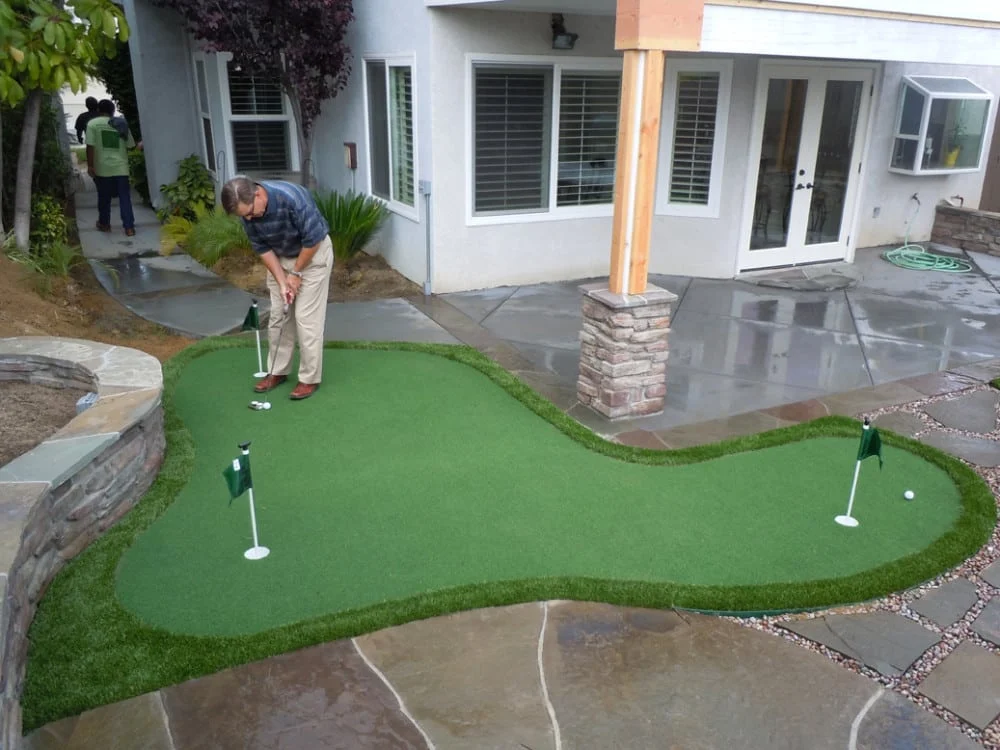
Putting Green Types & Complete Costs
Every backyard golf option with pricing, features, and specifications
Complete Putting Green Pricing
| Green Type | Price Range | Common Sizes | Key Features | Lifespan |
|---|---|---|---|---|
| DIY Turf Kit | $8 – $15/sq ft | 100-300 sq ft | Basic putting surface | 8-12 years |
| Professional Synthetic | $15 – $30/sq ft | 300-600 sq ft | Multiple holes, contours | 15-20 years |
| Tour-Quality Green | $25 – $40/sq ft | 500-1,000 sq ft | True roll, custom design | 15-25 years |
| Natural Grass | $20 – $35/sq ft | 400-800 sq ft | Authentic feel | Indefinite* |
| Portable Green | $500 – $3,000 total | 50-150 sq ft | Indoor/outdoor use | 5-10 years |
| Chipping Area | $20 – $35/sq ft | 200-500 sq ft | Short game practice | 15-20 years |
| Full Practice Area | $30 – $50/sq ft | 1,000+ sq ft | Putting, chipping, sand | 15-25 years |
| Modular System | $12 – $20/sq ft | Variable | Expandable design | 10-15 years |
Critical Putting Green Installation Warnings
Drainage is EVERYTHING – poor drainage turns your green into a swamp and destroys the investment! Proper base preparation requires 4-6 inches of crushed aggregate with precise grading. Sub-base must be compacted to 95% density or settling creates unplayable undulations. Never install over tree roots – they WILL cause bumps and tears. Cheap turf looks fake and plays terribly – minimum 1.5-inch pile height for realistic roll. Infill material critical: silica sand provides proper ball speed, rubber creates inconsistent bounce. DIY seaming shows within months – professional installation worth the cost. Edge containment prevents separation and maintains shape. UV-resistant turf essential or color fades within 2 years. Stimpmeter speeds vary wildly by turf quality – test before buying. Natural grass greens require daily maintenance and professional knowledge – not for casual golfers. Consider sun exposure – some turfs get dangerously hot (140°F+) in direct sun. Slope design requires expertise – too steep is unplayable, too flat is boring. HOA approval often required – check before starting!
Complete Installation & Construction Costs
Total investment breakdown for putting green projects
Putting Green Project Cost Breakdown
| Project Component | DIY Cost | Professional Cost | Importance | Notes |
|---|---|---|---|---|
| Design Planning | $0 – $200 | $500 – $1,500 | Critical | Contours, drainage plan |
| Excavation | $500 – $1,500 | $1,500 – $3,500 | Essential | 6-8 inch depth |
| Base Materials | $3 – $5/sq ft | $5 – $8/sq ft | Foundation | Crushed stone, sand |
| Drainage System | $500 – $1,000 | $1,000 – $2,500 | Crucial | Perforated pipe, gravel |
| Turf Material | $5 – $12/sq ft | $8 – $20/sq ft | Quality varies | Nylon best for putting |
| Installation Labor | 40-80 hours | $5 – $10/sq ft | Precision required | Seaming critical |
| Infill & Finishing | $1 – $2/sq ft | $2 – $3/sq ft | Ball roll quality | 16-30 lbs/sq ft |
| Cup Installation | $50 – $100/cup | $100 – $200/cup | Playing function | Regulation 4.25″ |
Putting Green Features & Add-On Costs
| Feature/Add-On | Cost Range | Benefits | Maintenance | Popular? |
|---|---|---|---|---|
| Multiple Break Points | +$2,000 – $5,000 | Challenging putts | None | Essential |
| Fringe Area | $10 – $15/sq ft | Realistic chipping | Minimal | Highly desired |
| Sand Bunker | $3,000 – $8,000 | Short game practice | Rake regularly | Serious golfers |
| LED Lighting | $2,000 – $5,000 | Night practice | Minimal | Extends use |
| Hitting Mat | $500 – $2,000 | Full swing practice | Replace periodically | Complete setup |
| Ball Return System | $1,000 – $3,000 | Continuous practice | Occasional cleaning | Convenience |
| Landscaping | $1,000 – $5,000 | Aesthetic appeal | Regular care | Completes look |
Factors Affecting Putting Green Costs
What determines your final backyard golf investment
Major Cost Variables
Size & Complexity
Simple green:
• 200-400 sq ft
• Basic contours
• $3,000-8,000
Complex design:
• 600+ sq ft
• Multiple tiers
• $15,000-30,000
Turf Quality
Basic turf:
• Polyethylene
• 8-10 stimp speed
• $5-8/sq ft
Premium nylon:
• True ball roll
• 10-12 stimp
• $12-20/sq ft
Site Preparation
Level site:
• Minimal excavation
• Standard base
• Normal pricing
Sloped/problem:
• Extensive grading
• Retaining walls
• +$3,000-8,000
Design Features
Flat design:
• Single tier
• 2-3 holes
• Basic contours
Tour style:
• Multiple breaks
• 4-6 holes
• +40-60% cost
Drainage Needs
Good drainage:
• Basic system
• Surface runoff
• Included in base
Poor drainage:
• French drains
• Pump systems
• +$2,000-5,000
Access & Location
Easy access:
• Equipment entry
• Standard install
• Base pricing
Limited access:
• Manual labor
• Wheelbarrow only
• +20-40% labor
Turf Selection & Playing Characteristics
Choosing the right surface for authentic putting
Putting Surface Comparison
| Turf Type | Stimp Speed | Price/Sq Ft | Best For | Characteristics |
|---|---|---|---|---|
| Polypropylene | 8-9 | $5 – $8 | Casual practice | Budget option, adequate roll |
| Polyethylene | 9-10 | $8 – $12 | Regular practice | Good durability, consistent |
| Nylon 6,6 | 10-12 | $12 – $18 | Serious golfers | Best ball roll, heat resistant |
| Dual Fiber | 10-11 | $15 – $20 | All conditions | Durability + performance |
| Natural Bent Grass | 9-13 | $20 – $35 | Purists | Authentic, high maintenance |
Real Estate Investment Returns
Putting green ROI for different property strategies
Primary Residence
ROI: 40-60% value return
Investment: $8,000-20,000
Benefits:
• Daily practice convenience
• Unique luxury feature
• Strong in golf communities
• Entertainment value
Rental Property
ROI: Limited application
Strategy: Luxury/vacation only
Reality:
• Maintenance concerns
• Damage potential
• Better for sales than rentals
• Golf communities exception
Fix & Flip
ROI: Highly market specific
Strategy: Golf neighborhoods
Budget: $5,000-10,000 max
Impact:
• Niche buyer appeal
• Can sit on market
• Photos well for listings
• Skip in non-golf areas
DIY vs Professional Installation
Why professional installation delivers better results
Installation Method Comparison
DIY Installation
Save: $5-10/sq ft
Time: 2-4 weekends
Good for:
• Small, flat areas
• Basic designs
• Tight budgets
Challenges:
• Seaming difficulties
• Drainage issues
Professional Install
Cost: $5-10/sq ft labor
Time: 3-5 days
Includes:
• Design expertise
• Proper drainage
• Seamless installation
• Contour creation
• Warranty coverage
Common DIY Mistakes
• Inadequate base prep
• Poor drainage planning
• Visible seam lines
• Uneven infill distribution
• Wrong turf selection
• Unrealistic contours
DIY Success Tips
• Start small and flat
• Rent plate compactor
• Use quality adhesive
• Apply infill gradually
• Test drainage thoroughly
• Watch installation videos
When Pros Essential
• Contoured designs
• Large installations
• Multiple break points
• Integrated features
• Natural grass greens
• Warranty important
Maintenance Needs
Regular care:
• Brush monthly
• Remove debris
• Check infill levels
• Clean cup areas
Annual:
• Deep cleaning
• Infill top-up
Money-Saving Strategies
Get a quality putting green while managing costs
Winter Installation
Save 15-25% on labor during slow season. Installers offer discounts December-February. Ground workable in most climates. Ready for spring golf season. Materials often on sale.
Start Simple, Expand Later
Begin with basic 300 sq ft green, add features annually. Modular turf systems allow expansion. Add fringe, bunkers, or chipping areas as budget permits. Spreads cost over years.
DIY Site Preparation
Excavation and base work are labor-intensive but straightforward. Rent equipment for $300/day, save $2,000-4,000. Have pros handle only turf installation for perfect seams.
Group Buying Power
Coordinate with golf buddies or neighbors. Bulk turf purchases save 15-20%. Share installation crew mobilization costs. Some installers offer package deals for multiple greens.
Skip Unnecessary Features
Focus on putting surface quality over bells and whistles. Ball returns, automatic cup changers add cost with minimal benefit. Invest in better turf instead of gadgets.
Remnant Turf Deals
Installers often have leftover premium turf from large jobs. Perfect for smaller greens at 30-50% discount. Quality materials at budget prices. Ask installers about remnants.
Frequently Asked Questions
Expert answers about backyard putting greens
⛳ Ready to Build Your Backyard Putting Green?
Find qualified putting green installers and golf landscape specialists

Knowledge Quiz: Putting Green Cost Guide
Open Quiz
5 quick questions - see how much you learned!
1) What is the listed price range for a Basic Putting Green?
Answer: B
The overview lists a Basic Green at $15 – $25 per sq ft (typically 200–400 sq ft).
2) What is the typical lifespan range for a Professional Synthetic putting green?
Answer: C
The table lists Professional Synthetic greens at 15–20 years.
3) What base preparation is recommended in the warnings section for proper performance and drainage?
Answer: A
The warnings emphasize 4–6 inches of crushed aggregate, proper grading, and tight compaction for drainage and a true roll.
4) Which infill material is described as providing proper ball speed?
Answer: D
The guide notes silica sand provides proper ball speed, while rubber can create inconsistent bounce.
5) What is the professional installed cost range for cup installation (per cup)?
Answer: B
The cost table lists professional cup installation at $100 – $200 per cup (regulation 4.25").
6) Which feature add-on is priced at $3,000 – $8,000 and is aimed at short game practice?
Answer: C
A Sand Bunker is listed at $3,000 – $8,000 for serious short game practice.
7) What ROI range is listed for a putting green on a primary residence?
Answer: A
The ROI section estimates 40–60% value return for most primary residences (higher in golf communities).
🌿 More Landscaping Cost Guides
Explore our complete outdoor improvement library
View All Landscaping Guides (25+) ▼
🌱 Lawn & Turf Services
🌳 Trees & Plants
💧 Water & Irrigation
🎨 Design & Hardscaping
🏗️ Structures & Recreation
Last updated: Jan 2026
Sources: United States Golf Association, Golf Course Superintendents Association, Synthetic Turf Council, American Society of Golf Course Architects, Professional Golfers' Association, Builds and Buys Research Team



