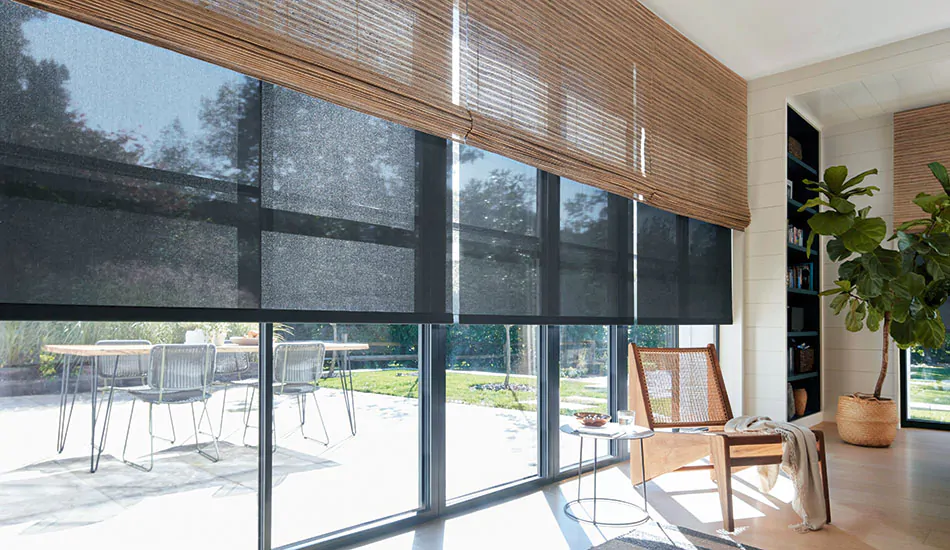
Complete Window Treatment Pricing
| Treatment Type |
Material Cost |
Installation |
Per Window Total |
10 Windows Total |
| Vinyl Mini Blinds |
$20-60 |
$30-90 |
$50-150 |
$500-1,500 |
| Faux Wood Blinds |
$40-100 |
$30-100 |
$70-200 |
$700-2,000 |
| Real Wood Blinds |
$80-200 |
$40-100 |
$120-300 |
$1,200-3,000 |
| Cellular/Honeycomb |
$100-200 |
$50-100 |
$150-300 |
$1,500-3,000 |
| Solar Shades |
$80-180 |
$40-120 |
$120-300 |
$1,200-3,000 |
| Roller Shades |
$60-150 |
$40-100 |
$100-250 |
$1,000-2,500 |
| Roman Shades |
$100-300 |
$50-150 |
$150-450 |
$1,500-4,500 |
| Motorized Blinds |
$200-400 |
$100-200 |
$300-600 |
$3,000-6,000 |
| Plantation Shutters |
$150-400 |
$50-200 |
$200-600 |
$2,000-6,000 |
| Curtains/Drapes |
$50-300 |
$50-150 |
$100-450 |
$1,000-4,500 |
⚠️
Critical Sunroom Window Treatment Warnings
Sunroom window treatments face extreme conditions that destroy standard products – wrong choices waste thousands and fail within months! UV exposure in sunrooms 3-5x higher than regular rooms, fading fabrics and warping materials. Temperature swings from 20°F to 140°F cause expansion/contraction that breaks mechanisms and warps slats. Moisture condensation ruins non-waterproof materials, breeding mold and causing operational failure. Common disasters: vinyl blinds melting/warping in direct sun (replacement needed within 6-12 months), fabric shades fading to nothing, wood blinds splitting/cracking from humidity changes, and cheap mechanisms jamming from temperature cycling. Energy impact massive – wrong treatments increase cooling costs 40-60%. Single-pane sunroom windows MUST have thermal treatments or rooms become unusable. Dark colors absorb heat making rooms unbearable while reflecting treatments can damage plants/furniture. Size matters – sunroom windows often larger than standard requiring custom sizing at 2-3x cost. Weight calculations critical for motorized options – large treatments need upgraded motors. Never use interior-only products in three-season rooms – temperature extremes destroy them. Professional measurement essential – DIY errors common with angled glass and non-standard openings. Consider maintenance access – high windows need motorization or become permanent dust collectors. Insurance note: improper treatments causing water damage may void coverage!
Performance Features & Benefits
| Feature |
Benefit |
Cost Impact |
Energy Savings |
Durability |
| UV Protection |
Prevents fading |
+$20-50/window |
5-10% |
Essential |
| Thermal Backing |
Temperature control |
+$30-80/window |
20-30% |
Highly recommended |
| Moisture Resistance |
Prevents warping |
+$40-100/window |
N/A |
Critical for longevity |
| Motorization |
Convenience/access |
+$150-300/window |
Better usage |
Reduces wear |
| Dual Shades |
Day/night options |
+$50-150/window |
15-25% |
Versatile |
| Side Channels |
Light gap control |
+$30-80/window |
10-15% |
Better seal |
| Top-Down/Bottom-Up |
Privacy + light |
+$50-100/window |
5-10% |
More options |
Material Comparison for Sunrooms
| Material |
Heat Resistance |
UV Resistance |
Moisture Tolerance |
Lifespan |
| Aluminum |
Excellent |
Excellent |
Excellent |
15-20 years |
| Faux Wood/Composite |
Very Good |
Very Good |
Excellent |
10-15 years |
| Cellular Fabric |
Good |
Good-Excellent |
Fair |
7-10 years |
| Solar Screen |
Excellent |
Excellent |
Good |
10-15 years |
| Real Wood |
Fair |
Poor-Fair |
Poor |
5-10 years* |
| Vinyl |
Poor-Fair |
Fair |
Good |
3-7 years |
| Fabric (Curtains) |
Fair |
Poor-Good** |
Fair |
3-8 years |
*In sunrooms with extreme conditions **Depends on UV treatment
Treatment Recommendations by Application
| Sunroom Use |
Best Treatment |
Key Features Needed |
Budget/Window |
| Living/Entertainment |
Cellular shades |
Light filtering, insulation |
$150-300 |
| Home Office |
Solar shades |
Glare reduction, view-through |
$120-300 |
| Dining Room |
Roman shades |
Elegant, light control |
$150-450 |
| Plant Room |
Adjustable blinds |
Variable light control |
$100-250 |
| Exercise/Yoga |
Roller shades |
Privacy, easy operation |
$100-250 |
| Breakfast Nook |
Café curtains + blinds |
Privacy + light |
$150-350 |
| Reading Room |
Top-down shades |
Natural light, no glare |
$200-400 |
| Multi-Purpose |
Motorized cellular |
Convenience, efficiency |
$300-500 |
🎯 Professional Selection Tips: Successful sunroom window treatments balance light control, energy efficiency, and durability for year-round performance. Start with orientation assessment: south-facing windows need maximum UV protection (99% blocking), west windows require heat reduction (solar shades ideal), while north-facing can use lighter treatments. Layer treatments for flexibility: solar shades for daytime + blackout for media viewing, sheers for privacy + cellular for insulation. Energy efficiency crucial: cellular shades with 3/4″ cells provide R-value of 3.5-5, reducing energy costs 20-30%. Side channels eliminate light gaps improving efficiency another 10-15%. Color selection impacts performance: white/reflective reduces heat gain 25% versus dark colors. Motorization worthwhile for windows over 8 feet high or behind furniture – prevents damage from reaching, ensures regular use. Smart integration allows scheduling – automatically lower during hot afternoons, raise for morning light. Consider dual shades combining sheer and blackout in one unit for ultimate flexibility. Cleaning requirements vary: aluminum/faux wood wipe clean easily, fabric requires professional cleaning. Measure three times – sunroom settling creates non-square openings requiring precise measurement. Inside mount looks cleaner but requires 2-3″ depth; outside mount hides poor window frames. Professional installation recommended for motorized or treatments over $300/window ensuring warranty validity.
🌡️
Energy Savings
Quality treatments:
• 20-30% energy reduction
• $300-600/year savings
• 3-5 year payback
No/poor treatments:
• Unusable in summer
• High HVAC costs
• Comfort complaints
🏠
Property Appeal
Coordinated treatments:
• Finished appearance
• Move-in ready
• Premium perception
Missing/mismatched:
• Looks incomplete
• Buyer negotiations
• -$2,000-5,000 value
🛡️
Furniture Protection
UV filtering:
• Prevents fading
• Extends furniture life
• Protects flooring
Replacement costs:
• Furniture: $5,000+
• Flooring: $3,000+
• Artwork protection
📊 Market Reality: Quality window treatments return 75-85% of investment through energy savings, comfort improvement, and resale value. Professionally installed treatments signal well-maintained property, while missing or damaged treatments raise red flags for buyers. Energy-efficient treatments increasingly important – buyers calculate operating costs, and untreated sunrooms appear expensive to maintain. Motorized treatments add “smart home” appeal commanding premium with tech-savvy buyers. Real estate photos dramatically improved with proper treatments – harsh sunlight creates poor listing images without them. Staging tip: coordinate treatment colors with décor for cohesive look. Regional preferences: Southern markets prioritize heat reduction, Northern buyers focus on insulation values, Coastal areas need humidity resistance. Investment properties benefit from durable, neutral treatments reducing tenant complaints about temperature. Quality treatments last 10-15 years versus 3-5 for budget options – explain lifecycle value to buyers. Include treatment specifications in listing: UV protection percentage, energy ratings, smart home compatibility. Appraisers increasingly recognize energy-efficient improvements adding 3-5% to home values. Warning: cheap treatments worse than none – signal deferred maintenance. Professional installation receipts and warranties transfer confidence to buyers. Consider leaving motorized treatment controls and programming guides for new owners.
📏
Measure Like a Pro
Accurate measurements save hundreds in returns/remakes. Measure width at top, middle, bottom – use narrowest. Height at left, center, right – use shortest. Inside mount needs 1/8″ deduction, outside mount add 2-3″ overlap. Free measuring services often available from retailers.
🛍️
Strategic Shopping Timing
Major sales happen January (new year), Memorial Day, July 4th, and Black Friday – save 25-50%. End of summer clearances offer deep discounts on inventory. Order during slow season (winter) for better pricing and faster delivery. Group purchases for volume discounts.
🎨
Mix Price Points
Invest in quality for high-sun windows (south/west), use budget options for north-facing or shaded windows. Motorize only hard-to-reach windows. Premium treatments in living areas, basic in utility spaces. This approach saves 30-40% overall.
🔧
DIY Where Sensible
Install simple treatments yourself – cordless blinds, café curtains, standard shades. Professional for motorized, high windows, or custom shutters. Many retailers offer free basic installation with minimum purchase. YouTube tutorials prevent costly mistakes.
💰
Consider Alternatives
Window film provides UV protection for $8-15/window – great supplement to basic shades. Exterior awnings reduce heat gain 65-75%, extending treatment life. Layering sheers with blinds costs less than custom dual shades. Plants provide natural screening.
🔄
Phase Installation
Start with most critical windows – south/west facing for heat control. Add treatments room by room as budget allows. Basic treatments now, upgrade to motorized later. This spreads cost over time while providing immediate benefits.
What’s the best window treatment for a hot sunroom?
For hot sunrooms, solar shades or cellular shades with reflective backing provide the best heat reduction while maintaining views and natural light. Solar shades block 90-99% of UV rays and reduce heat gain by up to 75% while still allowing visibility outside – perfect for maintaining the connection to nature that makes sunrooms special. Cost ranges from $120-300 per window installed. Cellular shades with metallized backing (often called “heat shield” technology) provide superior insulation with R-values up to 5, creating air pockets that block heat transfer. Dual cellular shades offer even better performance. Color matters significantly: white or reflective colors on the outside-facing surface reduce heat gain by 25-35% compared to dark colors. Motorization recommended for consistent use – studies show manual shades often left open defeating their purpose. For maximum cooling, combine treatments: solar shades for daytime + insulated cellular for early morning/late afternoon when sun angle is low. Outside mounting covers more glass area improving efficiency. Some homeowners layer exterior awnings with interior treatments for 85%+ heat reduction. Professional energy audit can calculate exact savings, but typical reduction in cooling costs ranges 20-40%. Key features to specify: openness factor 3-5% for solar shades, double or triple cell construction for cellular, side channels to eliminate gaps. Avoid dark colors, single-layer treatments, or anything without UV protection in hot sunrooms.
Are motorized blinds worth the extra cost for sunrooms?
Motorized blinds prove worthwhile for most sunroom applications, offering convenience, energy savings, and protection benefits that offset their higher initial cost of $300-600 per window. The primary advantage is consistent use – studies show motorized treatments are adjusted 75% more frequently than manual, maximizing energy efficiency and UV protection. For high or hard-to-reach windows (common in sunrooms with vaulted ceilings), motorization eliminates dangerous reaching or climbing. Smart motorized systems integrate with home automation, allowing scheduled operation: automatically lower during peak sun hours, raise for morning light, adjust based on temperature sensors. This automation can reduce cooling costs 30-40% compared to manually operated treatments left in suboptimal positions. Battery-powered options eliminate wiring needs, lasting 3-5 years per charge with solar recharging available. Hardwired systems cost more initially but provide reliable long-term operation. Group control allows operating all treatments simultaneously – valuable for sunrooms with 10+ windows. Safety benefits include cordless operation (required in homes with children) and obstacle detection preventing damage. Motorization extends treatment life by ensuring smooth, even operation without pulling or stress. ROI typically 4-6 years through energy savings and prevented sun damage. Consider motorizing at minimum: windows over 8 feet high, behind furniture, southern exposures needing frequent adjustment. Modern apps provide control from anywhere, perfect for vacation homes or adjusting before arrival home.
How do I prevent window treatments from fading in my sunroom?
Preventing fading in sunroom window treatments requires selecting appropriate materials and protective features since UV exposure in sunrooms exceeds interior rooms by 300-500%. Start with inherently fade-resistant materials: aluminum blinds, faux wood composites, and solution-dyed acrylic fabrics resist fading far better than natural materials or printed fabrics. Solar shades made from PVC-coated fiberglass or polyester maintain color 5-10 years even in extreme exposure. For fabric treatments, look for UV-inhibitor treatments adding 2-3 years to lifespan. Cellular shades with metallized backing reflect UV away from fabric faces. White and light colors show fading less than dark shades which absorb more UV energy. Position considerations matter: inside mounting exposes less treatment surface to direct sun. Layering treatments protects each – sheers protect heavier drapes behind them. Rotating treatments seasonally (switching sides on reversible shades) doubles lifespan. Apply UV-blocking window film ($8-15/sq ft) to glass, reducing UV penetration 99% while maintaining visibility. Professional fabric protection sprays ($20-30) applied annually help but aren’t miracle solutions. For valuable treatments, consider museum-quality UV filtering glass, though expensive at $25-40/sq ft. Realistic expectations important: even best materials fade eventually in sunrooms – budget for replacement every 7-10 years versus 15-20 for interior rooms. Some fading adds character to natural materials. Document original colors with photos for accurate replacement matching.
What window treatments work best for privacy without blocking light?
Achieving privacy while maintaining natural light – the primary reason for building a sunroom – requires strategic treatment selection and layering techniques. Top-down/bottom-up shades offer the ideal solution, allowing you to lower the top for light while raising the bottom for privacy, costing $200-400 per window. Sheer shades with adjustable vanes provide variable privacy: vanes open for filtered light and views out, closed for complete privacy while still allowing diffused light. Light-filtering cellular shades in white or neutral colors provide privacy while glowing softly with transmitted light, creating pleasant ambiance. Dual shades combining sheer and opaque materials in alternating stripes allow infinite adjustment between view-through and privacy. For fixed privacy with maximum light, bottom café curtains or shutters cover lower portions while leaving tops uncovered. Frosted window film on lower glass sections provides permanent privacy for $10-20/window. Practical solutions include: solar shades with 5% openness factor – can’t see in during day but provides nighttime visibility issues requiring secondary treatment; double cellular shades offering light-filtering front with blackout back; motorized shades programmed for privacy when needed. Layer treatments for ultimate flexibility: solar shades for day + cellular for night, sheers for softness + blinds for control. Side channels important for eliminating peek-through gaps. Consider privacy needs by room use and time – breakfast nooks need morning privacy, entertainment spaces need evening options.
Can I use regular curtains in a three-season sunroom?
Regular interior curtains generally shouldn’t be used in three-season sunrooms due to extreme temperature swings, humidity, and UV exposure that quickly destroy standard fabrics and hardware. Three-season rooms experience temperature ranges from below freezing to over 100°F, causing standard curtain fabrics to fade, mildew, and deteriorate within one season. Humidity condensation leads to mold and mildew growth on regular fabrics. Standard curtain rods rust, and brackets loosen from expansion/contraction. However, outdoor-rated curtain options exist specifically for these conditions. Marine-grade acrylic fabrics (Sunbrella, Outdura) resist fading, mold, and temperature extremes, lasting 5-10 years, costing $30-80 per panel. Olefin and polyester outdoor fabrics offer budget alternatives at $15-40 per panel. Hardware must be rust-proof: stainless steel, aluminum, or heavy-duty resin. Grommeted tops handle stress better than rod pockets. Weighted hems prevent excessive movement. Installation tips: outside mount prevents fabric touching cold glass reducing condensation contact, tension cables or tie-backs needed for wind control, removable mounting allows winter storage extending life. Many homeowners prefer outdoor roller shades or aluminum blinds for three-season rooms – more practical and durable. If using curtains, choose light colors showing less fading, simple styles without linings that trap moisture, and expect 3-5 year replacement cycle versus 10+ years for interior use. Consider seasonal removal during winter months preventing freeze damage.
How many window treatments should I budget for in a typical sunroom?
A typical sunroom requires treatments for 8-15 windows, though counts vary significantly based on design and size. Standard 12×16 foot sunrooms average 10-12 windows: 3-4 per long wall, 2-3 on the end wall, plus potential door treatments. Calculating your specific needs: count each operational window section separately (double-hungs count as one, not two), sliding doors need extra-wide treatments, fixed transoms above operational windows may not need treatment, consider knee wall windows separately from full-height. Budget considerations by sunroom type: three-season rooms average 10-12 windows at $100-250 each = $1,000-3,000 total; four-season rooms similar count but higher quality needed at $150-400 each = $1,500-4,800; contemporary glass rooms with floor-to-ceiling windows need fewer but larger treatments at $300-600 each. Don’t forget often-missed areas: door sidelights ($50-150 each), skylights if operable ($200-500 each with motorization), transition windows between house and sunroom. Money-saving strategies: group similar-sized windows for bulk pricing, treat some fixed windows with film only ($50-100), prioritize operational windows first. Professional designers recommend budgeting 8-12% of sunroom cost for treatments. For $30,000 sunroom, expect $2,400-3,600 for quality treatments. Phasing installation acceptable – start with 60% most critical windows. Remember: untreated sunrooms become unusable in temperature extremes, making treatments essential, not optional.
What’s the difference between solar shades and cellular shades for sunrooms?
Solar shades and cellular shades serve different primary purposes in sunrooms, with solar shades excelling at maintaining views while blocking heat and glare, while cellular shades prioritize insulation and complete light control. Solar shades use specially woven mesh fabrics that block 90-99% of UV rays while allowing you to see outside – openness factors from 1% (maximum privacy/heat blocking) to 10% (maximum visibility). They’re ideal for maintaining the outdoor connection that makes sunrooms special. Cost runs $120-300 per window, with motorization adding $150-300. Benefits include: superior glare reduction for TV/computer use, furniture protection from UV, maintaining views, and good heat reduction (up to 75%). Limitations: minimal insulation value (R-value near 0), limited privacy at night when interior lit, no blackout capability. Cellular shades trap air in honeycomb-shaped cells providing insulation R-values from 2.5 (single cell) to 5.0 (triple cell), significantly reducing heat transfer. They offer complete light control from sheer to blackout but block views when closed. Cost ranges $150-300 basic, $300-500 motorized. Benefits: energy efficiency reducing heating/cooling 20-30%, sound dampening, privacy options, available in light-filtering maintaining glow. Limitations: no view when closed, can trap moisture in cells, heavier requiring sturdy mounting. Many sunroom owners layer both: solar for daytime, cellular for temperature extremes and privacy, maximizing benefits of each.
How do I clean and maintain sunroom window treatments?
Proper maintenance extends sunroom window treatment life significantly, with cleaning frequency 2-3x higher than interior rooms due to increased dust, pollen, and humidity exposure. Maintenance schedules vary by material: Aluminum/vinyl blinds – monthly dusting with microfiber cloth, quarterly deep clean with mild soap solution, annual mechanism lubrication with silicone spray. Faux wood – bimonthly dusting, spot clean with damp cloth, avoid excess moisture. Cellular shades – monthly vacuuming with brush attachment on low setting, annual professional cleaning for stubborn dirt, spot clean with mild detergent. Solar shades – monthly dusting or vacuuming, quarterly wipe with damp microfiber, annual deep clean following manufacturer directions. Fabric treatments – weekly light vacuuming, professional cleaning every 1-2 years, treat stains immediately. Common maintenance issues: sticky mechanisms from humidity require cleaning and light lubrication; warped slats need replacement (keep spares from initial order); fading indicates UV damage – rotate if reversible; mold/mildew requires immediate treatment with appropriate cleaners. Preventive measures: operate treatments weekly preventing mechanism seizure, use dehumidifiers reducing moisture damage, install with proper clearances preventing rubbing, check mounting hardware quarterly for loosening. Professional cleaning costs $10-25 per window but extends life 30-50%. Document cleaning in maintenance log for warranty claims. Replace worn strings/cords before complete failure. Never use harsh chemicals, pressure washing, or excessive water on any treatments.