🏗️ Sunroom Foundation Cost Guide 2025

Complete pricing for proper sunroom foundation systems

💰 Sunroom Foundation Cost Overview

Concrete Slab

$5,000 – $8,000
Most common

Crawl Space

$8,000 – $12,000
Access benefits

Full Basement

$12,000 – $20,000
Extra space

Pier & Beam

$6,000 – $10,000
Sloped sites
🏗️

Foundation Types & Complete Pricing

Every foundation option with excavation and finishing costs

Complete Foundation System Pricing

Foundation Type Size (sq ft) Excavation Materials/Labor Total Cost
Concrete Slab 200-300 $1,000-2,000 $4,000-6,000 $5,000-8,000
Monolithic Slab 200-300 $1,500-2,500 $4,500-7,500 $6,000-10,000
Stem Wall 200-300 $2,000-3,000 $5,000-8,000 $7,000-11,000
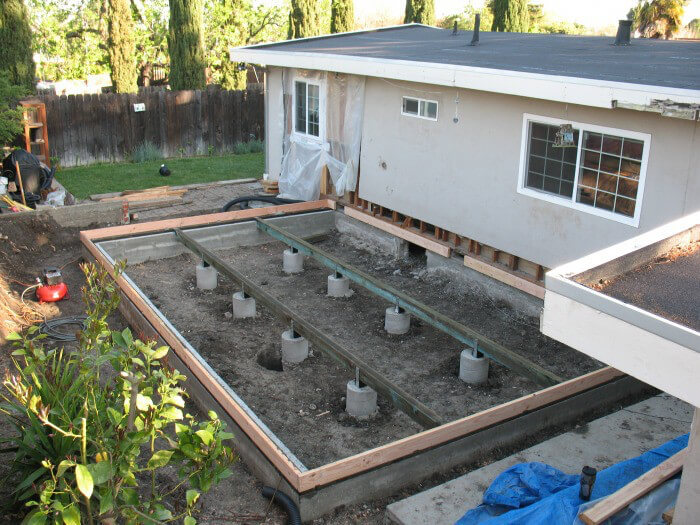
Crawl Space 200-300 $2,500-3,500 $5,500-8,500 $8,000-12,000
Full Basement 200-300 $4,000-6,000 $8,000-14,000 $12,000-20,000
Pier & Beam 200-300 $1,500-2,500 $4,500-7,500 $6,000-10,000
Helical Piers 200-300 $500-1,000 $7,500-12,000 $8,000-13,000
Deck Conversion Existing None $2,000-5,000 $2,000-5,000
⚠️

Critical Foundation Requirements & Warnings

Sunroom foundation failures cause catastrophic structural problems – cutting corners here destroys entire investments with settlement cracks appearing within 12-24 months! Foundation must support 40-60 pounds per square foot live loads plus glass/frame dead loads totaling 15-25 psf. Inadequate foundations cause 30% of sunroom failures: uneven settlement cracks glass, opens wall gaps, and voids warranties. Frost line depth absolutely critical – footings above frost line heave annually causing progressive damage. Many contractors skip soil testing ($500-1,500) leading to foundations failing in expansive clay or poor bearing soils. Building codes require engineered drawings for sunroom foundations – residential foundation standards insufficient for concentrated glass loads. Drainage represents second failure point: improper grading channels water under foundations causing erosion and settlement. French drains and proper slopes mandatory. Existing deck conversions tempting but dangerous – most decks designed for 40 psf live loads while sunrooms need 80-100 psf total capacity. Professional engineering evaluation essential. Vapor barriers under slabs prevent moisture infiltration damaging flooring. Insulation requirements vary by climate but edge insulation prevents thermal bridging. Never accept “it’s just like a regular room” – sunroom foundations have unique requirements. Budget contingency 20% for unexpected soil conditions!

📏

Foundation Components & Requirements

Essential elements for code-compliant sunroom foundations

Critical Foundation Components

Component Cost Range Purpose Code Required? Details
Soil Testing $500-1,500 Bearing capacity Recommended Prevents failures
Footings $50-100/linear ft Load distribution Yes Below frost line
Rebar/Steel $2-4/sq ft Reinforcement Yes #4 minimum
Vapor Barrier $0.50-1/sq ft Moisture control Yes (slabs) 10-mil minimum
Gravel Base $2-3/sq ft Drainage/stability Yes 4-6″ compacted
Insulation $1-3/sq ft Thermal break Climate zones Edge required
Drainage System $10-20/linear ft Water management Critical Perimeter drains
Waterproofing $3-5/sq ft Foundation protection Below grade Basement walls

Foundation Specifications by Climate Zone

Climate Zone Frost Depth Insulation R-Value Special Requirements Cost Impact
Zone 1-2 (Hot) 0-12″ R-5 Termite treatment Base cost
Zone 3-4 (Moderate) 12-36″ R-10 Standard frost protection +10-15%
Zone 5-6 (Cold) 36-60″ R-15 Deep footings +20-30%
Zone 7-8 (Very Cold) 60-84″ R-20 Frost-protected shallow +30-40%
🔨

Factors Affecting Foundation Costs

Major variables impacting your foundation investment

Primary Cost Drivers

🌍

Soil Conditions

Good soil:

• Sandy/gravel base

• Good drainage

• Standard excavation

Problem soil:

• Clay: +$2,000-5,000

• Rock: +$3,000-8,000

• Fill required: +$2,000-4,000

📐

Site Access

Easy access:

• Open yard

• Equipment entry

• Normal rates

Limited access:

• Hand digging: +50%

• Pump trucks: +$1,000

• Material handling: +30%

⛰️

Site Slope

Level site:

• Minimal grading

• Standard forms

• Base pricing

Sloped site:

• Retaining walls: +$3,000-8,000

• Stepped foundation: +20%

• Extra excavation: +30%

💧

Water Table

Deep water table:

• Standard dig

• Normal drainage

• No issues

High water table:

• Dewatering: +$2,000-5,000

• Waterproofing: +$3,000

• Sump pumps: +$1,500

🏗️

Local Codes

Standard requirements:

• Basic engineering

• Normal permits

• Typical inspections

Strict codes:

• Seismic design: +15%

• Wind requirements: +10%

• Extra inspections: +$500

🏠

Integration Needs

Standalone:

• Simple connection

• Basic waterproofing

• Standard cost

Complex tie-in:

• Match existing: +$1,000-3,000

• Underpinning: +$5,000-10,000

• Special details: +20%

🎨

Best Foundation Choice by Situation

Matching foundation types to your specific needs

Foundation Recommendations by Application

Situation Best Foundation Why Cost Range
Level Site, Good Soil Monolithic slab Cost-effective, fast $6,000-10,000
Cold Climate Frost-protected slab Prevents heaving $8,000-12,000
Sloped Site Pier & beam Minimizes excavation $6,000-10,000
High Water Table Elevated crawl space Above moisture $10,000-15,000
Future Utilities Crawl space Access for mechanicals $8,000-12,000
Existing Deck Reinforced deck Uses structure $2,000-5,000
Storage Needs Full basement Dual purpose $12,000-20,000
Poor Soil Helical piers Bypasses bad soil $8,000-13,000
Budget Build Basic slab Adequate support $5,000-8,000
Luxury Home Insulated basement Premium finish $15,000-25,000
🎯 Professional Foundation Selection Strategy: Foundation choice determines sunroom longevity – proper selection prevents 90% of structural problems. Monolithic slabs work well for most applications: single pour combining footings and slab reduces labor costs while providing adequate support for typical 200-300 sq ft sunrooms. Cold climates demand frost protection – either deep footings below frost line (adding $3,000-5,000) or frost-protected shallow foundations using rigid insulation. Crawl spaces offer advantages worth extra cost: access for utilities/repairs, better moisture control, and elevation matching existing house floors. Pier and beam systems excel on sloped sites avoiding massive excavation costs. For existing decks, professional evaluation essential – most need significant reinforcement costing $3,000-8,000 but still cheaper than new foundations. Soil testing ($500-1,500) seems expensive but prevents choosing wrong foundation type – expansive clay or poor bearing capacity changes everything. Consider future needs: crawl space allows adding radiant heat later, basement provides storage/mechanical space. Drainage cannot be overemphasized – proper grading and French drains prevent most foundation problems. Smart money invests in overbuilding foundations 20% – minimal cost increase provides 50% safety factor. Document all engineering and soil reports for future buyers demonstrating quality construction.
📈

Foundation Investment Impact

Long-term value of proper foundation systems

💰

Cost vs. Risk Analysis

Foundation failures cost:

• Repair: $10,000-30,000

• Glass replacement: $5,000+

• Unusable space: Priceless

Prevention: $2,000-3,000

• Soil testing

• Proper engineering

• Quality construction

🏠

Property Value Impact

Visible foundation issues:

• Kills deals instantly

• 20-30% value reduction

• Inspection red flags

Quality foundation:

• Buyer confidence

• Warranty transfers

• Premium perception

📊

Investment Strategy

Never compromise on:

• Proper depth/size

• Reinforcement

• Drainage systems

Can phase if needed:

• Interior finishes

• Fancy flooring

• Aesthetic elements

📊 Market Reality: Foundation quality directly correlates with sunroom longevity and property value – visible foundation problems tank home sales instantly. Proper foundations return 100% of investment by preventing catastrophic failures costing $20,000-50,000 to repair. Buyers and inspectors scrutinize sunroom foundations knowing they’re common failure points. Cracks, settlement, or moisture issues trigger immediate price negotiations often exceeding $10,000-20,000. Quality foundations last 50+ years with minimal maintenance, while inadequate ones fail within 5-10 years. Insurance claims for foundation failures often denied as “gradual deterioration” leaving homeowners with massive repair bills. Smart investors never cut foundation corners – the $2,000-3,000 “saved” by skipping engineering or drainage costs 10x more in repairs. Documentation critical: keep soil reports, engineering drawings, and inspection photos demonstrating professional installation. Stage sunrooms to subtly show foundation quality – exposed foundation edges in crawl spaces, clean perimeter drains, and level floors signal quality construction. Regional factors matter: areas with expansive soils or high water tables require specialized foundations costing more but preventing regional-specific failures. Consider foundation warranties (typically 10 years) transferable to buyers adding confidence. Quality foundations enable future upgrades while poor ones limit options forever.
🛠️

DIY vs Professional Foundation Work

Understanding why foundations demand professionals

Installation Method Comparison

🔨

DIY Extremely Limited

Possible only:

• Site preparation

• Marking layout

• Clean-up assistance

Never attempt:

• Concrete work

• Structural elements

• Grading/drainage

👷

Professional Essential

Expertise required:

• Load calculations

• Soil evaluation

• Code compliance

• Proper techniques

• Equipment operation

• Warranty coverage

⚠️

DIY Disaster Risks

• Inadequate footings = failure

• Wrong concrete mix

• Improper reinforcement

• Code violations

• No inspections

• Total rebuild likely

💡

Professional Process

• Site evaluation

• Engineered plans

• Permit acquisition

• Staged inspections

• Quality assurance

• Warranty protection

🏆

Choosing Contractors

• Foundation specialists

• Licensed/bonded

• Sunroom experience

• References available

• Warranty offered

• Insurance verified

📋

Timeline Reality

Professional:

• Permits: 1-2 weeks

• Excavation: 1-2 days

• Pour/cure: 3-5 days

• Total: 2-3 weeks

Weather dependent

💡

Smart Foundation Cost-Saving Strategies

Reduce costs without compromising structural integrity

📅

Combine with Other Work

Schedule foundation work when doing other concrete projects – driveways, patios, walkways. Concrete trucks charge minimums so combining pours saves $500-1,000. Same crew efficiency reduces labor costs 15-20%.

🏗️

Winter Scheduling

Foundation contractors offer 10-20% discounts December through February in most markets. Modern cold-weather concrete techniques work fine above 20°F. Heated enclosures available for extreme cold. Book early for spring completion.

🔍

Value Engineering

Work with engineer to optimize design – often can reduce concrete volume 15-20% while maintaining strength. Thickened edge slabs may eliminate separate footings. Smart rebar placement reduces steel costs. Worth $300-500 engineering fee.

🚚

Material Sourcing

Buy rebar and vapor barriers yourself saving contractor markup (20-30%). Coordinate delivery timing with contractor. Gravel/sand often cheaper from landscape suppliers than concrete companies. Savings: $500-1,500.

🏠

Phased Approach

Install full foundation but basic slab finish. Add decorative concrete, radiant heat, or premium finishes later. Gets structure up quickly while spreading costs. Rough slab fine under many flooring types.

💰

Multiple Bids Strategy

Get 4-5 bids and share competitive pricing. Many contractors match lowest price plus 5-10% for better quality. Beware extremely low bids – usually missing key components. Focus on detailed specifications not just price.

Frequently Asked Questions

Expert answers about sunroom foundations

Can I build a sunroom on my existing deck?
Converting existing decks to support sunrooms is possible but requires careful structural evaluation and usually significant reinforcement. Most residential decks are designed for 40 pounds per square foot live load, while sunrooms require 80-100 psf total capacity including dead loads from glass, frames, and roofing. Professional structural engineer evaluation ($500-1,000) is essential to determine upgrade requirements. Common necessary modifications include: additional posts/footings to reduce spans (typically every 6-8 feet), larger beams to handle increased loads (often doubling beam size), additional joists or sistering existing ones, new concrete footings meeting frost depth requirements, and diagonal bracing for lateral stability. Cost for reinforcement typically ranges $3,000-8,000 depending on deck size and current construction. Some decks prove too marginal to upgrade economically – if reinforcement costs exceed $8,000, new foundation often better value. Age matters significantly: decks over 15 years often have deterioration making upgrades impractical. Building codes may require bringing entire deck to current standards including railings, stairs, and connections. Advantage of deck conversion is elevation matching house floor level and faster construction. However, never assume deck adequate without engineering verification – failures catastrophic and liability significant. Many contractors will attempt conversions without proper analysis risking your investment.
How deep do sunroom footings need to be?
Footing depth requirements for sunrooms depend primarily on local frost line depths and soil conditions, with building codes mandating specific minimums to prevent frost heave and ensure stability. Frost line depths vary dramatically by region: Southern states (zones 1-2) may require only 12-16 inches, moderate climates (zones 3-4) typically need 24-42 inches, cold regions (zones 5-6) demand 48-72 inches, and extreme cold areas (zones 7-8) can require 72-84 inches or more. Local building departments provide specific frost line maps – never guess as being even 6 inches too shallow causes annual heaving and progressive damage. Beyond frost protection, footings must reach stable, undisturbed soil with adequate bearing capacity. This often means going deeper than frost requirements in areas with poor surface soils. Footing width equally important – typically 16-24 inches for sunroom loads, wider in poor soils. Stepped footings on slopes must maintain minimum depth at all points. Alternative frost protection includes insulated shallow foundations using rigid foam to redirect frost, saving thousands in excavation costs in deep frost areas. Some regions allow rubble trench foundations or helical piers avoiding deep excavation entirely. Professional contractors know local requirements, but verify with building department as codes change. Document footing depth with photos before concrete pour – inspectors and future buyers want proof of proper installation.
What’s the difference between a monolithic slab and a stem wall foundation?
Monolithic slabs and stem wall foundations represent two distinct approaches to sunroom foundation construction, each with specific advantages and applications. Monolithic slabs combine footings and floor slab in single concrete pour, creating continuous structure. Advantages include faster construction (one pour vs. multiple), lower labor costs (saves $1,000-2,000), simpler forming, and excellent for level sites with good drainage. Disadvantages: less flexibility for utilities, harder to modify later, and can telegraph soil movement into floor cracks. Typical cost: $25-35 per square foot. Stem wall foundations create perimeter wall on footings with separate slab pour inside. Benefits include: easier utility access/modifications, better on slopes allowing stepped foundations, superior moisture control with crawl space option, and isolation of floor from foundation movement. Drawbacks: higher cost ($35-45/sq ft), longer construction time (multiple pours/curing), and more complex waterproofing requirements. Climate considerations favor stem walls in wet regions for moisture control and monolithic slabs in dry areas for economy. Soil type matters: expansive soils benefit from stem walls isolating movement, while stable soils suit monolithic construction. For sunrooms, monolithic slabs work well when matching existing slab homes, while stem walls better match homes with crawl spaces/basements. Neither inherently superior – selection depends on site conditions, climate, and integration requirements.
Do I need special drainage for a sunroom foundation?
Proper drainage is absolutely critical for sunroom foundations – arguably more important than for house foundations due to typical placement and construction details. Sunrooms often extend into areas with questionable drainage, lack the protection of roof overhangs, and have large glass surfaces shedding significant water. Essential drainage components include: perimeter French drains around entire foundation (4-inch perforated pipe in gravel, costing $10-20/linear foot), positive grading away from structure (minimum 6 inches fall over 10 feet), and strategic downspout placement directing roof water well away from foundation. Waterproofing measures should include foundation coating or membrane on below-grade walls ($3-5/sq ft), capillary break between footing and wall, and proper vapor barriers under slabs. Common drainage failures: relying on surface grading alone (settles over time), connecting downspouts to foundation drains (overwhelms system), inadequate pipe sizing for roof area, and missing cleanouts for maintenance. Poor drainage causes: hydrostatic pressure cracking walls, frost heave from saturated soils, flooring failures from moisture infiltration, and mold/mildew in crawl spaces. Budget $2,000-4,000 for comprehensive drainage system – cheap insurance protecting $30,000+ investment. Many foundation warranties void without proper drainage. Install observation wells allowing monitoring of water levels. Consider sump pump in high water table areas. Document drainage installation with photos for future reference.
Can I add a basement under my sunroom?
Adding a basement under a sunroom can provide valuable storage, mechanical space, or even finished living area, but costs and complexity increase substantially compared to simpler foundation options. Full basements under sunrooms typically cost $60-100 per square foot versus $25-35 for slabs – a 200 sq ft sunroom basement adds $12,000-20,000. Advantages include: doubling usable space, protected area for HVAC equipment, storage for seasonal items, potential future finishing, and elevation matching existing basements. Challenges involve: excavation costs increasing with depth, waterproofing requirements adding $3,000-5,000, egress windows needed if finishing later ($2,000-4,000 each), and structural requirements for deeper foundations. Site conditions dramatically affect feasibility: high water tables require extensive drainage/pumping, rocky soil can double excavation costs, and slope stability must be maintained. Building codes treat sunroom basements identically to house basements: minimum 7-foot ceiling height, proper ventilation requirements, emergency egress if habitable, and fire separation from house. Many homeowners initially skip basement to save money, later regretting missed opportunity when adding one becomes impossible. If budget allows, unfinished basement provides future flexibility. Consider partial basement (4-5 feet) for utilities/storage at half the cost. Daylight basements on sloped lots offer best value, providing natural light and easier access.
What are helical piers and when should I use them?
Helical piers are steel shafts with helical plates that screw into the ground, providing deep foundation support without extensive excavation – ideal for challenging soil conditions where traditional foundations struggle. These engineered systems bypass poor surface soils, reaching stable strata sometimes 20-30 feet deep. Installation uses hydraulic equipment rotating piers until reaching specified torque indicating required bearing capacity. Advantages include: minimal excavation/disruption, installation in any weather, no concrete curing time, immediate load bearing, and adjustable if settlement occurs. Perfect applications: expansive clay soils causing traditional foundation movement, high water tables avoiding wet excavation, limited access sites where concrete trucks can’t reach, environmentally sensitive areas minimizing disturbance, and additions to existing structures avoiding undermining. Costs run $150-250 per pier with typical sunrooms needing 6-12 piers ($8,000-13,000 total) – comparable to problem soil traditional foundations. Disadvantages: requires specialized contractors, not DIY friendly, and some building departments unfamiliar with technology. Engineering typically required ($1,000-2,000) but provides precise load calculations. Installation takes 1-2 days versus weeks for deep traditional foundations. Long-term performance excellent with 50+ year life expectancy and transferable warranties. Consider when soil tests show bearing capacity under 2,000 psf, water table within 4 feet, or bedrock deeper than 8 feet.
How do I know if my soil is suitable for a standard foundation?
Soil suitability for sunroom foundations requires professional testing, though several indicators suggest potential problems warranting investigation. Good soil indicators: sandy or gravelly texture, good drainage after rain, no standing water, stable existing structures nearby, and minimal cracking in driveways/sidewalks. Problem soil warnings: clay that cracks when dry, swells when wet (expansive clay), standing water after rain, soft/spongy feel when walking, visible erosion patterns, and history of foundation problems in neighborhood. Professional soil testing ($500-1,500) includes: test pits or borings to design depth, bearing capacity measurements, expansion/contraction testing, groundwater level assessment, and engineering recommendations. Tests typically require 2-4 bore holes for residential sunrooms. Results indicate: bearing capacity in psf (2,000+ good, under 1,500 problematic), soil classification affecting design, expansion index for clay soils, and recommended foundation types. Common problem soils: expansive clay (30% of US) requiring special foundations, organic soils/peat needing removal or bypassing, fill dirt requiring deeper footings, and collapsible soils in arid regions. Don’t skip testing to save money – wrong foundation type costs 5-10x more to repair than initial testing. Many foundation contractors include basic testing, but independent geotechnical engineers provide unbiased recommendations. Keep soil reports forever – valuable for insurance claims and resale documentation.
What maintenance does a sunroom foundation require?
Sunroom foundations require minimal but critical maintenance to ensure long-term performance and prevent costly failures. Annual inspections should check for: cracks in visible concrete (hairline normal, growing cracks problematic), separation between foundation and structure, doors/windows sticking indicating movement, and water pooling near foundation. Drainage maintenance proves most critical: clean gutters/downspouts quarterly preventing overflow, ensure grade slopes away maintaining 6-inch fall over 10 feet, clear French drain outlets annually, and remove vegetation growing against foundation. Moisture control includes: monitoring crawl space humidity (should stay below 60%), running dehumidifiers if needed, ensuring vapor barriers remain intact, and checking for plumbing leaks immediately. Seasonal tasks: inspect after freeze/thaw cycles for heaving, check for erosion after heavy rains, seal any cracks before winter, and maintain positive drainage year-round. Every 3-5 years: professional inspection ($200-400) documenting condition, regrade settled areas, seal control joints, and update waterproofing if deteriorated. Warning signs requiring immediate attention: new or growing cracks, doors/windows out of square, water infiltration, and differential settlement. Preventive maintenance costs under $500 annually but prevents problems costing thousands. Document all maintenance with photos for warranty claims and resale. Well-maintained foundations last 50+ years; neglected ones fail within 10-20 years.

🏗️ Ready to Build Your Sunroom Foundation?

Connect with qualified foundation contractors

Last updated: August 2025

Sources: American Concrete Institute, International Code Council, National Association of Home Builders, Structural Engineering Institute, Post-Tensioning Institute, Builds and Buys Research Team