
Gretna Real Estate Investment Guide For 2026
A comprehensive resource for investors evaluating Nebraska’s fastest growing community, its top-rated school district, and a proposed megaproject that may or may not ever be built
Quick answers: Top 5 most searched Gretna investment questions ▼
Migration data: Where people are moving from to Gretna ▼
In This Guide
Click on any section to navigate directly to that content
1. Gretna Market Overview
Market Fundamentals
Gretna sits at the western edge of Sarpy County near the Elkhorn River, between Omaha and Lincoln along Interstate 80. It is routinely described as the fastest growing community in Nebraska’s fastest growing county, and it has an excellent school district, very high household incomes, and the second highest median home price in the state. It is also, on the arithmetic, the hardest place to make a rental work anywhere in this series.
Key economic indicators that define Gretna’s investment case:
- Population: Roughly 9,200 in the incorporated city, with the wider 68028 area at about 17,766
- School District: Gretna Public Schools, rated excellent by the Nebraska Department of Education, with Cedar Hollow Elementary and Gretna East High School recently opened
- Median Closing Price: Around $440,000, second only to Elkhorn in Nebraska
- Median Household Income: Reported near $124,000, the highest in this series
- Homeownership Rate: Reported around 75%, leaving roughly a quarter of households renting
- Property Tax: Reported effective rate near 1.97%, the highest in Sarpy County
The city motto is “The Great Life,” and by most quality of life measures Gretna earns it. Gretna Crossing Park opened with a fishing pond, disc golf, sports fields, an amphitheater, and a water park. Crime rates run below state and national averages. A regional Hy-Vee of roughly 135,000 square feet opened in 2024. None of that changes the rental math.
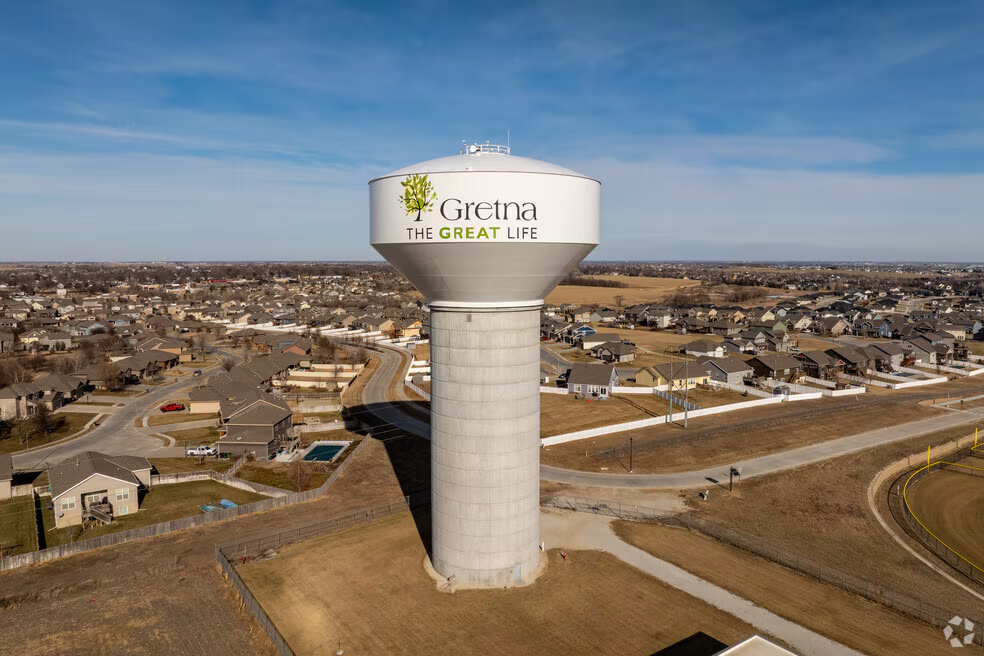
Gretna pairs Nebraska’s strongest suburban growth story with its weakest rental yields
2026 Economic Outlook
- Gretna Public Schools continuing to expand with new buildings serving a growing enrollment
- Residential development continuing across the wider 68028 area, much of it outside city limits
- Nebraska Crossing expansion still contested, with no confirmed construction timeline
- A pedestrian overpass across Highway 6/31 has been sought through federal funding to reconnect a city currently divided by the highway
- Sarpy County property taxes, reportedly highest in the county here, remaining the core investor headwind
Investment Climate
State it directly. Gretna produces the deepest negative carry of any market we have modeled in Nebraska. A median closing near $440,000 against a median home rent near $2,597 is a rent-to-price ratio around 0.59%. Add the county’s highest reported effective tax rate at roughly 1.97% and a retail purchase at 25% down runs somewhere between $650 and $1,050 per month negative, at cap rates of 3.1% to 3.6%.
Three structural factors compound the problem, and every one of them is specific to this city:
- The renter pool is the thinnest in this series. With homeownership around 75%, roughly one household in four rents. Your tenant is typically a relocating professional family renting for a year while they build, not a long-term renter by choice.
- Household incomes are high enough that most residents buy. A median near $124,000 means the people moving here can qualify for a mortgage, which removes them from your tenant pool entirely.
- Transaction volume is extremely thin. Some recent months have shown fewer than ten sales in the entire city, which makes comparable-sales analysis genuinely difficult and every published median unreliable.
What you get in exchange is a genuine growth story, an excellent district, and an area that has more than tripled in population over roughly two decades. If you are buying Gretna, you are buying land in the path of growth and a house that families want. You are not buying income.
Historical Performance
| Period | Market Driver | Avg Annual Appreciation | Key Event |
|---|---|---|---|
| 2000-2010 | Suburban expansion begins in earnest | 3-5% | The 68028 area roughly doubles from about 5,000 to 10,839 residents |
| 2011-2019 | School district reputation, Nebraska Crossing draw | 4-7% | Nebraska Crossing outlets establish Gretna as a regional retail destination |
| 2020-2022 | Low rates, new construction surge, suburban demand | 10-16% | Prices decouple sharply from rents, creating the yield problem that persists today |
| 2023-2024 | Rate shock at a high price base | 2-6% | Median estimated house value reported near $369,876 in 2024, up from about $101,300 in 2000 |
| 2025-2026 | Thin volume, contested megaproject, volatile prints | Highly variable | Voters narrowly approved a measure related to the Nebraska Crossing expansion in early 2025, though implementation questions remain |
Gretna price data is among the least reliable in this series and the reason is simple arithmetic. One recent month showed a median sale price of $320,000, down 11.7 percent year over year, on a total of four homes sold. Four transactions cannot produce a meaningful median. Six-month closing data puts the median near $440,000 and the median list price near $445,000. Do not underwrite any Gretna property off a monthly citywide figure. Have your agent pull closed comparable sales for the specific subdivision, vintage, and size.
Demand Drivers
- Gretna Public Schools – Rated excellent by the Nebraska Department of Education, with recent additions including Cedar Hollow Elementary and Gretna East High School. This is the primary reason families choose Gretna over cheaper alternatives.
- Interstate 80 Position – Gretna sits directly on the Omaha to Lincoln corridor, with Highway 370 and Highway 6 adding connections to Papillion, Bellevue, and Offutt Air Force Base.
- Nebraska Crossing – The existing roughly 40-acre outlet campus already draws regional shoppers, independent of whether the proposed expansion ever proceeds.
- New Construction Supply – Substantial residential development across the wider 68028 area, which sustains growth but also means your rental competes with brand new homes for sale.
- Parks and Amenity Investment – Gretna Crossing Park added a fishing pond, disc golf course, sports fields, amphitheater, playground, and water park.
- High-Income Household Base – A median household income reported near $124,000 supports both home values and premium rents, though it also means most residents buy rather than rent.
📚 New to real estate investing? Master the fundamentals with our professional course Learn more →
2. Neighborhood Hotspots
Gretna Investment Neighborhood Map
Interactive map of Gretna’s investment areas and the surrounding western Sarpy County corridor. Green stars show top hotspots, blue circles mark established markets, and orange circles highlight emerging areas.
Core Investment Neighborhoods
Detailed Submarket Analysis: Gretna and Western Sarpy County
| Submarket | Price Range (SFH) | Cap Rate | Growth Drivers | Best Strategy |
|---|---|---|---|---|
| Original Gretna / Downtown | $275K-$385K | 3.6-4.4% | Historic core, mid-century stock, lowest city pricing | Best available Gretna math, value-add |
| Highway 6 / 31 Corridor | $285K-$395K | 3.5-4.3% | Commercial spine, potential pedestrian overpass | Value-add, corridor improvement upside |
| Gretna Crossing Park Area | $350K-$470K | 3.3-4.1% | Park amenity, family demand, newer stock | Appreciation hold, funded carry |
| South Gretna / Highway 370 | $360K-$500K | 3.2-4.0% | New subdivisions, Papillion and Offutt access | Appreciation, deep negative carry |
| Gretna East / New Schools | $375K-$520K | 3.2-4.0% | New school facilities, eastern growth path | Appreciation only, newest inventory |
| Elkhorn River / Northwest | $390K-$650K | 3.0-3.8% | River valley setting, acreage, small-town feel | Premium hold, verify flood zone on every parcel |
| Tiburon Area | $420K-$700K | 2.9-3.7% | Golf community, premium demographic, district access | Executive rental, pure appreciation |
| Unincorporated 68028 | $300K-$700K | 3.0-4.5% | Acreage, new subdivisions, most of the area’s growth | Verify jurisdiction, services, and taxing entities |
| Papillion | $285K-$560K | 3.2-4.6% | Papillion-La Vista schools, county seat, data center corridor | Slightly better math, different district |
| La Vista | $215K-$375K | 3.2-5.4% | City Centre walkability, Papillion-La Vista schools | Better yields and much lower entry, small multi-family available |
| Bellevue | $185K-$400K | 4.0-6.5% | Offutt AFB, lowest corridor pricing, military demand | Best Sarpy County yields, VA conversion strategy |
| Springfield | $275K-$425K | 4.0-5.0% | Lowest Sarpy tax rate near 1.48%, small-town setting | Tax arbitrage inside the same county |
Expert Insight: “People call about Gretna because they hear fastest growing city in Nebraska and assume that means returns. Growth and yield are different things. Gretna grew because families want the schools and the new houses, and those same families buy rather than rent, which is why three quarters of the households here are owner-occupied. You are competing for the smallest renter pool in the metro while paying the highest tax rate in the county. If you want western Sarpy County exposure, Springfield’s tax rate is half a point lower on comparable property. That is real money on a four hundred thousand dollar house.” – Regional investment advisor, Sarpy County
3. Property Types
| Investment Goal | Best Property Type | Best Areas | Minimum Capital |
|---|---|---|---|
| Best Available Yield | Mid-century ranch bought below median | Original Gretna, Highway 6/31 corridor | $110,000+ |
| Maximum Appreciation | New construction in the growth path | Gretna East, South Gretna, unincorporated 68028 | $130,000+ and tolerance for deep negative carry |
| Zero Capital Entry (VA eligible) | Owner-occupied purchase, later converted | Anywhere in the district within your BAH range | Closing costs and reserves only |
| Same County, Lower Tax | Single-family in Springfield | Springfield, at a reported 1.48% versus Gretna’s 1.97% | $95,000+ |
| Actual Positive Cash Flow | Look outside Sarpy County entirely | Grand Island multi-family, Omaha’s older submarkets, Ashland | $70,000+ |
Don’t guess the costs. Our Complete Renovation & Remodeling Cost Guide covers 400+ pages of project-by-project breakdowns with real contractor pricing ranges.
4. Cost Analysis
Acquisition Cost Breakdown (Gretna)
| Expense Item | Typical Cost | Example ($440,000 Property) | Notes |
|---|---|---|---|
| Down Payment | 25% (investment) | $110,000 | The highest entry requirement of any city in this Nebraska series |
| Closing Costs | 2-3% of price | $8,800-$13,200 | Title, lender fees, recording, Nebraska documentary stamp tax |
| General Inspection | $450-$750 | $600 | Larger homes cost more to inspect. Newer stock has fewer findings. |
| Radon Test | $150-$250 | $200 | Nebraska has among the highest radon levels nationally. Mitigation $1,200-$2,500. |
| Jurisdiction and Annexation Verification | $0-$500 | $250 | Essential here. Much of the 68028 area sits outside city limits with different services. |
| HOA Covenant Review | $0-$400 | $200 | Critical on newer subdivisions and townhomes. Rental caps are common in Sarpy County. |
| Initial Repairs | 0-8% of price | $0-$35,200 | Minimal on new construction, meaningful on original-town mid-century stock |
| Carry Reserves (12 months) | 12 months of negative carry | $12,000-$13,000 | The largest carry reserve requirement in this series, because the shortfall is the largest |
| TOTAL MINIMUM ENTRY | ~30-39% of value | $132,000-$172,450 | More than double Grand Island’s entry, for a property producing negative income |
Sample Cash Flow Analysis: Original Gretna Value-Add
Purchase price $320,000, bought below the citywide median in the original town core. Renovation $25,000. All-in cost $345,000. Post-renovation appraised value $375,000. Leased to a district-seeking family at $2,200 per month. Modeled at 25% down with professional management. This is the best-case Gretna scenario.
| Item | Monthly | Annual | Notes |
|---|---|---|---|
| Gross Rent | $2,200 | $26,400 | 3BR renovated, below the reported $2,597 city median home rent |
| Less Vacancy (4%) | -$88 | -$1,056 | Low on paper, but the thin renter pool means gaps run long when they happen |
| Property Taxes | -$616 | -$7,388 | 1.97% of the reassessed $375,000 value. Twenty eight percent of gross rent. |
| Insurance | -$210 | -$2,520 | Landlord policy. Nebraska hail claims have pushed premiums up sharply. |
| Property Management (9%) | -$198 | -$2,376 | Standard Sarpy County residential rate |
| Maintenance + CapEx (7%) | -$154 | -$1,848 | Reduced because major systems were just replaced |
| Net Operating Income | $934 | $11,212 | Before mortgage |
| Mortgage ($240,000 loan, 25% down on purchase price, 7.0%, 30yr) | -$1,597 | -$19,158 | Principal and interest only, renovation paid in cash |
| CASH FLOW | -$662 | -$7,946 | And this is the best-case Gretna scenario |
| Cap Rate | 3.25% | NOI divided by $345,000 all-in cost | |
| Equity Created | $30,000 | $375,000 appraised value less $345,000 all-in cost |
A retail purchase at the median gets substantially worse. A $440,000 home renting at the reported $2,597 median produces about $1,137 of monthly NOI against a $2,195 payment, roughly $1,058 per month negative at a 3.1% cap rate. That is over $12,700 a year of funded shortfall on a single property, and it requires roughly $128,000 of capital to enter. A new four bedroom at $420,000 renting for $2,700 runs about $852 negative. A townhome at $330,000 renting for $2,100 runs about $735 negative.
Here is the comparison that puts Gretna in context. The same capital deployed into a Grand Island fourplex, roughly $126,500, produces about $375 per month positive at a 6.74% cap rate. The Gretna median purchase produces about $1,058 per month negative at 3.1%. That is a swing of roughly $1,433 per month, or over $17,000 a year, on comparable invested capital. Everything Gretna offers, the schools, the growth, the amenities, has to be worth that gap to you. For a yield-focused investor it is not close.
Expert Insight: “Gretna’s reported effective rate is the highest in Sarpy County, which is already the highest-rate county in Nebraska. Census data shows median real estate taxes paid on mortgaged housing units in the 68028 area running around eight thousand dollars. Eight thousand. On a rental grossing thirty one thousand in a good year, that is more than a quarter of your gross before you have paid insurance, management, or fixed anything. Investors look at the schools and the growth and forget to open the tax bill.” – Property tax consultant, Sarpy County
5. Legal Framework
⚠️ Critical Gretna Compliance Notice
Nebraska landlord-tenant law is straightforward, but Gretna presents two jurisdictional traps found nowhere else in this series: substantial development outside city limits with different service and taxing arrangements, and a proposed megaproject whose earlier versions included de-annexing land from the city entirely. Add the HOA rental restrictions common across Sarpy County. Statutes, ordinances, and covenants change. This guide is an overview only. Confirm current requirements with a Nebraska-licensed attorney and the City of Gretna before acquiring rental property.
Nebraska and Gretna Regulations
Residential tenancies in Gretna are governed by the Nebraska Uniform Residential Landlord and Tenant Act, Nebraska Revised Statutes 76-1401 through 76-1449, plus local and private restrictions:
- Jurisdiction and Annexation: The most important local issue here. The incorporated city covers roughly 1.2 square miles while the 68028 ZIP spans about 64. A parcel with a Gretna address may sit outside city limits, with different service providers, different code enforcement, and different taxing entities. Verify on the parcel record before you underwrite.
- HOA Rental Restrictions: Common across Gretna’s newer subdivisions and townhome communities. Covenants may cap the number of rentals, impose waiting lists, require board approval of tenants, or set minimum lease terms. They are enforceable and can make a property unrentable.
- School District Boundary: Gretna Public Schools is its own district, separate from Papillion-La Vista and Omaha. Some homes with Omaha mailing addresses fall inside Gretna attendance boundaries and some Gretna addresses do not. Confirm on the parcel.
- No Rent Control: Nebraska has no statewide rent control and Gretna has not adopted one. Nebraska Revised Statute 76-1490 requires at least sixty days written notice of a rent increase.
- No Just Cause Requirement: A landlord may decline to renew an expiring lease, and may terminate a month-to-month tenancy with at least 30 days written notice under Nebraska Revised Statute 76-1437(2).
- Security Deposits: Capped at one month’s rent, plus up to an additional one quarter month as a pet deposit. Return within 14 days with an itemized statement, or face liability of 1.5 times any amount wrongfully withheld.
- Nonpayment Notice: 3 day written notice to pay or vacate under Nebraska Revised Statute 76-1431(2). Lease violations generally get 14 days to cure with termination in 30.
- Military Tenants: With Offutt accessible via Highway 370, some Gretna tenants are servicemembers. The Servicemembers Civil Relief Act allows early lease termination on qualifying orders and cannot be waived by lease.
Compliance Best Practices
Public regulation here is light. The discipline is jurisdictional, financial, and contractual:
- Verify Jurisdiction First: Before anything else, confirm whether the parcel is inside Gretna city limits, in unincorporated Sarpy County, or in an area subject to a pending annexation. This changes services, code authority, and your tax bill.
- Read the Covenants Before You Offer: Not after. A rental cap can strand your capital in a property you cannot lease, and Gretna’s newer subdivisions are exactly the kind that carry them.
- Confirm the Attendance Zone: Your entire rent premium rests on Gretna Public Schools. Verify the specific school assignment on the parcel record rather than assuming from the address.
- Budget the Carry Honestly: With a monthly shortfall running $650 to $1,050 on typical purchases, twelve months of funded carry is the minimum realistic reserve, and eighteen is safer given the thin renter pool.
- Do Not Underwrite the Megaproject: The Nebraska Crossing expansion has been through multiple legal structures, faced constitutional objections, and remains unbuilt. Any value it creates is upside you did not pay for, not a projection you rely on.
- Model the Reassessment: Sarpy County assesses annually as of January 1 at or near full market value. Your renovation raises next year’s bill.
- Protest the Assessment: At a reported 1.97% effective rate, a successful protest to the County Board of Equalization is worth more than any rent increase. Appeals go to the Nebraska Tax Equalization and Review Commission.
Useful Gretna Resources
- City of Gretna, for permit, code, zoning, and annexation questions
- Sarpy County Assessor and Sarpy County Treasurer
- Gretna Public Schools, for attendance zone verification
- Sarpy County Register of Deeds, for recorded covenants and restrictions
- Nebraska Revised Statutes 76-1401 to 76-1449 (NURLTA)
- Nebraska Tax Equalization and Review Commission, for assessment appeals
| Regulation | Gretna Situation | Nebraska State Law | Investor Impact |
|---|---|---|---|
| Jurisdiction | City covers ~1.2 sq mi; the 68028 ZIP spans ~64 | Municipalities set their own boundaries and annexation | A Gretna address does not mean a Gretna parcel. Verify every time. |
| HOA Rental Caps | Common in newer subdivisions and townhomes | Covenants are enforceable private contracts | Can make a property unrentable. Read covenants before offering. |
| Registration | No citywide rental registration program | No statewide registration program | Lower public compliance burden than Omaha or Lincoln |
| Eviction | No local just cause ordinance | 3 day notice for nonpayment, 14/30 for lease breach | Fast process, rarely needed with this tenant profile |
| Rent Increases | No cap, but the renter pool is very small | At least 60 days written notice (76-1490) | Legal freedom, real constraint from a thin tenant market |
| Property Tax | Reported effective rate near 1.97%, highest in Sarpy County | State median near 1.39%, assessed at or near full market value | Roughly 28% of gross rent on a typical Gretna rental |
6. Step-by-Step Gretna Investment Playbook
Define Your Gretna Strategy
Gretna requires more honesty about intent than any market in this series, because none of these strategies produces monthly income:
Owner-Occupy Then Convert
The most defensible way to end up owning a Gretna rental. Buy as a primary with low or zero down financing, live in it, convert when you move. No capital tied up means the monthly shortfall is a manageable cost rather than a return killer.
Value-Add Equity Creation
Buy mid-century stock in the original town core below the citywide median, renovate, and take the return as equity. The sample deal here created $30,000 of equity while running $662 per month negative.
Low-Leverage Growth Hold
Buy with 40 percent down or cash and accept a 3.1 to 4.4 percent unlevered return against the strongest suburban growth story in Nebraska. The only structure that avoids a monthly shortfall here.
Same County, Lower Tax
If you want western Sarpy County exposure without Gretna’s tax rate, Springfield is reported near 1.48 percent against Gretna’s 1.97 percent. On a $450,000 property that spread is roughly $2,200 per year.
Build Your Gretna Team
The specific competence you need here is jurisdictional. Everything else is a standard Sarpy County team.
- Western Sarpy County Agent: Someone who can tell you instantly whether a parcel is inside city limits, which subdivisions carry rental caps, and which addresses fall in which attendance zone. In a market where the ZIP is fifty times the size of the city, this is not a nicety.
- Nebraska Real Estate Attorney: For covenant review, entity structure, NURLTA-compliant leases, and an SCRA-aware military clause.
- Property Tax Consultant: Genuinely load-bearing at the highest reported effective rate in Nebraska’s highest-rate county.
- Property Manager with Executive Rental Experience: Your tenant here is often a relocating professional family, not a conventional long-term renter. Ask how they source that tenant.
- Real Estate CPA: In a deep negative-carry market, the tax treatment of losses and your depreciation schedule carry unusual weight in the overall return.
- Insurance Agent: Nebraska hail exposure drives premiums, and larger newer homes cost more to insure.
Expert Tip: Ask any prospective Gretna agent one question before you hire them: “Is this specific parcel inside Gretna city limits, and what is the current annexation status of the surrounding area?” An agent who works this market answers immediately. One who has to look it up has never navigated the single most confusing thing about buying here.
Gretna-Specific Due Diligence
Standard due diligence plus the items that specifically bite in this market:
Physical Due Diligence
- Radon test, since Nebraska sits in one of the highest radon zones nationally
- Flood determination on Elkhorn River adjacent and low-lying western parcels
- Roof condition and hail claim history, which drives Nebraska insurance pricing
- Sewer lateral scope on original-town mid-century stock
- Basement drainage and grading, a recurring finding in Sarpy County soils
- On new construction, builder warranty status and any open structural claims
- Well and septic condition on acreage parcels outside city services
Regulatory and Financial Due Diligence
- Confirm whether the parcel sits inside Gretna city limits or in unincorporated Sarpy County
- Check for pending annexation affecting services and future taxing entities
- Obtain and read the full HOA covenants, checking specifically for rental caps
- Verify the Gretna Public Schools attendance zone on the parcel record
- Run the Sarpy County tax estimator on the specific parcel, not a county average
- Confirm utility availability and connection costs on acreage and edge parcels
- Price off closed comparable sales, since some months show fewer than ten citywide sales
Acquire, Lease, and Operate
Gretna homes have sold in roughly 25 days on recent data, slower than the Omaha metro core but on extremely thin volume. Your competition is almost entirely owner-occupant families and new-construction buyers.
Winning Offers in Gretna
- Compete against resale, not new construction. A builder can offer incentives you cannot match. Your opportunity is in the original town core where builders are not competing.
- Buy what families will not. Dated mid-century homes needing work are where an investor with contractors has an actual edge in a city dominated by new product.
- Never waive the jurisdiction check. Whether the parcel is in the city, in the county, or subject to pending annexation changes your operating costs permanently.
- Never waive the covenant review. Price and inspection are negotiable. Whether you can legally rent the property is not.
- Underwrite the reassessment. Your renovation raises next January’s bill at the highest reported rate in the county.
The Leasing Calendar
- March to May: Families search for a summer move so children start the school year in Gretna schools.
- June to August: Peak leasing window, strongest rents, and the only period when your unit fills quickly.
- September to November: Sharply slower. Families do not move mid-year.
- December to February: The weakest window in a market that already has the thinnest renter pool in this series. Avoid a vacancy here at all costs.
- Plan renewals early: Serve your sixty day notice well ahead of spring so a non-renewing tenant produces a summer vacancy, not a winter one.
Typical Gretna Management Fees
- Single-family management: 8-10% of monthly rent
- Townhome management: 8-10%, plus HOA coordination in some cases
- Leasing fee: 50-100% of one month’s rent
- Lease renewal fee: $150-$300 per renewal, and worth it given how costly a vacancy is here
- Self-managing saves roughly 9% of rent, which does not close a $662 monthly gap
7. Financing Options for Gretna
| Loan Type | Down Payment | Rate Premium | Best For | Gretna Note |
|---|---|---|---|---|
| Owner-Occupant Conventional | 3-5% | Standard + PMI | Buying a primary you may later convert | The most defensible path to a Gretna rental for an individual |
| VA Loan | 0% | Competitive, no PMI | Eligible service members who will owner-occupy | Offutt is accessible via Highway 370, though Gretna pricing exceeds many BAH tiers |
| Conventional Investment | 20-25% | +0.5-0.75% | W-2 income, good credit, standard purchases | $110,000 down on a median purchase, then $650 to $1,050 monthly negative |
| Cash / Low Leverage | 40-100% | n/a | Investors prioritizing growth exposure over leverage | The only structure that avoids a monthly shortfall in this market |
| Local Portfolio Loan | 20-30% | +0.75-1.75% | Multiple properties, self-employed, blanket loans | Nebraska community banks understand this corridor’s carry profile |
| DSCR Loan | 25-30% | +1.0-2.0% | Investors avoiding income verification | Will not qualify. Coverage lands near 0.52x to 0.58x, the worst in this series. |
| Construction / Land Loan | 25-35% | +1-2.5% | Building or holding land in the growth path | More relevant here than most markets given the scale of undeveloped 68028 land |
Gretna Financing Reality: The DSCR numbers state the case plainly. A Gretna median purchase producing roughly $1,137 of monthly NOI against a $2,195 payment lands near 0.52x coverage. The value-add example reaches about 0.58x. Both are far below the 1.0x most programs require, and both are the weakest figures in our entire Nebraska series, worse than Papillion’s 0.66x and Bellevue’s retail deals. For comparison, a Grand Island duplex clears at about 1.11x. The practical implication is that Gretna is a full-documentation, W-2-income, or cash market. If your acquisition plan depends on the property qualifying itself, this is not the city.
8. Frequently Asked Questions

Knowledge Quiz: Gretna Real Estate Investment
Open Quiz
5 quick questions on what you just learned about Gretna investing
1) Why do sources disagree about whether Gretna is growing?
Answer: C
The incorporated city holds roughly 9,200 people and has been essentially flat. The 68028 ZIP went from about 5,042 residents in 2000 to roughly 17,766 by 2024. Both statements are true about different geographies, which is why verifying jurisdiction on the parcel record matters before you underwrite anything here.
2) What should you do with the proposed Nebraska Crossing expansion in your underwriting?
Answer: A
The original good life district application was scrapped after an impasse with the City of Gretna, a later legislative route drew objections including constitutional challenges, and one version contemplated de-annexing the mall from Gretna entirely. A project that unsettled is optionality, never a projection.
3) What share of Gretna households rent?
Answer: D
Homeownership in Gretna is reported around 75%. Combined with a median household income near $124,000, most residents can qualify to buy rather than rent, which removes them from your tenant pool. Your typical tenant here is a relocating professional family renting for a year while they build.
4) Roughly what does a median-priced Gretna rental cost you per month at 25 percent down?
Answer: B
A $440,000 home renting at the reported $2,597 median produces about $1,137 of monthly NOI against a $2,195 payment. That is over $12,700 a year of funded shortfall, on roughly $128,000 of capital. The same capital in a Grand Island fourplex produces about $375 per month positive.
5) Which nearby option gives you the same school district quality with materially better yields?
Answer: C
La Vista offers Papillion-La Vista schools at prices from $215,000 to $375,000 with yields of 3.2% to 5.4%, plus small multi-family stock that reaches roughly break even. Elkhorn and Bennington share Gretna’s yield problem. The metro pattern holds: stronger district reputation means higher price and weaker yield, with La Vista the notable exception.
Work With a Local Expert in Gretna
We are building a verified network of real estate professionals across every market we cover.

About Our Expert Network
We are finalizing partnerships with verified real estate professionals across every market featured on Builds and Buys. Each expert in our network is selected for their hands-on investment experience, local market knowledge, and commitment to helping buyers and investors make sound decisions.
Our local specialists offer:
- Proven experience with investment and income-producing properties
- Deep knowledge of local pricing, rental yields, and neighborhood dynamics
- Guidance on financing, legal structure, and due diligence
- Access to off-market and pre-market opportunities
- Full transaction support from search through closing
- Ongoing portfolio and property management referrals
Services Covered
- Property sourcing and acquisition
- Investment analysis and underwriting
- Buyer representation
- Market comparables and valuations
- Short-term and long-term rental strategy
- Value-add and renovation guidance
- Legal and title referrals
- Financing and lender connections
- Property management referrals
- Insurance and inspection referrals
- 1031 exchange coordination
- Exit strategy planning
Get Connected or Join Our Network
Looking for a local expert to help with your investment? Reach out and we will connect you with the right professional for your market and strategy.
Are you a real estate professional with a track record working with investors? We are always expanding our network of verified local experts.
Contact us at support@buildsandbuys.com
Find Specialized Gretna Real Estate Professionals
Ready to Invest in Gretna?
Gretna has the best growth story in Nebraska and the worst rental math in this series, and both of those things are true at once. An excellent school district, household incomes near $124,000, an area that has more than tripled in population since 2000, and genuine amenity investment. Against that: the second highest prices in the state, the highest reported tax rate in Nebraska’s highest-rate county, the thinnest renter pool we have found anywhere, and monthly shortfalls of $650 to $1,050 on typical purchases. Buy Gretna as an owner-occupant who later converts, as a value-add investor working the original town core, or with low leverage as a growth hold. Do not buy it at 25 percent down expecting the rent to carry it, and do not underwrite a megaproject that has been rejected once and remains unbuilt.
Continue Your Research
Nebraska State Guide
See how Gretna compares to Omaha, Lincoln, Papillion, and other Nebraska markets.
La Vista City Guide
A strong school district at a much lower entry price, with real small multi-family stock.
144-Lesson Course
University-level real estate education covering financing, law, strategy, and management.
For further guidance, explore our State-by-State Investor guides, browse our expert articles, or follow our Step-by-Step Investment Guide.



