
Grand Island Real Estate Investment Guide For 2026
A comprehensive resource for investors looking at central Nebraska’s largest city, where small multi-family finally produces positive cash flow and single-family still does not
Quick answers: Top 5 most searched Grand Island investment questions ▼
Migration data: Where people are moving from to Grand Island ▼
In This Guide
Click on any section to navigate directly to that content
1. Grand Island Market Overview
Market Fundamentals
Grand Island is the fourth largest city in Nebraska and the commercial anchor of the central part of the state. It sits on the Platte River along Interstate 80 and US 281, roughly ninety minutes west of Lincoln, and serves as the retail, medical, and employment hub for a rural catchment far larger than its own population. For an investor, it is the first market in this Nebraska series where the numbers actually clear on a leveraged purchase, provided you buy the right property type.
Key economic indicators that define Grand Island’s investment case:
- Population: Roughly 53,000, the fourth largest city in Nebraska
- Major Employers: Case IH (Axial-Flow combines), Hornady Manufacturing, Chief Industries, Darling Ingredients, large-scale meat processing, CHI Health St. Francis, Grand Island Public Schools
- Median Household Income: Around $64,000 against a low housing cost base
- Median Home Price: Reported from roughly $212,000 to $282,000 depending on source and methodology
- Property Tax: Median effective rate near 1.67%, below Omaha, Lincoln, and the Sarpy County suburbs
- Average Commute: Roughly 13 minutes, among the shortest in the country
The Nebraska State Fair relocated to Grand Island in 2010 and now runs at Fonner Park, adding a seasonal economic layer to a city already built on manufacturing and food processing. This is a genuinely diversified small-city economy rather than a company town.
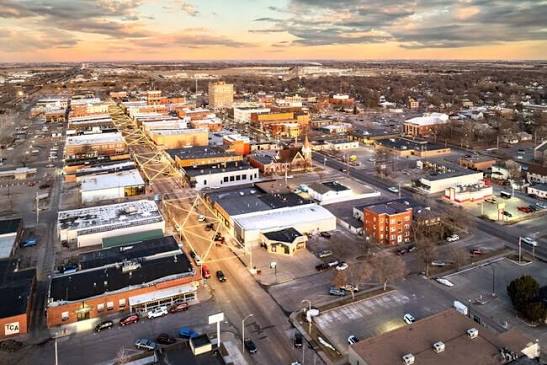
Grand Island anchors central Nebraska with manufacturing, processing, and regional healthcare
2026 Economic Outlook
- Manufacturing base spanning agricultural equipment, ammunition, and grain systems
- Food processing continuing to anchor a large shift-worker rental base
- City of Grand Island lowering its mill levy in consecutive years and holding city tax collections roughly flat since 2018
- Substantial parks and recreation investment approved, including the Island Oasis project
- Rents rising faster than prices in recent data, which is the opposite of the eastern metros and good for investors
Investment Climate
Here is the finding that matters most, and it is different from every other city in this series: in Grand Island, property type decides whether you make money, not neighborhood. A retail single-family purchase near the median rents for roughly $1,450 to $1,600 and runs $300 to $550 per month negative at 25% down. A renovated duplex at $220,000 all-in grossing $2,100 produces roughly $103 per month positive at a 5.9% cap rate. A fourplex at $360,000 all-in grossing $3,600 produces roughly $375 per month positive at a 6.7% cap.
The spread between property types is wider here than anywhere else in Nebraska. Successful Grand Island investors tend to share a few characteristics:
- Unit-count discipline because the same dollar buys far better returns in two to four units than in one
- Renovation capability since the affordable multi-family stock is old and most of it needs work
- Workforce tenant focus pricing units into the $950 to $1,300 band where demand is deepest
- Patience on acquisition because good small multi-family rarely lists and the market moves at 44 days rather than 8
- Realistic exit expectations since your resale buyer pool is smaller and slower than in Omaha or Lincoln
The slower pace is genuinely an advantage. In Omaha and Lincoln, homes go pending in roughly five to eight days and you are making decisions under pressure. Here you have time to run a sewer scope, get a real contractor bid, and walk away from a bad deal.
Historical Performance
| Period | Market Driver | Avg Annual Appreciation | Key Event |
|---|---|---|---|
| 2010-2014 | State Fair relocation, manufacturing stability | 2-3% | Nebraska State Fair moves to Fonner Park in 2010 |
| 2015-2019 | Steady manufacturing and processing employment | 3-5% | Quiet, low-volatility market with almost no investor competition |
| 2020-2022 | Low rates, buyers priced out of eastern metros | 8-13% | Out-of-area buyers discover central Nebraska pricing |
| 2023-2024 | Rate shock, but a strong rent cycle | 3-8% | Median rent rose sharply, improving yields for existing owners |
| 2025-2026 | Mixed, with sources in genuine disagreement | Flat to strongly positive | One source reported Grand Island leading Nebraska appreciation at 13.3%, another printed a slight decline over the same window |
Be careful with Grand Island price data. Reported medians range from roughly $212,000 to $282,000 depending on source and methodology, and appreciation figures for the most recent period range from slightly negative to 13.3 percent. Both cannot be right. That spread reflects a small transaction count where a handful of sales move the median, plus real differences between index estimates and closed sales. Price off closed comparable sales for the specific neighborhood and property type, and treat any citywide headline as a starting point.
Demand Drivers
- Manufacturing Base – Case IH builds Axial-Flow combines and hay and forage equipment here for global distribution. Hornady Manufacturing produces ammunition. Chief Industries spans grain storage systems, rail car products, ethanol, and modular construction.
- Food Processing – Large-scale meat processing and Darling Ingredients employ a substantial shift-working population that needs affordable housing close to work, year round.
- Regional Healthcare – CHI Health St. Francis serves a wide central Nebraska catchment, employing clinical staff and drawing traveling healthcare workers.
- Agricultural Services – Grand Island is the commercial center for a large farming region, supporting equipment dealers, input suppliers, transportation, and finance.
- Nebraska State Fair – Relocated to Fonner Park in 2010, adding seasonal lodging demand, event employment, and year-round facility use.
- I-80 and US 281 Corridors – The intersection of a transcontinental interstate and a major north-south highway supports logistics, trucking, and travel-related employment.
📚 New to real estate investing? Master the fundamentals with our professional course Learn more →
2. Neighborhood Hotspots
Grand Island Investment Neighborhood Map
Interactive map of Grand Island’s investment neighborhoods and the surrounding central Nebraska area. Green stars show top hotspots, blue circles mark established markets, and orange circles highlight emerging areas.
Core Investment Neighborhoods
Detailed Submarket Analysis: Grand Island and Central Nebraska
| Submarket | Price Range | Cap Rate | Growth Drivers | Best Strategy |
|---|---|---|---|---|
| Near Downtown / Third Street | $130K-$260K | 6.0-8.0% | Best multi-family stock, walkable core, lowest entry | Duplex and fourplex value-add, highest returns in the city |
| North Grand Island | $120K-$210K | 5.8-7.5% | Lowest entry price, dense workforce demand | Value-add workforce rental, long tenancies |
| Parkview / Central | $150K-$240K | 5.5-7.0% | Central location, mixed vintages, rental depth | Balanced hold, duplex where available |
| Fonner Park / State Fair Area | $145K-$245K | 5.5-7.0% | State Fair grounds, event and seasonal demand | Long-term hold with a seasonal mid-term angle |
| South Locust Corridor | $140K-$235K | 5.5-7.0% | Commercial spine, I-80 access, service employment | Workforce rental, small mixed-use |
| Northeast / Capital Heights | $165K-$255K | 5.2-6.5% | Mid-century stock, family demand, manageable condition | Family rental, lighter renovation scopes |
| Northwest Grand Island | $160K-$265K | 5.0-6.4% | Mixed vintages, minimal investor competition | Steady middle-market hold |
| West / Stolley Park | $175K-$285K | 4.8-6.0% | Case IH proximity, park amenity, family demand | Employment-adjacent family rental |
| Southwest Grand Island | $245K-$385K | 3.3-4.3% | Newer construction, strongest owner-occupant demand | Buy to live in, not to rent out |
| Copper Creek | $275K-$420K | 3.2-4.2% | Planned development, move-up buyers | Appreciation only, expect negative carry |
| Hastings | $155K-$245K | 6.8-8.5% | Two colleges, regional healthcare, manufacturing | Highest Tri-Cities yields, student and workforce mix |
| Kearney | $215K-$330K | 6.0-7.6% | UNK students, Buckle headquarters, I-80 corridor | Student rental, higher entry than Grand Island |
| Alda / Doniphan / Wood River | $125K-$230K | 5.5-7.5% | Commuter towns, low tax bills, small-town setting | Cash flow hold, but thin comps and slow resale |
Expert Insight: “Investors call about Grand Island and ask which neighborhood to buy in. Wrong question. The right question is how many doors. A single-family house here at two hundred fifty thousand renting for sixteen hundred is a losing deal in any neighborhood in this city. A duplex at two twenty renting for twenty one hundred works almost anywhere in the older core. The property type is the strategy in this market, and the good small multi-family almost never hits the MLS, so you have to know people.” – Regional investment advisor, central Nebraska
3. Property Types
| Investment Goal | Best Property Type | Best Areas | Minimum Capital |
|---|---|---|---|
| Maximum Cash Flow | Renovated fourplex | Near downtown, South Locust, North Grand Island | $120,000+ |
| Best Entry-Level Deal | Renovated duplex | Near downtown, Parkview, North Grand Island | $80,000+ |
| Equity Creation | Value-add single-family or duplex conversion | North Grand Island, older central blocks | $70,000+ |
| First Investment / House Hack | Owner-occupied duplex using FHA | Near downtown, Parkview, Northeast | $14,000+ |
| Lowest Management | Newer single-family, accepting negative carry | Southwest, Copper Creek, west side | $80,000+ |
Don’t guess the costs. Our Complete Renovation & Remodeling Cost Guide covers 400+ pages of project-by-project breakdowns with real contractor pricing ranges.
4. Cost Analysis
Acquisition Cost Breakdown (Grand Island)
| Expense Item | Typical Cost | Example ($195,000 Duplex) | Notes |
|---|---|---|---|
| Down Payment | 25% (investment) | $48,750 | The lowest entry requirement of any city in this Nebraska series |
| Closing Costs | 2-3% of price | $3,900-$5,850 | Title, lender fees, recording, Nebraska documentary stamp tax |
| General Inspection | $400-$700 | $600 | Multi-family inspections cost more. Worth every dollar on older stock. |
| Sewer Line Scope | $150-$300 | $225 | Essential. Nearly all affordable Grand Island stock predates 1970. |
| Radon Test | $150-$250 | $200 | Nebraska has among the highest radon levels nationally. Mitigation $1,200-$2,500. |
| Flood Determination | $0-$500 | $250 | Platte River proximity makes this essential on south and east parcels |
| Initial Repairs | 10-20% of price on older stock | $20,000-$40,000 | Higher percentage than metro markets, because the cheap stock is genuinely old |
| Reserves (6 months) | 6 months expenses | $7,000-$10,000 | Furnace and roof are the two most common capital events here |
| TOTAL MINIMUM ENTRY | ~42-55% of price | $80,825-$105,875 | A higher share of price than the metros, but a far smaller absolute number |
Sample Cash Flow Analysis: Near Downtown Value-Add Duplex
Purchase price $195,000. Renovation $25,000. All-in cost $220,000. Post-renovation appraised value $255,000. Both units leased to workforce tenants at $1,050. Modeled at 25% down with professional management.
| Item | Monthly | Annual | Notes |
|---|---|---|---|
| Unit A Rent | $1,050 | $12,600 | 2BR, renovated, priced into the deepest demand band |
| Unit B Rent | $1,050 | $12,600 | 2BR, renovated |
| Gross Income | $2,100 | $25,200 | |
| Less Vacancy (6%) | -$126 | -$1,512 | Conservative for a renovated core duplex with workforce demand |
| Property Taxes | -$355 | -$4,259 | 1.67% of the reassessed $255,000 value. Notably lighter than Sarpy or Douglas. |
| Insurance | -$165 | -$1,980 | Landlord policy. Central Nebraska hail exposure is real. |
| Property Management (9%) | -$189 | -$2,268 | Standard central Nebraska residential rate |
| Maintenance + CapEx (9%) | -$189 | -$2,268 | Older building, so budget honestly even after renovation |
| Net Operating Income | $1,076 | $12,913 | Before mortgage |
| Mortgage ($146,250 loan, 25% down on purchase price, 7.0%, 30yr) | -$973 | -$11,676 | Principal and interest only, renovation paid in cash |
| CASH FLOW | +$103 | +$1,237 | Positive, with a manager in place and conservative assumptions |
| Cap Rate | 5.87% | NOI divided by $220,000 all-in cost | |
| Cash-on-Cash Return | 1.41% | On $87,750 total cash invested including renovation and reserves | |
| Equity Created | $35,000 | $255,000 appraised value less $220,000 all-in cost |
Now compare that to the identical dollars in single-family. A $250,000 house in Grand Island rents for roughly $1,600, producing about $696 of monthly NOI against a $1,247 payment, which is $551 per month negative at a 3.34% cap rate. Same city, same tax rate, same tenant pool, same interest rate. The only variable that changed is the number of doors. That $654 monthly swing is the entire Grand Island investment thesis in one comparison.
Scale it up and it gets better. A fourplex at $330,000 plus $30,000 of renovation, grossing $3,600 from four units at $900, produces roughly $2,021 of monthly NOI against a $1,647 payment. That is about $375 per month positive at a 6.74% cap rate, on roughly $126,500 of invested capital. That is a genuinely workable return in 2026, and it is the reason serious Nebraska cash flow investors keep a search running in this city.
Expert Insight: “Grand Island’s property tax rate is about one sixty seven, which sounds high until you have underwritten a deal in Sarpy County at nearly two percent or Douglas at over two. On a two hundred fifty five thousand dollar duplex that difference is roughly a thousand dollars a year, and in a market where the whole cash flow is twelve hundred, a thousand dollars is the deal. Investors obsess over purchase price and ignore the levy. Out here the levy is half the reason the numbers work.” – Property tax consultant, central Nebraska
5. Legal Framework
⚠️ Critical Grand Island Compliance Notice
Nebraska is a landlord friendly state and Grand Island adds relatively little on top. The two items that actually bite here are zoning, since the multi-family strategy this guide recommends depends on it, and Platte River flood determination. Statutes and ordinances change. This guide is an overview only. Confirm current requirements with a Nebraska-licensed attorney and with the City of Grand Island before acquiring rental property, particularly if you intend to convert a property to additional units.
Nebraska and Grand Island Regulations
Residential tenancies in Grand Island are governed by the Nebraska Uniform Residential Landlord and Tenant Act, Nebraska Revised Statutes 76-1401 through 76-1449, plus the City of Grand Island municipal code:
- Zoning and Unit Count: The most important local issue for this market. Whether a parcel permits two, three, or four units determines whether the strategy in this guide is legal on that property. Confirm zoning and any existing legal nonconforming status in writing with the city before you close.
- No Statewide Registration: Nebraska has no statewide rental registration program, and Grand Island does not operate a citywide program equivalent to Omaha’s Ordinance 41767. The city does enforce property maintenance and building codes.
- No Rent Control: Nebraska has no statewide rent control and Grand Island has not adopted one. Nebraska Revised Statute 76-1490 requires at least sixty days written notice of a rent increase.
- No Just Cause Requirement: A landlord may decline to renew an expiring lease, and may terminate a month-to-month tenancy with at least 30 days written notice under Nebraska Revised Statute 76-1437(2).
- Security Deposits: Capped at one month’s rent, plus up to an additional one quarter month as a pet deposit. Return within 14 days with an itemized statement, or face liability of 1.5 times any amount wrongfully withheld.
- Nonpayment Notice: 3 day written notice to pay or vacate under Nebraska Revised Statute 76-1431(2). Lease violations generally get 14 days to cure with termination in 30.
- Landlord Entry: At least 24 hours notice for non-emergency entry under Nebraska Revised Statute 76-1423.
- Fair Housing and Language Access: Given Grand Island’s diverse tenant base, apply screening criteria uniformly and document consistently. Consider making lease documents available in the languages your applicant pool actually uses.
Compliance Best Practices
Grand Island compliance is light. The operational discipline is where the money is:
- Verify Zoning Before You Offer: Especially on any duplex conversion or on a property already operating with more units than the zoning obviously supports. Unpermitted conversions are common in older Nebraska housing stock and they become your problem at closing.
- Pull the Flood Determination: The Platte River runs along the south edge of the city. Flood status drives insurance cost, lender requirements, and resale liquidity simultaneously.
- Separate the Utilities Where You Can: Older Grand Island multi-family frequently has one meter and one furnace serving multiple units. Separating them improves your NOI permanently and makes the property far easier to sell.
- Photograph Everything: With the 1.5x deposit penalty, a dated photo set at every move-in and move-out is essential.
- Serve the 60 Day Rent Notice: Nebraska requires sixty days written notice of a rent increase, longer than many investors expect.
- Screen Consistently: Post objective written criteria and apply them identically to every applicant. This is good practice everywhere and it matters more in a diverse market.
- Protest the Assessment: Hall County assesses annually as of January 1. Protests go to the County Board of Equalization with appeal to the Nebraska Tax Equalization and Review Commission.
Useful Grand Island Resources
- City of Grand Island, for zoning, permits, code, and building questions
- Hall County Assessor and Hall County Treasurer
- Hall Regional Planning Commission, for zoning and development questions
- Nebraska Revised Statutes 76-1401 to 76-1449 (NURLTA)
- FEMA Flood Map Service Center, for parcel-level flood determination
- Nebraska Tax Equalization and Review Commission, for assessment appeals
| Regulation | Grand Island Situation | Nebraska State Law | Investor Impact |
|---|---|---|---|
| Zoning / Unit Count | Governs whether multi-family is permitted on a parcel | No statewide preemption | Decides whether the highest-return strategy here is available to you |
| Registration | No citywide program equivalent to Omaha’s | No statewide registration program | Lower compliance overhead and cost than Omaha or Lincoln |
| Eviction | No local just cause ordinance | 3 day notice for nonpayment, 14/30 for lease breach | Among the faster eviction processes in the country |
| Rent Increases | No cap, and rents have been rising faster than prices | At least 60 days written notice (76-1490) | Full pricing freedom in a market where yields are improving |
| Security Deposits | Follows state law | Max 1 month rent plus 1/4 month pet, return in 14 days | Tight window, and 1.5x penalty for getting it wrong |
| Property Tax | Median effective rate near 1.67% | State median near 1.39%, assessed at or near full market value | Meaningfully lighter than Omaha, Lincoln, or the Sarpy suburbs |
6. Step-by-Step Grand Island Investment Playbook
Define Your Grand Island Strategy
In this city the property type is the strategy. Pick which of these you are executing before you look at a single listing:
Small Multi-Family Cash Flow
Buy a duplex or fourplex in the older core, renovate to a durable workforce standard, and hold. This is the only strategy in this entire Nebraska series that reliably produces positive monthly cash flow with a manager in place at current interest rates.
Duplex Conversion
Buy a large older single-family home in the core at single-family pricing, convert it to two legal units, and exit at multi-family income. Highest return in the city when it works, and entirely dependent on zoning.
Value-Add Equity Creation
Buy tired single-family stock in North Grand Island well below the citywide median, renovate properly, and take your return as equity rather than yield. Frequently $25,000 to $45,000 created on a single well-executed project.
House Hack Entry
Buy an owner-occupied duplex using FHA financing at 3.5 percent down, live in one unit, and rent the other. Given Grand Island duplex pricing, this is one of the lowest-capital entries into real estate available anywhere in Nebraska.
Build Your Grand Island Team
Smaller market, thinner professional bench, and relationships matter more than anywhere else in this series. The best small multi-family here trades before it lists.
- Investor-Focused Local Agent: Someone who knows which older properties are legally multi-family and who hears about duplexes and fourplexes before they list. In a market with limited public inventory, this relationship is the whole game.
- Nebraska Real Estate Attorney: For entity structure, NURLTA-compliant leases, and zoning questions on any conversion project.
- General Contractor with Older-Home Experience: Knob-and-tube rewiring, galvanized repipes, sewer laterals, and utility separation are the four scopes that come up constantly here.
- Property Manager Who Handles Workforce Rentals: Ask how many doors they manage in the older core and what their average tenancy length is. Long tenancies are the point of this market.
- Real Estate CPA: For depreciation strategy and entity structuring across a portfolio of small multi-family.
- Insurance Agent: Central Nebraska hail exposure drives premiums, and multi-family pricing differs from single-family.
Expert Tip: Ask any prospective Grand Island agent one question: “When a duplex or fourplex comes available here, how do you usually hear about it?” An agent who works this market answers with names and relationships. An agent who says they watch the MLS is telling you they will never bring you a deal worth buying, because the good small multi-family in this city changes hands quietly.
Grand Island-Specific Due Diligence
Standard due diligence plus the items that specifically bite in this market:
Physical Due Diligence
- Sewer lateral scope on every property, since nearly all affordable stock predates 1970
- Radon test, given Nebraska’s high radon zone status
- Utility metering, specifically whether units are separately metered for gas, electric, and water
- Heating configuration, since one furnace serving multiple units is common and expensive to fix
- Electrical service capacity and knob-and-tube presence in pre-1950 buildings
- Roof condition and hail claim history, which drives Nebraska insurance pricing
- Egress windows in every bedroom, particularly basement units in older multi-family
Regulatory and Financial Due Diligence
- Confirm zoning and permitted unit count in writing with the city, before waiving contingencies
- Verify any existing multi-unit use is legal, not an unpermitted conversion
- Pull a FEMA flood determination, especially on south and east parcels near the Platte
- Run the Hall County tax estimator on the specific parcel and model the post-renovation reassessment
- Review existing leases, rent rolls, and deposit ledgers, and confirm deposits transfer at closing
- Verify actual rents against bank deposits rather than a seller’s stated rent roll
- Price off closed comparable sales, since citywide medians range from $212K to $282K by source
Acquire, Lease, and Operate
Grand Island moves at roughly 44 days on market rather than the five to eight days you face in Lincoln and Omaha. That pace is a genuine advantage for a careful buyer. Use it.
Winning Offers in Grand Island
- Source off-market. The best duplexes and fourplexes here rarely list. Build the agent relationship, mail long-term owners, and be the person they call first.
- Use the slower pace. Run a real inspection, get a genuine contractor bid, and verify zoning before you commit. You have time here that you do not have in the metros.
- Verify rents against deposits. On any occupied multi-family, ask for bank statements rather than accepting a stated rent roll. Below-market legacy rents are common and they are also an opportunity.
- Underwrite utility separation. If units share meters, price the separation into your renovation. It permanently improves NOI and resale.
- Never skip the zoning confirmation. Everything in this guide’s recommended strategy depends on unit count being legal.
First 30 Days After Closing
- Bind landlord insurance, confirming hail and water backup coverage explicitly
- Photograph every unit, dated, before any new tenant takes possession
- Review inherited leases and serve the sixty day notice on any below-market rent you intend to raise
- Order the sewer and utility work identified in inspection before it becomes an occupied-unit problem
- Set rents into the $950 to $1,300 band where Grand Island demand is deepest, and document your comps
Typical Grand Island Management Fees
- Single-family management: 8-10% of monthly rent
- Small multi-family management: 7-9% of monthly rent
- Leasing fee: 50-100% of one month’s rent
- Lease renewal fee: $150-$250 per renewal
- Note the thinner management bench here than in Omaha or Lincoln, so vet carefully
7. Financing Options for Grand Island
| Loan Type | Down Payment | Rate Premium | Best For | Grand Island Note |
|---|---|---|---|---|
| Conventional Investment | 20-25% | +0.5-0.75% | W-2 income, good credit, 1-4 unit purchases | $48,750 down on a $195,000 duplex. The lowest entry in this series. |
| House Hacking (FHA) | 3.5% | Standard + MIP | Owner-occupying one unit of a 2-4 unit property | Roughly $7,000 down on a $195,000 duplex. Exceptional entry point. |
| Local Portfolio Loan | 20-30% | +0.75-1.75% | Multiple properties, self-employed, blanket loans | Central Nebraska community banks know this market and lend on it readily |
| DSCR Loan | 20-25% | +1.0-2.0% | Investors avoiding income verification | Genuinely workable here on multi-family, unlike Papillion or Bellevue. Duplex coverage runs above 1.1x. |
| 203(k) / Renovation Loan | 3.5-25% | +0.25-1.0% | Buying and renovating in one loan | Excellent fit here, since nearly everything worth buying needs work |
| Commercial / Small Balance | 25-30% | +1-2% | Five or more units | Above four units you lose residential financing. Stay at four where you can. |
| Hard Money (Bridge) | 15-25% | 10-13% rate | Distressed acquisitions and conversion projects | Fewer active lenders out here than in the metros. Line up your source in advance. |
Grand Island Financing Reality: This is the one Nebraska market in this series where a DSCR loan genuinely works. The sample duplex produces roughly $1,076 of monthly NOI against a $973 payment, a coverage ratio near 1.11x, which clears the 1.0x threshold most programs require. Compare that to Papillion at roughly 0.66x and Bellevue where retail deals routinely fail the test. The reason is the combination of a low purchase price, a 1.67% tax rate rather than a 2% one, and multiple units per building. Note the flip side: on single-family here, DSCR fails just as badly as it does in the metros, because a $250,000 house renting for $1,600 produces about 0.56x coverage. Same city, same lender, opposite answer, decided entirely by unit count.
8. Frequently Asked Questions

Knowledge Quiz: Grand Island Real Estate Investment
Open Quiz
5 quick questions on what you just learned about Grand Island investing
1) What determines whether a Grand Island deal produces positive cash flow?
Answer: C
A $250,000 single-family house renting at $1,600 runs roughly $551 per month negative at a 3.34% cap. A duplex at $220,000 all-in grossing $2,100 runs about $103 positive at a 5.87% cap. Same city, same tax rate, same tenant pool. Only the door count changed.
2) How does Grand Island’s effective property tax rate compare to Omaha’s?
Answer: B
Grand Island’s median effective rate is reported near 1.67%, against roughly 2.11% in Omaha, 1.97% in Papillion, and 1.38% in Lincoln. On a $255,000 property that gap versus Omaha is worth over $1,100 a year, which on a deal netting $1,237 annually is close to the entire cash flow.
3) Why is Grand Island one of the few Nebraska markets where a DSCR loan works?
Answer: A
The sample duplex produces about $1,076 of monthly NOI against a $973 payment, roughly 1.11x coverage. Compare that to Papillion near 0.66x. Note the flip side though: a Grand Island single-family at $250,000 renting for $1,600 produces about 0.56x and fails just as badly.
4) What is the main practical constraint on the small multi-family strategy in Grand Island?
Answer: D
The strategy works but the inventory is thin and much of it trades off-market. Build an agent relationship, mail long-term owners from assessor records, watch estate activity, consider a zoning-permitted duplex conversion, and widen your search to Hastings and Kearney. Expect months rather than weeks.
5) What should you verify in writing before buying any multi-unit property in Grand Island?
Answer: B
Everything in the recommended Grand Island strategy depends on unit count being legal. Unpermitted conversions are common in older Nebraska housing stock and they become your problem at closing. Confirm zoning and any legal nonconforming status with the city in writing before waiving contingencies.
Work With a Local Expert in Grand Island
We are building a verified network of real estate professionals across every market we cover.

About Our Expert Network
We are finalizing partnerships with verified real estate professionals across every market featured on Builds and Buys. Each expert in our network is selected for their hands-on investment experience, local market knowledge, and commitment to helping buyers and investors make sound decisions.
Our local specialists offer:
- Proven experience with investment and income-producing properties
- Deep knowledge of local pricing, rental yields, and neighborhood dynamics
- Guidance on financing, legal structure, and due diligence
- Access to off-market and pre-market opportunities
- Full transaction support from search through closing
- Ongoing portfolio and property management referrals
Services Covered
- Property sourcing and acquisition
- Investment analysis and underwriting
- Buyer representation
- Market comparables and valuations
- Short-term and long-term rental strategy
- Value-add and renovation guidance
- Legal and title referrals
- Financing and lender connections
- Property management referrals
- Insurance and inspection referrals
- 1031 exchange coordination
- Exit strategy planning
Get Connected or Join Our Network
Looking for a local expert to help with your investment? Reach out and we will connect you with the right professional for your market and strategy.
Are you a real estate professional with a track record working with investors? We are always expanding our network of verified local experts.
Contact us at support@buildsandbuys.com
Find Specialized Grand Island Real Estate Professionals
Ready to Invest in Grand Island?
Grand Island is the first market in our Nebraska series where a leveraged purchase produces positive monthly cash flow with a manager in place, and the reason is unit count. A duplex here clears. A fourplex clears comfortably. A single-family house at retail does not, in any neighborhood, at any price point in this city. Combine a low entry price, a 1.67 percent property tax rate rather than a 2 percent one, a diversified manufacturing and processing employment base, and a workforce tenant population that stays for years, and you have the best cash flow opportunity in eastern and central Nebraska. The constraint is inventory. The good small multi-family here rarely lists, so build the relationships first and expect the search to take months.
Continue Your Research
Nebraska State Guide
See how Grand Island compares to Omaha, Lincoln, Hastings, and other Nebraska markets.
Hastings City Guide
Twenty five minutes south, with two colleges and the highest yields in the Tri-Cities.
144-Lesson Course
University-level real estate education covering financing, law, strategy, and management.
For further guidance, explore our State-by-State Investor guides, browse our expert articles, or follow our Step-by-Step Investment Guide.



