
Victorville and Apple Valley Real Estate Investment Guide For 2026
A comprehensive resource for investors targeting California’s High Desert — where Southern California logistics expansion, affordability-driven population growth, and the I-15 corridor’s strategic position create some of the strongest cash-flow metrics available anywhere within 90 miles of Los Angeles in 2026
Quick answers: Top 5 most searched Victorville/Apple Valley investment questions ▼
Migration data: Where people are moving from to the High Desert ▼
In This Guide
Click on any section to navigate directly to that content
1. Victorville and Apple Valley Market Overview
Market Fundamentals
The Victor Valley — anchored by Victorville, Apple Valley, and Hesperia — is California’s High Desert investment story. Situated 90 miles northeast of Los Angeles on the I-15 corridor connecting Southern California to Las Vegas, the region has transformed from a retirement and commuter market into a logistics and distribution powerhouse. Southern California Logistics Airport (SCLA) hosts 15,000+ jobs. Amazon, FedEx, Walmart, and dozens of other national distributors have planted permanent operations here.
Key economic indicators:
- Population: ~135,000 Victorville; ~78,000 Apple Valley; ~400,000+ combined Victor Valley
- Major Employers: SCLA logistics park (15,000+ jobs), Amazon, FedEx, Walmart, Stater Bros., Victor Valley Global Medical Center, Fort Irwin (NTC)
- Median Household Income: ~$58,000 Victorville; ~$68,000 Apple Valley
- Job Growth: 2.8% annually, led by logistics, healthcare, and retail
- Commuter Market: Significant LA Basin commuter population willing to trade commute for affordability
- Vacancy Rate: Under 5% for well-managed properties in desirable corridors
The Victor Valley’s fundamental investment case rests on California’s housing affordability crisis acting as a permanent tailwind. As long as LA Basin and Inland Empire home prices remain dramatically higher than the High Desert, households will continue migrating north on the I-15. That migration fills rentals, supports home prices, and creates the population density that attracts more retail and employment — a self-reinforcing growth cycle that has run continuously for 20+ years.
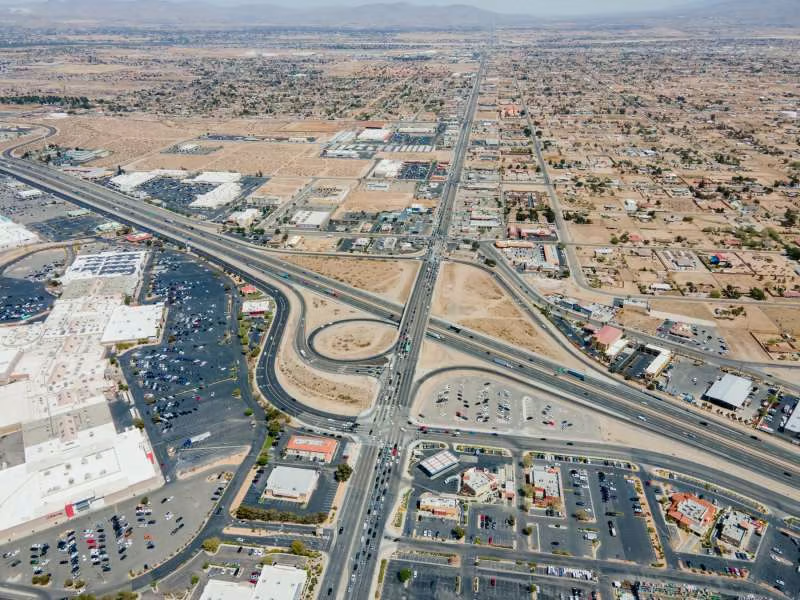
The Victor Valley — California’s High Desert logistics hub, 90 miles from Los Angeles on the I-15
2026 Economic Outlook
- SCLA logistics park Phase 3 expansion adding 3,000+ new jobs
- Victor Valley Global Medical Center expansion increasing healthcare workforce
- Brightline West high-speed rail terminal in Las Vegas strengthening I-15 corridor strategic value
- Apple Valley Town infrastructure improvements attracting higher-income residents
- Continued Inland Empire affordability pressure pushing families further into High Desert
- Solar and battery storage industry adding green-energy employment in desert region
Investment Climate: Victorville vs. Apple Valley
The two markets serve distinct investor profiles. Understanding the difference is essential before purchasing:
Victorville
Higher yield, higher management intensity. Central and south Victorville have elevated crime statistics requiring careful neighborhood selection. North Victorville near SCLA and Spring Valley Lake are meaningfully safer. Best for active investors comfortable with workforce housing management. Cap rates 6–8%.
- Strong cash flow in the right corridors
- Larger, more diverse employment base
- Value-add opportunities more plentiful
- Higher management intensity required
Apple Valley
Lower yield, lower management intensity. Apple Valley consistently ranks as one of the safer High Desert communities. Tenant pool is predominantly working families, tradespeople, and commuters. More passive-investor friendly. Cap rates 5–6.5%.
- Better tenant quality and retention
- Lower vacancy and management complexity
- Slightly higher entry prices
- Better long-term appreciation trajectory
Historical Performance
| Period | Market Driver | Avg Annual Appreciation | Key Event |
|---|---|---|---|
| 2010–2015 | Post-foreclosure recovery, SCLA early growth | 5–8% | High Desert rebounded sharply after deep 2008 crash; investors entered heavily |
| 2016–2019 | Inland Empire overflow, logistics expansion | 6–9% | Amazon and major distributors announce High Desert facilities; employment surges |
| 2020–2022 | Pandemic affordability migration, e-commerce logistics boom | 16–24% | Median prices surge from ~$280K to ~$420K; logistics hiring at record pace |
| 2023–2024 | Rate normalization, market stabilization | 2–5% | Prices hold despite rate headwinds; rental demand remains tight |
| 2025–2026 | Rate stabilization, SCLA Phase 3, Brightline corridor | 5–7% (projected) | New logistics jobs + Brightline West strengthening I-15 strategic value |
Demographic Trends Driving Demand
- Southern California Housing Crisis Overflow — As Riverside and San Bernardino County home prices have risen above $500,000, the High Desert’s $380,000–$450,000 range represents the last affordable option within reach of Southern California employment
- E-Commerce Logistics Growth — SCLA’s location at the intersection of I-15 and Highway 18 makes it ideal for last-mile and regional distribution; the facility has expanded every year for the last decade and shows no sign of slowing
- Military and Government — Fort Irwin National Training Center north of Barstow generates military families who prefer Apple Valley and north Victorville for family housing; San Bernardino County government employment is also a stable baseline employer
- Healthcare Expansion — Victor Valley Global Medical Center and Desert Valley Medical Center are expanding, creating stable mid-income healthcare employment in a market that previously lacked it
- Brightline West Effect — The Las Vegas high-speed rail terminal, when operational, will increase the I-15 corridor’s strategic and economic importance; proximity to the Victorville staging area adds to the region’s long-term logistics appeal
- Remote Worker Secondary Market — A growing segment of remote workers choosing High Desert for affordability with I-15 commute access on an as-needed basis
📚 New to real estate investing? Master the fundamentals with our professional course Learn more →
2. Neighborhood Hotspots
Victorville and Apple Valley Investment Map
Interactive map of Victor Valley investment neighborhoods. Green stars show top hotspots, blue circles mark established markets, and orange circles highlight emerging areas.
Core Investment Neighborhoods
Detailed Submarket Analysis
| Neighborhood | Price Range | Cap Rate | Growth Drivers | Best Strategy |
|---|---|---|---|---|
| Apple Valley — Central | $420K–$580K | 5.0–6.2% | Family demand, safety, schools, military | Buy-and-hold, passive investors |
| North Victorville / SCLA | $370K–$500K | 6.0–7.5% | Logistics employment, newer construction | Cash flow focus, workforce housing |
| Spring Valley Lake | $450K–$700K | 4.8–5.8% | Premium community, lake, upscale tenants | Premium buy-and-hold, appreciation |
| Central Victorville / Civic | $320K–$450K | 6.5–8.0% | College, healthcare, workforce housing | High cash flow, active management required |
| Hesperia | $380K–$520K | 5.5–6.8% | I-15 access, family demand, affordability | Balanced buy-and-hold |
| Apple Valley — Jess Ranch | $400K–$550K | 4.8–5.8% | Active adult/family, HOA community | Stable long-term hold |
| Adelanto | $300K–$420K | 6.0–8.0% | Lowest entry, industrial growth, new development | High yield, highest risk, active management |
Expert Insight: “The single most important decision a High Desert investor makes is which side of the Bear Valley Road dividing line they buy on. North of Bear Valley — meaning Apple Valley, Spring Valley Lake, and the SCLA corridor — you are in a fundamentally different market than south or central Victorville. The tenant quality, vacancy rates, and management demands are night and day. Investors who treat the entire Victor Valley as one market frequently buy in the wrong submarket and then blame the High Desert for their results when the issue was really location selection.” — Robert Chen, Broker, Victor Valley Investment Properties
3. Property Types
| Investment Goal | Best Property Type | Best Neighborhoods | Minimum Capital |
|---|---|---|---|
| Maximum Cash Flow | Small multifamily or SFH+ADU | Central Victorville, Adelanto, Hesperia | $100,000+ |
| Best Risk-Adjusted | SFH in Apple Valley or SCLA corridor | Apple Valley, North Victorville | $120,000+ |
| Best for Passive Investors | New construction SFH or Apple Valley SFH | Apple Valley, Spring Valley Lake | $125,000+ |
| Best Value-Add | Dated SFH needing renovation | Central Victorville, Hesperia | $85,000+ |
Don’t guess the costs. Our Complete Renovation & Remodeling Cost Guide covers 400+ pages of project-by-project breakdowns with real contractor pricing ranges.
4. Cost Analysis
Acquisition Cost Breakdown (Victor Valley)
| Expense Item | Typical Cost | Example ($420,000 Property) | Notes |
|---|---|---|---|
| Down Payment | 25% | $105,000 | Standard investment property; FHA/VA options for owner-occupants |
| Closing Costs | 2–3% | $8,400–$12,600 | Title, escrow, lender fees; all under conforming loan limit |
| Home Inspection | $350–$550 | $450 | Include HVAC inspection separately — desert climate is hard on systems |
| Pest / Termite | $100–$250 | $175 | Less critical in dry desert climate but still recommended |
| Initial Renovation | 0–8% of price | $0–$33,600 | Many older High Desert homes need flooring, paint, HVAC refresh |
| Reserves | $8,000–$15,000 | $10,000 | Lower than coastal markets; HVAC and roof are the primary capital risks |
| TOTAL MINIMUM ENTRY | ~30–38% of value | $124,025–$176,825 | One of California’s most accessible investment entry points |
Sample Cash Flow Analysis: Apple Valley 3-Bedroom SFH
| Item | Monthly | Annual | Notes |
|---|---|---|---|
| Gross Rent | $2,350 | $28,200 | 3BR Apple Valley central, renovated, family tenant |
| Less Vacancy (5%) | -$118 | -$1,410 | Apple Valley has lower vacancy than central Victorville |
| Property Taxes | -$368 | -$4,410 | ~1.05% of $420K purchase price |
| Insurance | -$120 | -$1,440 | Landlord policy; High Desert fire risk affects some zones |
| Property Management (9%) | -$212 | -$2,538 | Recommended; many capable PM firms serve the Victor Valley |
| Maintenance + CapEx (8%) | -$188 | -$2,256 | Desert climate is hard on HVAC; budget carefully for replacement |
| Net Operating Income | $1,344 | $16,146 | Before mortgage debt service |
| Mortgage ($420K, 25% down, 6.5%, 30yr) | -$1,996 | -$23,952 | $315K loan at 6.5% |
| NET CASH FLOW | -$652 | -$7,806 | Modest negative; improves significantly with ADU or rate improvement |
| Cap Rate | 3.84% | NOI / Purchase Price | |
| With ADU ($160K, $1,400/mo) | +$518 | +$6,216 | ADU turns property cash-flow positive; total investment $580K |
| Total Return (6% appreciation) | ~20% | Including equity, appreciation, principal paydown |
North Victorville / SCLA Scenario: The same analysis for a $390,000 property in the SCLA corridor at $2,100/month rent produces approximately -$350/month negative carry — nearly breakeven — with a cap rate of approximately 4.2% and the same ADU potential to flip it cash-flow positive. For investors targeting maximum cash flow, central Victorville multifamily at $500,000 with two 2BR units at $1,700 each generates approximately +$400–$600/month positive cash flow.
Expert Insight: “The High Desert is one of the few places in California where you can still buy a well-located, well-maintained single-family home under $450,000, rent it for $2,200–$2,400/month, and get close to breakeven cash flow from day one. With an ADU — which costs about $160,000 to build here vs. $250,000 in the IE — you tip into positive cash flow territory while adding $250,000–$350,000 in value. The numbers work here in a way they simply don’t in the San Bernardino Valley or anywhere closer to the coast.” — Angela Torres, Property Manager, High Desert Rental Group
5. Legal Framework
⚠️ California Landlord-Tenant Law Notice
California’s tenant protection laws apply throughout San Bernardino County, including Victorville and Apple Valley. The Tenant Protection Act of 2019 (AB 1482) imposes rent caps and just cause eviction requirements on many properties. San Bernardino County does not have additional local rent control beyond state law, which is an advantage compared to some California cities. Always consult a California-licensed real estate attorney before acquiring rental properties.
California AB 1482 in the High Desert
- Rent Caps: For covered properties, annual rent increases are capped at 5% plus local CPI, or 10% total — whichever is lower. Applies to most residential buildings built before 2010 (15-year rolling exemption).
- Just Cause Eviction: For tenants who have resided 12+ months in qualifying units, landlords must establish documented just cause for eviction. Acceptable causes include non-payment of rent, material lease violations, criminal activity, owner/family move-in, substantial renovation, or demolition.
- SFH Exemption: Individual-owned (not corporate-owned) single-family homes and condos are exempt from AB 1482 rent caps if the landlord provides the required written exemption notice at lease signing and each renewal. This exemption is critical to protect in the High Desert where value-add investors frequently reposition rents after renovation.
- New Construction Exemption: Properties built within the last 15 years are exempt. Many newer developments in North Victorville and Apple Valley fall under this exemption.
- No Additional Local Ordinances: Victorville, Apple Valley, and Hesperia do not have city-level rent control or just cause requirements beyond AB 1482 — a meaningful advantage over many California markets.
High Desert-Specific Considerations
- Section 8 Compliance: California law (SB 329) prohibits refusing tenants based on source of income including Section 8 vouchers. San Bernardino County Housing Authority administers vouchers; understand current payment standards for Victor Valley zip codes before acquiring properties where Section 8 is part of your strategy.
- Mold and Desert HVAC: The extreme temperature variation in the High Desert (110°F summers, occasional freezes) means HVAC systems fail frequently. California Civil Code requires habitable temperatures — a failed AC in July is an emergency repair obligation. Budget for HVAC as a capital expense, not just maintenance.
- AB 12 Security Deposits: California AB 12 (effective 2024) limits security deposits to one month’s rent. Careful upfront screening is more important than ever given reduced deposit protection.
- Landscaping and Exterior: San Bernardino County has water conservation requirements. Desert landscaping (xeriscaping) is both code-compliant and reduces tenant maintenance issues.
- ADU Permitting: Both Victorville and Apple Valley follow California state ADU streamlining law. Permit timelines are typically 2–5 months — faster than coastal markets — and fees are lower.
Key Resources
- City of Victorville: victorvilleca.gov
- Apple Valley Town: applevalley.org
- SB County Housing Authority: haca.net
- California Apartment Association: caanet.org
| Regulation | Requirement | Investor Impact | Strategy Response |
|---|---|---|---|
| AB 1482 Rent Cap | 5%+CPI / 10% max for covered units | Limits rent increases on older multifamily | Target SFH with exemption notices; buy new construction exempt buildings |
| Just Cause Eviction | Required after 12 months of tenancy | Cannot remove long-tenured tenants without cause | Rigorous upfront screening; document all violations from move-in |
| SFH Exemption | Must serve written notice at each lease signing | Protects value-add rent repositioning | Always serve AB 1482 exemption notice; use proper California lease addendum |
| Section 8 Acceptance | Cannot refuse vouchers (SB 329) | Expands applicant pool; government-backed income | Section 8 can be a positive strategy in central Victorville; know payment standards |
| AB 12 Security Deposits | Max 1 month rent (effective 2024) | Less financial cushion against damage | More critical than ever to screen tenants rigorously upfront |
| HVAC Habitability | Working AC/heat required by Civil Code | Emergency repair obligation in 110°F summers | Replace aging HVAC systems proactively; maintain service contracts |
6. Step-by-Step Victor Valley Investment Playbook
Choose Your Victor Valley Strategy
Apple Valley / Premium Passive
Buy quality SFH in Apple Valley or Spring Valley Lake. Target family tenants, tradespeople, and commuters. Use professional management. Accept 5–6% cap rates in exchange for lower management intensity and more reliable cash flow.
SCLA Logistics Workforce
Buy SFH within 10 minutes of SCLA in north Victorville. Target Amazon, FedEx, and Walmart employees earning $50,000–$80,000. Better yields than Apple Valley with manageable risk profile in improved north corridor.
Value-Add BRRRR
Acquire dated or distressed properties in Hesperia or north Victorville. Renovate to modern standard. Force equity via improved rents and condition. Refinance, repeat. Renovation cost advantage vs. coastal California is significant.
ADU Cash Flow Optimizer
Buy SFH in Apple Valley or North Victorville. Construct detached ADU. Turn near-breakeven property cash-flow positive. ADU build costs of $130,000–$180,000 here vs. $200,000–$280,000 in the Inland Empire make the math significantly more attractive.
Neighborhood Selection Is Everything
The most important single decision in the High Desert. A simplified framework:
- Use crime mapping before every purchase. NeighborhoodScout, SpotCrime, and San Bernardino County crime data allow street-level crime analysis. The difference between a block in north Victorville and a block in south Victorville can be dramatic even at similar price points.
- Check walkability to employment. Properties within 5 miles of SCLA, Victor Valley Global Medical Center, or Victor Valley College have structurally lower vacancy risk than properties in isolated residential pockets far from employment.
- Drive the neighborhood at different times. Daytime and weekend evenings reveal very different pictures of a neighborhood’s character. Do this before making an offer, not after.
- Evaluate school ratings. Apple Valley and north Victorville have meaningfully better school ratings than central and south Victorville. Families with children will not rent in neighborhoods they perceive as having poor schools, even at discounted rents.
- Proximity to I-15 is a positive. High Desert commuters use I-15 daily; properties within reasonable drive time to on-ramps capture the commuter rental demographic effectively.
Build Your High Desert Team
- Investor-Focused Real Estate Agent: Must know the neighborhood distinctions within the Victor Valley — not all High Desert agents do. Ask specifically about their experience with investment properties in both Victorville and Apple Valley.
- Property Management Company: Critical for out-of-area investors. The High Desert has experienced PM firms familiar with the local tenant pool, including Section 8 administration, military tenant protocols, and California AB 1482 compliance. Verify they have a local physical presence, not a remote call center.
- Desert-Experienced Contractor: HVAC replacement, stucco repair, swamp cooler vs. AC conversion, and desert landscaping all have local specifics. Use a contractor with direct High Desert experience.
- California Real Estate Attorney: For AB 1482 exemption notices, lease compliance, and any eviction proceedings through San Bernardino County Superior Court.
- Local CPA: For Prop 13 implications, depreciation schedules, and California-specific rental income treatment.
High Desert Due Diligence Checklist
Physical Due Diligence
- HVAC age and condition — replacement is $6,000–$14,000; desert climate demands quality systems
- Roof condition — flat and low-slope roofs common in desert construction; solar potential
- Foundation and soil movement — desert soil expansion can cause cracking
- Window quality — single-pane windows in older homes waste energy and affect tenant comfort
- Evaporative cooler vs. central AC — verify type and condition
- Water heater age — high desert water is mineral-rich; heaters fail sooner
Market and Regulatory
- Pull actual neighborhood crime data — not just general area stats
- Verify AB 1482 status and whether SFH exemption notices are required
- Check for any outstanding code violations with the city
- Confirm ADU eligibility and lot size for ADU plans
- Review current tenant lease terms and rental history if tenant-occupied
- Verify fire hazard zone status for areas east of the Cajon corridor
7. Financing Options for Victorville and Apple Valley
| Loan Type | Down Payment | Rate Premium | Best For | Victor Valley Note |
|---|---|---|---|---|
| Conventional Investment | 25% | +0.5–0.75% | Strong income, good credit | All High Desert properties are under conforming limit — no jumbo required |
| DSCR Loan | 25–30% | +1.5–2.5% | Self-employed, no income verification | Unlike coastal CA, many High Desert SFH and multifamily CAN qualify at 1.0x+ DSCR — game changer for investors |
| FHA (House Hacking) | 3.5% | Standard + MIP | First-time investors, owner-occupants | Excellent entry — 3.5% down on a $400K duplex in Victorville is ~$14,000 out of pocket |
| VA Loan | 0% | Below market | Veterans; Fort Irwin community | Fort Irwin veterans can use VA financing to house-hack a 2–4 unit near the base |
| Hard Money (Bridge) | 20–30% | 8–12% | BRRRR acquisitions, value-add | Active market of SB County hard money lenders; common for fix-and-rent investors |
| Portfolio Loan | 20–25% | +1–2% | Multiple properties, complex income | Pacific Premier, First Bank, and community SB County lenders offer portfolio products |
High Desert Financing Advantage — DSCR: One of the most significant differences between the High Desert and coastal California is that DSCR loans actually work here. With conventional financing at 6.5% on a $420,000 property generating $2,350/month rent, the debt service coverage ratio sits at approximately 0.85x — below the 1.0x threshold most DSCR lenders require. But for a $390,000 North Victorville property at $2,100/month, the ratio climbs above 1.0x — qualifying territory. For multifamily and well-yielding SFH, DSCR financing eliminates income documentation requirements entirely, opening the market to a far wider pool of investors than most California coastal markets allow.
8. Frequently Asked Questions

Knowledge Quiz: Victorville and Apple Valley Investment
Open Quiz
5 quick questions on what you just learned about Victor Valley investing
1) What is the largest single employer in the Victor Valley driving rental demand?
Answer: B
SCLA’s logistics park employs 15,000+ workers across Amazon, FedEx, Walmart, and dozens of other distributors. It is the economic engine that has transformed the Victor Valley from a retirement and commuter market into a logistics powerhouse, and it creates the workforce housing demand that underpins the investment thesis for the SCLA corridor.
2) Which Victor Valley submarket does the guide recommend for passive or out-of-state investors?
Answer: A
Apple Valley is consistently identified as the right choice for passive investors — safer community, working-family tenants, lower vacancy, and less demanding day-to-day management. Central Victorville and Adelanto offer higher cash-flow yields but require active, experienced management that is not suited to hands-off investors.
3) What is the key DSCR financing advantage that the High Desert has over coastal California markets?
Answer: C
The guide explains that coastal California properties typically cannot qualify for DSCR loans because low cap rates mean rental income falls well below debt service requirements (below 1.0x DSCR). High Desert properties — with lower purchase prices and competitive rents — can reach 1.0x+ DSCR, opening access to no-income-documentation financing that dramatically expands the investor pool.
4) What is the most critical maintenance budget item unique to High Desert investment properties?
Answer: D
HVAC is the single largest capital risk in High Desert investment properties. Temperatures exceeding 110°F in summer stress air conditioning systems severely, reducing their lifespan to 10–14 years (vs. 15–20 years in milder climates). California Civil Code requires habitable temperatures, making a failed AC unit in July an emergency repair obligation. The guide recommends proactive replacement of aging systems and mandatory annual service contracts.
5) What does the guide say about crime in Victorville and how investors should approach it?
Answer: B
The guide is explicit: Victorville’s crime statistics are heavily weighted by concentrated high-crime zones in central and south Victorville. North Victorville near SCLA, Spring Valley Lake, and Apple Valley have significantly different — and much lower — crime profiles than the most-cited statistics suggest. Street-level crime research (NeighborhoodScout, SpotCrime) at the specific block level is mandatory before any Victorville purchase.
Work With a Local Expert in the Victor Valley
We are building a verified network of real estate professionals across every market we cover.

About Our Expert Network
We are finalizing partnerships with verified real estate professionals across every market on Builds and Buys. Each expert is selected for hands-on investment experience, local market knowledge, and commitment to helping investors make sound decisions.
- Experience with investment properties across Victorville, Apple Valley, and Hesperia
- Knowledge of crime mapping, neighborhood selection, and High Desert tenant dynamics
- Guidance on AB 1482 compliance and SFH exemption notices
- Access to off-market and value-add opportunities
- Section 8 and military tenant strategy expertise
- ADU permitting and development guidance
Services Covered
- Property sourcing and acquisition
- Investment analysis and underwriting
- Buyer representation
- Neighborhood selection guidance
- Value-add renovation guidance
- Section 8 program navigation
- Legal and title referrals
- Property management referrals
- Insurance referrals
- Contractor referrals
- ADU permitting guidance
- Exit strategy planning
Get Connected or Join Our Network
Looking for a local expert for your High Desert investment? We will connect you with the right professional for your market and strategy.
Contact us at support@buildsandbuys.com
Find Specialized Victor Valley Real Estate Professionals
Ready to Invest in the Victor Valley?
The Victor Valley is not glamorous. It is not a wine-country lifestyle market or a beach town. It is a working California community where 400,000+ people live, earn, and rent — and where the structural forces of California’s housing crisis, logistics expansion, and population growth create durable rental demand year after year. For investors who choose the right neighborhoods, manage their properties actively, and understand the local dynamics, the High Desert delivers cash-flow returns that are genuinely difficult to replicate anywhere else within 90 miles of Los Angeles.
Continue Your Research
For further guidance, explore our State-by-State Investor guides, browse our expert articles, or follow our Step-by-Step Investment Guide.



