
Post Falls Real Estate Investment Guide For 2026
A comprehensive resource for investors targeting Kootenai County’s fastest-growing industrial and residential city, positioned between Spokane’s employment base and Coeur d’Alene’s premium market at a fraction of the cost
Quick answers: Top 5 most searched Post Falls investment questions ▼
Migration data: Where people are moving from to Post Falls ▼
In This Guide
Click on any section to navigate directly to that content
1. Post Falls Market Overview
Market Fundamentals
Post Falls sits at one of the most strategically positioned locations in North Idaho: directly on I-90, 20 miles west of Coeur d’Alene and 20 miles east of downtown Spokane, where the Spokane River cuts through Kootenai County before crossing the Washington state line. With a population exceeding 42,000 and growing at 4.5% annually, Post Falls is Kootenai County’s fastest-growing city and one of the most active residential construction markets in the Inland Northwest.
Key economic indicators defining Post Falls’s investment case:
- Population: 42,000+ and growing 4.5% annually
- Major Employers: Packaging Corporation of America (800+ jobs), Hecla Mining HQ, Zip-O-Log Mills, Hayden Beverage, Northwest Specialty Hospital, Post Falls School District, Riverbend Commerce Park industrial tenants
- Median Household Income: $68,000+ (growing 3.8% annually)
- Spokane Commute: 20 minutes to downtown Spokane; 10 minutes shorter than from CDA
- Job Growth: 3.1% annually, above national average
- Vacancy Rate: Under 3.8% citywide for long-term rentals
- New Construction: Among highest new permit activity in Kootenai County, providing modern rental inventory
Post Falls’s economy is distinctly more manufacturing and logistics-heavy than CDA’s tourism and healthcare focus. Packaging Corporation of America’s paper mill is one of the largest private employers in North Idaho. Hecla Mining’s corporate headquarters brings white-collar executive employment. Riverbend Commerce Park continues attracting industrial tenants. This diversity creates resilient demand across multiple tenant income levels.
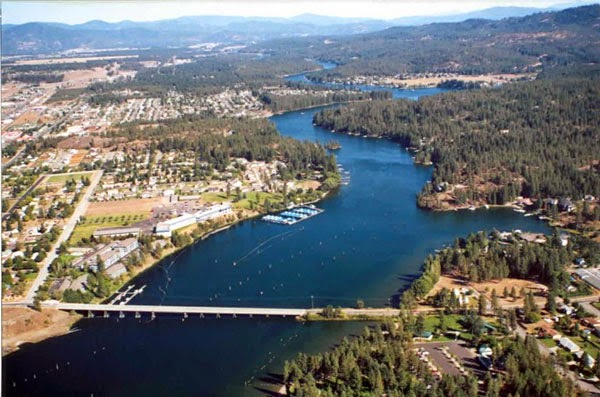
Post Falls bridges Kootenai County’s premium lifestyle market and Spokane’s employment base at prices 20 to 25% below neighboring Coeur d’Alene
2026 Economic Outlook
- Riverbend Commerce Park continued industrial expansion adding employment
- Highway 41 and I-90 interchange improvements improving logistics access
- New master-planned residential communities in north and west Post Falls absorbing in-migration
- Northwest Specialty Hospital service expansion adding healthcare employment
- Spokane International Airport 20-minute proximity attracting corporate and remote workers
The Post Falls Investment Thesis
Post Falls occupies a specific investment niche that neither Boise/Nampa nor Coeur d’Alene fills as well: a Spokane-adjacent Idaho community with a working-class to middle-income tenant base, active new construction, and a price-to-rent ratio that produces better conventional cash flow metrics than any other Kootenai County city. The investment case rests on three structural supports:
- Geographic positioning between two major metros (Spokane at 20 minutes, CDA at 10 minutes) creates dual-market demand from tenants serving both employment centers
- Manufacturing employment anchor in Packaging Corporation of America and Riverbend Commerce Park creates persistent working-class to middle-income tenant demand that is recession-resistant compared to tourism and tech-dependent markets
- Price gap arbitrage of 20 to 25% below CDA means investors can enter the same Kootenai County growth story with lower capital requirements and better initial yield metrics
Historical Performance
| Period | Market Driver | Avg Annual Appreciation | Key Event |
|---|---|---|---|
| 2012-2016 | Post-recession recovery, industrial employment stability | 3-5% | PCA expansion anchors manufacturing employment; new subdivision activity resumes |
| 2017-2019 | Kootenai County growth wave, CDA overflow begins | 6-9% | New master-planned communities break ground; retail corridor on Seltice expands |
| 2020-2022 | Pandemic migration wave, remote workers and California equity migrants | 20-30% | Post Falls captures overflow from CDA bidding wars; inventory hits historic lows |
| 2023-2024 | Rate shock, normalization, new construction supply adds | 3-6% | Prices held better than national average; new construction absorbed steadily |
| 2025-2026 | Rate stabilization, continued Kootenai County industrial development | 7-12% (projected) | Commerce Park expansion and new residential corridors sustaining demand momentum |
Post Falls has historically appreciated slightly less than CDA in percentage terms but delivers better cash flow, lower entry costs, and comparable total returns on invested capital. A $280,000 Post Falls property purchased in 2015 would be worth approximately $520,000 to $590,000 today, representing a 10-year compound appreciation of 6.5 to 7.5% annually.
Demographic Trends Driving Demand
- Spokane Commuter Preference – Workers employed in Spokane increasingly prefer Idaho residency for lifestyle reasons; Post Falls’s 20-minute Spokane commute is the shortest of any established Idaho city
- Manufacturing Workforce Stability – PCA and Riverbend Commerce Park tenants create stable, long-tenured working-class households with low mobility who value consistent, well-maintained rental housing
- CDA Overflow Families – Families wanting Kootenai County schools and lifestyle but priced out of CDA proper find Post Falls delivers comparable amenities at 20 to 25% lower prices
- New Construction Appeal – Post Falls’s active builder market attracts households seeking modern homes, open floor plans, and energy efficiency not available in older CDA neighborhoods at the same price point
- Young Family Formation – Post Falls’s median age of 34 and strong household-with-children share drives demand for 3 and 4 bedroom rentals with fenced yards, a product type where Post Falls has excellent inventory
📚 New to real estate investing? Master the fundamentals with our professional course Learn more →
2. Neighborhood Hotspots
Post Falls Investment Neighborhood Map
Interactive map of Post Falls’s investment neighborhoods. Green stars show top hotspots, blue circles mark established markets, and orange circles highlight emerging areas.
Core Investment Neighborhoods
Detailed Submarket Analysis: All Post Falls Neighborhoods
| Neighborhood | Price Range (SFH) | Cap Rate | Growth Drivers | Best Strategy |
|---|---|---|---|---|
| Prairie / North | $460K-$665K | 4.2-5.2% | New construction, family demand, school district, Spokane commuters | Family buy-and-hold, long-term appreciation |
| Riverbend / Commerce Park | $350K-$490K | 5.0-6.5% | Manufacturing employment, PCA, industrial park proximity | Cash flow, workforce housing, BRRRR |
| Old Town / Spokane River | $370K-$560K | 4.8-6.0% | River access, Centennial Trail, revitalization, character housing | Value-add, young professional rental, revitalization |
| Greensferry / Hwy 41 | $440K-$650K | 4.3-5.3% | Newer construction, retail access, family market, growth corridor | Family buy-and-hold, newer stock |
| Treaty Rock | $420K-$620K | 4.3-5.2% | Park proximity, established community, stable demand | Long-term buy-and-hold, stable family tenants |
| Seltice Way Corridor | $380K-$560K | 4.5-5.5% | Commercial access, central location, employer proximity | Balanced returns, SFH buy-and-hold |
| West Post Falls | $350K-$500K | 4.8-6.0% | Most affordable entry, near Washington state line, development growth | Maximum entry-level cash flow, long-term hold |
| South Post Falls / CDA Border | $440K-$660K | 4.2-5.2% | CDA spillover appreciation, southern growth, improving amenities | Appreciation play, CDA-adjacent demand |
| Beck / Northwest Frontier | $430K-$640K | 4.2-5.0% | Growth frontier, longer appreciation runway, mix of housing vintages | Early-stage appreciation, 7+ year hold |
Expert Insight: “Post Falls gets overlooked by investors who are laser-focused on Coeur d’Alene’s glamour. But the numbers tell a different story. A $420,000 Post Falls property renting for $1,975 a month produces meaningfully better cash flow than a $590,000 CDA property renting for $2,350 a month, and both are growing at roughly the same appreciation rate. For an investor with $130,000 to deploy, Post Falls produces a functional portfolio faster. The working-class tenant base near PCA and Riverbend Park also has lower turnover than I see in any other Kootenai County submarket. These tenants stay for years, not months.” – Kevin Walsh, North Idaho Investment Properties
3. Property Types
| Investment Goal | Best Property Type | Best Neighborhoods | Minimum Capital |
|---|---|---|---|
| Maximum Cash Flow | Duplex or workforce SFH | Riverbend, Seltice, West Post Falls | $90,000+ |
| Balanced Returns | Value-add or mid-market SFH | Old Town, Treaty Rock, Greensferry | $105,000+ |
| Maximum Appreciation | New construction family home | Prairie, Lancaster Road, South Post Falls | $120,000+ |
| Lowest Management | New construction SFH or family home | Prairie, Greensferry, South Post Falls | $115,000+ |
Don’t guess the costs. Our Complete Renovation & Remodeling Cost Guide covers 400+ pages of project-by-project breakdowns with real contractor pricing ranges.
4. Cost Analysis
Acquisition Cost Breakdown (Post Falls)
| Expense Item | Typical Cost | Example ($478,000 Property) | Notes |
|---|---|---|---|
| Down Payment | 25% (investment) | $119,500 | 20% possible with strong credit; FHA at 3.5% for house hack (owner-occupied duplex) |
| Closing Costs | 2-3% of price | $9,560-$14,340 | Idaho closing costs are moderate; most Post Falls properties under conforming limit |
| General Inspection | $375-$575 | $450 | Include crawlspace and roof; North Idaho moisture and snow load concerns in older homes |
| Radon Test | $150-$250 | $175 | North Idaho is moderate radon zone; worth testing pre-purchase |
| Initial Repairs | 0-8% of price | $0-$38,240 | New construction near zero; older Riverbend-area homes may need HVAC and roof work |
| Reserves (6 months) | 6 months expenses | $11,000-$15,000 | Include buffer for vacancy during tenant turnover |
| TOTAL MINIMUM ENTRY | ~29-32% of value | $140,685-$167,305 | 20 to 25% lower than comparable CDA purchase; meaningfully more accessible |
Sample Cash Flow Analysis: Post Falls vs. CDA Comparison
| Item | Post Falls 3BR SFH ($430K) | CDA Inland 3BR SFH ($580K) |
|---|---|---|
| Monthly Rent | $1,975 | $2,300 |
| Annual Gross Income | $23,700 | $27,600 |
| Operating Expenses (37%) | -$8,769 | -$10,212 |
| NOI | $14,931/yr ($1,244/mo) | $17,388/yr ($1,449/mo) |
| Cap Rate | 3.47% | 2.99% |
| Mortgage (25% down, 6.875%) | -$2,118/mo ($322.5K loan) | -$2,857/mo ($435K loan) |
| Monthly Cash Flow | -$874/mo | -$1,408/mo |
| Down Payment Required | $107,500 | $145,000 |
| Annual Appreciation (9.3%) | +$39,990 | +$53,940 |
| Net Annual Return | +$29,502 (22.4% on $132K invested) | +$37,044 (22.4% on $165K invested) |
This comparison illustrates Post Falls’s core investment advantage: identical return on invested capital to CDA, with $37,500 less capital required per property. An investor with $264,000 to deploy buys two Post Falls properties instead of one CDA property, doubling their rental income, doubling their appreciation exposure, and diversifying tenant risk while deploying the same capital. The lower monthly carry per property also makes the portfolio more resilient to vacancy or rate changes.
Path to Better Cash Flow: Riverbend Workforce SFH Example
| Item | Monthly | Annual |
|---|---|---|
| Rent (3BR, renovated) | $1,875 | $22,500 |
| Vacancy (4%) | -$75 | -$900 |
| Property Taxes (0.82%) | -$268 | -$3,214 |
| Insurance | -$115 | -$1,380 |
| Property Management (9%) | -$169 | -$2,025 |
| Maintenance + CapEx (9%) | -$169 | -$2,025 |
| NOI | $1,079 | $12,956 |
| Cap Rate ($390K purchase) | 3.32% | |
| Mortgage ($292,500 at 6.875%) | -$1,921 | -$23,052 |
| Cash Flow | -$842 | -$10,096 |
| Appreciation (9.3%) | +$36,270 | |
| Total Annual Return | +$29,894 (23.8% on $125K invested) |
Workforce housing in the Riverbend corridor delivers Post Falls’s best cash flow characteristics. A 4% vacancy assumption is realistic here, given that manufacturing and logistics workers tend toward multi-year tenancies. The lower purchase price reduces both the down payment required and the monthly mortgage carry, making this segment the closest Post Falls comes to cash-flow-neutral investing at current interest rates.
Expert Insight: “The metric most investors miss when evaluating Post Falls is turnover cost. My PCA-adjacent 3-bedroom properties average 26-month tenancies. My newer Prairie-area homes average 18 months. Every turnover costs me $1,500 to $2,500 in cleaning, repairs, and vacancy. That difference in tenancy length adds $4,000 to $6,000 in effective annual cash flow to the Riverbend-area properties that never shows up in the spreadsheet comparison. Industrial-area workforce housing in stable North Idaho cities has always been my best performing segment over a 10-year horizon.” – Kevin Walsh, North Idaho Investment Properties
5. Legal Framework
✅ Post Falls: Idaho’s Landlord-Friendly Law, Zero Local Additions
Post Falls and Kootenai County apply Idaho’s state landlord-tenant law with no additional local ordinances. There is no rent control, no just cause eviction requirement, no source of income mandate, and no local tenant screening restrictions. This makes Post Falls’s regulatory environment as simple and landlord-favorable as any investment market in the Pacific Northwest region. The core framework below is identical to the rest of Idaho. For full detail, see our Coeur d’Alene or Nampa guides. Always consult an Idaho-licensed attorney before your first acquisition.
Idaho Residential Landlord and Tenant Act: Key Points
- No Rent Control: Prohibited statewide. Post Falls landlords adjust rents to market at any lease renewal.
- No Just Cause Eviction: Landlords can decline to renew any lease for any lawful reason without documentation of cause.
- Non-Payment Notice: 3 days to pay or vacate. Idaho’s fastest notice period in the region.
- Month-to-Month Termination: 30-day written notice, no cause required.
- Security Deposits: No statutory maximum. Return within 21 days with itemized deductions.
- Section 8 Acceptance: Not mandatory in Idaho. Post Falls landlords choose whether to accept housing vouchers.
- Landlord Entry: 24-hour notice required except genuine emergencies.
- Tenant Screening: Full landlord discretion within federal Fair Housing law. No first-in-time rules, no source of income protections.
Kootenai County Eviction Process
The eviction process in Kootenai County Magistrate Court mirrors the fast Idaho standard:
- Serve 3-Day Notice (non-payment) or 30-day notice (no-cause). Personal delivery, posting plus mailing, or certified mail.
- File Unlawful Detainer Complaint at Kootenai County Magistrate Court, 324 W Garden Ave, Coeur d’Alene. Filing fee approximately $166.
- Hearing Scheduled within 3 to 7 days for non-payment cases. Straightforward cases result in landlord judgment at first hearing.
- Writ of Possession issued immediately after judgment.
- Kootenai County Sheriff executes writ within 3 to 5 days.
Total realistic timeline: 25 to 35 days uncontested. Attorney fees for a simple eviction run $400 to $800. Compare to 3 to 6 months in Washington and 4 to 8 months in California.
Post Falls vs. Spokane for Landlord Friendliness
Washington state has enacted significant tenant protections in recent years, including just cause eviction requirements and 20-day pay-or-vacate notices. Post Falls landlords operating 20 miles across the state line operate under a dramatically more favorable legal framework. This is a meaningful structural advantage for investors serving the same Spokane-metro workforce from the Idaho side of the border.
6. Step-by-Step Post Falls Investment Playbook
Choose Your Post Falls Strategy
Workforce Cash Flow
Buy workforce housing near PCA and Riverbend Commerce Park at $340,000 to $470,000. Accept older stock and more active management. Post Falls’s best initial yields. Manufacturing and logistics tenants stay longer than average, improving effective cash flow beyond what a spreadsheet shows.
Family Appreciation Play
Buy newer construction family homes in Prairie or Greensferry at $450,000 to $660,000. Accept moderate negative cash flow in exchange for lowest maintenance, highest-quality tenants, and appreciation aligned with Post Falls’s overall growth trajectory.
Value-Add / BRRRR
Acquire dated homes in Old Town, Riverbend, or Seltice at $340,000 to $430,000. Modernize kitchens, baths, and mechanicals. Post-renovation rents improve 25 to 35%. Refinance recovered equity. Kootenai County’s active renovation contractor market supports this strategy with reasonable labor costs.
House Hacking
Buy a duplex using FHA financing at 3.5% down. Owner-occupy one unit; rent the other. The rental unit covers most of the mortgage. Post Falls duplexes fall comfortably within FHA loan limits, making this the most capital-efficient entry point available in Kootenai County.
Build Your Post Falls Team
- Kootenai County Investor Agent: Post Falls and CDA have meaningfully different submarket dynamics. An agent who primarily works lakefront CDA will be less effective identifying the best Riverbend or Old Town value-add opportunities. Ask specifically: “What is your experience with workforce housing and value-add acquisitions in Post Falls proper?”
- Post Falls Property Manager: Several Kootenai County property management companies serve both CDA and Post Falls. Verify their specific Post Falls tenant screening process, their approach to the 3-day notice, and their contractor network for maintenance calls. Management fees run 8 to 10% of collected rent.
- Local Renovation Contractor: For value-add strategy, Kootenai County has a solid pool of renovation contractors serving the active North Idaho remodel market. Get 3 competitive bids on any renovation plan and verify current Kootenai County permit experience.
- Idaho Real Estate CPA: Idaho’s flat 5.8% income tax rate applies to Post Falls rental income. Cost segregation and depreciation optimization are worth the engagement for any investor planning more than one acquisition in the county.
Post Falls-Specific Due Diligence
Physical Due Diligence
- Full inspection including crawlspace, roof, and HVAC; North Idaho snowpack and humidity create specific moisture issues in crawlspace foundations
- Radon test (Kootenai County moderate radon zone)
- Sewer scope for pre-1990 construction (clay and concrete lines common)
- Verify Kootenai County permit history for additions and garage conversions
- Check flood zone status for properties near the Spokane River in Old Town and Riverbend
- Wildfire interface assessment for properties along Post Falls’s eastern and southern fringes near forest land
Industrial Proximity Check
- Verify noise and odor profile for properties adjacent to PCA paper mill operations (significant industrial noise and occasional odor events)
- Check Riverbend Commerce Park tenant mix for properties on the industrial zone’s residential border; some tenants generate heavy truck traffic on residential streets
- Verify that industrial proximity pricing discount is captured in your purchase; PCA-adjacent streets trade at 8 to 12% below equivalent non-industrial residential streets
- Confirm that the pricing discount is justified by the actual noise impact at the specific property through a site visit during daytime operating hours
Competing in Post Falls’s Market
- Act faster than in CDA: Post Falls properties priced correctly move in 5 to 12 days. Hesitation on well-priced workforce housing in the Riverbend corridor means losing to other cash-flow investors who monitor the market daily.
- New construction relationships: Post Falls has several active builders in Prairie and Greensferry. Establishing relationships directly with builders (rather than going through the MLS) provides access to inventory before public listing and potential negotiation on upgrades and rate buydowns.
- Industrial-adjacent opportunities: Properties directly adjacent to PCA operations are systematically discounted. Investors willing to evaluate the actual noise and odor impact on a case-by-case basis can find properties 10 to 15% below non-industrial residential comparable value while renting at near-comparable rates to industrial workers who prefer being close to work.
- Spokane-side investors: Many Washington-state investors incorrectly assume Post Falls operates under Washington landlord-tenant law. Educating Washington-based sellers about the Idaho regulatory advantage can sometimes facilitate favorable deal terms, as they underestimate the value of Idaho’s legal environment to the buyer.
Property Management in Post Falls
Tenant Screening for Post Falls’s Market
Idaho’s full landlord discretion in tenant selection within fair housing law applies. Effective Post Falls screening focuses on employment verification given the market’s manufacturing and logistics tenant base:
- Income verification at 2.5 to 3x monthly rent (written offer letter or 2 most recent pay stubs)
- Employment type note: manufacturing and shift workers may have irregular pay schedules; verify monthly net income rather than hourly rate alone
- Rental history: direct contact with prior landlord, not just reference letter
- Credit check with minimum threshold appropriate to neighborhood tier (550 to 580 for workforce housing; 600+ for newer construction)
- Background check through Idaho-compliant screening service
Typical Post Falls Management Fees
- Single-family management: 8-10% of monthly collected rent
- Multi-family management: 7-9% of monthly collected rent
- Leasing fee: 50-75% of one month’s rent
- Lease renewal fee: $150-$250 per renewal
- Maintenance markup: Some managers add 10% to contractor invoices; negotiate this upfront
7. Financing Options for Post Falls
| Loan Type | Down Payment | Rate Premium | Best For | Post Falls Note |
|---|---|---|---|---|
| Conventional Investment | 25% | +0.5-0.75% | W-2 income, standard SFH | Nearly all Post Falls SFH fall well under the $806,500 conforming limit; no jumbo needed |
| FHA (House Hack) | 3.5% | Standard + MIP | Owner-occupying 2-4 unit property | Best Post Falls entry strategy; duplexes fit comfortably within Kootenai County FHA limits |
| DSCR Loan | 25-30% | +1.5-2.5% | Self-employed, no income verification | Post Falls’s better rent-to-value ratio than CDA gives DSCR a better chance of qualifying; still tight on standard SFH |
| Portfolio Loan | 20-30% | +1-2% | Multiple properties, scaling | Idaho Central Credit Union and Numerica Credit Union offer local Kootenai County portfolio products |
| Hard Money (Bridge) | 15-25% | 9-13% rate | BRRRR, value-add acquisitions | Spokane-based hard money lenders actively fund Post Falls and Kootenai County value-add deals |
| Conventional with 20% | 20% | +0.75-1.25% (PMI) | Capital preservation, leveraged entry | PMI cancelable at 20% equity; useful for preserving capital across multiple Post Falls acquisitions |
Post Falls Financing Advantage: Because virtually all Post Falls properties fall below the $806,500 conforming loan limit, investors access standard conventional investment financing without the higher rates and stricter requirements of jumbo products. This contrasts favorably with CDA’s lakefront segment, where jumbo financing is often required, adding cost and complexity. Idaho Central Credit Union, headquartered in Chubbuck Idaho with strong Kootenai County presence, is worth contacting directly for competitive local investment property rates.
8. Frequently Asked Questions

Knowledge Quiz: Post Falls Real Estate Investment
Open Quiz
5 quick questions on what you just learned about Post Falls investing
1) What is the primary reason Post Falls delivers better cash flow metrics than Coeur d’Alene for long-term rental investors?
Answer: C
The guide explains that Post Falls home prices sit 20 to 25% below comparable CDA properties, while rents are only marginally lower. This compressed price-to-rent ratio is the core reason Post Falls delivers better conventional cap rates than CDA. The cash flow comparison table shows that a $430,000 Post Falls SFH achieves a 3.47% cap rate versus 2.99% for a comparable $580,000 CDA property, requiring $37,500 less capital while producing the same percentage return on invested capital.
2) Which major employer is the single largest manufacturing employer in Post Falls and anchors the city’s industrial workforce rental market?
Answer: A
Packaging Corporation of America (PCA) is Post Falls’s largest private manufacturing employer with 800+ workers. PCA’s presence anchors the workforce rental market in the Riverbend and Seltice corridors, creating stable demand for housing from employees who tend toward long-tenured, low-mobility tenancies. The guide notes that PCA-adjacent streets trade at 8 to 12% discounts to non-industrial comparables due to noise and odor proximity, but the workforce they employ actively seeks rental housing in surrounding neighborhoods.
3) What is the Spokane River Centennial Trail and what impact does it have on Old Town Post Falls investment values?
Answer: D
The Centennial Trail runs 37 miles from Spokane through Post Falls and into Coeur d’Alene, attracting approximately 1 million users annually. Properties with direct trail access in Old Town Post Falls command a 5 to 12% premium over comparable non-trail properties, according to local sales data. The trail is a key driver of Old Town’s revitalization, attracting young professional and active lifestyle tenants and supporting the long-term appreciation thesis for the neighborhood.
4) How does Post Falls’s Spokane commute time compare to Coeur d’Alene’s, and why does this matter for rental demand?
Answer: B
Post Falls sits approximately 20 miles east of downtown Spokane on I-90, while Coeur d’Alene is 30 miles east, making Post Falls’s commute 10 minutes shorter. For Spokane-employed households, this creates a meaningful daily time savings that drives tenant preference for Post Falls over CDA when affordability is a priority. This structural commute advantage contributes to Post Falls’s strong tenant demand from the Spokane employment base despite lower rents than CDA.
5) According to the guide, what is the most important due diligence step specific to Post Falls properties near the Spokane River?
Answer: C
The guide identifies FEMA flood zone status as the critical riverfront due diligence item for Post Falls. Properties in Special Flood Hazard Areas (SFHA) with federally backed mortgages must carry flood insurance at $800 to $3,000+ annually, significantly affecting cash flow. Investors should check flood zone status at FEMA’s Flood Map Service Center (msc.fema.gov) before making any offer on Old Town or Riverbend-corridor Post Falls properties. The guide also notes that most of Post Falls’s investment-grade residential areas, including Prairie, Treaty Rock, and Greensferry, are not in designated flood zones.
Work With a Local Expert in Post Falls
We are building a verified network of real estate professionals across every market we cover.

About Our Expert Network
We are finalizing partnerships with verified real estate professionals across every market featured on Builds and Buys. Each expert is selected for hands-on investment experience, local market knowledge, and commitment to helping investors make sound decisions.
- Proven experience with Post Falls investment and workforce housing
- Deep knowledge of Kootenai County neighborhood dynamics and rental yields
- Guidance on Idaho-specific due diligence, flood zones, and industrial proximity
- Access to off-market Post Falls opportunities
- Full transaction support from search through closing
- Property management and contractor referrals
Services Covered
- Property sourcing and acquisition
- Investment analysis and underwriting
- Buyer representation
- Market comparables and valuations
- Value-add and renovation guidance
- Workforce housing strategy
- Legal and title referrals
- Idaho financing connections
- Property management referrals
- Insurance and inspection referrals
- 1031 exchange coordination
- Exit strategy planning
Get Connected or Join Our Network
Looking for a local expert to help with your Post Falls investment? We will connect you with the right professional for your strategy.
Contact us at support@buildsandbuys.com
Find Specialized Post Falls Real Estate Professionals
Ready to Invest in Post Falls?
Post Falls rewards investors who look past the glamour of Coeur d’Alene’s lakefront and recognize that the underlying Kootenai County growth story plays out equally well, and sometimes better, in the industrial corridor city 10 miles to the west. The manufacturing employment base, Spokane commuter positioning, active new construction, and Idaho’s landlord-favorable legal environment combine to create a market where disciplined investors can build genuine wealth at entry points accessible to a wider range of capital. The Centennial Trail, Old Town revitalization, and ongoing infrastructure investment provide the long-term appreciation narrative. The workforce tenant base provides the stability.
Continue Your Research
For further guidance, explore our State-by-State Investor guides, browse our expert articles, or follow our Step-by-Step Investment Guide.



