
Coeur d’Alene Real Estate Investment Guide For 2026
A comprehensive resource for investors looking to capitalize on one of the American Northwest’s most desirable lakefront markets, combining natural beauty, tourism-driven short-term rental income, and structural appreciation driven by remote worker migration
Quick answers: Top 5 most searched Coeur d’Alene investment questions ▼
Migration data: Where people are moving from to Coeur d’Alene ▼
In This Guide
Click on any section to navigate directly to that content
1. Coeur d’Alene Market Overview
Market Fundamentals
Coeur d’Alene is North Idaho’s crown jewel, a lakefront city of 55,000 nestled between Lake Coeur d’Alene and the Bitterroot Mountains, 30 miles east of Spokane on I-90. What separates CDA from other Idaho markets is the coexistence of three entirely distinct demand drivers: a permanent workforce tied to Spokane’s employment base, a growing remote worker and retiree population seeking natural beauty and quality of life, and a robust tourism economy that generates 2.7 million visitors annually and supports one of the most productive short-term rental markets in the Inland Northwest.
Key economic indicators defining Coeur d’Alene’s investment case:
- Population: 55,000+ city, 175,000+ Kootenai County
- Major Employers: Kootenai Health (largest employer), Coeur d’Alene Resort, CDA School District, City of CDA, Lake City Law, financial services, remote tech workers
- Tourism: 2.7 million annual visitors, $1.2 billion in tourism spending
- Spokane Connection: 30-mile, 25-minute I-90 commute to Spokane’s 550,000-person employment base
- No Idaho Income Tax Advantage: Washington workers relocating save $8,000 to $30,000+ annually
- Vacancy Rate: Under 3.5% for long-term rentals; STR occupancy averages 65 to 78% annually
- Geographic Constraint: Lake, mountains, and Spokane River gorge prevent sprawl, supporting prices structurally
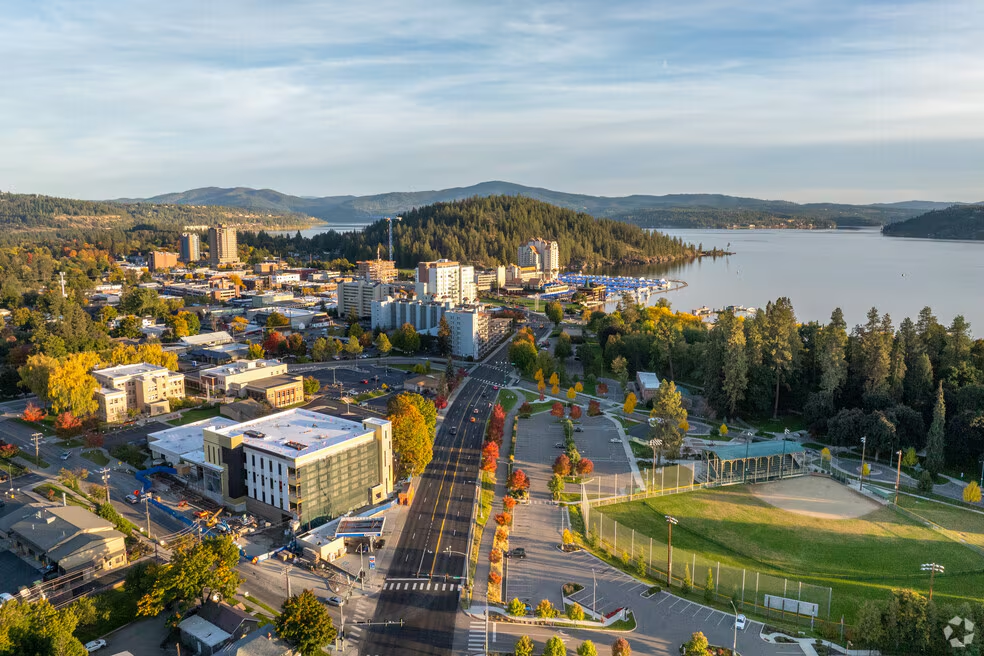
Lake Coeur d’Alene’s 25 miles of navigable water anchor a real estate market driven by tourism, lifestyle migration, and Spokane workforce demand
2026 Economic Outlook
- Kootenai Health campus expansion adding healthcare employment
- Continued remote worker migration from Seattle and San Francisco tech sectors
- Silver Mountain ski resort capacity expansion in Kellogg driving regional winter tourism
- Interstate 90 corridor commercial development supporting permanent population growth
- Short-term rental market stabilizing after 2021 to 2022 supply surge
Investment Climate
Coeur d’Alene is fundamentally a dual-strategy market: appreciation and short-term rental income for lakefront and downtown properties, and conventional long-term rental yield for inland neighborhoods. Investors entering without a clear strategy often underperform because applying long-term rental analysis to STR-capable properties leaves significant income on the table, while STR-managing inland properties adds complexity without proportional income improvement.
- STR premium of $15,000 to $35,000 per year in additional income over long-term rental for well-located downtown and near-lake properties
- Appreciation driven by constrained supply and sustained multi-source demand rather than single-employer concentration
- Idaho STR protection law (IC 67-6539) prevents future local bans, giving investors long-term regulatory certainty
- Seasonal demand patterns require active calendar management for STR optimization but are predictable and manageable
- Premium on local knowledge regarding which streets, subdivisions, and property types actually generate the rental income the market advertises
Historical Performance
| Period | Market Driver | Avg Annual Appreciation | Key Event |
|---|---|---|---|
| 2012-2016 | Post-recession recovery, Spokane spillover begins | 4-7% | Downtown CDA revitalization accelerates, resort investment grows |
| 2017-2019 | Airbnb growth, rising Seattle and California migration | 8-12% | STR market matures; CDA named top US vacation destination |
| 2020-2022 | Pandemic migration wave, remote work explosion | 22-35% | National media coverage; inventory near zero; bidding wars at all price points |
| 2023-2024 | Rate shock, normalization, STR supply catch-up | 2-6% | Prices held better than most Northwest markets; STR occupancy compressed slightly |
| 2025-2026 | Rate stabilization, continued remote worker in-migration | 8-14% (projected) | STR market rebalancing; permanent population growth resuming |
Coeur d’Alene’s long-term appreciation record of 8 to 11% annually places it among the top performing mid-size markets in the American Northwest. The 2020 to 2022 surge created a temporary valuation overshoot, but prices have held remarkably well compared to other pandemic-era boomtowns, supported by the structural demand described above. A $350,000 CDA property purchased in 2015 would be worth approximately $750,000 to $850,000 today.
Demographic Trends Driving Demand
- Washington Tax Arbitrage – Workers employed in Washington or earning Washington-sourced income but establishing Idaho residency avoid Washington’s income tax, saving significant amounts annually while living 30 minutes from Spokane employers
- California Equity Migration – Bay Area and Southern California homeowners arriving with $500,000 to $1,500,000 in home equity, purchasing CDA properties at cash or minimal financing and immediately entering the STR market
- Healthcare and Education Workforce – Kootenai Health’s 4,000+ employees and the CDA School District’s staff create steady middle-income long-term rental demand in inland neighborhoods
- Four-Season Recreation Demand – Boating, fishing, skiing, hiking, and cycling create genuine year-round tourism that prevents the deep off-season compression seen in single-season resort markets
- Conservative Political Migration – National in-migration from households seeking Idaho’s political environment has accelerated post-2020, particularly from Pacific Northwest metro areas
- Second Home Market – Pacific Northwest families treating CDA as a driveable weekend and vacation destination, keeping lakefront properties as income-generating assets during periods of non-use
📚 New to real estate investing? Master the fundamentals with our professional course Learn more →
2. Neighborhood Hotspots
Coeur d’Alene Investment Neighborhood Map
Interactive map of Coeur d’Alene’s investment neighborhoods. Green stars show top hotspots, blue circles mark established markets, and orange circles highlight emerging areas.
Core Investment Neighborhoods
Detailed Submarket Analysis: All CDA Neighborhoods
| Neighborhood | Price Range | Cap Rate | Growth Drivers | Best Strategy |
|---|---|---|---|---|
| Downtown / Lakefront | $550K-$1.5M+ | 3.0-4.5% LT / 5.5-9.0% STR | Tourism, resort proximity, walkability, lake access | STR, luxury LT, appreciation |
| Lakeview / Spokane Ave | $520K-$950K | 3.5-5.0% LT / 4.5-7.0% STR | Lake views, boat access, STR-capable, lower than lakefront | STR or LT, appreciation play |
| NW Boulevard / Midtown | $480K-$780K | 4.0-5.5% | Walkability, healthcare, craft beer and dining scene | Long-term rental, value-add |
| North CDA / Canfield | $480K-$750K | 4.0-5.0% | Family demand, school district, Kootenai Health | Family buy-and-hold, long-term stability |
| Government Way Corridor | $420K-$640K | 4.5-5.5% | Commercial access, medical offices, stable workforce | Balanced returns, SFH buy-and-hold |
| CDA Place / Sunridge | $650K-$1.2M | 3.0-4.5% | Golf, executive tenants, upscale amenities, Spokane commuters | Executive LT rental, appreciation |
| Ramsey / Huetter | $440K-$680K | 4.0-5.0% | Family focus, newer homes, I-90 Spokane commute | Family buy-and-hold, lower maintenance |
| Fernan Lake Area | $430K-$750K | 4.5-6.5% (STR capable) | Smaller lake access, outdoor recreation, rural feel | STR potential, outdoor lifestyle, value relative to CDA lakefront |
| Southeast CDA / Silver Lake | $380K-$580K | 4.5-5.5% | Affordability, value-add stock, growth potential | Value-add, BRRRR, emerging market play |
| Dalton Gardens | $460K-$720K | 3.5-5.0% | Larger lots, county jurisdiction, rural character | Long-term appreciation, lifestyle rental |
Expert Insight: “The biggest mistake investors make in Coeur d’Alene is buying on the wrong side of the lake access equation. A property 3 blocks from the water in the wrong direction generates $22,000 a year on Airbnb. The identical property one block from a public lake access point generates $52,000. The difference is almost entirely about walkable lake access and perceived proximity, not actual distance. Before any CDA STR acquisition, walk the property to the nearest lake access at 9 AM on a Saturday morning during summer. The experience you have doing that walk is exactly what your guests will rate you on.” – Jennifer Walsh, North Idaho Investment Properties
3. Property Types
| Investment Goal | Best Property Type | Best Neighborhoods | Minimum Capital |
|---|---|---|---|
| Maximum STR Income | Lakefront condo or near-lake townhome | Downtown, Lakefront, Lakeview Corridor | $140,000+ |
| Best Long-Term Cash Flow | Small multi-family or inland SFH | Midtown, Government Way, Southeast CDA | $110,000+ |
| Maximum Appreciation | Lakefront SFH or premium condo | Downtown Lakefront, CDA Place | $300,000+ |
| Lowest Management | Newer SFH or executive rental | North CDA, Ramsey, CDA Place | $120,000+ |
Don’t guess the costs. Our Complete Renovation & Remodeling Cost Guide covers 400+ pages of project-by-project breakdowns with real contractor pricing ranges.
4. Cost Analysis
Acquisition Cost Breakdown (Coeur d’Alene)
| Expense Item | Typical Cost | Example ($598,000 Property) | Notes |
|---|---|---|---|
| Down Payment | 25% (investment) | $149,500 | Standard for non-owner-occupied; 20% possible with strong profile |
| Closing Costs | 2-3% of price | $11,960-$17,940 | Title, escrow, lender fees; Idaho closing costs are moderate |
| General Inspection | $400-$650 | $500 | Include roof, crawlspace, and radon test; moisture issues common in North Idaho |
| Dock / Waterfront Inspection | $300-$600 | $450 (if applicable) | Mandatory for lakefront properties; dock permits and easements require separate verification |
| STR Setup (if applicable) | $8,000-$25,000 | $15,000 | Furnishing, photography, listing setup, safety equipment; one-time cost for STR conversion |
| Business License (STR) | $75-$150/year | $100 | City of CDA STR business license; annual renewal required |
| Reserves (6 months) | 6 months expenses | $18,000-$24,000 | STR properties need higher reserves for off-season income gaps |
| TOTAL MINIMUM ENTRY (LT) | ~28-30% of value | $179,960-$191,440 | Long-term rental entry |
| TOTAL MINIMUM ENTRY (STR) | ~31-34% of value | $194,960-$203,440 | STR-ready entry including setup and higher reserves |
Cash Flow Analysis: Two Strategies Compared
| Item | Strategy A: Downtown Condo STR | Strategy B: North CDA SFH Long-Term |
|---|---|---|
| Purchase Price | $640,000 | $520,000 |
| Annual Gross Revenue | $54,000 (STR, 68% occ @ $217 avg) | $27,600 ($2,300/month LT) |
| Platform Fees / Vacancy | -$8,100 (15% platform) | -$1,380 (5% vacancy) |
| Property Taxes (~0.80%) | -$5,120 | -$4,160 |
| Insurance (STR rider / landlord policy) | -$2,400 | -$1,560 |
| STR Management (20%) / LT Mgmt (9%) | -$10,800 | -$2,484 |
| HOA (if applicable) | -$4,800 (est. $400/mo) | $0 |
| Cleaning / Supplies / Maintenance | -$6,500 | -$2,208 (8%) |
| Net Operating Income | $16,280/yr ($1,357/mo) | $15,808/yr ($1,317/mo) |
| Cap Rate | 2.54% | 3.04% |
| Mortgage (25% down, 6.875%) | -$3,152/mo ($480K loan) | -$2,561/mo ($390K loan) |
| Monthly Cash Flow | -$1,795/mo | -$1,244/mo |
| Annual Appreciation (11%) | +$70,400/yr | +$57,200/yr |
| Total Annual Return | +$49,260 (24.7% on $199K deployed) | +$42,272 (24.8% on $170K deployed) |
This comparison illustrates why both strategies can work in CDA: the STR approach generates more gross income but carries higher costs and complexity, ending up with similar total returns on invested capital as the simpler long-term rental approach. The STR condo generates higher paper return if appreciation projections hold, but requires significantly more active management. Investor preference for passive vs. active income is often the deciding factor between these two paths.
Expert Insight: “The investors who make the most money in Coeur d’Alene are not necessarily the ones buying the highest-priced lakefront properties. They are the ones who correctly identify which mid-tier properties are one well-executed STR listing away from doubling their effective yield. A $620,000 home that has a lake view from the deck but has never been listed on Airbnb might generate $24,000 a year as a long-term rental or $48,000 a year as a managed STR. Finding those unlisted STR candidates and getting them to market is where the real alpha is in this market right now.” – Thomas Bergman, Kootenai County Investment Group
5. Legal Framework
✅ Idaho: Landlord-Friendly and STR-Protected
Coeur d’Alene investors benefit from Idaho’s uniformly landlord-favorable state law and a landmark 2021 STR protection statute (Idaho Code 67-6539) that prevents local governments from banning short-term rentals outright. This gives CDA investors long-term regulatory certainty that is simply unavailable in most other vacation rental markets. The City of CDA imposes reasonable business licensing requirements for STRs but cannot restrict days of operation or impose occupancy caps. This overview covers key provisions. Consult an Idaho attorney before acquisition.
Idaho Landlord-Tenant Law (Long-Term)
- No Rent Control: Prohibited statewide. Landlords raise rents to market at renewal with proper notice only.
- No Just Cause Eviction: Non-renewal at lease end requires no documented cause.
- Non-Payment Notice: 3-day pay-or-vacate. Fastest in the region.
- Month-to-Month Termination: 30-day written notice, no cause required.
- Security Deposits: No statutory maximum. Return within 21 days with itemized deductions.
- Section 8: Not mandatory in Idaho. Landlord discretion on voucher acceptance.
- Entry Notice: 24 hours required except genuine emergencies.
- Eviction Timeline: 3 to 5 weeks for uncontested cases in Kootenai County Magistrate Court.
Coeur d’Alene STR Requirements
Idaho Code 67-6539 prohibits local bans on STRs but allows cities to regulate them. Current CDA requirements:
- Business License: City of CDA STR business license required. Annual fee approximately $75 to $150.
- Building Code Compliance: Property must meet minimum safety standards including smoke detectors, CO detectors, fire extinguishers, and egress requirements.
- No Day Caps: Unlike many cities, CDA does not cap the number of nights a property can be rented.
- No Occupancy Restrictions: Standard building code occupancy limits apply but no STR-specific occupancy caps.
- Transient Occupancy Tax: STR operators must collect and remit Idaho lodging tax (7% state + applicable local tax). Most platforms (Airbnb, VRBO) collect and remit automatically.
- HOA Caution: Many downtown and lakefront condo associations have their own STR restrictions independent of city law. HOA review is mandatory before any STR acquisition.
- Kootenai County: Properties outside CDA city limits in unincorporated Kootenai County follow county regulations, which are generally even less restrictive than the city.
Useful CDA Resources
- City of CDA Business Licensing: cdaid.org
- Idaho STR Protection Statute: legislature.idaho.gov (IC 67-6539)
- Kootenai County Planning: kcgov.us
- Idaho Rental Owners Association: idahoroma.org
| Regulation | Coeur d’Alene / Idaho | Typical Restrictive Market | Investor Impact |
|---|---|---|---|
| STR Local Ban | Prohibited by state law | Cities can and do ban STR in many states | Long-term regulatory certainty for CDA STR investors |
| STR Day Caps | None in CDA | 90-180 day caps common nationally | CDA STR operators can run year-round without restriction |
| Rent Control | Prohibited statewide | Common in OR, CA, WA | LT landlords can adjust rents to market at renewal |
| Non-Payment Notice | 3 days | 14-30 days in many states | Faster action dramatically reduces lost rent |
| Eviction Timeline | 3-5 weeks typical | 3-9 months in CA, OR, WA | Reduced risk and lost rent exposure vs. West Coast markets |
| Lodging Tax (STR) | 7% state + local; platforms auto-collect | Varies; often 12-18% in high-tax states | Idaho’s lower tax rate improves competitive pricing for guests |
6. Step-by-Step Coeur d’Alene Investment Playbook
Choose Your CDA Strategy Before Buying
CDA’s dual-market nature means strategy selection before purchase is non-negotiable. The same property is often worth dramatically different amounts depending on whether it is operated as a short-term or long-term rental, and not every property qualifies for both:
Short-Term Rental (STR)
Buy within walking distance of downtown, the lake, or a boat launch. Furnish and list on Airbnb and VRBO. Actively manage calendar pricing, cleaning logistics, and guest communications. Generates highest gross income but requires either owner involvement or a 20 to 25% STR management fee.
Long-Term Rental
Buy inland neighborhood SFH or small multi-family. Place a qualified long-term tenant. Use Idaho-friendly lease and property management. Predictable monthly income without STR complexity. Better suited for out-of-state investors and those without STR management capability.
Corporate / Furnished Mid-Length
Furnish a downtown or near-lake property for 30 to 90 day stays. Target Kootenai Health executives, Spokane corporate relocations, and seasonal workers. Avoids nightly turnover and most STR complexities while generating 20 to 40% above unfurnished long-term rates.
Value-Add / BRRRR
Buy distressed inland properties in Southeast CDA or Silver Lake area at below-market prices. Renovate to current standards. Refinance recovered equity into additional acquisitions. Best suited for investors with access to Kootenai County contractors and renovation management capability.
Build Your Coeur d’Alene Team
- Kootenai County Investment Agent: Must understand CDA’s specific STR-capable vs. non-STR submarkets. Ask specifically: “Which streets within 3 blocks of downtown have the best STR reviews and least HOA restrictions?” An agent who cannot answer this is not the right fit for STR-oriented buying.
- STR Management Company (if STR strategy): CDA has a growing number of local STR management companies. Interview for their average occupancy rates, dynamic pricing software, and cleaning network capacity. Expect 18 to 25% of gross revenue. Request verified income statements from comparable properties they manage.
- Idaho Long-Term Property Manager (if LT strategy): Kootenai County property management fees run 8 to 10% of collected rent. Verify Idaho-current lease agreements and eviction experience.
- STR-Savvy Idaho CPA: Idaho income tax at 5.8% flat rate applies to STR income. A CPA familiar with Idaho lodging tax compliance, STR depreciation (cost segregation is especially valuable for STR properties), and Kootenai County assessment appeals will create significant value.
- Idaho Real Estate Attorney: For HOA review on condo acquisitions and STR compliance letter if building’s rules are ambiguous.
Pro Tip on STR Management Selection: Ask any STR manager you interview to pull the Airbnb AirDNA data for the specific address you are considering buying. A competent STR manager will have this data ready and be able to show you realistic occupancy and revenue projections with comparable property benchmarks. If they quote revenue estimates without data, they are guessing.
CDA-Specific Due Diligence
Physical Due Diligence
- Full inspection including crawlspace and roof; North Idaho’s heavy snowpack and rainfall create moisture and structural issues in older homes
- Radon testing (North Idaho is in a moderate radon zone)
- Dock and riparian rights verification for lakefront properties; dock permits are separate from property rights and may not transfer cleanly
- Septic system inspection for properties on private systems (common in rural Kootenai County)
- Wildfire defensibility assessment for properties in forested areas adjacent to CDA
STR-Specific Due Diligence
- Pull and read the complete HOA CC&Rs and rules, not just the management company summary. STR restrictions are often buried in older documents and not flagged by agents.
- Verify city STR business license eligibility at the specific address; some zones have additional requirements
- Pull AirDNA or Mashvisor data for the specific address to validate revenue projections before purchase
- Walk the property to the lake or downtown amenities to assess actual guest experience
- Check the building’s existing STR review history if applicable
Competing in CDA’s Market
- Know your STR revenue ceiling before bidding: CDA lakefront buyers regularly overbid based on optimistic STR revenue projections. Use actual AirDNA data for the specific address and apply a conservative 60 to 65% occupancy assumption. Do not bid based on the seller’s broker’s revenue projections.
- Pre-inspections for downtown condos: Competitive lakefront and downtown condo offers often waive inspection contingencies. Pre-inspecting before submitting allows clean offers that compete without sacrificing discovery of material defects.
- Off-season purchases: CDA’s market has a mild seasonal pattern with fewer competitive offers in November through February. Motivated sellers who have not found a summer buyer are more willing to negotiate. Purchases closed in winter can be listed on STR platforms well before the summer peak.
- Target un-optimized STR listings: Properties currently listed as long-term rentals or vacant that sit in STR-capable locations often discount significantly compared to properties already operating as STRs. The operator premium disappears if you can bring the property to market yourself.
STR Operations and Seasonal Management
CDA’s STR market has a clear seasonal pattern that requires calendar-based revenue management:
Seasonal Revenue Pattern
| Season | Months | Occupancy | Nightly Rate | Strategy |
|---|---|---|---|---|
| Peak Summer | June-August | 85-95% | $220-$400+ | Max rate, minimum 2-3 night stays |
| Shoulder (Spring/Fall) | Apr-May, Sep-Oct | 55-70% | $140-$220 | Dynamic pricing, accept 1-night stays |
| Winter | Nov-Mar | 35-50% | $95-$160 | Lower rates, target ski visitors (Silver Mountain), holiday spikes |
CDA’s four-season appeal prevents the deep winter collapse seen in single-season ski or beach markets. Silver Mountain in Kellogg (45 minutes), winter holidays, and weekend Spokane getaways sustain meaningful winter demand. Budget for approximately 45 to 55% of annual STR revenue being generated in June through August, with shoulder months adding 30 to 35% and winter contributing the balance.
7. Financing Options for Coeur d’Alene
| Loan Type | Down Payment | Rate Premium | Best For | CDA Note |
|---|---|---|---|---|
| Conventional Investment | 25% | +0.5-0.75% | W-2 income, standard SFH investment | CDA inland SFH; most under the $806,500 conforming limit |
| Jumbo Investment | 25-30% | +0.75-1.25% | $806K+ lakefront and premium properties | Required for lakefront homes; Inland NW banks (Banner, Idaho Central) offer competitive jumbo |
| DSCR Loan | 25-30% | +1.5-2.5% | Self-employed, STR income qualification | Some DSCR lenders accept STR income at 75% of gross; can qualify strong STR properties |
| Second Home Loan | 10% | +0.25-0.5% | Buyers intending to use property personally and rent casually | Lower down payment and rate than investment loan; requires 14+ days personal use annually; lender disclosure rules apply for STR |
| Portfolio Loan | 20-30% | +1-2% | Multiple properties, unique property types | Idaho Central Credit Union and Numerica Credit Union offer local portfolio products for Kootenai County investors |
| Hard Money (Bridge) | 15-25% | 9-13% rate | BRRRR, value-add acquisitions | Spokane-area hard money lenders actively fund Kootenai County value-add deals |
| Cash / 1031 Exchange | 100% | N/A | California equity migrants, 1031 exchange buyers | A meaningful share of CDA lakefront transactions are all-cash; 1031 exchange activity from CA and WA sellers is active |
CDA Financing Reality: A notable portion of the lakefront and premium CDA market transacts in cash, particularly from California equity migrants and 1031 exchange buyers. This means conventionally financed buyers face a structural disadvantage in competitive offers on premium lakefront properties. Strategies to compete include pre-approval letters from local Kootenai County lenders (more credible to local listing agents than out-of-state banks), personal escalation letters, and targeting off-season listings where cash buyer competition is reduced.
8. Frequently Asked Questions

Knowledge Quiz: Coeur d’Alene Real Estate Investment
Open Quiz
5 quick questions on what you just learned about Coeur d’Alene investing
1) What does Idaho Code 67-6539 do for Coeur d’Alene real estate investors?
Answer: C
Idaho Code 67-6539, enacted in 2021, prevents local governments from banning STRs outright. This gives CDA investors a level of regulatory certainty unavailable in most other vacation rental markets, where city councils can and do eliminate STR rights with a single vote. The City of CDA can still require business licenses and code compliance, but cannot cap days of operation or eliminate STR entirely.
2) What is the most critical due diligence step before buying a downtown CDA condo for use as an STR?
Answer: B
The guide identifies HOA STR restrictions as the most common reason CDA STR investors lose money on otherwise well-located properties. While Idaho state law prevents city bans, HOA CC&Rs are private contracts that can and do restrict STR. These restrictions are often buried in older documents and not flagged by agents. Reviewing the complete CC&Rs, bylaws, rules, and 2 years of board meeting minutes before committing is non-negotiable.
3) What is a realistic annual gross STR revenue expectation for a well-managed 2-bedroom downtown CDA condo with good lake proximity?
Answer: D
The guide states that a realistic annual gross STR revenue range for a well-located, well-managed 2-bedroom downtown CDA condo is $40,000 to $55,000 annually. After platform fees (15%), STR management (20%), cleaning, supplies, HOA, insurance, and taxes, net NOI typically represents 28 to 35% of gross revenue. The guide cautions against using peak summer rates to project annual income, noting that annual average nightly rates across the full calendar year run $175 to $220 at realistic occupancy.
4) Why do Washington state workers moving to Coeur d’Alene receive a meaningful financial benefit beyond just lower housing costs?
Answer: A
This is a subtle but important distinction. Washington state has no income tax, so workers there are not escaping Washington income taxes. The advantage is that workers employed in Washington (Spokane) establish Idaho residency, which means their income is subject to Idaho’s 5.8% flat rate rather than Washington’s state-level taxes on capital gains and other income categories. Additionally, remote workers formerly in California (13.3% state income tax) or other high-tax states save significantly by establishing Idaho residency while working remotely. The 25-minute I-90 commute to Spokane makes the relocation practical even for Spokane office workers.
5) According to the guide, what percentage of annual STR revenue does a well-operated CDA downtown condo typically generate during the peak summer months of June through August?
Answer: C
The guide states that approximately 45 to 55% of annual CDA STR revenue is generated during June through August, with shoulder months adding 30 to 35% and winter contributing the balance. CDA’s four-season appeal, including Silver Mountain skiing 45 minutes away and winter holiday getaway demand from Spokane, prevents the extreme seasonal collapse seen in single-season markets. This is more favorable seasonal distribution than many pure beach or ski markets.
Work With a Local Expert in Coeur d’Alene
We are building a verified network of real estate professionals across every market we cover.

About Our Expert Network
We are finalizing partnerships with verified real estate professionals across every market featured on Builds and Buys. Each expert in our network is selected for their hands-on investment experience, local market knowledge, and commitment to helping buyers and investors make sound decisions.
Our local CDA specialists offer:
- Proven experience with Kootenai County investment and STR properties
- Deep knowledge of CDA’s neighborhood dynamics, STR performance, and pricing
- Guidance on HOA compliance, STR licensing, and lakefront due diligence
- Access to off-market and pre-market Kootenai County opportunities
- Full transaction support from search through closing
- STR management referrals and long-term property management connections
Services Covered
- STR property sourcing
- Investment analysis and underwriting
- Buyer representation
- HOA STR compliance review
- Lakefront due diligence
- STR setup and management referrals
- Legal and title referrals
- Idaho financing connections
- Long-term property management
- Insurance referrals
- 1031 exchange coordination
- Exit strategy planning
Get Connected or Join Our Network
Looking for a local expert to help with your Coeur d’Alene investment? Reach out and we will connect you with the right professional for your market and strategy.
Contact us at support@buildsandbuys.com
Find Specialized Coeur d’Alene Real Estate Professionals
Ready to Invest in Coeur d’Alene?
Coeur d’Alene is one of the most compelling investment stories in the American Northwest, combining natural scarcity, multi-source demand, Idaho’s landlord-friendly laws, and a state statute protecting the STR market that investors in most other vacation destinations can only envy. The market demands patience, local knowledge, and honest cash flow underwriting, but the investors who approach it with discipline have built substantial wealth here through multiple market cycles. The combination of Spokane employment, tourism revenue, and remote worker migration creates a demand structure that is genuinely difficult to replicate elsewhere.
Continue Your Research
For further guidance, explore our State-by-State Investor guides, browse our expert articles, or follow our Step-by-Step Investment Guide.



