
Wichita Real Estate Investment Guide For 2026
A comprehensive resource for investors looking to capitalize on Kansas’s largest market, where aviation manufacturing, deep inventory, and genuine affordability meet the highest carrying costs in the state
Quick answers: Top 5 most searched Wichita investment questions ▼
Migration data: Where people are moving from to Wichita ▼
In This Guide
Click on any section to navigate directly to that content
1. Wichita Market Overview
Market Fundamentals
Wichita is Kansas’s largest city and the only market in the state with genuine metropolitan scale outside the Kansas City corridor. Known as the Air Capital of the World, it has built aircraft for a century, and aviation manufacturing remains the wage anchor. What most out of state investors do not realize until they dig in is how much else sits alongside it: Koch Industries is headquartered here, Cargill’s protein division moved its headquarters downtown, two large hospital systems compete for staff, McConnell Air Force Base flies the Air Force’s newest tanker, and Wichita State University runs one of the country’s most significant aviation research institutes.
Key economic indicators that define the Wichita investment case:
- Population: approximately 397,000 city proper, roughly 650,000 across the metro
- Major Employers: Spirit AeroSystems, Textron Aviation, Koch Industries, Cargill Protein, Wesley Medical Center, Ascension Via Christi, McConnell Air Force Base, Wichita State University, Wichita Public Schools
- Median Household Income: roughly $60,000
- Median Home Price: approximately $225,000
- Renter Households: roughly 40 percent, the highest share of any Kansas market
- Vacancy Rate: approximately 6 to 8 percent, concentrated in the oldest and least maintained stock
The renter share is the number that matters most. Four in ten Wichita households rent, in a metro of 650,000 people. That is a tenant pool no other Kansas market comes close to, and it means a well positioned rental in Wichita leases faster and re leases more reliably than an equivalent property anywhere else in the state.
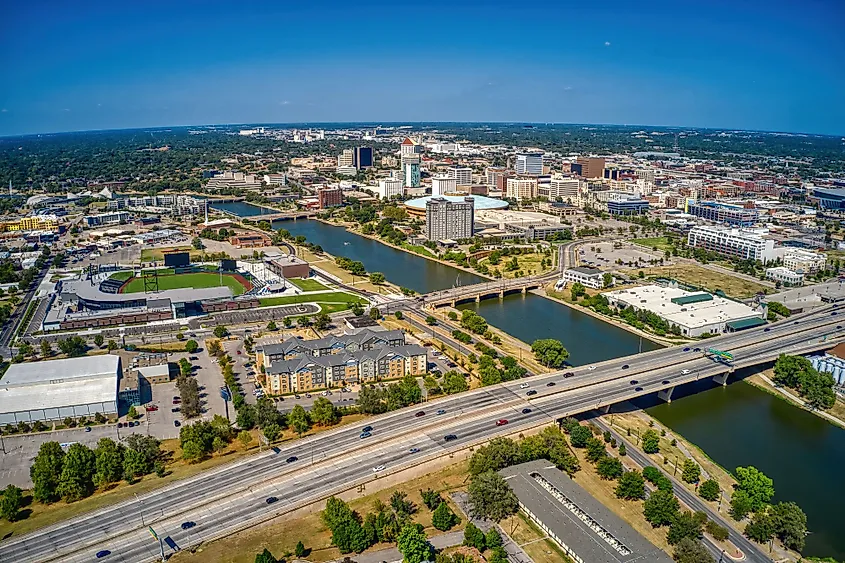
Wichita pairs a century old aviation manufacturing base with the deepest rental market in Kansas
2026 Economic Outlook
- Commercial aerospace production rates remain the single largest swing factor for the local economy
- McConnell Air Force Base tanker mission supporting stable military and contractor employment
- Wichita State University research campus continuing to draw aviation and advanced manufacturing partners
- Downtown and Delano investment along the Arkansas River corridor, anchored by Riverfront Stadium
- Health system expansion competing for nursing and allied health staff
- Continued outward growth into the Maize, Goddard, Andover, and Derby school districts
Investment Climate
Wichita is a market where the acquisition side is easy and the operating side is where deals are won or lost. Inventory is deep, prices are low by national standards, financing is straightforward, and there is far less institutional competition than in Kansas City. The discipline required is entirely on the expense line. Successful Wichita investors tend to share these characteristics:
- Honest expense modeling because property taxes near 1.4 percent of value and hail priced insurance together consume close to 30 percent of gross rent
- School district literacy since the metro is carved into multiple districts whose boundaries do not follow city limits and whose rent premiums are substantial
- Submarket precision because Wichita’s neighborhoods vary more block to block than almost any city its size
- Reserve depth to absorb an aviation downturn and a percentage based hail deductible in the same year
- Renovation capability given that the gap between renovated and unimproved rental stock is wide and profitable
The market’s principal risk is aviation cyclicality. Commercial aerospace production rates drive thousands of jobs at a handful of large employers, and those rates move with airline order books and manufacturer decisions made far from Kansas. Wichita has been through several of these cycles and has come out of each one, but an investor carrying thin reserves through a downturn will feel it in vacancy and in rent collection.
The offsetting strength is that no other Kansas market gives you this much optionality. Within a single metro you can buy a 4.5 percent cap appreciation play in College Hill, a 9 percent cash flow property in South Wichita, a student rental near Wichita State, and a suburban family home in the Maize district, all inside a 25 minute drive of each other.
Historical Performance
| Period | Market Driver | Avg Annual Appreciation | Key Event |
|---|---|---|---|
| 2010-2014 | Slow post recession recovery, general aviation weakness | 1-3% | Business jet demand slow to recover, aerospace employment soft |
| 2015-2019 | Commercial aerospace ramp, downtown investment begins | 4-6% | Old Town and Douglas Avenue revitalization gains momentum |
| 2020-2022 | National affordability migration, historically low inventory | 10-15% | Out of state investors discover sub $150,000 cash flow inventory |
| 2023-2024 | Rate shock plus a severe insurance repricing cycle | 3-5% | Kansas property insurance premiums surge after consecutive severe hail seasons |
| 2025-2026 | Normalization, widening premium for renovated stock | 4-6% (projected) | Suburban school district homes and renovated core properties outperform |
Over a 15 year window Wichita has produced roughly 5 to 6 percent average annual appreciation. A $130,000 house purchased in 2011 is worth roughly $250,000 to $280,000 today. That is a real result, and it is meaningfully better than most of Kansas outside Johnson County, but it is not why investors are here. Wichita’s case is the combination of scale, tenant depth, and an entry price that lets an investor own five doors for what one Johnson County property costs.
Demographic Trends Driving Demand
- Aviation and Manufacturing Workforce – Skilled trades earning well above the local cost of living, many of whom rent for years before buying, concentrated in south and east Wichita
- Healthcare Employment – Two competing hospital systems generating steady long term demand plus a consistent flow of travel nurses on 13 week contracts
- Wichita State University – Roughly 23,000 students supporting a distinct rental submarket around the Fairmount neighborhood
- McConnell Air Force Base – Military households with housing allowances providing reliable, predictable rent in southeast Wichita and Derby
- Rural Kansas Consolidation – Households leaving smaller Kansas towns for the metro, the single largest source of in migration
- Immigrant and Refugee Settlement – Wichita is Kansas’s primary immigrant gateway, creating deep and stable demand for affordable workforce housing in the southern half of the city
📚 New to real estate investing? Master the fundamentals with our professional course Learn more →
2. Neighborhood Hotspots
Wichita Investment Neighborhood Map
Interactive map of Wichita’s investment neighborhoods. Green stars show top hotspots, blue circles mark established markets, and orange circles highlight emerging areas across the metro.
Core Investment Neighborhoods
Detailed Submarket Analysis: All Wichita Metro Neighborhoods
| Neighborhood | Price Range (SFH) | Cap Rate | Growth Drivers | Best Strategy |
|---|---|---|---|---|
| College Hill / Crown Heights | $275K-$650K | 4.5-5.5% | Historic character, walkability, professional demand, limited supply | Appreciation hold, premium rental, historic renovation |
| East Wichita / Eastborough | $210K-$450K | 5.0-6.0% | Established neighborhoods, premium demographic, resale liquidity | Stable family rental, long hold, appreciation |
| Northwest / Maize District | $225K-$400K | 5.0-6.0% | Premier school district, newest stock, family relocation | Turnkey buy and hold, lowest turnover |
| Bel Aire / Kechi | $225K-$400K | 5.5-6.5% | Independent cities, newer housing, high household incomes | Family rental, stable tenancy, balanced returns |
| Riverside | $175K-$350K | 5.5-6.5% | River and park setting, historic stock, low turnover | Renovation and hold, premium long term rental |
| West Wichita / Goddard District | $190K-$340K | 5.5-6.5% | Goddard school district, family demand, steady occupancy | Buy and hold, family rental, balanced returns |
| Delano District | $130K-$260K | 6.0-7.5% | Riverfront Stadium, restaurant district, gentrification momentum | Value add, BRRRR, mid term furnished |
| Old Town / Downtown | $120K-$400K | 6.0-8.0% | Entertainment district, loft conversions, young professionals | Mixed use conversion, loft rental, commercial hybrid |
| Northeast Wichita | $140K-$240K | 6.0-7.5% | Mid century stock, WSU access, north industrial corridor | Value add, balanced cash flow, small multi-family |
| Fairmount / Wichita State | $110K-$200K | 6.5-8.5% | Wichita State University, research campus, student demand | Student rental, by-the-room leasing, multi-bedroom |
| Park City | $140K-$250K | 6.5-8.0% | Affordable north metro, independent city, I-135 access | Cash flow buy and hold, workforce rental |
| South Wichita / South Broadway | $95K-$180K | 7.0-9.0% | Industrial employment, deep workforce demand, affordability | Highest metro cash flow, value add, small multi-family |
| Planeview | $70K-$135K | 8.0-10.5% | Lowest entry price in Wichita, aviation workforce heritage | Highest gross yields, experienced operators only |
Expert Insight: “Wichita punishes people who buy by zip code. This city changes character faster block to block than anywhere else I work, and two houses eight blocks apart at the same price can be completely different assets. The other thing out of state buyers get wrong constantly is the school district. A Wichita mailing address does not mean Wichita USD 259, and a suburban address does not guarantee a suburban district. Maize, Goddard, Andover, and Derby boundaries cut through the metro in ways that make no intuitive sense. Pull the district off the Sedgwick County parcel record every single time, because the rent difference between the right side and the wrong side of that line is real money.” – Danielle Osborn, Investment Broker, Air Capital Property Advisors
3. Property Types
| Investment Goal | Best Property Type | Best Neighborhoods | Minimum Capital |
|---|---|---|---|
| Maximum Cash Flow | Renovated post war SFH or duplex | South Wichita, Planeview, Northeast Wichita | $40,000+ |
| Best Appreciation | Renovated historic Craftsman | College Hill, Crown Heights, Riverside | $75,000+ |
| Lowest Turnover Income | Newer suburban single family | Maize district, Goddard district, Bel Aire | $60,000+ |
| Highest Revenue Per Door | 4-5 bedroom student rental, by the room | Fairmount, near Wichita State | $45,000+ |
| Lowest Entry Cost | Duplex with FHA house hack | Delano, Fairmount, Old Town fringe | $10,000+ |
Don’t guess the costs. Our Complete Renovation & Remodeling Cost Guide covers 400+ pages of project-by-project breakdowns with real contractor pricing ranges.
4. Cost Analysis
Acquisition Cost Breakdown (Wichita)
| Expense Item | Typical Cost | Example ($225,000 Property) | Notes |
|---|---|---|---|
| Down Payment | 20-25% (investment) | $45,000-$56,250 | Wichita price points clear all conventional and DSCR minimum loan amounts |
| Closing Costs | 2-3% of price | $4,500-$6,750 | Title, escrow, lender fees, recording. Kansas closings are handled by title companies. |
| General Inspection | $375-$550 | $450 | Non negotiable on any pre 1990 Wichita home |
| Roof and Hail Damage Assessment | $0-$250 | $150 | Wichita sits in the heart of hail alley. Roof age drives your premium more than any other factor. |
| Basement and Moisture Evaluation | Included or $200-$400 | $250 | Most Wichita homes have basements. Waterproofing and drainage failures are the most common expensive surprise. |
| Foundation Evaluation (if indicated) | $0-$700 | $0-$700 | Expansive clay soils cause real movement. Pier and wall repair runs $7,000-$30,000. |
| Sewer Scope | $175-$325 | $225 | Clay and cast iron laterals throughout the pre 1970 core |
| Termite / Wood Destroying Insect Report | $75-$150 | $100 | Kansas has active subterranean termite pressure. Treatment $1,200-$2,500. |
| School District and Environmental Verification | $0 | $0 | Free but essential. Confirm the district and any environmental site boundary on the Sedgwick County parcel record. |
| Initial Repairs | 3-22% of price | $6,750-$49,500 | Roofs, basements, panels, and heating and cooling dominate the budget on core inventory |
| Reserves (6 months) | 6 months expenses | $9,000-$13,000 | Must cover a full percentage based hail deductible, which can be 2-5% of dwelling coverage |
| TOTAL MINIMUM ENTRY | ~29-55% of value | $65,900-$126,900 | Range depends almost entirely on renovation scope. Turnkey suburban deals sit at the low end. |
Property tax note, and this is the single most important line on the page: Kansas assesses residential property at 11.5 percent of appraised value, then applies the local mill levy. In Wichita and Sedgwick County the combined levy from city, county, school district, and state lands the effective rate at roughly 1.35 to 1.5 percent of market value annually. On a $225,000 house that is $3,000 to $3,400 per year, which is roughly triple what the same house would cost in property tax in Oklahoma. Rates also vary by school district, which is another reason the district matters. Always budget your first year taxes on your purchase price, not on the seller’s prior bill.
Sample Cash Flow Analysis: Northeast Wichita 3 Bedroom Value Add Rental
Deal structure: $125,000 purchase, $20,000 renovation (roof, panel upgrade, heating and cooling replacement, basement waterproofing, kitchen and bath, flooring, paint), $3,500 closing. Total basis $148,500. After repair value approximately $175,000. Rented at $1,250 per month.
| Item | Monthly | Annual | Notes |
|---|---|---|---|
| Gross Rent | $1,250 | $15,000 | 3BR fully renovated, above typical local rental condition |
| Less Vacancy (6%) | -$75 | -$900 | Wichita’s deep renter pool leases renovated product quickly |
| Property Taxes | -$204 | -$2,450 | ~1.4% effective, reassessed toward post renovation value. 16% of gross rent. |
| Insurance | -$158 | -$1,900 | Landlord policy on ~$215,000 replacement cost with a 2% wind and hail deductible and new roof credit. 13% of gross rent. |
| Maintenance + CapEx (9%) | -$113 | -$1,350 | Appropriate for a fully renovated mid century home with a dry basement |
| Net Operating Income (self managed) | $700 | $8,400 | Before mortgage |
| Property Management (9%) | -$113 | -$1,350 | Optional. Drops NOI to $587/month or $7,044/year. |
| Mortgage ($93,750 at 7.0%, 30yr) | -$624 | -$7,488 | Principal and interest only, 25% down on purchase price |
| CASH FLOW (self managed) | $76 | $912 | Positive but thin at current rates |
| CASH FLOW (professionally managed) | -$37 | -$444 | Slightly negative. Management is the difference between positive and negative here. |
| Cap Rate | 5.7% self managed / 4.7% managed | NOI divided by total basis of $148,500 | |
| Total Return Year One (self managed) | ~20% | Cash flow plus $954 principal paydown plus 5.2% appreciation on $175,000 | |
| Immediate Forced Equity | $26,500 | $175,000 ARV less $148,500 total basis, realized at refinance |
Look at where the money goes. Property taxes and insurance together take $4,350 per year, or 29 percent of gross rent, before a single repair is made or a single dollar of debt is serviced. That is the defining feature of Wichita underwriting and it is why the metro cap rates quoted on listing sheets rarely survive contact with a real operating statement. The return here comes from forced equity of $26,500 on day one plus appreciation, not from monthly cash flow, and self management is what keeps the property in positive territory at all.
Expert Insight: “I have reviewed hundreds of Wichita pro formas from out of state buyers and the same two lines are wrong almost every time. They budget property tax off the seller’s current bill, which was frozen at an old valuation, and it resets on sale. And they budget insurance off a national average when Wichita is in the middle of hail alley and carriers price on replacement cost. Between those two errors a spreadsheet can show an 8 percent cap rate on a property that actually delivers 5. Fix the taxes and the insurance first, before you look at anything else, and you will know within thirty seconds whether the deal is real. What is left after that fix is still a good market, it is just an honest one.” – Reid Callahan, CPA, Sedgwick County Real Estate Advisory
5. Legal Framework
⚠️ Wichita Compliance Notice
Kansas is moderately landlord friendly, with a fast eviction process balanced against real tenant protections that Oklahoma does not have, including a hard cap on security deposits. Wichita layers property maintenance and occupancy codes on top of state law. This guide provides an overview as of 2026 only. Statutes and municipal ordinances change. Always confirm current requirements with a licensed Kansas real estate attorney and with City of Wichita Housing and Community Services before acquiring rental property.
Kansas and Wichita Regulations
The governing statute is the Kansas Residential Landlord and Tenant Act, codified at K.S.A. 58-2540 and following:
- Nonpayment of Rent: 3 day written notice to pay or vacate. This is among the shortest notice periods in the country, shorter even than Oklahoma.
- Lease Violations: 14 day written notice to cure, with termination effective 30 days from notice if the breach is not remedied.
- Month to Month Termination: 30 days written notice by either party.
- Security Deposits, and this is the key difference from Oklahoma: Kansas caps deposits at one month’s rent for unfurnished units and one and a half months for furnished, with an additional half month permitted for pets. Return is due within 30 days with an itemized statement of any deductions.
- No Separate Escrow Required: Unlike Oklahoma, Kansas does not require deposits to be held in a segregated account, though keeping them separate remains best practice.
- Landlord Entry: Reasonable notice required, generally interpreted as 24 hours, at reasonable times except in emergency.
- No Rent Control: Kansas law preempts municipal rent control. Rent may be set and raised freely with proper notice.
- Self Help Eviction Prohibited: Changing locks, removing doors, or shutting off utilities to force a tenant out exposes you to damages and attorney fees. Kansas enforces this despite its otherwise landlord friendly posture.
- No Source of Income Protection: Kansas does not require landlords to accept housing choice vouchers.
- Wichita Specific: The city enforces property maintenance, occupancy, and nuisance codes through code enforcement. Occupancy limits matter particularly for by the room student rentals near Wichita State. Confirm current registration, inspection, and occupancy requirements directly with the city.
Compliance Best Practices
Kansas gives landlords real operating latitude, but the deposit cap and the self help prohibition are where small landlords most often get caught out:
- Respect the Deposit Cap. Charging more than one month’s rent on an unfurnished unit is a straightforward violation. If an applicant is higher risk, address it through a co signer or a higher income threshold rather than a larger deposit.
- Never Attempt Self Help. Despite Kansas’s reputation, locking a tenant out or cutting utilities is illegal and expensive. The formal process is fast enough that there is no reason to try.
- Use a Kansas Specific Lease. Generic online leases frequently contain provisions unenforceable under the KRLTA and omit required disclosures. Have a Sedgwick County attorney review your template once, then reuse it.
- Itemize Deposit Deductions in Writing. The 30 day return requirement comes with an itemization obligation. Photograph and video every room at move in and move out.
- Federal Fair Housing Applies. Kansas’s lack of extra state protections does not change your obligations under the Fair Housing Act. Apply written criteria consistently to every applicant.
- Lead Paint Disclosure. Federally required for any dwelling built before 1978, which covers the overwhelming majority of core Wichita housing stock.
- Watch Occupancy Limits on Room Rentals. If you are leasing by the bedroom near Wichita State, confirm the city’s occupancy rules for unrelated persons before you configure the property.
Useful Wichita and Sedgwick County Resources
- City of Wichita: wichita.gov
- Sedgwick County Appraiser for parcel, valuation, and school district data
- Sedgwick County Treasurer for tax records and payment schedules
- Sedgwick County Register of Deeds for deeds, liens, and easements
- Kansas Statutes K.S.A. 58-2540 for the Residential Landlord and Tenant Act
- Kansas Department of Health and Environment for environmental site information
| Regulation | Wichita / Kansas | Typical Tenant Protective State | Investor Impact |
|---|---|---|---|
| Eviction for Nonpayment | 3 day notice, hearing typically within days of service | 14-30 day notice, 2-6 month court timeline | Among the shortest notice periods in the United States |
| Just Cause Required | No | Yes in many jurisdictions | Term leases may be allowed to expire without justification |
| Rent Control | Prohibited statewide by preemption | Permitted or mandated locally | Rents adjust to market with only standard notice |
| Security Deposit Cap | Capped at 1 month unfurnished, 1.5 furnished, plus 0.5 for pets | Often capped at 1 month, 14-21 day return | Cannot size the deposit to risk. Screen harder instead. |
| Deposit Escrow Account | Not required by statute | Segregated account and interest often required | Lower administrative burden than neighboring states |
| Source of Income Protection | Not required | Voucher acceptance mandatory | Voucher participation is a business choice, not an obligation |
| Property Tax Burden | ~1.35-1.5% effective, resets on sale | Varies widely, often capped or assessed below market | The single largest operating expense. Budget on purchase price. |
6. Step-by-Step Wichita Investment Playbook
Define Your Wichita Strategy
Wichita supports more distinct strategies than any other Kansas market outside Kansas City. Be clear on which one you are executing before you make an offer:
Value Add / BRRRR
Buy dated houses in Delano, Northeast, or South Wichita at $95,000 to $165,000, complete a full systems renovation including the basement, lease at a premium to unimproved comparables, then refinance. The highest return strategy in the market.
School District Buy and Hold
Acquire inside the Maize, Goddard, Andover, or Derby boundaries. Accept lower current yield in exchange for the longest tenancies in the metro, the lowest maintenance burden, and the strongest resale liquidity.
Student Rental Near Wichita State
Acquire a four or five bedroom house in Fairmount and lease by the bedroom. Highest gross yields available in the city, offset by summer vacancy, higher wear, and occupancy code compliance requirements.
Historic District Appreciation
Acquire and renovate a Craftsman or Tudor in College Hill, Crown Heights, or Riverside. The weakest current yield in the city but the strongest appreciation, the deepest professional tenant pool, and the best exit.
Build Your Wichita Team
Wichita has a genuinely deep professional bench, which is one of its underrated advantages over every other Kansas market except Johnson County. Use it, but vet for investor experience specifically:
- Agent Who Knows the District Lines: The most valuable qualification in this metro. Ask a prospective agent to explain where the Maize boundary runs relative to city limits. If they cannot, keep interviewing.
- Independent Insurance Agent, Not a Captive One: The highest leverage team member in Kansas. An agent shopping five carriers can move a landlord premium by $700 or more per year on the same house.
- General Contractor with Basement Experience: Most Wichita homes have basements and most expensive surprises come from them. Get references from two completed rental renovations, not homeowner remodels.
- Kansas Real Estate Attorney: For lease template review under the KRLTA, entity setup, and any contested eviction. Sedgwick County local counsel preferred.
- Property Manager or a Decision to Self Manage: Wichita has real competition among management companies. Interview at least three and compare flat fee against percentage structures, because at these rent levels the difference is your entire cash flow.
- Real Estate CPA: For depreciation, entity structure, and Sedgwick County property tax valuation appeals, which are worth filing more often than most investors realize.
Expert Tip: Ask any prospective insurance agent these three questions before you sign anything: what is my wind and hail deductible, is it a flat dollar amount or a percentage of dwelling coverage, and is my roof settled at replacement cost or actual cash value? Those three variables determine whether a hail claim costs you $1,000 or $10,000. Wichita gets hail almost every spring, so this is not hypothetical.
Wichita Specific Due Diligence
Standard due diligence items plus these Sedgwick County critical checks:
Physical Due Diligence
- Basement condition and water management. The most common expensive surprise in Wichita. Check for staining on the walls, a functioning sump pump, exterior grading that moves water away, and any evidence of past flooding.
- Roof age, layer count, and documented hail claim history. The largest single insurance variable.
- Foundation movement assessment. Expansive clay soils cause real wall bowing and settling in older basements.
- Electrical panel capacity and wiring type. 60 amp services, fuse boxes, and cloth wiring appear throughout the pre 1960 core and are frequently uninsurable.
- Supply plumbing material. Galvanized steel supply lines will fail and require full repipe.
- Sewer lateral scope for clay and cast iron lines.
- Heating and cooling system age. Central air is expected in this market and its absence costs real rent.
- Storm shelter or basement safe area. Increasingly expected by Kansas tenants and a genuine leasing advantage.
Title, Regulatory, and Environmental
- School district on the parcel record. The highest value fifteen minutes of due diligence in this metro. Verify with the Sedgwick County Appraiser, not the listing or the mailing address.
- Environmental site boundaries. Wichita has documented groundwater contamination areas in and near the central city with associated city and state remediation programs. Properties inside those boundaries can carry specific disclosure and certification requirements that affect financing and resale. Ask your title company directly and verify with the City of Wichita and the Kansas Department of Health and Environment.
- Sedgwick County Register of Deeds search for liens, judgments, and easements.
- Open code enforcement cases or nuisance abatement liens with the City of Wichita.
- Permit history for additions, basement finishes, and any unpermitted second unit.
- Occupancy limits if you plan to lease by the bedroom near Wichita State.
- Flood zone determination near the Arkansas River, Little Arkansas River, and the Big Slough drainage.
- Current valuation and appeal history with the Sedgwick County Appraiser, since your tax basis resets on sale.
Sourcing Deals in Wichita
Wichita has the deepest inventory in Kansas, which means the challenge is filtering rather than finding. Channels that work:
- Investor focused agent relationships: With this much inventory, an agent who pre screens on your buy box saves more time than any other single relationship. Give them your criteria in writing including the district requirement.
- Estate sales and probate: Wichita’s core neighborhoods have a large cohort of long tenured owners releasing 1940s through 1960s homes. Build relationships with estate attorneys and local auction companies.
- Sedgwick County tax foreclosure sales: The county conducts periodic tax foreclosure auctions. Lowest basis acquisitions available, but they demand careful title work and an as is tolerance.
- Direct mail to absentee and long tenured owners: Pull the Sedgwick County Appraiser list for owners of 20 plus years and out of county mailing addresses.
- Tired landlord outreach: Wichita has a large population of small local landlords with 5 to 30 doors who bought decades ago and are aging out. Portfolio purchases at a discount are genuinely available here more than anywhere else in Kansas.
- Move fast on renovated suburban district inventory: Correctly zoned, move in ready homes in the Maize and Andover boundaries are the most competitive segment in the metro. Have financing pre approved.
Property Management in Wichita
Wichita rent levels sit at the threshold where management economics get tight. A 9 percent fee on $1,250 of rent is $113 per month, which on a leveraged deal at current rates is the entire cash flow and then some. Understand the tradeoff before deciding:
Tenant Screening Protocol
Kansas caps your deposit at one month, which means you cannot price risk into the deposit the way an Oklahoma landlord can. Screening is your only real protection. Apply consistently to every applicant:
- Verifiable gross income of at least 3 times monthly rent
- Direct employer verification, noting whether income is permanent staff or aerospace contract work that moves with production rates
- Two prior landlord references, contacting the landlord before the current one who has an incentive to give a good reference
- Full credit and eviction records search including surrounding Kansas counties and northern Oklahoma
- Written, posted criteria applied identically to every applicant to stay clean under federal fair housing law
- For higher risk applicants, use a co signer rather than attempting a larger deposit, which Kansas law does not permit
Typical Wichita Management Fees
- Single family management: 8-10% of monthly rent
- Multi family management: 7-9% of monthly rent
- Leasing fee: 50-100% of one month’s rent
- Lease renewal fee: $100-$275 per renewal
- Flat fee management: $85-$135 per door per month, often better economics than percentage at Wichita rent levels
- Student rental management: typically higher given per bedroom leasing complexity and turnover
- Maintenance coordination markup: typically 10% on vendor invoices, so confirm this before signing
7. Financing Options for Wichita
| Loan Type | Down Payment | Rate Premium | Best For | Wichita Note |
|---|---|---|---|---|
| Conventional Investment | 20-25% | +0.5-0.75% | Strong income, good credit, most Wichita price points | The default. Wichita’s median clears every lender minimum with room to spare. |
| DSCR Loan | 20-25% | +1.5-2.5% | Investors avoiding income documentation, portfolio builders | Works well here, but note that lenders count taxes and insurance in the ratio, and both are high in Sedgwick County. Run the DSCR before you assume approval. |
| Community Bank Portfolio Loan | 20-30% | +0.5-1.5% | Multiple properties, self employed, sub $100,000 acquisitions | Essential for Planeview and South Wichita deals that fall below national lender minimums |
| House Hacking (FHA) | 3.5% | Standard + MIP | Owner occupying one unit of a 2-4 unit property | At Wichita duplex prices this can mean under $7,000 down. The strongest entry point in the market. |
| FHA 203(k) Renovation | 3.5% | Standard + MIP | Owner occupants buying deferred maintenance houses | Rolls the roof, basement, panel, and heating and cooling work into the loan. Well matched to Delano and Riverside stock. |
| Hard Money (Bridge) | 15-25% | 10-13% rate | BRRRR acquisitions, auction purchases, heavy renovations | Active local lender presence in Wichita, more than most Kansas markets |
| Blanket Portfolio Loan | 25-35% | +1-2% | Packaging 5+ doors into one note | Practical once you own 5 or more Wichita properties, common among local operators |
| Commercial / Mixed Use Loan | 25-35% | +1-2.5% | Old Town and Douglas Avenue buildings, 5+ unit multifamily | Shorter amortization and balloon terms are standard. Local banks are the realistic source. |
Wichita Financing Reality: Financing is the easy part of investing here. A median price near $225,000 clears every conventional and DSCR minimum, hard money is locally available, and community banks will write the small balance notes on Planeview and South Wichita deals that national lenders will not touch. The one trap worth naming is DSCR underwriting. Lenders include taxes and insurance in the coverage calculation, and in Sedgwick County those two lines are large enough that a property which cash flows fine on your spreadsheet can still fall short of a 1.20x ratio. Run the DSCR with real Sedgwick County tax figures and a real hail country insurance quote before you count on the approval.
8. Frequently Asked Questions

Knowledge Quiz: Wichita Real Estate Investment
Open Quiz
5 quick questions on what you just learned about Wichita investing
1) Roughly what share of gross rent do property taxes and insurance consume on a typical Wichita rental?
Answer: C
Kansas assesses residential property at 11.5 percent of appraised value with a Sedgwick County effective rate around 1.35 to 1.5 percent, and Wichita sits in hail alley where carriers price on replacement cost. In the guide’s sample deal those two lines take $4,350 per year against $15,000 of gross rent, or 29 percent, before a single repair or debt payment.
2) Where should you verify a Wichita property’s school district before making an offer?
Answer: B
Maize, Goddard, Andover, Derby, Valley Center, Haysville, and Circle districts all cut into the metro, and their boundaries do not follow city limits or the mailing address. The district affects rent, tenancy length, resale, and even your mill levy, so verify it on the parcel record every time.
3) What is the most common expensive surprise in a Wichita home that investors from southern markets tend to miss?
Answer: A
Full or partial basements are standard in Wichita, unlike Oklahoma markets to the south where they are rare. A wet basement is a chronic, recurring problem that costs you tenants, and waterproofing and drainage remediation runs $5,000 to $20,000. Check for wall staining, a working sump pump, and exterior grading before closing.
4) How does Kansas security deposit law differ from Oklahoma’s, and why does it matter?
Answer: D
Kansas caps deposits at one month’s rent unfurnished, one and a half months furnished, plus a half month for pets. Oklahoma has no cap but does require a segregated escrow account. The practical consequence in Wichita is that you cannot size a deposit to a risky applicant, so use a co signer or a higher income threshold instead and screen harder up front.
5) What does the guide recommend regarding Wichita’s aviation industry exposure?
Answer: B
Aviation cyclicality is real and outside local control, but Koch Industries, Cargill Protein, two hospital systems, McConnell Air Force Base, and Wichita State genuinely offset it. The guide recommends nine to twelve months of reserves rather than six, favoring the student, healthcare adjacent, and suburban district submarkets, and avoiding concentration in the neighborhoods where aerospace employment is most heavily represented.
Work With a Local Expert in Wichita
We are building a verified network of real estate professionals across every market we cover.

About Our Expert Network
We are finalizing partnerships with verified real estate professionals across every market featured on Builds and Buys. Each expert in our network is selected for their hands-on investment experience, local market knowledge, and commitment to helping buyers and investors make sound decisions.
Our local specialists offer:
- Proven experience with investment and income-producing properties
- Deep knowledge of local pricing, rental yields, and neighborhood dynamics
- Guidance on financing, legal structure, and due diligence
- Access to off-market and pre-market opportunities
- Full transaction support from search through closing
- Ongoing portfolio and property management referrals
Services Covered
- Property sourcing and acquisition
- Investment analysis and underwriting
- Buyer representation
- Market comparables and valuations
- Short-term and long-term rental strategy
- Value-add and renovation guidance
- Legal and title referrals
- Financing and lender connections
- Property management referrals
- Insurance and inspection referrals
- 1031 exchange coordination
- Exit strategy planning
Get Connected or Join Our Network
Looking for a local expert to help with your investment? Reach out and we will connect you with the right professional for your market and strategy.
Are you a real estate professional with a track record working with investors? We are always expanding our network of verified local experts.
Contact us at support@buildsandbuys.com
Find Specialized Wichita Real Estate Professionals
Ready to Invest in Wichita?
Wichita gives you something no other Kansas market outside the Kansas City corridor can: real metropolitan scale, the deepest inventory in the state, a renter base of 40 percent, and prices that still let an investor own five doors for what one Johnson County house costs. Within a 25 minute drive you can buy a 4.5 percent cap appreciation play in College Hill, a 9 percent cash flow property in South Wichita, a student rental by the bedroom near Wichita State, and a suburban family home in the Maize district. The discipline this market demands is entirely on the expense side. Model the property taxes off your purchase price, get a real hail country insurance quote before you go under contract, verify the school district on the parcel record, and look hard at the basement. Do those four things and Wichita will treat you very well for a very long time.
Continue Your Research
Kansas State Guide
See how Wichita compares to Kansas City, Overland Park, Lawrence, Topeka, and other Kansas markets.
Step-by-Step Invest
Complete framework for building a real estate investment strategy from scratch.
144-Lesson Course
University-level real estate education covering financing, law, strategy, and management.
For further guidance, explore our State-by-State Investor guides, browse our expert articles, or follow our Step-by-Step Investment Guide.



