
Vancouver Washington Real Estate Investment Guide For 2026
A comprehensive resource for investors seeking strong cash flow, Washington state tax advantages, and Portland metro access at a fraction of Oregon’s price tag
Quick answers: Top 5 most searched Vancouver WA investment questions ▼
Migration data: Where people are moving from to Vancouver WA ▼
In This Guide
Click on any section to navigate directly to that content
1. Vancouver WA Market Overview
Market Fundamentals
Vancouver Washington sits directly across the Columbia River from Portland, Oregon and has quietly become one of the most compelling real estate investment stories in the Pacific Northwest. Investors who understand the market recognize a unique structural advantage: Portland metro employment, zero Washington state income tax, and home prices 30 to 40 percent below comparable Oregon neighborhoods, all in a single package.
Key economic indicators that define Vancouver WA’s investment case:
- Population: 195,000+ city proper, 525,000+ Clark County
- Major Employers: SEH America (semiconductor), PeaceHealth Medical Center, Banfield Pet Hospital (HQ), Columbia Machine, iQ Credit Union, C-TRAN, Clark County government
- Portland Access: 15–30 minute drive or bus to Portland’s core employment (Intel, Nike, Adidas, Oregon Health & Science University)
- Median Household Income: $72,000+ (Clark County, growing annually)
- Job Growth: 3.1% annually in Clark County, outpacing Oregon metro average
- No State Income Tax: Washington residents working in Oregon pay Oregon income tax, but Washington residents working remotely or in Washington pay zero
- Vacancy Rate: Under 4.5% citywide, supporting strong rental demand
Vancouver’s economy has matured beyond its historic role as a Portland bedroom community. A growing technology and healthcare sector anchored by SEH America and PeaceHealth, a revitalizing downtown core centered on Esther Short Park, and strategic highway access via I-5 and I-205 have created a genuine economic identity alongside the Portland commuter base.
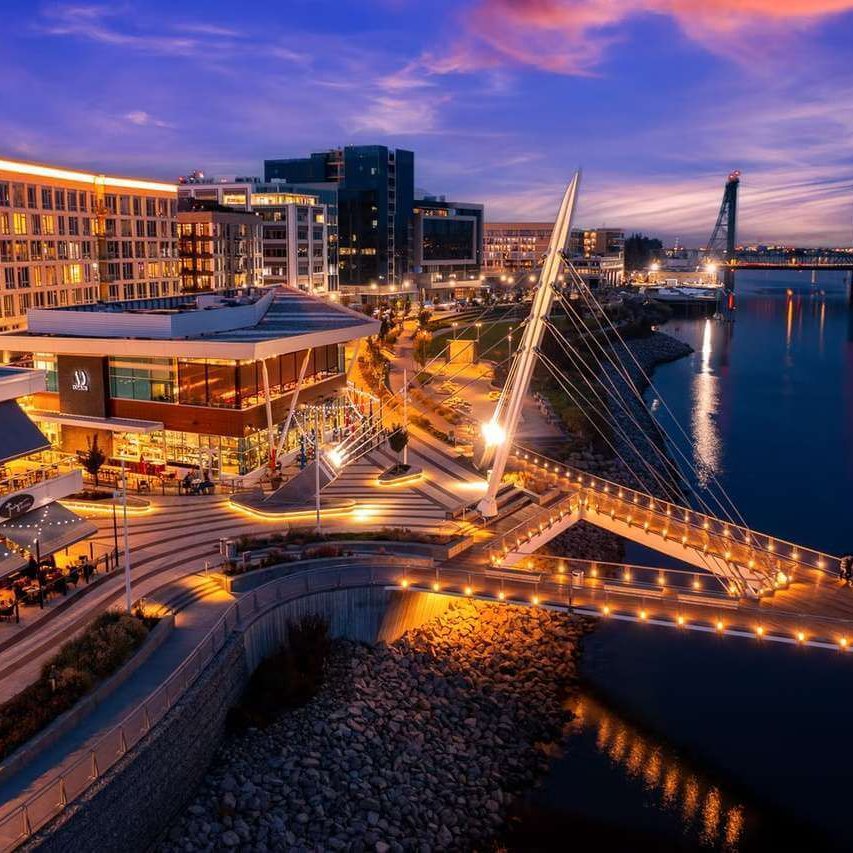
Vancouver WA’s Columbia River waterfront reflects a city benefiting from Portland proximity and Washington tax advantages
2026 Economic Outlook
- SEH America semiconductor facility driving high-income employment in east Clark County
- PeaceHealth expansion and OHSU Oregon campus driving healthcare demand
- Downtown revitalization around Waterfront Vancouver development attracting young renters
- Remote work normalization allowing Portland earners to live in Washington full-time
- I-5 Bridge Replacement Project advancing, improving transit connectivity to Portland
Investment Climate
Vancouver WA’s investment environment is defined by an unusually favorable combination for 2026: genuine cash flow potential, appreciation driven by structural migration, and a landlord regulatory environment that is among the most reasonable in the Pacific Northwest. Successful Vancouver WA investors tend to share a few characteristics:
- Cash flow orientation with positive or neutral cash flow achievable in most neighborhoods with conventional financing
- Tax advantage awareness understanding how Washington residency affects their own tax position as investors
- Portland market literacy tracking Oregon regulatory changes that push landlords and capital across the river
- Neighborhood trajectory focus identifying which corridors are receiving Portland spillover demand earliest
- Long-term patience as the market matures from a bedroom community to a genuine independent economic hub
The Portland regulatory environment has become one of Vancouver’s most reliable investment tailwinds. Every time Portland passes more restrictive landlord legislation (and it does so frequently), another cohort of Oregon landlords and investors considers moving their capital across the river. This cross-border capital flow has been accelerating since 2019 and shows no sign of reversing.
Historical Performance
| Period | Market Driver | Avg Annual Appreciation | Key Event |
|---|---|---|---|
| 2010–2014 | Post-recession recovery, Portland spillover begins | 4–6% | Clark County diversifying beyond Portland commuter base |
| 2015–2019 | Portland housing crisis, Oregon regulation increases | 8–12% | Portland median home crosses $400K; Vancouver looks like value |
| 2020–2022 | Pandemic remote work, suburban demand surge | 15–22% | Inventory hit record lows; multiple offers standard in all price ranges |
| 2023–2024 | Rate shock, normalization | 2–4% | Inventory rose modestly but absorption remained healthy at $400K–$500K |
| 2025–2026 | Rate stabilization, Oregon exodus acceleration | 6–9% (projected) | Waterfront Vancouver development creating new demand; I-5 Bridge Replacement advancing |
Vancouver WA’s 15-year track record shows average annual appreciation of 6–8%, consistently outperforming the national average while maintaining cash flow characteristics that most Pacific Northwest markets cannot match. A $250,000 Vancouver property purchased in 2010 would be worth approximately $600,000–$700,000 today, while generating consistent rental income throughout.
Demographic Trends Driving Demand
- Portland Tax Refugees — Professionals earning Oregon salaries relocating to Vancouver to eliminate state income tax while maintaining the same commute to Portland employers
- Portland Landlord Exodus — Oregon investors selling Portland rentals under increasingly restrictive regulations and redeploying capital in Washington
- California Migration — West Coast professionals seeking Portland metro access at lower price points, choosing Vancouver for its housing value
- Healthcare Employment Growth — PeaceHealth and OHSU expansion creating a concentrated high-income healthcare worker population on the Washington side
- Semiconductor Industry Workers — SEH America and supporting industries creating a technology employment base independent of Portland
- Remote Workers — Post-pandemic normalization allowing full Washington residency with zero Oregon income tax exposure, transforming the tax calculus for remote workers at Portland-area companies
- Clark College Enrollment — 12,000+ students creating consistent rental demand in central and north Vancouver neighborhoods
📚 New to real estate investing? Master the fundamentals with our professional course Learn more →
2. Neighborhood Hotspots
Vancouver WA Investment Neighborhood Map
Interactive map of Vancouver WA’s investment neighborhoods. Green stars show top hotspots, blue circles mark established markets, and orange circles highlight emerging areas.
Core Investment Neighborhoods
Detailed Submarket Analysis: All Vancouver WA Neighborhoods
| Neighborhood | Price Range (SFH) | Cap Rate | Growth Drivers | Best Strategy |
|---|---|---|---|---|
| Uptown Village / Arnada | $380K–$520K | 5.5–7.0% | Arts scene, walkability, gentrification, Clark College | Value-add SFH, small multi-family, BRRRR |
| Salmon Creek | $430K–$580K | 5.0–6.5% | PeaceHealth Medical Center, good schools, family demand | Buy-and-hold SFH, stable long-term rental |
| Fisher’s Landing / East Vancouver | $420K–$560K | 5.5–7.0% | I-205 Portland commuter access, newer stock, strong schools | Cash flow SFH, Portland commuter rental |
| Esther Short / Downtown | $320K–$520K | 5.5–6.5% | Waterfront revitalization, urban renewal, young renters | Condo, urban rental, appreciation play |
| Hough | $360K–$500K | 6.0–7.5% | Historic character, downtown proximity, Clark College | Value-add, historic renovation, BRRRR |
| Cascade Park | $390K–$510K | 5.5–6.5% | Mid-market stability, family demand, dual highway access | Stable buy-and-hold, lower-risk balanced returns |
| Hazel Dell | $330K–$430K | 6.5–8.0% | Best cash flow entry, affordable stock, working-class demand | Cash flow focus, value-add, portfolio building |
| Shumway | $420K–$580K | 5.0–6.0% | Historic homes, larger lots, professional tenant base | Appreciation hold, low-turnover professional rental |
| Fruit Valley | $290K–$380K | 7.0–9.0% | Lowest entry, gentrification spillover, waterfront proximity | Highest cash flow play, value-add, long-term patient capital |
| Camas (Clark County) | $550K–$800K | 4.5–5.5% | SEH America tech workers, premium schools, tight supply | Premium appreciation, executive rental, stable demographics |
Expert Insight: “The most overlooked opportunity in Vancouver right now is Hough and lower Arnada. Properties within a 10-minute walk of Esther Short Park are trading at 25 to 35 percent below comparable Portland neighborhoods like Overlook or Woodlawn, yet the lifestyle quality, commute access, and rental demand are essentially equivalent. As more Portland professionals realize the tax math on living in Washington, the gap should close meaningfully over the next 5 to 7 years.” — David Park, Principal, Columbia River Capital Partners
3. Property Types
| Investment Goal | Best Property Type | Best Neighborhoods | Minimum Capital |
|---|---|---|---|
| Maximum Cash Flow | Small multi-family or value-add SFH | Hazel Dell, Fruit Valley, Hough | $80,000+ |
| Best Appreciation | SFH in gentrifying corridors | Arnada, Esther Short, Hough | $100,000+ |
| Balanced Returns | SFH buy-and-hold with ADU potential | Salmon Creek, Fisher’s Landing | $110,000+ |
| Lowest Management | New townhome or 2010s+ SFH | Orchards, Salmon Creek, Fisher’s Landing | $105,000+ |
Don’t guess the costs. Our Complete Renovation & Remodeling Cost Guide covers 400+ pages of project-by-project breakdowns with real contractor pricing ranges.
4. Cost Analysis
Acquisition Cost Breakdown (Vancouver WA)
| Expense Item | Typical Cost | Example ($465,000 Property) | Notes |
|---|---|---|---|
| Down Payment | 25% (investment) | $116,250 | Standard for investment properties. House hacking allows 3.5–5% with FHA. |
| Closing Costs | 2–3% of price | $9,300–$13,950 | Title, escrow, lender fees, recording. Washington has no transfer tax for most residential purchases. |
| General Inspection | $400–$600 | $500 | Moisture inspection important in Pacific Northwest. Older Vancouver homes may have moisture intrusion. |
| Sewer Scope | $175–$350 | $250 | Recommended for pre-1980 homes. Sewer line replacement runs $8,000–$18,000. |
| Oil Tank Scan | $150–$300 | $200 | Pre-1965 homes only. Remediation can exceed $20,000 if a leaking tank is found. |
| Initial Repairs | 0–8% of price | $0–$37,200 | Older Arnada and Hazel Dell homes often need roof, HVAC, or deferred maintenance work. |
| Reserves (6 months) | 6 months expenses | $8,000–$12,000 | Lower than Seattle due to lower monthly expenses |
| TOTAL MINIMUM ENTRY | ~28–32% of value | $134,450–$180,150 | Significantly more accessible than Seattle or Portland premium neighborhoods |
Sample Cash Flow Analysis: Salmon Creek Single-Family Home
| Item | Monthly | Annual | Notes |
|---|---|---|---|
| Rental Income (3BR SFH) | $2,100 | $25,200 | Salmon Creek, updated 3BR/2BA, 1,600 sq ft |
| Less Vacancy (5%) | -$105 | -$1,260 | Conservative estimate; Salmon Creek typically under 3% |
| Property Taxes | -$420 | -$5,040 | ~1.08% effective rate on $467K assessed value |
| Insurance | -$110 | -$1,320 | Landlord policy, Clark County |
| Property Management (9%) | -$189 | -$2,268 | Recommended for out-of-area investors |
| Maintenance + CapEx | -$210 | -$2,520 | 10% of rent; 1990s home, reasonable maintenance budget |
| Net Operating Income | $1,066 | $12,792 | Before mortgage |
| Mortgage ($470K purchase, 25% down, 6.5%, 30yr) | -$2,229 | -$26,748 | Principal and interest on $352,500 loan |
| CASH FLOW | -$1,163 | -$13,956 | Modest negative carry at current rates; much better than Seattle/Portland equivalents |
| Cap Rate | 2.73% | NOI / Purchase Price | |
| Total Return (7.5% appreciation) | ~21% | Including equity, appreciation, and principal paydown on $116,250 invested |
Cash flow improves significantly in lower-priced neighborhoods. The same analysis run on a Hazel Dell value-add property at $380,000 purchase price typically shows positive cash flow of $200 to $400 per month with conventional financing. Fruit Valley properties under $340,000 can generate $400 to $700 per month positive cash flow, among the best in the Pacific Northwest at this price range.
Vancouver WA vs. Portland: Side-by-Side Investor Comparison
| Factor | Vancouver WA | Portland OR (Comparable) | Vancouver Advantage |
|---|---|---|---|
| Median SFH Price | $465,000 | $535,000 | 15% lower entry |
| Average Rental Yield | 5.5% | 4.2% | +130 basis points |
| Eviction Timeline | 4–8 weeks | 6–18 months | Dramatically faster |
| Rent Control | None (statewide ban) | Yes (3% cap in Portland) | Full market-rate flexibility |
| No-Cause Eviction | 20-day notice allowed | Banned in Portland | Flexible tenant management |
| State Income Tax | None | Up to 9.9% | $10K–$15K+ annual savings for investor |
| Property Tax Rate | ~1.08% effective | ~1.02% effective | Slightly higher but offset by income tax savings |
Expert Insight: “Vancouver is the only market in the Pacific Northwest where you can still buy a positive cash flow rental at scale with conventional financing. Every time I run a comparison between a Portland rental and a Vancouver rental at the same price point, Vancouver wins on yield by 100 to 150 basis points before you even account for the landlord law advantages. For investors who want to build a portfolio rather than just own one or two assets, Vancouver is the answer right now.” — Jennifer Walsh, CPA, Pacific Northwest Property Advisors
5. Legal Framework
✅ Vancouver WA: One of the More Landlord-Friendly Markets in the Pacific Northwest
Washington state landlord-tenant law is considerably more balanced than Oregon, and Clark County applies state law without the additional layers of restriction found in Seattle or Portland. This does not mean landlords have unlimited rights. Standard fairness rules, habitability requirements, and discrimination laws apply fully. But compared to Portland’s rent control, just cause eviction requirements, and relocation assistance mandates, Vancouver WA operates in a meaningfully different regulatory environment. Always consult a licensed Washington state attorney before acquiring rental properties.
Washington State Landlord-Tenant Law
The Residential Landlord-Tenant Act (RCW 59.18) governs all Clark County rental properties:
- No Rent Control: Washington has a statewide ban on local rent control ordinances. Landlords can raise rents to market rate with proper notice.
- Rent Increase Notice: 60 days advance written notice required for any rent increase (regardless of amount).
- No-Cause Eviction: Landlords may terminate month-to-month tenancies with 20 days written notice, without cause. (Note: this may be subject to legislative changes; verify current law.)
- Non-Payment Eviction: 14-day pay-or-vacate notice for unpaid rent. If not cured, unlawful detainer action follows.
- Security Deposits: Must be returned within 21 days of move-out with itemized statement. No statewide cap on deposit amount.
- Habitability Standards: Landlords must maintain heat, hot water, weathertight structure, sanitary facilities, and electrical systems.
- Maintenance Response: 24 hours for heat and hot water failures; 72 hours for refrigerator, range, and other appliances.
- No Source of Income Protection: Washington state does not require landlords to accept Section 8 vouchers (though discrimination in other protected classes remains illegal).
Clark County and Vancouver Specific Rules
Vancouver and Clark County add relatively few layers beyond state law:
- No Local Rent Control: Vancouver has not enacted any rent stabilization measures. State preemption applies.
- No First-in-Time Requirement: Unlike Seattle, Vancouver landlords can select among qualified applicants using their own judgment (within fair housing law limits).
- Business License: All rental property owners in Vancouver must hold a current City of Vancouver business license ($90–$150/year depending on revenue).
- Rental Registration: Clark County does not have a mandatory rental unit registration or inspection program comparable to Seattle’s RRIO.
- STR Rules (Short-Term Rentals): Vancouver requires a business license and compliance with zoning for STR operation. No strict primary residence requirement as in Seattle, but zoning review is required. Always verify current regulations.
- Fair Housing: Federal and state fair housing laws apply fully. No discrimination based on race, color, national origin, religion, sex, familial status, or disability.
Useful Vancouver WA Resources
- Washington State Landlord-Tenant Act: app.leg.wa.gov (RCW 59.18)
- Rental Housing Association of WA: RHAwa.com
- City of Vancouver Business License: cityofvancouver.us
- Clark County Assessor (property taxes): clark.wa.gov/assessor
| Regulation | Vancouver WA | Portland OR | Seattle WA |
|---|---|---|---|
| Rent Control | None (state ban) | Yes (3% annual cap) | None (state ban) |
| Just Cause Eviction | No (20-day notice allowed) | Yes (strictly required) | Yes (strictly required) |
| Eviction Timeline | 4–8 weeks | 6–18 months | 45–180+ days |
| First-in-Time Rule | No | No (Portland does not have this) | Yes (Seattle only) |
| Section 8 Acceptance | Not required statewide | Required statewide in Oregon | Required statewide in Washington |
| Rental Registration | Business license only | Registration required | RRIO required (inspections) |
| Rent Increase Notice | 60 days | 90 days | 180 days (CPI-exceeding increases) |
⚠️ Important Note on Washington Law Changes: Washington state has seen increasing legislative activity around tenant protections in recent sessions. While the state remains significantly more landlord-friendly than Oregon, some laws (including no-cause eviction rules) have been subject to legislative debate. Always verify current law with a Washington-licensed real estate attorney before acquiring investment property in Clark County.
6. Step-by-Step Vancouver WA Investment Playbook
Define Your Vancouver WA Strategy
Vancouver WA offers something Seattle and Portland cannot: genuine cash flow alongside appreciation. Before buying, be clear on which of these strategies you are executing:
Cash Flow Portfolio Build
Buy affordable SFH in Hazel Dell, Fruit Valley, or Orchards. Stabilize and rent. Repeat across multiple properties as equity builds. Vancouver’s lower price points allow building a 4 to 8 property portfolio on the same capital Seattle or Portland would require for 1 to 2 assets.
Portland Arbitrage Play
Target Portland commuter corridors (Fisher’s Landing, Cascade Park, Salmon Creek). Rent to Portland-employed families who choose Vancouver for the tax savings and school quality. Stable tenants with strong incomes and low turnover.
Value-Add / BRRRR
Buy dated homes in Arnada, Hough, or Hazel Dell. Renovate kitchens, bathrooms, and key systems. Reappraise and refinance to pull equity. Redeploy into next purchase. Works especially well in Vancouver’s older core where housing stock is most underutilized.
Appreciation / Downtown Bet
Buy in Esther Short, lower Arnada, or the Waterfront zone. Accept break-even or slightly negative cash flow while the downtown revitalization matures. Best for investors who see Vancouver becoming an independent urban destination, not just a Portland satellite.
Build Your Vancouver WA Team
The regulatory environment is more straightforward than Seattle or Portland, but local expertise still matters enormously for identifying deals and avoiding common pitfalls. Essential team members:
- Clark County-Focused Real Estate Agent: Must have genuine investment transaction experience. Should understand the Portland commuter demand dynamics and know which neighborhoods are receiving the most Oregon migration pressure.
- Washington State Real Estate Attorney: For entity setup (LLC preferred), lease template review, and any legal disputes. Clark County courts move much faster than Multnomah County for any landlord matters.
- Vancouver-Area Property Manager: Strongly recommended for out-of-area investors. Look for companies managing 100+ Clark County doors with documented experience in the Portland commuter market.
- Clark County General Contractor: For value-add work, you need a contractor who understands Clark County permit requirements and has subcontractor relationships in the market. Portland-based contractors may not be competitive on Vancouver projects.
- Pacific Northwest CPA with Washington Rental Experience: The Washington versus Oregon tax analysis for investors living in either state is nuanced. An accountant who handles both sides of the river is invaluable.
Expert Tip: When interviewing property managers, ask specifically: “How many of your current tenants work in Portland and commute from Vancouver?” Companies that track this are thinking about the demand dynamics that define the Vancouver market. High Portland-commuter tenant share typically means higher income tenants, lower default rates, and longer average tenancy.
Vancouver WA-Specific Due Diligence
Physical Due Diligence
- Sewer scope for all pre-1980 homes (clay pipe common in Arnada, Hough, Hazel Dell)
- Oil tank scan for pre-1965 construction
- Moisture and mold inspection given Pacific Northwest rainfall patterns
- Roof inspection with moss assessment (endemic in Vancouver)
- HVAC age and condition (older systems in 1950s–1970s stock)
- Foundation drainage especially on lots with slopes toward the Columbia
- Radon testing for basement units in Clark County (elevated risk area)
Market Due Diligence
- Pull 90-day rental comps specific to the neighborhood and unit type
- Verify commute time to I-5 and I-205 crossing points during peak hours
- Check school district boundaries if targeting family rental demographic
- Review any active city planning overlays (downtown districts have design review)
- Confirm flood zone status (portions near the Columbia and Lake River)
- Verify ADU eligibility on lot if ADU strategy is planned
- Check Vancouver business license history of the property (existing rental verification)
Competing and Winning in the Vancouver Market
Vancouver WA is more competitive than many investors expect, particularly in the $380,000 to $520,000 range that includes the best rental properties. Strategies that work:
- Pre-inspections in high-demand neighborhoods: Arnada, Salmon Creek, and Fisher’s Landing properties that are priced well often receive multiple offers within days. Conducting your inspection before offering allows cleaner, contingency-reduced offers.
- Know the Oregon investor exodus opportunity: Portland landlords selling Vancouver properties that already have tenants often need quick, clean closings without seller concessions. Being positioned as a knowledgeable Washington-market buyer can win deals without the highest price.
- Target the Hazel Dell and Fruit Valley off-market: Long-term owner-occupants in these neighborhoods rarely list conventionally. Direct mail and wholesaler relationships surface the best value-add opportunities before they reach the MLS.
- Occupied tenant properties: Properties with challenging tenant situations in Portland-commuter neighborhoods can be acquired at meaningful discounts. Washington’s more functional eviction process makes these manageable compared to Portland equivalents.
- Clark County auctions and tax sales: A small but consistent supply of Clark County distressed properties moves through auction channels at below-market prices, particularly in Hazel Dell and older Arnada.
7. Financing Options for Vancouver WA
| Loan Type | Down Payment | Rate Premium | Best For | Vancouver WA Note |
|---|---|---|---|---|
| Conventional Investment | 25% | +0.5–0.75% | Strong W-2 income, good credit | Most Vancouver properties stay below the conforming loan limit of $806,500, keeping costs lower than Seattle |
| FHA (House Hacking) | 3.5% | Standard + MIP | Owner-occupying one unit of 2–4 unit property | Best entry point; Arnada and Hough duplexes ideal for this strategy |
| DSCR Loan | 25–30% | +1.5–2.5% | Self-employed, no income docs | Vancouver cap rates are high enough that many properties actually qualify at 1.0x DSCR, unlike Seattle or Portland |
| Portfolio Loan | 20–25% | +1–2% | Multiple properties, investors with 5+ loans | Columbia Credit Union, iQ Credit Union, and local Clark County banks offer portfolio programs |
| Hard Money (Bridge) | 15–25% | 8–12% rate | BRRRR acquisitions, fix-and-flip | Several Portland-based hard money lenders are very active in the Clark County market |
| 1031 Exchange Into Vancouver | Equity from sold property | Standard | Portland investors exiting Oregon properties | Major opportunity: Portland landlords selling under Oregon restrictions can 1031 into Vancouver WA for dramatically better landlord laws |
| VA Loan (Veterans) | 0% | Below market | Eligible veterans, owner-occupied | Vancouver is close to several military installations (JBLM 2 hours south). VA buyers are a significant buyer pool to understand as a seller eventually. |
Vancouver WA Financing Advantage: Unlike Seattle, the majority of Vancouver WA investment properties fall below the $806,500 conforming loan limit, qualifying for conventional conforming rates rather than jumbo pricing. This translates to 0.25 to 0.50 percent lower interest rates on most purchases, improving cash flow by $80 to $150 per month relative to what Seattle or higher-priced Portland investments would cost to finance. Combined with the higher cap rates, Vancouver WA is genuinely one of the best-penciling Pacific Northwest markets for new investors entering with $100,000 to $150,000 in capital.
8. Frequently Asked Questions

Knowledge Quiz: Vancouver WA Real Estate Investment
Open Quiz
5 quick questions on what you just learned about investing in Vancouver WA
1) What is the single biggest structural driver of Vancouver WA’s real estate demand?
Answer: B
The guide identifies the Portland employment plus Washington zero income tax combination as the primary driver. A professional earning $120,000 working in Washington saves $10,000 to $14,000 per year by living in Vancouver vs. Oregon. This structural advantage is permanent and self-reinforcing, creating sustained demand for Vancouver housing at a meaningful discount to Portland prices.
2) How does Vancouver WA’s eviction process compare to Portland OR?
Answer: C
Clark County’s eviction process uses Washington state law, which allows no-cause eviction with 20 days notice and processes non-payment evictions in 4 to 8 weeks. Portland’s just cause eviction ordinance, relocation assistance requirements, and heavily backed-up Multnomah County housing court create timelines of 6 to 18 months for even straightforward cases. This difference is one of the primary reasons Portland investors are moving capital to Vancouver.
3) Which Vancouver WA neighborhood does the guide identify as offering the best cash flow entry point?
Answer: D
The guide identifies Hazel Dell as Vancouver’s best cash flow entry point, with cap rates of 6.5 to 8.0% and SFH prices of $330,000 to $430,000. The guide specifically notes that Hazel Dell and Fruit Valley properties can generate $200 to $700 per month positive cash flow even with conventional 25% down financing, which is exceptional in the Pacific Northwest context.
4) Why does the guide say Vancouver WA is better suited for DSCR loans than Seattle?
Answer: A
The guide explains that Seattle’s cap rates of 3 to 4.5% are so far below current interest rates that NOI cannot cover debt service, disqualifying most Seattle properties for DSCR lending. Vancouver’s cap rates of 5.5 to 7.5% in many neighborhoods are high enough that the property’s income covers the mortgage, meeting the 1.0x DSCR threshold that lenders require.
5) What does the guide say about the I-5 Bridge Replacement Project and which neighborhoods stand to benefit most?
Answer: B
The guide explains that the I-5 Bridge Replacement Project includes extension of Portland’s MAX Yellow Line light rail across the Columbia River into downtown Vancouver. The guide identifies Esther Short, lower Arnada, and Hough as closest to anticipated station locations, with investors buying in those neighborhoods in 2025 to 2026 potentially positioned for strong appreciation as the project advances into the early 2030s.
Work With a Local Expert in Vancouver WA
We are building a verified network of real estate professionals across every market we cover.

About Our Expert Network
We are finalizing partnerships with verified real estate professionals across every market featured on Builds and Buys. Each expert in our network is selected for their hands-on investment experience in Clark County, knowledge of the Portland commuter demand dynamics, and commitment to helping investors make sound decisions on both sides of the Columbia River.
Our local specialists offer:
- Proven experience with investment and income-producing properties in Clark County
- Deep knowledge of Vancouver WA neighborhood pricing, rental yields, and Portland commuter demand
- Guidance on Washington vs. Oregon tax structure and how it affects investor returns
- Access to off-market and pre-market opportunities including Portland investor selloffs
- Full transaction support from search through closing
- Ongoing portfolio and property management referrals in the Clark County market
Services Covered
- Property sourcing and acquisition
- Investment analysis and underwriting
- Buyer representation
- Market comparables and valuations
- Short-term and long-term rental strategy
- Value-add and renovation guidance
- Legal and title referrals
- Financing and lender connections
- Property management referrals
- Insurance and inspection referrals
- 1031 exchange coordination (Portland → Vancouver)
- Exit strategy planning
Get Connected or Join Our Network
Looking for a local expert to help with your Vancouver WA investment? Reach out and we will connect you with the right professional for your market and strategy.
Are you a Clark County real estate professional with a track record working with investors? We are always expanding our network of verified local experts.
Contact us at support@buildsandbuys.com
Find Specialized Vancouver WA Real Estate Professionals
Ready to Invest in Vancouver WA?
Vancouver Washington is one of the most compelling real estate investment markets in the Pacific Northwest for investors who understand the dynamics. Portland metro employment, Washington’s zero income tax, genuine cash flow potential at accessible price points, and a landlord regulatory environment that actually functions, all combine to create an investment thesis that is hard to replicate anywhere else on the West Coast. Whether you are a first-time investor building your first portfolio or a Portland landlord exiting Oregon for a more landlord-friendly jurisdiction, Vancouver WA deserves serious consideration in 2026.
Continue Your Research
Washington State Guide
See how Vancouver compares to Seattle, Spokane, Tacoma, and other Washington markets.
Step-by-Step Invest
Complete framework for building a real estate investment strategy from scratch.
144-Lesson Course
University-level real estate education covering financing, law, strategy, and management.
For further guidance, explore our State-by-State Investor guides, browse our expert articles, or follow our Step-by-Step Investment Guide.



