
South Sioux City Nebraska Real Estate Investment Guide For 2026
A comprehensive resource for investors looking to build cash flow in Nebraska’s corner of the tri-state Sioux City metro in 2026
Quick answers: Top 5 most searched South Sioux City investment questions ▼
Migration data: Where people are moving from to South Sioux City ▼
In This Guide
Click on any section to navigate directly to that content
1. South Sioux City Market Overview
Market Fundamentals
South Sioux City is Nebraska’s largest city in Dakota County, though Dakota City holds the county seat, sitting directly across the Missouri River from Sioux City, Iowa, a city of roughly 85,000. Together with nearby South Dakota communities, the two cities anchor the genuinely cross-state Sioux City metropolitan area. South Sioux City itself covers a compact 6.6 square miles, but its economic reach extends well beyond its borders through the shared Missouri River metro.
Key economic indicators that define South Sioux City’s investment case:
- Population: Roughly 14,500-14,800 city proper, part of Dakota County’s approximately 21,700 residents
- Major Employers: Tyson Foods, South Sioux City Community School District, and the broader Sioux City metro job market accessible across the river
- Foreign-Born Share: Roughly 34% of residents were born outside the United States, among the highest shares of any Nebraska city, reflecting a long manufacturing-driven immigration history
- Homeownership Rate: Roughly 54-56%, meaningfully below the eastern Nebraska norm
- Primary Employment Sector: Manufacturing is the single largest sector for South Sioux City residents, ahead of healthcare and education
South Sioux City’s real advantage is structural: it offers Nebraska’s more landlord-friendly legal framework and generally lower relative pricing than the Iowa side, while sitting close enough to Sioux City, Iowa, for residents to access a genuinely larger metro job market, retail base, and healthcare system. That cross-river relationship is the single most important thing to understand about this market.
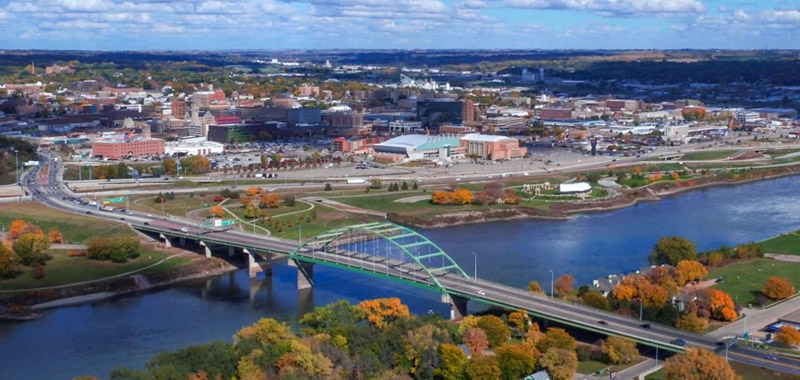
South Sioux City sits on the Missouri River directly across from Sioux City, Iowa, forming a genuine tri-state metro
2026 Economic Outlook
- Manufacturing, including Tyson operations in the area, remains the dominant local employment driver
- Population estimated near 14,772 as of mid-2025, continuing modest growth
- The 22-mile Al Bengtson Trail Network and riverfront amenities continue supporting quality-of-life demand
- Wide price variation across data sources signals a market where local, tier-specific comps matter more than a citywide average
- Days on market commonly around 45, a moderate pace for a small Nebraska city
Investment Climate
South Sioux City offers solid yields near the manufacturing corridor and Dakota Avenue, backed by a genuinely large regional tenant pool given the shared Sioux City metro economy. Successful South Sioux City investors tend to share a few characteristics:
- Clarity on which side of the river a comparable sale sits on, since Iowa and Nebraska pricing, taxation, and landlord-tenant law do not translate directly
- Comfort with a genuinely international tenant base, given the city’s high foreign-born share
- Local relationships since the professional pool, while benefiting from proximity to the larger Sioux City market, still requires Nebraska-specific expertise
- Manufacturing-aware underwriting, recognizing that employment here is genuinely concentrated in industrial and processing work
- A local property manager or a real self-management plan, ideally one that understands both the Nebraska and Iowa sides of the metro
South Sioux City rewards an investor who treats it as Nebraska’s access point into a larger metro economy, not as an isolated small town, while still respecting that Nebraska law, not Iowa law, governs any property here.
Historical Performance
| Period | Market Driver | Avg Annual Appreciation | Key Event |
|---|---|---|---|
| 2010-2014 | Post-recession stability, manufacturing base steady | 0-2% | Minimal price movement, cross-river metro economy holds |
| 2015-2019 | Steady manufacturing and metro-area demand | 1-3% | Al Bengtson Trail Network expansion supports amenity base |
| 2020-2022 | Cheap money, essential-industry manufacturing held through the pandemic | 3-6% | Manufacturing operations classified as essential, continued through disruption |
| 2023-2024 | Rate shock, wide price dispersion across data sources | 1-4% | Median property value figures diverge meaningfully by measurement approach |
| 2025-2026 | Normalization, riverfront district continuing to draw newer development | 1.5-3.5% | Population estimated near 14,772, continued modest growth |
South Sioux City’s appreciation trend has been modest and steady, buoyed by the resilience of manufacturing employment through economic disruptions and the genuine amenity value of its riverfront and trail investments.
Demographic Trends Driving Demand
- Manufacturing Base – The largest employment sector for South Sioux City residents, including Tyson operations in the area, anchoring steady workforce rental demand
- Cross-River Metro Access – Proximity to Sioux City, Iowa, a city of roughly 85,000, gives residents access to a genuinely larger job market, retail base, and healthcare system than the Nebraska city alone could support
- International Community – Roughly a third of residents were born outside the United States, reflecting decades of manufacturing-driven immigration to the Sioux City metro
- Al Bengtson Trail Network – A genuine 22-mile paved trail system and annual events like the Mighty Mo Run support quality-of-life demand and community identity
- Young Population – A median age around 30-31, notably younger than the Nebraska state median, supporting active rental and family formation demand
- South Sioux City Community Schools – A single district serving the city, a genuine draw for family buyers and renters alike
📚 New to real estate investing? Master the fundamentals with our professional course Learn more →
2. Area Hotspots
South Sioux City Investment Area Map
Interactive map of South Sioux City’s investment areas. Green stars show top hotspots, blue circles mark established markets, and orange circles highlight emerging areas.
Core Investment Areas
Detailed Area Analysis: All South Sioux City Submarkets
| Area | Price Range (SFH) | Cap Rate | Growth Drivers | Best Strategy |
|---|---|---|---|---|
| Dakota Avenue / Manufacturing Corridor | $140K-$225K | 6.5-8.5% | Manufacturing employment, largest local sector | Workforce rental buy-and-hold |
| Central South Sioux City | $150K-$240K | 6-8% | Established diverse community, central location | Balanced hold, family rental |
| Sioux City, Iowa Bridge Corridor | $155K-$250K | 5.5-7.5% | Direct Iowa commute access, cross-river convenience | Commuter rental hold |
| Riverfront / Al Bengtson Trail District | $220K-$400K | 4-5.5% | River views, trail network, newest inventory | Long-term family rental, appreciation hold |
Expert Insight: “The thing people get wrong about South Sioux City is treating it like an isolated small town when it is really a corner of a much bigger metro. Sioux City proper across the river has close to six times the population. That means our tenant pool draws from a genuinely regional economy, not just this 6.6 square mile city. What it also means is you cannot casually compare a South Sioux City listing to a Sioux City, Iowa listing and think you understand the deal. Different tax structure, different landlord-tenant law, different everything except the river between them.” – Dakota County real estate broker
3. Property Types
| Investment Goal | Best Property Type | Best Areas | Minimum Capital |
|---|---|---|---|
| Maximum Cash Flow | Manufacturing corridor single-family or duplex | Dakota Avenue / Manufacturing Corridor | $35,000+ |
| Maximum Appreciation | Riverfront new construction | Riverfront / Al Bengtson Trail District | $55,000+ |
| Balanced Returns | Established central single-family | Central South Sioux City | $36,000+ |
| Cross-River Commuter Demand | Single-family near the bridge corridor | Sioux City, Iowa Bridge Corridor | $38,000+ |
| First Investment / House Hack | Owner-occupied duplex using FHA | Dakota Avenue Corridor, Central South Sioux City | $18,000+ |
Don’t guess the costs. Our Complete Renovation & Remodeling Cost Guide covers 400+ pages of project-by-project breakdowns with real contractor pricing ranges.
4. Cost Analysis
Acquisition Cost Breakdown (South Sioux City)
| Expense Item | Typical Cost | Example ($185,000 Property) | Notes |
|---|---|---|---|
| Down Payment | 25% (investment) | $46,250 | 20% is available on some 2-4 unit programs |
| Closing Costs | 2-3% of price | $3,700-$5,550 | Title, lender fees, recording, Nebraska documentary stamp tax |
| General Inspection | $350-$525 | $425 | Older Dakota Avenue and central stock warrants a thorough structural review |
| Radon Test | $150-$250 | $200 | Dakota County shows among the highest predicted radon potential in Nebraska. Mitigation runs $1,200-$2,500. |
| Flood Risk Review | $150-$300 | $0-$225 | Genuinely relevant given the Missouri River corridor, verify flood zone status on riverfront properties |
| Initial Repairs | 0-15% of price | $0-$27,750 | Highly variable, older Dakota Avenue and central stock skews toward the higher end |
| Reserves (6 months) | 6 months expenses | $6,500-$9,500 | Reasonable given the city’s genuinely deep, manufacturing-anchored tenant pool |
| TOTAL MINIMUM ENTRY | ~31-49% of value | $57,150-$90,650 | Moderate entry cost, reflecting the city’s genuinely mixed price tiers |
Sample Cash Flow Analysis: Dakota Avenue Corridor Single-Family
Purchase price $165,000. Light renovation $12,000. All-in cost $177,000. Rented as a 3-bedroom single-family at $1,050/month.
| Item | Monthly | Annual | Notes |
|---|---|---|---|
| Gross Rent | $1,050 | $12,600 | 3BR single-family, Dakota Avenue corridor, close to manufacturing employment |
| Less Vacancy (7%) | -$74 | -$888 | Reasonable assumption given the city’s deep manufacturing-anchored tenant pool |
| Property Taxes | -$207 | -$2,484 | Roughly 1.4% of the $177,000 all-in value, confirm current Dakota County levy |
| Insurance | -$110 | -$1,320 | Landlord policy, confirm flood coverage separately if the property is near the river |
| Property Management (10%) | -$98 | -$1,176 | Standard South Sioux City residential management rate |
| Maintenance + CapEx (9%) | -$95 | -$1,140 | Slightly conservative given the light renovation just completed |
| Net Operating Income | $466 | $5,592 | Before mortgage |
| Mortgage ($123,750 loan, 25% down on purchase price, 7.0%, 30yr) | -$823 | -$9,876 | Principal and interest only, renovation paid in cash |
| CASH FLOW | -$357 | -$4,284 | Negative at 25% down and 7.0% financing on the purchase price alone |
| Cap Rate | 3.16% | NOI divided by $177,000 all-in cost, at the retail rent used here |
The blunt version: as with every market in this series, financing a retail purchase at current rates lands negative even near steady manufacturing employment. The properties that actually deliver South Sioux City’s advertised 6.5-8.5% yields near Dakota Avenue are bought at a real discount below the $165,000 used here, from a listing that has sat past 45 days, or bought with a larger down payment.
Expert Insight: “Investors sometimes come to South Sioux City expecting Sioux City, Iowa pricing and get confused when the numbers don’t quite match on either side. They are two different tax and legal systems sitting a bridge apart. Underwrite the Nebraska side on Nebraska numbers. Do not import an Iowa cap rate assumption or an Iowa tax assumption into a South Sioux City deal, because the two states genuinely diverge on both fronts.” – Dakota County property manager
5. Legal Framework
⚠️ South Sioux City Compliance Notice
Nebraska is a landlord friendly state, and South Sioux City does not currently operate a municipal rental registration or inspection program. Statutes and municipal ordinances change. This guide provides an overview only. Always confirm current requirements with a Nebraska-licensed real estate attorney and the City of South Sioux City before acquiring rental property, and never assume Iowa law applies to a Nebraska-side property just because Sioux City, Iowa, sits a bridge away.
Nebraska and South Sioux City Regulations
Residential tenancies in South Sioux City are governed by the Nebraska Uniform Residential Landlord and Tenant Act, Nebraska Revised Statutes 76-1401 through 76-1449. South Sioux City has no additional municipal rental registration ordinance layered on top of state law:
- No Municipal Rental Registration: Unlike Omaha’s Ordinance 41767, South Sioux City does not currently require rental unit registration or a mandatory inspection cycle. Confirm current status with the city before relying on this.
- No Rent Control: Nebraska has no statewide rent control and South Sioux City has not adopted one. Rent increases on a month-to-month tenancy require written notice ahead of the next rental period, and 30 days is the standard practice.
- No Just Cause Requirement: A landlord may decline to renew an expiring lease, and may terminate a month-to-month tenancy with at least 30 days written notice under Nebraska Revised Statute 76-1437(2).
- Security Deposits: Capped at one month’s rent, plus up to an additional one quarter month’s rent as a pet deposit. Must be returned within 14 days of termination with an itemized statement of any deductions.
- Wrongful Withholding Penalty: A tenant may recover 1.5 times any amount wrongfully withheld. Document unit condition on move-in and move-out with dated photographs.
- Nonpayment Notice: 3 day written notice to pay or vacate under Nebraska Revised Statute 76-1431(2).
- Lease Violation Notice: Generally 14 days to cure, with termination in 30 days if the breach is not remedied.
- Landlord Entry: At least 24 hours notice required for non-emergency entry, at reasonable times.
Compliance Best Practices
South Sioux City compliance is simple on paper, but the cross-river metro location creates a few genuine practical wrinkles:
- Confirm City Rules Directly: Check with the City of South Sioux City directly for current rental rules before you close, since these can change.
- Never Assume Iowa Rules Apply: Sioux City, Iowa, follows Iowa Code Chapter 562A, a genuinely different landlord-tenant framework than Nebraska’s NURLTA. Confirm which state governs any specific property before relying on comps or advice from across the river.
- Photograph Everything: Given the 1.5x deposit penalty, a full dated photo set at move-in and move-out is the cheapest insurance available.
- Use a Nebraska-Specific Lease: Generic online leases routinely include clauses unenforceable under NURLTA, and a lease template copied from an Iowa-side property manager may not comply with Nebraska law.
- Confirm Flood Zone Status on Riverfront Properties: Given the Missouri River corridor, verify flood zone designation and insurance requirements explicitly for any property near the river.
- Serve Notices Correctly: The 3 day nonpayment notice must be in writing and properly served, the same statewide standard that applies everywhere in Nebraska.
Useful South Sioux City Resources
- City of South Sioux City: southsiouxcity.org
- Dakota County Assessor’s Office (Dakota City)
- Dakota County Treasurer’s Office (Dakota City)
- Nebraska Revised Statutes 76-1401 to 76-1449 (NURLTA)
- Dakota County District Court (Dakota City)
| Regulation | South Sioux City Requirement | Nebraska State Law | Investor Impact |
|---|---|---|---|
| Eviction | No local just cause ordinance | 3 day notice for nonpayment, 14/30 for lease breach | Among the faster eviction processes in the country, and genuinely faster than Iowa’s process across the river |
| Registration | None currently, unlike Omaha’s Ordinance 41767 | No statewide registration program | One less compliance cost than an Omaha rental, confirm current status before closing |
| Rent Increases | No cap, no local ordinance | No rent control, written notice before the next rental period | Full freedom to reprice to market at renewal |
| Security Deposits | Follows state law | Max 1 month rent plus 1/4 month pet, return in 14 days | Tight window, and 1.5x penalty for getting it wrong; note Iowa allows up to two months rent, a real difference if you own on both sides |
| Property Tax | Effective rate varies by source, roughly 1.2-1.7% | State median near 1.39%, assessed at or near full market value | Confirm current Dakota County levy for the specific parcel, distinct from Iowa’s assessment methodology |
6. Step-by-Step South Sioux City Investment Playbook
Define Your South Sioux City Strategy
South Sioux City’s position inside a larger cross-state metro creates genuinely different strategies than an isolated small Nebraska town. Pick which of these you are executing before you look at a single listing:
Manufacturing Workforce Cash Flow
Buy near Dakota Avenue, price for manufacturing workers including Tyson employees, and hold. Requires buying at a genuine discount to work at current financing rates.
Cross-River Commuter Rental
Buy near the Iowa bridge corridor and target tenants who work in the larger Sioux City, Iowa metro but prefer Nebraska’s landlord-tenant framework.
Central Family Hold
Buy in Central South Sioux City’s established neighborhoods and target long-tenure family renters at a balanced yield.
Riverfront Appreciation Hold
Buy newer riverfront construction near the Al Bengtson Trail Network and accept lower yield for the strongest lifestyle appeal and appreciation in the city.
Build Your South Sioux City Team
Because South Sioux City sits inside a larger cross-state metro, some professionals in the market may work primarily on the Iowa side. Confirm Nebraska-specific expertise directly. Non-negotiable team members:
- Nebraska-Licensed Agent Active in Dakota County: Confirm they actually close Nebraska-side transactions regularly, not just Iowa-side Sioux City deals.
- Nebraska Real Estate Attorney: For entity structure, NURLTA-compliant lease review, and eviction filings if they become necessary. Confirm they practice Nebraska law specifically, not Iowa law.
- Local Property Manager or Self-Management Plan: A manager who understands the genuinely regional tenant pool while applying Nebraska-specific compliance.
- General Contractor Familiar with Older Homes: Essential for Dakota Avenue and central South Sioux City properties given the age of the housing stock.
- Real Estate CPA: For depreciation strategy and entity structuring, ideally one familiar with both Nebraska and Iowa tax treatment if you’re considering properties on both sides of the river.
- Dakota County Assessor Contact: Worth understanding the reassessment cycle directly.
Expert Tip: Ask any prospective South Sioux City agent or attorney directly whether they primarily work Nebraska or Iowa transactions. Given the shared metro, it’s genuinely common for local professionals to specialize on one side of the river, and you want someone whose day-to-day expertise is Nebraska law and Nebraska comps.
South Sioux City-Specific Due Diligence
Standard due diligence plus the items that specifically matter in this market:
Physical Due Diligence
- Full structural and mechanical inspection on any older Dakota Avenue or central South Sioux City property
- Radon test, given Dakota County’s high predicted radon potential
- Flood zone verification for any riverfront or near-river property
- Roof condition and hail damage history, a recurring statewide consideration
- Electrical service size on older housing stock
- Confirm which utility provider serves the specific parcel, since some services may cross municipal boundaries in this metro
Regulatory and Financial Due Diligence
- Confirm current City of South Sioux City rental rules directly
- Pull the Dakota County Assessor record and confirm the current effective tax rate for the specific parcel
- Verify the property is genuinely on the Nebraska side of the state line, not an Iowa-side listing mistakenly compared
- Review any existing leases and whether deposits transfer at closing
- Given genuinely wide price variation across data sources, use a local appraiser with actual South Sioux City transaction history
- Confirm flood insurance requirements explicitly for any Missouri River-adjacent property
Acquire, Renovate, and Operate
South Sioux City homes commonly sell in around 45 days, a moderate pace reflecting the city’s access to a genuinely larger regional buyer pool through the shared Sioux City metro.
Winning Offers in South Sioux City
- Target listings past 45 days. A property sitting past the average has real negotiating room.
- Underwrite the discount, not the retail price. The cash flow analysis in this guide shows retail-priced financing lands negative even near steady manufacturing employment.
- Get a local Nebraska-side appraiser. The genuinely wide price spread across data sources means an appraiser unfamiliar with the Nebraska-Iowa divide can easily misprice a property.
- Confirm your tenant source before you close. Know whether you are targeting manufacturing workforce, cross-river commuters, or established central families, since the underwriting differs for each.
- Do not skip the flood zone check on riverfront properties. This is a genuine, recurring consideration given the Missouri River corridor.
First 30 Days After Closing
- Confirm current City of South Sioux City rental requirements directly
- Bind landlord insurance and confirm flood coverage explicitly if near the river
- Photograph the entire unit, dated, before any tenant takes possession
- Set the rent to South Sioux City’s actual local rent comps, not an Iowa-side or broader Nebraska assumption
- List the property where the local tenant pool actually looks, which given the regional metro may include both Nebraska and Iowa-facing platforms
Typical South Sioux City Management Fees
- Single-family management: 9-11% of monthly rent
- Leasing fee: 50-100% of one month’s rent
- Lease renewal fee: $125-$250 per renewal
- Confirm whether your manager is licensed and active specifically on the Nebraska side
7. Financing Options for South Sioux City
| Loan Type | Down Payment | Rate Premium | Best For | South Sioux City Note |
|---|---|---|---|---|
| Conventional Investment | 20-25% | +0.5-0.75% | W-2 income, good credit, standard purchases | Every South Sioux City purchase fits comfortably under the conforming limit |
| House Hacking (FHA) | 3.5% | Standard + MIP | Owner-occupying one unit of a 2-4 unit property | Given lower homeownership rates, small multi-family stock is genuinely available here, act quickly when one lists |
| Rural Development Loan (USDA) | 0% | Standard, with guarantee fee | Owner-occupants in USDA-eligible areas | May apply outside South Sioux City’s core, confirm eligibility by address |
| Local Community Bank Portfolio Loan | 20-30% | +0.5-1.5% | Multiple properties, self-employed, blanket loans | Dakota County and regional Sioux City metro community banks operate on both sides of the river, confirm they lend on Nebraska property specifically |
| DSCR Loan | 20-25% | +1.0-2.0% | Investors avoiding income verification | Workable near Dakota Avenue given a favorable rent-to-price ratio on discounted purchases |
| 203(k) / Renovation Loan | 3.5-25% | +0.25-1.0% | Buying and renovating in one loan | Well suited to older Dakota Avenue and central stock, confirm your lender will actually appraise a South Sioux City address |
| Hard Money (Bridge) | 10-25% | 10-13% rate | Value-add acquisitions, estate purchases | Given proximity to the larger Sioux City metro, more regional lenders are active here than in an isolated small Nebraska town, but confirm they lend on the Nebraska side |
South Sioux City Financing Reality: Financing itself is rarely the constraint given how far below conforming loan limits these prices sit, and the shared Sioux City metro means more regional lenders are active in this market than in a truly isolated small Nebraska town. The genuine friction point is confirming that any lender, appraiser, or comp you use is specific to the Nebraska side, since Iowa pricing and tax treatment do not translate directly.
8. Frequently Asked Questions

Knowledge Quiz: South Sioux City Real Estate Investment
Open Quiz
5 quick questions on what you just learned about South Sioux City investing
1) What makes South Sioux City’s metro position genuinely different from an isolated small Nebraska town?
Answer: C
South Sioux City sits across the Missouri River from Sioux City, Iowa, and together with nearby South Dakota communities they form a genuine cross-state Sioux City metropolitan area, giving South Sioux City access to a much larger regional economy than its 6.6 square mile footprint alone.
2) Which state’s landlord-tenant law governs a South Sioux City rental property?
Answer: B
Nebraska’s NURLTA governs any South Sioux City property, regardless of the shared metro economy with Sioux City, Iowa. Iowa Code Chapter 562A only applies to properties actually located in Iowa.
3) What is the single largest employment sector for South Sioux City residents?
Answer: A
Manufacturing is the single largest employment sector for South Sioux City residents, ahead of healthcare and education, and it anchors the city’s rental demand near the Dakota Avenue corridor.
4) Under Nebraska law, how much notice must a landlord give for nonpayment of rent?
Answer: D
Nebraska Revised Statute 76-1431(2) provides for a 3 day written notice to pay or vacate for nonpayment of rent, the same statewide standard that applies across Nebraska including South Sioux City.
5) Why should investors avoid using Sioux City, Iowa comparable sales when pricing a South Sioux City property?
Answer: B
Nebraska and Iowa have genuinely different property tax structures, assessment methodologies, and landlord-tenant frameworks, so a Sioux City, Iowa comparable sale does not directly translate to South Sioux City, Nebraska pricing or underwriting.
Work With a Local Expert in South Sioux City
We are building a verified network of real estate professionals across every market we cover.

About Our Expert Network
We are finalizing partnerships with verified real estate professionals across every market featured on Builds and Buys. Each expert in our network is selected for their hands-on investment experience, local market knowledge, and commitment to helping buyers and investors make sound decisions.
Our local specialists offer:
- Proven experience with investment and income-producing properties
- Deep knowledge of local pricing, rental yields, and neighborhood dynamics
- Guidance on financing, legal structure, and due diligence
- Access to off-market and pre-market opportunities
- Full transaction support from search through closing
- Ongoing portfolio and property management referrals
Services Covered
- Property sourcing and acquisition
- Investment analysis and underwriting
- Buyer representation
- Market comparables and valuations
- Short-term and long-term rental strategy
- Value-add and renovation guidance
- Legal and title referrals
- Financing and lender connections
- Property management referrals
- Insurance and inspection referrals
- 1031 exchange coordination
- Exit strategy planning
Get Connected or Join Our Network
Looking for a local expert to help with your investment? Reach out and we will connect you with the right professional for your market and strategy.
Are you a real estate professional with a track record working with investors? We are always expanding our network of verified local experts.
Contact us at support@buildsandbuys.com
Find Specialized South Sioux City Real Estate Professionals
Ready to Invest in South Sioux City?
South Sioux City offers something genuinely rare in this guide series: Nebraska’s landlord-friendly legal framework and relatively lower pricing, paired with real access to a larger, cross-state metro economy through Sioux City, Iowa. Manufacturing anchors steady rental demand, the riverfront and trail network add genuine lifestyle appeal, and a deep, genuinely international tenant base rounds out a market with real depth for its size. Buy below list, price rent for the tenant pool that actually exists here, and never let an Iowa-side comparable sale substitute for genuine Nebraska underwriting.
Continue Your Research
Nebraska State Guide
See how South Sioux City compares to Omaha, Norfolk, and other Nebraska markets.
Step-by-Step Invest
Complete framework for building a real estate investment strategy from scratch.
144-Lesson Course
University-level real estate education covering financing, law, strategy, and management.
For further guidance, explore our State-by-State Investor guides, browse our expert articles, or follow our Step-by-Step Investment Guide.



