
Seward Nebraska Real Estate Investment Guide For 2026
A comprehensive resource for investors looking to build equity in Nebraska’s official Fourth of July City and Lincoln’s closest college town in 2026
Quick answers: Top 5 most searched Seward investment questions ▼
Migration data: Where people are moving from to Seward ▼
In This Guide
Click on any section to navigate directly to that content
1. Seward Market Overview
Market Fundamentals
Seward is the Seward County seat, sitting just 25 to 30 minutes from Lincoln, Nebraska’s capital and second-largest city. This genuine commuter proximity is the single biggest factor shaping Seward’s real estate market, and it shows up directly in the numbers: median home values here run roughly $245,000 to $320,000, the highest of any city in this Nebraska guide series. Seward is also home to Concordia University, Nebraska, a private Lutheran institution founded in 1894 with roughly 2,300 to 3,500 total students, and to the largest Fourth of July celebration in the state, officially recognized by Nebraska Governor J. James Exon in 1973.
Key economic indicators that define Seward’s investment case:
- Population: Roughly 7,650-7,750 city proper, part of Seward County’s approximately 17,600 residents
- Major Employers: Concordia University Nebraska, local healthcare and schools, and a genuine share of residents commuting to Lincoln
- Median Household Income: Roughly $68,300-$72,600, among the highest of any city in this guide series
- Days on Market: Genuinely fast, recently averaging 23 days countywide
- Homeownership Rate: Roughly 60.6% in the city, meaningfully below the 72% county rate given the university’s student renter population
Seward’s honest investment story is one of appreciation and liquidity, not cash flow. Entry prices here run well above every other city in this guide series, and gross rental yields are correspondingly the lowest. What investors gain in exchange is genuine, ongoing demand from Lincoln’s growing metro area, a well-educated and higher-income renter base, and a housing market that moves fast rather than sitting unsold.
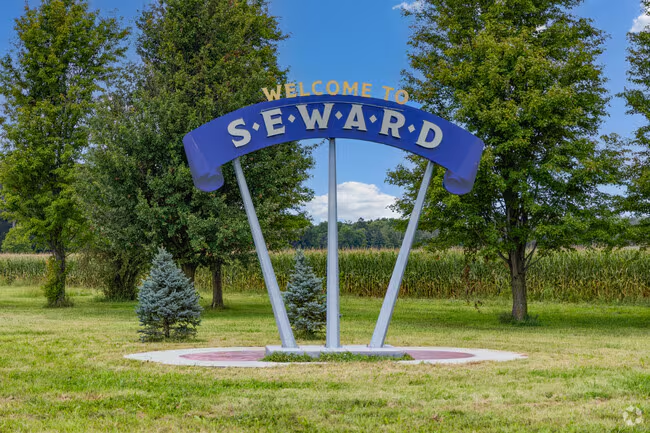
Seward, Nebraska’s official 4th of July City since 1973, sits just 25-30 minutes from Lincoln
2026 Economic Outlook
- Genuine Lincoln-commuter demand continues supporting home price appreciation, up roughly 8.4% over the past year per Zillow data
- Concordia University continues as a stable local institution with roughly 2,300-3,500 total students
- The annual Fourth of July celebration continues drawing 30,000-40,000 visitors, supporting downtown vitality
- Days on market remain genuinely fast, recently averaging 23 days countywide
- Gross rental yields remain the lowest in this guide series, reflecting genuinely high entry prices relative to rents
Investment Climate
Seward offers the lowest gross yields but genuinely the strongest appreciation and fastest market velocity of any city in this guide series. Successful Seward investors tend to share a few characteristics:
- Acceptance of lower day-one cash flow in exchange for genuine appreciation and market liquidity
- Comfort with genuinely higher entry pricing than every other city in this Nebraska guide series
- Local relationships since the professional pool understands both the university and Lincoln-commuter rental markets
- Realistic sizing of the student rental niche, given Concordia’s genuinely private, tuition-driven enrollment model
- A local property manager or a real self-management plan, ideally one familiar with both university and commuter-family rental demand
Seward rewards an investor who genuinely values Lincoln-metro-adjacent growth and market liquidity over the highest possible gross yield, the opposite tradeoff from several western Nebraska markets in this guide series.
Historical Performance
| Period | Market Driver | Avg Annual Appreciation | Key Event |
|---|---|---|---|
| 2010-2014 | Stable university enrollment, early Lincoln commuter interest | 2-4% | Concordia continues expanding academic programs |
| 2015-2019 | Continued Lincoln metro growth spilling into Seward County | 3-5% | Genuine, ongoing commuter demand strengthens |
| 2020-2022 | Cheap money, surging remote-work-era small-town demand | 6-10% | Seward sees strong out-of-town buyer interest |
| 2023-2024 | Rate shock, continued genuine appreciation | 5-8% | Days on market shorten from 46 to 23, a genuinely tightening market |
| 2025-2026 | Normalization, genuine market velocity | 5-7% | Home values up roughly 8.4% year-over-year per Zillow |
Seward’s appreciation trend is genuinely the strongest and steadiest of any city in this guide series, a direct reflection of its real Lincoln-commuter demand and the ongoing growth of the broader Lincoln metropolitan area.
Demographic Trends Driving Demand
- Lincoln Commuter Proximity – A genuine 25-30 minute drive to Nebraska’s capital and second-largest city, the single biggest driver of Seward’s premium pricing
- Concordia University, Nebraska – A private Lutheran university founded 1894 with roughly 2,300-3,500 total students across undergraduate and graduate programs
- Nebraska’s Official Fourth of July City – Officially designated in 1973, drawing 30,000-40,000 annual visitors for the state’s largest Independence Day celebration
- Well-Educated Local Population – Roughly 38.5% of adults hold a bachelor’s degree or higher, notably high for a Nebraska small city
- Regional Service Hub Role – As the Seward County seat, the city pulls in residents from surrounding communities for schools, healthcare, and shopping
- Genuine Lincoln Metro Growth Spillover – Seward benefits directly from the broader Lincoln metropolitan area’s ongoing expansion
📚 New to real estate investing? Master the fundamentals with our professional course Learn more →
2. Area Hotspots
Seward Investment Area Map
Interactive map of Seward’s investment areas. Green stars show top hotspots, blue circles mark established markets, and orange circles highlight emerging areas.
Core Investment Areas
Detailed Area Analysis: All Seward Submarkets
| Area | Price Range (SFH) | Cap Rate | Growth Drivers | Best Strategy |
|---|---|---|---|---|
| Concordia University Corridor | $220K-$340K | 5-6.5% | University proximity, deepest student demand | Student rental, by-the-room leasing |
| Historic Downtown Seward | $200K-$310K | 4.5-6% | Historic character, civic identity | Value-add, long-term hold |
| Established Residential Seward | $230K-$350K | 4-5.5% | Established community, commuter demand | Long-term family rental |
| Newer Lincoln-Commuter Growth Areas | $260K-$400K | 3.5-5% | Lincoln metro expansion, newest inventory | Appreciation-focused hold |
Expert Insight: “Seward is the one town on my list where I tell clients up front: this is not a cash flow play. Prices are the highest in the region for a town this size, and that’s because of Lincoln, plain and simple. People want small-town living with a real commute to a real job market, and Seward delivers that better than almost anywhere else nearby. If you want yield, look west. If you want a market that’s actually going to be worth more in five years with tenants who pay on time, Seward is genuinely one of the better bets in the state.” – Seward County real estate broker
3. Property Types
| Investment Goal | Best Property Type | Best Areas | Minimum Capital |
|---|---|---|---|
| Maximum Cash Flow (Relative) | Student rental near campus | Concordia University Corridor | $52,500+ |
| Maximum Appreciation | New construction | Newer Lincoln-Commuter Growth Areas | $65,000+ |
| Balanced Returns | Historic downtown value-add single-family | Historic Downtown Seward | $47,500+ |
| Tenant Stability | Established family single-family | Established Residential Seward | $57,500+ |
| First Investment / House Hack | Owner-occupied duplex using FHA | Historic Downtown Seward, Concordia University Corridor | $40,000+ |
Don’t guess the costs. Our Complete Renovation & Remodeling Cost Guide covers 400+ pages of project-by-project breakdowns with real contractor pricing ranges.
4. Cost Analysis
Acquisition Cost Breakdown (Seward)
| Expense Item | Typical Cost | Example ($250,000 Property) | Notes |
|---|---|---|---|
| Down Payment | 25% (investment) | $62,500 | 20% is available on some 2-4 unit programs |
| Closing Costs | 2-3% of price | $5,000-$7,500 | Title, lender fees, recording, Nebraska documentary stamp tax |
| General Inspection | $375-$550 | $450 | Older downtown stock warrants a thorough structural review |
| Radon Test | $150-$250 | $200 | Confirm current mitigation guidance for Seward County |
| Initial Repairs | 0-12% of price | $0-$30,000 | Highly variable, though Seward’s genuinely faster market means fewer deeply distressed properties sit unrenovated |
| Reserves (6 months) | 6 months expenses | $8,000-$11,000 | Reasonable given Seward’s genuinely low vacancy and strong tenant demand |
| TOTAL MINIMUM ENTRY | ~31-45% of value | ~$77,500-$111,700 | Genuinely the highest entry cost of any city in this Nebraska guide series |
Sample Cash Flow Analysis: Established Residential Single-Family
Purchase price $240,000. Light renovation $10,000. All-in cost $250,000. Rented as a 3-bedroom single-family at $1,350/month.
| Item | Monthly | Annual | Notes |
|---|---|---|---|
| Gross Rent | $1,350 | $16,200 | 3BR single-family, established Seward neighborhood |
| Less Vacancy (5%) | -$68 | -$810 | Genuinely conservative given Seward’s strong tenant demand and fast-moving market |
| Property Taxes | -$292 | -$3,500 | Roughly 1.4% of the $250,000 all-in value, confirm current Seward County levy |
| Insurance | -$135 | -$1,620 | Landlord policy, confirm current rate for the specific parcel |
| Property Management (10%) | -$128 | -$1,536 | Standard Seward residential management rate |
| Maintenance + CapEx (8%) | -$108 | -$1,296 | Slightly conservative given the light renovation just completed |
| Net Operating Income | $619 | $7,438 | Before mortgage |
| Mortgage ($180,000 loan, 25% down on purchase price, 7.0%, 30yr) | -$1,198 | -$14,376 | Principal and interest only, renovation paid in cash |
| CASH FLOW | -$579 | -$6,938 | Genuinely negative at 25% down and 7.0% financing, the largest gap in this guide series |
| Cap Rate | 2.98% | NOI divided by $250,000 all-in cost, at the retail rent used here |
The blunt version: Seward genuinely produces the most negative retail-financed cash flow example in this entire guide series. Investors here should expect to make their return primarily through appreciation, roughly 5-7% annually per recent history, and rent growth over time, not immediate cash-on-cash income. A larger down payment, an all-cash purchase, or a genuine below-market acquisition are the realistic paths to positive day-one cash flow in Seward.
Expert Insight: “I don’t sugarcoat it with clients looking at Seward: the cash flow math is tight, sometimes negative, at full financing. What I tell them is to look at what this town has done in value over the last five years and ask whether they’d rather own a piece of that or chase a higher cap rate somewhere the population is shrinking. Different investors want different things, and that’s fine, but go into Seward knowing it’s an equity play first.” – Seward County property manager
5. Legal Framework
⚠️ Seward Compliance Notice
Nebraska is a landlord friendly state, and Seward does not currently operate a municipal rental registration or inspection program. Statutes and municipal ordinances change. This guide provides an overview only. Always confirm current requirements with a Nebraska-licensed real estate attorney and the City of Seward before acquiring rental property.
Nebraska and Seward Regulations
Residential tenancies in Seward are governed by the Nebraska Uniform Residential Landlord and Tenant Act, Nebraska Revised Statutes 76-1401 through 76-1449. Seward has no additional municipal rental registration ordinance layered on top of state law:
- No Municipal Rental Registration: Unlike Omaha’s Ordinance 41767, Seward does not currently require rental unit registration or a mandatory inspection cycle. Confirm current status with the city before relying on this.
- No Rent Control: Nebraska has no statewide rent control and Seward has not adopted one. Rent increases on a month-to-month tenancy require written notice ahead of the next rental period, and 30 days is the standard practice.
- No Just Cause Requirement: A landlord may decline to renew an expiring lease, and may terminate a month-to-month tenancy with at least 30 days written notice under Nebraska Revised Statute 76-1437(2).
- Security Deposits: Capped at one month’s rent, plus up to an additional one quarter month’s rent as a pet deposit. Must be returned within 14 days of termination with an itemized statement of any deductions.
- Wrongful Withholding Penalty: A tenant may recover 1.5 times any amount wrongfully withheld. Document unit condition on move-in and move-out with dated photographs.
- Nonpayment Notice: 3 day written notice to pay or vacate under Nebraska Revised Statute 76-1431(2).
- Lease Violation Notice: Generally 14 days to cure, with termination in 30 days if the breach is not remedied.
- Landlord Entry: At least 24 hours notice required for non-emergency entry, at reasonable times.
Compliance Best Practices
Seward compliance is simple on paper, but the genuinely fast-moving, higher-priced market brings its own considerations:
- Confirm City Rules Directly: Check with the City of Seward directly for current rental rules before you close, since these can change.
- Move Decisively on Listings. Given days on market genuinely near 23, be prepared to act quickly on a good property.
- Photograph Everything: Given the 1.5x deposit penalty, a full dated photo set at move-in and move-out is the cheapest insurance available.
- Use a Nebraska-Specific Lease: Generic online leases routinely include clauses unenforceable under NURLTA. Have a Nebraska attorney review your template once and then reuse it.
- Consider By-the-Room Lease Structure Carefully: If leasing to students by the room, have a Nebraska attorney confirm your lease structure complies with NURLTA.
- Winterize Properly: Frozen and burst supply lines during a Nebraska cold snap are a leading cause of catastrophic claims on vacant units.
Useful Seward Resources
- City of Seward: cityofsewardne.gov
- Seward County Assessor’s Office
- Seward County Treasurer’s Office
- Nebraska Revised Statutes 76-1401 to 76-1449 (NURLTA)
- Seward County District Court (Seward)
| Regulation | Seward Requirement | Nebraska State Law | Investor Impact |
|---|---|---|---|
| Eviction | No local just cause ordinance | 3 day notice for nonpayment, 14/30 for lease breach | Among the faster eviction processes in the country, standard statewide timeline applies |
| Registration | None currently, unlike Omaha’s Ordinance 41767 | No statewide registration program | One less compliance cost than an Omaha rental, confirm current status before closing |
| Rent Increases | No cap, no local ordinance | No rent control, written notice before the next rental period | Full freedom to reprice to market at renewal |
| Security Deposits | Follows state law | Max 1 month rent plus 1/4 month pet, return in 14 days | Tight window, and 1.5x penalty for getting it wrong |
| Property Tax | Effective rate varies by source, roughly 1.3-1.7% | State median near 1.39%, assessed at or near full market value | Confirm current Seward County levy for the specific parcel |
6. Step-by-Step Seward Investment Playbook
Define Your Seward Strategy
Seward’s genuinely premium pricing means picking a realistic strategy matters more here than in any other city in this guide series. Pick which of these you are executing before you look at a single listing:
Concordia Student Rental
Buy near Concordia University, lease by-the-room or as a whole unit to students, and hold. The strongest relative yield available in Seward, though still modest compared to western Nebraska markets.
Downtown Value-Add
Acquire an older historic downtown property below its post-renovation value, renovate to a workable standard, and hold for genuine long-term appreciation.
Lincoln-Commuter Long-Term Hold
Buy in an established or newer Seward neighborhood and target long-term commuter families, prioritizing genuine appreciation over immediate cash flow.
All-Cash or Large Down Payment
Given Seward’s genuinely tight cash flow math at full financing, some investors here choose an all-cash purchase or a substantially larger down payment to achieve genuine positive cash flow immediately.
Build Your Seward Team
Seward’s professional pool understands the town’s genuinely premium, fast-moving nature. Non-negotiable team members:
- Local Seward or Seward County Agent: Someone who can move quickly given the market’s genuinely fast pace and understands both university and Lincoln-commuter demand.
- Nebraska Real Estate Attorney: For entity structure, NURLTA-compliant lease review, and eviction filings if they become necessary.
- Local Property Manager or Self-Management Plan: Ideally one experienced with student rental turnover as well as family rentals.
- General Contractor Familiar with Older Homes: Essential for historic downtown properties given the age of the housing stock.
- Real Estate CPA: For depreciation strategy and entity structuring.
- Seward County Assessor Contact: Worth understanding the reassessment cycle directly given Seward’s genuinely strong appreciation trend.
Expert Tip: Ask a prospective Seward agent directly about their experience with Lincoln-commuter buyers specifically, since this demand source is genuinely central to how Seward prices differently from a purely rural Nebraska town.
Seward-Specific Due Diligence
Standard due diligence plus the items that specifically matter in this market:
Physical Due Diligence
- Full structural and mechanical inspection on any older historic downtown or campus-adjacent property
- Confirm current radon testing guidance for Seward County
- Fire and life-safety review for any property configured for multiple unrelated student tenants
- Roof condition and hail damage history, a recurring statewide consideration
- Electrical service size on older housing stock
- Foundation and grading review on any newer growth-corridor construction
Regulatory and Financial Due Diligence
- Confirm current City of Seward rental rules directly, including any occupancy limits for unrelated tenants
- Pull the Seward County Assessor record and confirm the current effective tax rate for the specific parcel
- Review any existing leases and whether deposits transfer at closing
- Given Seward’s genuine appreciation trend, confirm comparable sales are current, since a stale comp can meaningfully understate true value here
- Confirm your lender will underwrite student rental income if pursuing a DSCR or similar loan
- Have financing pre-arranged given the market’s genuinely fast pace
Acquire, Renovate, and Operate
Seward’s genuinely fast pace, homes recently averaging just 23 days on market countywide, means having financing pre-arranged and moving decisively is essential.
Winning Offers in Seward
- Move quickly and decisively. Seward’s genuinely fast market leaves little room for hesitation on a good property.
- Underwrite total return, not just day-one cash flow. The cash flow analysis in this guide shows retail-priced financing lands genuinely negative, with the investment case resting on appreciation.
- Get a local appraiser. Genuine, ongoing appreciation means comparable sales can shift meaningfully month to month.
- Confirm your tenant source before you close. Know whether you are targeting Concordia students, Lincoln commuters, or established local families, since the underwriting differs for each.
- Consider a larger down payment or all-cash approach if immediate positive cash flow is a priority.
First 30 Days After Closing
- Confirm current City of Seward rental requirements directly
- Bind landlord insurance and confirm hail and freeze-related coverage explicitly
- Photograph the entire unit, dated, before any tenant takes possession
- Set the rent to Seward’s actual local rent comps, not a broader Nebraska assumption
- If targeting students, list well ahead of the academic calendar and connect with Concordia’s off-campus housing resources
Typical Seward Management Fees
- Single-family management: 9-11% of monthly rent
- Student rental / by-the-room management: often higher given lease complexity, sometimes 12-15%
- Leasing fee: 50-100% of one month’s rent
- Self-management is common in Seward given the small local manager pool
7. Financing Options for Seward
| Loan Type | Down Payment | Rate Premium | Best For | Seward Note |
|---|---|---|---|---|
| Conventional Investment | 20-25% | +0.5-0.75% | W-2 income, good credit, standard purchases | Every Seward purchase fits comfortably under the conforming limit |
| House Hacking (FHA) | 3.5% | Standard + MIP | Owner-occupying one unit of a 2-4 unit property | Genuinely limited duplex inventory at Seward’s higher price tier, act quickly when one lists |
| Rural Development Loan (USDA) | 0% | Standard, with guarantee fee | Owner-occupants in USDA-eligible areas | May apply outside Seward’s core, confirm eligibility by address |
| Local Community Bank Portfolio Loan | 20-30% | +0.5-1.5% | Multiple properties, self-employed, blanket loans | Seward County and regional Lincoln-area community banks understand this market’s genuine strength well |
| DSCR Loan | 20-30% | +1.0-2.5% | Investors avoiding income verification | Genuinely harder to qualify at retail prices given Seward’s low gross yield, works best with a larger down payment |
| 203(k) / Renovation Loan | 3.5-25% | +0.25-1.0% | Buying and renovating in one loan | Well suited to older historic downtown stock, confirm your lender will actually appraise a Seward address at current value |
| Hard Money (Bridge) | 10-25% | 10-13% rate | Value-add acquisitions, estate purchases | Seward’s genuine appreciation and fast market make a renovate-and-refinance strategy more viable than in a slower market |
Seward Financing Reality: Financing itself is rarely the constraint given how far below conforming loan limits these prices sit, and Seward County community banks understand this market’s genuine strength well. The real friction point is qualifying at Seward’s genuinely low gross yield, so DSCR-style loans work best paired with a larger down payment, and having financing pre-arranged is essential given the market’s fast pace.
8. Frequently Asked Questions

Knowledge Quiz: Seward Real Estate Investment
Open Quiz
5 quick questions on what you just learned about Seward investing
1) What is the primary driver of Seward’s genuinely premium home prices?
Answer: C
Seward’s genuine 25-30 minute commuting distance to Lincoln is the primary driver of its premium pricing, the highest of any city in this Nebraska guide series.
2) In what year was Seward officially designated “Nebraska’s Official 4th of July City”?
Answer: B
Nebraska Governor J. James Exon officially designated Seward “Nebraska’s Official 4th of July City” in 1973, though the town’s first Independence Day celebration dates back to 1868.
3) How does the guide describe Seward’s investment case relative to gross rental yield?
Answer: A
Seward genuinely has the lowest gross rental yields in this Nebraska guide series, a direct reflection of its premium entry pricing relative to rents, with the investment case resting on genuine appreciation rather than immediate cash flow.
4) Under Nebraska law, how much notice must a landlord give for nonpayment of rent?
Answer: D
Nebraska Revised Statute 76-1431(2) provides for a 3 day written notice to pay or vacate for nonpayment of rent, the same statewide standard that applies across Nebraska including Seward.
5) What genuine institution is Seward home to, founded in 1894?
Answer: C
Concordia University, Nebraska, a private Lutheran institution founded in 1894, is located in Seward and enrolls roughly 2,300-3,500 total students across undergraduate and graduate programs.
Work With a Local Expert in Seward
We are building a verified network of real estate professionals across every market we cover.

About Our Expert Network
We are finalizing partnerships with verified real estate professionals across every market featured on Builds and Buys. Each expert in our network is selected for their hands-on investment experience, local market knowledge, and commitment to helping buyers and investors make sound decisions.
Our local specialists offer:
- Proven experience with investment and income-producing properties
- Deep knowledge of local pricing, rental yields, and neighborhood dynamics
- Guidance on financing, legal structure, and due diligence
- Access to off-market and pre-market opportunities
- Full transaction support from search through closing
- Ongoing portfolio and property management referrals
Services Covered
- Property sourcing and acquisition
- Investment analysis and underwriting
- Buyer representation
- Market comparables and valuations
- Short-term and long-term rental strategy
- Value-add and renovation guidance
- Legal and title referrals
- Financing and lender connections
- Property management referrals
- Insurance and inspection referrals
- 1031 exchange coordination
- Exit strategy planning
Get Connected or Join Our Network
Looking for a local expert to help with your investment? Reach out and we will connect you with the right professional for your market and strategy.
Are you a real estate professional with a track record working with investors? We are always expanding our network of verified local experts.
Contact us at support@buildsandbuys.com
Find Specialized Seward Real Estate Professionals
Ready to Invest in Seward?
Seward is honestly the most expensive, lowest-yield, and fastest-moving market in this entire Nebraska guide series, driven by genuine proximity to Lincoln, a real private university, and the state’s largest Fourth of July celebration. This is not a cash flow market, and pretending otherwise would be dishonest. What Seward offers instead is genuine, ongoing appreciation, real market liquidity, and a well-educated, higher-income tenant base. Buy for total return, move decisively given the market’s genuine pace, and bring a larger down payment if immediate positive cash flow matters to you.
Continue Your Research
Nebraska State Guide
See how Seward compares to Lincoln, York, and other southeast Nebraska markets.
Step-by-Step Invest
Complete framework for building a real estate investment strategy from scratch.
144-Lesson Course
University-level real estate education covering financing, law, strategy, and management.
For further guidance, explore our State-by-State Investor guides, browse our expert articles, or follow our Step-by-Step Investment Guide.



