
San Luis Obispo Real Estate Investment Guide For 2026
A comprehensive resource for investors targeting California’s Central Coast jewel, where Cal Poly’s permanent enrollment demand, wine country proximity, and one of the nation’s most consistently praised quality-of-life rankings converge to create a remarkably resilient investment market
Quick answers: Top 5 most searched SLO investment questions ▼
Migration data: Where people are moving from to San Luis Obispo ▼
In This Guide
Click on any section to navigate directly to that content
1. San Luis Obispo Market Overview
Market Fundamentals
San Luis Obispo sits at an enviable intersection of university town, coastal resort community, and wine country destination. This triple identity creates three overlapping demand streams that together produce one of the most resilient rental markets in California. The city of 47,000 people is physically constrained by its Urban Reserve Line, a growth boundary that has prevented sprawl and supported long-term property values since the 1990s.
Key market indicators for 2026:
- City Population: 47,000 with Urban Reserve Line preventing significant expansion
- County Population: 285,000 with diverse investment options from Paso Robles to Pismo Beach
- Cal Poly SLO: 22,000 students, consistently ranked among the top polytechnic universities in the US
- Major Employers: Cal Poly SLO, Sierra Vista Regional Medical Center, Pacific Gas and Electric, County of SLO, Mindbody Inc., tourism and agriculture
- Median Household Income: $72,000 city; $82,000 county; rising with remote work influx
- Vacancy Rate: Under 2.5% in Cal Poly-adjacent areas; under 4% citywide
- Wine Country Draw: Paso Robles wine region (400+ wineries), Edna Valley, and Avila Beach drive STR and tourism demand
SLO’s investment case rests on a foundation that distinguishes it from most California markets: it does not rely on a single economic driver. The university provides a rental demand floor, the lifestyle premium attracts permanent migrants from expensive metro areas, and the tourism and wine country economy supports STR income in coastal communities.
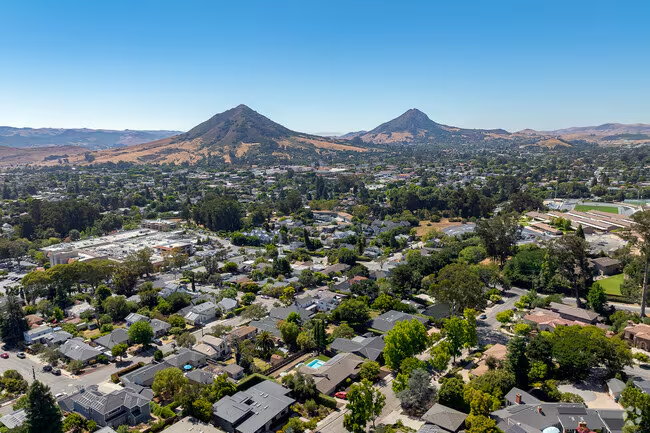
San Luis Obispo’s protected greenbelt, thriving downtown, and Cal Poly presence create a uniquely supply-constrained and demand-rich investment environment
2026 Economic Outlook
- Remote work migration from Bay Area and LA continuing above pre-pandemic levels
- Cal Poly enrollment growth and consistent underbuilding of on-campus housing sustaining off-campus demand
- Paso Robles wine industry expansion driving North County investment interest
- Pacific Coast Rail corridor discussions bringing potential infrastructure improvement
- Mindbody and growing tech sector adding professional worker rental demand beyond Cal Poly
Investment Climate
SLO offers a more balanced investment environment than Santa Barbara or Napa, with genuine cash flow potential in the Cal Poly corridor and Paso Robles paired with meaningful appreciation across the county. California state tenant protection laws apply, and STR regulations vary significantly by jurisdiction. Key characteristics of successful SLO investors:
- University market knowledge to exploit the Cal Poly rental premium through per-room lease structures and strategic property positioning
- North County awareness to capture Paso Robles’s better cash flow metrics while still participating in Central Coast appreciation
- Coastal STR opportunity recognition in Pismo Beach and Shell Beach, where wine tourism and beach demand combine for strong STR income
- Urban Reserve Line understanding as the mechanism that protects SLO city’s supply constraint and underpins its long-term appreciation case
Historical Performance
| Period | Market Driver | Avg Annual Appreciation | Key Event |
|---|---|---|---|
| 2010-2014 | Post-recession Cal Poly demand, coastal lifestyle appeal | 5-7% | SLO ranked happiest city in America (Gallup) |
| 2015-2019 | Bay Area spillover, Paso Robles wine boom, STR discovery | 7-11% | Paso Robles established as major wine destination; coastal STR demand surges |
| 2020-2022 | Remote work migration, lifestyle premium surge | 16-24% | Bay Area remote workers relocated permanently; inventory hit all-time lows |
| 2023-2024 | Rate adjustment, normalization | 3-5% | Volume slowed but price floor held; Cal Poly rental demand remained strong |
| 2025-2026 | Rate stabilization, continued lifestyle migration | 6-9% (projected) | Remote work normalization driving sustained demand; Paso Robles wine tourism recovering strongly |
Demand Drivers
- Cal Poly SLO Enrollment – 22,000 students with the university consistently building insufficient on-campus housing. Off-campus demand is permanent and growing, producing vacancy rates under 2.5% in adjacent areas.
- Happiness Premium Migration – SLO’s repeated recognition as one of America’s happiest cities creates a self-reinforcing migration pattern from LA and the Bay Area that sustains demand independent of economic cycles.
- Urban Reserve Line Supply Constraint – SLO’s growth boundary prevents suburban expansion and maintains the compact, walkable character that attracts buyers, supporting prices through supply limitation.
- Paso Robles Wine Country – 400+ wineries and a growing culinary scene anchor North County tourism and STR demand, creating an investment opportunity at 30 to 40% below SLO city prices.
- Coastal Tourism – Pismo Beach, Shell Beach, Avila Beach, and Morro Bay collectively draw millions of visitors annually, supporting STR yields in the county’s coastal communities.
- Central California Positioning – Equidistant between LA and San Francisco, SLO serves as a gateway and overnight destination for travelers on both the PCH and Highway 101.
📚 New to real estate investing? Master the fundamentals with our professional course Learn more →
2. Neighborhood Hotspots
San Luis Obispo Investment Neighborhood Map
Interactive map of San Luis Obispo County’s investment areas. Green stars show top hotspots, blue circles mark established markets, and orange circles highlight emerging areas.
Core Investment Neighborhoods
Detailed Submarket Analysis: SLO County
| Area | Price Range (SFH) | Cap Rate | Growth Drivers | Best Strategy |
|---|---|---|---|---|
| Cal Poly Adjacent | $850K-$1.2M | 5.5-7.5% | UCSB demand, per-room rental premium, permanent enrollment | Per-room student rental, multi-family |
| Downtown SLO / Lizzie | $950K-$1.6M | 4.0-5.5% | Walkability, professional demand, historic character | LTR appreciation, Victorian value-add |
| Pismo Beach / Shell Beach | $950K-$2M | 6.0-10.0% STR | Beach tourism, wine country gateway, year-round demand | STR with personal use |
| Paso Robles | $550K-$900K | 5.5-7.0% | Wine industry employment, growing culinary scene, affordability | Best county cash flow, LTR, value-add |
| Morro Bay | $700K-$1.3M | 5.0-7.5% STR | Morro Rock tourism, fishing culture, coastal STR demand | STR, coastal LTR |
| Atascadero | $650K-$950K | 4.5-6.0% | Mid-county commuter, Cal Poly spillover, improving amenities | LTR buy-and-hold, balanced returns |
| Arroyo Grande | $750K-$1.1M | 4.5-5.5% | Historic village, beach proximity, family demand | Family LTR, appreciation hold |
| Avila Beach | $1.2M-$2.5M | 7-12% STR | Private beach, very limited inventory, premium STR | Premium STR, trophy coastal |
| Oceano / Grover Beach | $500K-$750K | 4.5-6.5% | Most affordable coastal, OHV tourism, South County overflow | Best entry coastal, LTR and STR |
| Nipomo | $550K-$800K | 4.5-5.5% | South County affordability, new construction, growth corridor | New construction buy-and-hold, long-term appreciation |
Expert Insight: “Investors who drive through SLO County and buy based on what they see miss the best opportunity: the per-room Cal Poly rental premium. A 4-bedroom house near campus that would rent as a whole unit for $3,400/month generates $5,600 to $6,400/month rented by the room to four students at $1,400 to $1,600 each. That income difference fundamentally changes the investment math and makes Cal Poly-adjacent properties some of the best-returning residential investments in California when you factor in appreciation on top of that yield. The key is management systems and parent co-signers on every lease.” – Kevin Walsh, Principal, Central Coast Investment Properties
3. Property Types
| Investment Goal | Best Property Type | Best Locations | Minimum Capital |
|---|---|---|---|
| Maximum Appreciation | SFH in supply-constrained SLO city | Downtown SLO, Lizzie St, Cal Poly adjacent | $225,000+ |
| Best Cash Flow in County | SFH near Cal Poly (per-room) or Paso Robles LTR | North SLO, Paso Robles | $150,000+ |
| Best STR Income | Permitted coastal SFH or cottage | Pismo Beach, Shell Beach, Avila Beach, Morro Bay | $225,000+ |
| Lowest Entry in County | SFH in Oceano, Nipomo, or Templeton | Oceano, Grover Beach, Nipomo, Templeton | $125,000+ |
Our Complete Renovation & Remodeling Cost Guide covers 400+ pages of project-by-project breakdowns with real contractor pricing ranges.
4. Cost Analysis
Acquisition Cost Breakdown (SLO County)
| Expense Item | Typical Cost | Example ($875K Property) | Notes |
|---|---|---|---|
| Down Payment | 25% (investment) | $218,750 | Standard California investment property requirement |
| Closing Costs | 2-3% | $17,500-$26,250 | Title, escrow, lender fees; California escrow above national average |
| Wildfire / Hazard Insurance | $3,000-$12,000/year | $4,000-$9,000 typical | Lower than Santa Barbara area for most SLO city properties; rural and hillside properties face higher premiums |
| General Inspection | $450-$800 | $600 | Septic required for rural and wine country properties |
| STR Permit Application | $400-$1,500 | $600-$1,200 | If purchasing for STR; fees and availability vary by jurisdiction |
| Initial Repairs or Update | 0-12% of price | $0-$105,000 | Value-add properties in Paso Robles and Atascadero often need updates; Cal Poly properties need durability-focused renovation |
| Reserves (6 months) | 6 months expenses | $18,000-$28,000 | Account for August turnover month in Cal Poly properties; seasonal STR variability for coastal properties |
| TOTAL MINIMUM ENTRY | ~29-33% of value | $255,000-$290,000 | More accessible than Santa Barbara or Bay Area; genuine cash flow opportunity in best SLO markets |
Sample Cash Flow: Cal Poly 4BR (Per-Room Model) vs. Whole-Unit LTR
| Item | Per-Room Monthly | Per-Room Annual | Whole-Unit Annual |
|---|---|---|---|
| Gross Rent | $5,600 (4 rooms × $1,400) | $67,200 | $40,800 ($3,400/month whole unit) |
| Vacancy / Turnover | -$280 | -$3,360 (5%) | -$2,040 |
| Property Taxes | -$750 | -$9,000 (~1% of $900K) | -$9,000 |
| Insurance | -$550 | -$6,600 | -$6,600 |
| Property Management (12% per-room; 10% whole) | -$672 | -$8,064 | -$4,080 |
| Maintenance + CapEx | -$672 | -$8,064 (12% for student housing) | -$4,080 |
| Net Operating Income | $2,676 | $32,112 | $15,000 |
| Mortgage ($900K, 25% down, 6.75%, 30yr) | -$4,389 | -$52,668 | -$52,668 |
| CASH FLOW | -$1,713 | -$20,556 (per-room) | -$37,668 (whole unit) |
| Cap Rate | 3.57% (per-room) | 1.67% (whole unit) |
This comparison shows the dramatic impact of the per-room rental model in the Cal Poly market. The per-room approach improves annual cash flow by $17,112 ($1,426/month) on the same property, reducing the negative carry by 46%. For investors in both scenarios, the combination of reduced negative carry and strong SLO appreciation (7 to 10% annually) generates compelling total returns. The per-room model reaches near-positive cash flow in favorable interest rate environments or with higher down payments.
Expert Insight: “SLO is the Central Coast market where the investment math is most accessible to investors who are not ultra-wealthy. Paso Robles LTR can get to near-positive or positive cash flow with a 30% down payment at today’s rates, which is nearly impossible in Santa Barbara or Monterey. And the appreciation upside is comparable because you are still in a supply-constrained, lifestyle-premium Central Coast market. I tell investors who have $200,000 to $300,000 available capital and a 10-year horizon that Paso Robles is the best risk-adjusted bet on the California Central Coast right now.” – Sarah Mendez, Investment Advisor, Paso Robles Wine Country Realty
5. Legal Framework
⚠️ California and Local Compliance Notice
SLO County investors navigate California state tenant protection laws, city and county-level STR regulations that differ significantly across jurisdictions, and Coastal Commission requirements for properties in the Coastal Zone. STR rules are especially diverse across the county: Pismo Beach, Shell Beach, Morro Bay, SLO city, unincorporated county, and Paso Robles all have different STR frameworks. Always consult a California real estate attorney before acquiring any rental property in SLO County and verify STR permit availability at the parcel level before making any STR-dependent purchase.
California State Laws
- AB 1482 (Tenant Protection Act): Caps rent increases at 5% plus CPI (max 10%) for most residential properties 15+ years old. Just cause eviction required for tenants in 12+ months. Applies to most of SLO County’s existing housing stock.
- AB 12 (Security Deposits, 2024): Deposits capped at one month’s rent for unfurnished units. Critical for Cal Poly student landlords who relied on larger deposits for wear-and-tear protection. Parent co-signers become even more important.
- Just Cause Eviction: For covered tenants (12+ months), must have specific documented cause including non-payment, material lease violation, criminal activity, owner move-in, or demolition.
- Source of Income Protection: Cannot reject tenants based on legal payment source including Section 8 vouchers.
- ADU Laws: SB 9 and SB 10 facilitate ADU construction on most SLO County residential lots, potentially adding income for SFH investors without requiring a full multi-family property acquisition.
- Student Lease Specifics: Per-room leases with individual student tenants require careful lease drafting to ensure each room is treated as a separate tenancy with its own rights and obligations under California law.
STR Regulations by Jurisdiction
STR rules vary significantly across SLO County:
- SLO City: STR permits available but limited. Primary residence preference. Annual renewal required. Contact Community Development at 805-781-7170 for current permit availability.
- Pismo Beach: Active STR permit system with annual renewal. Strong local STR economy. Both owner-occupied and non-owner-occupied permits available in most residential zones.
- Morro Bay: STR permit required with good neighbor policy and annual renewal. Coastal Zone review required for some properties.
- Paso Robles: Actively developing STR regulations as wine tourism grows. Relatively permissive compared to coastal communities but evolving rapidly.
- Unincorporated SLO County: County STR permit system with varying rules by area designation. Some rural wine country areas more permissive than cities.
- TOT Registration: Transient Occupancy Tax (9 to 12% depending on jurisdiction) applies to all STR revenue. Platform collection is standard but operator registration typically required.
Key Resources
- SLO City Community Development: 805-781-7170
- SLO County Planning: slocounty.ca.gov/planning
- Pismo Beach STR Info: pismobeach.org
- CA FAIR Plan: cfpnet.com
| Regulation | SLO County Application | California Baseline | Investor Impact |
|---|---|---|---|
| Eviction | Just cause for covered tenants (12+ months) | AB 1482 statewide | Cannot remove established tenants without documentation; student leases typically end naturally each year |
| Rent Increases | 5% + CPI (max 10%) for covered properties | AB 1482 statewide | Student housing with annual leases effectively exempt as new leases are signed each year |
| Security Deposits | 1 month maximum (AB 12) | AB 12 statewide | Require parent co-signers for student housing to compensate for reduced deposit protection |
| STR Operation | Permit required; rules vary by jurisdiction | Local authority | Pismo Beach relatively permissive; SLO city more restrictive; always verify before purchase |
| Coastal Zone | CDP required for Coastal Zone properties (Pismo, Morro Bay, Avila) | Coastal Commission jurisdiction | Renovation timelines extended for coastal properties |
| Per-Room Leasing | Legal under California law with proper individual lease agreements | Individual tenancy rules apply to each room | Each tenant has independent California tenant rights; lease structure requires attorney review |
6. Step-by-Step SLO Investment Playbook
Define Your SLO County Strategy
Cal Poly Per-Room Play
Buy a 3 to 5 bedroom property near Cal Poly. Lease by the room to individual students with parent co-signers. Achieve 5.5 to 7.5% yields on a university-town asset with 8 to 10% annual appreciation.
Coastal STR Play
Buy a permitted STR property in Pismo Beach, Shell Beach, or Morro Bay. Leverage wine and beach tourism for strong STR income. Use for personal enjoyment during off-peak periods.
Paso Robles Cash Flow
Buy LTR-focused SFH or multi-family in Paso Robles. Best cash flow in the county with comparable appreciation to SLO city at 35 to 40% lower entry prices. Wine industry employment provides stable tenant base.
SLO City Appreciation
Buy a well-located SFH or bungalow in Downtown SLO or the Lizzie Street corridor. Accept negative cash flow in exchange for the highest long-term appreciation in the county driven by supply constraints and lifestyle premium demand.
Master the Cal Poly Rental Calendar
If investing near Cal Poly, the academic calendar drives everything:
- April to May: Marketing and leasing season. Most Cal Poly students sign leases for the following September well in advance. Market aggressively in April.
- June to August: Transition period. Some June move-outs for graduating seniors. August is your maintenance and preparation window before new leases start.
- September: New lease start for most students. Ensure all maintenance, painting, and cleaning is complete before September 1.
- September to May: Active tenancy period. Low management intensity if students are well-screened and parent co-signers are in place.
- Key protocol: Require parent co-signers on every student lease. Conduct move-in inspections with photos. Schedule mid-year inspections in January to identify issues early.
Expert Tip: Cal Poly students and their parents research off-campus housing extensively. A well-maintained, cleanly photographed property listed in April with clear per-room pricing, utilities included or excluded (specify which), and prompt responses to inquiries will lease within a week. Properties that sit into June and July are typically priced incorrectly or need maintenance attention.
SLO County-Specific Due Diligence
Physical Due Diligence
- Fire Hazard Severity Zone check (rural and hillside properties)
- Wildfire insurance quotes for any rural or canyon property before offering
- Septic inspection for rural, wine country, and older Paso Robles properties
- Well water test for rural properties on private water sources
- Coastal erosion or bluff assessment for Morro Bay and Pismo bluff properties
- Seismic evaluation near Cuesta Ridge fault zone
- Moisture inspection for older downtown SLO homes
Regulatory Due Diligence
- STR permit status and transferability for coastal acquisitions
- Coastal Zone determination and CDP requirement analysis
- AB 1482 applicability analysis for existing tenanted properties
- Per-room lease legality review with California real estate attorney
- ADU eligibility assessment for SFH properties
- Existing tenant lease terms and rent amounts (particularly relevant in Paso Robles value-add plays)
- TOT registration status for any STR acquisition
Build Your SLO Team
- Cal Poly-Specialist Property Manager: If investing near campus, use a manager with a documented Cal Poly tenant database. The best managers have pre-screened student tenant lists from the previous year and fill vacancies before the property is even listed publicly.
- SLO Investment Agent: Agents who work specifically with investor buyers in SLO County understand per-room rental value, STR permit transferability, and Paso Robles versus coastal investment trade-offs. Avoid generalist agents unfamiliar with investment analysis.
- California Real Estate Attorney: For per-room lease structure review, AB 1482 compliance, and STR regulatory guidance across different SLO County jurisdictions.
- Local Contractor with University Property Experience: Cal Poly properties need durability-focused renovations, not cosmetic luxury upgrades. A contractor who understands student housing wear patterns will recommend flooring, fixtures, and finishes that hold up and reduce long-term maintenance costs.
- STR Management Company with Central Coast Knowledge: For coastal STR properties, use a company with specific Pismo Beach or Morro Bay experience and local connections for maintenance and cleaning turnover.
Optimize for SLO’s Unique Market Dynamics
- ADU addition: Most SLO city and county SFH lots are eligible for ADUs under recent California law. Adding an ADU can add $800 to $1,500/month in rental income and $200,000 to $400,000 in property value, dramatically improving both cash flow and exit value.
- Utilities structure for student housing: Including utilities in Cal Poly per-room rents simplifies leasing and allows slightly higher per-room rates. Alternatively, divide utility responsibility by the room count per tenant. Never put all utilities in the name of one student tenant alone.
- Wine country STR calendar: For Paso Robles and rural SLO County STR, the Harvest Wine Weekend (October) and Zinfandel Festival (March) are peak events commanding 3 to 5x average nightly rates. Block these dates for maximum revenue and price accordingly 6+ months in advance.
- Pismo STR seasonality: Summer (June to August) drives the highest Pismo Beach STR occupancy. Mardi Gras weekend (February) is a unique Pismo event that generates full occupancy at above-average rates. Price dynamically using PriceLabs or Beyond calibrated to these local events.
- Off-market sourcing: SLO County has a small, tight-knit real estate community. Relationships with local agents who know which landlords are considering selling, particularly aging Cal Poly student housing owners who want to simplify their portfolios, produce the best off-market opportunities.
7. Financing Options for SLO County
| Loan Type | Down Payment | Rate Premium | Best For | SLO Note |
|---|---|---|---|---|
| Conventional Investment | 25% | +0.5-0.75% | Paso Robles, Atascadero, Oceano properties below $806K | Many Paso Robles properties fall within conventional limits; best rate available for qualifying properties |
| Jumbo Investment | 25-30% | +0.75-1.25% | SLO city, Pismo Beach, coastal communities | Most SLO city and Pismo Beach properties exceed conventional limits |
| Second Home Loan | 10-20% | +0.25-0.5% | Coastal STR properties used personally 14+ days/year | Very relevant for Pismo Beach and Morro Bay buyers who plan personal use; meaningfully lower rate |
| DSCR Loan | 25-30% | +1.5-2.5% | STR-intended coastal properties; Paso Robles where LTR income is strong | Paso Robles properties may qualify at 1.0x DSCR; STR income projections can qualify coastal properties |
| House Hacking (FHA) | 3.5% | Standard + MIP | Owner-occupying one room or unit in Cal Poly area duplex | Best first-investment entry point in SLO; live in one room, rent remaining rooms per-room to Cal Poly students |
| Portfolio Loan | 20-30% | +1-2% | Self-employed investors, multiple SLO County properties, rural parcels | Pacific Premier Bank, Pacific Western, and SLO-area community banks understand local investment market |
| Hard Money (Bridge) | 15-25% | 8-12% rate | Value-add Paso Robles or Atascadero acquisitions | Useful for fast acquisitions of dated properties where conventional appraisal would be below purchase price |
SLO Financing Reality: SLO County is one of the few Central Coast markets where DSCR financing can actually work for some properties. Paso Robles SFH with strong LTR rents can reach 1.0x debt service coverage, which is impossible in Santa Barbara or Carmel. This opens up an investor class, particularly self-employed buyers without traditional W-2 income, that is simply locked out of more expensive Central Coast markets. For Cal Poly student housing operators, the per-room income model produces better DSCR ratios than any other SLO rental strategy, though lenders may use a conservative whole-unit market rent in their analysis rather than the per-room premium.
8. Frequently Asked Questions

Knowledge Quiz: San Luis Obispo Real Estate Investment
Open Quiz
5 quick questions on what you just learned about SLO investing
1) What does the guide identify as the primary mechanism keeping SLO city housing supply constrained despite growing demand?
Answer: B
The guide identifies SLO’s Urban Reserve Line as the specific mechanism that prevents suburban sprawl and keeps the city’s housing supply artificially tight relative to demand. Unlike physical barriers, the URL is a policy decision that has been consistently maintained and has broad political support in SLO.
2) According to the guide’s cash flow analysis, how much does the per-room model improve annual cash flow compared to whole-unit renting on the same Cal Poly 4BR property?
Answer: D
The guide’s cash flow analysis shows the per-room model at -$20,556 annually versus -$37,668 for whole-unit renting on the same $900K Cal Poly property, a difference of $17,112 per year ($1,426/month). This 46% reduction in negative carry dramatically changes the investment’s economics.
3) Which SLO County area does the guide identify as offering the best cash flow for LTR investors?
Answer: A
The guide identifies Paso Robles as the best LTR cash flow market in SLO County, with cap rates of 5.5 to 7.0% at entry prices 35 to 40% below SLO city. The combination of wine industry employment, growing culinary scene, and genuine affordability makes it the guide’s top recommendation for investors prioritizing cash flow over proximity to the coast.
4) What does the guide say is the most important protocol for managing Cal Poly student tenants under California’s AB 12 deposit cap?
Answer: C
The guide emphasizes that requiring parent co-signers on every student lease is the primary protection mechanism now that AB 12 caps security deposits at one month’s rent. A parent or guardian guaranty provides an additional financial party for damage claims and dramatically reduces non-payment risk in the student housing market.
5) What is the peak revenue event for Pismo Beach STR properties that operators should book 6+ months in advance?
Answer: B
The guide identifies Pismo Beach’s Mardi Gras weekend (February) as a unique local event generating full occupancy at above-average rates, combined with summer beach season (June to August) as the highest-revenue periods. The guide also notes that Paso Robles Harvest Wine Weekend (October) is a key revenue event for wine country STR operators. Both should be priced and booked well in advance.
Work With a Local Expert in San Luis Obispo
We are building a verified network of real estate professionals across every market we cover.

About Our Expert Network
We are finalizing partnerships with verified real estate professionals across every market featured on Builds and Buys. Each expert is selected for hands-on investment experience, local market knowledge, and commitment to helping buyers and investors make sound decisions.
- Proven experience with investment and income-producing properties
- Deep knowledge of local pricing, rental yields, and neighborhood dynamics
- Guidance on financing, legal structure, and due diligence
- Access to off-market and pre-market opportunities
- Full transaction support from search through closing
- Ongoing portfolio and property management referrals
Services Covered
- Property sourcing and acquisition
- Cal Poly student housing expertise
- Buyer representation
- Market comparables and valuations
- STR strategy and permit guidance
- Value-add and renovation guidance
- Legal and title referrals
- Financing and lender connections
- Property management referrals
- Insurance referrals
- 1031 exchange coordination
- Exit strategy planning
Get Connected or Join Our Network
Looking for a local expert to help with your SLO County investment? Reach out and we will connect you with the right professional.
Contact us at support@buildsandbuys.com
Find Specialized SLO Real Estate Professionals
Ready to Invest in San Luis Obispo?
San Luis Obispo County is the Central Coast’s most accessible and most diverse investment market. From Cal Poly student housing generating the region’s best cash flow yields to coastal STR properties in Pismo Beach and Morro Bay, from Paso Robles wine country buy-and-hold to Downtown SLO appreciation plays, the county offers a strategy for virtually every investor capital level and risk tolerance. The common thread across all SLO County investment strategies is supply constraint, whether through the Urban Reserve Line in SLO city, Coastal Commission limits on coastal communities, or the natural boundaries of the wine country corridor. That supply constraint, combined with the enduring demand from one of California’s most beloved lifestyle destinations, is the foundation of one of the state’s most reliable long-term wealth-building markets.
Continue Your Research
California State Guide
See how SLO compares to Los Angeles, San Diego, Santa Barbara, and other California markets.
Step-by-Step Invest
Complete framework for building a real estate investment strategy from scratch.
144-Lesson Course
University-level real estate education covering financing, law, strategy, and management.
For further guidance, explore our State-by-State Investor guides, browse our expert articles, or follow our Step-by-Step Investment Guide.



