
Rock Springs Wyoming Real Estate Investment Guide For 2026
A comprehensive resource for investors targeting Southwest Wyoming’s energy and transportation hub, where I-80 corridor advantages, trona and energy sector diversification, Western Wyoming Community College, and some of Wyoming’s most accessible cap rates create a compelling cash flow opportunity in 2026
Quick answers: Top 5 most searched Rock Springs investment questions ▼
Migration data: Where people are moving from to Rock Springs ▼
In This Guide
Click on any section to navigate directly to that content
1. Rock Springs Market Overview
Market Fundamentals
Rock Springs is Southwest Wyoming’s economic engine and its most misunderstood investment market. The city’s reputation as a boom-and-bust energy town masks a more nuanced reality: Sweetwater County’s trona mining sector is structurally different from oil and gas, the I-80 corridor position creates logistics employment independent of energy prices, and Western Wyoming Community College anchors a stable educational economy that persists through every commodity cycle.
Key economic indicators defining Rock Springs’s investment case:
- Population: 15,200 city, 44,000 Sweetwater County
- Trona Mining: Sweetwater County holds 70% of world’s known trona reserves; major operators include Solvay, Genesis Alkali, Tronox
- Natural Gas: Jonah Field and Pinedale Anticline production employs thousands in the region
- I-80 Corridor: Major interstate logistics hub; trucking, distribution, and transportation employment
- WWCC: Western Wyoming Community College with approximately 2,500 students
- Memorial Hospital of Sweetwater County: Healthcare anchor providing stable professional employment
Rock Springs is Wyoming’s third-largest city and the largest city in the state with consistently investable cap rates. Unlike Gillette where energy dominates completely, Rock Springs has a genuine multi-sector economy that provides meaningful downside protection.
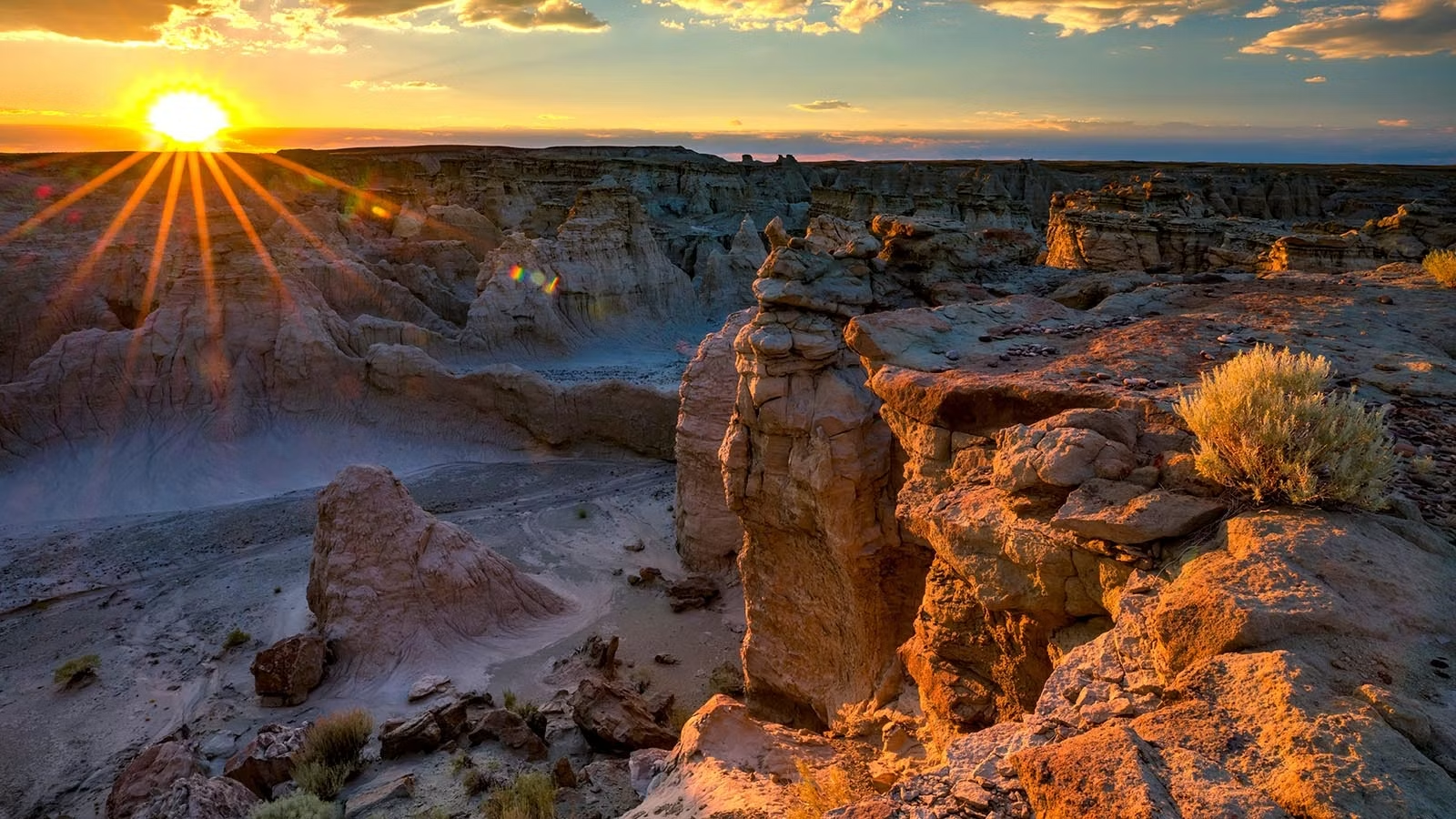
Rock Springs sits in the Red Desert of southwest Wyoming, with the Flaming Gorge recreation area 40 miles south providing outdoor amenities that attract workers and visitors
2026 Economic Outlook
- Trona sector stable; global soda ash demand growing with glass production
- Natural gas markets recovering; Jonah Field activity increasing
- I-80 freight corridor investment supporting logistics employment growth
- WWCC enrollment stable with growing workforce development programs
- Flaming Gorge recreation investment driving tourism infrastructure
The Rock Springs Investment Thesis
Rock Springs offers the strongest combination of tenant pool depth and cash flow yield available in Wyoming’s affordable markets. Where Worland and Riverton offer similar or better cap rates on smaller populations, Rock Springs’s 15,000-plus residents create a meaningfully larger and more liquid tenant market. Where Casper offers similar population depth, Rock Springs offers meaningfully better cap rates at lower acquisition prices.
- The trona stability advantage. Trona is not subject to OPEC decisions, shale technology disruptions, or the commodity price volatility that defines oil and gas. Soda ash demand grows with global manufacturing and construction, which is a far more stable driver than energy prices. Rock Springs investors who lived through the 2015 to 2019 oil downturn saw this clearly: trona operations barely flinched while natural gas employment contracted.
- Energy wages support rent levels. Trona miners and energy workers in Sweetwater County earn $75,000 to $110,000 annually. This income level creates tenants who can and do pay $1,400 to $1,800 per month in rent without strain. The income-to-rent ratio in Rock Springs is among the most favorable of any Wyoming market, reducing credit risk in the tenant pool.
- I-80 corridor independence. I-80 runs directly through Rock Springs, creating a logistics and transportation employment base entirely separate from energy. Trucking companies, distribution centers, and I-80 service employers provide stable employment that does not track commodity prices.
- WWCC rental demand. Western Wyoming Community College’s 2,500-plus students create consistent year-round rental demand near campus that provides a baseline of occupancy independent of energy sector fluctuations.
Historical Performance
| Period | Market Driver | Avg Annual Appreciation | Key Event |
|---|---|---|---|
| 2010-2014 | Natural gas boom, strong trona demand | 5-8% | Jonah Field and Pinedale Anticline at peak production; Rock Springs housing tightened significantly |
| 2015-2019 | Natural gas price collapse; trona holds | -2 to 3% | Gas employment contracted; trona stability prevented severe price declines; vacancy rose to 12% |
| 2020-2022 | Recovery, pandemic migration, energy rebound | 8-13% | Prices recovered from 2015 lows; energy rebound plus remote work migration tightened market |
| 2023-2024 | Sustained energy activity, trona expansion | 5-8% | Genesis Alkali expansion adding trona employment; market tightening |
| 2025-2026 | Trona stability, gas recovery, I-80 logistics growth | 5-8% (projected) | Multiple demand sectors converging; vacancy at 6 to 8% and tightening |
Rock Springs’s 2015 to 2019 period is the most important data point for investors. When natural gas employment contracted sharply, prices declined modestly rather than collapsing, demonstrating the stabilizing effect of trona employment and I-80 logistics. Investors who held through the downturn recovered fully by 2020 and have seen continued appreciation since. The lesson: Rock Springs has real downside protection that pure gas or oil markets lack.
Demand Drivers in Detail
- Trona Mining (Primary Stability Anchor) – Sweetwater County’s trona operations are generational employers. The major operators, Solvay, Genesis Alkali, Tronox, and others, have operated for 50 to 70 years and have demonstrated stability through multiple energy cycles. Their employees earn above-market wages and represent Rock Springs’s most reliable long-term tenant demographic.
- Natural Gas (Secondary Cyclical Driver) – Jonah Field and Pinedale Anticline natural gas production employs thousands in and around Rock Springs. This employment amplifies demand during gas upcycles but contracts during downturns. Investors who model for the trough rather than the peak manage Rock Springs effectively.
- I-80 Logistics Corridor – The I-80 / I-191 intersection makes Rock Springs a regional logistics hub. Trucking, warehousing, and transportation employment provides a baseline of tenant demand completely independent of energy prices. This is Rock Springs’s most underappreciated demand driver.
- Western Wyoming Community College – WWCC’s 2,500-plus enrollment creates consistent student and faculty housing demand. The college’s healthcare, workforce development, and trades programs attract adult learners who prefer off-campus rentals in established residential neighborhoods.
- Memorial Hospital of Sweetwater County – Healthcare employment provides stable professional tenant demand year-round. Healthcare workers are among Rock Springs’s most creditworthy tenant profiles, comparable to the pattern seen in other Wyoming hospital communities.
- Regional Retail and Services Hub – Rock Springs is the retail and service center for a vast region of Southwest Wyoming. This creates stable employment in healthcare, retail, education, and government sectors that is independent of energy commodity prices.
📚 New to real estate investing? Master the fundamentals with our professional course Learn more →
2. Neighborhood Hotspots
Rock Springs Investment Neighborhood Map
Interactive map of Rock Springs’s investment neighborhoods. Green stars mark top hotspots, blue circles show established markets, and orange circles highlight emerging areas.
Core Investment Neighborhoods
Detailed Submarket Analysis: Rock Springs Neighborhoods
| Neighborhood | Price Range (SFH) | Cap Rate | Growth Drivers | Best Strategy |
|---|---|---|---|---|
| College Hill / WWCC | $250K to $340K | 7.5 to 9% | College proximity, faculty and student demand, year-round occupancy | Student housing, consistent cash flow, BRRRR |
| Hillview / White Mountain | $280K to $380K | 7 to 8% | Trona and energy professionals, quality neighborhood, stable demand | Quality buy-and-hold, professional workforce rentals |
| Downtown Historic District | $210K to $310K | 8 to 10% | Heritage appeal, walkability, value-add potential, urban lifestyle demand | Value-add, BRRRR, highest cash flow play |
| Clearview / Vista Estates | $310K to $430K | 6.5 to 7.5% | Newer construction, family demand, school access | Remote investor preferred, family rentals, lower maintenance |
| Hospital / Healthcare District | $275K to $370K | 7 to 8% | Healthcare worker demand, stable employment, quality tenants | Healthcare worker focus, low-turnover strategy |
| I-80 Corridor Workforce | $220K to $300K | 8 to 10% | Logistics workers, I-80 transportation employment, affordability | Maximum yield, workforce housing, I-80 positioning |
Expert Insight: “Investors dismiss Rock Springs because they hear ‘energy town’ and stop thinking. The trona story changes the calculus completely. Those miners are making $85,000 to $110,000 a year and they need somewhere to live. They are not speculative workers who leave when prices fall; they have 20-year careers at the same plant. A well-maintained 3-bedroom near College Hill renting to a trona miner is one of the most stable cash flow assets in Wyoming. I have managed properties in Rock Springs for 15 years and the trona tenants are the best payers in the portfolio, every single year.” – Robert Jansen, Sweetwater County Property Management
3. Property Types
| Investment Goal | Best Property Type | Best Location | Minimum Capital |
|---|---|---|---|
| Maximum Cash Flow | Value-add downtown or I-80 workforce | Downtown Historic, I-80 Corridor | $57,000 to $80,000 |
| Best Tenant Quality | Quality SFH for trona miner or energy worker | Hillview, White Mountain | $72,000 to $100,000 |
| Lowest Vacancy Risk | SFH near WWCC campus | College Hill | $65,000 to $88,000 |
| Lowest Management Burden | Newer SFH in Clearview or Vista Estates | Northwest Rock Springs | $80,000 to $110,000 |
Don’t guess the costs. Our Complete Renovation & Remodeling Cost Guide covers 400+ pages of project-by-project breakdowns with real contractor pricing ranges.
4. Cost Analysis
Acquisition Cost Breakdown (Rock Springs)
| Expense Item | Typical Cost | Example ($285,000 Property) | Notes |
|---|---|---|---|
| Down Payment | 25% (investment) | $71,250 | Standard for investment; 20% possible with strong credit |
| Closing Costs | 2 to 3% | $5,700 to $8,550 | Wyoming’s lean closing cost structure; modestly higher than very small markets |
| General Inspection | $350 to $500 | $425 | Focus on HVAC, roof, and plumbing; older homes need thorough review |
| Radon Test | $150 to $250 | $175 | Wyoming elevated radon; test every property before purchase |
| Initial Repairs | 0 to 8% | $0 to $22,800 | Older Rock Springs stock often needs roofing, HVAC, and electrical updates |
| Reserves (6 months) | 6 months expenses | $8,000 to $12,000 | Energy cycle protection; model for 8 to 10% vacancy in base case |
| TOTAL MINIMUM ENTRY | ~30 to 35% | $85,550 to $115,200 | Reasonable for Rock Springs’s scale and yield profile |
Sample Cash Flow Analysis: College Hill 3-Bedroom SFH (Trona Miner Tenant)
| Item | Monthly | Annual | Notes |
|---|---|---|---|
| Gross Rent | $1,550 | $18,600 | 3BR, College Hill area, clean and well-maintained |
| Less Vacancy (8%) | -$124 | -$1,488 | Conservative for Rock Springs; trona tenant reduces to 5% |
| Property Taxes | -$143 | -$1,710 | ~0.6% of $285,000; Wyoming’s low effective rate |
| Insurance | -$105 | -$1,260 | Landlord policy; Wyoming wind coverage essential |
| Property Management (10%) | -$155 | -$1,860 | Many Rock Springs investors self-manage; optional at 15,000 population |
| Maintenance + CapEx (8%) | -$124 | -$1,488 | Reserve for HVAC, roof, and general maintenance |
| Net Operating Income | $899 | $10,794 | Before mortgage; cap rate of 3.79% on $285K price |
| Mortgage ($213,750 at 7%, 30yr) | -$1,423 | -$17,076 | 25% down conventional investment loan |
| CASH FLOW (managed, 8% vacancy) | -$524 | -$6,282 | Slightly negative with full professional management |
| CASH FLOW (self-managed, 5% vacancy, trona tenant) | +$290 | +$3,480 | Genuine positive cash flow with quality tenant and self-management |
| Cap Rate (purchase price) | 7.75% | NOI without management fee / purchase price; strong for any market | |
| Total Return (6% appreciation) | ~14 to 16% | Including equity, appreciation, and principal paydown |
Rock Springs’s cash flow profile mirrors Riverton and Douglas: slightly negative with full professional management at current rates, but genuinely positive for self-managing investors with quality tenants. The key differentiator from those smaller markets is the larger tenant pool. Rock Springs’s 15,200 residents mean vacancy periods are shorter and tenant options are broader when units turn over, making the cash flow projections more reliable in practice.
Expert Insight: “I always tell first-time investors to look at what industry the tenant works in before looking at the property. In Rock Springs, a trona miner at $95,000 a year is a completely different tenant than a gas field worker at $85,000 a year. Both earn good wages but the trona worker is still there when gas prices crash. That stability shows up in my default rate data and my vacancy data year after year. If I am picking between two identical properties, one near the trona operations and one near the gas operations, I take the trona property every time.” – Patricia Nguyen, Rock Springs Investment Properties
5. Legal Framework
Wyoming Landlord-Friendly Framework with Rock Springs Specifics
Rock Springs and Sweetwater County operate under Wyoming’s straightforward landlord-tenant law with no local overlays. No rent control, no just cause eviction requirements, no rental registration requirements, and no source-of-income protections. The legal environment is simple, consistent, and investor-friendly. Rock Springs does have one notable local consideration: the historic downtown district has some design guidelines for exterior modifications that investors should understand before renovating.
Wyoming Landlord-Tenant Essentials
- No Rent Control: Wyoming prohibits rent control statewide. Rock Springs landlords can raise rents freely at lease renewal with proper notice. As energy wages drive rental market rates up during upcycles, landlords can capture market increases without bureaucratic approval.
- Eviction (Non-Payment): 3-day notice to pay or quit. File unlawful detainer after 3 days. Sweetwater County courts process cases efficiently. Full eviction typically resolves in 3 to 6 weeks from initial notice.
- Eviction (Lease Violation): 3-day notice to cure. No just cause requirement for month-to-month non-renewal; 30-day notice sufficient.
- Security Deposits: Maximum 1.5 months rent for unfurnished units. Return within 30 days with itemized deductions.
- Tenant Screening: Full landlord discretion subject to federal Fair Housing. No source-of-income protections in Wyoming.
Rock Springs-Specific Considerations
- Historic Downtown Design Review: The Downtown Historic District has design guidelines that may apply to exterior modifications of properties within the district boundaries. Check with the City of Rock Springs planning department before altering the exterior of pre-1940 downtown properties. Interior renovations are not covered.
- No Rental Registration: Rock Springs does not require landlord registration or rental operating licenses. Zero compliance overhead.
- Short-Term Rentals: No specific STR ordinance in Rock Springs as of 2026. Wyoming lodging tax (4%) applies to stays under 30 days. Register with Wyoming Department of Revenue before operating any STR.
- Property Taxes: Sweetwater County effective rate approximately 0.6% of assessed value; among Wyoming’s lowest effective rates nationally.
- Energy Sector Leases: Some trona and energy operators have corporate housing arrangements with landlords. These corporate leases can provide guaranteed monthly rent regardless of individual employee occupancy. Ask local property managers about corporate housing programs with major employers.
Useful Rock Springs Resources
- City of Rock Springs: rswy.net
- Sweetwater County Assessor: sweetwatercountywy.gov
- Wyoming DOR (STR Tax): revenue.wyo.gov
- Wyoming Attorney General Landlord Guide: ag.wyo.gov
| Regulation | Wyoming / Rock Springs Rule | Investor Impact |
|---|---|---|
| Eviction Speed | 3-day notice, 3 to 6 weeks total | Fast eviction timeline reduces non-payment exposure |
| Rent Increases | Any amount; 30-day notice for month-to-month | Full flexibility; energy upcycle rent increases permissible |
| Historic Downtown | Design guidelines may apply to exterior modifications | Verify with City of Rock Springs before any exterior alterations on pre-1940 buildings |
| Corporate Housing | Permitted; standard lease terms apply | Trona operators sometimes guarantee rent regardless of occupancy; worth exploring |
| Rental Registration | Not required in Rock Springs | Zero compliance overhead; no inspections or licensing |
6. Step-by-Step Rock Springs Investment Playbook
Choose Your Rock Springs Strategy
Trona Miner Anchor Rental
Acquire a well-maintained home in Hillview or College Hill. Market specifically to trona mining employees with multi-year lease structures. Accept modest management simplification over maximum yield in exchange for Rock Springs’s most stable, highest-paying tenant demographic.
Downtown BRRRR
Buy dated downtown historic property at deep discount. Renovate respecting original heritage character. Refinance at improved ARV. Rock Springs’s downtown is at a similar inflection point to other Wyoming heritage districts where renovation is beginning to command serious premiums.
WWCC Student Housing
Buy a 3 to 4 bedroom home near Western Wyoming Community College and rent by the room to students or healthcare/trades program adults. Higher gross income than standard lease with more management. Best for local or semi-local investors familiar with Rock Springs’s WWCC community.
I-80 Workforce Maximum Yield
Buy an affordable property near the I-80/I-191 interchange. Target trucking and logistics workers as tenants. This demographic is entirely energy-independent and provides stable year-round occupancy at yields that are among the highest available in any Wyoming market of comparable size.
Build Your Rock Springs Team
- Local Real Estate Agent: Rock Springs has an active agent market given its size. Find one with investor-specific experience who understands the trona versus natural gas employment distinction and can identify properties with stable versus cyclical tenant profiles.
- Property Manager: Rock Springs’s 15,000 residents support a more developed property management industry than smaller Wyoming markets. Ask specifically about their experience managing properties for trona mining and energy sector tenants and their corporate housing program contacts.
- Contractor: Rock Springs has better contractor availability than smaller Wyoming markets. For downtown renovation work, specifically seek contractors with experience in the historic district’s heritage character requirements.
- Corporate Housing Contact: Reach out to the human resources departments at Solvay, Genesis Alkali, and other major trona operators to understand their corporate housing programs. Some operators will guarantee rent on multiple units if the quality and location meet their requirements.
- Wyoming Real Estate Attorney: For any commercial or mixed-use acquisitions in the historic downtown, a Wyoming attorney familiar with Sweetwater County commercial property is worth consulting on title and zoning matters.
Rock Springs-Specific Due Diligence
Physical Due Diligence
- Radon test: Sweetwater County has elevated readings; test every property
- Heating: High desert elevation means cold winters; inspect furnace condition carefully
- Roof: Wyoming wind damage prevalent; inspect for hail and wind damage
- Foundation: High desert soils can have expansion and contraction issues; inspect for cracking
- Electrical: Many older Rock Springs homes have dated wiring; budget for panel upgrades
- Energy efficiency: High winds and temperature extremes make insulation and window quality important for tenant retention
Market and Legal Due Diligence
- Verify tenant’s employer and sector before finalizing lease; distinguish trona from gas for stability analysis
- Check historic district status before any exterior modification plans
- Confirm zoning with City of Rock Springs for any mixed-use or multi-family conversion plans
- Research corporate housing programs with major trona operators before purchasing
- Verify broadband availability for properties targeting remote workers
- Model base case at 8 to 10% vacancy; model stress case at 15% for energy downturn scenario
Managing Rock Springs Properties Through Energy Cycles
- Always know your tenant’s sector: Trona miners and I-80 logistics workers are cycle-resistant. Natural gas field workers are cycle-sensitive. This distinction should inform your portfolio composition and your reserve sizing. A portfolio weighted toward trona tenants needs 6-month reserves; a portfolio weighted toward gas workers needs 12-month reserves.
- Engage corporate housing programs proactively: Solvay and Genesis Alkali run formal corporate housing programs for newly arriving employees and contractors. Landlords who register their properties with these programs often receive guaranteed rent arrangements that eliminate vacancy risk entirely. Ask your property manager how to access these programs.
- Price at the trona worker’s comfort level: A trona miner earning $90,000 a year will comfortably pay $1,500 to $1,800 a month in rent. Pricing below this range means leaving money on the table; pricing above it means competing for a smaller tenant pool. Your property manager’s current trona operator employee housing data is the best pricing guide.
- Build cycle reserves early: Establish your 6 to 12 month expense reserve during the first year of ownership when cash flow is positive. The time to build reserves is not during a downturn; it is during the first year of operation when energy activity is typically robust.
- The I-80 hedge: Consider specifically acquiring one property near the I-80 corridor for every two energy-proximate properties. The I-80 workforce housing generates slightly lower rents but essentially zero energy sector correlation, providing genuine portfolio diversification within a single Wyoming market.
7. Financing Options for Rock Springs
| Loan Type | Down Payment | Rate Premium | Best For | Rock Springs Note |
|---|---|---|---|---|
| Conventional Investment | 25% | +0.5 to 0.75% | W-2 income, strong credit | All Rock Springs residential properties within conforming limits; standard access |
| DSCR Loan | 25 to 30% | +1.5 to 2.5% | Self-employed, portfolio builders | Rock Springs’s 7.5 to 9% cap rates support DSCR qualification; verify with lender; viable option |
| Portfolio Loan | 20 to 25% | +0.75 to 1.5% | Multiple properties, relationship banking | Local Sweetwater County banks understand market dynamics and trona sector stability |
| FHA (House Hack) | 3.5% | Standard + MIP | Owner-occupant in 2 to 4 unit property | Limited multi-family stock; best path is SFH with basement conversion potential near WWCC |
| Hard Money (Bridge) | 15 to 25% | 9 to 12% rate | BRRRR acquisitions, renovation projects | Wyoming hard money lenders in Cheyenne and Casper serve Rock Springs; larger market makes lenders more comfortable |
| Corporate Housing Lease | N/A (income strategy) | N/A | Investors with quality properties near trona plants | Trona operators sometimes guarantee rent regardless of occupancy; worth pursuing as income enhancement |
Rock Springs Financing Advantage: Rock Springs is one of the few Wyoming markets where DSCR loans are genuinely viable across most property types. The 7.5 to 9% cap rates in College Hill and the downtown district comfortably support 1.0x or better debt service coverage even at current interest rates, enabling self-employed investors and portfolio builders to finance Rock Springs acquisitions without W-2 income documentation. The larger market also means more national lenders are comfortable lending here than in the very small Wyoming markets like Worland or Riverton where some DSCR lenders hesitate over population size.
8. Frequently Asked Questions

Knowledge Quiz: Rock Springs, Wyoming Real Estate Investment
Open Quiz
5 quick questions on what you just learned about investing in Rock Springs
1) Why is trona mining considered more stable than oil and gas as a real estate demand driver?
Answer: C
Trona is processed into soda ash used in glass, detergents, and chemicals. Demand tracks industrial production, which is far more stable than energy commodity prices. Additionally, Sweetwater County holds approximately 70% of the world’s known trona reserves, making the operations geographically irreplaceable. No OPEC-equivalent can flood the market and collapse prices as happens with oil and gas.
2) What unique corporate housing opportunity exists in Rock Springs that is unavailable in most Wyoming markets?
Answer: B
Major trona operators run corporate housing programs for newly relocating employees. In some arrangements, operators provide guaranteed monthly rent regardless of individual employee occupancy, effectively eliminating vacancy risk for approved landlords. Contact Solvay, Genesis Alkali, or other major operator HR departments directly, or ask your Rock Springs property manager about existing corporate housing relationships.
3) What makes Rock Springs’s I-80 corridor position a distinct investment advantage over other Wyoming cash flow markets?
Answer: A
Rock Springs sits at the I-80/I-191 intersection, creating logistics, trucking, and transportation employment entirely separate from energy commodity prices. Unlike trona or natural gas workers who track mineral sector health, I-80 logistics workers remain employed regardless of energy cycles. Acquiring one I-80 corridor property for every two energy-proximate properties provides genuine portfolio diversification within Rock Springs.
4) What is Rock Springs’s “58-nationality heritage” and why does it matter for downtown investment?
Answer: D
Rock Springs’s 1870s through 1920s coal mining boom attracted workers from 58 nationalities, creating architectural diversity visible in the downtown historic district today. This authentic heritage character, expressed in Victorian commercial buildings and varied worker cottages, is increasingly valued by quality tenants and investors seeking authenticity. The downtown renovation wave is earlier-stage than in Douglas or Sheridan, suggesting more appreciation runway for early movers.
5) How does Rock Springs compare to Gillette as a Wyoming energy market investment from a risk perspective?
Answer: C
Rock Springs’s trona sector faces stable industrial demand growth, while Gillette’s coal sector faces secular decline from energy transition pressures. Rock Springs also has I-80 logistics employment providing non-energy diversification that Gillette lacks. Both offer similar cap rates, but Rock Springs’s structural risk profile is meaningfully better. For investors choosing between the two, Rock Springs is the lower-risk option with comparable yields.
Work With a Local Expert in Rock Springs
We are building a verified network of real estate professionals across every market we cover.

About Our Expert Network
We are finalizing partnerships with verified real estate professionals across every market featured on Builds and Buys. Each expert in our network is selected for their hands-on investment experience, local market knowledge, and commitment to helping buyers and investors make sound decisions.
- Proven experience with investment and income-producing properties
- Deep knowledge of local pricing, rental yields, and neighborhood dynamics
- Guidance on financing, legal structure, and due diligence
- Access to off-market and pre-market opportunities
- Full transaction support from search through closing
- Ongoing portfolio and property management referrals
Services Covered
- Property sourcing and acquisition
- Investment analysis and underwriting
- Buyer representation
- Market comparables and valuations
- Short-term and long-term rental strategy
- Value-add and renovation guidance
- Legal and title referrals
- Financing and lender connections
- Property management referrals
- Insurance and inspection referrals
- 1031 exchange coordination
- Exit strategy planning
Get Connected or Join Our Network
Looking for a local expert in Rock Springs? Reach out and we will connect you with the right professional for your market and strategy.
Are you a real estate professional with experience in the Sweetwater County investment market? We are always expanding our expert network.
Contact us at support@buildsandbuys.com
Find Specialized Wyoming Real Estate Professionals
Ready to Invest in Rock Springs?
Rock Springs is Wyoming’s most misunderstood investment market. The energy town reputation obscures the trona sector’s remarkable stability, the I-80 corridor’s non-energy diversification, and the genuine cash flow that Wyoming’s third-largest city delivers at prices that most states’ investors would consider extraordinarily cheap. The investors who understand the trona distinction, engage the corporate housing programs, and hold through energy cycles consistently find Rock Springs delivers on its cash flow promise with more durability than the city’s reputation suggests. The numbers work. The tenant pool is real. The legal environment is straightforward. Do your homework on the trona versus gas distinction, model conservatively for energy cycles, and Rock Springs rewards the effort.
Continue Your Research
Wyoming State Guide
See how Rock Springs compares to Casper, Cheyenne, and other Wyoming markets.
Step-by-Step Invest
Complete framework for building a real estate investment strategy from scratch.
144-Lesson Course
University-level real estate education covering financing, law, strategy, and management.
For further guidance, explore our State-by-State Investor guides, browse our expert articles, or follow our Step-by-Step Investment Guide.



