
Pasadena Real Estate Investment Guide For 2026
A comprehensive resource for investors targeting Southern California’s most intellectually anchored city, where Caltech, JPL, the Huntington, and the Rose Bowl create durable demand that has made Pasadena one of the San Gabriel Valley’s most consistently appreciating real estate markets
Quick answers: Top 5 most searched Pasadena investment questions ▼
Migration data: Where people are moving from to Pasadena ▼
In This Guide
Click on any section to navigate directly to that content
1. Pasadena Market Overview
Market Fundamentals
Pasadena occupies a singular position in the Southern California real estate market. Unlike most LA submarkets that are defined by a single industry or lifestyle category, Pasadena’s investment case rests on a genuinely diverse institutional base: one of the world’s great science universities, a NASA research center, a world-class art museum complex, a major regional hospital, a beloved college football stadium, and one of Southern California’s most successful historic retail districts. This institutional diversity creates housing demand that is resistant to single-sector downturns in a way that few LA submarkets can match.
Key economic indicators defining the Pasadena investment case:
- Population: 140,000+ city proper
- Major Institutions: California Institute of Technology (Caltech), Jet Propulsion Laboratory (JPL, NASA contractor), Huntington Library and Gardens, Art Center College of Design, Norton Simon Museum, Huntington Hospital, Tournament of Roses
- Median Household Income: $85,000+ citywide; significantly higher in northwest Pasadena neighborhoods near Caltech and JPL
- Metro A Line (Gold Line): Direct rail connection to DTLA in 30 to 40 minutes, making Pasadena viable for downtown LA workers
- No Local Rent Control: Only California’s statewide AB 1482 applies, providing maximum rent flexibility
- Historic Architecture Premium: Bungalow Heaven and other historic districts command 15 to 25 percent price premiums over comparable non-historic Pasadena homes
Pasadena’s investment environment benefits from being one of the few LA area cities where the “university town” dynamic applies at scale. The combination of Caltech, JPL, Art Center, and multiple hospitals creates a resident population with exceptional educational credentials, stable long-term employment, and above-average income stability across economic cycles.
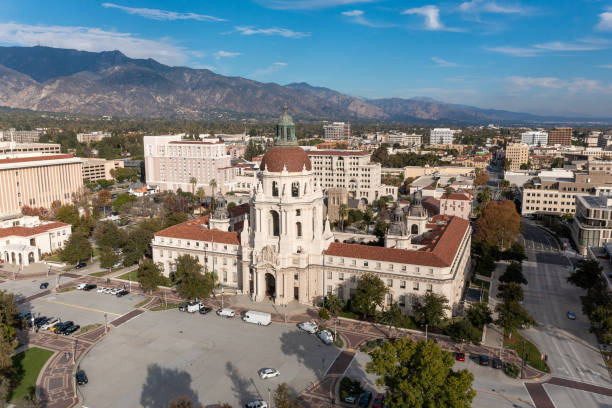
Pasadena’s iconic City Hall and the San Gabriel Mountains backdrop define a city where institutional stability, historic architecture, and the LA metro’s appreciation engine converge
2026 Economic Outlook
- JPL’s continued NASA mission expansion adding engineering positions
- Caltech’s AI and quantum computing research drawing new postdoctoral talent
- Old Pasadena retail and hospitality sector recovery post-pandemic fully complete
- Metro A Line ridership increasing as downtown LA employment recovers
- Huntington Hospital expansion adding 500+ medical positions
- Art Center College of Design attracting national and international design talent
Investment Climate
Pasadena’s investment environment is defined by stability and quality over pure appreciation velocity. The city does not produce the 20-plus percent appreciation spikes of peak Silicon Valley cycles or Oceanside’s transformation momentum, but it also does not produce the 20-plus percent corrections that follow those spikes. Pasadena is a market where 7 to 10 percent annual appreciation, near-zero vacancy in academic corridors, and long-tenure high-quality tenants create wealth through steady compounding rather than dramatic cycles. Successful Pasadena investors tend to share these characteristics:
- Academic community targeting specifically marketing properties to Caltech graduate students, postdoctoral researchers, and JPL engineers who represent the most reliable tenant demographic in the entire SGV
- Historic preservation awareness understanding that Mills Act historic preservation contracts can dramatically reduce property tax on qualifying historic properties, improving cash flow on otherwise marginal deals
- ADU strategy execution converting Pasadena’s large-lot Craftsman era properties to two and three unit income properties using California’s statewide ADU laws
- No-rent-control leverage marketing to long-term tenants with the confidence that at vacancy, rents can fully reset to market, which is particularly valuable given Pasadena’s proximity to cities with local rent control
- Metro A Line awareness understanding how transit proximity affects value and demand for DTLA-commuting renters who represent a growing segment of Pasadena’s rental market
Historical Performance
| Period | Market Driver | Avg Annual Appreciation | Key Event |
|---|---|---|---|
| 2010-2014 | Post-recession recovery, JPL growth | 5-8% | Pasadena outperformed most SGV cities in recovery due to institutional employment stability |
| 2015-2019 | Metro Gold Line (now A Line) extension, LA tech sector growth | 8-12% | Gold Line Foothill extension opened; DTLA tech sector expansion made Pasadena a viable commuter destination |
| 2020-2022 | Pandemic space premium, DTLA flight to suburbs | 15-22% | Pasadena’s large Craftsman lots and outdoor spaces drove demand from DTLA families seeking more room |
| 2022-2024 | Rate shock, normalization | 2-4% | Prices held relatively well due to institutional employment base; Caltech and JPL demand did not soften |
| 2025-2026 | Rate stabilization, continued institutional demand | 6-9% (projected) | Caltech’s AI research expansion and JPL mission growth driving hiring; DTLA return-to-office pulling commuter demand back |
Pasadena’s 20-year appreciation track record shows average annual gains of 7 to 9 percent with notably lower volatility than comparable LA submarkets during downturns. The institutional employment base provides a demand floor that absorbs shocks more effectively than markets dependent on a single private-sector employer. A $600,000 Pasadena Craftsman purchased in 2005 would be worth approximately $1.7 to $2.1 million today.
Demographic Trends Driving Demand
- Caltech Academic Community with 2,200 graduate students, hundreds of postdoctoral researchers, and faculty earning $150,000 to $400,000 creating permanent, self-renewing demand for high-quality housing within walking or biking distance of campus
- JPL Engineering Corps with 5,000-plus NASA contractor engineers and scientists earning $130,000 to $250,000 choosing Pasadena specifically for proximity to their work, creating a stable non-academic professional renter base
- Huntington Hospital and Medical Corridor with 600-plus bed hospital and adjacent medical offices creating consistent demand from physicians, nurses, and healthcare administrators for premium housing near Huntington Drive
- Art Center College of Design with 2,000-plus students in industrial design, transportation design, and communication arts creating a creative industry renter demographic that brings energy and culture to Pasadena neighborhoods near the hilltop campus
- DTLA Commuter Market with Metro A Line providing 30 to 40 minute rail access to downtown Los Angeles, making Pasadena increasingly attractive to DTLA-employed professionals who want more space, better schools, and lower housing costs than comparable Silver Lake or Echo Park addresses
- Rose Bowl and Tournament of Roses Legacy with the annual New Year’s Day Rose Parade and Rose Bowl Game generating national visibility and sustained cultural interest in Pasadena that supports premium pricing for properties with parade route proximity and has historically attracted international buyers
📚 New to real estate investing? Master the fundamentals with our professional course Learn more →
2. Neighborhood Hotspots
Pasadena Investment Neighborhood Map
Interactive map of Pasadena’s investment neighborhoods. Green stars show top hotspots, blue circles mark established markets, and orange circles highlight emerging areas.
Core Investment Neighborhoods
Detailed Submarket Analysis: Pasadena Neighborhoods
| Neighborhood | Price Range | Cap Rate | Growth Drivers | Best Strategy |
|---|---|---|---|---|
| Bungalow Heaven | $900K-$1.6M | 3.8-4.8% | Mills Act tax savings, historic premium, national recognition | Mills Act + ADU, appreciation, long-term hold |
| Caltech Area | $750K-$1.2M | 4.0-5.2% | Caltech and JPL perpetual demand, near-zero vacancy | Academic community hold, minimum vacancy strategy |
| Madison Heights / Prospect Park | $1.4M-$3M+ | 3.0-4.0% | Prestige address, large lots, Old Pasadena proximity | Premium appreciation, executive rental |
| North Pasadena / Altadena border | $850K-$1.3M | 4.0-5.0% | Large lots, ADU potential, outdoor lifestyle, value vs. south | Best value-add, ADU development, outdoor tenant focus |
| Old Pasadena / Playhouse District | $700K-$1.1M | 4.0-5.2% | Walkability, Metro A Line, urban lifestyle demand | Urban condo appreciation, DTLA commuter rental |
| San Rafael Hills | $1.2M-$2.5M+ | 3.0-4.0% | Views, Arroyo Seco access, limited inventory, privacy | Premium appreciation, view-premium rental |
| East Pasadena | $800K-$1.2M | 4.5-5.8% | More affordable entry, Arcadia schools adjacency, SGV community | Best Pasadena yields, value-add, balanced returns |
| South Pasadena (adjacent city) | $1.1M-$2.0M | 3.5-4.5% | Top SGV school district, small-town character, limited inventory | School-premium hold, low-turnover family rental |
| Northwest Pasadena | $750K-$1.0M | 4.5-6.0% | JPL proximity, La Cañada adjacency, undervalued vs south | JPL tenant focus, value-add, appreciation hold |
| Central Pasadena | $700K-$1.1M | 4.0-5.5% | Metro A Line access, broad tenant appeal, Rose Parade proximity | Balanced returns, condo appreciation, DTLA commuter |
Expert Insight: “The most overlooked strategy in Pasadena right now is the Mills Act combined with ADU. You buy a qualifying Craftsman in Bungalow Heaven, apply for Mills Act status through the city, get your property taxes reduced by 40 to 60 percent, then build an ADU in the backyard. The combination turns what might be a -$1,800 per month negative carry position into near-neutral cash flow while you hold one of the most consistently appreciating asset types in Southern California. Nobody in the mainstream investment community is talking about this.” – David Martinez, Historic Property Specialist, SGV Capital Partners
3. Property Types
| Investment Goal | Best Property Type | Best Area | Minimum Capital |
|---|---|---|---|
| Maximum Appreciation | Premium SFH in prestige address | Madison Heights, Prospect Park, San Rafael Hills | $400,000+ |
| Lowest Vacancy | Condo or SFH within 0.5 mile of Caltech | Caltech area, South Lake District | $200,000+ |
| Best Tax-Optimized Strategy | Mills Act historic SFH with ADU | Bungalow Heaven, Prospect Park historic area | $280,000+ |
| Best Cash Flow | Multi-family or SFH with ADU | East Pasadena, Northwest Pasadena, Central Pasadena | $220,000+ |
Don’t guess the costs. Our Complete Renovation & Remodeling Cost Guide covers 400+ pages of project-by-project breakdowns with real contractor pricing ranges.
4. Cost Analysis
Acquisition Cost Breakdown (Pasadena)
| Expense Item | Typical Cost | Example ($1,050,000 Property) | Notes |
|---|---|---|---|
| Down Payment | 25% (investment) | $262,500 | LA County conforming limit is $1,149,825; many Pasadena purchases qualify for conventional rates |
| Closing Costs | 2-3% of price | $21,000-$31,500 | Title, escrow, lender fees; LA County documentary transfer tax |
| Historic Review (if applicable) | $500-$1,200 | $700 | Mills Act eligibility assessment; if pursuing historic tax strategy, essential before purchase |
| General Inspection | $500-$800 | $600 | Foundation critical for Craftsman homes; knob-and-tube wiring common pre-1940 |
| Pest Inspection | $150-$350 | $200 | Section 1 typically seller-paid; older Craftsman homes common inspection item |
| Initial Repairs / Historic Updates | 0-8% of price | $0-$84,000 | Older Craftsman homes often need electrical, plumbing updates; costs must be historically sensitive |
| Reserves (6 months) | 6 months carrying costs | $18,000-$28,000 | Negative carry in most cases requires meaningful reserves |
| TOTAL MINIMUM ENTRY | ~28-32% of value | $303,500-$408,700 | Significant but lower than equivalent LA Westside or OC coastal markets |
Sample Cash Flow Analysis: Bungalow Heaven Craftsman with Mills Act and ADU
| Item | Monthly | Annual | Notes |
|---|---|---|---|
| Main House Rent | $3,600 | $43,200 | 3BR Craftsman, Bungalow Heaven, renovated |
| ADU Rent (detached 1BR) | $1,950 | $23,400 | Detached ADU, $160K build, academic/professional demand |
| Gross Income | $5,550 | $66,600 | |
| Less Vacancy (4%) | -$222 | -$2,664 | Conservative; academic demand keeps vacancy very low |
| Property Taxes (Mills Act reduced) | -$445 | -$5,340 | Mills Act reduces tax from ~$14,000 to ~$5,340/yr (50% savings example) |
| Insurance | -$200 | -$2,400 | Landlord policy; historic homes may require specialty coverage |
| Property Management (9%) | -$480 | -$5,760 | Recommended for Mills Act compliance and AB 1482 compliance |
| Maintenance / CapEx | -$500 | -$6,000 | Higher for historic homes; original woodwork requires skilled maintenance |
| Net Operating Income | $3,703 | $44,436 | Before mortgage; Mills Act making this viable |
| Mortgage ($1.21M total, 25% down, 7.0% conventional, 30yr) | -$6,049 | -$72,588 | Conventional rate on $907,500 loan (within LA conforming limit) |
| CASH FLOW | -$2,346 | -$28,152 | Without Mills Act this would be ~-$3,350/month; ADU critical |
| Cap Rate | 3.7% | NOI / Total Cost | |
| Total Return (8% appreciation) | ~20% | Including equity, appreciation, principal paydown, Mills Act tax savings |
The Mills Act transforms this analysis dramatically. Without the tax reduction, property taxes would be approximately $14,000 per year, adding $733 per month to carrying costs and pushing negative carry to roughly -$3,350 per month. The Mills Act brings this to -$2,346 per month, and without the ADU it would be -$4,300 per month. The combination of Mills Act plus ADU is uniquely powerful in the Pasadena market and represents a strategy that is genuinely not available in most other California investment cities.
Expert Insight: “Pasadena gives you something you cannot find anywhere else in Southern California: a built-in tax reduction strategy through the Mills Act that can legitimately add $600 to $1,200 per month to your effective cash flow. It requires patience because the application process takes 6 to 9 months, and it requires commitment because Mills Act properties have renovation restrictions. But for investors who understand historic preservation and are committed to the long-term hold, it is the most powerful cash flow improvement tool in any California urban market.” – Jennifer Cho, Historic Property Advisor, San Gabriel Valley Investment Group
5. Legal Framework
✅ Pasadena Regulatory Advantage
Pasadena has no local rent control ordinance, making it one of the most investor-friendly cities in Los Angeles County for landlords. Only California’s statewide AB 1482 applies to most Pasadena residential rental properties, providing annual increase flexibility of 5 percent plus local CPI up to 10 percent maximum and just cause eviction requirements after 12 months. This is dramatically more favorable than the City of Los Angeles RSO, Santa Monica SMRCL, or any other LA-area local rent control ordinance. Combined with the unique Mills Act historic preservation program that can significantly reduce property taxes, Pasadena offers a legal and tax environment that rewards patient, long-term real estate investors in a way few California cities can match.
California AB 1482 and Key Regulations
AB 1482 (Applies to Most Pasadena Rentals):
- Annual rent increases capped at 5 percent plus local CPI, maximum 10 percent, for properties 15-plus years old
- Just cause eviction required after tenant occupies for 12 months
- Security deposit capped at 1 month’s rent (AB 12, effective July 2024)
- SFH and condos with separate title owned by individual (non-corporate) landlords may be exempt with proper written notice to tenant
- New construction (buildings with first certificate of occupancy within last 15 years) exempt from AB 1482 rent cap
Mills Act Historic Preservation Program:
- California State program allowing local governments to offer property tax reductions in exchange for historic preservation commitments
- Pasadena actively administers the Mills Act; applications accepted annually
- Tax reduction based on income capitalization method rather than assessed value; typically results in 40 to 70 percent property tax savings
- 10-year renewable contract; automatically renews annually unless either party gives notice
- Restrictions on alterations to character-defining historic features; requires Secretary of the Interior Standards for rehabilitation
- Does transfer to new owners; Mills Act contract survives property sale
Pasadena-Specific Compliance Practices
- Mills Act Application Timing: Applications are accepted annually by the City of Pasadena’s Planning Division. The process takes 6 to 9 months from application to approval. Plan your investment thesis around this timeline if the Mills Act strategy is central to your return projections.
- Historic District Renovation Compliance: Properties in designated historic districts or with individual landmark status must obtain Certificate of Appropriateness (COA) approval from the Historic Preservation Commission before making exterior alterations. This applies even to ADU construction on historic properties; design review required.
- AB 1482 Exemption Notice: For qualifying SFH and condo properties, serve the written AB 1482 exemption notice at lease commencement. This preserves maximum rent flexibility.
- ADU Design in Historic Districts: The Pasadena Planning Department reviews ADU designs in historic districts to ensure compatibility with the character of the primary historic structure. Plan for a design review process and engage a designer familiar with Pasadena’s historic design guidelines.
- Bungalow Heaven Design Guidelines: Properties in the Bungalow Heaven Landmark District must follow specific architectural guidelines for any alterations. Consult with Pasadena’s Historic Preservation staff before any exterior modification.
Key Pasadena Resources
- Pasadena Planning Division: cityofpasadena.net/planning
- Mills Act Program: cityofpasadena.net/planning/mills-act
- Pasadena Historic Preservation: cityofpasadena.net/planning/historic-preservation
- California Apartment Association, LA: caanet.org/chapters/los-angeles
| Regulation | Pasadena | City of Los Angeles | Santa Monica |
|---|---|---|---|
| Local Rent Control | None; AB 1482 only | LA RSO (pre-1978 buildings) | SMRCL (pre-1979 buildings, strictest in CA) |
| Annual Rent Cap | 5% + CPI, max 10% (AB 1482) | ~3-5% (LA RSO) | ~1-3% + MAR cap (SMRCL) |
| Vacancy Rent Reset | Full market reset (no MAR) | Vacancy decontrol (full reset) for most units | Partial; MAR caps even new-tenant rents |
| Just Cause Eviction | After 12 months (AB 1482) | From day one for RSO units | From day one for all covered units |
| Mills Act Availability | Yes; active program with significant savings | Available in some LA neighborhoods | Limited availability in Santa Monica |
| Overall Investor Rating | ★★★★☆ (best in LA County) | ★★☆☆☆ (RSO complexity) | ★★☆☆☆ (strictest local rent control) |
6. Step-by-Step Pasadena Investment Playbook
Define Your Pasadena Strategy
Pasadena’s unique combination of Mills Act, Caltech academic demand, no local rent control, and Craftsman architecture creates multiple distinct investment approaches:
Mills Act + ADU (Signature Pasadena Strategy)
Buy a qualifying historic Craftsman. Apply for Mills Act to reduce property taxes 40 to 70 percent. Build ADU to increase income. Unique combination that is not available in any other comparable LA area market. Requires patience for the 6 to 9 month Mills Act application process.
Academic Community Hold (Caltech Area)
Buy near Caltech campus. Accept modest negative carry as the price of owning the lowest-vacancy investment in the SGV. Near-zero vacancy from Caltech’s perpetual housing shortage. No rent control, full market reset at vacancy, 10-year hold for excellent total return.
Value-Add (North/East Pasadena)
Buy dated properties in North or East Pasadena at below-average Pasadena prices. Renovate to capture overflow demand from Caltech, JPL, and Huntington Hospital professionals who want Pasadena access at below-premium prices. Better yields than Bungalow Heaven at lower entry capital.
Metro A Line Urban Appreciation
Buy condos and townhomes near Metro A Line stations in Old Pasadena and Central Pasadena. Target DTLA-commuting professionals who want more space than equivalent DTLA or Silver Lake addresses can provide. Growing demographic as DTLA return-to-office creates transit demand.
Build Your Pasadena Team
- Pasadena Investment Agent with Historic Property Experience: Pasadena’s historic neighborhoods require an agent who understands Mills Act eligibility assessment, Certificate of Appropriateness requirements, and how historic status affects ADU development approvals. A standard SGV agent without historic property experience will miss the nuances that define Pasadena’s best investment opportunities.
- Mills Act Specialist or Historic Preservation Consultant: If pursuing the Mills Act strategy, engage a consultant who has successfully navigated Pasadena’s application process. They will assess whether your target property qualifies, estimate the tax savings, and manage the application process with the city.
- California Landlord-Tenant Attorney: AB 1482 compliance review, AB 1482 exemption notice preparation for qualifying SFH and condos, and eviction proceedings if necessary. No local rent control means the process is simpler than in LA proper, but the attorney must be current on statewide 2024 to 2025 law changes.
- Property Manager with Academic Tenant Experience: Managing Caltech graduate student and postdoctoral tenants requires understanding of academic lease cycles (typically September start dates), VISA and international student documentation, and the specific needs of researchers who may be in the lab at unusual hours. Ask specifically about their experience managing rentals near Caltech or similar academic institutions.
- Historic-Property Contractor: Any renovation or ADU construction on a historic Pasadena property requires a contractor who understands Secretary of the Interior Standards for Rehabilitation and Pasadena’s Certificate of Appropriateness process. Standard contractors unfamiliar with historic requirements can create expensive compliance problems.
Expert Tip: When targeting Caltech area properties for academic tenants, contact Caltech’s Off-Campus Housing Office before marketing any available unit. Caltech maintains an active referral list for graduate students and postdoctoral researchers seeking off-campus housing. Being on this list essentially eliminates your marketing cost for vacancies and gives you access to pre-screened, employment-verified tenants before they reach the general rental market.
Pasadena-Specific Due Diligence
Physical Due Diligence
- Foundation inspection; Craftsman homes often have pier-and-beam foundations requiring specific evaluation
- Electrical assessment; knob-and-tube wiring common in pre-1940 Craftsman homes; insurance may require upgrade
- Plumbing; galvanized pipes common in older Craftsman stock; replacement costly but necessary
- Pest inspection; older wood-frame Craftsman homes have higher termite risk
- Roof inspection; original Craftsman-era roofing materials require specialty restoration contractors
- ADU feasibility check; confirm lot coverage, setbacks, utility capacity, and historic district compatibility before any purchase with ADU plans
- Earthquake vulnerability; pre-1940 construction may need seismic retrofit evaluation given LA seismic zone
Historic and Regulatory Due Diligence
- Confirm Mills Act eligibility with Pasadena Planning before purchase if Mills Act strategy is central
- Verify historic landmark or contributing status in any historic district
- Review any existing Mills Act contract terms if property already has Mills Act status
- Check for Certificate of Appropriateness requirements for any planned exterior changes
- Verify AB 1482 coverage status and new construction exemption eligibility
- Confirm ADU compatibility with historic district design guidelines
- Check for any outstanding code violations or historic preservation enforcement actions
- Verify Metro A Line station proximity if transit-adjacent rental strategy is planned
Access the Academic Tenant Market and Execute the Mills Act
Pasadena’s most distinctive investment advantages require specific execution:
- Caltech Off-Campus Housing registration: Register available units with Caltech’s Off-Campus Housing Office (housing.caltech.edu). This is free and gives direct access to Caltech’s vetted graduate student and postdoc pool before they reach Zillow or Craigslist.
- JPL Housing Bulletin Board: JPL maintains an internal housing board for employees. Contact JPL’s Human Resources to understand how to list units through their employee notification system.
- Art Center College of Design: Art Center’s student services office maintains housing resources; list available units particularly for 1BR to 2BR units that suit design students and faculty.
- Mills Act application timeline: Applications are accepted during Pasadena’s annual Mills Act application window, typically in late spring. If you purchase a qualifying property, prepare your application immediately and submit during the next available window. Do not wait; each missed window costs a full year of tax savings.
- Mills Act maintenance planning: A Mills Act contract requires ongoing historic maintenance. Budget for periodic work by historic-qualified contractors. The tax savings easily exceed this cost for well-maintained properties, but the obligation is real and must be planned for.
7. Financing Options for Pasadena
| Loan Type | Down Payment | Rate Premium | Best For | Pasadena Note |
|---|---|---|---|---|
| Conventional Investment | 25% | +0.5-0.75% | Most Pasadena purchases under $1,149,825 | LA County conforming limit of $1,149,825 means many Pasadena Craftsman and condo purchases avoid jumbo rates |
| Jumbo Investment | 25-30% | +0.75-1.5% | Madison Heights, Prospect Park, San Rafael Hills SFH | Premium Pasadena addresses exceed the conforming limit; less prevalent than in Westside or Irvine markets |
| FHA (Owner-Occupant) | 3.5% | Standard + MIP | House hacking near Caltech or in Bungalow Heaven | LA County FHA limit of $1,149,825; FHA for owner-occupant is viable house-hacking entry point for Caltech-area condos |
| DSCR Loan | 25-30% | +1.5-2.5% | Post-ADU and post-Mills Act properties with improved income | Standard Pasadena properties do not qualify; post-Mills Act plus ADU combination may approach 1.0x DSCR in some cases |
| HELOC for ADU | N/A (equity draw) | HELOC prime + 0.5-1% | ADU financing on existing Pasadena property | Pasadena appreciation has created substantial equity for long-term owners; HELOC draws readily accessible |
| Portfolio Loan | 20-30% | +1-2% | Multiple SGV properties, self-employed investors | East West Bank and Cathay Bank particularly active with SGV portfolio products for the Asian-American professional community |
| Hard Money (Bridge) | 20-25% | 9-12% rate | Value-add acquisitions in North or East Pasadena | Several SGV-focused hard money lenders active in Pasadena and adjacent cities |
Pasadena Financing Advantage: LA County’s conforming loan limit of $1,149,825 covers a meaningful proportion of Pasadena’s housing stock, particularly Craftsman homes in Bungalow Heaven, Caltech-area condos, and North Pasadena SFH that fall below this threshold. Investors who can structure their purchase within the conforming limit avoid the 0.75 to 1.5 percent jumbo rate premium, saving $375 to $750 per month on a $750,000 loan versus a comparable purchase requiring jumbo financing. This, combined with the Mills Act property tax savings that can reach $1,000 per month or more for qualifying properties, makes Pasadena’s total carrying cost improvement potential among the most significant of any San Gabriel Valley or adjacent LA County market.
8. Frequently Asked Questions

Knowledge Quiz: Pasadena Real Estate Investment
Open Quiz
5 quick questions on what you just learned about Pasadena investing
1) What is the Mills Act and what makes it particularly valuable for Pasadena real estate investors?
Answer: C
The Mills Act is a California state historic preservation program administered locally by cities including Pasadena. Properties meeting historic qualifications enter a 10-year contract with the city committing to maintain the property’s historic character. In exchange, property taxes are recalculated using an income capitalization method rather than the standard assessed value method, typically resulting in 40 to 70 percent annual tax savings. On a $1.2M Pasadena Craftsman, this can translate to $6,000 to $10,000 per year in reduced taxes, representing $500 to $833 per month in effective cash flow improvement. Combined with ADU income, this transforms many borderline negative-carry positions into manageable holding costs.
2) Why does the Caltech area maintain vacancy rates under 2 percent year-round for rental properties?
Answer: A
Caltech is chronically undersupplied with on-campus housing, pushing the majority of its 2,200 graduate students and hundreds of postdoctoral researchers into the private rental market. Unlike undergraduate-dominated university towns where student demand fluctuates with enrollment cycles, Caltech’s PhD programs typically run 4 to 6 years, creating extremely long-tenure tenant demand. This produces vacancy rates under 2 percent within 0.5 mile of campus, essentially year-round. Caltech demand is also genuinely recession-proof; university research funding continues through economic downturns, and graduate students cannot simply stop needing housing when the economy softens.
3) What is Pasadena’s most significant regulatory advantage over neighboring Los Angeles neighborhoods for real estate investors?
Answer: D
Pasadena has no local rent control ordinance, making it significantly more landlord-friendly than the City of Los Angeles (which has the RSO applying to pre-1978 buildings) or Santa Monica (which has the SMRCL, the strictest local rent control in California). Pasadena properties are governed only by California’s statewide AB 1482, which allows 5 percent plus CPI up to 10 percent annually, requires just cause eviction only after 12 months, and allows full market-rate reset at vacancy with no Maximum Allowable Rent caps. The guide identifies Pasadena as the best-rated city in Los Angeles County for landlord friendliness at ★★★★☆.
4) What is the Bungalow Heaven Historic District and why does it represent a unique investment opportunity in Pasadena?
Answer: B
Bungalow Heaven is a nationally designated landmark historic district in northeast Pasadena containing over 1,000 historic Craftsman bungalows from the early 20th century. Properties within the district are contributing historic structures that qualify for Pasadena’s active Mills Act program, enabling 40 to 70 percent property tax reductions. The district’s national recognition drives buyer demand from throughout California and beyond, supporting consistent appreciation. Combined with ADU development potential on the large Craftsman-era lots, the Mills Act plus ADU strategy available in Bungalow Heaven is the guide’s signature Pasadena investment approach.
5) How does JPL’s employment base complement Caltech’s academic demand for Pasadena rental properties?
Answer: C
JPL and Caltech create complementary but distinct rental demand in Pasadena. Caltech’s graduate students seek studio to 2BR units within walking distance of the south Pasadena campus; they earn $30,000 to $60,000 in stipends. JPL’s 5,000-plus engineers and scientists earn $130,000 to $250,000 and typically have families; they seek 3 to 4BR housing in northwest Pasadena and the La Cañada Flintridge corridor near the JPL campus. For premium family-size SFH, JPL employees are the primary target demographic. The two institutions together cover the full spectrum of professional rental demand in Pasadena, from single researchers to established family households, creating a diversified tenant base that insulates the market from single-sector downturns.
Work With a Local Expert in Pasadena
We are building a verified network of real estate professionals across every market we cover.

About Our Expert Network
We are finalizing partnerships with verified real estate professionals across every market featured on Builds and Buys. Each expert in our network is selected for their hands-on investment experience, local market knowledge, and commitment to helping buyers and investors make sound decisions.
Our local specialists offer:
- Proven experience with investment and income-producing properties
- Deep knowledge of local pricing, rental yields, and neighborhood dynamics
- Guidance on financing, legal structure, and due diligence
- Access to off-market and pre-market opportunities
- Full transaction support from search through closing
- Ongoing portfolio and property management referrals
Services Covered
- Property sourcing and acquisition
- Investment analysis and underwriting
- Buyer representation
- Market comparables and valuations
- Short-term and long-term rental strategy
- Value-add and renovation guidance
- Legal and title referrals
- Financing and lender connections
- Property management referrals
- Insurance and inspection referrals
- 1031 exchange coordination
- Exit strategy planning
Get Connected or Join Our Network
Looking for a local expert to help with your Pasadena investment? Reach out and we will connect you with the right professional.
Are you a real estate professional with a track record in Pasadena or the San Gabriel Valley? We are always expanding our network of verified local experts.
Contact us at support@buildsandbuys.com
Find Specialized Pasadena Real Estate Professionals
Ready to Invest in Pasadena?
Pasadena is not the highest-octane market in California, and that is precisely why it deserves serious attention from investors who have watched Silicon Valley and Westside cycles burn through capital reserves with their extreme carrying costs and dramatic corrections. Pasadena offers something rarer: steady 7 to 9 percent annual appreciation, an institutional employment base that does not vanish during tech downturns, no local rent control, and a uniquely powerful tax optimization tool in the Mills Act that literally does not exist in most other California cities at the scale Pasadena offers. For investors who value durable compounding over peak-cycle excitement, Pasadena remains one of the most defensible long-term investment positions in all of Southern California.
Continue Your Research
California State Guide
See how Pasadena compares to Los Angeles, San Francisco, San Diego, Irvine, and Silicon Valley.
Step-by-Step Invest
Complete framework for building a real estate investment strategy from scratch.
144-Lesson Course
University-level real estate education covering financing, law, strategy, and management.
For further guidance, explore our State-by-State Investor guides, browse our expert articles, or follow our Step-by-Step Investment Guide.



