Oregon Coastal Communities Real Estate Investment Guide For 2026
Newport / Lincoln City / Seaside
A comprehensive resource for investors targeting Oregon’s most dynamic vacation rental and second-home markets along 130 miles of Pacific coastline, from the boardwalk of Seaside to the fishing docks of Newport
Quick answers: Top 5 most searched Oregon Coast investment questions ▼
Migration data: Where people are moving to the Oregon Coast from ▼
In This Guide
Click on any section to navigate directly to that content
1. Oregon Coastal Market Overview
Market Fundamentals
Oregon’s coastline is one of the Pacific Northwest’s most compelling real estate investment corridors, anchored by three distinct market centers: Newport to the south with its research economy and fishing heritage, Lincoln City in the center with casino-driven year-round tourism, and Seaside to the north as Portland’s closest coastal gateway. Together these three cities represent the core of a vacation rental and second-home market that has seen consistent growth driven by permanent supply constraints and expanding visitor demand.
Key investment drivers across Oregon’s coastal communities:
- Oregon Planning Goal 18: The state’s Beaches and Dunes goal severely restricts new oceanfront and ocean-view development, permanently capping supply near the water
- Portland Proximity: 4M+ Portland metro residents drive coastal tourism; Seaside is 1.5 hours away, Lincoln City 2 hours, Newport 2.5 hours
- STR-Friendly Regulation: All three cities permit vacation rentals with licensing, unlike Portland which has heavily restricted the STR market
- Visitor Volume: Lincoln County receives 4M+ annual visitors; Clatsop County receives 3M+; growing at 3 to 5 percent annually
- No Sales Tax: Oregon has no state sales tax, a meaningful appeal for California retirees and shoppers
- Median Home Price: $385,000 to $420,000 across the three cities, significantly below California coastal comparisons
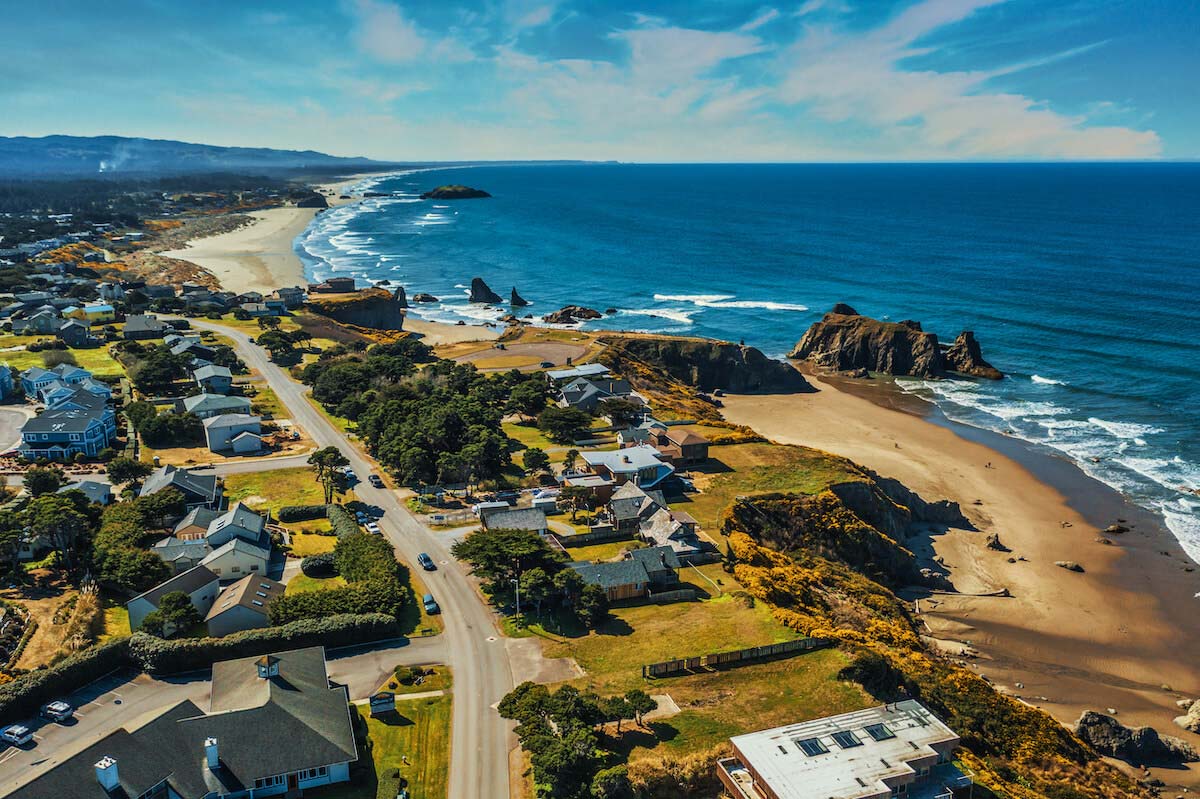
Oregon’s coast combines strict development controls with growing visitor demand, creating a permanent supply-demand imbalance that benefits long-term investors
2026 Economic Outlook by City
- Newport: NOAA campus expansion adding 150+ research positions; OSU Hatfield Marine Science Center growing research programs
- Lincoln City: Chinook Winds Casino Resort $45M expansion completed; new convention facilities driving midweek occupancy
- Seaside: Seaside Convention Center expansion attracting new events; direct benefit from Portland remote work migration
- Highway 101 improvements reducing drive times from Portland metro
- Oregon state marketing investment in off-peak coastal tourism growing shoulder-season bookings
The Three-City Investment Case
| City | Median Home Price | STR Annual Gross (2BR) | Primary Demand Driver | Best Investor Profile |
|---|---|---|---|---|
| Newport | $400,000-$440,000 | $42,000-$68,000 | Research/science employment, bay and ocean tourism, fishing | Mixed STR + long-term rental, year-round stability |
| Lincoln City | $380,000-$430,000 | $50,000-$80,000 | Casino tourism, outlet shopping, kite festivals, beach | Maximum STR revenue, highest peak-season yield |
| Seaside | $360,000-$420,000 | $35,000-$60,000 | Portland weekend gateway, boardwalk, convention traffic, Cannon Beach overflow | Lowest entry, Portland appreciation tie, weekend STR |
Historical Performance
| Period | Market Driver | Avg Annual Appreciation | Key Event |
|---|---|---|---|
| 2010-2014 | Post-recession recovery, stable tourism base | 2-4% | Airbnb and VRBO begin driving coastal Oregon vacation rental demand |
| 2015-2019 | STR platform growth, Portland housing affordability push | 5-8% | Short-term rental revenue doubles as platform adoption grows; investors take notice |
| 2020-2022 | Pandemic domestic travel boom, remote work relocation | 18-28% | Coastal Oregon prices surge as Portland residents buy vacation homes and relocate permanently; STR occupancy hits record highs |
| 2023-2024 | Post-pandemic normalization, rate adjustment | 2-4% | Market stabilizes; STR revenue softens from pandemic peaks but remains well above 2019 levels |
| 2025-2026 | Rate stabilization, events investment, shoulder season growth | 4-7% (projected) | Lincoln City casino expansion and Seaside convention investment driving renewed demand; supply still constrained by coastal planning law |
Key Risks Specific to Coastal Oregon Investment
- Tsunami Inundation Zones: Oregon DOGAMI maps identify tsunami risk zones across all coastal communities. Properties in high inundation zones face insurance, financing, and long-term value risks. Always verify with DOGAMI maps at oregongeology.org/slido before purchase.
- FEMA Flood Zone Designations: Coastal flood zones A and V require mandatory flood insurance, adding $1,500 to $4,000 per year to operating costs. Verify flood zone status at msc.fema.gov before any offer.
- Marine Weather Damage: Pacific storms can cause significant damage to exterior wood, windows, roofing, and decking. Budget 12 to 15 percent of gross revenue for maintenance on oceanfront properties versus 8 to 10 percent for inland coastal properties.
- Seasonal Income Concentration: June through September accounts for 55 to 65 percent of annual STR revenue. Cash reserves and shoulder-season marketing strategies are essential for managing the winter income gap.
- STR Regulatory Evolution: Coastal Oregon cities are reviewing STR regulations regularly. Investors should assume the regulatory environment will tighten over the next 5 to 10 years and not model their returns on a permanently unrestricted STR environment.
- Insurance Cost Escalation: Coastal property insurance has risen significantly in Oregon in recent years. Obtain insurance quotes before closing; some properties that cash flow well at current insurance rates may not pencil if rates increase another 20 to 30 percent.
📚 New to real estate investing? Master the fundamentals with our professional course Learn more →
2. City-by-City Investment Hotspots
Oregon Coast Investment Map: Newport, Lincoln City, and Seaside
Interactive map showing the three coastal investment markets and their key neighborhoods. Green stars show top investment hotspots, blue circles mark established markets, and orange circles highlight emerging areas.
The Three Core Investment Markets
Detailed Neighborhood Comparison Across All Three Markets
| Area | Price Range | STR Annual Gross | Key Demand Driver | Best Strategy |
|---|---|---|---|---|
| Newport: Nye Beach | $450K-$750K | $52,000-$80,000 | Oceanfront, arts district, walkability | Premium STR, appreciation hold |
| Newport: Agate Beach | $400K-$600K | $42,000-$65,000 | Wide beach, ocean views, quieter setting | STR, family vacation rentals |
| Newport: South Beach / NOAA | $320K-$460K | N/A (long-term focus) | NOAA, OSU Hatfield, research employment | Long-term professional rentals, stable yield |
| Lincoln City: Roads End | $420K-$700K | $55,000-$80,000 | Secluded beach, Siletz Bay views, premium | Premium STR, highest nightly rates |
| Lincoln City: D River / Central | $360K-$550K | $48,000-$72,000 | Casino, outlet mall, beach access, proven STR data | Proven STR with performance comps available |
| Lincoln City: Taft / South | $300K-$420K | $35,000-$55,000 | State park, most affordable Lincoln City entry | Value-add, emerging STR, best cash flow |
| Seaside: Beachfront / Broadway | $380K-$600K | $40,000-$65,000 | Portland weekend demand, boardwalk, convention | Weekend STR, highest Seaside nightly rates |
| Seaside: Inland / Residential | $300K-$420K | $28,000-$45,000 | Affordable Seaside entry, beach proximity | Long-term hold, appreciation, supplemental STR |
| Gearhart (North of Seaside) | $430K-$700K | $40,000-$68,000 | Golf, uncrowded beach, upscale second-home buyers | Premium STR, upscale second-home hold |
Expert Insight: “The most common mistake I see coastal Oregon investors make is buying the cheapest available property rather than the most bookable one. A $380,000 house three blocks from the beach in Lincoln City will outperform a $480,000 property with a partial ocean view on paper because the three-block property is harder to book. Guests who are spending $250 per night for a vacation are choosing based on photos and proximity to the water. Ocean view and easy beach access is the single biggest driver of STR revenue on the Oregon coast.” – Maria Sandoval, Oregon Coastal Investment Properties
3. Property Types
| Investment Goal | Best Property Type | Best City / Area | Minimum Capital |
|---|---|---|---|
| Maximum STR Revenue | Ocean-view vacation home | Lincoln City Roads End, Newport Nye Beach | $112,500+ |
| Best Entry Price / Yield | Near-beach cottage, value-add | Lincoln City Taft, Seaside inland | $75,000+ |
| Lowest Management Hassle | Ocean-view condo (STR-permitted HOA) | Lincoln City D River, Newport Bayfront | $70,000+ |
| Year-Round Stability | Long-term rental SFH near employment | Newport South Beach, Toledo | $80,000+ |
Don’t guess the costs. Our Complete Renovation & Remodeling Cost Guide covers 400+ pages of project-by-project breakdowns with real contractor pricing ranges.
4. Cost Analysis
Acquisition Cost Breakdown (Oregon Coastal)
| Expense Item | Typical Cost | Example ($420,000 Property) | Coastal-Specific Notes |
|---|---|---|---|
| Down Payment | 25% (investment/STR) | $105,000 | Second-home financing available at 10-15% down if owner uses property personally |
| Closing Costs | 2-3% of price | $8,400-$12,600 | Oregon escrow-based closings; title, lender fees, recording |
| Coastal Hazard Inspection | $400-$700 | $550 | Full inspection including moisture, weatherproofing, decking, and exterior condition |
| Flood Zone Verification and Insurance Quote | $0-$350 | $150 | Verify at msc.fema.gov; if Zone A or V, mandatory flood insurance adds $1,500-$4,000/yr |
| Tsunami Zone Verification | Free (online) | $0 | Check Oregon DOGAMI at oregongeology.org/slido; affects insurance and financing |
| STR Furnishing Package | $12,000-$35,000 | $20,000 | Required for STR launch; quality directly impacts review scores and future bookings |
| Hot Tub (if adding) | $6,000-$15,000 | $10,000 | Strongly recommended; adds $8,000-$18,000 annual STR revenue on the coast |
| STR License Fees | $150-$500/yr | $300 | City STR permit plus Oregon Transient Room Tax registration |
| Reserves (6 months) | 6 months expenses | $15,000-$22,000 | Critical buffer for winter low season and coastal storm repairs |
| TOTAL MINIMUM ENTRY (STR) | ~36-42% of value | $159,400-$199,600 | Higher than standard residential due to STR startup and furnishing costs |
Sample STR Cash Flow Analysis: Lincoln City 3BR Near-Beach Vacation Home
| Item | Monthly Average | Annual | Notes |
|---|---|---|---|
| Summer Revenue (Jun-Sep) | $6,800 | $27,200 | $265/night avg, 85% occupancy, 4 months |
| Shoulder Revenue (Apr-May, Oct) | $3,400 | $10,200 | $210/night avg, 55% occupancy, 3 months |
| Winter Revenue (Nov-Mar) | $2,100 | $10,500 | $175/night avg, 40% occupancy; casino drives winter Lincoln City traffic |
| Gross Revenue | $3,992 | $47,900 | |
| STR Management Fee (25%) | -$998 | -$11,975 | Full-service local management; essential for remote ownership |
| Platform Fees (Airbnb/VRBO 3%) | -$120 | -$1,437 | Host service fee varies by platform |
| Property Taxes | -$308 | -$3,696 | ~0.88% of $420K assessed value |
| Insurance (coastal + flood) | -$280 | -$3,360 | Landlord/STR policy; higher than inland due to coastal location |
| Utilities (STR owner-paid) | -$200 | -$2,400 | Electric, gas, water, internet; guest-included in STR |
| Maintenance + CapEx (13% coastal) | -$519 | -$6,227 | Higher than inland due to salt air, wind, moisture exposure |
| Net Operating Income | $1,567 | $18,805 | Before mortgage |
| Mortgage ($420K purchase, 25% down, 6.75%, 30yr) | -$2,034 | -$24,408 | Principal and interest only |
| CASH FLOW | -$467 | -$5,603 | Manageable; improves with rates declining or revenue growth |
| STR Yield Equivalent | 4.5% (NOI/purchase) | Improves materially as STR revenue grows annually | |
| Total Return (5.5% appreciation) | ~16-19% | Including equity, appreciation, principal paydown on $130K invested |
Adding a hot tub ($10,000 investment) to this property would likely increase annual gross revenue by $10,000 to $14,000, turning this property cash flow positive within the first year of operation. Making the property dog-friendly adds an estimated 15 to 20 percent occupancy improvement in winter and shoulder months. These two amenity additions are the highest-return operational decisions for any coastal Oregon STR investor.
Expert Insight: “The STR numbers on the Oregon coast are extremely seasonal, so the mistake investors make is modeling on summer-only data. A Lincoln City property that grosses $7,500 in July will gross $1,800 in January. Your underwriting needs to model the full 12 months honestly. That said, the coastal market has shown consistent year-over-year revenue growth of 5 to 8 percent as visitor volume grows and operators get better at shoulder-season marketing. Properties that would have been marginally negative five years ago are cash flow positive today simply from revenue growth.” – Tom Harrington, Lincoln County Investment Real Estate
5. Legal Framework
⚠️ Three Separate Regulatory Jurisdictions Apply
Oregon coastal investors must navigate three layers of regulation: Oregon statewide landlord-tenant law (SB 608 rent stabilization, just cause eviction), city-specific STR licensing in Newport, Lincoln City, and Seaside, and Oregon Transient Lodging Tax requirements that apply to all STRs statewide. Additionally, tsunami zone and coastal development regulations can affect renovation permits and future use. This section covers the key requirements in all three cities. Regulations are actively evolving; confirm current requirements with each city’s planning and licensing office before purchase.
STR Regulations by City (As of 2026)
Newport (Lincoln County)
- City STR business license required ($150-$300/yr)
- Lincoln County Transient Occupancy Tax registration required (10.4% TOT)
- Local contact person must be available 24/7 during guest stays
- Occupancy limits apply (typically 2 per bedroom + 2)
- No current cap on total STR units in Newport
- Noise and parking rules enforced; guest disturbance complaints can threaten license
Lincoln City
- Lincoln City STR permit required (annual renewal)
- Lincoln County + Oregon state Transient Lodging Tax (combined ~12-13%)
- 24/7 local contact person required within 30 miles
- Maximum occupancy per city code (typically 2 per bedroom + 2, up to 12)
- Trash, parking, and exterior maintenance compliance required for permit renewal
- No cap on STR density currently; actively monitoring for future restrictions
Seaside (Clatsop County)
- Seaside city business license required
- Clatsop County lodging tax + Oregon state tax (combined ~10-12%)
- Relatively permissive STR environment; one of the most investor-friendly cities on the coast
- Standard occupancy and noise ordinances apply
- Check for flood plain building restrictions if renovating near beach
- No STR density caps currently in Seaside
Oregon Statewide Rules + Coastal-Specific Requirements
- Oregon Transient Lodging Tax: 1.8% statewide on all STR revenue. Platforms including Airbnb and VRBO collect and remit this automatically, but direct bookings require manual remittance.
- Rent Stabilization (SB 608): Applies to long-term rentals in buildings over 15 years old. Caps annual increases at 7% + CPI. Not applicable to STRs under 30 days.
- Just Cause Eviction: Required after 12 months for long-term tenants. Not applicable to vacation rental guests.
- Oregon Coastal Management Program: Governs development, renovation, and land use within the coastal zone. Governed by the Oregon Department of Land Conservation and Development. Major renovations near the ocean may require Coastal Permit review.
- Tsunami Inundation Zone Disclosure: Oregon law requires disclosure of tsunami inundation zone status in real estate transactions. Sellers must disclose if the property is in a mapped inundation zone.
- FEMA Flood Insurance: Properties in FEMA flood zones A or V require mandatory purchase of flood insurance if financed with a federally backed mortgage. Some lenders require flood insurance in Zone X (500-year flood plain) as well.
- Oregon Occupancy Tax Platforms: Airbnb and VRBO remit Oregon and county lodging taxes automatically. If using direct booking tools, you are responsible for tax collection and remittance.
Key Resources
- Oregon DOGAMI Tsunami Maps: oregongeology.org/slido
- FEMA Flood Map: msc.fema.gov
- Oregon Transient Lodging Tax: oregon.gov/dor/programs/businesses/Pages/lodging.aspx
- Newport Business License: newportoregon.gov
- Lincoln City STR Permits: lincolncity.org
- Seaside Business License: cityofseaside.us
| Regulation | Newport | Lincoln City | Seaside |
|---|---|---|---|
| STR Permit Required | Yes, city business license | Yes, Lincoln City STR permit | Yes, city business license |
| Total Lodging Tax | ~12.2% combined | ~12.8% combined | ~11.8% combined |
| Local Contact Required | Yes, 24/7 | Yes, within 30 miles | Yes |
| STR Density Cap | None currently | None currently | None currently |
| STR Friendliness | Moderate to High | High | High |
| Rent Stabilization (long-term) | Oregon SB 608 applies | Oregon SB 608 applies | Oregon SB 608 applies |
6. Step-by-Step Oregon Coastal Investment Playbook
Choose Your City and Strategy
The three coastal markets serve different investor profiles. Choose based on your goals, capital, and tolerance for seasonal income variability:
Newport: Stability and Diversification
Best for investors who want the STR upside without full seasonal exposure. NOAA and OSU create professional long-term rental demand as a backstop. Nye Beach delivers strong STR revenue; South Beach supports professional tenants if STR performance disappoints.
Lincoln City: Maximum STR Revenue
Best for investors fully committed to the STR model who want the highest achievable revenue per dollar invested. Casino drives year-round occupancy. Roads End delivers the highest nightly rates; D River offers the best available STR performance data.
Seaside: Lowest Entry, Portland Appreciation Tie
Best for first-time coastal investors or those looking for the lowest capital entry. Proximity to Portland drives the most frequent visitor traffic. Long-term appreciation tied to Portland metro growth. Best value for investors who also want to use the property personally.
Value-Add + STR Launch
Buy a dated coastal cottage in Lincoln City Taft or Seaside inland at $300,000 to $380,000. Invest $50,000 to $80,000 in renovations including hot tub, new kitchen, and fresh coastal aesthetic. Launch on Airbnb and VRBO targeting 7.5 to 10 percent yield from day one.
Coastal-Specific Due Diligence
Standard real estate due diligence plus these Oregon coast-specific requirements:
Physical Due Diligence
- Full inspection with specific focus on exterior wood rot, window sealing, and roofing in marine environment
- Deck condition assessment (coastal decks deteriorate 2-3x faster than inland)
- Hot tub or spa condition if present
- Foundation drainage and crawl space moisture barriers
- Heating system adequacy for winter occupancy at coastal temperatures
- Septic system inspection if applicable (some coastal properties are not on city sewer)
- STR-grade appliance, WiFi, and smart lock system condition if assuming existing STR operation
Regulatory and Market Due Diligence
- Verify tsunami inundation zone status at DOGAMI (oregongeology.org/slido)
- Pull FEMA flood zone designation at msc.fema.gov and obtain flood insurance quote
- Confirm current STR permit status and any outstanding complaints on the license
- Review STR performance history if property has been operating (request booking records from seller)
- Verify HOA rules on STR if purchasing a condo or HOA-governed property
- Check for any coastal development restrictions affecting renovation plans
- Confirm parking availability for guests (parking complaints are a common STR license issue)
Build Your Coastal Oregon Team
- Coastal-Specialist Real Estate Agent: Must understand STR performance data and know how to value properties based on booking revenue rather than comparable sales alone. Ask them to provide AirDNA or Rabbu data on comparable properties.
- Full-Service STR Management Company: Non-negotiable for remote investors. Evaluate management companies by their guest review scores on Airbnb (average 4.7+ is the benchmark), their portfolio size in your target city, and their reporting transparency. Expect to pay 22 to 28 percent of gross revenue.
- Coastal Oregon Contractor: For renovation or maintenance, you need a contractor experienced specifically with coastal conditions. Exterior materials, window installation, and roofing standards differ significantly from inland Oregon.
- Oregon Real Estate CPA: STR income taxation differs from long-term rental income for Oregon and federal purposes. Short-term rental tax treatment, bonus depreciation, and cost segregation on furnished vacation properties require specific expertise.
- Oregon Coastal Insurance Specialist: Standard landlord insurance is often inadequate for coastal STR properties. You need a policy that covers guest liability, vacation rental business interruption, and coastal weather damage. Get quotes from 3 to 4 insurers before closing.
Expert Tip: Before making an offer on any Oregon coastal STR property, request 12 months of actual booking data from the seller or pull comparable data from AirDNA for that specific neighborhood. Properties with 3 to 4 years of booking history give you the most reliable underwriting data. New-to-STR properties require more conservative projections.
Maximize STR Performance
STR revenue in coastal Oregon is highly elastic based on listing quality, amenities, and management. The gap between a top-performing and average-performing listing in Lincoln City can be $15,000 to $25,000 in annual revenue:
- Professional photography is mandatory. Listings with professional photos generate 20 to 40 percent more bookings on Airbnb. For a $50,000 gross revenue property, professional photos pay for themselves in the first week of additional bookings.
- Hot tub is the single highest-ROI amenity. A $10,000 hot tub investment on the Oregon coast generates $10,000 to $18,000 in additional annual revenue, with a full payback in under 12 months.
- Dog-friendly designation opens the largest incremental market. Portland has one of the highest dog ownership rates of any U.S. city. Listing as dog-friendly adds 15 to 25 percent to winter and shoulder occupancy when the dog-owner market is most available to travel.
- Dynamic pricing tools are not optional. Tools including PriceLabs, Wheelhouse, and Beyond Pricing optimize nightly rates based on local demand, competitor pricing, and booking lead time. Manually priced listings leave 10 to 20 percent of potential revenue on the table.
- Reviews drive bookings. Maintaining a 4.8+ star rating on Airbnb is the most important long-term performance factor. Guest experience management, quick response times, and well-stocked properties are the primary drivers.
- Seasonal minimum stays protect peak revenue. Setting 3 to 5 night minimums during July and August prevents single-night bookings that block higher-value multi-night reservations.
7. Financing Options for Oregon Coastal Properties
| Loan Type | Down Payment | Rate Premium | Best For | Coastal Oregon Note |
|---|---|---|---|---|
| Second Home Conventional | 10-15% | +0.25-0.5% | Owner who uses property personally; lower down payment | Best entry for buyers who also want personal use; must occupy personally to qualify |
| Investment Conventional | 25% | +0.5-0.75% | Pure investment; no personal use required | Most coastal Oregon STR properties qualify as conforming under $806,500 |
| DSCR (STR Income) | 25-30% | +1.5-2.5% | STR investors without W-2 income documentation | Some DSCR lenders use AirDNA market rent data for coastal STRs; verify lender’s STR income methodology |
| Portfolio Loan | 20-30% | +1-2% | Multiple coastal properties, self-employed investors | Oregon coast community banks (Oregon Coast Bank, People’s Bank) understand this market |
| HELOC on Primary Residence | N/A (equity draw) | Prime + 0.5-1% | Portland homeowners with equity using it to buy coastal investment | Very common strategy for Portland metro buyers; STR revenue can service HELOC draws |
| Hard Money / Bridge | 15-25% | 8-12% rate | Value-add acquisition, renovation-then-refi strategy | Oregon coastal hard money lenders active; best for value-add deals that will refi at higher ARV |
Second Home Financing Advantage: If you intend to use the property personally for even a few weeks per year, second-home financing at 10 to 15 percent down is available at rates very close to primary residence rates. This dramatically reduces the capital required to enter the coastal market. The key restriction: lenders require you to occupy the property personally for some portion of the year (not a hard rule, but part of the intent certification). Most coastal Oregon investors who want to personally use the property qualify for this program and should use it over investment financing when available.
8. Frequently Asked Questions

Knowledge Quiz: Oregon Coastal Real Estate Investment
Open Quiz
5 quick questions on what you just learned about Oregon coastal investing
1) What is the single highest-ROI amenity investment the guide recommends for coastal Oregon STR properties?
Answer: C
The guide specifically identifies the hot tub as the single highest-return amenity investment on the Oregon coast. A $10,000 hot tub addition generates $10,000 to $18,000 in additional annual STR revenue, delivering full payback in under 12 months. Dog-friendly designation is the second most impactful revenue driver, targeting Portland’s high dog-ownership visitor base.
2) Which of the three cities does the guide recommend for maximum STR revenue and why?
Answer: A
The guide shows Lincoln City achieving the highest STR annual gross revenue of the three cities ($50,000-$80,000 for a 2BR oceanfront) and attributes the casino as the key differentiator. Lincoln City winter occupancy is consistently 5 to 15 percentage points higher than comparable coastal markets without a casino anchor, reducing the seasonal income problem that challenges all coastal Oregon STRs.
3) What two databases should every investor check before purchasing any Oregon coastal property?
Answer: D
The guide emphasizes that tsunami inundation zone status (checked at oregongeology.org/slido) and FEMA flood zone designation (checked at msc.fema.gov) are non-negotiable due diligence requirements for any Oregon coastal purchase. Properties in high tsunami inundation zones or FEMA flood zones A and V carry significantly different insurance costs, financing constraints, and long-term value implications than properties above the inundation line.
4) What percentage of annual STR revenue does the guide attribute to the summer peak season (June through September)?
Answer: B
The guide’s cash flow analysis shows summer (June through September) accounting for 55 to 65 percent of annual STR revenue. The shoulder seasons (April to May and October) contribute 20 to 25 percent, while winter (November through March) contributes 15 to 20 percent. This concentration requires careful cash reserve planning and active shoulder-season marketing to smooth annual income.
5) What is the key advantage of second-home financing versus investment financing for Oregon coastal purchases?
Answer: C
The guide identifies second-home financing as the most capital-efficient entry path for Oregon coastal investors who intend to use the property personally. At 10 to 15 percent down versus the 25 percent required for pure investment financing, the capital savings on a $420,000 property are $42,000 to $63,000. The key qualification: the buyer must intend to use the property personally for some portion of the year.
Work With a Local Expert on the Oregon Coast
We are building a verified network of real estate professionals across every market we cover.

About Our Expert Network
We are finalizing partnerships with verified real estate professionals across every market featured on Builds and Buys. Each expert in our network is selected for their hands-on investment experience, local market knowledge, and commitment to helping buyers and investors make sound decisions.
- Proven experience with vacation rental and investment properties on the Oregon coast
- Deep knowledge of STR performance data, tsunami zone considerations, and coastal regulations
- Guidance on financing, legal structure, and due diligence specific to coastal Oregon
- Access to off-market and pre-market vacation rental opportunities
- Full transaction support from search through closing
- STR management company referrals across Newport, Lincoln City, and Seaside
Services Covered
- Vacation rental property sourcing
- STR performance analysis and underwriting
- Buyer representation on the coast
- Market comparables and valuations
- Tsunami and flood zone guidance
- Value-add renovation strategy
- Legal and title referrals
- Coastal financing specialists
- STR management referrals
- Coastal insurance specialists
- 1031 exchange coordination
- Exit strategy planning
Get Connected or Join Our Network
Looking for a local expert to help with your Oregon coastal investment? Reach out and we will connect you with the right professional for your target city and strategy.
Contact us at support@buildsandbuys.com
Find Specialized Oregon Coast Real Estate Professionals
Ready to Invest on the Oregon Coast?
Newport, Lincoln City, and Seaside represent three distinct but complementary investment markets along one of the Pacific Coast’s most supply-constrained shorelines. Oregon’s strict coastal planning law means the oceanfront and ocean-view properties that exist today are essentially all that will ever exist, creating a permanent floor under long-term values. For investors willing to understand the seasonal income model, build the right management team, and choose properties based on guest experience rather than lowest price, coastal Oregon delivers some of the Pacific Northwest’s strongest vacation rental returns combined with a compelling long-term appreciation thesis tied to Portland metro growth.
Continue Your Research
Oregon State Guide
See how coastal Oregon compares to Portland, Eugene, Bend, Salem, and Corvallis.
Step-by-Step Invest
Complete framework for building a real estate investment strategy from scratch.
144-Lesson Course
University-level real estate education covering financing, law, strategy, and management.
For further guidance, explore our State-by-State Investor guides, browse our expert articles, or follow our Step-by-Step Investment Guide.