
Derby Real Estate Investment Guide For 2026
A comprehensive resource for investors looking at the largest and fastest growing Wichita suburb, where a school district is the product, an Air Force refueling wing sits at the north edge, and a well bought rental can return 17 percent while losing money every month
Quick answers: Top 5 most searched Derby investment questions ▼
Migration data: Where people are moving from to Derby ▼
In This Guide
Click on any section to navigate directly to that content
1. Derby Market Overview
Market Fundamentals
Derby sits about ten miles southeast of downtown Wichita in Sedgwick County, and it is the largest and fastest growing suburb of the largest metro in Kansas. Three things drive it: Derby USD 260, which is the reason most families move here and the thing they are actually paying for; McConnell Air Force Base immediately north, with Derby the closest community to the gate; and a short commute into Wichita’s aviation manufacturing and healthcare economy. It is a genuinely growing market and it therefore works nothing like the small city guides elsewhere in this Kansas series.
Key economic indicators that define the Derby investment case:
- Population: approximately 25,000 and rising, within a metro of roughly 650,000
- Major Employers: McConnell Air Force Base, Derby USD 260, and via a short commute the Wichita aviation manufacturers, major healthcare systems, Sedgwick County government, and the metro retail and service base
- Median Household Income: roughly $88,000, among the highest covered in this series
- Median Home Price: approximately $265,000
- Vacancy Rate: approximately 4 to 6 percent
- Median Age: approximately 35
The defining feature of this market for an investor is the yield. Cap rates here run 4.5 to 6.5 percent, the lowest range in this Kansas series, and at 25 percent down the sample deal in this guide loses money every month. It still returns 17 percent, because 4.5 percent appreciation on a $285,000 house is $12,825 a year. Derby builds wealth through equity rather than through rent, which is the exact inverse of the southeast Kansas markets, and confusing the two is how investors get hurt at both ends of the state.
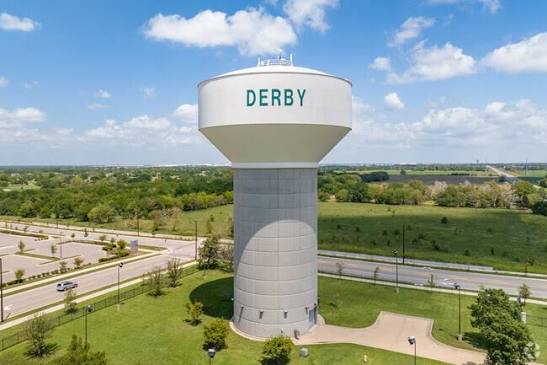
Derby is the largest Wichita suburb and one of the few genuinely growing markets in this Kansas series
2026 Economic Outlook
- Derby USD 260 remaining the primary demand driver and the reason families pay a premium here
- McConnell Air Force Base anchoring rental demand, with a long term tanker recapitalisation mission
- Wichita aviation manufacturing employment reachable on a short commute
- Continued residential development on the eastern and southern edges of the city
- Low vacancy supported by genuine population growth rather than by supply shortage
- Cap rates likely to stay compressed while appreciation carries investor returns
Investment Climate
Derby rewards patient capital and punishes investors who need monthly income. Successful investors here tend to share these characteristics:
- A long horizon and no need for monthly cash flow, because at standard leverage there is not any
- The ability to put more than 25 percent down, which is the practical lever that turns negative cash flow positive here
- Understanding of the school district as the product, since Derby USD 260 is what tenants and future buyers are paying for
- Familiarity with military tenancy, including housing allowance dynamics and early lease termination rights under federal law
- Discipline about HOA covenants, because newer subdivisions here can restrict or cap rentals outright
- Realistic expense assumptions, since a low cap rate leaves very little room for an underestimated line item
The advantages are real and worth stating clearly. This is a growing market in the largest metro in Kansas, with 4 to 6 percent vacancy driven by actual demand rather than by supply constraint. Appreciation at 4.5 percent is roughly triple what southeast Kansas produces. Housing stock is newer, so maintenance runs lower and capital expenditure is further away. Resale liquidity is genuine, which is something most markets in this series cannot offer. And military demand provides a floor under rents that is set by federal housing allowance rather than by local wages.
The costs are the mirror image. At 25 percent down the sample deal loses $75 a month self managed and $233 a month with a manager, which means an investor without reserves or additional income to cover that gap should not buy here. Cap rates of 4.5 to 6.5 percent leave almost no margin for error, so an insurance increase or a longer vacancy hurts disproportionately. HOA covenants can prevent renting entirely in some developments. And the 17 percent return depends on appreciation continuing, which is a forecast rather than a fact.
Historical Performance
| Period | Market Driver | Avg Annual Appreciation | Key Event |
|---|---|---|---|
| 2000-2008 | Suburban expansion, school district reputation | 4-6% | Sustained subdivision development as families relocate out of Wichita for the district |
| 2009-2013 | Aviation downturn and national housing correction | -1 to 2% | Wichita aviation employment contracts sharply, and Derby feels it through the commuter base |
| 2014-2019 | Recovery, tanker mission investment | 3-5% | Long term investment in the KC-46 mission at McConnell supports base area demand |
| 2020-2022 | Record low rates, suburban demand surge | 11-16% | Sharp repricing as suburban family housing is bid up nationally |
| 2023-2026 | Rate normalization, continued growth | 3-5% (projected) | Population growth and district demand supporting values while higher rates compress investor cash flow |
Over a 20 year window Derby has produced roughly 4 to 5 percent average annual appreciation, near the top of this Kansas series and behind only the strongest Kansas City metro submarkets. A $150,000 house purchased in 2006 is worth roughly $255,000 to $290,000 today, and that gap is the entire investment case here. The row worth studying is 2009 to 2013, because it shows the one genuine vulnerability: Derby’s commuter base depends on Wichita aviation manufacturing, and when that industry contracted, this market went flat and briefly negative. The base and the school district cushioned it, but they did not prevent it.
Demographic Trends Driving Demand
- Derby USD 260 – The primary reason families relocate here, and the single most important thing a tenant or future buyer is paying for. In this market the district is the product.
- McConnell Air Force Base – Air refueling operations immediately north, with Derby the closest community to the gate. Housing allowance sets both the ceiling and the floor on rents.
- Wichita Aviation Manufacturing – A short commute to the metro’s core industry, providing skilled wages and also the market’s main cyclical exposure
- Metro Healthcare and Services – Wichita’s hospital systems and wider service economy within easy commuting distance
- Family Household Formation – A median age of 35 and a heavily family oriented population, which is what makes four bedroom homes the core rental product
- Continued Residential Development – New subdivisions expanding the eastern and southern edges, which supports growth and also adds competing supply
📚 New to real estate investing? Master the fundamentals with our professional course Learn more →
2. Neighborhood Hotspots
Derby Investment Neighborhood Map
Interactive map of Derby and the southeast Wichita metro. Green stars show top hotspots, blue circles mark established markets, and orange circles highlight emerging areas. Note that several surrounding communities sit in different school districts and different counties.
Core Investment Neighborhoods
Detailed Submarket Analysis: Derby and Southeast Wichita Metro
| Area | Price Range | Cap Rate | School District | Best Strategy |
|---|---|---|---|---|
| Oaklawn-Sunview | $95K-$165K | 8-10.5% | Verify on the parcel | Highest yields locally, unincorporated, confirm district and jurisdiction first |
| Belle Plaine | $110K-$185K | 7.5-9.5% | Belle Plaine USD 357 | Small town hold, much lower entry, longer commute, thin resale |
| Douglass | $120K-$200K | 7-9% | Douglass USD 396 | Butler County small town, rural setting, limited rental depth |
| Haysville | $150K-$240K | 6.5-8% | Haysville USD 261 | Better yields than Derby without the USD 260 premium |
| Old Derby / Downtown | $155K-$235K | 6.5-8% | Derby USD 260 | Best yields inside city limits, value add, same district premium |
| Mulvane | $175K-$275K | 6-7.5% | Mulvane USD 263 | County line market, local employment, Derby and Wichita commute |
| South Derby / K-15 | $185K-$275K | 6-7.5% | Derby USD 260 | Growth edge, better value than east Derby, check HOA covenants |
| Woodlawn / West Derby | $195K-$285K | 5.5-6.5% | Derby USD 260 | Established hold, verify flood zone toward the Arkansas River |
| Rose Hill | $200K-$310K | 5.5-6.5% | Rose Hill USD 394 | Butler County district premium, smaller and quieter alternative |
| North Derby / Base Corridor | $215K-$310K | 5.5-6.5% | Derby USD 260 | Military rentals, BAH driven, SCRA applies, steadiest demand |
| Rock Road / Central Derby | $235K-$340K | 5-6% | Derby USD 260 | Long hold family rental, strongest resale liquidity |
| Southeast Growth Edge | $250K-$400K | 4.5-5.5% | Derby USD 260 | Newest construction, appreciation play, HOA restrictions likely |
| East Derby / Newer | $290K-$450K | 4.5-5.5% | Derby USD 260 | Lowest maintenance, strongest appreciation, read the HOA covenants first |
Expert Insight: “The conversation I have most often with investors coming here from a cash flow market is that Derby will not do what they are used to. They run the numbers, see they are five hundred dollars short a month against what they expected, and assume they have found a bad deal. They have not. They have found a normal Derby deal. This market pays you in equity, not in rent, and if you need the rent you should be somewhere else in Kansas. The second thing, and this one costs people real money: read the covenants before you write an offer on anything in the newer subdivisions. Some of them cap how many houses in the development can be rentals, and if the cap is already met the answer is no matter what the covenant says in principle. Call the association and ask for the current count.” – Camille Ostrander, Investment Broker, Derby Metro Property Group
3. Property Types
| Investment Goal | Best Property Type | Best Neighborhoods | Minimum Capital |
|---|---|---|---|
| Highest Total Return | Four bedroom family home in USD 260 | Rock Road corridor, north Derby, east Derby | $82,000+ |
| Actual Monthly Cash Flow | Oaklawn-Sunview property, or a Derby purchase at 35% down | Oaklawn-Sunview, Old Derby | $35,000+ |
| Best Yield Inside Derby | Old Derby value add, or a duplex where available | Old Derby, downtown | $59,000+ |
| Steadiest Demand | Military rental near the McConnell gate | North Derby, gate corridor | $70,000+ |
| Lowest Maintenance | Newer construction, covenants permitting | East Derby, southeast growth edge | $88,000+ |
Don’t guess the costs. Our Complete Renovation & Remodeling Cost Guide covers 400+ pages of project-by-project breakdowns with real contractor pricing ranges.
4. Cost Analysis
Acquisition Cost Breakdown (Derby)
| Expense Item | Typical Cost | Example ($265,000 Property) | Notes |
|---|---|---|---|
| Down Payment | 25%, or 35% to reach positive cash flow | $66,250-$92,750 | The most consequential decision in this market. 25% loses money monthly. 35% does not. |
| HOA Covenant and Rental Cap Review | $0 | $0 | The defining Derby check on newer subdivision property. Read the covenants and ask the association for the current rental count, since some cap the percentage of leased homes. |
| School District Verification | $0 | $0 | Free, and essential on anything outside Derby city limits. USD 260, 261, 263, 394, and Wichita 259 all serve parts of this area. |
| Flood Zone Determination | $0-$50 | $25 | Relevant on the western side of the city toward the Arkansas River |
| Closing Costs | 2-3% of price | $5,300-$7,950 | Title, escrow, lender fees, recording. Kansas closings handled by title companies. |
| General Inspection | $400-$650 | $500 | Non negotiable even on newer stock, where builder era defects are the thing to look for |
| Roof and Hail Damage Assessment | $0-$300 | $200 | South central Kansas takes serious hail. Roof age is a significant insurance variable here. |
| Insurance Quote on the Actual Address | $0 | $0 | Free, and at a 5.3% cap rate a $600 annual surprise is nearly 4% of your NOI. Quote before removing contingencies. |
| Radon Test | $125-$200 | $150 | Kansas records high radon readings statewide. Mitigation runs $900-$2,000. |
| Sewer Lateral Scope | $200-$350 | $275 | Worth doing in Old Derby and on anything pre 1980. Less critical on newer construction. |
| Foundation Evaluation | $0-$500 | $300 | Order when movement is flagged. South central Kansas soils do move. |
| Initial Repairs | 0-15% of price | $0-$40,000 | Near zero on newer subdivision stock, meaningful in Old Derby |
| Reserves (6 months) Plus Negative Cash Flow Cushion | 6 months plus 12 months of shortfall | $16,000-$22,000 | Unique to this market. Reserve for the monthly shortfall as well as for repairs, or you will be funding it from income you did not plan to use. |
| TOTAL MINIMUM ENTRY | ~33-63% of value | $88,600-$166,300 | The highest entry cost in this Kansas series outside the Kansas City metro |
The reserve line in that table is different from every other guide in this series, and deliberately so. Everywhere else, reserves cover repairs and vacancy. In Derby at 25 percent down you are also funding an ongoing monthly shortfall, and that is a structurally different situation. A $75 monthly deficit is $900 a year, and $233 with a manager is nearly $2,800 a year, and neither of those is a surprise expense. It is a planned cost of holding an appreciating asset. Investors who understand that going in do fine. Investors who assumed the rent would cover the mortgage find themselves selling in year three, which in a market that pays you through appreciation is the one outcome that guarantees you lose. On tax, Sedgwick County produces an effective rate around 1.4 to 1.6 percent of market value, lower than most markets in this series, which is one of the few things working in your favour here.
Sample Cash Flow Analysis: North Derby Four Bedroom near the Base
Deal structure: $255,000 purchase of a 2000s four bedroom in north Derby within Derby USD 260, no HOA rental restriction, outside the flood plain. $12,000 in updates (paint, flooring, appliances, minor mechanical), $6,000 closing. Total basis $273,000. After repair value approximately $285,000. Rented at $1,975 per month.
| Item | Monthly | Annual | Notes |
|---|---|---|---|
| Gross Rent | $1,975 | $23,700 | 4BR in USD 260 near the base. Housing allowance sets a practical ceiling here. |
| Less Vacancy (5%) | -$99 | -$1,185 | Low, and driven by genuine population growth rather than by supply shortage |
| Property Taxes | -$356 | -$4,275 | ~1.5% effective. 18% of gross rent, though the rate itself is lower than most of this series. |
| Insurance | -$165 | -$1,980 | 8% of gross rent. South central Kansas hail exposure on a newer roof. |
| Maintenance + CapEx (8%) | -$158 | -$1,896 | Lower than elsewhere in this series because the stock is newer and systems are not near end of life |
| Net Operating Income (self managed) | $1,197 | $14,364 | Before mortgage |
| Property Management (8%) | -$158 | -$1,896 | Drops NOI to $1,039/month or $12,468/year |
| Mortgage ($191,250 at 7.0%, 30yr, 25% down) | -$1,272 | -$15,264 | Principal and interest only. This line is what makes the market difficult at standard leverage. |
| CASH FLOW (self managed, 25% down) | -$75 | -$900 | Negative. Plan to fund it, and understand you are being paid elsewhere. |
| CASH FLOW (professionally managed, 25% down) | -$233 | -$2,796 | Nearly $2,800 a year out of pocket. This is the number most out of area investors miss. |
| CASH FLOW (self managed, 35% down) | +$94 | +$1,128 | $165,750 loan at $1,103. Positive, on $107,250 of capital, for a 14.6% total return. |
| Cap Rate | 5.3% self managed / 4.6% managed | NOI divided by total basis of $273,000. The lowest in this Kansas series. | |
| Total Return Year One (25% down, self managed) | ~17.0% | Minus $900 cash flow plus $1,937 principal paydown plus 4.5% appreciation on $285,000, on $81,750 invested | |
| Where the Return Actually Comes From | 93% appreciation | $12,825 of a $13,862 total. Principal paydown adds $1,937. Rent contributes nothing. |
Set this against the Coffeyville guide and you have the two ends of Kansas real estate in one comparison. Coffeyville: $39,000 in, $174 a month out, 10.0 percent total return, and essentially no appreciation. Derby: $81,750 in, $75 a month negative, 17.0 percent total return, and 93 percent of that return arriving as appreciation you cannot spend until you sell or refinance. Neither is better. They are different instruments serving different purposes, and the mistake is applying one market’s expectations to the other. An investor who needs monthly income should not buy Derby at 25 percent down. An investor building long term equity should not expect Coffeyville to compound. The 35 percent down row exists because it is the practical middle path here: $107,250 of capital turns the monthly figure positive at $94, and total return settles at a still strong 14.6 percent.
Expert Insight: “At a five percent cap rate you have almost no room, and people do not internalise what that means until something goes wrong. On a Coffeyville house an extra six hundred dollars of insurance is annoying. Here it is four percent of your entire net operating income, and you were already negative. So the discipline in a low cap market is not about finding bargains, it is about not being wrong on any expense line. Quote the insurance on the actual address. Get the tax figure from the county rather than from the current owner’s bill, because it resets when you buy. Find out what the HOA dues are and whether they are going up. Every one of those is free to check and any one of them can turn a thin deal into a bad one.” – Reid Callahan, CPA, Kansas Real Estate Advisory
5. Legal Framework
⚠️ Derby Compliance Notice
Kansas state landlord law applies uniformly statewide, but three Derby specific layers sit on top of it. HOA covenants in newer subdivisions can restrict, cap, or prohibit rentals entirely, and they are private contracts that bind you regardless of what state law permits. The Servicemembers Civil Relief Act gives military tenants federal early termination rights on qualifying orders that override your lease. And school district boundaries in this area are genuinely complex, with USD 260, 261, 263, 394, and Wichita 259 all serving nearby parcels. Note also that Sedgwick County District Court sits in Wichita, so evictions are filed there rather than in Derby. This guide provides an overview as of 2026 only. Always confirm current requirements with a licensed Kansas real estate attorney before acquiring rental property.
Kansas Regulations and Derby Specific Layers
The governing statute is the Kansas Residential Landlord and Tenant Act at K.S.A. 58-2540 and following:
- Nonpayment of Rent: 3 day written notice to pay or vacate, among the shortest notice periods in the country.
- Lease Violations: 14 day written notice to cure, with termination effective 30 days from notice if the breach is not remedied.
- Month to Month Termination: 30 days written notice by either party.
- Security Deposits: Capped at one month’s rent unfurnished, one and a half months furnished, plus an additional half month for pets.
- Landlord Entry: Reasonable notice required, generally interpreted as 24 hours, at reasonable times except in emergency.
- No Rent Control: Kansas law preempts municipal rent control.
- Court Venue: Sedgwick County District Court sits in Wichita. Derby evictions are filed and heard there, not locally.
- HOA Covenants: Private contracts recorded against the property that can limit or prohibit leasing, set minimum lease terms, require board approval of tenants, or cap the number of rentals in a development. Enforceable, and they bind you as owner.
- Servicemembers Civil Relief Act: Federal law permitting a servicemember to terminate a residential lease early on qualifying permanent change of station or deployment orders, with notice and a copy of the orders. This overrides your lease terms.
- School District Boundaries: USD 260 Derby, USD 261 Haysville, USD 263 Mulvane, USD 394 Rose Hill, and Wichita USD 259 all serve parts of this area. Verify on the parcel.
- Federal Lead Paint Rules: Mandatory disclosure on pre 1978 housing, which is mainly Old Derby.
Compliance Best Practices
Derby operating risk sits in covenants, military tenancy rules, and thin margins:
- Read the HOA Covenants Before You Write an Offer. The defining Derby step. Look specifically for leasing prohibitions, minimum lease terms, board approval requirements, and rental percentage caps.
- Ask the Association for the Current Rental Count. A covenant permitting rentals in principle is worthless if the development has already hit its cap. This is a phone call and it costs nothing.
- Use a Military Clause Lease Addendum that acknowledges SCRA rights. It does not change your obligations under federal law, but it sets expectations clearly and reduces disputes.
- Verify the School District on the Parcel, not from the listing, not from the mailing address, and not from proximity. In a market where the district is the product, this is the most consequential free check available.
- Quote Insurance and Confirm Taxes Before Removing Contingencies. At a 5.3 percent cap rate you have no margin, and the tax figure resets when you buy.
- Budget for HOA Dues as an Operating Expense, since they are real money the cap rate has to absorb, and they can rise.
- Verify Flood Zone Status on the western side of the city toward the Arkansas River.
- Understand That Housing Allowance Caps Your Rent. Pricing above what the allowance supports will simply extend your vacancy near the base.
Useful Derby and Sedgwick County Resources
- City of Derby: derbyks.com
- Sedgwick County Appraiser for parcel and valuation data
- Sedgwick County District Court in Wichita for eviction filings
- Sedgwick County Register of Deeds for deeds, liens, easements, and recorded HOA covenants
- Derby USD 260 for school boundary verification
- FEMA Flood Map Service Center for flood zone determination
- Kansas Statutes K.S.A. 58-2540 for the Residential Landlord and Tenant Act
| Factor | Derby (McConnell AFB) | Junction City / Leavenworth (Army) | Investor Impact |
|---|---|---|---|
| Service Branch and Mission | Air Force air refueling, tied to a long term aircraft programme | Army combat division and a staff college | Aircraft based missions tend to be steadier than deployment and rotation cycles |
| Surrounding Economy | A growing suburb inside the largest Kansas metro | Small standalone cities where the post dominates | Derby has genuine non military demand. The Army markets have much less. |
| SCRA Early Termination | Applies identically | Applies identically | Federal law. Budget for turnover you cannot control anywhere near a base. |
| Housing Allowance Effect | Sets floor and ceiling, competing with civilian demand | Sets floor and ceiling, with far less civilian competition | Derby rents are supported by families and the base together, not by the base alone |
| Appreciation | 4.5% | 3.0% and 5.0% respectively | Derby’s growth is metro driven rather than post driven, which is more durable |
| Monthly Cash Flow at 25% Down | -$75 self managed | +$62 and +$181 respectively | The Army markets pay you monthly. Derby pays you at sale. |
6. Step-by-Step Derby Investment Playbook
Define Your Derby Strategy
The first decision here is not which neighborhood. It is how much you put down, because that determines whether this is an income investment or an equity one:
Appreciation Hold at 25% Down
Buy a four bedroom in USD 260 and accept a monthly shortfall in exchange for the highest total return in this Kansas series outside the Kansas City metro. 93 percent of that return is appreciation, which means you are paid at refinance or sale rather than monthly.
Balanced Hold at 35% Down
The same property with more equity. Cash flow turns positive at $94 a month, total return settles at 14.6 percent, and you are no longer funding a shortfall. The practical middle path and the right answer for most investors here.
Old Derby Value Add
Buy pre 1970 stock about $100,000 below the Derby median, inside the same school district, and renovate. The best yields available within city limits and the only Derby strategy that reliably cash flows at standard leverage.
Oaklawn-Sunview Income Position
Buy two or three miles north at roughly a third of Derby prices for genuine monthly income within the Wichita metro. Verify school district and jurisdiction on the parcel before offering, since that verification is the whole basis of the play.
Build Your Derby Team
This is a metro market, so professional depth is genuinely available here in a way it is not elsewhere in this series. Use it:
- Agent Who Knows the Subdivisions and Their Covenants: The most valuable person on this list. Ask directly which developments restrict rentals, because a good Derby agent will know without looking it up.
- Property Manager With Military Tenancy Experience: Ask specifically about SCRA handling, housing allowance pricing, and PCS season turnover. Wichita metro managers who work the base corridor know this well.
- Independent Insurance Agent: South central Kansas hail plus a thin cap rate means this line matters more than the premium suggests. Shop it properly.
- Lender Who Will Quote Both 25 and 35 Percent Down: Because that comparison is the actual decision in this market, and you want the real numbers rather than a rule of thumb.
- Home Inspector: Used every time, including on newer construction where builder era defects are the thing you are looking for.
- Real Estate Attorney for Covenant Review: Worth one engagement if you are buying in a covenanted development. Covenants are enforceable contracts and reading them casually is a mistake.
- Real Estate CPA: For depreciation, entity structure, and Sedgwick County valuation appeals.
Expert Tip: Ask your lender to quote the deal at 25 percent and at 35 percent down side by side before you look at properties, and look at both the monthly figure and the total return together. Most investors default to 25 percent because that is the standard investment loan and never examine the alternative. In Derby that default costs you $169 a month in cash flow, and the extra capital costs you 2.4 points of total return. Which of those matters more is a personal question about your situation, but you should answer it deliberately rather than by accepting a default.
Derby Specific Due Diligence
Standard due diligence items plus these Derby critical checks:
Regulatory and Financial
- HOA covenants read in full, looking for leasing prohibitions, minimum lease terms, board approval requirements, and rental percentage caps.
- Current rental count from the association, because a cap that is already met means no.
- HOA dues confirmed, including any scheduled increases or pending special assessments.
- School district verified on the parcel, which is the most consequential free check in this market.
- Property tax figure from the county at your purchase price, not the seller’s current bill, since it resets.
- Written insurance quote on the address, given the thin margin.
- Flood zone determination on the western side of the city.
- Comparable rents near the base, checked against current housing allowance rather than against listing asks.
Physical Due Diligence
- Roof age and hail claim history, the largest insurance variable in south central Kansas.
- Builder era defects on newer construction, which is what an inspection on a 2000s house is actually looking for. Do not skip it because the house looks new.
- Foundation and soil movement, since south central Kansas soils do move and repair is expensive relative to a thin margin.
- HVAC age and remaining life, which on a 2000s house may be approaching replacement.
- Sewer lateral scope on anything pre 1980, particularly in Old Derby.
- Radon testing on every property.
- Water heater and appliance ages, since these are the near term capital items on newer stock.
- Asbestos and lead paint on pre 1978 Old Derby property.
Sourcing Deals in Derby
Unlike the small markets in this series, Derby has genuine competition from owner occupants. That changes what works:
- Target Old Derby specifically. The only pocket in the city where value add is possible, roughly $100,000 below the median inside the same school district, and largely overlooked by investors chasing the newer subdivisions.
- Look for houses without HOA covenants. Genuinely valuable and rarely advertised. Older Derby stock and some pockets of the west side sit outside any association, which removes an entire category of risk.
- Watch the PCS season inventory. Military households selling on orders have a schedule they cannot move, and near the base that produces motivated sellers on a predictable cycle.
- Compete on certainty rather than price. Against owner occupants who need financing contingencies, a clean inspection period and a firm close is often worth more than an extra few thousand dollars.
- Consider Oaklawn-Sunview and Haysville for yield, where investor competition is thinner and prices are far below Derby’s.
- Build a relationship with a Wichita metro lender who will move quickly, since speed is the main lever available in a market with real buyer competition.
Property Management in Derby
Management costs $158 a month on the sample deal and takes cash flow from minus $75 to minus $233. That is a genuine decision rather than a formality:
Tenant Screening Protocol
Kansas caps your deposit at one month. Apply written criteria identically to every applicant, and note that military applicants require some additional understanding:
- Verifiable gross household income of at least 3 times monthly rent, counting basic pay plus housing allowance for military applicants since the allowance is genuine income
- Direct employer or command verification, with a Leave and Earnings Statement being the standard document for military households
- Two prior landlord references, contacting the landlord before the current one, and expecting out of state references from PCS moves
- Full credit and eviction records search, applied consistently, recognising that frequent address changes are normal for military families and are not an adverse signal
- Written, posted criteria applied identically and documented every time
- A military clause addendum acknowledging SCRA rights, which sets expectations clearly even though federal law applies regardless
Typical Derby Management Fees
- Single family management: 8-10% of monthly rent
- Small multi-family management: 6-8% of monthly rent
- Leasing fee: 50-100% of one month’s rent, which matters more here because PCS turnover is frequent near the base
- Lease renewal fee: $150-$300 per renewal
- Flat fee management: $130-$185 per door per month, which at a $1,975 rent usually beats a percentage
- Maintenance coordination markup: typically 10% on vendor invoices
- Ask specifically about SCRA experience and PCS season leasing. A manager who handles the base corridor regularly is worth more than a slightly lower fee.
7. Financing Options for Derby
| Loan Type | Down Payment | Rate Premium | Best For | Derby Note |
|---|---|---|---|---|
| Conventional Investment, 35% Down | 35% | +0.25-0.5% | Most Derby investors | The practical answer here. Turns cash flow positive at $94, keeps total return at 14.6%, and often earns a better rate than 25% down. |
| Conventional Investment, 25% Down | 25% | +0.5-0.75% | Investors maximising total return who can fund the shortfall | 17% total return with a $75 monthly deficit self managed, $233 with a manager. Only take this if you have the reserves. |
| VA Loan | 0% | Standard + funding fee | Eligible servicemembers and veterans, owner occupied | Genuinely relevant beside an Air Force base. Owner occupied only, and a house bought this way can become a rental on your next PCS. |
| House Hacking (FHA, 2 to 4 units) | 3.5% | Standard + MIP | Owner occupants entering the market | Constrained by very limited multi-family inventory in Derby. Look at Old Derby and the Wichita side if this is your route. |
| DSCR Loan | 20-25% | +1.5-2.5% | Investors avoiding income documentation | Available in this metro, but the coverage test is difficult at these cap rates. Expect to need a larger down payment to qualify, which is the same conclusion by another route. |
| FHA 203(k) Renovation | 3.5% | Standard + MIP | Owner occupants renovating Old Derby stock | A strong fit for Old Derby, where dated houses sit well below the city median inside the same school district. |
| Local Portfolio / Community Bank | 20-30% | +0.5-1.5% | Multiple doors, Old Derby, small multi-family | Useful for portfolios and for older property, though less essential than in the small markets since conventional lending works fine here. |
| HELOC on Existing Equity | N/A | Variable | Funding the larger down payment | A practical way to reach 35% down without liquidating other assets, though it does add a variable rate obligation. |
Derby Financing Reality: Unlike most markets in this series, financing here is easy to obtain and hard to make work. Conventional lending, DSCR, and portfolio options are all readily available in the Wichita metro. The constraint is the cap rate: at 5.3 percent, a standard 25 percent down investment loan produces negative monthly cash flow, and a DSCR coverage test on the same property will likely fail without more equity. So the real financing question in Derby is not who will lend, it is how much you should put down. At 25 percent you get a 17 percent total return and pay $900 a year for the privilege, or $2,796 with a manager. At 35 percent you get 14.6 percent and collect $1,128. Both are legitimate positions. Ask your lender to quote them side by side before you shop, because that comparison is the actual decision and most investors never run it.
8. Frequently Asked Questions

Knowledge Quiz: Derby Real Estate Investment
Open Quiz
5 quick questions on what you just learned about Derby investing
1) Where does 93 percent of the Derby sample deal’s return come from?
Answer: C
4.5 percent on a $285,000 house is $12,825. Principal paydown adds $1,937, and cash flow is minus $900. Derby pays you in equity you cannot access until refinance or sale, which means the strategy requires you to hold and to fund the monthly shortfall from other income. Selling in year three after transaction costs at both ends is how an appreciation play turns into a loss.
2) What free phone call should you make before offering on a newer Derby subdivision house?
Answer: B
Covenants can prohibit leasing, impose minimum lease terms, require board approval of tenants, or cap the percentage of homes that may be rented. The cap is the one that catches people: a covenant permitting rentals in principle is worthless if the development has already hit its limit. Read the recorded covenants in full, then call the association for the current count. Both are free and both happen before you offer.
3) What does the Servicemembers Civil Relief Act mean for a landlord near McConnell?
Answer: D
SCRA permits early termination on qualifying permanent change of station or deployment orders, with notice and a copy of the orders. It applies identically at McConnell, Fort Riley, and Fort Leavenworth, and it is not negotiable. This is not a reason to avoid military tenants, who are among the most reliable available. It is a reason to budget for turnover you do not control and to use a military clause addendum that sets expectations clearly.
4) Why do prices roughly triple between Oaklawn-Sunview and Derby proper?
Answer: A
Two or three miles separate them, prices fall to roughly a third, and yields roughly double. In a market where the school district is the product, that gap is not an oversight. Oaklawn-Sunview is unincorporated Sedgwick County, so services and code enforcement differ too. It is a genuine yield opportunity for an investor who verifies district and jurisdiction on the specific parcel with the district and county, and a trap for one who assumes from proximity.
5) What is the practical effect of moving from 25 percent down to 35 percent in Derby?
Answer: C
The larger down payment cuts the mortgage from $1,272 to $1,103, turning minus $75 into plus $94 a month. But the return is now spread over $107,250 rather than $81,750, so the percentage falls to 14.6. Both are legitimate positions. Ask your lender to quote them side by side before you shop, because that comparison is the actual decision in this market and most investors accept the 25 percent default without ever running it.
Work With a Local Expert in Derby
We are building a verified network of real estate professionals across every market we cover.

About Our Expert Network
We are finalizing partnerships with verified real estate professionals across every market featured on Builds and Buys. Each expert in our network is selected for their hands-on investment experience, local market knowledge, and commitment to helping buyers and investors make sound decisions.
Our local specialists offer:
- Proven experience with investment and income-producing properties
- Deep knowledge of local pricing, rental yields, and neighborhood dynamics
- Guidance on financing, legal structure, and due diligence
- Access to off-market and pre-market opportunities
- Full transaction support from search through closing
- Ongoing portfolio and property management referrals
Services Covered
- Property sourcing and acquisition
- Investment analysis and underwriting
- Buyer representation
- Market comparables and valuations
- Short-term and long-term rental strategy
- Value-add and renovation guidance
- Legal and title referrals
- Financing and lender connections
- Property management referrals
- Insurance and inspection referrals
- 1031 exchange coordination
- Exit strategy planning
Get Connected or Join Our Network
Looking for a local expert to help with your investment? Reach out and we will connect you with the right professional for your market and strategy.
Are you a real estate professional with a track record working with investors? We are always expanding our network of verified local experts.
Contact us at support@buildsandbuys.com
Find Specialized Derby Real Estate Professionals
Ready to Invest in Derby?
Derby is the opposite of most markets in this Kansas series and it needs to be approached that way. A four bedroom in USD 260 at 25 percent down returns 17 percent while losing $75 a month, or $233 with a manager, and 93 percent of that return is appreciation you cannot touch until you refinance or sell. Put 35 percent down instead and cash flow turns positive at $94 with a still strong 14.6 percent return, which is the right answer for most investors here. Whichever you choose, read the HOA covenants and ask the association for the current rental count before you write an offer, verify the school district on the parcel because in this market the district is the product, quote insurance and confirm the tax figure at your purchase price since a 5.3 percent cap rate leaves no margin, and understand SCRA before you sign a military tenant. Do that and you own a position in the most reliably demanded suburban housing in the largest metro in Kansas.
Continue Your Research
For further guidance, explore our State-by-State Investor guides, browse our expert articles, or follow our Step-by-Step Investment Guide.



