
Deadwood Real Estate Investment Guide For 2026
A comprehensive resource for investors looking to capitalize on a National Historic Landmark gaming town, with a critical warning about the city’s strict short term rental ordinance
Quick answers: Top 5 most searched Deadwood investment questions ▼
Migration data: Where people are moving from to Deadwood ▼
In This Guide
Click on any section to navigate directly to that content
1. Deadwood Market Overview
Market Fundamentals
Deadwood is the county seat of Lawrence County, sitting in a canyon formed by Whitewood Creek in the northern Black Hills, more than 4,530 feet above sea level, roughly 40 miles northwest of Rapid City and just northeast of Lead. Founded during the 1876 gold rush, when the city briefly swelled to roughly 25,000 residents, Deadwood never fully died out as its mines emptied, instead reinventing itself around historic preservation and, later, legal gaming.
Key economic indicators that define Deadwood’s investment case:
- Population: 1,156 at the 2020 census, estimated at 1,343 by 2023
- National Historic Landmark: The entire town was designated a National Historic Landmark in 1961, protecting its Gold Rush-era architecture
- Legal Gaming Since 1989: Approved by 64% of South Dakota voters in 1988, effective November 1, 1989, making Deadwood the third place in the US to legalize gaming
- Short-Term Rental Restriction: Effectively banned in residential zones under City Ordinance Chapter 17.53, with a narrow 14-day exception tied to the Sturgis Motorcycle Rally each August
- No State Income Tax: Same statewide advantage as the rest of South Dakota
- Geographic Footprint: Under 5 square miles, genuinely constraining available residential inventory
Deadwood’s home price data, per Redfin’s July 2026 figures, shows a citywide median sale price of $364,817 across all home types, down 4.0% year over year. This is notably higher than most cities in this South Dakota series, a reflection of genuine Black Hills tourism-market scarcity within a town whose steep canyon geography leaves little room for new construction.
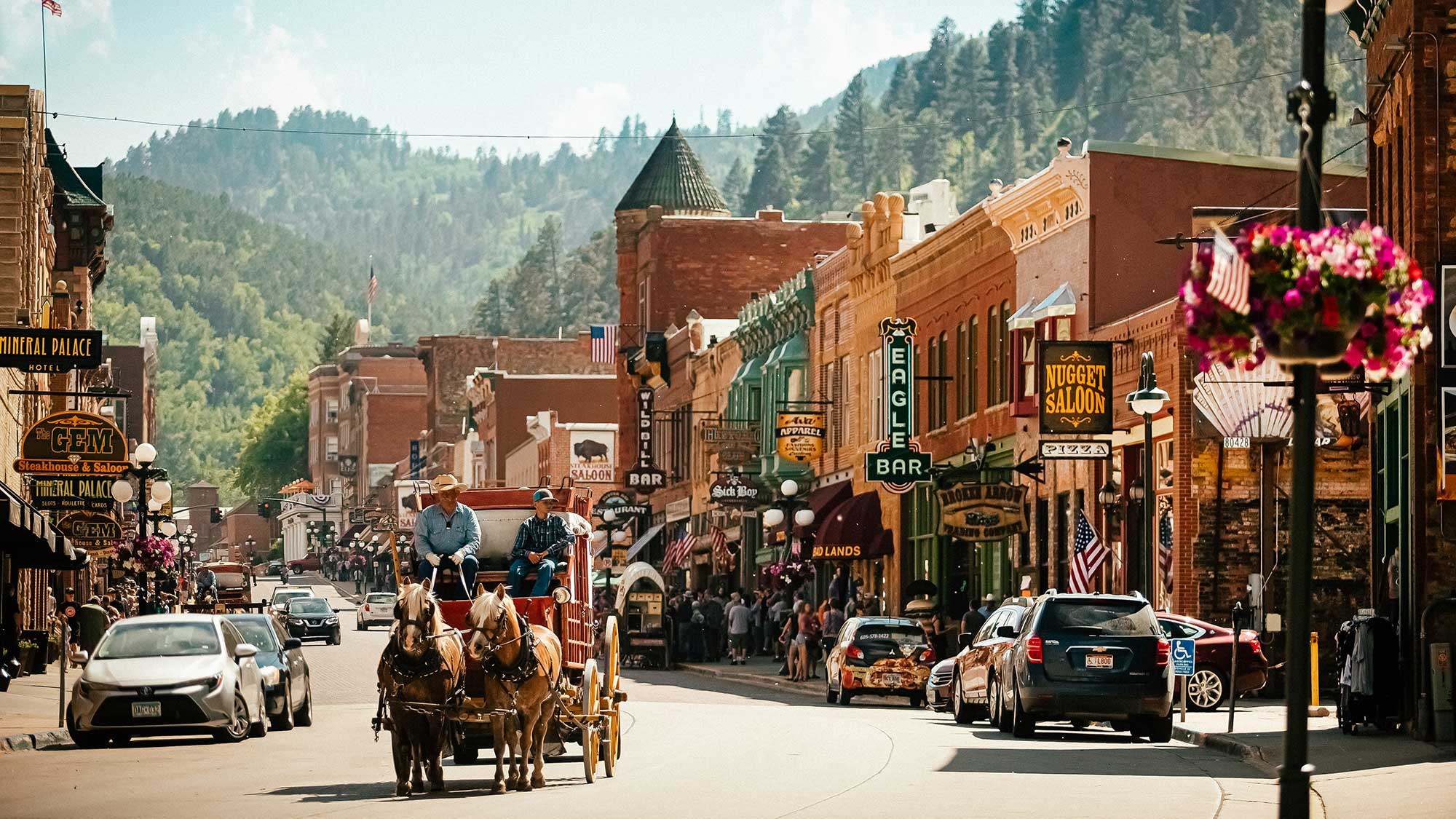
Deadwood combines a National Historic Landmark district with a gaming economy that has funded its own preservation since 1989, though its short-term rental ordinance rules out the Airbnb strategy many buyers assume
2026 Economic Outlook
- Gaming hall tourism continuing to anchor the local economy alongside outdoor recreation in the surrounding Black Hills National Forest
- Days of ’76, Wild Bill Days, and the Deadwood Jam continuing to draw annual visitor traffic
- Genuinely constrained new-construction supply given the town’s steep canyon geography and historic preservation requirements
- Continued strict enforcement of the residential STR ban outside the narrow Sturgis Rally exception
Investment Climate
Deadwood’s investment environment shares South Dakota’s statewide landlord-friendly legal framework for standard long-term leasing, but its uniquely strict local short-term rental ordinance sets it apart from most other tourism-driven towns in this South Dakota series. Successful Deadwood investors tend to share a few characteristics:
- STR-realistic expectations understanding that this is fundamentally a long-term rental and owner-occupied market, not a vacation-rental market, outside the narrow rally exception
- Historic preservation comfort given the town’s National Historic Landmark status and the exterior renovation guidelines that come with it
- Scarcity awareness recognizing that Deadwood’s steep canyon geography and under-5-square-mile footprint genuinely limit available inventory
- Gaming-tourism-economy fluency understanding how casino and hospitality employment drives local long-term rental demand
- Regulatory comfort operating under the same statewide landlord-friendly leasing framework as the rest of South Dakota
Deadwood will not deliver the Airbnb income many investors assume from a National Historic Landmark gaming town. Instead, it offers a genuinely constrained, historically significant long-term rental market serving local casino and hospitality workers, with strong owner-occupied appeal for history-minded buyers.
Historical Performance
| Period | Market Driver | Avg Annual Appreciation | Key Event |
|---|---|---|---|
| 1989-2000 | Gaming legalization and revitalization | 2-4% | Legal gaming begins November 1, 1989, funding a wave of historic preservation across the National Historic Landmark district |
| 2001-2015 | Steady tourism growth | 1-3% | Deadwood continues drawing tourism as True West magazine and other outlets recognize its Old West character |
| 2016-2019 | HBO series renewed interest | 2-4% | Renewed national attention following the HBO Deadwood television series and subsequent film |
| 2020-2022 | Pandemic-era relocation, statewide trend | 8-13% | Statewide relocation trend lifts Deadwood alongside larger South Dakota markets and the broader Black Hills |
| 2023-2025 | Rate shock, constrained new supply | 3-6% | Genuine geographic and preservation-driven constraints keep new construction limited |
| 2026 (current) | Modest pullback off elevated pricing | -4.0% YoY (current, per Redfin) | Citywide median sale price sits at $364,817, down 4.0% year over year as of July 2026 |
Deadwood’s appreciation history reflects a genuinely unusual small town that has repeatedly reinvented itself, from mining boomtown to National Historic Landmark to gaming destination. The current modest year-over-year pullback should be read against Deadwood’s genuinely low transaction volume, consistent with the pattern seen across small South Dakota markets in this series.
Demographic Trends Driving Demand
- Gaming and Hospitality Employment – Dozens of gaming halls anchoring the local economy and driving long-term rental demand from casino and hotel workers
- National Historic Landmark Tourism – Five history museums and genuine Old West architecture drawing visitors and history-minded buyers alike
- Black Hills National Forest Recreation – Snowmobiling, skiing, and year-round outdoor access supporting a broader Black Hills lifestyle draw
- Annual Festival Calendar – Days of ’76, Wild Bill Days, and the Deadwood Jam supporting seasonal visitor traffic and local hospitality employment
- Genuine Land Scarcity – A steep canyon setting and under-5-square-mile footprint keeping new residential supply structurally limited
- Lead-Deadwood Regional Ties – Close proximity to Lead supports a combined local labor market and shared regional services
📚 New to real estate investing? Master the fundamentals with our professional course Learn more →
2. Neighborhood Hotspots
Deadwood Investment Neighborhood Map
Interactive map of Deadwood’s investment neighborhoods. Green stars show top hotspots, blue circles mark established markets, and orange circles highlight emerging areas.
Core Investment Neighborhoods
Detailed Submarket Analysis: All Deadwood Neighborhoods
| Neighborhood | Price Range | Cap Rate | Growth Drivers | Best Strategy |
|---|---|---|---|---|
| Hillside Residential (Deadwood Gulch) | $280K-$420K | 4.5-5.5% | Local workforce demand, genuine scarcity | Long-term rental |
| Mount Moriah Area | $260K-$380K | 4.5-5.5% | Established residential, quieter setting | Long-term rental |
| Whitewood Creek Canyon Edge | $300K-$450K | 3.5-4.5% | Relatively more space within a constrained footprint | Long-term rental, balanced hold |
| Downtown / Historic Main Street | $320K-$500K+ | 3.5-4.5% | Gaming hall proximity, National Historic Landmark tourism | Mixed-use ownership, long-term residential leasing |
Expert Insight: “The number one question I get from out-of-town buyers is about Airbnb, and I have to tell almost all of them no before we go any further. Deadwood’s STR ordinance is genuinely one of the strictest in the state. What actually works here is long-term rental to the people who work the casinos and hotels, or buying for yourself and just loving living in a National Historic Landmark.” – local Black Hills real estate agent
3. Property Types
| Investment Goal | Best Property Type | Best Neighborhoods | Minimum Capital |
|---|---|---|---|
| Maximum Cash Flow (Long-Term) | Hillside historic single-family | Hillside Residential (Deadwood Gulch) | $70,000+ |
| Balanced Returns | Established residential single-family | Mount Moriah Area | $65,000+ |
| Historic Mixed-Use | Historic mixed-use downtown property | Downtown / Historic Main Street | $80,000+ |
| Narrow-Window Vacation Rental | Rally-window conditional use rental | Any zone, subject to CUP approval | Varies; requires permit costs and approval timeline |
Don’t guess the costs. Our Complete Renovation & Remodeling Cost Guide covers 400+ pages of project-by-project breakdowns with real contractor pricing ranges.
4. Cost Analysis
Acquisition Cost Breakdown (Deadwood)
| Expense Item | Typical Cost | Example ($365,000 Property) | Notes |
|---|---|---|---|
| Down Payment | 25% (investment) | $91,250 | Among the highest down payment totals in this South Dakota series given elevated Black Hills pricing |
| Closing Costs | 2-3% of price | $7,300-$10,950 | Title, escrow, lender fees, recording |
| General Inspection | $450-$700 | $575 | Standard whole-home inspection |
| Radon Test | $150-$250 | $200 | South Dakota sits in a moderate-to-elevated radon zone |
| Historic District Compliance Review (If Applicable) | $0-$500 | $250 | Recommended for any exterior renovation planning within the National Historic Landmark district |
| Initial Repairs | 0-8% of price | $0-$29,200 | Varies significantly given the town’s largely older, hillside-built housing stock |
| Reserves (6 months) | 6 months expenses | $8,500-$11,000 | Emergency fund for vacancy and repairs |
| TOTAL MINIMUM ENTRY | ~29-34% of value | $107,975-$123,925 | Among the highest total entry costs in this South Dakota series, alongside Sioux Falls and Dakota Dunes |
Sample Cash Flow Analysis: Hillside Single-Family Long-Term Rental
| Item | Monthly | Annual | Notes |
|---|---|---|---|
| Gross Rent | $1,350 | $16,200 | 2-3BR hillside long-term rental |
| Less Vacancy (5%) | -$68 | -$810 | Standard conservative estimate |
| Property Taxes | -$330 | -$3,960 | Approximate 1.2% effective rate on $330,000 purchase, Lawrence County |
| Insurance | -$120 | -$1,440 | Landlord policy |
| Property Management (9%) | -$122 | -$1,464 | Recommended for out-of-state investors |
| Maintenance + CapEx | -$135 | -$1,620 | 10% of gross rent, reflecting older hillside housing stock |
| Net Operating Income | $575 | $6,900 | Before mortgage |
| Mortgage ($330,000 price, 25% down, 6.75%, 30yr) | -$1,605 | -$19,260 | Principal and interest only on $247,500 loan |
| CASH FLOW | -$1,030 | -$12,360 | Genuinely negative on this leveraged, long-term-rental-only example; illustrates why Deadwood cash flow depends heavily on entry price and down payment size |
| Cap Rate | 2.1% | NOI / Purchase Price (below the 4.5-5.5% Hillside average due to the higher end of the range used here) | |
| Same Deal at $290,000 Entry Price | +$300 | +$3,600 | Illustrates why entry price discipline is especially important in Deadwood given elevated purchase prices |
This example uses a $330,000 purchase price toward the higher end of the hillside range, modeled strictly as a long-term rental, since STR income cannot legally be assumed on a standard residential property here. A comparable property purchased closer to $290,000 narrows the cash flow gap considerably, underscoring how much entry price discipline matters in a market where the STR upside many investors assume is simply not available.
Expert Insight: “People run their Deadwood numbers off Airbnb comps from Sturgis or Spearfish, then wonder why the math doesn’t work once they actually read the zoning ordinance. Model this as a long-term rental from day one, and if the deal still works, great, that’s a real deal. If it only works with STR income, walk away or start the Conditional Use Permit process before you close, not after.” – local Black Hills property manager
5. Legal Framework
✅ Same Landlord-Friendly Statute as the Rest of South Dakota, for Long-Term Leasing
Landlord-tenant law in South Dakota is set entirely at the state level, so everything in this section applies to standard long-term leasing in Deadwood and Lawrence County exactly as it does everywhere else in this series. Senate Bills 89 and 90, passed in 2024, made the entire state more landlord-friendly. Deadwood’s short-term rental restriction, covered separately below, is a distinct local zoning ordinance layered on top of this statewide framework.
🚫 Short-Term Rentals Are Effectively Prohibited
Deadwood City Ordinance Chapter 17.53, Transient Commercial Use of Property, expressly prohibits transient commercial use of residential property for remuneration. In plain terms, this bans traditional Airbnb-style short-term rentals in residential zones, citywide.
The only built-in exception: transient commercial use for 14 days or less during August, beginning four days before the official start of the Sturgis Motorcycle Rally and ending three days after it concludes each year. Outside that narrow window, an investor must pursue a Conditional Use Permit for a Bed and Breakfast Establishment, Specialty Resort, or Vacation Home Establishment, reviewed annually by the Deadwood Planning and Zoning Commission, before offering any residential property for short-term stays.
South Dakota-Specific Regulations (Long-Term Leasing)
Governed statewide by SDCL Chapter 43-32 (landlord-tenant) and Chapter 21-16 (Forcible Entry and Detainer). Key points for Deadwood investors:
- No Mandatory Notice for Nonpayment: SB90 (2024) repealed the requirement for a separate three-day notice to quit before filing. A landlord can file a Forcible Entry and Detainer complaint directly once rent is three or more days past due, subject to any lease terms.
- Month-to-Month Termination: SB89 (2024) reduced the notice period for ending a tenancy-at-will without cause from 30 days to 15 days.
- No Cure Period for Lease Violations: South Dakota does not require landlords to give tenants an opportunity to cure most lease violations before eviction.
- Security Deposit Cap: One month’s rent, with limited additional pet-damage charges permitted in some cases.
- Deposit Return Deadline: Two weeks after the tenant provides a forwarding address.
Historic District Compliance
As a National Historic Landmark district covering the entire town, Deadwood applies genuine historic preservation review to exterior work:
- Exterior Renovation Review: Confirm requirements with the City’s Historic Preservation Commission before planning any exterior changes.
- Written Lease Every Time: Since state default protections are limited, the lease itself defines most terms. Use a current, South Dakota-specific template.
- Document Rent Due Dates Precisely: A FED complaint can be filed once rent is three or more days late; precise records protect you if timing is disputed.
- Use a Sheriff for Removal: Self-help evictions remain illegal statewide.
Useful Deadwood Resources
- City of Deadwood Planning Department: cityofdeadwood.com, for STR ordinance and Conditional Use Permit questions
- Lawrence County Register of Deeds and Treasurer
- South Dakota Unified Judicial System eviction forms: ujs.sd.gov
- Deadwood Historic Preservation Commission for exterior renovation guidelines
| Regulation | Deadwood / South Dakota Requirement | Comparison Reference | Investor Impact |
|---|---|---|---|
| Short-Term Rentals | Prohibited citywide outside a 14-day August Sturgis Rally exception; CUP required otherwise | Far stricter than Sturgis or Spearfish elsewhere in this South Dakota series | Do not underwrite STR income without a confirmed permit |
| Nonpayment Notice (Long-Term Lease) | No mandatory notice; file after rent is 3+ days late (SB90, 2024) | Identical statewide, including all other cities in this series | Faster path to court filing on delinquent tenants |
| Historic Exterior Review | Applies citywide given National Historic Landmark status | A genuinely unique consideration in this South Dakota series | Confirm requirements before planning exterior renovation work |
| Rent Control | None statewide | Identical statewide | Full pricing flexibility on long-term lease renewals |
6. Step-by-Step Deadwood Investment Playbook
Confirm Your Deadwood Strategy Is Legally Viable Before Anything Else
Because Deadwood’s STR restriction is so central to this market, the very first step is not choosing a neighborhood, it is confirming which of these strategies you are actually able to execute:
Long-Term Rental to Local Workforce
Buy on the hillside or near Mount Moriah, targeting the gaming and hospitality workforce on standard 12-month leases. This is Deadwood’s realistic default strategy.
Owner-Occupied Historic Home
Buy a hillside or downtown historic property for personal use, embracing National Historic Landmark living rather than pursuing rental income at all.
Conditional Use Permit Vacation Rental
Pursue a Bed and Breakfast, Specialty Resort, or Vacation Home Establishment permit through the Planning and Zoning Commission before assuming any STR income is available.
Historic Mixed-Use Commercial
Buy a downtown building combining ground-floor commercial lease income with long-term residential leasing on upper-floor units, subject to historic preservation compliance.
Build Your Deadwood Team
Deadwood’s team requirements go beyond the rest of South Dakota given its historic preservation and STR-permitting complexity.
- Local Agent With Deadwood-Specific Experience: Ideally someone who understands both the historic district and the STR ordinance’s practical implications for buyers.
- South Dakota Real Estate Attorney: For entity setup, lease review, and specifically for any Conditional Use Permit application.
- Local Property Manager Familiar With the STR Ordinance: Genuinely essential given how easily an out-of-state investor could assume STR legality that does not exist here.
- Contractor Familiar With Historic District Guidelines: Essential for any exterior renovation work within the National Historic Landmark district.
- CPA Familiar With Multi-State Filing: For out-of-state investors, since South Dakota has no state income tax but your home state may still tax the rental income.
Expert Tip: Before making an offer, ask the City of Deadwood Planning Department directly, in writing, whether the specific property you are considering is eligible for a Conditional Use Permit for short-term rental use, rather than relying on an agent’s general impression of the ordinance.
Deadwood-Specific Due Diligence
Standard due diligence items plus these Deadwood-relevant checks:
Physical Due Diligence
- Foundation and structural review given the steep hillside setting of much of Deadwood’s housing stock
- Radon test, particularly on any home with a basement
- Drainage and grading assessment given the canyon topography and elevated wildfire and heavy-snow considerations
Regulatory Due Diligence
- Confirm in writing with the City whether any STR use, even the 14-day Sturgis Rally exception, is currently available for the specific property
- Confirm National Historic Landmark district exterior renovation requirements before planning any changes
- Pull current Lawrence County assessed value and mill levy for the specific parcel
Competing and Closing in Deadwood
Deadwood’s genuinely constrained inventory means good long-term rental properties can move quickly. Strategies that work:
- Underwrite as a long-term rental first, always: Never let a listing’s STR income projection drive your offer price without written City confirmation of permit eligibility.
- Move decisively on well-priced hillside inventory: Given the town’s genuine land scarcity, quality long-term rental stock does not sit on the market long.
- Budget for historic compliance from day one: Factor exterior renovation review timelines into any value-add plan.
- Build a relationship with the Planning Department: For investors specifically pursuing a Conditional Use Permit, an early, direct conversation with the City saves significant time and risk.
Property Management in Deadwood
South Dakota’s statewide compliance simplicity applies to long-term leasing here, but management should account for the local gaming-tourism workforce.
Tenant Screening & Rent Collection Protocol
- Screen for income (2.5-3x monthly rent), credit, and rental history; South Dakota law does not restrict landlord discretion beyond federal Fair Housing rules
- Expect a genuine share of applicants employed in gaming, hospitality, or tourism-adjacent roles
- Document nonpayment precisely, since a FED complaint can be filed once rent is three or more days late under SB90
- Track deposit return deadlines carefully given the two-week window
Typical Deadwood Management Fees
- Single-family long-term management: 9-11% of monthly rent
- Leasing fee: 50-100% of one month’s rent
- Lease renewal fee: $100-$200 per renewal
- Conditional Use Permit vacation rental management (if approved): typically 20-30% of gross booking revenue
7. Financing Options for Deadwood
| Loan Type | Down Payment | Rate Premium | Best For | Deadwood Note |
|---|---|---|---|---|
| Conventional Investment | 25% | +0.5-0.75% | Strong W-2 income, good credit | Most Deadwood purchases stay under conforming loan limits, though premium downtown mixed-use listings can approach that threshold |
| DSCR Loan | 25-30% | +1-2% | Investors who want no income verification | Must be underwritten strictly on long-term rent, never on assumed STR income; expect a larger down payment requirement given lower cap rates |
| Portfolio / Community Bank Loan | 20-25% | +0.75-1.5% | Investors scaling to multiple doors, self-employed | Local Black Hills community banks are a genuinely useful resource given the smaller national-lender footprint in Deadwood specifically |
| Renovation/Rehab Loan (203k or similar) | 3.5-15% | +0.25-0.75% | Historic value-add purchases needing renovation financed into the loan | Coordinate scope of work with historic preservation requirements before finalizing renovation budget with the lender |
Deadwood Financing Reality: Never bring a lender a DSCR calculation built on assumed short-term rental income for a Deadwood property. The city’s STR ordinance is a matter of public record, and a pro forma built on unavailable income is a genuine underwriting error, not just an optimistic assumption.
8. Frequently Asked Questions

Knowledge Quiz: Deadwood Real Estate Investment
Open Quiz
5 quick questions on what you just learned about Deadwood investing
1) What does Deadwood City Ordinance Chapter 17.53 do?
Answer: C
Deadwood City Ordinance Chapter 17.53 expressly prohibits transient commercial use of residential property, effectively banning traditional Airbnb-style short-term rentals in residential zones, with a narrow August exception.
2) What is the one built-in exception to Deadwood’s STR ban?
Answer: B
The ordinance does not apply to transient commercial use for 14 days or less during August, beginning four days before the official start of the Sturgis Motorcycle Rally and ending three days after it concludes.
3) Why was gaming originally legalized in Deadwood in 1989?
Answer: A
Deadwood legalized limited gaming in 1989 specifically with an eye toward generating funds to help preserve the historic town, directly tying gaming revenue to National Historic Landmark preservation.
4) Roughly what is Deadwood’s population?
Answer: D
Deadwood’s population was 1,156 at the 2020 census, estimated at 1,343 by 2023, a small town despite once swelling to roughly 25,000 during the peak gold rush.
5) Is South Dakota’s SB89/SB90 eviction framework different in Deadwood than in the other cities covered in this guide series?
Answer: A
South Dakota landlord-tenant law for standard long-term leases is governed entirely at the state level under SDCL Chapters 43-32 and 21-16, applying identically in Lawrence County as in every other South Dakota county in this series. Deadwood’s STR ordinance is a separate local zoning matter.
Work With a Local Expert in Deadwood
We are building a verified network of real estate professionals across every market we cover.

About Our Expert Network
We are finalizing partnerships with verified real estate professionals across every market featured on Builds and Buys. Each expert in our network is selected for their hands-on investment experience, local market knowledge, and commitment to helping buyers and investors make sound decisions.
Our local specialists offer:
- Proven experience with investment and income-producing properties
- Deep knowledge of local pricing, rental yields, and neighborhood dynamics
- Guidance on financing, legal structure, and due diligence
- Access to off-market and pre-market opportunities
- Full transaction support from search through closing
- Ongoing portfolio and property management referrals
Services Covered
- Property sourcing and acquisition
- Investment analysis and underwriting
- Buyer representation
- Market comparables and valuations
- Short-term and long-term rental strategy
- Value-add and renovation guidance
- Legal and title referrals
- Financing and lender connections
- Property management referrals
- Insurance and inspection referrals
- 1031 exchange coordination
- Exit strategy planning
Get Connected or Join Our Network
Looking for a local expert to help with your investment? Reach out and we will connect you with the right professional for your market and strategy.
Are you a real estate professional with a track record working with investors? We are always expanding our network of verified local experts.
Contact us at support@buildsandbuys.com
Find Specialized Deadwood Real Estate Professionals
Ready to Invest in Deadwood?
Deadwood offers something no other city in this South Dakota series can: an entire town designated a National Historic Landmark, with a gaming economy legalized in 1989 specifically to fund its own preservation. That history makes for a genuinely compelling place to own property, but the single most important fact for any investor is the city’s strict short-term rental ordinance, which effectively rules out the Airbnb strategy many buyers assume when they hear “casino town.” Approach Deadwood as a long-term rental and historic ownership market, verify any STR ambitions with the City in writing, and the genuine scarcity of this small canyon town works in your favor.
Continue Your Research
Sturgis Guide
Compare Deadwood’s strict STR ban to Sturgis’s actively embraced rally-season short-term rental economy.
South Dakota State Guide
See how Deadwood compares to every other city covered in this South Dakota series.
144-Lesson Course
University-level real estate education covering financing, law, strategy, and management.
For further guidance, explore our State-by-State Investor guides, browse our expert articles, or follow our Step-by-Step Investment Guide.



