Dayton Real Estate Investment Guide For 2026
A comprehensive resource for investors targeting Nevada’s fastest-growing corridor community, positioned between Carson City and the Reno-Sparks metro with strong demand, affordable entry, and one of the state’s most active new construction pipelines
Quick answers: Top 5 most searched Dayton investment questions ▼
Migration data: Where people are moving from to Dayton ▼
In This Guide
Click on any section to navigate directly to that content
1. Dayton Market Overview
Market Fundamentals
Dayton occupies a strategically advantageous position in the Nevada real estate landscape, sitting on US Highway 50 just 10 miles east of Carson City and roughly 40 miles southeast of Reno. This placement gives residents access to two distinct employment markets while living in a community that retains a small-town feel and offers affordability neither of those cities can match. What was once Nevada’s oldest town, with roots in the Comstock silver rush era, has evolved into one of the state’s most dynamic residential growth corridors.
Key economic indicators defining Dayton’s investment case:
- Population: ~15,500 and growing 3 to 5% annually, Lyon County’s fastest-growing community
- Employment Access: Carson City (10 miles west), Reno-Sparks metro (40 miles north), with US-50 and US-395 providing direct access
- Major Nearby Employers: Nevada State Government (Carson City), Carson Tahoe Regional Medical Center, casinos, manufacturing, Tesla Gigafactory (via Reno)
- Median Household Income: $72,000 to $82,000, stable professional and government worker base
- No State Income Tax: Nevada advantage adds meaningful after-tax income versus California or Oregon
- New Construction Activity: Among the highest residential permit volumes in Lyon County
- Elevation: 4,800 feet, true four-season high desert climate
Dayton’s economy is anchored by its role as a bedroom community rather than a standalone employment center. This means its rental market moves in direct response to conditions in Carson City and the Reno-Sparks metro. As those markets become more expensive, Dayton captures overflow demand. This is a structural advantage that strengthens over time rather than cycling with industry trends.
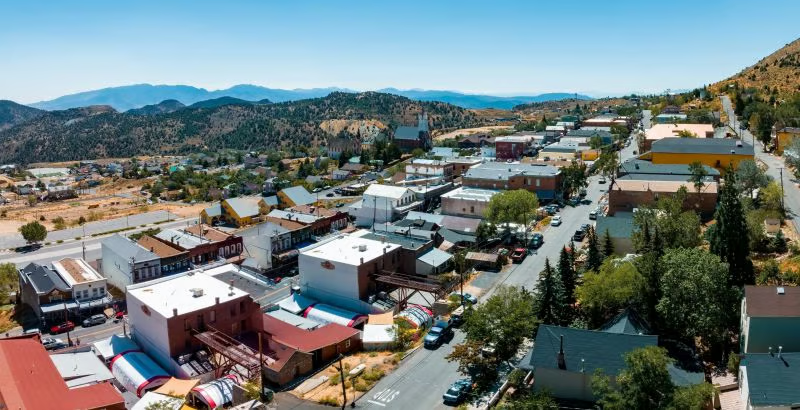
Dayton’s position between Carson City and Reno makes it Nevada’s most strategically located bedroom community
2026 Economic Outlook
- Carson City home prices exceeding $500,000 accelerating Dayton overflow demand
- Nevada state government employment stable with periodic growth
- New master-planned subdivision development bringing modern housing stock
- Lyon County infrastructure investment supporting continued growth
- Remote worker migration from California and Oregon continuing
Investment Climate
Dayton presents a balanced investment case that sits comfortably between Fernley’s cash-flow focus and Carson City’s pure appreciation play. Investors here benefit from a stable, professional tenant base with low turnover, Nevada’s favorable regulatory environment, and a growth trajectory supported by structural demand rather than speculative factors.
- Near-neutral to modest positive cash flow with conventional financing on well-selected properties, better than Carson City and most larger Nevada markets
- Low tenant turnover driven by stable government and professional employment with families putting down roots
- Strong appreciation runway as Carson City and Reno prices continue to push more residents east along the US-50 corridor
- Active new construction confirming developer confidence but also introducing some near-term supply competition
- Simple regulatory environment with Nevada state law and no layered Lyon County tenant protections
The primary consideration for Dayton investors is the new construction pipeline. Active homebuilder activity means existing rental properties face some competition from brand-new homes being offered for rent. Investors should focus on neighborhoods where land is constrained or where existing stock has a meaningful quality advantage over competing rentals.
Historical Performance
| Period | Market Driver | Avg Annual Appreciation | Key Event |
|---|---|---|---|
| 2010-2014 | Post-recession recovery, early Carson City overflow | 3-5% | Dayton Valley area gains traction with families |
| 2015-2019 | Tesla Gigafactory effect, Carson City price increases | 6-9% | New subdivision development accelerates |
| 2020-2022 | Pandemic migration, California exodus to Nevada | 14-20% | Record population growth, inventory depleted |
| 2023-2024 | Rate normalization, steady family demand | 5-8% | Market stabilizes, new construction fills gaps |
| 2025-2026 | Carson City overflow, continued migration | 7-10% (projected) | Carson City median exceeds $500K, Dayton captures demand |
Demographic Trends Driving Demand
- Carson City State Workers – Nevada state government employs thousands of workers in Carson City. As the capital’s home prices exceed $500,000, these government employees on stable salaries look east to Dayton for equivalent commute access at 20 to 25% lower cost
- Healthcare Workforce – Carson Tahoe Regional Medical Center and surrounding medical offices employ nurses, technicians, and administrative staff who increasingly rent in Dayton
- California Tax Migrants – Sacramento-area and Bay Area households choosing Nevada for zero state income tax, selecting Dayton for high-desert lifestyle and Carson City access
- Remote Workers – Post-pandemic professionals who can work from anywhere, choosing Dayton for affordability, four seasons, and Nevada tax advantages
- Retirees and Pre-Retirees – Dayton Valley’s golf community and high-desert lifestyle attract older households from California who want outdoor recreation without California costs
- Young Families – Dayton’s school quality, space, and new construction attract young families who choose it over denser Carson City neighborhoods
📚 New to real estate investing? Master the fundamentals with our professional course Learn more →
2. Neighborhood Hotspots
Dayton Investment Neighborhood Map
Interactive map of Dayton’s investment neighborhoods. Green stars show top hotspots, blue circles mark established markets, and orange circles highlight emerging areas.
Core Investment Neighborhoods
Detailed Submarket Analysis: Dayton Area Neighborhoods
| Neighborhood | Price Range (SFH) | Cap Rate | Growth Drivers | Best Strategy |
|---|---|---|---|---|
| Dayton Valley | $410K-$480K | 5.5-6.5% | Golf community, amenities, premium demographic | Appreciation hold, quality tenants |
| Central Dayton / US-50 | $370K-$430K | 6.0-7.0% | Carson City commuters, central access, school proximity | Buy-and-hold, balanced returns |
| Historic Old Town | $300K-$380K | 6.5-7.5% | Renovation potential, lower entry, value-add | BRRRR, value-add, renovate and hold |
| New North Subdivisions | $400K-$460K | 5.5-6.5% | New construction, families, low maintenance | New construction hold, passive investors |
| East Dayton Established | $360K-$420K | 5.8-6.8% | Established community, family demographic, larger lots | Long-term family rental, stable hold |
| Mound House Area | $280K-$370K | 6.5-8.0% | Between two markets, affordability, value-add | Maximum yield, value-add, patient investor |
Expert Insight: “Dayton’s secret weapon is the Carson City government employment base. These are stable, salaried workers who cannot get fired in an economic downturn the way private sector employees can. They have consistent incomes, they pay on time, and they stay for years because they have jobs to return to every morning. For a landlord, that demographic is as close to ideal as you will find in a small Nevada market. The fact that Dayton is the most affordable option for those workers within 15 minutes of the capital is not going to change anytime soon.” – Active Lyon County investor
3. Property Types
| Investment Goal | Best Property Type | Best Neighborhoods | Minimum Capital |
|---|---|---|---|
| Maximum Cash Flow | Value-add SFH, Old Town stock | Old Town Dayton, Mound House Area | $80,000+ |
| Balanced Returns | Established SFH in central Dayton | Central Dayton, East Dayton | $100,000+ |
| Maximum Appreciation | Dayton Valley golf community home | Dayton Valley | $110,000+ |
| Low Maintenance | New construction SFH | New north subdivisions | $105,000+ |
Don’t guess the costs. Our Complete Renovation & Remodeling Cost Guide covers 400+ pages of project-by-project breakdowns with real contractor pricing ranges.
4. Cost Analysis
Acquisition Cost Breakdown (Dayton)
| Expense Item | Typical Cost | Example ($390,000 Property) | Notes |
|---|---|---|---|
| Down Payment | 25% (investment) | $97,500 | Standard for investment property conventional financing |
| Closing Costs | 2-3% of price | $7,800-$11,700 | Title, escrow, lender fees, recording. Nevada closing costs reasonable. |
| General Inspection | $350-$500 | $425 | HVAC and roof are top priority in high-desert climate |
| Well/Septic Inspection | $400-$800 | $500 | Required for any property outside Dayton city water/sewer service area |
| Initial Repairs / Updates | 0-7% of price | $0-$27,300 | Older homes typically need paint, flooring, appliances at minimum |
| Reserves (6 months) | 6 months expenses | $9,000-$13,000 | HVAC replacement is the most common large expense in desert properties |
| TOTAL MINIMUM ENTRY | ~28-32% of value | $115,225-$150,425 | Accessible relative to Carson City or Reno equivalent |
Sample Cash Flow Analysis: Central Dayton 3-Bedroom Single-Family
| Item | Monthly | Annual | Notes |
|---|---|---|---|
| Gross Rent | $1,875 | $22,500 | 3BR, Central Dayton, updated, Carson City commuter tenant |
| Less Vacancy (5%) | -$94 | -$1,125 | Conservative. Dayton vacancy often runs lower with stable tenants. |
| Property Taxes | -$293 | -$3,510 | ~0.9% of $390K assessed value. Lyon County rate. |
| Insurance | -$115 | -$1,380 | Landlord policy. Nevada rates moderate. |
| Property Management (9%) | -$169 | -$2,025 | Carson City or Lyon County based management |
| Maintenance + CapEx (8%) | -$150 | -$1,800 | HVAC primary expense in high desert. Lower than wet climates. |
| Net Operating Income | $1,054 | $12,660 | Before mortgage |
| Mortgage ($390K, 25% down, 6.75%, 30yr) | -$950 | -$11,400 | Principal and interest on $292,500 loan |
| MONTHLY CASH FLOW | +$104 | +$1,260 | Modest positive cash flow. Rare in western US at current rates. |
| Cap Rate | 3.25% | NOI / Purchase Price | |
| Cash-on-Cash Return | 1.3% | Annual cash flow / total cash invested (~$97,500) | |
| Total Return (8% appreciation) | ~34% | Including equity, appreciation, principal paydown, cash flow |
Dayton sits just above breakeven on monthly cash flow with conventional financing, similar to Fernley but with slightly higher entry prices offset by slightly higher rents and stronger appreciation potential. The total return picture is compelling: an 8% annual appreciation on a $390,000 asset leveraged with 25% down produces significant equity growth alongside the positive carry, all without the regulatory complexity of larger Nevada metros.
Expert Insight: “The comparison that matters for Dayton investors is not Dayton vs. Fernley, it is Dayton vs. Carson City. Carson City offers the same commute to state government employment at $120,000 to $150,000 more in purchase price. That premium has never made financial sense for investors, and as Carson City prices keep rising, the gap that Dayton fills only grows wider. We are not betting on Dayton outperforming Carson City in appreciation. We are betting that the Carson City workforce keeps needing somewhere to live at a price they can afford.” – Active investor in the Carson City corridor
5. Legal Framework
✅ Nevada’s Landlord-Friendly Environment
Dayton operates entirely under Nevada state law and Lyon County rules. There are no city-specific tenant protections, no rent control ordinances, and no additional compliance layers beyond standard Nevada landlord-tenant statutes. Nevada is consistently rated among the top 10 most landlord-friendly states in the country, making Dayton an operationally simple environment for investors from any background.
Nevada Landlord-Tenant Law Key Points
- Summary Eviction Process: Nevada’s fastest-in-the-west eviction process uses a summary proceeding for non-payment cases. Serve a 7-day notice to pay or quit. If the tenant does not comply, file for summary eviction with the Lyon County Justice Court. Total timeline for uncontested cases typically runs 3 to 4 weeks.
- No Rent Control: Nevada law preempts local rent control ordinances statewide. Dayton and Lyon County cannot impose rent caps. Landlords may raise rent to market rate with proper notice.
- Rent Increase Notice: 45 days written notice required for periodic tenancy. For fixed-term leases, increases take effect at renewal date.
- Security Deposit Limit: Maximum 3 months’ rent. Must return with itemized statement within 30 days of tenant departure.
- No Just Cause Requirement: Nevada does not require just cause for eviction at end of lease. Standard 30-day notice sufficient for month-to-month tenancies.
- Entry Notice: 24-hour advance notice required for non-emergency entry.
- Maintenance Obligations: Standard habitability requirement. Tenant may deduct up to one month’s rent for repairs if landlord fails to act after 14-day written notice.
Dayton and Lyon County Specifics
- No Local Rent Control: Lyon County has no additional tenant protections beyond Nevada state law.
- Business License: Verify current requirements with Lyon County and the Dayton community for rental property business licensing. Requirements can vary.
- HOA Rules: Dayton Valley and newer subdivisions often have HOAs. Always review CC&Rs for any rental restrictions, short-term use limits, or property modification rules before purchasing.
- Short-Term Rentals: Nevada allows STRs with proper registration. Lyon County has an STR ordinance requiring registration and health and safety compliance. Verify current requirements before operating.
- Well and Septic: Properties outside city water and sewer must meet Lyon County environmental health standards. Always verify utility status before purchase.
- Carson City Proximity: Some Dayton properties may be in the Carson City sphere of influence for planning purposes. Verify zoning and annexation status for any development plans.
Useful Dayton Resources
- Lyon County: lyon-county.org
- Lyon County Assessor: lyon-county.org/assessor
- Nevada Justice Court (evictions): nevadajudiciary.us
- Nevada Real Estate Division: red.nv.gov
| Regulation | Nevada / Dayton | California Comparison | Investor Impact |
|---|---|---|---|
| Eviction Timeline | 7-day notice, 3-4 weeks total uncontested | 60-120+ days minimum | Dramatically lower legal cost and exposure |
| Rent Control | None. State preemption. | AB 1482 statewide, many local ordinances stricter | Full rent adjustment flexibility to market rate |
| Rent Increase Notice | 45 days | 90 days for increases over 10% | Shorter runway required for market adjustments |
| Security Deposit | Up to 3 months rent | 2 months unfurnished | Greater upfront protection available |
| State Income Tax | None | Up to 13.3% | Significant after-tax return advantage for California investors |
| Just Cause Eviction | Not required in Nevada | AB 1482 requires just cause after 12 months | More flexibility to reclaim property or non-renew |
6. Step-by-Step Dayton Investment Playbook
Define Your Dayton Strategy
Dayton supports multiple investor strategies. Choose based on your capital, timeline, and desired level of involvement:
Carson City Commuter Hold
Buy in central Dayton or Dayton Valley. Target stable government and healthcare workers who commute to Carson City. Lowest turnover in the market with reliable monthly income.
Value-Add BRRRR
Target 1980s and 1990s Old Town Dayton homes. Renovate to modern standards. Refinance equity. Lower entry prices make full capital recovery achievable. Best cap rates in the market post-renovation.
New Construction Passive Hold
Buy new construction for low maintenance and quality tenant attraction. Ideal for out-of-state investors who want minimal management burden. Builder incentives can improve initial returns significantly.
Dayton Valley Appreciation Play
Buy in Dayton Valley’s golf community for the highest-quality tenant demographic and strongest long-term appreciation trajectory. Accept near-neutral cash flow in exchange for above-average appreciation and minimal tenant issues.
Build Your Dayton Team
Dayton is served by Carson City-area professionals as well as Lyon County specialists. Essential team members:
- Carson City or Lyon County Real Estate Agent: Must have closed Dayton investment transactions specifically. Carson City agents often know the Dayton market well given the corridor relationship.
- Property Manager Covering Lyon County: Carson City-based management companies frequently service Dayton. Verify they have active Dayton rentals and understand government worker tenants.
- HOA Review Attorney: For any Dayton Valley or subdivision purchase, have CC&Rs reviewed before closing. HOA rental restrictions are the most common surprise for Dayton investors.
- Nevada-Licensed General Contractor: For value-add work in Old Town Dayton, verify Lyon County permit experience and familiarity with older Nevada construction.
- Nevada Real Estate CPA: For entity structuring and depreciation planning optimized for Nevada’s no-income-tax environment.
Dayton-Specific Due Diligence
Physical Due Diligence
- HVAC inspection and life remaining. High-desert summers push cooling systems hard. Replacement cost $6,000 to $12,000.
- Roof condition and UV degradation. Nevada sun accelerates roofing material deterioration.
- Insulation levels in older homes. Dayton winters at 4,800 feet are genuine and heating costs matter to tenants.
- Well water quality if on well. High elevation water often has mineral content issues.
- Foundation and grading. Desert clay soils expand and contract with moisture cycles.
- Crawl space or basement moisture. Cold winters at elevation mean condensation risks differ from lower-elevation Nevada markets.
Market and Legal Due Diligence
- HOA CC&R review for any subdivision or planned community. Rental caps and STR restrictions are common in Dayton Valley specifically.
- City utilities vs. well/septic verification. Affects operating costs and management complexity significantly.
- Zoning and annexation status for development plans. Some Dayton parcels sit in the Carson City planning sphere.
- New construction pipeline near target property. Competing new rentals can affect lease-up timelines.
- Current tenant lease terms and status if buying occupied rental.
- Rental comparable verification from local management company or agent, not just Zillow estimates.
Operating Your Dayton Rental
Dayton’s tenant demographic rewards certain management approaches:
- Emphasize commute in marketing: Dayton’s primary selling point for most tenants is the 10-minute commute to Carson City. Lead with it in every listing. “10 minutes to the Capitol” outperforms generic neighborhood descriptions.
- Long-term lease incentives: Government workers value stability. Offering a modest rent discount for 24-month leases reduces your turnover costs significantly and these tenants are worth retaining.
- Heating costs matter: Unlike lower-elevation Nevada markets, Dayton winters are real. Make sure heating systems are efficient and mention updated HVAC in listings. Tenants price this in.
- HOA compliance management: If your property is in a subdivision or Dayton Valley HOA, your property manager must track HOA rules and keep the property compliant. Violations create tenant friction and fines.
- Pet-friendly premium: Dayton’s family and outdoor-lifestyle demographic has a high pet ownership rate. Allowing pets with appropriate deposits and fees increases your tenant pool and justifies a $75 to $150 monthly pet premium.
7. Financing Options for Dayton
| Loan Type | Down Payment | Rate Premium | Best For | Dayton Note |
|---|---|---|---|---|
| Conventional Investment | 25% | +0.5-0.75% | Strong W-2 income, good credit | Most Dayton properties are within conforming loan limits. Straightforward product. |
| DSCR Loan | 20-25% | +1.0-2.0% | Self-employed, multiple properties | Dayton cap rates sometimes qualify at 1.0x. Borderline. Run numbers carefully before assuming qualification. |
| House Hacking (FHA) | 3.5% | Standard + MIP | Owner-occupying a unit while renting others | Limited multi-family in Dayton. Best entry path for new investors moving to the area. |
| Portfolio Loan | 20-30% | +1-2% | Multiple properties, blanket financing | Nevada Community Bancorp, local credit unions. Good for building a Lyon County or Carson City corridor portfolio. |
| Hard Money (Bridge) | 15-25% | 9-13% rate | Value-add acquisitions, BRRRR | Carson City and Reno-area hard money lenders active. Short term only for Old Town value-add plays. |
| Owner-Occupied Conventional | 5-10% | Standard rate | Moving to Dayton and buying primary residence with rental intent | Popular with California migrants relocating to Nevada. Live in home one year then convert to investment. |
Dayton Financing Reality: Dayton sits in a middle zone for DSCR qualification. Cap rates of 6 to 7% are better than Carson City or Reno but may not reliably produce 1.0x debt service coverage at current interest rates depending on the specific property. Investors should model DSCR qualification on each property individually rather than assuming it. Conventional financing with full income documentation remains the most reliable path for most Dayton purchases. Local Nevada lenders who know the market will generally give you more flexibility than national lenders unfamiliar with Lyon County.
8. Frequently Asked Questions

Knowledge Quiz: Dayton Real Estate Investment
Open Quiz
5 quick questions on what you just learned about Dayton investing
1) What is Dayton’s primary structural investment advantage according to the guide?
Answer: C
The guide identifies Dayton as the primary beneficiary of Carson City’s affordability crisis. As Carson City median prices exceed $500,000, the government and healthcare workforce that anchors the capital’s economy looks east to Dayton where the same commute is available at 20 to 25% lower cost. This structural overflow demand strengthens over time as the price gap grows.
2) What critical due diligence step does the guide require for any Dayton Valley or subdivision purchase?
Answer: B
The guide specifically calls the full CC&R and bylaw review “non-negotiable” for any Dayton Valley or subdivision purchase. HOA rental caps (limiting the percentage of homes that can be rented), short-term rental prohibitions, pet restrictions, and landscaping rules are all common in Dayton’s HOA communities and can fundamentally affect the viability of an investment strategy.
3) What does the guide say distinguishes Dayton’s tenant base from Fernley’s?
Answer: D
The guide distinguishes the two Lyon County markets by their employment base. Fernley’s demand is driven by Amazon, Dollar General, and I-80 logistics workers. Dayton’s demand is driven by Carson City state government employees, Nevada Legislature staff, and Carson Tahoe Regional Medical Center workers. Both are stable tenant bases but with different characteristics. Dayton’s government workers tend toward lower turnover and longer tenancies.
4) How does Dayton’s 4,800-foot elevation affect property management versus lower-elevation Nevada markets?
Answer: A
The guide notes that Dayton winters reach the teens Fahrenheit, pipes can freeze in under-insulated older homes, and heating costs matter significantly to tenants. Older 1980s and 1990s Dayton homes are often under-insulated for the elevation. Properties with efficient heating systems command $75 to $150 per month more in rent and retain tenants better. This is meaningfully different from Las Vegas or Reno (lower elevation) management considerations.
5) What is the guide’s recommended marketing approach for Dayton rental properties?
Answer: B
The guide specifically recommends leading with the Carson City commute in all Dayton listings, noting that “10 minutes to the Capitol” outperforms generic neighborhood descriptions. The core value proposition for most Dayton tenants is access to Carson City employment at Dayton’s lower cost of living. Marketing that makes this explicit immediately differentiates Dayton properties from alternatives and attracts the stable government worker tenant the guide identifies as the ideal Dayton renter.
Work With a Local Expert in Dayton
We are building a verified network of real estate professionals across every market we cover.

About Our Expert Network
We are finalizing partnerships with verified real estate professionals across every market featured on Builds and Buys. Each expert in our network is selected for their hands-on investment experience, local market knowledge, and commitment to helping buyers and investors make sound decisions.
Our local specialists offer:
- Proven experience with investment and income-producing properties
- Deep knowledge of local pricing, rental yields, and neighborhood dynamics
- Guidance on financing, legal structure, and due diligence
- Access to off-market and pre-market opportunities
- Full transaction support from search through closing
- Ongoing portfolio and property management referrals
Services Covered
- Property sourcing and acquisition
- Investment analysis and underwriting
- Buyer representation
- Market comparables and valuations
- Short-term and long-term rental strategy
- Value-add and renovation guidance
- Legal and title referrals
- Financing and lender connections
- Property management referrals
- Insurance and inspection referrals
- 1031 exchange coordination
- Exit strategy planning
Get Connected or Join Our Network
Looking for a local expert to help with your investment? Reach out and we will connect you with the right professional for your market and strategy.
Are you a real estate professional with a track record working with investors? We are always expanding our network of verified local experts.
Contact us at support@buildsandbuys.com
Find Specialized Dayton Real Estate Professionals
Ready to Invest in Dayton?
Dayton’s investment case rests on a simple, durable foundation: Carson City will always need affordable housing for its workforce, and Dayton is the closest, most livable place that provides it. As Nevada’s capital city prices continue rising, the structural demand flowing east into Dayton only strengthens. Add Nevada’s landlord-friendly laws, near-neutral cash flow at conventional financing terms, and one of the state’s most active new construction pipelines, and you have a market that rewards patient, well-informed investors with steady returns and low regulatory friction.
Continue Your Research
Nevada State Guide
See how Dayton compares to Las Vegas, Reno, Carson City, and other Nevada markets.
Step-by-Step Invest
Complete framework for building a real estate investment strategy from scratch.
144-Lesson Course
University-level real estate education covering financing, law, strategy, and management.
For further guidance, explore our State-by-State Investor guides, browse our expert articles, or follow our Step-by-Step Investment Guide.