
Cody Real Estate Investment Guide For 2026
A comprehensive resource for investors looking to capitalize on Wyoming’s Gateway to Yellowstone, where extreme seasonal tourism, genuine appreciation, and a landlord favorable legal framework combine in 2026
Quick answers: Top 5 most searched Cody investment questions ▼
Migration data: Where people are moving from to Cody ▼
In This Guide
Click on any section to navigate directly to that content
1. Cody Market Overview
Market Fundamentals
Cody sits 52 miles from Yellowstone National Park’s east entrance, founded in 1896 by Colonel William “Buffalo Bill” Cody and branded today as the Gateway to Yellowstone. Few American towns of 10,500 people welcome 300,000 to 400,000 visitors a year, and that ratio is the single fact that explains Cody’s real estate market more than any other.
Key economic indicators that define Cody’s investment case:
- Population: 10,523 city proper (2026), county seat of Park County
- Major Employers: Cody Regional Health, the Buffalo Bill Center of the West (five museums), tourism and hospitality, agriculture, Park County government
- Median Household Income: $72,570
- Unemployment Rate: Approximately 3.4%, among the lowest in Wyoming
- No State Income Tax: Combined with relatively low costs, a steady draw for retirees and tourism entrepreneurs
- Effective Property Tax Rate: Approximately 0.65% across Park County, still far below the 1.02% national median
Cody’s economy does not run on a single seasonal peak. Summer brings the bulk of visitor traffic, but agriculture, healthcare, and a genuine year round arts and culture scene anchored by the Buffalo Bill Center of the West give the city a steadier base than a pure ski or beach resort town.
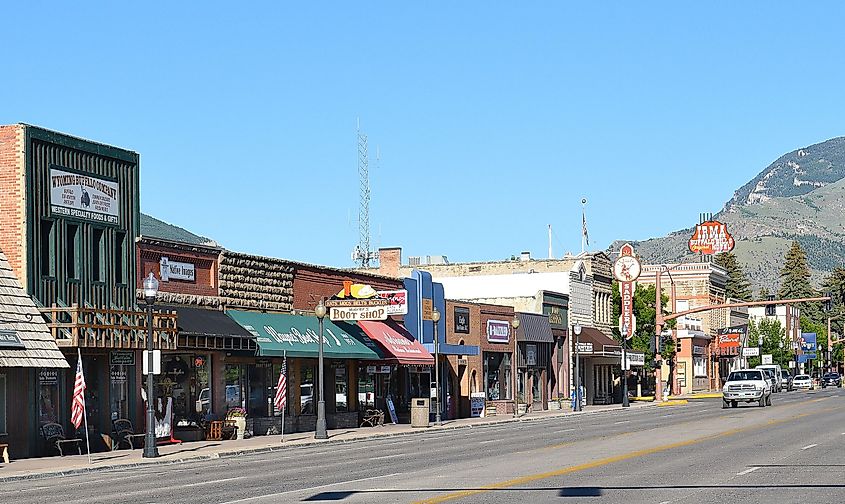
Cody’s Sheridan Avenue sits 52 miles from Yellowstone’s east entrance, a combination that defines the entire local economy
2026 Economic Outlook
- Continued mid single digit home price appreciation, up roughly 5.5% over the past year per Zillow and Redfin data
- Park County property values have risen sharply over the past several years, prompting active state level property tax relief discussion
- The West Strip commercial corridor along Yellowstone Avenue continues adding national retailers and services
- Cody Regional Health and the Buffalo Bill Center of the West continuing to anchor steady, non seasonal employment
- Forward Cody, the city’s economic development organization, actively recruiting employers to diversify beyond pure tourism
Investment Climate
Cody’s investment environment rewards investors who are honest about what they are buying. Successful Cody investors tend to share a few characteristics:
- An appreciation first mindset, since standard long term rentals typically run negative at conventional financing given how far prices have outrun local rents
- Genuine interest in the tourism economy, since short term rental income can meaningfully change the math on the right property
- Comfort with extreme seasonality, since the town’s population effectively doubles from June through September and goes quiet the rest of the year
- Wildfire risk awareness, given that the substantial majority of Cody properties carry some level of wildfire exposure according to First Street Foundation data
- Realistic expectations about isolation for anyone considering Wapiti Valley or South Fork acreage, where wells, septic, and long winter drives are part of daily life, not a footnote
Wyoming’s overall housing market is expected to stabilize through 2026, but Cody and Park County have been a notable exception to that broader cooling, with home prices still climbing in the mid single digits as Yellowstone area demand continues outpacing the area’s genuinely limited buildable land.
Historical Performance
| Period | Market Driver | Avg Annual Appreciation | Key Event |
|---|---|---|---|
| Pre 2020 | Steady tourism driven growth typical of a small gateway town | 3 to 5% | Consistent Yellowstone visitor growth supporting demand |
| 2020 to 2022 | Pandemic migration, remote work, national park boom | 15 to 24% | Park County median sale price jumped from roughly $286,000 to $415,000 in two years |
| 2023 to 2024 | Continued strong demand despite higher rates | 6 to 16% | Park County assessor reported values still climbing even as sales volume slowed |
| 2025 to 2026 | Sustained Yellowstone gateway demand | 5 to 6% (current trend) | Cody home values still rising while broader Wyoming market stabilizes |
Unlike most of Wyoming, where 2025 and 2026 have brought a clear cooling trend, Cody and Park County have continued posting genuine appreciation. Local assessors and brokers attribute this directly to Cody’s unusual position as a small town that functions as a major national tourism destination, a dynamic that has proven far more durable than typical small city demand drivers.
Demographic Trends Driving Demand
- Yellowstone Gateway Status – Direct access to the park’s east entrance drives both tourism and a steady stream of visitors who eventually relocate
- Buffalo Bill Center of the West – Five museums and a research library anchoring a genuine, year round cultural economy beyond pure outdoor recreation
- Cody Nite Rodeo and Cody Stampede – The world’s only nightly rodeo (June through August) plus a four day Fourth of July event that triples the city’s population
- Retiree Migration – Cody’s median age of 42.3 reflects a steady inflow of retirees drawn by scenery, low taxes, and quality healthcare access
- Agricultural Base – Sugar beets, hay, and corn production around Cody and Powell providing a non tourism economic floor
- Limited Buildable Land – Shoshone National Forest and surrounding topography constrain new supply, concentrating growth in specific corridors
📚 New to real estate investing? Master the fundamentals with our professional course Learn more →
2. Area Hotspots
A note on how Cody is organized: Cody does not have named subdivisions with HOAs the way Cheyenne or larger cities do. What it has are distinct areas, each with a genuinely different price point, utility situation, and lifestyle, and that is how this guide breaks it down rather than inventing neighborhood names that do not reflect how Cody actually works.
Cody Investment Area Map
Interactive map of Cody’s investment areas. Green stars show top hotspots, and the blue circle marks Powell, the established and more affordable nearby market.
Core Investment Areas
Detailed Area Analysis: Cody and the Surrounding Market
| Area | Price Range | Cap Rate | Growth Drivers | Best Strategy |
|---|---|---|---|---|
| Beck Lake Area | $300K-$475K | 4.0-5.5% | Best cash flow, city services, rec center proximity | Long term cash flow buy and hold |
| Powell | $250K-$380K | 5.0-6.5% | Most affordable in the area, Northwest College, commuters | Best yields in the broader Cody market |
| Downtown / Historic District | $280K-$500K | 3.0-4.5% | Walkability, tourist density, Buffalo Bill Center proximity | Value add, seasonal short term rental |
| South Fork | $500K-$1.5M+ | 2.5-3.5% | Acreage, river frontage, agritourism potential | Long term appreciation, ranch operation |
| Wapiti Valley / North Fork | $400K-$2M+ | STR dependent, 8-15%+ | Direct Yellowstone gateway, lodge and outfitter demand | Short term rental, lodge operation |
Expert Insight: “Every out of state caller wants the Wapiti Valley cabin with the river view, and I understand why, it is genuinely the most beautiful real estate I show in this state. But I always walk them through Beck Lake first. That is the property that pays your mortgage every month regardless of how many people drive through the East Gate that summer. Buy your cash flow in town and your dream property in the valley once the numbers actually support it.” – Dave Peterson, Broker, Real Estate Outlaws, Cody
3. Property Types
| Investment Goal | Best Property Type | Best Areas | Minimum Capital |
|---|---|---|---|
| Best Cash Flow Near Cody | Single family home | Powell, Beck Lake Area | $65,000+ |
| Maximum Tourism Income | Wapiti Valley cabin or lodge property | Wapiti Valley / North Fork | $100,000+ |
| Maximum Appreciation | South Fork ranch acreage | South Fork | $130,000+ |
| Balanced Returns | Value add historic home | Downtown / Historic District | $80,000+ |
Don’t guess the costs. Our Complete Renovation & Remodeling Cost Guide covers 400+ pages of project by project breakdowns with real contractor pricing ranges.
4. Cost Analysis
Acquisition Cost Breakdown (Cody)
| Expense Item | Typical Cost | Example ($350,000 Property) | Notes |
|---|---|---|---|
| Down Payment | 25% (investment) | $87,500 | Standard for investment properties in Cody |
| Closing Costs | 2-3% of price | $7,000-$10,500 | Title, escrow, lender fees, recording |
| General Inspection | $400-$650 | $525 | Standard whole home inspection |
| Wildfire Risk Assessment | $150-$350 | $250 | Cody carries severe wildfire risk per First Street Foundation data; critical for any purchase |
| Well and Septic Inspection | $400-$700 | $550 | Required for any South Fork or Wapiti Valley purchase |
| Initial Repairs | 0-8% of price | $0-$28,000 | Older Downtown homes often need more |
| Reserves (6 months) | 6 months expenses | $8,500-$11,500 | Emergency fund for vacancy and repairs |
| TOTAL MINIMUM ENTRY | ~28-32% of value | $98,000-$112,000 | Significantly less capital than coastal markets, more than Cheyenne given Cody’s elevated prices |
Sample Cash Flow Analysis: Downtown Historic Single Family Home
| Item | Monthly | Annual | Notes |
|---|---|---|---|
| Gross Rent | $1,800 | $21,600 | 3BR historic home, standard 12 month lease |
| Less Vacancy (5%) | -$90 | -$1,080 | Conservative estimate |
| Property Taxes | -$190 | -$2,275 | 0.65% effective rate on $350,000 value |
| Insurance | -$117 | -$1,400 | Landlord policy, wildfire exposure rider |
| Property Management (10%) | -$180 | -$2,160 | Optional for hands on local owners |
| Maintenance + CapEx (8%) | -$144 | -$1,728 | Allowance for older mechanicals and winter wear |
| Net Operating Income | $1,080 | $12,957 | Before mortgage |
| Mortgage ($350,000 price, 25% down, 6.75%, 30yr) | -$1,704 | -$20,443 | Principal and interest only, $262,500 loan |
| CASH FLOW | -$624 | -$7,486 | Negative on a standard 12 month lease, before any short term rental upside |
| Cap Rate | 3.70% | NOI / Purchase Price, standard lease basis | |
| Total Return (5.5% appreciation) | ~14-17% | Including appreciation and principal paydown, even after negative carry |
This is Cody’s honest baseline on a standard 12 month lease: negative cash flow, offset by appreciation strong enough to still produce a respectable total return. The real upside case is operating this same home, or a comparable property in Wapiti Valley, as a furnished short term rental during the June through September visitor season, when Cody’s hotel inventory runs full and nightly rates climb well above what a standard lease can generate.
Expert Insight: “I tell people the same thing every spring. Cody real estate is not a spreadsheet that balances on a standard lease, full stop. It is a bet on Yellowstone, on the Buffalo Bill Center, on the rodeo, on 300,000 people a year wanting to be here in July. If you believe in that bet, and the numbers over the past five years say you should, the appreciation and the seasonal income together have outperformed plenty of markets that looked better on paper from month one.” – Renee Castellano, CPA, Castellano Tax and Advisory
5. Legal Framework
⚠️ Cody Compliance Notice
Cody adds no city level landlord tenant ordinances on top of Wyoming’s statewide framework, identical to the rest of this guide series. The Cody specific issue that deserves real attention is wildfire risk. Redfin and First Street Foundation data show the substantial majority of Cody properties carry wildfire exposure, and that should shape your insurance shopping and due diligence directly, particularly for Wapiti Valley and South Fork purchases near the national forest boundary.
Wyoming Statewide Regulations
Cody landlords operate entirely under Wyoming Statutes Title 1, Chapter 21 (Forcible Entry and Detainer) and Title 34, Chapter 2 (Landlord and Tenant), identical to every other city in this guide series:
- Eviction for Nonpayment: 3 day notice to pay rent or vacate under Wyo. Stat. § 1-21-1002. If unpaid, the landlord may file a forcible entry and detainer action.
- Eviction for Lease Violation: 3 day notice to cure or vacate, with no requirement to offer a second chance.
- Month to Month Termination: 30 days written notice from either party, with no cause required.
- Security Deposits: No statutory cap. Must be held in a separate account and returned within 30 days of move out, with an itemized statement of deductions.
- No Rent Control: Landlords may set and increase rent freely, subject only to lease terms and notice requirements.
- No Source of Income Protection: Cody landlords are not required to accept housing vouchers.
- No Anti Retaliation Statute: Wyoming does not prohibit a landlord from responding to a tenant’s code violation report.
- Landlord Entry: At least 24 hours notice required for non emergency entry such as repairs or showings.
Compliance Best Practices
Cody’s regulatory simplicity is real, but several local realities deserve specific attention:
- Wildfire Insurance Shopping: Confirm coverage and any defensible space requirements before closing, especially for Wapiti Valley and South Fork purchases near Shoshone National Forest.
- Short Term Rental Permitting: Confirm current Park County and City of Cody requirements before purchasing a Wapiti Valley or Downtown property for short term rental use.
- Well and Septic Documentation: Required for nearly any out of town purchase; confirm water rights and septic permit history before closing.
- Always Use a Written Lease: Wyoming does not require one, but a written lease remains the single best protection for both parties.
- Follow the Court Process: Self help eviction remains illegal in Wyoming regardless of how clear the lease violation is.
- Track the 14 Day Deposit Notice: Landlords must notify tenants in writing within 14 days of receiving a deposit, including where it is held.
Useful Cody Resources
- Park County Assessor: parkcounty-wy.gov
- Wyoming Legal Services (free civil legal aid): wyomingdpa.org
- Park County Circuit Court (small claims, evictions): courts.state.wy.us
- Forward Cody (economic development context): forwardcody.com
| Regulation | Wyoming / Cody Standard | National Comparison | Investor Impact |
|---|---|---|---|
| Eviction for Nonpayment | 3 day notice, court process roughly 2 to 4 weeks total | National average 4 to 8 weeks or longer | Among the fastest, lowest cost eviction processes in the country |
| Wildfire Risk | Severe risk citywide per First Street Foundation data | Varies widely; most major metros carry far less exposure | Requires proactive insurance shopping for nearly every Cody property |
| Rent Control | None at the state or city level | Increasingly common in coastal and resort markets | Full freedom to set market rent and increase it as needed |
| Security Deposit Cap | No statutory maximum | Many states cap at 1 to 2 months rent | Greater flexibility to protect against damage and unpaid rent |
| Property Tax Effective Rate | 0.65% across Park County | 1.02% national median | Roughly 36% lower carrying cost than a typical U.S. market |
6. Step by Step Cody Investment Playbook
Define Your Cody Strategy
Cody is an appreciation and tourism market first. Before buying, be clear on which of these strategies you are executing:
In Town Cash Flow
Buy in the Beck Lake Area or in Powell for Cody’s best available long term rental yields. Still modestly negative to neutral at standard financing, but the most straightforward, lowest maintenance strategy in this guide.
Yellowstone Gateway Short Term Rental
Buy a cabin or lodge property in the Wapiti Valley and capture premium nightly rates from the 300,000 to 400,000 annual visitors passing through. The highest potential return and the highest operational complexity in this guide series.
Downtown Value Add Plus Seasonal STR
Buy a dated historic home near Sheridan Avenue, renovate, and run a hybrid strategy: standard lease most of the year with furnished, premium rate operation during the June through September visitor season.
South Fork Land and Appreciation
Buy acreage along the South Fork of the Shoshone River for the strongest long term land value growth in the area, accepting limited rental income in exchange for water rights, river frontage, and genuine scarcity.
Build Your Cody Team
Cody’s small market and unusual geography make local relationships especially important. Core team members:
- Cody Investor Focused Agent: Should understand the genuinely different economics of Downtown, Beck Lake, South Fork, and Wapiti Valley, which are not interchangeable markets.
- Wyoming Real Estate Attorney: For entity setup, lease review, and water rights review on any acreage purchase.
- Lender Experienced With Remote Wyoming Property: Wapiti Valley and South Fork properties can be genuinely difficult to finance through standard conventional channels.
- Insurance Agent Specializing in Wildfire Exposed Property: Essential for nearly any Cody purchase, not just out of town acreage.
- Local Property Manager With Seasonal STR Experience: If pursuing the Wapiti Valley or Downtown short term rental strategy, confirm specific experience with the June through September tourism season.
Expert Tip: Before making an offer on any Wapiti Valley property, call a lender directly and confirm they will actually finance it, not just quote a rate. Several national lenders decline rural Wyoming properties near national forest boundaries outright. Knowing this before you write an offer, not after, saves real time and earnest money.
Cody Specific Due Diligence
Standard due diligence items plus these Cody critical checks:
Physical Due Diligence
- Wildfire defensible space and vegetation clearance, especially for Wapiti Valley and South Fork properties
- Well, septic, and water rights documentation for any property outside city limits
- Access road condition and winter maintenance responsibility for out of town purchases
- Backup power situation for Wapiti Valley properties, where outages can be extended
- Roof and foundation condition given Cody’s cold winters and high desert wind exposure
- Cell service and internet availability verification for any rural property if remote management is planned
Regulatory Due Diligence
- Confirm current Park County and City of Cody short term rental permitting requirements before purchase
- Verify zoning and any national forest boundary or access easement issues for Wapiti Valley properties
- Pull permit history for any additions or renovations on older Downtown homes
- Confirm water rights documentation and irrigation district membership for any South Fork acreage
- Confirm insurability before waiving an inspection contingency, especially for wildfire exposed properties
- Review grizzly bear management and waste storage requirements for any North Fork or forest adjacent property
Competing in Cody’s Market
Cody has continued appreciating even as broader Wyoming cools, which means real competition for well priced, well located properties:
- Limited inventory: Cody’s genuinely constrained buildable land keeps available listings thin relative to demand, particularly Downtown and Beck Lake.
- Seasonal listing patterns: Spring and early summer bring the most new listings as sellers time sales around the tourism season.
- Off market sourcing: Build relationships with Cody specific brokerages, since Wapiti Valley and South Fork properties often transact through word of mouth before reaching the open market.
- Cash and quick close advantages: Given financing difficulty on rural properties, a buyer who can move quickly or pay cash has genuine leverage in Wapiti Valley negotiations.
- Cody Stampede timing: The Fourth of July week, when the city’s population triples, is a useful real world data point for understanding peak tourism demand before committing to a short term rental strategy.
Property Management in Cody
Cody’s light regulatory framework makes self management viable for in town long term rentals, while Wapiti Valley short term rentals genuinely benefit from specialized, locally based management.
Tourism Season Rental Protocol
For Downtown and Wapiti Valley short term rentals, build these practices into your operating plan:
- Budget for extreme seasonality, with June through September commanding premium rates and the rest of the year requiring active marketing or a standard lease fallback
- Confirm defensible space and wildfire mitigation steps are documented and current each season
- Build grizzly bear safe waste storage and guest education into your operating procedures for any forest adjacent property
- Maintain relationships with local cleaning and maintenance contractors given Cody’s limited service provider pool relative to peak season demand
- Track the Cody Nite Rodeo schedule, Cody Stampede, and Buffalo Bill Center event calendar for dynamic pricing opportunities
Typical Cody Management Fees
- Single family long term management: 8-10% of monthly rent
- Leasing fee: 50-75% of one month’s rent
- Lease renewal fee: $100-$250 per renewal
- Wapiti Valley and Downtown short term rental management: Often 22-28% given seasonal turnover and remote location logistics
7. Financing Options for Cody
| Loan Type | Down Payment | Rate Premium | Best For | Cody Note |
|---|---|---|---|---|
| Conventional Investment | 25% | +0.5-0.75% | Downtown and Beck Lake Area purchases with city utilities | Standard rates currently run 6.4-6.9% before the investor premium |
| DSCR Loan | 25-30% | +1.5-2.5% | Investors who want no income verification | Genuinely viable for Wapiti Valley short term rentals when underwritten on realistic seasonal income; difficult for standard long term leases |
| Rural / Acreage Portfolio Loan | 25-35% | +1-2% | South Fork and Wapiti Valley acreage purchases | Regional Wyoming and Montana banks are often more willing than national lenders to finance well and septic properties |
| FHA House Hacking | 3.5% | Standard + MIP | Owner occupying a Downtown or Beck Lake property | A meaningful entry point given Cody’s rising median price |
| Cash Purchase | 100% | N/A | Wapiti Valley lodge or remote acreage purchases | Common in this segment given financing difficulty; provides real negotiating leverage |
| Hard Money (Bridge) | 15-25% | 8-12% rate | Value add renovation, competitive offers | Useful for Downtown renovation projects needing a fast close |
Cody Financing Reality: Financing is genuinely bifurcated in this market. In town properties with city utilities finance like any standard investment property. Wapiti Valley and remote South Fork acreage are a different animal entirely, with some national lenders declining outright and local or regional Wyoming banks, portfolio lenders, or cash purchases filling the gap. Confirm financing is actually available before falling in love with a specific property.
8. Frequently Asked Questions

Knowledge Quiz: Cody Real Estate Investment
Open Quiz
5 quick questions on what you just learned about Cody investing
1) What single fact does this guide say explains Cody’s real estate market more than any other?
Answer: D
Cody’s defining characteristic is its extreme ratio of year round population to annual visitors, driven by its position 52 miles from Yellowstone’s east entrance, which shapes everything from pricing to the seasonal short term rental opportunity.
2) According to the guide’s sample cash flow analysis, what happens to a $350,000 Downtown home on a standard 12 month lease at 25% down financing?
Answer: B
The guide’s honest baseline shows negative cash flow on a standard lease, with total return still respectable at 14 to 17% once 5.5% annual appreciation and principal paydown are included.
3) What does the guide identify as the biggest financing challenge for Wapiti Valley properties?
Answer: C
Remote, well and septic properties near national forest boundaries in the Wapiti Valley can be genuinely difficult to finance through standard conventional channels, making confirmed financing before writing an offer essential.
4) Which nearby town does the guide identify as offering the best long term rental cap rates in the broader Cody market?
Answer: A
Powell, fifteen to twenty minutes northeast of Cody, offers a meaningfully lower median price against comparable rents, producing the best long term cap rates of 5.0% to 6.5% in the broader Cody market area.
5) What Cody specific risk factor does the guide flag as deserving attention for nearly every property in the city, not just rural acreage?
Answer: D
Redfin data shows the substantial majority of Cody properties carry wildfire risk, making proactive insurance shopping a genuine due diligence priority for nearly any purchase in the city, not just Wapiti Valley or South Fork acreage.
Work With a Local Expert in Cody
We are building a verified network of real estate professionals across every market we cover.

About Our Expert Network
We are finalizing partnerships with verified real estate professionals across every market featured on Builds and Buys. Each expert in our network is selected for their hands on investment experience, local market knowledge, and commitment to helping buyers and investors make sound decisions.
Our local specialists offer:
- Proven experience with investment and income producing properties
- Deep knowledge of local pricing, rental yields, and neighborhood dynamics
- Guidance on financing, legal structure, and due diligence
- Access to off market and pre market opportunities
- Full transaction support from search through closing
- Ongoing portfolio and property management referrals
Services Covered
- Property sourcing and acquisition
- Investment analysis and underwriting
- Buyer representation
- Market comparables and valuations
- Short term and long term rental strategy
- Value add and renovation guidance
- Legal and title referrals
- Financing and lender connections
- Property management referrals
- Insurance and inspection referrals
- 1031 exchange coordination
- Exit strategy planning
Get Connected or Join Our Network
Looking for a local expert to help with your investment? Reach out and we will connect you with the right professional for your market and strategy.
Are you a real estate professional with a track record working with investors? We are always expanding our network of verified local experts.
Contact us at support@buildsandbuys.com
Find Specialized Cody Real Estate Professionals
Ready to Invest in Cody?
Cody asks investors for the same honesty it asks of anyone moving there: know exactly what you are buying. It is not Cheyenne’s day one cash flow story, and the standard long term lease math runs negative on most properties at conventional financing. What Cody offers instead is something genuinely rare, a real, durable tie to one of the most visited destinations on earth, a 300,000 to 400,000 person annual tourism wave against a town of 10,500, and appreciation that has kept climbing even as the rest of Wyoming cooled. Investors who plan their financing around that reality, or who build a strategy around the Wapiti Valley’s genuine short term rental upside, are buying into one of the most distinctive small markets in this entire guide series.
Continue Your Research
Wyoming State Guide
See how Cody compares to Jackson, Sheridan, Cheyenne, and other Wyoming markets.
Step-by-Step Invest
Complete framework for building a real estate investment strategy from scratch.
144-Lesson Course
University level real estate education covering financing, law, strategy, and management.
For further guidance, explore our State-by-State Investor guides, browse our expert articles, or follow our Step-by-Step Investment Guide.



