
Bremerton / Port Orchard Real Estate Investment Guide For 2026
A comprehensive resource for investors targeting the Kitsap Peninsula’s dual-anchor market, where Naval Station Bremerton and Puget Sound Naval Shipyard create one of the most durable military-driven demand bases in the Pacific Northwest, all at entry prices 40 to 55 percent below Seattle
Quick answers: Top 5 most searched Bremerton / Port Orchard investment questions ▼
Migration data: Where people are moving from to Bremerton / Port Orchard ▼
In This Guide
Click on any section to navigate directly to that content
1. Bremerton / Port Orchard Market Overview
Market Fundamentals
Bremerton and Port Orchard anchor the eastern Kitsap Peninsula across Puget Sound from Seattle, connected by one of Washington State’s busiest ferry routes. They form one of the Pacific Northwest’s most compelling investment markets for a reason that is often underappreciated by western Washington investors: the largest naval industrial complex on the West Coast sits here, and its economic footprint is permanent, federally guaranteed, and growing.
Key economic indicators:
- Bremerton population: 45,000+; Port Orchard: 17,000+ and expanding rapidly; Kitsap County: 285,000+
- Puget Sound Naval Shipyard (PSNS): Largest naval ship repair facility on the West Coast, 14,000+ employees, federal payroll
- Naval Base Kitsap: Homeport to multiple nuclear submarine and surface ship squadrons; permanent military population
- Major civilian employers: Harrison Medical Center, Kitsap County government, Olympic College, Washington State Ferries
- Ferry connections: Bremerton to Seattle (60 min), Southworth to West Seattle (35 min), Kingston to Edmonds
- No state income tax: Washington’s key affordability advantage for relocators
- Vacancy rate: Under 3.5% across Kitsap Peninsula
The Kitsap Peninsula is geographically bounded by Puget Sound to the east, Hood Canal to the west, and the Tacoma Narrows to the south. This water boundary limits the land available for development and creates a supply constraint that has supported property values through every market cycle of the past four decades.
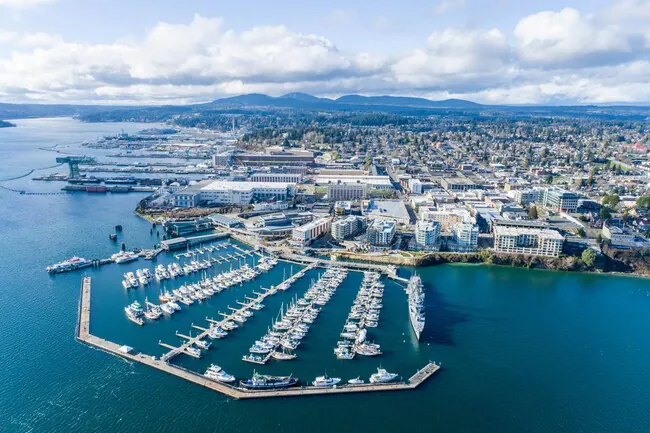
The Bremerton waterfront and Puget Sound Naval Shipyard define the economic identity of the eastern Kitsap Peninsula
2026 Economic Outlook
- PSNS Columbia-class submarine construction support driving engineering hiring
- Port Orchard Bethel corridor commercial and residential expansion accelerating
- Downtown Bremerton revitalization gathering momentum with new mixed-use development
- Olympic College enrollment growth creating student housing demand
- Kitsap Transit expansion improving peninsula connectivity and commuter appeal
Why This Market Is Structurally Sound
Bremerton and Port Orchard sit at the intersection of three independent demand drivers, any one of which would be sufficient to support a healthy real estate market. Together, they create unusual resilience:
- Federal naval employment: PSNS is not a corporate employer that can announce layoffs, relocate operations, or be disrupted by economic cycles. It is a strategic military asset whose presence is determined by national defense requirements and congressional appropriations. The submarine maintenance mission at PSNS has been growing, not shrinking, as the Navy’s Pacific fleet posture intensifies.
- Seattle ferry commuter demand: Every year the Seattle-Bremerton price gap remains wide, more families make the calculation that a 60-minute ferry ride is worth saving $300,000 to $500,000 on a home. As remote and hybrid work has reduced required commute frequency, the ferry commuter pool has grown dramatically. This demand source scales directly with Seattle’s unaffordability.
- Kitsap Peninsula lifestyle and affordability: Waterfront access, Olympic Mountains views, outdoor recreation, and genuine community character at prices that allow families to build equity rather than merely pay rent. This lifestyle appeal is attracting a permanent migration of households who have no connection to the Navy or Seattle and simply want what the peninsula offers.
Historical Performance
| Period | Market Driver | Avg Annual Appreciation | Key Event |
|---|---|---|---|
| 2010-2014 | PSNS stable, post-recession recovery | 3-5% | Federal employment base cushioned Kitsap from recession depth seen in other WA markets |
| 2015-2019 | Seattle spillover begins, PSNS expansion | 8-12% | Ferry commuter demographic grows as Seattle prices accelerate. Port Orchard begins rapid residential expansion. |
| 2020-2022 | Pandemic remote work, inventory collapse | 18-25% | Kitsap becomes major remote worker destination. Multiple offer wars. Port Orchard breaks $400K median. |
| 2023-2024 | Rate correction, normalization | 3-6% | Market softened but PSNS civilian workforce insulated Bremerton from deeper correction than Tacoma or South King. |
| 2025-2026 | PSNS submarine mission growth, ferry demand | 7-11% (projected) | Columbia-class support mission expanding. Port Orchard Bethel corridor breaking ground on major residential projects. |
A $280,000 Bremerton property purchased in 2010 is worth approximately $580,000 to $700,000 today. A Port Orchard property at the same price has performed similarly. Crucially, Kitsap Peninsula properties declined less severely than most Puget Sound markets in 2008 to 2009 and recovered faster, specifically because the PSNS federal payroll did not contract during the financial crisis.
Understanding Bremerton vs. Port Orchard
Bremerton: The Navy and Ferry Hub
Bremerton is the urban core of the Kitsap Peninsula with the ferry terminal, PSNS main gate, downtown revitalization, and Harrison Medical Center all within a compact walkable area. It attracts two distinct tenant types simultaneously: Navy and shipyard employees who want proximity to work, and Seattle commuters who want ferry access. Downtown Bremerton is at an early but genuine revitalization inflection point that sophisticated investors are beginning to recognize.
- Direct ferry to Seattle (60 min)
- PSNS main gate walkable
- Downtown revitalization underway
- Lower entry prices than Port Orchard
- Highest yield multifamily in the market
Port Orchard: The Growth Story
Port Orchard is the fastest-growing community on the Kitsap Peninsula. The Bethel corridor is seeing new residential and commercial development at a pace that is transforming what was a quiet bedroom community into a genuine urban node. Port Orchard’s Southworth ferry to West Seattle opens a second Seattle commute corridor. Lower base prices than Bremerton and stronger forward appreciation make it the clearest long-term appreciation play on the peninsula.
- Fastest residential growth in Kitsap County
- Southworth ferry to West Seattle (35 min)
- New construction opportunity on Bethel corridor
- Lower entry than Silverdale
- Strongest forward appreciation case
📚 New to real estate investing? Master the fundamentals with our professional course Learn more →
2. Neighborhood Hotspots
Bremerton / Port Orchard Investment Neighborhood Map
Interactive map of Kitsap Peninsula investment neighborhoods. Green stars show top hotspots, blue circles mark established markets, and orange circles highlight emerging areas.
Core Investment Neighborhoods
Detailed Submarket Analysis
| Neighborhood | City | Price Range | Cap Rate | Growth Drivers | Best Strategy |
|---|---|---|---|---|---|
| Manette / Ferry District | Bremerton | $410K-$580K | 5.0-6.5% | Ferry access, walkability, Seattle commuter | Appreciation hold, commuter tenant focus |
| Downtown Bremerton | Bremerton | $330K-$520K | 5.5-7.5% | Revitalization, ferry, PSNS, waterfront | Value-add, multi-unit, urban revitalization |
| East Bremerton / PSNS | Bremerton | $370K-$510K | 5.5-7.5% | Shipyard adjacency, military demand | Best cash flow, BRRRR, military tenant |
| Naval Hospital Area | Bremerton | $390K-$530K | 5.0-6.5% | Naval hospital, military families, schools | Military family SFH, stable hold |
| Silverdale | Silverdale | $490K-$680K | 4.5-6.0% | Commercial hub, top schools, healthcare | Premium SFH hold, professional tenants |
| Bethel Corridor | Port Orchard | $420K-$580K | 5.0-6.5% | Fastest growth, Southworth ferry, new construction | New construction, growth play, family rental |
| Port Orchard Downtown | Port Orchard | $290K-$450K | 5.5-7.5% | Revitalization, waterfront, marina, value-add | Lowest entry, value-add, early revitalization |
| Poulsbo / North Kitsap | Poulsbo | $480K-$680K | 4.5-5.5% | Lifestyle community, Kingston ferry, waterfront | Premium appreciation, lifestyle tenant |
| Gorst / South Bremerton | Bremerton | $320K-$450K | 5.5-7.0% | Affordable entry, transport corridor | Cash flow focus, working class rental |
| Belfair / North Mason | Mason County | $280K-$400K | 6.0-8.0% | Lowest entry, Hood Canal, long-term growth | Maximum yield, long hold, emerging play |
Expert Insight: “The most misunderstood dynamic in the Kitsap market is that PSNS employees are not just military families. Over 11,000 of the 14,000 PSNS workers are civilian federal government employees, many in GS-11 to GS-14 pay grades earning $85,000 to $130,000. They are long-term residents with excellent job security who stay in the area for decades. These civilian shipyard workers are some of the most stable, maintenance-conscious, long-term tenants you will ever place in a Kitsap property. The military family tenant gets all the attention, but the civilian federal employee is often the better long-term rental bet.” — Andrea Voss, Principal, Kitsap Investment Properties, Bremerton
3. Property Types
| Investment Goal | Best Property Type | Best Location | Minimum Capital |
|---|---|---|---|
| Maximum Appreciation | SFH in ferry-proximate or growth corridor | Manette, Port Orchard Bethel, Silverdale | $120,000+ |
| Best Cash Flow | Duplex or triplex, PSNS adjacent | East Bremerton, Downtown Bremerton, Gorst | $110,000+ |
| Military Tenant Focus | 3-4BR SFH near PSNS or Naval Hospital | East Bremerton, Naval Hospital area, Silverdale | $105,000+ |
| Lowest Management | New construction SFH or newer condo | Bethel corridor, Silverdale | $115,000+ |
Our Complete Renovation & Remodeling Cost Guide covers 400+ pages of project-by-project breakdowns with real contractor pricing ranges.
4. Cost Analysis
Acquisition Cost Breakdown (Bremerton / Port Orchard)
| Expense Item | Typical Cost | Example ($445,000 Property) | Notes |
|---|---|---|---|
| Down Payment | 25% (investment) | $111,250 | Standard for investment loans. 20% sometimes available with strong credit. |
| Closing Costs | 2-3% of price | $8,900-$13,350 | Title, escrow, lender fees, recording |
| Sewer Scope | $250-$400 | $300 | Mandatory for all pre-1990 Kitsap homes. Older Bremerton neighborhoods have clay lateral issues. |
| General Inspection | $400-$600 | $475 | Include moisture and mold inspection. Pacific Northwest climate requires attention to crawl spaces and attic ventilation. |
| Oil Tank Scan | $150-$300 | $200 | Recommended for pre-1970 Bremerton homes. Abandoned oil tanks present on some older properties. |
| Initial Repairs | 0-8% of price | $0-$35,600 | Older Bremerton homes often need roofing, electrical upgrades, and moisture remediation. |
| Reserves (6 months) | 6 months expenses | $9,000-$13,000 | Emergency fund for vacancy and repairs |
| TOTAL MINIMUM ENTRY | ~28-32% of value | $130,125-$173,175 | Significantly lower capital requirement than equivalent Seattle or Eastside properties |
Sample Cash Flow Analysis: East Bremerton Duplex (PSNS Adjacent)
This example shows the near-breakeven cash flow achievable on Kitsap multifamily, a dramatic improvement over Seattle’s -$2,768/month on a comparable investment.
| Item | Monthly | Annual | Notes |
|---|---|---|---|
| Unit 1 Rent | $1,700 | $20,400 | 3BR upper unit, East Bremerton duplex |
| Unit 2 Rent | $1,550 | $18,600 | 2BR lower unit |
| Gross Income | $3,250 | $39,000 | |
| Vacancy (4%) | -$130 | -$1,560 | Conservative for sub-3.5% vacancy peninsula market |
| Property Taxes | -$320 | -$3,840 | ~0.87% Kitsap County effective rate on $440K assessed |
| Insurance | -$145 | -$1,740 | Landlord policy, duplex |
| Property Management (9%) | -$293 | -$3,510 | Recommended for all investors |
| Maintenance + CapEx | -$325 | -$3,900 | 10% of rent. Include annual moisture/roof inspection in Pacific NW climate. |
| Net Operating Income | $2,037 | $24,450 | Before mortgage |
| Mortgage ($460K purchase, 25% down, 6.5%, 30yr) | -$2,181 | -$26,172 | P&I on $345,000 loan |
| CASH FLOW | -$144 | -$1,728 | Near-breakeven. Reaches positive with 30% down ($138K). |
| Cap Rate | 5.3% | NOI / Purchase Price | |
| Total Return (9% appreciation) | ~23% | Including appreciation, equity, principal paydown |
The 30% Down Scenario: At 30% down ($138,000 on this $460,000 property), the loan drops to $322,000 and the payment falls to $2,035/month, producing +$2/month positive cash flow. This is the entry point where Kitsap multifamily becomes cash-flow-neutral with a 30 percent equity position. Compare this to Seattle’s East Beacon Hill duplex at -$329/month with 25% down and -$2,768/month for a Seattle SFH. The Kitsap math is the most compelling of any western Washington market in this guide series.
Expert Insight: “What I tell investors who are comparing Bremerton to south King County or Pierce County is to think about what happens when the economy turns. In 2008, Bremerton declined about 12 percent from peak versus 28 to 35 percent in Auburn and Lakewood. The recovery was also faster. When Boeing lays people off or Amazon adjusts headcount, those markets feel it immediately. When PSNS has a bad quarter, there is no such thing. The federal payroll at PSNS does not fluctuate with economic cycles. That distinction is worth a lot when you’re deciding where to put capital for the next 15 years.” — Robert Kinsley, Kitsap Peninsula Investment Group, Silverdale
5. Legal Framework
✅ Washington State Law, No City Overlay
Bremerton, Port Orchard, and all Kitsap County communities operate exclusively under Washington State landlord-tenant law. No city in Kitsap County has adopted additional tenant protection ordinances beyond the state framework. No just cause eviction requirement, no first-in-time rule, no 180-day rent increase notice, no city rental registration program. This is the same clean regulatory environment as Everett and the Tri-Cities, and a dramatic improvement over Seattle’s municipal overlay. Evictions in Kitsap County typically complete in 30 to 45 days for non-payment cases.
Washington State RLTA Provisions
- No-Cause Termination: 20-day written notice at end of lease term. Full landlord flexibility without Seattle’s just cause requirement.
- Non-Payment Eviction: 14-day pay or vacate. Unlawful detainer completion typically 30 to 45 days uncontested.
- Rent Increases: 60 days written notice. No statutory cap on the amount. No 180-day requirement.
- Security Deposits: No statutory maximum. Return within 21 days with itemized statement.
- Source of Income: Washington State prohibits discrimination based on Section 8 and housing assistance vouchers statewide. Must accept eligible voucher holders.
- Entry: 24-hour advance notice for non-emergency entry.
- No Rental Registration: No city rental licensing or inspection program in any Kitsap community.
- Habitability: 24-hour response for heat and hot water failures; reasonable time for other repairs.
Kitsap vs. Seattle Regulatory Comparison
| Rule | Kitsap County | Seattle |
|---|---|---|
| Just Cause Eviction | Not required | Always required |
| First-in-Time Rule | Does not apply | Strictly enforced |
| Rent Increase Notice | 60 days | 180 days (above CPI) |
| Rental Registration | None | RRIO mandatory |
| Eviction Timeline | 30-45 days | 90-180+ days |
| Move-In Fee Cap | State law only | Strict city caps |
Key Resources
- WA Landlord-Tenant Act: app.leg.wa.gov
- Kitsap County Assessor: kitsapgov.com/assessor
- Bremerton City Planning: bremertonwa.gov
- Port Orchard City: cityofportorchard.us
- PSNS Housing Office: cnic.navy.mil/bremerton
Military Tenant Considerations
The Servicemembers Civil Relief Act (SCRA) provides special protections for military tenants that all Kitsap landlords must understand:
- Early lease termination right: Active duty service members can terminate a lease with 30 days written notice when they receive PCS orders or deployment orders of 90 days or more. This is a federal right that supersedes any lease term. For landlords, this means military tenants can legally break a lease with appropriate notice. The practical reality is that PCS orders are typically known months in advance, giving landlords time to re-market.
- Interest rate cap: SCRA caps interest rates on pre-service obligations at 6 percent. This affects lease-purchase and installment agreements but not standard rental leases.
- The practical reality of SCRA: Despite early termination rights, military families in Kitsap are among the most desired tenants in the market. Their BAH fully covers rent, they are accountable to a command structure that discourages property damage or payment problems, and the pipeline of incoming military families ensures rapid re-tenanting when one family PCSes out. Most experienced Kitsap landlords prefer military tenants despite SCRA, not because of it.
- Military housing referral programs: The PSNS Housing Referral Office maintains a list of private landlords who work with military families. Getting on this list is a reliable source of pre-qualified, high-income tenant referrals. Contact CNIC Bremerton’s housing office directly.
6. Step-by-Step Bremerton / Port Orchard Investment Playbook
Choose Your Kitsap Strategy
The Kitsap Peninsula supports four distinct investor strategies depending on capital, time horizon, and tenant preference:
Military Tenant Cash Flow
Buy duplexes or SFH near PSNS main gate in East Bremerton. Market to incoming Navy and civilian federal employees via the PSNS Housing Referral Office. BAH covers full rent, creating reliable income. Focus on 3 to 4 bedroom homes for families.
Ferry Commuter Appreciation
Buy in Manette or near the Bremerton ferry terminal. Target Seattle tech and professional workers on hybrid schedules who want ferry access at a fraction of Seattle prices. This demographic is growing as Seattle remains unaffordable and remote work normalizes 2 to 3 day commutes.
Port Orchard Growth Play
Buy new construction or existing SFH in the Bethel corridor. Highest forward appreciation on the peninsula. Target young families relocating from south King County and Pierce County who want more space, better schools, and Southworth ferry access to West Seattle employment.
Downtown Bremerton Value-Add
Buy dated properties in Downtown Bremerton or East Bremerton. Renovate to capture the growing professional renter demographic attracted by improving downtown amenities and ferry access. BRRRR strategy works well at Bremerton’s lower price points where renovation value multiples are strong.
Build Your Kitsap Peninsula Team
- Kitsap Investment Agent: Prioritize agents with specific military tenant placement experience. The best Kitsap agents have established relationships with the PSNS Housing Referral Office and can surface incoming PCS families before they compete on the open rental market. Ask how many of their rental placements annually go to military or federal civilian employees.
- Property Manager with Military Expertise: Verify they understand SCRA requirements, the BAH allotment payment setup, and the PCS timeline so they can begin re-marketing vacant units before the departing tenant’s last day. The best Kitsap managers maintain waitlists of incoming military families from the PSNS housing referral program.
- Kitsap-Familiar Lender: Olympic Peninsula Credit Union, Sound Credit Union, and Washington Federal all have strong Kitsap Peninsula mortgage operations. They understand local appraisal conditions and multifamily underwriting better than national lenders who are unfamiliar with the market.
- Pacific Northwest Contractor: Essential for value-add properties. Must understand moisture control, crawl space encapsulation, and the specific building challenges of Puget Sound’s wet climate. A contractor who treats moisture issues as cosmetic rather than structural will cost you significant money over time.
Expert Tip: Contact the PSNS Housing Referral Office directly before your first purchase. They will walk you through the landlord participation process, explain what incoming families need, and add you to their referral list. Getting on this list can eliminate vacancy almost entirely. Some well-positioned Kitsap landlords have never experienced a vacancy gap between military tenant transitions because the housing office connects departing families with incoming ones directly through the referral network.
Kitsap-Specific Due Diligence
Physical Due Diligence
- Moisture and mold inspection is the top priority: Puget Sound’s marine climate, with annual rainfall of 55+ inches and high relative humidity, makes moisture intrusion the most common and costly property issue in Kitsap. Inspect crawl spaces, attic ventilation, and window sealing carefully.
- Sewer scope inspection mandatory for all pre-1990 Bremerton homes. Older Bremerton neighborhoods have clay lateral lines that root intrude and collapse.
- Oil tank scan for pre-1970 properties. Abandoned heating oil tanks are present on older Bremerton lots.
- Roof inspection with attention to moss accumulation and gutter condition. Pacific Northwest moss growth degrades roofing significantly faster than drier climates.
- Septic system inspection for Port Orchard and rural Kitsap properties that are not on city sewer. Septic systems add maintenance costs and have replacement lifespans.
- Seismic assessment for older unreinforced masonry buildings near downtown Bremerton.
Market and Regulatory Due Diligence
- Pull all permits for improvements. Unpermitted additions are common in older Bremerton neighborhoods. Garages converted to living space, basement bedroom additions, and deck expansions without permits create issues for insurance and resale.
- Confirm sewer vs. septic status. Port Orchard’s expanding city limits mean some properties have recently been connected to city sewer; verify the current status and any pending assessment obligations.
- Verify current tenant lease terms and BAH payment arrangement for military tenant properties. Confirm whether rent is paid via allotment (automatic, reliable) or personal check from the service member.
- For Port Orchard Bethel corridor properties: check HOA status and rental restrictions on newer builder community properties. Some developments have HOA rental caps or approval requirements.
- Confirm ferry schedule and current crossing time for Bremerton properties marketed to Seattle commuters. Ferry schedule changes affect commuter appeal significantly.
Competing in the Kitsap Market
- Faster pace than pre-pandemic but not Seattle-level frenzy: The Kitsap market allows standard inspection contingencies in most transactions. You rarely need to pre-inspect or waive contingencies, giving you genuine due diligence time that is not available in competitive Seattle neighborhoods.
- Act on military tenant properties with existing tenants: Properties currently occupied by military tenants at below-market rents are frequently discounted 8 to 15 percent below vacant comparable properties because buyers are uncertain about SCRA and tenant transition. For investors who understand the process, these properties represent genuine opportunity. A military family on year 2 of a 3-year tour is not a risk, it is a known tenant lifecycle with predictable transition timing.
- Target estate and long-term homeowner properties: Bremerton has a significant population of homeowners who purchased during the 1960s to 1980s Navy construction era. These estates and long-term owners frequently produce below-market pricing on properties that need updating but have strong structural bones and excellent locations relative to PSNS and the ferry.
- Build agent relationships before the PCS season: Most military PCS orders are issued in winter for summer reporting dates. The Kitsap market sees its highest activity from April through August as incoming families search for housing. Agents who have built relationships in the market surface properties months before this rush period.
Property Management in Kitsap
Military PCS Season Management
The PCS cycle creates a predictable management calendar that experienced Kitsap managers navigate efficiently:
- December-February: PCS orders issued for summer reporting. Begin re-marketing if current tenant has orders.
- March-May: Incoming family house hunting trips. Most occupied. Market aggressively to incoming families via PSNS referral.
- June-August: Peak transition period. Most military family moves occur in summer to minimize school disruption.
- September-November: Secondary transition period. Occasional mid-tour transitions. Good time for minor updates between tenancies.
Typical Kitsap Management Fees
- Single-family management: 8-10% of monthly rent
- Multi-family management: 7-9% of monthly rent
- Leasing fee: 50-100% of one month’s rent
- Lease renewal fee: $150-$300
- Military BAH allotment setup: Often included or $100-$200 one-time
- Annual moisture and roof inspection coordination: $200-$400
7. Financing Options for Bremerton / Port Orchard
| Loan Type | Down Payment | Rate Premium | Best For | Kitsap Note |
|---|---|---|---|---|
| Conventional Investment | 25% | +0.5-0.75% | W-2 income investors, good credit | Most Kitsap properties within $806,500 conforming limit. Standard conforming pricing available for most purchases. |
| VA Loan (veteran eligible) | 0% | Below market | Veterans and active duty who will occupy one unit | The most powerful entry strategy in this market. Veterans living near PSNS can use VA loan to house hack a duplex at zero down. After meeting VA occupancy requirements, convert to full investment property. |
| House Hack (FHA) | 3.5% | Standard + MIP | Owner-occupying one unit of 2-4 unit property | Kitsap duplexes at $430K-$550K within FHA limits. Entry as low as $15,000-$19,000 down. Excellent first investment vehicle for non-veteran buyers. |
| DSCR Loan | 20-30% | +1.5-2.5% | Portfolio growth, no income verification | Viable for Kitsap duplexes and triplexes with 30% down, approaching DSCR 1.0x. Better than Seattle but not as clean as Tri-Cities multifamily. Military BAH income is typically accepted by DSCR lenders for qualification. |
| Portfolio Loan | 20-30% | +1-2% | Multiple properties, self-employed investors | Sound Credit Union, Olympic Peninsula CU, and Washington Federal active in Kitsap with portfolio products. |
| Hard Money (Bridge) | 15-25% | 8-12% rate | BRRRR, value-add acquisitions | Lower loan amounts than western WA reduce total bridge interest cost. Renovation projects in Kitsap move well with organized contractors given lower demand pressure than Seattle. |
| Seller Financing | 10-20% | Negotiated | Long-term homeowners open to installment sale | More common than western WA. Long-term PSNS civilian employee homeowners approaching retirement sometimes prefer installment sale income over lump sum. Worth asking in estate and older homeowner situations. |
The VA Loan Advantage for Veteran Investors: If you are a veteran or active duty service member, the Kitsap Peninsula is one of the strongest markets in Washington State for the VA loan house-hacking strategy. Buy a duplex in East Bremerton or Gorst at $450,000 to $550,000 with zero down using your VA entitlement, occupy one unit, rent the other at $1,700 to $1,900/month, and your effective housing cost drops to $700 to $900/month. After meeting VA occupancy requirements, relocate, convert both units to rentals, and repeat. No other financing product available to veterans produces this combination of zero down, below-market rates, and immediate rental income in a market where the tenant pipeline is as reliable as PSNS’s. Many of the most successful Kitsap real estate investors started with exactly this strategy.
8. Frequently Asked Questions

Knowledge Quiz: Bremerton / Port Orchard Real Estate Investment
Open Quiz
5 quick questions on what you just learned about investing in Bremerton and Port Orchard
1) Why does the guide say PSNS civilian employees are often better long-term tenants than military families in Kitsap?
Answer: B
The guide highlights that over 11,000 of PSNS’s 14,000 employees are civilian federal government workers, many in GS-11 to GS-14 pay grades earning $85,000 to $130,000. Unlike military families who rotate on PCS orders every 2 to 4 years, civilian shipyard employees are long-term Kitsap residents who stay for careers. They are stable, maintenance-conscious tenants who provide multi-year or even decade-long tenancy stability that is actually more valuable than the reliable but shorter military family tenure.
2) What is the single most important physical maintenance issue specific to Kitsap Peninsula properties?
Answer: C
Bremerton receives approximately 55 inches of rainfall annually with persistent high humidity. The guide identifies moisture management as the top physical maintenance priority, covering crawl space encapsulation ($3,000-$8,000), annual roof moss treatment, window and door sealing on older properties, and attic ventilation inspection. Investors who proactively budget $2,000 to $4,000 annually for moisture management dramatically reduce the risk of major structural remediation costs over a long hold.
3) What does the guide identify as the most powerful financing strategy for veteran investors on the Kitsap Peninsula?
Answer: D
The guide calls the VA loan house-hacking strategy on Kitsap duplexes one of the strongest entry strategies in Washington State for eligible veterans. Buying a $450,000 to $550,000 East Bremerton duplex at zero down, occupying one unit while renting the other at $1,700 to $1,900/month, reduces effective housing cost to $700 to $900/month. After meeting VA occupancy requirements, the veteran can relocate, convert both units to rentals, and repeat. No other financing product combines zero down, below-market rates, and immediate rental income in a market with PSNS’s reliable tenant pipeline.
4) How does the Servicemembers Civil Relief Act (SCRA) affect Kitsap landlords who rent to military tenants?
Answer: A
SCRA allows military members to terminate leases with 30 days written notice when receiving PCS or qualifying deployment orders. This is a genuine right landlords must understand and accept. However, the guide notes that experienced Kitsap landlords prefer military tenants despite SCRA because BAH fully covers rent reliably, the military command structure discourages property damage and payment problems, and the PSNS pipeline of incoming families means re-tenanting typically occurs with minimal vacancy. PCS orders are usually known months in advance, giving landlords time to re-market before the departing tenant’s final day.
5) At what down payment level does the guide’s East Bremerton duplex example reach positive cash flow?
Answer: C
The guide’s East Bremerton duplex cash flow analysis shows -$144/month at 25% down ($115,000). At 30% down ($138,000), the loan drops to $322,000 and the monthly payment falls to $2,035, producing approximately neutral or breakeven cash flow. The guide positions this as comparable to Everett’s multifamily and dramatically better than Seattle’s -$2,768/month on a comparable investment, making it the strongest multifamily cash flow market of the western Washington markets covered in this guide series.
Work With a Local Expert in Bremerton / Port Orchard
We are building a verified network of real estate professionals across every market we cover.

About Our Expert Network
We are finalizing partnerships with verified real estate professionals across every market featured on Builds and Buys. Each expert in our network is selected for their hands-on investment experience, local market knowledge, and commitment to helping buyers and investors make sound decisions.
Our Kitsap Peninsula specialists offer:
- Specific experience with PSNS military and civilian federal employee tenant placement
- Deep knowledge of BAH rates, SCRA requirements, and military lease structuring
- Connections to the PSNS Housing Referral Office for direct tenant pipeline access
- Ferry commuter market knowledge including which Bremerton neighborhoods command ferry premiums
- Full transaction support from search through closing
- Ongoing property management referrals with military tenant specialization
Services Covered
- Property sourcing and acquisition
- Investment analysis and underwriting
- Buyer representation
- Military BAH lease structuring
- PSNS Housing Office referral setup
- Value-add and renovation guidance
- Legal and title referrals
- Financing and lender connections
- Property management referrals
- Insurance and inspection referrals
- 1031 exchange coordination
- Exit strategy planning
Get Connected or Join Our Network
Looking for a local expert for your Kitsap Peninsula investment? Reach out and we will connect you with the right professional.
Are you a real estate professional with a track record working with investors in Bremerton, Port Orchard, or Silverdale? We are always expanding our verified expert network.
Contact us at support@buildsandbuys.com
Find Specialized Kitsap Peninsula Real Estate Professionals
Ready to Invest in Bremerton / Port Orchard?
The Kitsap Peninsula offers what few western Washington markets can: genuine proximity to Seattle’s employment market, a geographically constrained supply base, and a federal military employment anchor whose resilience has been demonstrated through every economic cycle of the past four decades. Puget Sound Naval Shipyard is not a corporate employer making quarterly decisions about headcount. It is a strategic national asset whose mission is growing. Port Orchard is not a speculative growth story. It is a community with real infrastructure investment, real families arriving, and real demand that is driving construction and commercial development in measurable, visible ways. The ferry commuter market is not a theory. It is an observable, growing demographic of professionals who have done the math and chosen space, affordability, and Puget Sound views over a Seattle zip code. All three demand drivers will still be operating 20 years from now. The investors who recognize this earliest build positions that look obviously correct in retrospect.
Continue Your Research
Washington State Guide
See how Bremerton and Port Orchard compare to Tacoma, Olympia, and other western Washington markets.
Step-by-Step Invest
Complete framework for building a real estate investment strategy from scratch.
144-Lesson Course
University-level real estate education covering financing, law, strategy, and management.
For further guidance, explore our State-by-State Investor guides, browse our expert articles, or follow our Step-by-Step Investment Guide.



