Harrisburg Real Estate Investment Guide For 2026
A comprehensive resource for investors looking to capitalize on the fastest-appreciating suburb in the Sioux Falls metro, a market built almost entirely on school district demand
Quick answers: Top 5 most searched Harrisburg investment questions ▼
Migration data: Where people are moving from to Harrisburg ▼
In This Guide
Click on any section to navigate directly to that content
1. Harrisburg Market Overview
Market Fundamentals
Harrisburg has transformed over the past decade from a small Lincoln County town into the fastest-appreciating major suburb in the Sioux Falls metro. Sitting on I-29 South roughly 10 minutes from Sioux Falls, Harrisburg’s investment case is unlike anything else in this South Dakota series: it is driven almost entirely by school district demand rather than employment, tourism, or a university.
Key economic indicators that define Harrisburg’s investment case:
- Population: 8,519 (Niche estimate), one of South Dakota’s fastest-growing communities
- Core Demand Driver: The Harrisburg School District, rated above average, cited consistently as the community’s biggest draw
- Location: Lincoln County, on I-29 South, roughly 10 minutes from Sioux Falls
- No State Income Tax: Same statewide advantage as the rest of South Dakota
- Property Tax Advantage: Lincoln County rates consistently run below Minnehaha County (Sioux Falls) rates
- Transaction Depth: 83 closed sales year-to-date 2026 on RASE MLS, a genuinely active market for a city this size
Harrisburg’s commercial base has grown alongside its residential explosion, with the Highway 11 and Cliff Avenue corridor now offering Hy-Vee, Home Depot, and a growing range of dining and retail that reduces residents’ dependence on driving into Sioux Falls for everyday needs. But the economic engine is genuinely different from every other city in this series: Harrisburg does not have a dominant local employer, university, or tourism draw. Families move here, and rent here, primarily to access its schools.
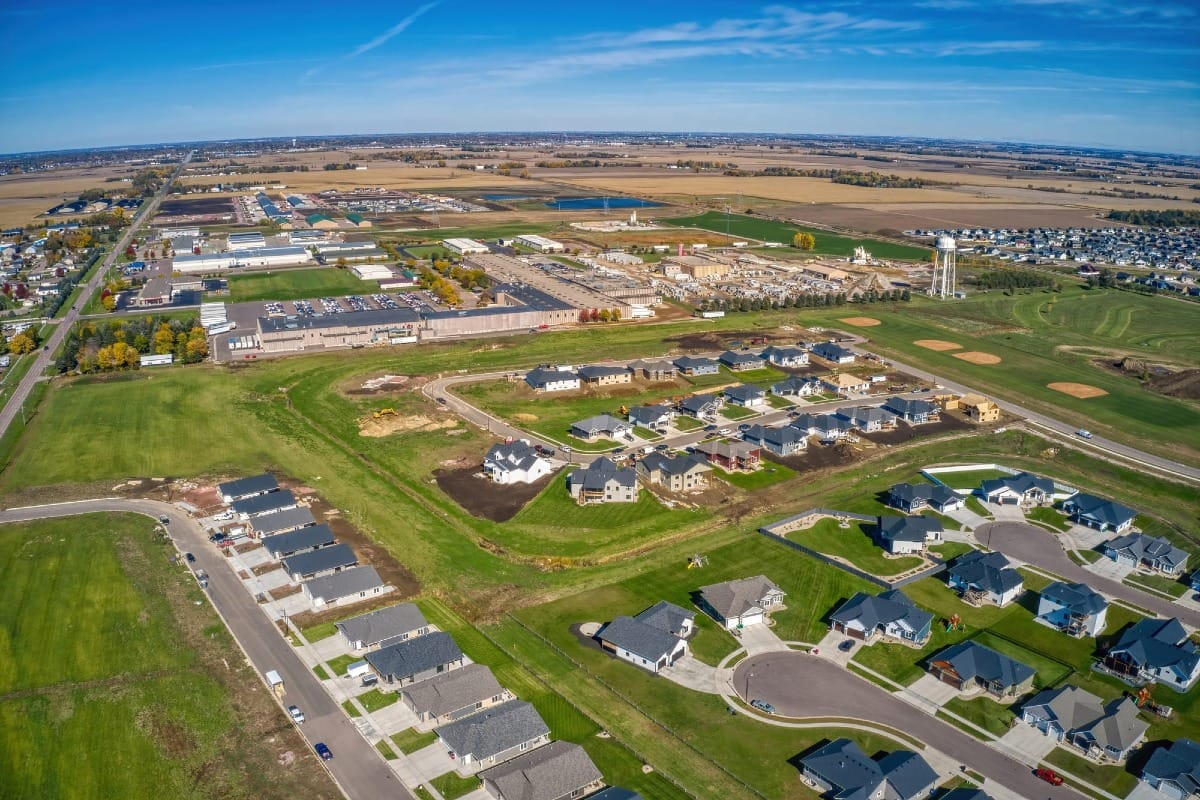
Harrisburg’s rapid growth is driven almost entirely by the Harrisburg School District rather than a local employer
2026 Economic Outlook
- Median listing prices reached roughly $449,900 in April 2026, up 12.5% year over year
- Homes selling in a median of 26 days, nearly 55% faster than the prior year
- Active new subdivisions including Mydland Estates, Jefferson Heights, Copper Creek Heights, and Aspen Ridge
- Continued commercial buildout along the Highway 11 / Cliff Avenue corridor
- South Sioux Falls healthcare and commercial employment growth spilling directly into the Harrisburg market
Investment Climate
Harrisburg’s investment environment shares South Dakota’s statewide landlord-friendly legal framework, but the underlying market dynamics are the most distinctive in this entire series. Successful Harrisburg investors tend to share a few characteristics:
- Appreciation-first mentality accepting compressed cap rates in exchange for the strongest price growth trajectory in the South Dakota series
- School-district-tenant awareness understanding that Harrisburg’s renter pool skews toward financially stable families making a deliberate, often temporary, enrollment-driven choice rather than a typical transient renter
- New-construction fluency since there is essentially no older value-add housing stock in this market
- Patience with thin rental supply since most residents own rather than rent, meaning available rental inventory itself is genuinely limited
- Regulatory comfort operating under the same statewide landlord-friendly framework as the rest of South Dakota
Harrisburg is the clearest total-return, appreciation-driven counterpart to the cash-flow-heavy neighborhoods covered elsewhere in this South Dakota series. Investors should approach it accordingly: this is not a market to underwrite on cap rate alone.
Historical Performance
| Period | Market Driver | Avg Annual Appreciation | Key Event |
|---|---|---|---|
| 2014-2018 | Early suburban growth from a small Lincoln County town | 5-7% | Harrisburg begins its transformation into a genuine Sioux Falls suburb |
| 2019-2022 | School district reputation solidifies, pandemic-era relocation | 10-15% | Highway 11 / Cliff Avenue commercial corridor begins major buildout |
| 2023-2025 | Continued tight supply, sustained demand | 6-10% | Harrisburg establishes itself as the fastest-appreciating major Sioux Falls suburb |
| 2026 (current) | Record-tight inventory, new subdivision delivery | 6.1-12.5% (current pace, sold vs. listing) | Homes selling nearly 55% faster than the prior year |
Harrisburg’s appreciation curve is the steepest in this South Dakota series. A $260,000 Harrisburg property purchased in 2020 would be worth roughly $370,000-$400,000 today, reflecting the compounding effect of consistently tight supply meeting sustained school-district-driven demand.
Demographic Trends Driving Demand
- Harrisburg School District Reputation – Consistently cited as the single biggest reason families choose the community, and the primary reason renters choose it too
- Sioux Falls Metro Spillover – Proximity to the growing south Sioux Falls healthcare and commercial employment corridor via I-29
- Lifestyle and Space Preference – Larger lot sizes and a “wide-open” prairie feel appeal to families leaving denser core Sioux Falls neighborhoods
- Consistently Tight Supply – A structural, multi-year housing shortage relative to demand is the single biggest factor behind Harrisburg’s appreciation rate
- Growing Local Commercial Base – The Highway 11 / Cliff Avenue corridor increasingly supports day-to-day needs without requiring a Sioux Falls commute for shopping
- Community Infrastructure Investment – A dedicated park system, community aquatic center, and youth sports programming reinforce the family-oriented identity driving continued in-migration
📚 New to real estate investing? Master the fundamentals with our professional course Learn more →
2. Neighborhood Hotspots
Harrisburg Investment Neighborhood Map
Interactive map of Harrisburg’s investment neighborhoods. Green stars show top hotspots, blue circles mark established markets, and orange circles highlight emerging areas.
Core Investment Neighborhoods
Detailed Submarket Analysis: All Harrisburg Neighborhoods
| Neighborhood | Price Range (SFH) | Cap Rate | Growth Drivers | Best Strategy |
|---|---|---|---|---|
| Mydland Estates | $340K-$480K | 3.5-4.5% | Top-searched subdivision, modern floor plans | Long-term appreciation |
| Jefferson Heights | $330K-$460K | 3.5-4.5% | Energy-efficient new construction | Low-maintenance buy-and-hold |
| Copper Creek Heights | $320K-$440K | 3.5-4.5% | Competitive new-build pricing | Balanced appreciation play |
| Aspen Ridge | $330K-$450K | 3.5-4.5% | School district access, new construction | Long-term appreciation |
| Highway 11 / Cliff Ave Corridor | $310K-$430K | 3.5-4.5% | Commercial corridor proximity | Retail-proximity appreciation |
| Original Harrisburg Townsite | $260K-$380K | 4.0-5.0% | Closest to older/value stock in this market | Best relative cash flow in Harrisburg |
| Lake Ole / Central Park Area | $300K-$420K | 3.5-4.5% | Park and lake amenity access | Family buy-and-hold |
Expert Insight: “Everyone who calls me about Harrisburg wants to know the cap rate, and I have to reset expectations every time. This is not a South Dakota cash-flow market. It’s the closest thing this state has to a coastal-suburb appreciation play: a school district people will pay a premium to access, tight supply, and a track record of 6 to 12 percent annual price growth. Buy it for the equity curve, not the monthly check.” – local Harrisburg-area real estate agent
3. Property Types
| Investment Goal | Best Property Type | Best Neighborhoods | Minimum Capital |
|---|---|---|---|
| Maximum Appreciation | New construction single-family | Mydland Estates, Jefferson Heights | $81,000+ |
| Best Relative Cash Flow | Original townsite home | Original Harrisburg Townsite | $65,000+ |
| School-Enrollment Family Rental | Standard new-build single-family | Any Harrisburg School District subdivision | $78,000+ |
| Lower-Capital Entry | Owner-occupant house hack | Any subdivision with accessory living space | Varies with owner-occupant financing terms |
Don’t guess the costs. Our Complete Renovation & Remodeling Cost Guide covers 400+ pages of project-by-project breakdowns with real contractor pricing ranges.
4. Cost Analysis
Acquisition Cost Breakdown (Harrisburg)
| Expense Item | Typical Cost | Example ($372,000 Property) | Notes |
|---|---|---|---|
| Down Payment | 25% (investment) | $93,000 | The highest down payment requirement of any city in this South Dakota series |
| Closing Costs | 2-3% of price | $7,440-$11,160 | Title, escrow, lender fees, recording |
| General Inspection | $450-$700 | $575 | Still worthwhile even on new construction to verify builder quality |
| Radon Test | $150-$250 | $200 | South Dakota sits in a moderate-to-elevated radon zone |
| Initial Repairs | 0-2% of price | $0-$7,440 | Minimal given the near-universally new housing stock |
| Reserves (6 months) | 6 months expenses | $9,000-$12,000 | Emergency fund for vacancy and repairs |
| TOTAL MINIMUM ENTRY | ~28-32% of value | $109,590-$124,075 | The highest total entry point of any city in this South Dakota series |
Sample Cash Flow Analysis: Mydland Estates New-Construction Single-Family
| Item | Monthly | Annual | Notes |
|---|---|---|---|
| Gross Rent | $2,100 | $25,200 | 4BR Mydland Estates rental, school-district-motivated family tenant |
| Less Vacancy (4%) | -$84 | -$1,008 | Conservative estimate; school-district tenants often sign full-year leases |
| Property Taxes | -$322 | -$3,868 | ~1.04% approximate effective rate, Lincoln County (below Minnehaha County’s ~1.16%) |
| Insurance | -$120 | -$1,440 | Often lower than older housing stock given new-construction condition |
| Property Management (9%) | -$189 | -$2,268 | Recommended for out-of-state investors |
| Maintenance + CapEx | -$105 | -$1,260 | 5% of rent, lower given new-construction condition |
| Net Operating Income | $1,280 | $15,356 | Before mortgage |
| Mortgage ($372,000 price, 25% down, 6.75%, 30yr) | -$1,811 | -$21,732 | Principal and interest only on $279,000 loan |
| CASH FLOW | -$531 | -$6,376 | Negative, consistent with Harrisburg’s appreciation-first character |
| Cap Rate | 4.1% | NOI / Purchase Price | |
| Total Return Including 6.1% Appreciation | ~19-22% | Including equity, appreciation, and principal paydown on the leveraged position |
This example shows why Harrisburg is fundamentally a total-return market: negative monthly cash flow paired with strong equity growth still produces a compelling overall return once appreciation and principal paydown are factored in, provided the investor has the financial capacity to carry the negative carry.
Expert Insight: “I tell investors the same thing every time: Harrisburg is a wealth-building play for someone with strong outside income who can comfortably carry a few hundred dollars a month of negative cash flow. It is absolutely not the right property for someone trying to replace their income with rental cash flow. Know which investor you are before you buy here.” – local Harrisburg-area property manager
5. Legal Framework
✅ Same Landlord-Friendly Statute as the Rest of South Dakota
Landlord-tenant law in South Dakota is set entirely at the state level, so everything covered in this section applies identically in Harrisburg and Lincoln County as it does in Sioux Falls, Rapid City, Brookings, Aberdeen, Box Elder, and Watertown. Senate Bills 89 and 90, passed in 2024, made the entire state more landlord-friendly. Always confirm current statute language with a South Dakota-licensed attorney before acting.
South Dakota-Specific Regulations
Governed statewide by SDCL Chapter 43-32 (landlord-tenant) and Chapter 21-16 (Forcible Entry and Detainer). Key points for Harrisburg investors:
- No Mandatory Notice for Nonpayment: SB90 (2024) repealed the requirement for a separate three-day notice to quit before filing. A landlord can file a Forcible Entry and Detainer complaint directly once rent is three or more days past due, subject to any lease terms.
- Month-to-Month Termination: SB89 (2024) reduced the notice period for ending a tenancy-at-will without cause from 30 days to 15 days.
- No Cure Period for Lease Violations: South Dakota does not require landlords to give tenants an opportunity to cure most lease violations before eviction.
- Security Deposit Cap: One month’s rent, with limited additional pet-damage charges permitted in some cases.
- Deposit Return Deadline: Two weeks after the tenant provides a forwarding address.
- No Rent Control: No rent control statute anywhere in South Dakota.
⚠️ HOA Considerations in Newer Subdivisions
Given how much of Harrisburg’s housing stock is recent-construction subdivisions, verify any applicable HOA rules and rental restrictions before purchasing, since some newer developments carry covenants that limit or regulate rental activity. This is a property-specific consideration, not a statewide landlord-tenant law issue.
Compliance Best Practices
South Dakota’s landlord-friendly environment still rewards good documentation:
- Written Lease Every Time: Since state default protections are limited, the lease itself defines most terms. Use a current, South Dakota-specific template.
- Document Rent Due Dates Precisely: A FED complaint can be filed once rent is three or more days late; precise records protect you if timing is disputed.
- Confirm HOA Rental Rules in Writing: Before listing a Harrisburg subdivision property for rent, confirm the HOA permits rental use and understand any registration requirements.
- Track Deposit Deadlines: Build the two-week return window into your management workflow.
- Use a Sheriff for Removal: Self-help evictions remain illegal statewide.
Useful Harrisburg Resources
- City of Harrisburg: harrisburgsd.gov
- Lincoln County Register of Deeds and Treasurer
- South Dakota Unified Judicial System eviction forms: ujs.sd.gov
- Harrisburg School District: for enrollment boundary verification
| Regulation | Harrisburg / South Dakota Requirement | Comparison Reference | Investor Impact |
|---|---|---|---|
| Nonpayment Notice | No mandatory notice; file after rent is 3+ days late (SB90, 2024) | Identical statewide, including Sioux Falls | Faster path to court filing on delinquent tenants |
| Property Tax Rate | ~1.04% approximate effective (Lincoln County) | Below Minnehaha County’s ~1.16% (Sioux Falls) | Modest carrying-cost advantage relative to Sioux Falls proper |
| HOA Rental Restrictions | Property-specific, common in newer subdivisions | More relevant here than in older-housing-stock cities in this series | Confirm before purchase, not after |
| Rent Control | None statewide | Identical statewide | Full pricing flexibility on renewals |
6. Step-by-Step Harrisburg Investment Playbook
Define Your Harrisburg Strategy
Harrisburg supports fewer distinct strategies than other cities in this series, precisely because it is such a specialized, appreciation-driven market. Before buying, be clear on which of these you are executing:
Long-Term Appreciation
Buy new construction in any Harrisburg School District subdivision and hold for equity growth. Accept modest negative cash flow as the cost of participating in the strongest appreciation trajectory in this South Dakota series.
Best Relative Cash Flow
Buy in the original Harrisburg townsite for the closest thing this market has to a value entry point, still accepting compressed yields relative to other South Dakota cities.
Owner-Occupant Entry
Buy a home with an accessory or lower-level living space, live in part of it, and rent the rest to offset your own housing cost while building equity.
Build Your Harrisburg Team
Harrisburg’s team requirements mirror the rest of South Dakota, with new-construction fluency being especially important given the housing stock.
- Local Agent with New-Construction and Harrisburg-Specific Experience: Ideally with active builder relationships across the top subdivisions.
- South Dakota Real Estate Attorney: For entity setup, lease review, and HOA covenant review specific to newer subdivisions.
- Local Property Manager Familiar with the School-Enrollment Tenant Profile: Given Harrisburg’s distinct, lower-turnover-but-time-limited renter base.
- CPA Familiar With Multi-State Filing: For out-of-state investors, since South Dakota has no state income tax but your home state may still tax the rental income.
Expert Tip: Ask any prospective Harrisburg agent for their honest read on whether a given subdivision’s HOA restricts rentals. Given how new most of this housing stock is, this single question can eliminate otherwise attractive-looking listings before you waste time on due diligence.
Harrisburg-Specific Due Diligence
Standard due diligence items plus these Harrisburg-relevant checks:
Physical Due Diligence
- Standard inspection even on new construction, to verify builder quality
- Radon test, particularly on any home with a basement
- Confirm which builder constructed the home and their local reputation and warranty terms
Regulatory Due Diligence
- Confirm HOA rules and any rental restrictions or registration requirements before purchase
- Verify Harrisburg School District enrollment boundary for the specific parcel
- Review current tenant lease terms and confirm they reflect the 2024 statutory changes
- Check Lincoln County assessed value trend for property tax planning
Competing and Closing in Harrisburg
Homes are selling in a median of 26 days, nearly 55% faster than the prior year, in a market with consistently tight supply. Strategies that work:
- Move quickly and decisively: This is the most competitive market in this South Dakota series; hesitation costs opportunities.
- Underwrite the full cost basis including likely negative carry: Go in with clear eyes about the cash flow reality rather than hoping the numbers work better than they do.
- Negotiate builder incentives on new construction: As in Box Elder, active new-build listings sometimes include rate buydowns or closing cost credits worth asking about.
- Confirm HOA and school boundary before falling in love with a listing: Both can materially affect a property’s investment case.
Property Management in Harrisburg
Harrisburg’s thin rental supply and distinct tenant profile call for a somewhat different management approach than the rest of this South Dakota series.
Tenant Screening & Rent Collection Protocol
- Screen for income (2.5-3x monthly rent), credit, and rental history; South Dakota law does not restrict landlord discretion beyond federal Fair Housing rules
- Given the school-enrollment tenant profile, ask directly about the family’s expected timeline (renting while house-hunting, waiting on a relocation, etc.) to plan for likely lease renewal or turnover
- Document nonpayment precisely, since a FED complaint can be filed once rent is three or more days late under SB90
- Track deposit return deadlines carefully given the two-week window
Typical Harrisburg Management Fees
- Single-family management: 8-10% of monthly rent
- Leasing fee: 50-100% of one month’s rent
- Lease renewal fee: $100-$250 per renewal
7. Financing Options for Harrisburg
| Loan Type | Down Payment | Rate Premium | Best For | Harrisburg Note |
|---|---|---|---|---|
| Conventional Investment | 25% | +0.5-0.75% | Strong W-2 income, good credit | Nearly all Harrisburg purchases stay under conforming loan limits, though the highest-priced listings approach that threshold |
| Owner-Occupant Conventional / FHA | 3.5-20% | Standard rates | House-hacking buyers living in part of the property | A genuinely more accessible entry point than pure investment financing, given Harrisburg’s high price point |
| DSCR Loan | 20-25% | +1-2% | Investors who want no income verification | Qualifies more tightly here than almost anywhere else in this South Dakota series, given the market’s genuinely low cap rates |
| New-Construction Builder Financing | Varies | Often includes rate buydown | Buyers purchasing directly from active subdivisions | Ask about incentives on active Mydland Estates, Jefferson Heights, or similar listings |
Harrisburg Financing Reality: This is the one market in this South Dakota series where DSCR loans genuinely struggle to qualify at standard investor terms given how compressed cap rates run relative to purchase price. Investors without strong outside income to support conventional financing should expect this to be one of the more difficult South Dakota markets to finance purely on a rental income basis, and should plan financing accordingly before shopping for a property.
8. Frequently Asked Questions

Knowledge Quiz: Harrisburg Real Estate Investment
Open Quiz
5 quick questions on what you just learned about Harrisburg investing
1) What is the single biggest demand driver for Harrisburg real estate?
Answer: B
Unlike every other city in this South Dakota series, Harrisburg’s growth is driven almost entirely by its school district reputation rather than employment, a university, or a military installation.
2) How does Harrisburg’s typical cap rate compare to the rest of this South Dakota series?
Answer: D
Harrisburg’s cap rates run 3.5-4.5%, the lowest of any city in this South Dakota series, reflecting purchase prices that have appreciated faster than achievable rents.
3) Why is value-add or BRRRR investing genuinely limited in Harrisburg?
Answer: A
Harrisburg’s rapid recent growth means nearly all of its housing stock is new or near-new construction, leaving little of the dated inventory that value-add and BRRRR strategies depend on elsewhere in this South Dakota series.
4) What tenant profile does the guide describe as typical for Harrisburg rentals?
Answer: C
Harrisburg’s renter pool skews toward financially stable families making a deliberate, often temporary, choice to rent while accessing the Harrisburg School District before they buy a home locally.
5) Is South Dakota’s SB89/SB90 eviction framework different in Harrisburg than in the other cities covered in this guide series?
Answer: A
South Dakota landlord-tenant law is governed entirely at the state level under SDCL Chapters 43-32 and 21-16, so the timeline and procedure are identical in Lincoln County as in every other South Dakota county covered in this guide series. The main local variation is the lower Lincoln County property tax rate and HOA-specific rental restrictions in newer subdivisions.
Work With a Local Expert in Harrisburg
We are building a verified network of real estate professionals across every market we cover.

About Our Expert Network
We are finalizing partnerships with verified real estate professionals across every market featured on Builds and Buys. Each expert in our network is selected for their hands-on investment experience, local market knowledge, and commitment to helping buyers and investors make sound decisions.
Our local specialists offer:
- Proven experience with investment and income-producing properties
- Deep knowledge of local pricing, rental yields, and neighborhood dynamics
- Guidance on financing, legal structure, and due diligence
- Access to off-market and pre-market opportunities
- Full transaction support from search through closing
- Ongoing portfolio and property management referrals
Services Covered
- Property sourcing and acquisition
- Investment analysis and underwriting
- Buyer representation
- Market comparables and valuations
- Short-term and long-term rental strategy
- Value-add and renovation guidance
- Legal and title referrals
- Financing and lender connections
- Property management referrals
- Insurance and inspection referrals
- 1031 exchange coordination
- Exit strategy planning
Get Connected or Join Our Network
Looking for a local expert to help with your investment? Reach out and we will connect you with the right professional for your market and strategy.
Are you a real estate professional with a track record working with investors? We are always expanding our network of verified local experts.
Contact us at support@buildsandbuys.com
Find Specialized Harrisburg Real Estate Professionals
Ready to Invest in Harrisburg?
Harrisburg is the appreciation-focused counterpart to the cash-flow markets covered elsewhere in this South Dakota series, the fastest-appreciating major suburb in the Sioux Falls metro, driven almost entirely by the reputation of the Harrisburg School District rather than employment or tourism. Cap rates run compressed and negative cash flow is common, but the equity growth trajectory, 6 to 12 percent annually depending on the measure, is the strongest in this entire series. This is the right property for an investor with strong outside income who wants long-term wealth building, not for someone seeking near-term monthly income.
Continue Your Research
Sioux Falls Guide
Compare Harrisburg’s appreciation-first market to Sioux Falls’ stronger cash-flow neighborhoods.
South Dakota State Guide
See how Harrisburg compares to Sioux Falls, Rapid City, Brookings, Aberdeen, Box Elder, and Watertown.
144-Lesson Course
University-level real estate education covering financing, law, strategy, and management.
For further guidance, explore our State-by-State Investor guides, browse our expert articles, or follow our Step-by-Step Investment Guide.