
Newton Real Estate Investment Guide For 2026
A comprehensive resource for investors targeting Harvey County’s rail anchored county seat, where BNSF employment, a private college, and a twenty five minute Wichita commute produce genuine cash flow at entry prices half the metro
Quick answers: Top 5 most searched Newton investment questions ▼
Migration data: Where people are moving from to Newton ▼
In This Guide
Click on any section to navigate directly to that content
1. Newton Market Overview
Market Fundamentals
Newton is the seat of Harvey County, positioned on Interstate 135 roughly twenty five miles north of Wichita. The city exists because of the railroad. Newton was established as a Santa Fe railhead in the 1870s, briefly held a reputation as one of the roughest cattle towns in the West, and then settled into a very different identity when Mennonite immigrants from Russia arrived in the area bringing Turkey Red winter wheat, which reshaped Kansas agriculture entirely.
Key economic indicators that define Newton’s investment case:
- Population: Roughly 19,000 in the city, approximately 34,000 across Harvey County
- Major Employers: BNSF Railway, Newton Medical Center, USD 373 Newton schools, Bethel College, Harvey County government, and a manufacturing base including aviation and agricultural equipment suppliers
- Median Household Income: Roughly $58,000 to $63,000
- Median Home Value: Approximately $155,000
- Commute Access: 25 to 30 minutes to north Wichita, roughly 35 to the Wichita aviation corridor
- Rail Access: BNSF mainline operations plus an Amtrak Southwest Chief station, unusual for a city this size
What separates Newton from most Kansas towns of comparable size is employment diversity. Five independent sectors, none of which depends on the others, is genuinely uncommon at 19,000 people.
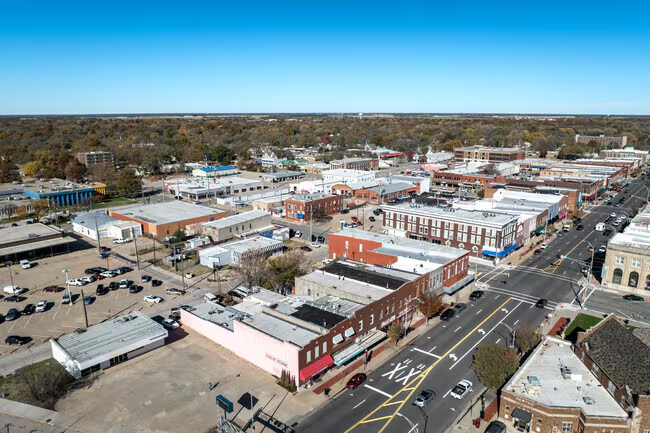
Newton was built by the railroad and still runs on it, with four other employment sectors layered on top
2026 Economic Outlook
- Wichita aviation manufacturing cycles continuing to influence north metro commuter demand
- Newton Medical Center anchoring regional healthcare employment for Harvey County
- BNSF freight volumes driving rail employment stability along the mainline
- Bethel College maintaining a steady small residential student and faculty population
- Downtown and Old Town revitalization supporting small business and residential conversion
Investment Climate
Newton is a straightforward cash flow market with an unusually resilient employment base for its size. The primary risks are not economic, they are physical, and they come down to two things: the age of the housing stock and the rail corridor.
On age, a large share of Newton homes were built between 1900 and 1970. Original electrical service, galvanized supply lines, and foundations that have moved through decades of expansive clay soil cycles are all common. Maintenance reserves that work in a newer suburb will not work here.
On the rail corridor, the BNSF mainline runs through the city and it is active around the clock. Proximity to the tracks materially affects rentability, tenant retention, and resale, and the effect is not uniform. A property three blocks from the line rents normally. A property backing onto it rents at a discount and turns over faster. Walk the block at night before you buy, because a daytime showing will not tell you what you need to know.
Successful Newton investors tend to share these characteristics:
- Rail proximity awareness understanding exactly how close a property sits to the mainline and pricing that into both rent and offer
- Realistic maintenance budgeting at 12 to 14 percent of rent rather than the standard 10, given the age of the stock
- Employer targeting marketing specifically to hospital, rail, college, and school district employees, who are the most stable tenants in the city
- Cash flow orientation buying for monthly income and accepting 3 to 4 percent appreciation
- Local relationships since Newton is a small, tight community where reputation and word of mouth genuinely determine deal flow
The reward is a market where an investor can acquire a cash flowing rental for $35,000 to $50,000 all in, backed by employment that does not evaporate, in a community with unusually long tenant tenure.
Historical Performance
| Period | Market Driver | Avg Annual Appreciation | Key Event |
|---|---|---|---|
| 2010-2014 | Slow recovery, aviation sector weakness | 0-2% | Wichita aviation downturn dampening regional demand |
| 2015-2019 | Aviation recovery, stable local employment | 2-4% | Steady absorption, minimal investor competition |
| 2020-2022 | Low rates, remote work, affordability migration | 9-14% | Out of area investors enter the market, inventory tightens |
| 2023-2024 | Rate shock, normalization | 2-4% | Days on market lengthen, renovation costs compress margins |
| 2025-2026 | Rate stabilization, steady employment base | 3-4% (projected) | Wichita metro pricing continuing to push commuters north on I-135 |
Newton’s long run appreciation sits in the 3 percent range, which is typical for a stable Kansas small market. The pandemic period was an outlier driven by out of area investor demand, and treating those years as a baseline is the most common underwriting error here. Model 3 percent and treat anything more as upside. What Newton lacks in appreciation it makes up in stability: values here did not collapse in 2008 the way they did in speculative markets, because there was never speculation to unwind.
Demographic Trends Driving Demand
- Wichita Commuter Migration – Households working in north Wichita and the aviation corridor choosing Newton for lower housing costs and small town life
- Rail Employment Stability – BNSF operations provide well paid, benefit backed employment that is not correlated with local economic conditions
- Regional Healthcare Concentration – Newton Medical Center draws clinical and support staff from across Harvey County and adjacent counties
- County Seat Consolidation – Residents of Halstead, Hesston, Burrton, and rural Harvey County relocating to Newton for services and employment
- Bethel College – A small residential campus in North Newton contributing steady student, faculty, and staff rental demand
- Limited New Construction – Very little new supply means existing rental inventory absorbs essentially all demand growth
📚 New to real estate investing? Master the fundamentals with our professional course Learn more →
2. Neighborhood Hotspots
Newton Investment Neighborhood Map
Interactive map of Newton’s investment areas and the surrounding Harvey County corridor. Green stars show top hotspots, blue circles mark established markets, and orange circles highlight emerging areas.
Core Investment Areas
Detailed Submarket Analysis: Newton and Harvey County
| Submarket | Price Range (SFH) | Cap Rate | Growth Drivers | Best Strategy |
|---|---|---|---|---|
| North Newton / Bethel | $150K-$260K | 5.5-6.2% | Bethel College, professional tenants, best condition | Long-term hold, faculty rental, lowest turnover |
| West Newton / Kansas Ave | $140K-$230K | 5.9-6.7% | Best condition to price, family demand, I-135 access | Value-add, family rental, commuter marketing |
| Medical Center Corridor | $135K-$215K | 6.0-6.8% | Hospital employment, professional tenant pool | Long-term hold, duplex, healthcare worker focus |
| Historic Downtown / Old Town | $85K-$165K | 6.5-7.5% | Railroad era architecture, walkability, low entry | Value-add, BRRRR, historic renovation |
| East Newton | $95K-$170K | 6.5-7.4% | Established neighborhoods, moderate pricing | Cash flow, value-add, check track distance |
| South Newton / Rail Corridor | $65K-$135K | 7.2-8.5% | BNSF and industrial employment, lowest entry | Highest Newton yields, workforce housing, active management |
| Hesston | $150K-$260K | 5.4-6.2% | Hesston College, ag manufacturing, strong wages | Stable hold, professional tenants, verify storm history |
| Halstead | $85K-$165K | 6.5-7.8% | Hospital employment, quiet river town character | Cash flow hold, small tenant pool, longer vacancy |
| Sedgwick | $70K-$145K | 6.8-8.2% | Dual commute to Newton and Wichita, low entry | High yield hold, commuter workforce housing |
| Burrton / Peabody | $40K-$110K | 7.5-9.5% | Agricultural base, very low acquisition cost | Highest yields, very thin market, long holds only |
Expert Insight: “Newton is one of the few Kansas towns under twenty thousand people where I do not worry about a single employer walking away, because there is no single employer. Rail, hospital, college, schools, county, manufacturing. That diversity is worth more than a point of cap rate to me. But there is one thing about Newton that nobody puts in a listing, and it is the tracks. The BNSF mainline runs right through this town and it runs all night. I have watched out of area investors buy a house on a Saturday afternoon showing, get it rented, and then deal with turnover every ten months because the tenant did not know what they were signing up for. Drive the block at eleven at night before you write the offer. If you can hear it, price it into your rent and your purchase, and it can still be a fine deal. Just do not find out afterward.” – Mark Richardson, Principal, Kansas Investment Properties
3. Property Types
| Investment Goal | Best Property Type | Best Areas | Minimum Capital |
|---|---|---|---|
| Maximum Cash Flow | Duplex or workforce single-family | Downtown, South Newton, Medical Center corridor | $28,000+ |
| Lowest Turnover | College area or hospital corridor single-family | North Newton, Medical Center corridor | $52,000+ |
| Balanced Returns | Mid century single-family with light renovation | West Newton, Kansas Avenue corridor | $45,000+ |
| Best Appreciation | Newer west side or commuter corridor homes | West Newton, Hesston, Valley Center | $55,000+ |
Don’t guess the costs. Our Complete Renovation & Remodeling Cost Guide covers 400+ pages of project-by-project breakdowns with real contractor pricing ranges.
4. Cost Analysis
Acquisition Cost Breakdown (Newton)
| Expense Item | Typical Cost | Example ($145,000 Property) | Notes |
|---|---|---|---|
| Down Payment | 25% (investment) | $36,250 | Standard conventional investment property requirement |
| Closing Costs | 2-3% of price | $2,900-$4,350 | Kansas has no state real estate transfer tax |
| General Inspection | $350-$600 | $450 | Non-negotiable given the age of Newton housing stock |
| Sewer Scope | $200-$400 | $275 | Essential on pre-1960 homes. Clay lateral failure is common. |
| Electrical Evaluation | $150-$400 | $250 | Knob and tube or 60 amp service will affect insurability |
| Roof Inspection | $150-$350 | $225 | South central Kansas hail exposure. Roof age drives insurability. |
| Initial Repairs | 5-25% of price | $7,250-$36,250 | Highly variable. Historic district properties need the most. |
| Reserves (6 months) | 6 months expenses | $5,000-$7,000 | Include a full wind and hail deductible |
| TOTAL MINIMUM ENTRY | ~31-35% of value | $45,250-$48,800 | Before renovation budget |
Sample Cash Flow Analysis: West Newton 3BR Single-Family
| Item | Monthly | Annual | Notes |
|---|---|---|---|
| Gross Rent | $1,200 | $14,400 | 3BR/2BA mid century ranch, updated, three blocks from the tracks |
| Less Vacancy (7%) | -$84 | -$1,008 | Newton tenure is long, so this is conservative |
| Property Taxes | -$195 | -$2,340 | 11.5% assessment ratio at roughly 145 mills. Verify the parcel. |
| Insurance | -$150 | -$1,800 | Landlord policy. South central Kansas hail and tornado exposure. |
| Property Management (10%) | -$120 | -$1,440 | Wichita based managers do serve Newton, which helps |
| Maintenance + CapEx (13%) | -$156 | -$1,872 | Elevated for older stock. Do not use the standard 10 percent here. |
| Net Operating Income | $495 | $5,940 | Before mortgage |
| Mortgage ($145K, 25% down, 6.75%, 30yr) | -$705 | -$8,460 | Principal and interest only |
| CASH FLOW | -$210 | -$2,520 | Negative at 25% down with full management and honest reserves |
| Cap Rate | 4.10% | NOI divided by purchase price | |
| Gross Yield | 9.93% | Rent divided by price. This is what listing sites quote. | |
| Total Return (3.5% appreciation) | ~9% | Appreciation plus principal paydown less negative carry, on cash invested |
This is deliberately the pessimistic case, and it is the version nobody publishes. A property showing a 9.9 percent gross yield still runs negative at 25 percent down once you pay a manager and reserve honestly for a sixty year old house. That is not an argument against Newton. It is an argument against underwriting on gross yield.
Here is how Newton investors actually make it work. Self managing adds back $1,440 annually and brings this property to roughly breakeven. Buying at the lower end is the single biggest lever: the same $1,200 rent against a $110,000 purchase instead of $145,000 produces roughly $170 per month positive. A duplex at $185,000 renting two units at $825 carries one tax bill and one insurance policy and typically clears $250 to $400 monthly positive. Thirty five percent down reduces annual debt service by about $1,700 and gets you to genuinely positive. The winning Newton formula is usually a duplex or a well bought single family under $120,000, in North or West Newton, marketed directly to hospital and rail employees.
Expert Insight: “The Newton advantage that investors underuse is tenant tenure. This is a town where people stay. Mennonite community roots, multigenerational families, rail employees with thirty year careers, hospital staff who are not going anywhere. If you place a good tenant in a decent Newton house you may not see a turnover for five or six years, and turnover is where small market landlords actually lose money. Two months vacant plus a make ready wipes out a year of cash flow. So my advice in Newton is to underprice rent slightly, screen hard, treat the tenant well, and let low turnover do the work. The pro forma looks worse and the actual return looks better.” – Sarah Whitfield, CRE Advisor, Johnson County Property Group
5. Legal Framework
⚠️ Kansas Compliance Notice
Kansas is a landlord friendly state, but that does not make requirements optional. The Kansas Residential Landlord and Tenant Act sets specific notice periods, deposit limits, and return deadlines, and failure to follow them will lose you an eviction case regardless of how clearly the tenant breached. Note also that North Newton is a separately incorporated city with its own governance, so requirements there may differ from Newton proper. Municipal rules are set locally and change, so confirm current rental and zoning requirements with the correct city before you close. This guide is an overview, not legal advice. Consult a Kansas licensed real estate attorney.
Kansas Landlord-Tenant Framework
Newton operates under the Kansas Residential Landlord and Tenant Act, found at KSA 58-2540 and following. The key provisions:
- Security Deposit Limits: Maximum of one month’s rent for an unfurnished unit and one and a half months for a furnished unit, plus up to an additional half month specifically for pets.
- Deposit Return: The landlord must determine deductions and return the balance within fourteen days of that determination, and in no case more than thirty days after termination of the tenancy.
- Nonpayment of Rent: A three day notice to pay or vacate. One of the shortest notice periods in the country.
- Lease Violations: Written notice specifying the breach, giving fourteen days to remedy, with termination in thirty days if not cured.
- Month to Month Termination: Thirty days written notice from either party.
- No Rent Control: Kansas statute prohibits municipalities from enacting rent control.
- No Just Cause Requirement: A landlord may decline to renew at expiration without stating a reason, subject to fair housing law.
- Entry: Reasonable notice and reasonable times, except in emergency.
Newton and Harvey County Practicalities
Beyond state law, these local items materially affect Newton operations:
- Two Separate Cities: North Newton is its own incorporated municipality with separate governance from Newton. Confirm which jurisdiction a property sits in before assuming any local requirement applies.
- Rail Corridor Considerations: Properties adjacent to BNSF right of way may face setback, drainage, or crossing access issues. Verify the property line relative to railroad easements.
- Property Tax Structure: Kansas assesses residential property at 11.5 percent of appraised value, then applies the local mill levy. Harvey County’s rate is high but applies to low values, so dollar amounts stay manageable.
- Annual Valuation Notices: The Harvey County Appraiser mails notices each spring with a limited appeal window.
- Storm Shelter Expectations: This is tornado country and the region has a documented history of destructive events. Basement access or a shelter materially affects rentability and is often the first question a family tenant asks.
- City Rental Requirements: Registration, inspection, and occupancy rules are set at the municipal level in Kansas. Verify current City of Newton requirements before closing.
- No Transfer Tax: Kansas imposes no state real estate transfer tax, reducing costs on both acquisition and exit.
Useful Kansas Resources
- Kansas Residential Landlord and Tenant Act: KSA 58-2540 et seq.
- Harvey County Appraiser: parcel values and appeal process
- Harvey County District Court: forcible detainer filings
- City of Newton: zoning, permits, and rental requirements
- City of North Newton: separate municipal requirements
| Regulation | Kansas Requirement | Typical Tenant Protective State | Investor Impact |
|---|---|---|---|
| Nonpayment Notice | 3 days to pay or vacate | 14 to 30 days | Delinquency resolves quickly, limiting loss exposure |
| Eviction Timeline | Typically 3 to 6 weeks total | 2 to 6 months | Materially lower carrying cost on a problem tenancy |
| Just Cause to Terminate | Not required | Required in many jurisdictions | Full flexibility at lease expiration |
| Rent Control | Prohibited statewide by statute | Permitted or mandated locally | Rents reset freely to market |
| Security Deposit | 1 month unfurnished, plus 0.5 month for pets | Often capped at 1 month with no pet allowance | Pet deposit flexibility matters in a market with high pet ownership |
| Municipal Jurisdiction | Newton and North Newton are separate cities | Usually a single municipal authority | Confirm which city rules apply to your specific parcel |
6. Step-by-Step Newton Investment Playbook
Define Your Newton Strategy
Newton supports four distinct approaches. Choose before you look at listings, because rail proximity tolerance, renovation capability, and capital requirement differ substantially between them.
Small Multi-Family Cash Flow
Acquire duplexes and small multi family, ideally under $200,000. One tax bill and one insurance policy against two or more rents is the most reliable path to positive monthly income in Newton.
Institutional Employer Focus
Buy near the hospital and Bethel College and market directly to those employers. Lower yields but the longest tenancies in the market, which is where small market returns are actually won or lost.
Historic Value-Add
Buy pre-1940 railroad era stock downtown, modernize systems while preserving character. Newton’s architecture supports rents well above what the purchase price suggests once the work is done.
Wichita Commuter Rental
Buy newer west side homes and market to households working in north Wichita and the aviation corridor. Higher income tenants, better condition stock, and a demand driver independent of Newton’s own economy.
Build Your Newton Team
Newton benefits from Wichita proximity, so the professional bench is deeper than in an isolated small market. But the people who genuinely know Newton are local, and in a community this tight, relationships determine deal flow.
- Local Harvey County Agent: Must know rail proximity block by block, which historic properties have had system updates, and the difference between Newton and North Newton jurisdiction.
- Independent Insurance Agent: South central Kansas hail and tornado exposure makes carrier selection matter enormously. Premium spread on identical properties is often 30 percent or more.
- Contractor with Old House Experience: Newton’s stock demands someone who has replaced a service panel in a 1910 house. A new construction framer is the wrong hire here.
- Property Manager: Several Wichita based managers serve Newton, which is a genuine advantage over more remote Kansas markets. Confirm current Newton door count.
- Kansas Real Estate Attorney: For entity formation, lease review under KSA 58-2540, and Harvey County eviction filings.
- Real Estate CPA: For depreciation planning, entity structuring, and Harvey County valuation appeals.
Expert Tip: Ask any prospective Newton agent one question: “How close is this property to the BNSF mainline, and how does that affect what it rents for?” A genuinely local agent answers immediately with specifics. Anyone who dismisses the question does not understand what drives turnover in this market.
Newton-Specific Due Diligence
Standard inspection items plus these Newton critical checks. The first item on the left column is the one out of area investors skip and regret.
Physical Due Diligence
- Visit the property at night. Rail traffic runs around the clock and a daytime showing will not tell you what a tenant experiences.
- Electrical service size and type. Knob and tube or 60 amp service affects safety and insurability.
- Sewer lateral scope. Clay line failure is common in pre-1960 Newton homes.
- Foundation evaluation for expansive clay soil movement over many decades
- Roof age, material, and hail history before you request an insurance quote
- Plumbing supply material. Galvanized lines will need replacement.
- Basement access or storm shelter. Family tenants ask about this first in tornado country.
Financial and Regulatory Due Diligence
- Pull the actual parcel tax bill from the Harvey County Appraiser
- Confirm whether the parcel is in Newton or North Newton, since requirements differ
- Obtain a binding insurance quote, not an estimate, during your inspection period
- Verify the property line relative to BNSF right of way and any rail easements
- Verify current municipal rental registration or inspection requirements
- Pull permit history for additions, basement finishes, and unit conversions
- Confirm zoning if you intend a duplex conversion or upper floor residential use
Competing in Newton’s Market
Newton has thin inventory and a small pool of serious buyers. Competition is milder than the Wichita metro, but good properties still move and reputation matters more than price.
- Be the buyer who closes: In a community this size, reputation travels fast. Agents route deals to investors who perform, and one failed closing will follow you for years.
- Buy the rail adjacent properties others avoid, but only knowingly: Track proximity trades at a real discount. If the numbers work with honest turnover assumptions and slightly below market rent, that discount is opportunity.
- Target tired landlords: Newton has long-term local owners with small portfolios reaching retirement. Direct outreach to owners of record on multiple parcels is productive here.
- Work the surrounding towns: Halstead, Sedgwick, Burrton, and Peabody have almost no investor competition. Yields are higher and so is liquidity risk.
- Use local financing for speed: Harvey County community banks close quickly and understand these properties better than a national underwriting model does.
- Buy in winter: Newton listing activity drops sharply between November and February, and sellers who list then generally need to sell.
Property Management in Newton
Kansas gives landlords substantial legal latitude, so the differentiator in Newton is tenant retention rather than regulatory compliance. Turnover is the single largest destroyer of returns in a market with rents this size.
Tenant Screening Protocol
Newton’s tenant pool divides into four groups worth understanding before you set criteria:
- Hospital and college employees, the most stable group, concentrated in North and West Newton
- BNSF rail employees, well paid with benefits, but subject to transfer along the network
- Wichita commuters, generally higher income, drawn to newer west side housing
- Local workforce and service employment, the largest group with the most turnover
- Screen for income at three times monthly rent, verified through pay stubs or direct employer contact
- Verify two years of rental history with direct prior landlord contact, not application references
- Apply written criteria consistently to every applicant to satisfy federal fair housing obligations
- Take the full permitted deposit including the additional half month for pets, since Kansas allows it
Typical Harvey County Management Fees
- Single-family management: 9-12% of monthly rent
- Multi-family management: 8-10% of monthly rent
- Leasing fee: 50-100% of one month’s rent
- Lease renewal fee: $100-$250 per renewal
- Minimum monthly fee: Common in small markets, often $85-$125, which matters on a low rent unit
7. Financing Options for Newton
| Loan Type | Down Payment | Rate Premium | Best For | Newton Note |
|---|---|---|---|---|
| Local Community Bank | 20-25% | +0.5-1.25% | Most Newton investors | Usually the best option. Harvey County banks understand these properties. |
| Conventional Investment | 25% | +0.5-0.75% | Documented income, good credit | Many lenders set minimums that exclude sub-$100K Newton properties |
| House Hacking (FHA) | 3.5% | Standard + MIP | Owner occupying one unit of a 2-4 unit property | Newton has real duplex inventory, making this genuinely viable |
| USDA Rural Development | 0% | Standard + fee | Owner occupants in eligible areas | Check by address. Surrounding Harvey County towns often qualify. |
| DSCR Loan | 20-25% | +1-2% | Investors avoiding income documentation | Works better here than in Johnson County, but watch loan minimums |
| Cash | 100% | N/A | Sub-$110K acquisitions | Common at Newton price points. Refinance later once seasoned. |
| Renovation Loan (203k / HomeStyle) | 3.5-25% | +0.5-1.5% | Historic downtown rehabs | Genuinely useful given how much Newton stock needs system work |
Newton Financing Reality: The binding constraint in Newton is loan size, not qualifying. Many national lenders will not write a mortgage below $75,000 or $100,000, which excludes a meaningful share of Newton inventory. That is why Harvey County community banks and credit unions dominate lending here. They write smaller loans, they understand a century old house near the tracks, and they close faster than a national underwriting desk. Wichita proximity also means you have access to a deeper lender pool than most Kansas small markets. Build the banking relationship before you find the deal.
8. Frequently Asked Questions

Knowledge Quiz: Newton Real Estate Investment
Open Quiz
5 quick questions on what you just learned about Newton investing
1) What does the guide identify as Newton’s core structural advantage over most Kansas towns its size?
Answer: C
Newton has BNSF rail operations, Newton Medical Center, Bethel College, USD 373 and county government, and a manufacturing base, none of which depends on the others. That diversity at 19,000 people is genuinely uncommon and is why Newton holds value through downturns better than single employer Kansas towns.
2) What does the guide recommend doing before writing an offer on any Newton property?
Answer: B
The BNSF mainline runs through Newton and operates around the clock. Rail proximity materially affects rent, turnover, and resale, and a daytime showing will not reveal what a tenant actually experiences. The effect diminishes sharply with distance, so three or four blocks away is generally a non-issue.
3) How long is the Kansas notice period for nonpayment of rent?
Answer: A
Kansas requires only a three day notice to pay or vacate under KSA 58-2564, one of the shortest periods in the country. Combined with no just cause requirement and a statutory prohibition on rent control, this makes Kansas among the most landlord friendly states. The most common reason landlords lose is a defective notice.
4) How should investors think about Bethel College as a rental demand driver?
Answer: D
Bethel is a small private liberal arts college with enrollment in the hundreds, not a state university. Per bedroom student leasing economics do not translate at that scale. What Bethel does provide is faculty and staff households who rent whole houses for years, giving North Newton the longest tenancies in Harvey County.
5) Why does the guide emphasize tenant retention so heavily in Newton?
Answer: C
With rents around $1,200 and net operating income near $500 per month, an extended vacancy plus turnover costs can erase a year of returns. Newton’s advantage is that households here tend to stay, so the guide recommends pricing rent slightly below market, screening hard, and letting low turnover do the work.
Work With a Local Expert in Newton
We are building a verified network of real estate professionals across every market we cover.

About Our Expert Network
We are finalizing partnerships with verified real estate professionals across every market featured on Builds and Buys. Each expert in our network is selected for their hands-on investment experience, local market knowledge, and commitment to helping buyers and investors make sound decisions.
Our local specialists offer:
- Proven experience with investment and income-producing properties
- Deep knowledge of local pricing, rental yields, and neighborhood dynamics
- Guidance on financing, legal structure, and due diligence
- Access to off-market and pre-market opportunities
- Full transaction support from search through closing
- Ongoing portfolio and property management referrals
Services Covered
- Property sourcing and acquisition
- Investment analysis and underwriting
- Buyer representation
- Market comparables and valuations
- Short-term and long-term rental strategy
- Value-add and renovation guidance
- Legal and title referrals
- Financing and lender connections
- Property management referrals
- Insurance and inspection referrals
- 1031 exchange coordination
- Exit strategy planning
Get Connected or Join Our Network
Looking for a local expert to help with your investment? Reach out and we will connect you with the right professional for your market and strategy.
Are you a real estate professional with a track record working with investors? We are always expanding our network of verified local experts.
Contact us at support@buildsandbuys.com
Find Specialized Newton Real Estate Professionals
Ready to Invest in Newton?
Newton is one of the more genuinely investable small markets in Kansas, and the reason is boring in the best way: five independent employment sectors, tenants who stay for years, and entry prices that make a real portfolio achievable. It rewards investors who check rail proximity honestly, reserve properly for century old housing, and understand that in a market with $1,200 rents, keeping a good tenant for six years matters more than squeezing another fifty dollars out of the lease. It will not appreciate like Johnson County. It pays you steadily instead, and it keeps paying when other small Kansas markets stumble.
Continue Your Research
Kansas State Guide
See how Newton compares to Wichita, Topeka, Lawrence, and every other Kansas market.
Wichita Guide
The regional anchor 25 miles south, and Newton’s natural portfolio pairing for scale.
144-Lesson Course
University-level real estate education covering financing, law, strategy, and management.
For further guidance, explore our State-by-State Investor guides, browse our expert articles, or follow our Step-by-Step Investment Guide.



