Independence Real Estate Investment Guide For 2026
A comprehensive resource for investors weighing a Montgomery County seat where aircraft are built, a Pulitzer winning playwright grew up, oil boom era housing sells for less than a used car, and the hospital closed in 2015
Quick answers: Top 5 most searched Independence investment questions ▼
Migration data: Where people are moving from to Independence ▼
In This Guide
Click on any section to navigate directly to that content
1. Independence Market Overview
Market Fundamentals
Independence is the seat of Montgomery County in southeast Kansas, twenty miles northwest of Coffeyville and about twenty miles north of the Oklahoma line. It was an oil boom town in the early twentieth century and the housing stock still shows it: substantial early twentieth century homes in and around the historic core, built when this was a genuinely prosperous place. Today it has roughly 8,300 residents, a county courthouse, a community college, and something almost no Kansas town this size has, which is an aircraft manufacturing plant.
Key economic indicators that define the Independence investment case:
- Population: approximately 8,300, down from a mid century peak above 12,000
- Major Employers: aircraft manufacturing at the Independence plant, Montgomery County government and the courthouse, Independence USD 446, Independence Community College, local healthcare and social services, and the retail and service sector
- Median Household Income: roughly $45,000, modestly above Coffeyville
- Median Home Price: approximately $85,000
- Vacancy Rate: approximately 8 to 10 percent
- Median Age: approximately 41
Four features define this market. It is a declining city, gently rather than steeply, and should be underwritten for income rather than growth. It is the county seat, which means courthouse employment and a district court that sits here. It has aircraft manufacturing, which pays well and is genuinely more cyclical than the refining or food processing that anchors comparable towns. And its hospital closed in 2015, with healthcare provided at reduced scale since, which is a real economic loss and something any investor should verify the current position on.
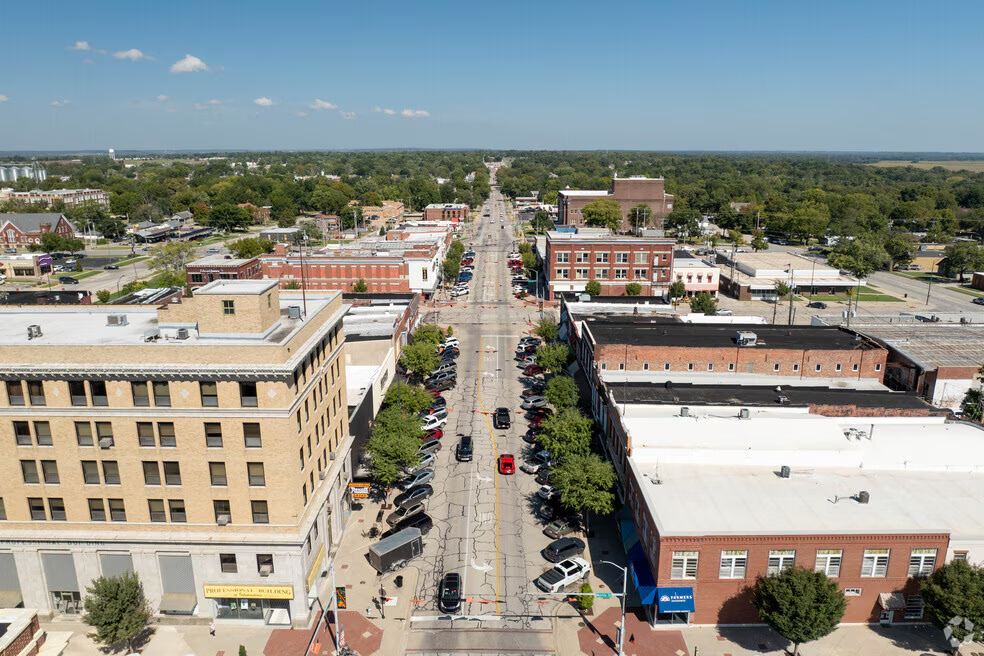
Independence combines oil boom era housing stock with an unusually varied employment base for a town this size
2026 Economic Outlook
- Aircraft manufacturing remaining the highest wage private employer, with the cyclicality that industry carries
- County seat functions providing stable public sector employment that Coffeyville lacks
- Independence Community College anchoring a student, faculty, and staff rental component
- Healthcare provision at reduced scale following the 2015 hospital closure. Verify current facilities.
- Continued gradual population decline across the city and Montgomery County
- Cultural assets including the William Inge Theatre Festival and Neewollah supporting a modest visitor economy
Investment Climate
Independence suits an investor who wants monthly income and is willing to take on a larger renovation to get it. Successful investors here tend to share these characteristics:
- An income only thesis, because this is a declining market and appreciation of 1.5 percent will not do any work for you
- Willingness to renovate properly, since the best opportunity here is early twentieth century housing that needs a full mechanical and electrical scope
- Cash or a southeast Kansas community bank relationship, as much of this inventory sits near or below mainstream loan minimums
- Insurance literacy on older stock, because knob and tube wiring is common here and some carriers decline it outright
- Street level knowledge, since block by block variation in southeast Kansas is wide and city averages mislead
- Realistic exit expectations, as the buyer pool in a shrinking county is thin
The advantage is absolute monthly income. The sample deal here, a fully renovated 1910s four bedroom, produces $203 a month self managed and $90 with a manager taking ten percent, which is the second strongest managed figure in this entire Kansas series behind only Pittsburg. Independence also has a more varied employment base than most southeast Kansas towns, combining skilled manufacturing, county government, and a community college, which spreads your tenant risk across genuinely different sectors.
The costs are worth stating plainly. That income requires $54,000 of capital against Coffeyville’s $39,000, and because the extra money buys income rather than growth, total return drops to 8.7 percent rather than rising. Aircraft manufacturing is more cyclical than the industries anchoring comparable towns. The hospital closure in 2015 removed a substantial employer and a service that affects who chooses to live here, particularly older households. And this remains a declining city in a declining county. Independence rewards a specific plan executed carefully. It does not reward optimism.
Historical Performance
| Period | Market Driver | Avg Annual Appreciation | Key Event |
|---|---|---|---|
| 1960-2000 | Long post oil contraction | Well below inflation | Population drifts down from a mid century peak as the regional economy restructures |
| 1996-2008 | Aviation manufacturing arrives and expands | 1-3% | The aircraft plant establishes a skilled manufacturing wage base unusual for a town this size |
| 2009-2014 | General aviation downturn | Flat to negative | The financial crisis hits general aviation demand hard, demonstrating this industry’s cyclicality directly |
| 2015 | Hospital closure | Negative locally | Mercy Hospital Independence closes, removing a major employer and a regional service |
| 2020-2026 | National repricing, then normalization | 1-2% (projected) | Prices move off a very low base during the rate cycle, then structural decline resumes |
Over a 20 year window Independence has produced roughly 1 to 2 percent average annual appreciation, in line with Coffeyville and at the bottom of this Kansas series. A $62,000 house purchased in 2006 is worth roughly $82,000 to $92,000 today, which after inflation is close to flat in real terms. Two rows deserve attention. The 2009 to 2014 period is the clearest evidence available of what aviation cyclicality does to a town this dependent on it, and it was worse than what refining or food processing towns experienced in the same years. The 2015 row is the hospital, and it matters both as an employment loss and because healthcare access shapes who is willing to live somewhere, particularly older households in a market whose median age is already 41.
What Actually Drives Demand Here
- Aircraft Manufacturing – The highest wage private employment in the county, and a genuinely unusual asset for a town of 8,300, with the cyclicality general aviation carries
- County Seat Functions – Courthouse, district court, and county administration providing stable public sector employment
- Independence Community College – Students, faculty, and staff supporting a distinct rental submarket in the north of the city
- Independence USD 446 – A reliable local employer as in every Kansas town
- Oil Boom Era Housing Stock – Substantial early twentieth century homes at prices that make full renovation arithmetic work, which is the core opportunity here
- Cultural and Recreational Assets – The William Inge Theatre Festival, Neewollah each October, Riverside Park and the Ralph Mitchell Zoo, and Elk City Lake northwest of town
📚 New to real estate investing? Master the fundamentals with our professional course Learn more →
2. Neighborhood Hotspots
Independence Investment Neighborhood Map
Interactive map of Independence and northern Montgomery County investment areas. Green stars show top hotspots, blue circles mark established markets, and orange circles highlight emerging areas.
Core Investment Neighborhoods
Detailed Submarket Analysis: Independence and Northern Montgomery County
| Area | Price Range | Cap Rate | Primary Tenant Pool | Best Strategy |
|---|---|---|---|---|
| East Independence / Verdigris ⚠️ | $30K-$70K | 11-14% on paper | Workforce | Verify flood zone first. The Verdigris flooded this region severely in 2007. |
| South Independence | $30K-$75K | 11-14% on paper | Workforce | Lowest local pricing, widest block variation, drive every street |
| Sycamore | $30K-$75K | 9-12% on paper | Very limited local | Minimal rental depth, extremely thin resale, long hold only |
| Elk City | $35K-$80K | 9-12% | Local, some recreational | Lake and state park proximity, minimal rental depth |
| Cherryvale | $40K-$90K | 9.5-12% | Local workforce | Small town hold, own school district, very thin resale |
| Downtown / Penn Avenue | $45K-$105K | 9.5-13% | Mixed, families in larger homes | Full historic renovation, largest houses per dollar in Kansas |
| Neodesha | $45K-$95K | 9.5-12% | Local, Independence commuters | Wilson County, own school district, very low entry |
| Central Independence | $60K-$110K | 9-12% | Mixed across all employers | Mid century value add, most predictable scopes |
| North / College Corridor | $65K-$120K | 9-11.5% | Students, faculty, staff, mixed | Mixed hold, hedge against aviation cyclicality |
| West / Aviation Corridor | $75K-$140K | 8-10% | Aircraft plant workforce | Best tenants locally, size the position for industry cyclicality |
| Riverside Park / Zoo District | $80K-$150K | 7.5-9.5% | Families, professionals | Family hold, park and zoo amenity, mature streets |
| Northwest / Country Club | $105K-$185K | 6.5-8% | Plant management, county officials | Premium hold, the only genuine resale liquidity in the county |
Expert Insight: “The old houses are the opportunity here and most people underestimate what they cost to bring back. These were built when there was oil money in this town, so you get four and five bedrooms and real square footage for sixty or seventy thousand dollars, and there is almost nothing else like that available in renovated condition, which is exactly why the rent holds up. But you are rewiring from knob and tube, you are repiping, and you are dealing with plaster. Budget thirty five thousand and mean it, because the person who budgets eighteen ends up with a half finished house they cannot rent or sell. The other thing I always say: get the insurance conversation done before you fall in love with one of these. Several carriers simply will not write knob and tube, and finding that out after your inspection is a bad afternoon.” – Marguerite Ellsworth, Investment Broker, Montgomery County Property Advisors
3. Property Types
| Investment Goal | Best Property Type | Best Neighborhoods | Minimum Capital |
|---|---|---|---|
| Most Monthly Income | Fully renovated pre 1940 four bedroom | Downtown, Penn Avenue, central Independence | $54,000+ |
| Lowest Capital Entry | Mid century value add, or a property in Cherryvale or Neodesha | Central Independence, Cherryvale, Neodesha | $32,000+ |
| Most Reliable Tenants | Aviation workforce or county government rental | West Independence, Riverside Park district | $46,000+ |
| Sector Diversification | Student and faculty rental near ICC | North Independence, college corridor | $40,000+ |
| Best Available Resale | Established home in the country club area | Northwest Independence | $58,000+ |
Don’t guess the costs. Our Complete Renovation & Remodeling Cost Guide covers 400+ pages of project-by-project breakdowns with real contractor pricing ranges.
4. Cost Analysis
Acquisition Cost Breakdown (Independence)
| Expense Item | Typical Cost | Example ($85,000 Property) | Notes |
|---|---|---|---|
| Down Payment | 20-25%, or 100% cash | $17,000-$21,250 | Low by the standards of this series. Note some inventory sits near or below mainstream loan minimums. |
| Wiring Type Confirmation | $0 | $0 | The defining Independence check on historic stock. Knob and tube is common here and several carriers decline it outright, which can stop a financed purchase. |
| Insurance Quote on the Actual Address | $0 | $0 | Ask specifically about wiring, roof age, and whether they write dwellings at this value. Do it before the inspection. |
| Flood Zone Determination | $0-$50 | $25 | Essential east toward the Verdigris. The river flooded this region severely in 2007. |
| Historic District Status Check | $0 | $0 | Free. Confirm with the city whether the parcel sits in any designated district, since that can affect exterior work approvals and timelines. |
| Closing Costs | 2-4% of price | $2,000-$3,400 | A higher percentage than larger markets because fixed costs do not scale down with price |
| General Inspection | $450-$700 | $550 | Higher on a large historic two story than on a mid century ranch. Non negotiable. |
| Electrical Assessment | $200-$450 | $300 | Get a full rewire quote on any pre 1940 house rather than an opinion. It is often the largest single line in the scope. |
| Sewer Lateral Scope | $200-$350 | $275 | Critical on century old property where clay laterals are the norm |
| Radon Test | $125-$200 | $150 | Kansas records high radon readings statewide. Mitigation runs $900-$2,000. |
| Foundation Evaluation | $0-$500 | $350 | Order readily on century old stone or brick foundations, which behave differently from poured concrete |
| Code Enforcement and Lien Check | $0 | $0 | Free, and relevant in a declining market where vacant property enforcement is active |
| Initial Repairs | 0-55% of price on historic stock | $0-$47,000 | The number that decides whether an Independence deal works. On a $68,000 historic house a proper scope is $34,000, half the purchase price. |
| Reserves (6 months) | 6 months plus a vacancy cushion | $7,000-$10,500 | Size for a 9% vacancy assumption and for aviation cyclicality |
| TOTAL MINIMUM ENTRY | ~31-90% of value | $26,300-$83,900 | Low entry, and a historic renovation deliberately pushes toward the upper end of that range |
The wiring question deserves its own paragraph because it stops more Independence deals than anything else. Knob and tube wiring is genuinely common in pre 1940 housing here, and a meaningful number of insurance carriers will not write a policy on a house that has it. Since a lender requires coverage, that turns an insurance problem into a financing problem and kills the purchase. Establish two things before you make an offer on any historic property: whether the house has been rewired, and if not, what a full rewire quote actually is. On a large two story that figure is frequently $10,000 to $16,000 and it is often the biggest single item in the scope. Get the number from an electrician, not an estimate from a listing agent. On tax, Montgomery County produces an effective rate around 1.9 to 2.1 percent, among the highest in this series, which is what funding county services on a shrinking valuation base requires.
Sample Cash Flow Analysis: Downtown Historic Four Bedroom
Deal structure: $68,000 purchase of a 1910s four bedroom two story near the historic core, outside the mapped flood plain, on a block confirmed by driving it. $34,000 renovation (full rewire from knob and tube, repipe, roof replacement, kitchen, two bathrooms, furnace and central air, plaster repair, durable flooring, paint, radon mitigation), $3,000 closing. Total basis $105,000. After repair value approximately $118,000. Rented at $1,125 per month. Independence USD 446.
| Item | Monthly | Annual | Notes |
|---|---|---|---|
| Gross Rent | $1,125 | $13,500 | 4BR fully renovated. Very little competing four bedroom supply in this condition. |
| Less Vacancy (9%) | -$101 | -$1,215 | A declining market with surplus housing, though slightly better than Coffeyville’s 10% |
| Property Taxes | -$197 | -$2,360 | ~2.0% effective on the post renovation value. 17% of gross rent. |
| Insurance | -$150 | -$1,800 | 13% of gross rent. Higher than mid century stock, and the full rewire is why it is not higher still. |
| Maintenance + CapEx (12%) | -$135 | -$1,620 | Elevated for a century old house with more square footage and more systems to maintain |
| Net Operating Income (self managed) | $542 | $6,505 | Before mortgage |
| Property Management (10%) | -$113 | -$1,350 | Priced at 10%, typical at these rent levels in southeast Kansas |
| Mortgage ($51,000 at 7.0%, 30yr, 25% down) | -$339 | -$4,068 | Principal and interest only, financed on the purchase price with renovation paid in cash |
| CASH FLOW (self managed, 25% down) | +$203 | +$2,436 | Beats Coffeyville’s $174 in absolute terms, on more capital |
| CASH FLOW (professionally managed, 25% down) | +$90 | +$1,080 | Second strongest managed figure in this Kansas series, behind only Pittsburg |
| CASH FLOW (all cash, $105,000 in) | +$542 | +$6,505 | 6.2% cash on cash with no debt, and no lender to satisfy on a century old house |
| Cap Rate | 6.2% self managed / 4.9% managed | NOI divided by total basis of $105,000 | |
| Total Return Year One (25% down, self managed) | ~8.7% | $2,436 cash flow plus $517 principal paydown plus 1.5% appreciation on $118,000, on $54,000 invested | |
| Immediate Forced Equity | $13,000 | $118,000 ARV less $105,000 total basis. Verify comparable sales, which are thin for renovated historic stock. |
Put this beside the Coffeyville guide and you get a lesson that applies well beyond Montgomery County. Independence produces $203 a month against Coffeyville’s $174, and $90 managed against $79. More income, both ways. And yet its total return is 8.7 percent against Coffeyville’s 10.0 percent, because it takes $54,000 to get there rather than $39,000. The extra $15,000 bought income, not growth, and in a market appreciating at 1.5 percent there is nothing else for it to buy. That is the trade in plain terms: if you are optimising percentage return on limited capital, the smaller Coffeyville deal wins. If you want the most dollars arriving each month and have the capital available, the Independence historic renovation wins. Neither answer is universally right, and an investor who does not know which one they are optimising for will pick badly.
Expert Insight: “People see the total return column and conclude the cheaper market is better, and that is not what those numbers say. Return on capital and dollars in your pocket are two different objectives and they frequently point in opposite directions. If you have forty thousand dollars, the smaller deal is clearly right for you. If you have a hundred thousand and you want it working rather than sitting, the historic renovation puts more money in your account every month even though the percentage looks worse. Decide which one you are solving for before you look at a single listing, because otherwise you will just be drawn to whichever number happens to be biggest on the page.” – Reid Callahan, CPA, Kansas Real Estate Advisory
5. Legal Framework
⚠️ Independence Compliance Notice
Kansas state landlord law applies uniformly statewide. Four Independence specific items need care. First, insurability of historic stock, since knob and tube wiring is common here and several carriers decline it outright, which can stop a financed purchase. Second, flood plain status east toward the Verdigris River, which flooded this region severely in 2007. Third, whether the parcel sits in a designated historic district, which can affect exterior work approvals. Fourth, code enforcement on vacant and deteriorated property, which is active in a declining market. Note that as the county seat, Independence is where Montgomery County District Court sits, which is a modest procedural convenience. This guide provides an overview as of 2026 only. Always confirm current requirements with a licensed Kansas real estate attorney before acquiring rental property.
Kansas Regulations and Local Considerations
The governing statute is the Kansas Residential Landlord and Tenant Act at K.S.A. 58-2540 and following:
- Nonpayment of Rent: 3 day written notice to pay or vacate, among the shortest notice periods in the country.
- Lease Violations: 14 day written notice to cure, with termination effective 30 days from notice if the breach is not remedied.
- Month to Month Termination: 30 days written notice by either party.
- Security Deposits: Capped at one month’s rent unfurnished, one and a half months furnished, plus an additional half month for pets. At a $1,125 rent that is a thin cushion on a large old house, so screening carries the weight.
- Landlord Entry: Reasonable notice required, generally interpreted as 24 hours, at reasonable times except in emergency.
- No Rent Control: Kansas law preempts municipal rent control.
- Court Venue: Montgomery County District Court sits in Independence as the county seat, which means your filings and hearings are local.
- Historic District Considerations: Verify with the city whether a parcel sits within any designated district, since exterior alterations can require review and add time to a renovation schedule.
- Insurability of Older Wiring: Not a statute but a practical constraint. Several carriers decline knob and tube, and lenders require coverage, so this becomes a financing barrier.
- Code Enforcement: Municipal enforcement on vacant and deteriorated property is active. Check for existing violations and liens before closing.
- Federal Lead Paint Rules: Mandatory disclosure on all pre 1978 housing, which is the overwhelming majority of this city and every property in the historic core.
Compliance Best Practices
Independence operating risk concentrates in the condition and insurability of older housing:
- Confirm Wiring Type and Get a Rewire Quote Before Offering. The defining Independence step on historic stock. Free to ask, and a full rewire on a large two story is frequently $10,000 to $16,000, which decides whether the deal works.
- Talk to an Insurance Agent Before an Inspector. Establish that a carrier will write the property given its wiring, roof age, and value. Discovering otherwise after paying for inspections is an avoidable loss.
- Pull the Flood Determination, particularly east toward the Verdigris. The 2007 flood was severe across this region.
- Check Historic District Status With the City. Free, and it affects what exterior work needs approval and how long it takes.
- Check Code Enforcement and Lien Status Before Closing. Free, and relevant where vacant property enforcement is active.
- Follow Lead Safe Renovation Practices. Every property in the historic core predates 1978, and lead safe work practices apply to disturbing painted surfaces.
- Use Written, Posted Screening Criteria Applied Identically, documented every time, since the deposit cap leaves little cushion.
- Document Condition Thoroughly at Move In. Photograph everything, which matters more on a century old house with plaster and original detail.
Useful Independence and Montgomery County Resources
- City of Independence: independenceks.gov
- Montgomery County Appraiser for parcel and valuation data
- Montgomery County District Court in Independence for eviction filings
- Montgomery County Register of Deeds for deeds, liens, and easements
- City of Independence building and code enforcement for permits, violations, and historic district status
- FEMA Flood Map Service Center for flood zone determination
- Kansas Statutes K.S.A. 58-2540 for the Residential Landlord and Tenant Act
| Factor | Independence | Coffeyville, 20 Miles Southeast | Investor Impact |
|---|---|---|---|
| County Seat Status | Yes. Courthouse, county administration, district court. | No | Stable public sector employment plus local court venue for filings |
| Anchor Industry | Aircraft manufacturing, higher wage and more cyclical | Refining and fertilizer, recession resistant | Better wages here, more volatility. Size the position accordingly. |
| Hospital | Closed in 2015, reduced scale services since. Verify current position. | Coffeyville Regional Medical Center operating | A genuine disadvantage here, both as employment and as a factor in who chooses to live where |
| Housing Stock | Substantial oil boom era homes, larger per dollar | More mid century, lower entry prices | Bigger renovation scopes here, and more rent when done properly |
| Higher Education | Independence Community College | Coffeyville Community College | Both offer a student and faculty rental component |
| Sample Deal Outcome | $203/mo on $54,000, 8.7% total return | $174/mo on $39,000, 10.0% total return | More dollars here, better percentage there. Know which you are optimising for. |
6. Step-by-Step Independence Investment Playbook
Define Your Independence Strategy
Every viable strategy here is an income strategy, and the first one is what makes this market distinctive:
Historic Full Renovation
Buy an oil boom era four or five bedroom, rewire and repipe it properly, and rent it to a family. The most monthly income available in Montgomery County, because there is very little competing large house supply in renovated condition.
Aviation Workforce Hold
Buy in west Independence and rent to the aircraft plant’s skilled workforce. The best tenants in the county on the best private wages, with genuine industry cyclicality to size around.
County and College Diversified Hold
Buy where tenants work for the courthouse, the school district, or the community college. Public sector and education employment that does not track the aviation cycle, which is the real hedge available in this market.
Montgomery County Pair
Own in both Independence and Coffeyville. Twenty miles apart, one running on aviation and county government and the other on refining, with the smaller Coffeyville deal giving you capital efficiency and the Independence renovation giving you monthly dollars.
Build Your Independence Team
The historic renovation strategy depends entirely on two people: an electrician and an insurance agent. Line both up first:
- Independent Insurance Agent, Contacted First: Establish which carriers will write a pre 1940 house at this value, and specifically what their position is on knob and tube. This determines what you can buy.
- Electrician Who Will Quote a Full Rewire: The single largest line in most historic scopes, frequently $10,000 to $16,000 on a large two story. Get a real number before you offer, not an estimate.
- Contractor Experienced With Century Old Houses: Plaster, balloon framing, and stone foundations behave differently from post war construction, and a contractor who only works on ranches will underbid and then discover why.
- Southeast Kansas Community Bank Lender: They will write loans at these sizes and understand historic stock in a way a national underwriter will not.
- Home Inspector Who Works on Older Property: Ask specifically about experience with pre 1940 houses.
- Property Manager Who Handles Larger Older Homes: Ask whether they take century old property, since some will not.
- Real Estate CPA: For depreciation, entity structure, and Montgomery County valuation appeals, which matter at a 2 percent tax rate.
Expert Tip: Ask the electrician for the rewire quote before you make an offer, not during your inspection period. Most sellers of vacant historic property will allow access for a quote if you ask, and that single number tells you more about whether the deal works than anything else you will learn. A house at $68,000 needing a $12,000 rewire is a workable deal. The same house needing $24,000 because of plaster access issues and a service upgrade is not, and those two houses look identical from the street. Get the number first and let it decide what you offer.
Independence Specific Due Diligence
Standard due diligence items plus these Independence critical checks:
Regulatory and Financial
- Carrier position on knob and tube, established before you search rather than after you offer. Several decline it, and lenders require coverage.
- Full rewire quote from an electrician, which is the number that decides most historic deals here.
- Flood zone determination, essential east toward the Verdigris.
- Historic district status confirmed with the city, since it affects exterior work approvals and timelines.
- Code enforcement and lien history, free and relevant in a declining market.
- Drive the street personally, since block variation in southeast Kansas is wide.
- Current valuation and appeal history, since a 2 percent rate makes over assessment expensive.
- Comparable sales for renovated historic stock, which are genuinely thin and will tighten a refinance appraisal.
Physical Due Diligence
- Wiring type throughout, not just at the panel. A house can have an updated panel and original knob and tube behind the walls, which is exactly the situation carriers care about.
- Foundation type and condition. Stone and brick foundations from this era behave differently from poured concrete and need someone who knows them.
- Sewer lateral scope, since clay laterals are the norm on century old property.
- Roof age, layer count, and structure, noting that a large two story roof is a bigger job than a ranch.
- Plaster condition throughout, which drives both cost and schedule and is easy to underestimate.
- Supply plumbing material, since galvanized steel corrodes closed from the inside.
- Radon testing on every property.
- Lead paint on every pre 1978 surface, which means every property in the historic core.
Sourcing Deals in Independence
There is no institutional competition here and inventory is not the constraint. Finding historic property that has already been rewired, or that can be economically, is. Channels that work:
- Target already rewired historic houses specifically. The most valuable thing you can find in this market. A pre 1940 house with modern wiring removes the insurance barrier, removes the largest renovation line, and most listings do not mention it. Ask on every property.
- Estate sales and inherited property. The primary source of historic stock here. An older population means a steady flow of family homes that heirs living elsewhere want resolved, often priced to move.
- Properties that failed on insurance. Extremely common with knob and tube, and these sellers are genuinely motivated. If you have the rewire budget ready, this is your advantage over every other buyer.
- Retiring landlords. The best source in any town this size. Portfolios move as blocks, often with tenants in place.
- Long vacant historic property, approached with discipline. Some of these are the best deals here and some are not economically repairable. Get the rewire and foundation numbers before you get attached.
- Community bank relationships. Local lenders know what is available, which blocks work, and will finance at sizes national programs decline.
Property Management in Independence
At $90 a month under a 10 percent fee, Independence holds up under professional management better than almost anything else in this series. That gives you a genuine choice:
Tenant Screening Protocol
Kansas caps your deposit at one month, which on a large century old house is a thin cushion. Apply written criteria identically to every applicant:
- Verifiable gross household income of at least 3 times monthly rent, counting all adult earners, which at $1,125 is a meaningful filter against a $45,000 median income
- Direct employer verification, noting that the aircraft plant, county government, the school district, and the community college are all straightforward to confirm
- Two prior landlord references, contacting the landlord before the current one
- Full credit and eviction records search, applied consistently to every applicant
- Written, posted criteria applied identically and documented every time
- Thorough photographic move in documentation, which matters more on a historic house with plaster and original detail that is expensive to restore
Typical Independence Management Fees
- Single family management: 9-11% of monthly rent
- Small multi-family management: 8-10% of monthly rent
- Leasing fee: 50-100% of one month’s rent
- Lease renewal fee: $75-$150 per renewal
- Flat fee management: $95-$130 per door per month, which at a $1,125 rent can beat a percentage
- Maintenance coordination markup: typically 10% on vendor invoices
- Ask whether they manage century old property, since the maintenance profile differs and some managers prefer post war stock. The good ones here know these houses well.
7. Financing Options for Independence
| Loan Type | Down Payment | Rate Premium | Best For | Independence Note |
|---|---|---|---|---|
| Local Portfolio / Community Bank | 20-30% | +0.5-2.0% | Historic property and anything at these loan sizes | Your first call. Southeast Kansas banks write $50,000 loans on century old houses that national programs decline outright. |
| Cash Purchase | 100% | None | Buyers of unrewired historic property | Solves the insurance barrier entirely, since no lender means no coverage requirement while you rewire. $105,000 all in produces $542 a month. |
| FHA 203(k) Renovation | 3.5% | Standard + MIP | Owner occupants restoring a historic home | Genuinely well matched here, since it finances purchase and renovation together, which is exactly the problem a $34,000 scope creates. Finding a willing lender takes effort. |
| HELOC on Existing Equity | N/A | Variable | Funding the renovation portion | Very practical here, because the $34,000 scope is where the money goes and purchase financing rarely covers it. |
| Conventional Investment | 25% | +0.5-0.75% | Purchases above the loan floor | Workable on west and northwest inventory. Expect difficulty on unrewired historic property because of the insurance requirement. |
| USDA Rural Development | 0% | Standard + guarantee fee | Owner occupants in eligible areas | Check eligibility maps for Cherryvale, Neodesha, Elk City, and rural Montgomery County. Income limits apply, owner occupied only. |
| Seller Financing | Negotiable | Negotiable | Inherited and long vacant historic property | Genuinely available here. Sellers of unrewired houses know how hard conventional financing is. Ask on every deal. |
| DSCR Loan | 20-25% | +1.5-2.5% | Generally not available here | Loan minimums plus reluctance to write in declining small markets means assume this route is closed. |
Independence Financing Reality: The financing question here is really the insurance question. A lender requires coverage, several carriers will not write knob and tube, and much of the best historic inventory has knob and tube, which means conventional financing on exactly the property you most want to buy is the hardest thing to arrange. Three routes get around it. Buy cash, rewire, then finance or refinance the completed house, which is the cleanest path and why so much historic property here trades for cash. Use a southeast Kansas community bank that will look at the property and your rewire plan rather than running it through a model. Or use FHA 203(k) if you will owner occupy, since it finances purchase and renovation together and directly solves the problem the $34,000 scope creates. Seller financing is also more available here than in most Kansas markets for the same underlying reason, so ask on every deal.
8. Frequently Asked Questions

Knowledge Quiz: Independence Real Estate Investment
Open Quiz
5 quick questions on what you just learned about Independence investing
1) What single check stops more Independence historic deals than anything else?
Answer: B
Knob and tube is common in pre 1940 housing here, and a meaningful number of carriers will not write a policy on a house that has it. Since a lender requires coverage, an insurance problem becomes a financing problem and the purchase dies. Establish carrier positions before you search, and get a full rewire quote, frequently $10,000 to $16,000 on a large two story, before you offer.
2) Why does Independence produce more monthly cash flow than Coffeyville but a lower total return?
Answer: D
Independence produces $203 a month self managed against Coffeyville’s $174, and $90 managed against $79. More dollars both ways. But it takes $54,000 to get there rather than $39,000, so total return falls to 8.7 percent against 10.0 percent. Return on capital and dollars in your pocket are different objectives that frequently point in opposite directions. Decide which you are solving for before you look at listings.
3) How does aircraft manufacturing compare to the refining and food processing anchoring other Kansas markets?
Answer: A
People eat beef and burn fuel through recessions. New aircraft get deferred hard when conditions tighten, by individuals and by businesses. The 2009 to 2014 general aviation downturn hit this town in a way that refining and food processing towns in this series did not experience in the same years. You get the best private wages in the county and genuine volatility. Do not put your whole Independence position in the aviation corridor.
4) What did Independence lose in 2015 that Coffeyville still has?
Answer: C
Mercy Hospital Independence closed in 2015. That matters twice: as a substantial employment loss in a town of 8,300, and because healthcare access shapes where people choose to live, particularly older households in a market whose median age is already 41. Verify the current healthcare position directly, since rural provision changes. Independence retains its county seat status, its community college, and its aircraft plant.
5) What is the correct renovation budget mindset on a $68,000 historic house here?
Answer: B
A proper scope on a century old four bedroom runs around $34,000, roughly half the purchase price. That ratio is uncomfortable and it is correct. The renovation is where the value is created, not the purchase: $68,000 plus $34,000 produces a $118,000 house renting for $1,125 because renovated four bedroom supply is genuinely scarce here. Half finished historic houses are the most common way to lose money in this market.
Work With a Local Expert in Independence
We are building a verified network of real estate professionals across every market we cover.

About Our Expert Network
We are finalizing partnerships with verified real estate professionals across every market featured on Builds and Buys. Each expert in our network is selected for their hands-on investment experience, local market knowledge, and commitment to helping buyers and investors make sound decisions.
Our local specialists offer:
- Proven experience with investment and income-producing properties
- Deep knowledge of local pricing, rental yields, and neighborhood dynamics
- Guidance on financing, legal structure, and due diligence
- Access to off-market and pre-market opportunities
- Full transaction support from search through closing
- Ongoing portfolio and property management referrals
Services Covered
- Property sourcing and acquisition
- Investment analysis and underwriting
- Buyer representation
- Market comparables and valuations
- Short-term and long-term rental strategy
- Value-add and renovation guidance
- Legal and title referrals
- Financing and lender connections
- Property management referrals
- Insurance and inspection referrals
- 1031 exchange coordination
- Exit strategy planning
Get Connected or Join Our Network
Looking for a local expert to help with your investment? Reach out and we will connect you with the right professional for your market and strategy.
Are you a real estate professional with a track record working with investors? We are always expanding our network of verified local experts.
Contact us at support@buildsandbuys.com
Find Specialized Independence Real Estate Professionals
Ready to Invest in Independence?
Independence produces the most monthly income in Montgomery County and a lower percentage return than the town twenty miles down the road, and both of those come from the same place. Oil money built four and five bedroom houses here a century ago and they now sell for sixty or seventy thousand dollars. Renovate one properly and it rents for $1,125 because almost nothing else that size exists in that condition, producing $203 a month self managed and $90 with a manager. Getting there takes $54,000 and a thirty four thousand dollar scope you cannot shortcut. Establish which carriers will write knob and tube before you look at a single house, get a full rewire quote before you offer, pull the flood determination, and drive the block. This is a declining city with an aircraft plant, a courthouse, a community college, and no hospital since 2015. Buy it for the rent cheque with your eyes open and it will pay you well.
Continue Your Research
Kansas State Guide
See how Independence compares to Wichita, Pittsburg, and other Kansas markets.
Coffeyville Guide
The other Montgomery County market twenty miles southeast, running on a refinery.
144-Lesson Course
University-level real estate education covering financing, law, strategy, and management.
For further guidance, explore our State-by-State Investor guides, browse our expert articles, or follow our Step-by-Step Investment Guide.