
Lenexa Real Estate Investment Guide For 2026
A comprehensive resource for investors looking to capitalize on the Johnson County city that built itself a downtown from scratch, where three school districts, a purpose built civic core, and one of the metro’s largest industrial corridors converge in a single small city
Quick answers: Top 5 most searched Lenexa investment questions ▼
Migration data: Where people are moving from to Lenexa ▼
In This Guide
Click on any section to navigate directly to that content
1. Lenexa Market Overview
Market Fundamentals
Lenexa occupies the geographic center of Johnson County, wedged between Overland Park to the east, Olathe to the south, and Shawnee to the north. That position is the whole story. Lenexa inherits characteristics from all three neighbors, prices between them, and adds two things none of them have: a deliberately constructed downtown and one of the largest industrial and logistics corridors in the Kansas City metro.
Key economic indicators that define the Lenexa investment case:
- Population: approximately 57,000
- Major Employers: the Lenexa industrial and logistics corridor along I-35 and Renner Boulevard, engineering and professional services firms, AdventHealth Lenexa City Center, the City of Lenexa, plus proximity to the Garmin campus and the Overland Park corporate corridors
- Median Household Income: roughly $100,000
- Median Home Price: approximately $395,000, between Olathe and Overland Park
- Vacancy Rate: approximately 4 to 5 percent
- School Districts: three separate districts serve different parts of the city
The three district split is the defining structural feature and the thing most out of state investors miss entirely. Shawnee Mission USD 512 serves the north and east, De Soto USD 232 serves the west, and Olathe USD 233 serves the south. All three are strong districts. All three carry different mill levies, which means your property tax rate varies within the same city. And the boundaries follow subdivision lines and historical annexation patterns rather than anything a map would suggest.
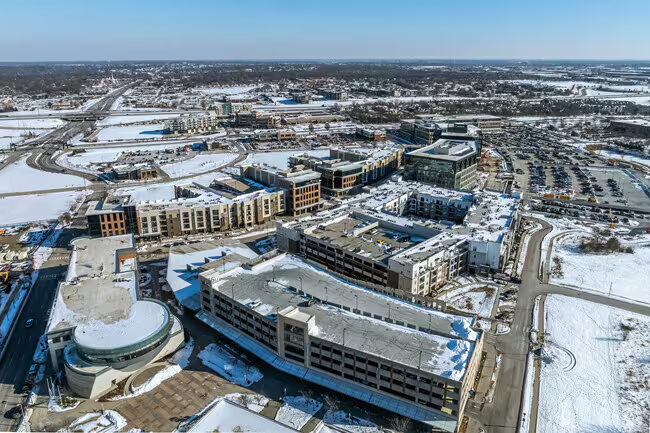
Lenexa is one of the few American suburbs of its size to deliberately build itself a walkable downtown
2026 Economic Outlook
- Lenexa City Center continuing to add residential, commercial, and civic density around the purpose built core
- The I-35 and Renner Boulevard industrial corridor remaining one of the metro’s primary logistics and distribution nodes
- Healthcare employment expanding around the AdventHealth Lenexa City Center campus
- Western Lenexa development continuing into the De Soto school district as land is absorbed
- Spillover effects from the major industrial project underway to the west in De Soto
- Old Town Lenexa maintaining its role as the city’s historic and festival anchor
Investment Climate
Lenexa is a middle of the road Johnson County market in the best sense. It does not have Overland Park’s prestige premium or Olathe’s depth of untouched inventory, but it sits between them on almost every metric and offers a couple of things that are genuinely distinctive. Successful Lenexa investors tend to share these characteristics:
- District boundary discipline because three districts in one small city means the parcel record is non negotiable before every offer
- Tenant profile awareness since Lenexa serves both professional households and industrial and logistics workers, and those groups want different properties
- Balanced expectations understanding this is a modest negative carry market at 25 percent down that turns positive just above 35 percent
- Renovation capability to work the eastern half’s 1970s through early 1990s inventory
- HOA discipline as Johnson County subdivisions frequently carry rental caps that can make a property unrentable
- Medium term horizons of seven to twelve years, since appreciation rather than cash flow drives most of the return
The market’s principal advantage is diversification of demand. Most Johnson County suburbs chase the same professional family tenant. Lenexa has that tenant plus a substantial industrial workforce, which means a well positioned three bedroom rental at an attainable price point has two separate pools competing for it. That shows up as low vacancy and fast lease up.
The principal limitation is that Lenexa lacks a single dominant identity. There is no Blue Valley equivalent driving a clear premium, no Garmin sized single employer, and no obvious headline. That makes the city easy to overlook and slightly harder to underwrite, since submarket variation matters more here than city level averages. It also means less investor competition, which is not a bad thing.
Historical Performance
| Period | Market Driver | Avg Annual Appreciation | Key Event |
|---|---|---|---|
| 2010-2014 | Post recession recovery, western subdivision buildout resumes | 3-5% | Johnson County recovers ahead of the national average |
| 2015-2019 | City Center construction, industrial corridor expansion | 5-8% | Lenexa City Center civic campus and public market open, reshaping the city’s identity |
| 2020-2022 | Remote work migration, record low inventory, cheap debt | 12-17% | Distribution and logistics demand surges, supporting the industrial corridor |
| 2023-2024 | Rate shock, inventory lock in, insurance repricing | 3-5% | Western Johnson County industrial investment announced, shifting the growth narrative west |
| 2025-2026 | Normalization, City Center maturation, western corridor growth | 5-7% (projected) | Attached housing around City Center and family homes in the De Soto district leading |
Over a 20 year window Lenexa has produced roughly 5.5 to 6.5 percent average annual appreciation, effectively tracking Overland Park and slightly ahead of Olathe. A $195,000 house purchased in 2006 is worth roughly $440,000 to $490,000 today. The distinctive feature of the Lenexa record is how much the City Center development changed the city’s trajectory. Before it, Lenexa was a well regarded but unremarkable suburb. Since it, the city has an identity and a walkable core that supports a rental submarket which simply did not exist here fifteen years ago.
Demographic Trends Driving Demand
- Three District Access – Families targeting Shawnee Mission, De Soto, or Olathe schools can all find a Lenexa address that works, which broadens the buyer and tenant pool considerably
- Industrial and Logistics Workforce – Skilled trades, distribution, and supervisory households creating steady demand for attainable three bedroom rentals
- Professional Households – Engineering, healthcare, and corporate workers drawn by the central location and short commutes in every direction
- City Center Urban Seekers – Professionals and downsizers wanting walkability and newer attached housing without leaving Johnson County
- Westward Family Migration – Move up buyers pushing into the De Soto district portion of west Lenexa for newer construction and larger lots
- Cross County Movement – Households relocating between Overland Park, Shawnee, and Olathe frequently landing in Lenexa as the price and location compromise
📚 New to real estate investing? Master the fundamentals with our professional course Learn more →
2. Neighborhood Hotspots
Lenexa Investment Neighborhood Map
Interactive map of Lenexa’s investment areas. Green stars show top hotspots, blue circles mark established markets, and orange circles highlight emerging areas from the older eastern half out to the growing western edge.
Core Investment Neighborhoods
Detailed Submarket Analysis: All Lenexa Areas
| Area | Price Range | Cap Rate | Typical School District | Best Strategy |
|---|---|---|---|---|
| Northeast / Quivira Corridor | $285K-$370K | 5.2-6.2% | Shawnee Mission | Value add, BRRRR, best available cash flow |
| Renner Blvd / Industrial Edge | $295K-$400K | 5.2-6.2% | Mixed, verify per parcel | Workforce rental, fast lease up, attainable entry |
| Rosehill / North Central | $300K-$425K | 5.0-5.9% | Shawnee Mission | Value add, balanced buy and hold |
| Sar-Ko-Par / Central | $310K-$440K | 5.0-5.9% | Shawnee Mission / De Soto | Renovation with park amenity, balanced returns |
| Old Town Lenexa | $270K-$450K | 4.9-5.9% | Shawnee Mission | Appreciation, historic renovation, walkable niche |
| Lenexa City Center | $300K-$525K | 4.7-5.7% | Mixed, verify per parcel | Attached housing, professional and downsizer rental |
| South Lenexa / 103rd Corridor | $330K-$480K | 4.7-5.6% | Olathe | Family rental, three city border, verify district |
| Canyon Creek | $375K-$540K | 4.6-5.4% | De Soto / Olathe | Established family rental, low friction hold |
| Black Hoof / Lake Lenexa | $370K-$540K | 4.6-5.5% | De Soto / Shawnee Mission | Amenity adjacency, renovation and appreciation |
| Clear Creek / West Central | $390K-$570K | 4.5-5.3% | De Soto | Balanced buy and hold, newer stock |
| Cedar Niles / Southwest | $400K-$650K | 4.4-5.2% | De Soto / Olathe | Western corridor positioning, verify boundaries |
| Falcon Valley / West Lenexa | $450K-$750K | 4.2-5.0% | De Soto | Premium family rental, appreciation hold |
| Prairie Star / Far West | $475K-$800K | 4.2-4.9% | De Soto | Newest construction, appreciation runway |
Expert Insight: “Lenexa is the city where I most often see investors buy the wrong side of a street. Three districts inside one small city means the parcel record is not optional here, it is the first thing you pull, before you even look at photos. I have watched a buyer underwrite rent based on De Soto district comps and then find out at closing that the house feeds Shawnee Mission. Both are excellent districts, but they are not interchangeable in a tenant’s mind and they carry different mill levies, so you got the wrong rent number and the wrong tax number at the same time. Fifteen minutes on the county site prevents all of it.” – Nathan Brill, Investment Broker, City Center Realty Advisors
3. Property Types
| Investment Goal | Best Property Type | Best Neighborhoods | Minimum Capital |
|---|---|---|---|
| Best Available Cash Flow | Renovated 1970s or 1980s single family | Quivira corridor, Renner Boulevard edge, Rosehill | $75,000+ |
| Best Total Return | Value add with full systems update | Quivira corridor, Sar-Ko-Par, Old Town fringe | $105,000+ |
| Maximum Appreciation | City Center attached or De Soto district family home | Lenexa City Center, Falcon Valley, Prairie Star | $130,000+ |
| Lowest Entry Cost | Townhome or condo, or FHA owner occupied entry | City Center, Quivira corridor, Renner Boulevard edge | $70,000+ |
| Fastest Lease Up | Attainable renovated 3BR near the industrial corridor | Renner Boulevard edge, southern Quivira corridor | $80,000+ |
Don’t guess the costs. Our Complete Renovation & Remodeling Cost Guide covers 400+ pages of project-by-project breakdowns with real contractor pricing ranges.
4. Cost Analysis
Acquisition Cost Breakdown (Lenexa)
| Expense Item | Typical Cost | Example ($395,000 Property) | Notes |
|---|---|---|---|
| Down Payment | 25% standard, 35%+ for positive carry | $98,750-$138,250 | 25% is modestly negative. Just above 35% turns most Lenexa deals positive. |
| Closing Costs | 2-3% of price | $7,900-$11,850 | Title, escrow, lender fees, recording. Kansas closings handled by title companies. |
| General Inspection | $425-$625 | $500 | Non negotiable on the eastern half’s older inventory |
| Radon Test | $125-$200 | $150 | Johnson County has among the highest radon readings in the country. Mitigation runs $900-$2,000. |
| Plumbing Material Identification | Included in inspection | $0 | Polybutylene is common across the late 1970s through early 1990s stock. Full repipe runs $6,000-$15,000. |
| Basement and Moisture Evaluation | Included or $200-$400 | $250 | Nearly universal here. Waterproofing and drainage remediation runs $5,000-$20,000. |
| Roof and Hail Damage Assessment | $0-$250 | $150 | The Kansas City metro takes regular hail. Roof age is the largest insurance variable. |
| Sewer Scope | $200-$350 | $250 | Essential in Old Town and the oldest northeast subdivisions |
| HOA Document Review | $0-$400 | $0-$400 | Rental caps are common across Johnson County. Critical on City Center attached product. |
| School District Verification | $0 | $0 | The single most important free step in Lenexa. Three districts, and the mill levy differs between them. |
| Initial Repairs | 0-16% of price | $0-$63,200 | Near zero on newer western stock, substantial on eastern 1970s and 1980s inventory |
| Reserves (6 months) | 6 months expenses plus negative carry | $13,000-$19,000 | Must cover a percentage based hail deductible and any negative carry |
| TOTAL MINIMUM ENTRY | ~31-61% of value | $120,700-$240,700 | The high end reflects a 35% down value add. Between Olathe and Overland Park, as with everything here. |
Property tax note, with a Lenexa specific wrinkle: Kansas assesses residential property at 11.5 percent of appraised value, and the combined Johnson County mill levy puts the effective rate at roughly 1.3 to 1.45 percent of market value. But in Lenexa the school district component of that levy differs depending on whether your property is in Shawnee Mission, De Soto, or Olathe. That means two comparable houses in the same city can carry meaningfully different annual tax bills. Pull the actual levy for the specific parcel rather than applying a city average, and remember the valuation resets to your purchase price on sale.
Sample Cash Flow Analysis: Northeast Lenexa 1980s Value Add
Deal structure: $300,000 purchase, $28,000 renovation (kitchen, two baths, flooring, paint, polybutylene repipe, heating and cooling replacement, radon mitigation), $7,500 closing. Total basis $335,500. After repair value approximately $378,000. Rented at $2,300 per month. Shawnee Mission district.
| Item | Monthly | Annual | Notes |
|---|---|---|---|
| Gross Rent | $2,300 | $27,600 | 3BR fully renovated, well above typical local rental condition |
| Less Vacancy (5%) | -$115 | -$1,380 | Two tenant pools competing for attainable renovated stock keeps vacancy low |
| Property Taxes | -$425 | -$5,100 | ~1.35% effective on the post renovation value. 18% of gross rent. Varies by district. |
| Insurance | -$208 | -$2,496 | Landlord policy on ~$385,000 replacement cost with a 2% wind and hail deductible |
| Maintenance + CapEx (9%) | -$207 | -$2,484 | Appropriate given the repipe and system replacements are already done |
| Net Operating Income (self managed) | $1,345 | $16,140 | Before mortgage |
| Property Management (8%) | -$184 | -$2,208 | Optional. Drops NOI to $1,161/month or $13,932/year. |
| Mortgage ($225,000 at 7.0%, 30yr, 25% down) | -$1,497 | -$17,964 | Principal and interest only |
| CASH FLOW (self managed, 25% down) | -$152 | -$1,824 | Modestly negative, between the Olathe and Overland Park equivalents |
| CASH FLOW (self managed, 35% down) | +$48 | +$576 | $195,000 loan at 7.0% is $1,297/month. Marginal but positive, so budget just above 35%. |
| Cap Rate | 4.8% self managed / 4.2% managed | NOI divided by total basis of $335,500 | |
| Total Return Year One (25% down, self managed) | ~22% | Negative $1,824 cash flow plus $2,281 principal paydown plus 6.2% appreciation on $378,000, on $110,500 invested | |
| Immediate Forced Equity | $42,500 | $378,000 ARV less $335,500 total basis, realized at refinance |
Lenexa lands almost exactly where its geography suggests. The Olathe equivalent runs $135 per month negative on $106,250 invested. This one runs $152 negative on $110,500. Overland Park runs $179 negative on $115,500. Three cities, same county, same schools tier, and a clean progression in both capital required and monthly carry. All three deliver total returns in the 21 to 22 percent range in year one because appreciation is doing the work in every case. What differs is how much capital you tie up to get there.
Expert Insight: “The thing I have to explain to nearly every out of state client about Lenexa is that there is no single property tax rate here. People pull a Johnson County average off a website, apply it to their pro forma, and are off by four or five hundred dollars a year because their parcel is in a different school district than they assumed. Three districts, three levies, one city. It is not a large error on a single property but it changes which deals clear your threshold, and over a portfolio it compounds. Pull the actual levy for the actual parcel. Every time.” – Reid Callahan, CPA, Kansas Real Estate Advisory
5. Legal Framework
⚠️ Lenexa Compliance Notice
Kansas state landlord law is moderately favorable and applies uniformly statewide. In Lenexa the two things that vary are private HOA covenants, which frequently cap or prohibit rentals, and your school district, which changes both your tax levy and your rent comparables depending on which part of the city you buy in. This guide provides an overview as of 2026 only. Always confirm current requirements with a licensed Kansas real estate attorney and with the City of Lenexa before acquiring rental property.
Kansas and Lenexa Regulations
The governing statute is the Kansas Residential Landlord and Tenant Act, codified at K.S.A. 58-2540 and following:
- Nonpayment of Rent: 3 day written notice to pay or vacate, among the shortest notice periods in the country.
- Lease Violations: 14 day written notice to cure, with termination effective 30 days from notice if the breach is not remedied.
- Month to Month Termination: 30 days written notice by either party.
- Security Deposits: Capped at one month’s rent unfurnished, one and a half months furnished, plus an additional half month permitted for pets. Return due within 30 days with an itemized statement.
- Landlord Entry: Reasonable notice required, generally interpreted as 24 hours, at reasonable times except in emergency.
- No Rent Control: Kansas law preempts municipal rent control.
- Self Help Eviction Prohibited: Changing locks, removing doors, or shutting off utilities exposes you to damages and attorney fees.
- No Source of Income Protection: Kansas does not require landlords to accept housing choice vouchers.
- Court Venue: Evictions are filed in Johnson County District Court in Olathe, roughly fifteen minutes from most Lenexa addresses.
- HOA Covenants: Private covenants frequently cap rentals, impose minimum lease terms, or require board approval. Particularly important on City Center attached product.
- City Codes: Lenexa enforces property maintenance, occupancy, and nuisance codes. Confirm current registration and inspection requirements directly with the city.
Compliance Best Practices
Lenexa operating risk concentrates in private restrictions and in boundary confusion:
- Verify the School District First. Before photos, before rent comps, before anything. Three districts in one small city means the parcel record determines both your rent number and your tax number.
- Read the CCRs Before Removing Contingencies. Rental caps, waiting lists, minimum lease terms, board approval. Call the management company and get the answer in writing.
- Document the Plumbing Material on any purchase in the eastern half. Polybutylene is common in the late 1970s through early 1990s stock.
- Respect the Deposit Cap. One month unfurnished. Use a co signer for higher risk applicants rather than a larger deposit, which Kansas law does not permit.
- Never Attempt Self Help. The formal process is fast and the penalties for shortcuts are real.
- Use a Kansas Specific Lease reviewed once by Johnson County counsel, then reused.
- Screen for the Right Tenant Pool. A property near the industrial corridor and a property in Falcon Valley serve different households. Set your criteria and marketing accordingly.
- File Property Tax Appeals when the assessment overshoots your purchase price or the property’s condition.
Useful Lenexa and Johnson County Resources
- City of Lenexa: lenexa.com
- Johnson County Appraiser for parcel, valuation, and school district data
- Johnson County District Court in Olathe for eviction filings
- Johnson County Register of Deeds for deeds, liens, and recorded covenants
- Kansas Statutes K.S.A. 58-2540 for the Residential Landlord and Tenant Act
- Kansas Department of Health and Environment for radon information
| Regulation | Lenexa / Kansas | Typical Tenant Protective State | Investor Impact |
|---|---|---|---|
| Eviction for Nonpayment | 3 day notice, filed in Johnson County District Court | 14-30 day notice, 2-6 month court timeline | Among the shortest notice periods in the United States |
| Rental Restrictions | No public restriction, but HOA covenants routinely cap rentals | Public permit caps and registration schemes | The binding constraint is private, and heaviest on attached product |
| Rent Control | Prohibited statewide by preemption | Permitted or mandated locally | Rents adjust to market with only standard notice |
| Security Deposit Cap | Capped at 1 month unfurnished, 1.5 furnished, plus 0.5 for pets | Often capped at 1 month, 14-21 day return | Cannot size the deposit to risk. Screen harder instead. |
| Source of Income Protection | Not required | Voucher acceptance mandatory | Voucher participation is a business choice, not an obligation |
| Property Tax Burden | ~1.3-1.45% effective, and it varies by school district within the city | Varies widely, often capped or assessed below market | Largest operating expense at 18% of gross rent. Pull the parcel specific levy. |
6. Step-by-Step Lenexa Investment Playbook
Define Your Lenexa Strategy
Lenexa’s three district structure and dual tenant base mean strategy selection matters more here than in a more uniform city:
Eastern Half Value Add
Buy an untouched 1970s or 1980s house in the Quivira corridor or Rosehill at $285,000 to $345,000, complete a full renovation including the repipe, and lease into a market where renovated inventory is genuinely scarce.
City Center Attached Hold
Acquire a townhome or condo in or adjacent to Lenexa City Center. The only walkable submarket in this part of the county, serving a professional and downsizer tenant that the surrounding suburbs cannot house.
Workforce Rental Near the Corridor
Acquire an attainable three bedroom near the Renner Boulevard industrial spine and lease to the logistics and skilled trades workforce. The fastest lease up in Lenexa and a tenant pool most Johnson County investors never access.
De Soto District Appreciation Hold
Acquire a newer family home in the western third inside the De Soto district. Accept $300 to $650 monthly negative carry in exchange for the longest tenancies in the city and the strongest resale liquidity.
Build Your Lenexa Team
The full Johnson County professional bench is available. Vet for investor experience and, specifically here, for boundary literacy:
- Agent Who Knows All Three District Boundaries: Ask a prospective agent to name the three districts serving Lenexa and roughly where each one sits. If they cannot, they will cost you money on rent comps.
- Contractor Experienced With Polybutylene Repipes: A repipe on the eastern half’s 1980s stock is a $6,000 to $15,000 line item and it needs doing properly. Get references from two completed rental jobs.
- Real Estate Attorney for CCR Review: Especially important on City Center attached product where rental caps are most common.
- Independent Insurance Agent: The metro takes regular hail and carriers price on replacement cost. Shop at least four.
- Property Manager or a Decision to Self Manage: An 8 percent fee is $184 a month at these rent levels, more than the entire cash flow on a 25 percent down deal.
- Real Estate CPA: For depreciation, entity structure, and Johnson County valuation appeals, plus getting your district specific levy right.
Expert Tip: Ask your property manager how they market a Lenexa rental, and listen for whether they distinguish between the two tenant pools. A three bedroom near the Renner Boulevard corridor should be marketed differently than a Falcon Valley home, in different places, with different photos and a different lead time. Managers who run one generic playbook across the whole city leave both money and lease up speed on the table here.
Lenexa Specific Due Diligence
Standard due diligence items plus these Lenexa critical checks:
Physical Due Diligence
- Plumbing supply material. Polybutylene is common across the eastern half’s late 1970s through early 1990s stock. Identify it before closing, not after a flood.
- Radon testing. Johnson County records among the highest radon levels in the country and basements are nearly universal. Test every property.
- Basement condition and water management. Wall staining, efflorescence, sump pump function, exterior grading.
- Roof age, layer count, and hail claim history.
- Electrical panel and branch wiring, including aluminum branch wiring in the oldest 1970s examples.
- Heating and cooling system age. Original 1980s equipment is well past service life.
- Sewer lateral scope in Old Town and the oldest northeast subdivisions.
- Foundation and basement wall movement in expansive clay soils.
Title, HOA, and Regulatory
- School district on the parcel record. The single most important item in this city. Shawnee Mission, De Soto, or Olathe, and it changes both your rent comps and your mill levy.
- The specific mill levy for that parcel. Do not apply a Johnson County or city average. Pull the actual figure.
- HOA covenants and rental restrictions. Rental caps, waiting lists, minimum lease terms, board approval. Heaviest on City Center attached product.
- HOA financial health. Reserve study, special assessment history, pending capital projects.
- Current valuation and appeal history, since your tax basis resets on sale.
- Johnson County Register of Deeds search for liens, judgments, and easements.
- Open code enforcement cases with the City of Lenexa.
- Proximity to industrial and logistics uses, including truck routes and noise, which affects rent on the eastern and central corridors.
- Flood zone determination near Cedar Creek, Little Mill Creek, and the Lake Lenexa drainages.
Sourcing Deals in Lenexa
Lenexa gets less investor attention than its neighbors, which works in your favor. Channels that work:
- Target original condition houses in the northeast quadrant. Owner occupants want move in ready. An untouched 1983 kitchen removes most of your competition.
- Estate sales and original owner turnover. The eastern subdivisions have a large cohort of original owners aging out. Build relationships with estate attorneys and senior move managers.
- Work the district boundaries deliberately. Properties on the desirable side of a district line that the seller did not realize they had are a genuine and recurring inefficiency in this city.
- Non warrantable condo projects in and around City Center that fail conventional financing standards and trade at a discount to cash buyers.
- Direct mail to long tenured owners. Pull the Johnson County Appraiser list for owners of 25 plus years in the eastern subdivisions.
- Have financing fully underwritten before you look. Well priced Lenexa inventory moves in days.
Property Management in Lenexa
Management fees run $150 to $260 per month at Lenexa rent levels, which exceeds the cash flow on a 25 percent down deal. The dual tenant base is the offsetting consideration, since matching the marketing to the right pool materially affects lease up speed:
Tenant Screening Protocol
Kansas caps your deposit at one month, so screening is your protection. Apply consistently to every applicant regardless of which tenant pool they come from:
- Verifiable gross income of at least 3 times monthly rent, which at these rent levels means $83,000 or more annually
- Direct employer verification, noting whether employment is salaried professional, shift based industrial, or contract work
- Two prior landlord references, contacting the landlord before the current one
- Full credit and eviction records search including Johnson County and the Missouri side of the metro
- Written, posted criteria applied identically to every applicant under federal fair housing law
- For higher risk applicants use a co signer rather than a larger deposit, which Kansas law does not permit
Typical Lenexa Management Fees
- Single family management: 8-10% of monthly rent
- Townhome and condo management: 8-10% of monthly rent
- Leasing fee: 50-100% of one month’s rent
- Lease renewal fee: $125-$300 per renewal
- Flat fee management: $115-$190 per door per month, often better economics at Lenexa rent levels
- HOA liaison and compliance handling: sometimes billed separately, so confirm before signing
- Maintenance coordination markup: typically 10% on vendor invoices
7. Financing Options for Lenexa
| Loan Type | Down Payment | Rate Premium | Best For | Lenexa Note |
|---|---|---|---|---|
| Conventional Investment | 25% | +0.5-0.75% | Strong W-2 income, good credit | The default. Produces a modest negative carry of roughly $150 per month on typical deals. |
| Conventional at 35%+ Down | 35-40% | +0.25-0.5% | Investors who require positive carry | Just above 35% flips a Lenexa deal positive. Budget 37% for a comfortable margin. |
| DSCR Loan | 25-35% | +1.5-2.5% | Investors avoiding income documentation | Marginal at 25% down. Often works at 30-35% on eastern half value add deals with the higher yields. |
| FHA 203(k) Renovation | 3.5% | Standard + MIP | Owner occupants buying dated eastern Lenexa homes | Very well matched here. Rolls kitchen, baths, repipe, and systems into the loan on exactly the inventory investors want. |
| House Hacking (FHA) | 3.5% | Standard + MIP | Owner occupying while renting rooms or a finished basement | Small multi-family is scarce. The room or basement suite version is the realistic path here. |
| Portfolio / Community Bank | 25-30% | +0.5-1.5% | Multiple properties, self employed, non warrantable condos | The route for non warrantable City Center condo projects that conventional lenders decline |
| HELOC on Existing Equity | N/A | Variable | Funding renovations or larger down payments | Common given the equity Johnson County owners have accumulated since 2019 |
| Hard Money (Bridge) | 15-25% | 10-13% rate | Value add acquisitions, competitive clean offers | Active Kansas City metro lender presence. Well suited to the eastern half BRRRR strategy. |
Lenexa Financing Reality: One financing detail is specific to this city. If you are buying attached product in or around City Center, confirm condo warrantability early, because a non warrantable project cuts you off from conventional financing entirely and forces you to a portfolio lender or cash. That is not necessarily bad, since non warrantable projects trade at a discount, but you need to know before you write the offer rather than three weeks into escrow. For everything else, expect conventional financing with full documentation, and plan on just above 35 percent down if positive monthly carry matters to you. The FHA 203(k) remains the most capital efficient path for anyone willing to occupy the property for a year or two.
8. Frequently Asked Questions

Knowledge Quiz: Lenexa Real Estate Investment
Open Quiz
5 quick questions on what you just learned about Lenexa investing
1) How many school districts serve Lenexa, and why does it matter twice over?
Answer: C
Shawnee Mission USD 512 serves the north and east, De Soto USD 232 the west, and Olathe USD 233 parts of the south. Each carries its own mill levy, so two comparable Lenexa houses at the same value can have annual tax bills differing by hundreds of dollars. Getting the district wrong gives you the wrong revenue assumption and the wrong largest expense at the same time.
2) What does Lenexa’s industrial corridor give investors that most Johnson County suburbs lack?
Answer: A
Most Johnson County suburbs compete exclusively for the professional family tenant. Lenexa has that tenant plus a substantial industrial and logistics workforce, which means two pools looking at the same attainable listing. The offsetting risk is proximity: truck routes and industrial adjacency reduce rent more than most pro formas assume, so visit at 7am on a weekday before buying.
3) Where does the guide say Lenexa’s best available yields are found?
Answer: B
The northeast Quivira corridor and the Renner Boulevard edge hold a large stock of structurally sound 1970s and 1980s homes on mature lots that have never been renovated for rent. Cap rates run 5.2 to 6.2 percent there against 4.2 to 5.0 percent in the western De Soto district areas. Renovated inventory is scarce enough in that band that a properly finished house leases in days.
4) Comparing the three Johnson County cities on the same value add deal, which statement is accurate?
Answer: D
Olathe runs $135 negative on about $106,000 invested, Lenexa $152 on $110,500, Overland Park $179 on $115,500. All three produce roughly 21 to 22 percent total returns in year one because appreciation is doing the work. The practical differences are capital tied up, monthly carry, and how much untouched value add inventory remains.
5) What makes Lenexa City Center unusual for a suburb of this size?
Answer: C
Most suburbs of Lenexa’s size grew outward from highway interchanges and never had a downtown. Lenexa built one as a coordinated plan with a civic campus, public market, recreation center, and mixed use housing. For investors that created a professional and downsizer tenant who wants walkability without leaving Johnson County. Yields there are weaker than the eastern half, and HOA rental caps are heaviest on the newer attached product, so it is an appreciation play rather than an income one.
Work With a Local Expert in Lenexa
We are building a verified network of real estate professionals across every market we cover.

About Our Expert Network
We are finalizing partnerships with verified real estate professionals across every market featured on Builds and Buys. Each expert in our network is selected for their hands-on investment experience, local market knowledge, and commitment to helping buyers and investors make sound decisions.
Our local specialists offer:
- Proven experience with investment and income-producing properties
- Deep knowledge of local pricing, rental yields, and neighborhood dynamics
- Guidance on financing, legal structure, and due diligence
- Access to off-market and pre-market opportunities
- Full transaction support from search through closing
- Ongoing portfolio and property management referrals
Services Covered
- Property sourcing and acquisition
- Investment analysis and underwriting
- Buyer representation
- Market comparables and valuations
- Short-term and long-term rental strategy
- Value-add and renovation guidance
- Legal and title referrals
- Financing and lender connections
- Property management referrals
- Insurance and inspection referrals
- 1031 exchange coordination
- Exit strategy planning
Get Connected or Join Our Network
Looking for a local expert to help with your investment? Reach out and we will connect you with the right professional for your market and strategy.
Are you a real estate professional with a track record working with investors? We are always expanding our network of verified local experts.
Contact us at support@buildsandbuys.com
Find Specialized Lenexa Real Estate Professionals
Ready to Invest in Lenexa?
Lenexa sits at the center of Johnson County and prices, yields, and carries like it. What makes it worth a serious look is not the averages, it is what the averages hide. Three separate school districts inside one small city. A purpose built downtown that gave Lenexa a walkable rental submarket none of its neighbors can match. An industrial corridor that supplies a second tenant pool most Johnson County investors never get access to. And a large eastern half of 1970s and 1980s homes that nobody has renovated for rent. Pull the parcel record before every offer, check the plumbing material, read the covenants, test for radon, and visit the property on a weekday morning. Do that and this city rewards the investor who bothers to look past the city level numbers.
Continue Your Research
Kansas State Guide
See how Lenexa compares to Overland Park, Olathe, Wichita, and other Kansas markets.
Step-by-Step Invest
Complete framework for building a real estate investment strategy from scratch.
144-Lesson Course
University-level real estate education covering financing, law, strategy, and management.
For further guidance, explore our State-by-State Investor guides, browse our expert articles, or follow our Step-by-Step Investment Guide.



