
Glendale Arizona Real Estate Investment Guide For 2026
A comprehensive resource for investors looking to capitalize on the Phoenix metro’s West Valley anchor city, where sports venues, healthcare, manufacturing, and affordability combine to create one of Arizona’s most compelling cash flow investment markets in 2026
Quick answers: Top 5 most searched Glendale investment questions ▼
Migration data: Where people are moving from to Glendale ▼
In This Guide
Click on any section to navigate directly to that content
1. Glendale Market Overview
Market Fundamentals
Glendale is the Phoenix metro’s West Valley anchor city and one of Arizona’s most compelling cash flow real estate markets for 2026. With 255,000+ residents, a diverse economic base spanning healthcare, sports and entertainment, manufacturing, and financial services, Glendale offers investors a combination increasingly difficult to find in the Phoenix metro: genuine positive cash flow potential alongside meaningful long-term appreciation.
Key economic indicators defining Glendale’s investment case:
- Population: 255,000+ city proper, part of 4.8M greater Phoenix metro
- Major Employers: Banner University Medical Center West, USAA (4,000+ employees), Arizona Cardinals / State Farm Stadium, Camelback Ranch (Dodgers/White Sox), Glendale Community College, Amazon, multiple manufacturing and distribution operations
- Median Household Income: $62,000 and rising with professional in-migration
- Job Growth: 2.8% annually driven by healthcare, logistics, and entertainment expansion
- Arizona Income Tax: Flat 2.5% rate among the lowest in the nation
- Vacancy Rate: Under 5% citywide, under 3.5% in family neighborhoods near Arrowhead
Glendale’s positioning in the Phoenix metro is distinct. It is not a tech suburb like Chandler or a luxury market like Scottsdale. It is a working city with real employment anchors, genuine community character, and price points that still generate positive cash flow for investors who buy correctly. The Stadium District and Westgate Entertainment District give Glendale an entertainment economy that no other West Valley city can match.
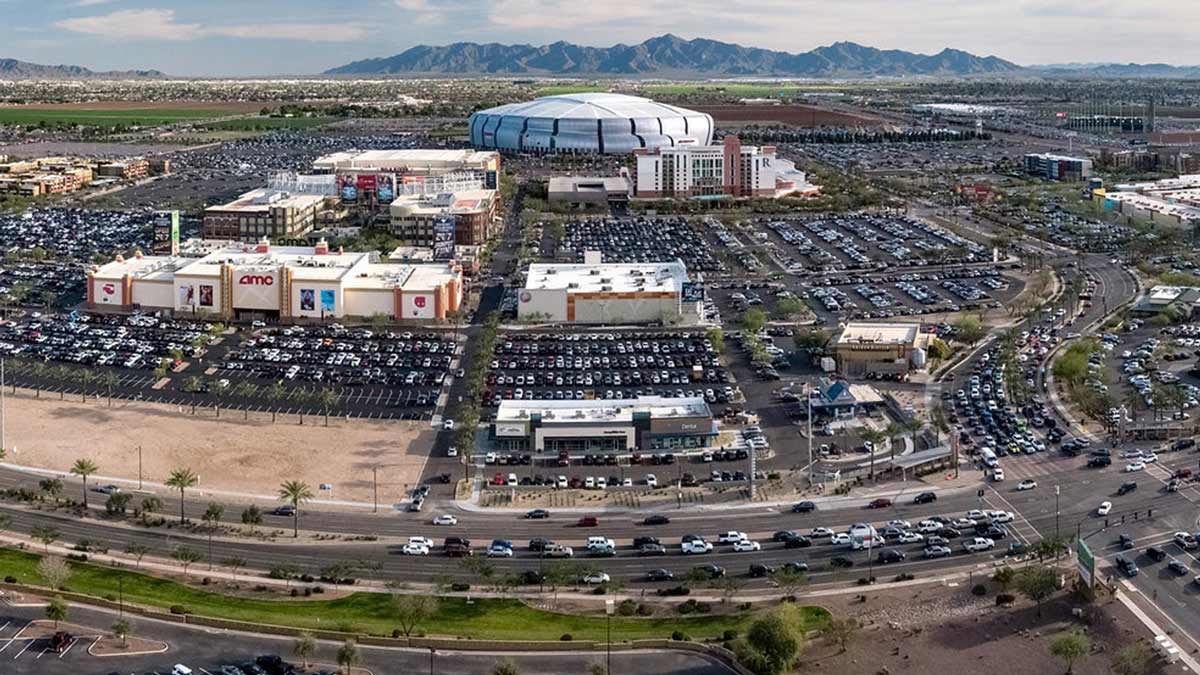
Glendale anchors the Phoenix metro’s West Valley with sports, healthcare, and affordable family communities
2026 Economic Outlook
- State Farm Stadium major events calendar continues driving hospitality and STR demand
- Banner Health West Campus expansion adding medical employment
- USAA campus continued expansion with financial services hiring
- Loop 101 corridor industrial and logistics growth adding workforce housing demand
- Camelback Ranch spring training (Dodgers and White Sox) driving seasonal visitor demand
Investment Climate
Glendale’s investment environment is defined by genuine cash flow opportunity and a unique sports and entertainment demand driver that no spreadsheet analysis fully captures. Successful Glendale investors share these characteristics:
- Cash flow discipline identifying properties where rents cover expenses with conventional financing, particularly in the Red and Olive Avenue corridors
- Event economy awareness understanding that Stadium District STRs produce outsized event-weekend returns that compress effective holding costs dramatically
- Workforce tenant expertise targeting Banner Health nurses, USAA analysts, and manufacturing supervisors who are excellent long-term tenants with stable income
- North vs. South strategy clarity recognizing that North Glendale near Arrowhead and South Glendale near the stadium serve completely different investment profiles
- Value-add timing in Historic Glendale where the revitalization story is still early enough to buy ahead of full price discovery
Arizona’s landlord-friendly legal environment gives Glendale investors operational advantages over comparable markets in California, Nevada, or Colorado. No rent control, fast evictions (3 to 5 weeks), and state STR preemption allow investors to run portfolios with the kind of operational flexibility that investors in coastal markets simply cannot access.
Historical Performance
| Period | Market Driver | Avg Annual Appreciation | Key Event |
|---|---|---|---|
| 2010-2014 | Post-recession recovery, Stadium District stabilization | 4-6% | Westgate Entertainment District opens, creating hospitality anchor |
| 2015-2019 | West Valley growth, Banner Health expansion, USAA hiring | 6-9% | Super Bowl XLIX drives national attention to Glendale as STR market |
| 2020-2022 | Pandemic migration, West Valley affordability premium | 18-26% | West Valley absorbs Phoenix metro’s most significant in-migration wave |
| 2023-2024 | Rate normalization, digestion of pandemic gains | 2-5% | Super Bowl LVII (2023) in Glendale drives record STR revenue for investors |
| 2025-2026 | Rate stabilization, Banner and USAA growth | 7-11% (projected) | College Football Playoff and major events sustaining STR demand |
Glendale’s 15-year appreciation track record of 7 to 9% annually compares favorably with the broader Phoenix metro while delivering significantly better cash flow. A $280,000 Glendale property purchased in 2015 would be worth approximately $480,000 to $530,000 today. The combination of that appreciation with above-average rental yields has produced total returns that rival East Valley markets at a fraction of the entry cost.
Demographic Trends Driving Demand
- Banner Health Healthcare Workforce – The West Campus medical center and associated outpatient facilities employ thousands of nurses, technicians, and administrators who prefer renting near their hospital, creating a deep, stable professional tenant pool
- USAA Financial Services Campus – Over 4,000 employees at the Glendale campus earning above-median incomes seek quality rentals in North Glendale and Peoria adjacent communities
- Sports and Entertainment Workers – The Arizona Cardinals, stadium operations, Westgate Entertainment District, and Camelback Ranch create year-round hospitality and service employment
- West Valley Population Growth – The broader Northwest Phoenix metro is the fastest-growing corridor in Arizona, with Glendale at its center absorbing demand spillover from Peoria, Surprise, and Goodyear
- Glendale Community College – 25,000+ students creating consistent affordable rental demand in central Glendale corridors near campus
- California Affordability Migration – Middle-income households leaving California find Glendale’s combination of West Valley amenities and below-Phoenix-average pricing extremely appealing
📚 New to real estate investing? Master the fundamentals with our professional course Learn more →
2. Neighborhood Hotspots
Glendale Investment Neighborhood Map
Interactive map of Glendale’s investment neighborhoods. Green stars show top hotspots, blue circles mark established markets, and orange circles highlight emerging areas.
Core Investment Neighborhoods
Detailed Submarket Analysis: All Glendale Neighborhoods
| Neighborhood | Price Range (SFH) | Cap Rate | Growth Drivers | Best Strategy |
|---|---|---|---|---|
| Stadium District / Westgate | $340K-$560K | 6-12% (STR model) | NFL, Super Bowl, CFP, concerts, Westgate | Hybrid STR/long-term, event-focused rental |
| Arrowhead Ranch / North Glendale | $420K-$680K | 4.5-5.5% | USAA, Banner Health, top schools, lakes | Long-term family SFH, buy-and-hold |
| Historic Glendale / Murphy Park | $280K-$430K | 5.5-7.0% | Arts district, antique row, GCC, revitalization | Value-add, BRRRR, revitalization hold |
| Banner Health / 59th Ave Corridor | $310K-$470K | 5.5-6.5% | Banner Health employment, medical workforce | Stable cash flow, healthcare worker tenants |
| Peoria Ave / Thunderbird Corridor | $320K-$490K | 5.0-6.0% | Loop 101, Arrowhead retail, family demand | Balanced returns, family rentals |
| GCC Area / Central Glendale | $270K-$420K | 5.5-7.0% | Glendale Community College, young worker demand | Student and young professional rentals |
| Olive Ave / 67th Ave | $260K-$390K | 6.0-7.5% | Manufacturing, service workers, affordability | Highest long-term cash flow in Glendale |
| Sahuaro Ranch Area | $310K-$480K | 5.0-6.0% | Historic park, established community, family appeal | Long-term family SFH, stable occupancy |
| Maryvale Adjacent | $240K-$360K | 6.5-8.5% | Affordability, workforce housing, Phoenix access | Maximum cash flow, active management required |
| Northern Loop 101 / Peoria Border | $380K-$580K | 4.5-5.5% | New construction, West Valley growth, Peoria spillover | New construction, low maintenance, appreciation |
Expert Insight: “The Stadium District is the most misunderstood investment in the Phoenix metro. Investors see the long-term cap rates and think it is an ordinary suburban market. What they miss is that a well-managed STR property within 1.5 miles of State Farm Stadium can generate its entire annual target income in 6 to 8 event weekends. The remaining 46 weeks of long-term or medium-term rental is essentially bonus income. We have clients who purchased 4-bedroom homes near the stadium in 2019 and are netting over $55,000 per year on properties that cost $380,000 at purchase, primarily driven by 8 to 10 high-demand event weekends.” – Jennifer Walsh, Owner, West Valley Investment Properties
3. Property Types
| Investment Goal | Best Property Type | Best Neighborhoods | Minimum Capital |
|---|---|---|---|
| Maximum Total Return | Event STR SFH near stadium | Stadium District within 2 miles | $90,000+ |
| Best Long-Term Cash Flow | Small multi-family or value-add SFH | Central Glendale, Olive corridor | $70,000+ |
| Passive Family Rental | SFH in established family community | Arrowhead Ranch, Sahuaro Ranch, Thunderbird | $105,000+ |
| Value-Add / BRRRR | Older SFH with renovation upside | Historic Glendale, Olive Ave, Central | $75,000+ |
Don’t guess the costs. Our Complete Renovation & Remodeling Cost Guide covers 400+ pages of project-by-project breakdowns with real contractor pricing ranges.
4. Cost Analysis
Acquisition Cost Breakdown (Glendale)
| Expense Item | Typical Cost | Example ($390,000 Property) | Notes |
|---|---|---|---|
| Down Payment | 25% (investment) | $97,500 | Standard for investment properties in Arizona |
| Closing Costs | 2-3% of price | $7,800-$11,700 | Arizona closing costs are among the lowest in the nation |
| Home Inspection | $350-$550 | $425 | Include roof, HVAC, and pool if applicable |
| Pool Inspection | $150-$300 | $200 | Most Glendale SFH have pools. Critical for STR properties near stadium. |
| HVAC Inspection | $100-$200 | $150 | Critical in Arizona summer heat. Budget $6,000-$14,000 for full replacement. |
| STR Setup Costs (if applicable) | $5,000-$15,000 | $8,000 | Furnishings, linens, smart locks, STR-ready setup for stadium properties |
| Initial Repairs / Turnover | 0-5% of price | $0-$19,500 | Paint, flooring, and minor updates typical for Glendale vintage homes |
| Reserves (6 months) | 6 months expenses | $8,000-$12,000 | Emergency fund including STR slow season coverage |
| TOTAL MINIMUM ENTRY | ~30-35% of value | $121,575-$148,975 | STR setup adds to entry cost but dramatically improves yield |
Sample Cash Flow Analysis: Stadium District SFH (Hybrid STR Model)
| Item | Monthly | Annual | Notes |
|---|---|---|---|
| Long-Term Rent (7 months off-season) | $1,950 | $13,650 | 4BR SFH, Stadium District, May to Nov |
| STR Event Weekends (10 NFL + 4 major events) | N/A | $32,000 | 14 event weekends avg $2,285/weekend (2 nights min) |
| STR Non-Event Nights (Dec-Apr) | N/A | $8,500 | ~60 non-event nights at $140/night, 65% occupancy |
| Total Gross Income | ~$4,512 | $54,150 | Blended hybrid model |
| Property Taxes | -$110 | -$1,320 | ~0.8% of assessed value |
| Insurance (STR-rated) | -$175 | -$2,100 | STR properties require specialized insurance. Slightly higher than standard landlord policy. |
| STR Management (20% of STR revenue) | -$675 | -$8,100 | STR management fee on $40,500 STR revenue |
| Pool and Cleaning Services | -$250 | -$3,000 | Pool service + cleaning between STR stays |
| Maintenance and CapEx | -$325 | -$3,900 | Higher with STR turnover wear |
| Net Operating Income | $2,977 | $35,730 | Before mortgage |
| Mortgage ($450K purchase, 25% down, 6.75%, 30yr) | -$2,188 | -$26,256 | Principal and interest on $337,500 loan |
| CASH FLOW | +$789 | +$9,474 | Positive cash flow, rare in the Phoenix metro at current rates |
| Cap Rate (NOI/Purchase) | 7.9% | Far above Phoenix metro average | |
| Total Return (9% appreciation) | ~38% | Cash flow + appreciation + principal paydown vs. cash invested |
Note: This model is conservative on event weekend rates. Super Bowl years produce 2 to 3x the normal event weekend revenue and can add $25,000 to $40,000 in a single event. Investors who purchased before Super Bowl LVII in Glendale (2023) generated in some cases their entire annual revenue target in one weekend.
Expert Insight: “Most investors underestimate how transformative the event calendar is for Stadium District cash flow. What looks like a conventional suburban SFH with modest long-term rental yield becomes a completely different financial instrument when you factor in the event premium pricing. The key is buying the right property: 4 bedrooms, 2 bathrooms, a pool, and parking for 4 to 6 vehicles. Those properties specifically are what event groups want and are willing to pay significant premiums for. The 3-bedroom no-pool property nearby captures maybe 40% of the event revenue.” – Robert Acosta, STR Specialist, Glendale Event Properties
5. Legal Framework
✅ Arizona: One of America’s Most Landlord-Friendly States
Arizona’s landlord-tenant laws are consistently ranked among the most investor-friendly in the United States. No rent control, efficient eviction processes of 3 to 5 weeks, no just-cause eviction requirements, and state preemption of local STR bans make Glendale an excellent operating environment. Glendale adds some specific STR permit requirements but the overall framework strongly favors property owners.
Arizona Landlord-Tenant Fundamentals
- No Rent Control: Arizona state law prohibits rent control permanently. Landlords set rents at market rate with 30-day notice for month-to-month tenancies.
- Fast Evictions: Non-payment triggers a 5-day pay-or-quit notice. Court filing, hearing, and writ of restitution typically complete in 3 to 5 weeks. Among the fastest in the nation.
- No Just Cause Required: Landlords can decline to renew any lease at expiration without providing cause.
- Security Deposits: No statutory cap. Must return with itemized deductions within 14 business days of move-out.
- AC as Habitability: Functioning air conditioning is legally required in Arizona. Landlord must respond to AC failure within 24 hours in summer months.
- Pool Safety Mandatory: Arizona law requires all residential pools to have compliant fencing. Glendale actively enforces this for rental properties.
Glendale STR Regulations
Glendale has specific requirements for short-term rental operators, particularly important for Stadium District investors:
- STR Permit Required: All STR operators must obtain a City of Glendale STR permit. Annual renewal required. Fee is nominal.
- Transaction Privilege Tax (TPT): STRs are subject to Arizona TPT. Must register with Arizona Department of Revenue and collect and remit tax on rental income under 30 days.
- Neighbor Notification: Glendale requires notification to adjacent neighbors upon STR permit application. No approval required.
- HOA Restrictions: Many Arrowhead and newer master-planned communities have HOA STR restrictions. Always verify before purchase.
- Occupancy Limits: Glendale enforces occupancy limits. Event properties must not exceed permitted occupancy. This is important for large groups renting for Super Bowl and similar events.
- State STR Preemption: Arizona state law prevents Glendale from banning STRs. The STR operating environment is therefore stable and protected from local political pressure.
Key Glendale Resources
- Glendale STR Permits: glendaleaz.com/permits
- Arizona Dept. of Revenue (TPT): azdor.gov
- Arizona Landlord-Tenant Act: azleg.gov/ARS/33
- Glendale Code Enforcement: 623-930-2960
| Regulation | Glendale / Arizona | National Average | Investor Impact |
|---|---|---|---|
| Eviction Speed | 3 to 5 weeks | 6 to 12 weeks | Significantly reduces non-payment risk exposure |
| Rent Control | Banned by state law | Common in major cities | Full market rate flexibility at all times |
| STR Regulation | Permit required, bans not permitted | Varies widely, many cities ban or cap | Arizona STR preemption creates stable operating environment |
| Security Deposit Cap | No cap | Most states cap at 1 to 2 months | Greater flexibility for higher-risk tenants |
| Pool Safety Enforcement | Actively enforced by Glendale | Varies | All pools must have compliant fencing before renting |
| TPT on STR | Required on rentals under 30 days | Varies by state | Adds compliance step but Airbnb and VRBO collect and remit automatically in Arizona |
6. Step-by-Step Glendale Investment Playbook
Choose Your Glendale Strategy
Glendale supports four distinct investment strategies. Choose one and execute it with discipline:
Event STR Strategy
Buy a 4-bedroom SFH with pool within 2 miles of State Farm Stadium. Operate as STR during NFL season, Super Bowl, CFP, and major events. Long-term rent or medium-term rent between events. Highest total return strategy in Glendale.
Healthcare Worker Housing
Target furnished rentals near Banner Health West Campus for travel nurses and medical contractors on 30 to 90 day assignments. Consistent occupancy, above-market rents, and professional tenants. 30-day minimum avoids STR permit complexity.
Long-Term Family Rental
Acquire SFH in Arrowhead Ranch or the Thunderbird corridor targeting USAA and Banner Health families for 2 to 5 year tenancies. Minimal management, excellent tenant quality, and steady Phoenix metro appreciation.
Value-Add / BRRRR
Buy undervalued older homes in Historic Glendale or Olive corridor. Renovate kitchens, bathrooms, and curb appeal. Refinance to pull equity. Repeat. Glendale’s affordable entry price points make the math work where other Phoenix suburbs no longer do.
Build Your Glendale Team
- Glendale Investment Agent: Must know the difference between Stadium District and Arrowhead from an investor perspective. Should be able to quote comparative STR revenue estimates and pull recent rental comps by neighborhood.
- STR Management Company: If pursuing the event model, partner with a Glendale-area STR management company with documented Super Bowl and major event experience. Ask for their revenue track record on comparable properties during NFL season and major events.
- Arizona Real Estate Attorney: Entity structuring (LLC standard) and lease review. Particularly important if operating furnished healthcare rentals due to 30-day minimum compliance requirements.
- HVAC Contractor on Speed Dial: AC emergency response in Arizona summer is non-negotiable. Establish the relationship before your first tenant call.
- Arizona Real Estate CPA: STR income and TPT compliance create tax planning needs specific to Arizona. Annual tax strategy review is valuable given the multiple income streams Glendale properties can generate.
Expert Tip: When vetting STR management companies for Stadium District properties, ask specifically: “What was the average gross revenue per night for a 4-bedroom property during the last Super Bowl weekend you managed?” Companies with genuine event experience will have real numbers. Companies without it will hedge. The event premium management requires specialized dynamic pricing expertise that generic property managers simply do not have.
Glendale-Specific Due Diligence
Physical Due Diligence
- HVAC age and condition (systems over 12 years approaching end of life in Arizona heat)
- Roof condition and type (flat roofs common in Glendale vintage homes)
- Pool equipment, fence compliance, and gate hardware for rental safety liability
- Parking capacity for STR properties (events groups need 4 to 6 car spaces minimum)
- Stucco and exterior condition for curb appeal impact on STR listing photos
- Electrical panel capacity (old 100-amp panels inadequate for multi-AC unit demand)
- Water heater age (hard water and heavy usage accelerates degradation)
STR and Regulatory Due Diligence
- Confirm HOA rules on STR use before any Stadium District purchase. Some HOAs prohibit STRs outright.
- Verify distance to State Farm Stadium (within 2 miles is the STR premium zone)
- Check existing STR permit status and any code enforcement history
- Confirm pool fence compliance with Glendale and Maricopa County requirements
- Review any existing HOA restrictions on occupancy, parking, or commercial activity
- Confirm TPT registration requirements and tax implications for your specific strategy
- Review comparable STR revenue data (AirDNA or Rabbu) for immediate block, not just zip code
Acquiring and Managing Glendale Properties
- Stadium District targeting: Draw a 2-mile radius from State Farm Stadium (33.5276, -112.2626). Every SFH with 4+ bedrooms and a pool within that radius is a potential event STR candidate. Run the revenue analysis before looking at any other property metrics.
- Historic Glendale off-market sourcing: Long-term owners on Glendale Avenue and immediate side streets have often owned since the 1970s and 1980s. Direct mail to absentee or long-term owner properties in this corridor surfaces deals before MLS exposure.
- Super Bowl calendar awareness: Phoenix area Super Bowls have been awarded regularly and State Farm Stadium is on the rotation. Properties purchased before a Super Bowl announcement and held through the event year generate exceptional returns. Monitor NFL Super Bowl site announcements.
- Pool as revenue driver, not cost center: A heated pool in a Stadium District property adds $150 to $400 per event night in premium pricing. The annual pool service cost of $1,200 to $1,800 is recovered in a single event weekend. Never walk away from a Stadium District property solely because it has a pool.
- Healthcare corridor targeting: Banner Health’s 59th Avenue West Campus address is 5601 W Euclid Ave. Properties within 1.5 miles that allow furnished medium-term rentals are your travel nurse housing candidates. Focus on 2-bedroom properties with laundry in unit, as these are the highest demand configuration for medical professionals.
7. Financing Options for Glendale
| Loan Type | Down Payment | Rate Premium | Best For | Glendale Note |
|---|---|---|---|---|
| Conventional Investment | 25% | +0.5-0.75% | Strong W-2 income, good credit | Most Glendale properties fall under conforming loan limits, keeping rates lower |
| DSCR Loan | 25-30% | +1.0-1.75% | Self-employed, portfolio investors | Glendale’s cap rates often qualify for DSCR. STR DSCR lenders use projected STR income, which dramatically improves qualification. |
| STR DSCR Loan | 25-30% | +1.5-2.25% | Stadium District STR investors | Specialized lenders underwrite to AirDNA projected revenue. Glendale’s event market makes these properties strong qualifiers. |
| FHA (House Hack) | 3.5% | Standard + MIP | Owner-occupying one unit of a duplex or triplex | Central Glendale has a good supply of older duplexes for house hacking entry |
| Portfolio Loan | 20-25% | +0.75-1.5% | Multiple properties, investors with 4+ financed loans | Arizona-based lenders like Western Alliance and Pinnacle Bank active in West Valley market |
| Hard Money (BRRRR) | 10-20% | 9-13% rate | Value-add acquisitions requiring renovation | Very active hard money market in Phoenix metro. Glendale’s affordable prices keep loan amounts within hard money sweet spot. |
| Cash-Out Refinance | N/A (equity) | Standard investment rate | Investors with existing Phoenix metro equity | Glendale’s 2020 to 2022 appreciation created significant refinanceable equity for early buyers |
Glendale Financing Advantage: The STR DSCR loan product is particularly powerful for Stadium District properties. Lenders who specialize in STR DSCR loans use projected annual STR revenue (sourced from AirDNA or Rabbu) rather than long-term rental rates to determine debt service coverage. Because Glendale’s event market produces significantly above-average STR revenue projections, properties that would fail conventional DSCR qualification often qualify easily under STR DSCR underwriting. This opens a financing path for self-employed and portfolio investors that simply does not exist for comparable properties in other Phoenix suburbs.
8. Frequently Asked Questions

Knowledge Quiz: Glendale Arizona Real Estate Investment
Open Quiz
5 quick questions on what you just learned about Glendale investing
1) What makes the Stadium District in Glendale unique compared to other Phoenix metro investment areas?
Answer: C
The guide details how State Farm Stadium’s event calendar, including NFL home games, Super Bowls, College Football Playoff championships, WrestleMania, and major concerts, creates predictable demand spikes where well-positioned 4-bedroom properties command $400 to $6,000+ per night during events. This event economy is unique in the Phoenix metro and creates a distinct investment thesis not available in Chandler, Tempe, or Mesa.
2) What property configuration does the guide identify as essential for maximizing Stadium District STR revenue?
Answer: B
The guide specifically identifies 4 bedrooms, 2 bathrooms, a pool, and parking for 4 to 6 vehicles as the configuration event groups demand and will pay the highest premiums for. A 3-bedroom no-pool property in the same location captures only about 40% of the event revenue potential. The expert quote in the guide reinforces this: the right property specification is critical to maximizing the Stadium District investment thesis.
3) What is the travel nurse housing strategy and why is Glendale particularly suited for it?
Answer: D
The guide details how travel nurses on hospital assignments need furnished private housing for 8 to 13 weeks. Glendale’s Banner Health West Campus creates consistent demand. Rentals of 30 days or more avoid Arizona STR regulations and TPT requirements entirely, making this a simpler operating model than event STR. The guide notes $2,200 to $3,200/month rates, 30 to 50% above unfurnished long-term rates, with properties typically booking within 72 hours on Furnished Finder.
4) What does the guide identify as the primary risk specific to Stadium District STR investing in Glendale?
Answer: A
The guide explicitly cites event dependency as a key Stadium District risk, noting that the Arizona Coyotes NHL franchise left Glendale in 2024 as an example of how major anchors can move. It recommends investors always underwrite a realistic long-term rental fallback scenario. HOA STR restrictions expanding is the second major risk, as more communities are voting to restrict STR use and historical HOA meeting minutes must be reviewed before any Stadium District HOA purchase.
5) What financing product does the guide identify as particularly powerful for Stadium District STR properties in Glendale?
Answer: C
The guide details how specialized STR DSCR lenders use projected annual STR revenue from data services like AirDNA rather than long-term rental rates for qualification. Because Glendale’s event market produces significantly above-average STR revenue projections, properties that fail conventional DSCR qualification often easily qualify under STR DSCR underwriting. This opens the financing path for self-employed and portfolio investors specifically for Stadium District properties.
Work With a Local Expert in Glendale
We are building a verified network of real estate professionals across every market we cover.

About Our Expert Network
We are finalizing partnerships with verified real estate professionals across every market featured on Builds and Buys. Each expert in our network is selected for their hands-on investment experience, local market knowledge, and commitment to helping buyers and investors make sound decisions.
Our local specialists offer:
- Proven experience with investment and income-producing properties
- Deep knowledge of local pricing, rental yields, and neighborhood dynamics
- Guidance on financing, legal structure, and due diligence
- Access to off-market and pre-market opportunities
- Full transaction support from search through closing
- Ongoing portfolio and property management referrals
Services Covered
- Property sourcing and acquisition
- Investment analysis and underwriting
- Buyer representation
- Market comparables and valuations
- Short-term and long-term rental strategy
- Value-add and renovation guidance
- Legal and title referrals
- Financing and lender connections
- Property management referrals
- Insurance and inspection referrals
- 1031 exchange coordination
- Exit strategy planning
Get Connected or Join Our Network
Looking for a local expert to help with your Glendale investment? Reach out and we will connect you with the right professional for your market and strategy.
Are you a real estate professional with a track record working with investors in Glendale or the West Valley? We are always expanding our network of verified local experts.
Contact us at support@buildsandbuys.com
Find Specialized Glendale Real Estate Professionals
Ready to Invest in Glendale?
Glendale is not a market that announces itself loudly. It does not have Scottsdale’s luxury brand or Chandler’s tech cachet. What it has is something more useful to investors: genuine cash flow potential, a unique event economy that no spreadsheet analysis fully captures, a major healthcare employment anchor, and price points that still make the investment math work in 2026. The Stadium District opportunity in particular is one of the most distinctive investment cases in Arizona, a market where a single well-positioned property can generate its entire annual financial target in a handful of event weekends. That kind of return compression simply does not exist in any other Phoenix suburb.
Continue Your Research
Arizona State Guide
See how Glendale compares to Scottsdale, Tempe, Chandler, Mesa, and other Arizona markets.
Step-by-Step Invest
Complete framework for building a real estate investment strategy from scratch.
144-Lesson Course
University-level real estate education covering financing, law, strategy, and management.
For further guidance, explore our State-by-State Investor guides, browse our expert articles, or follow our Step-by-Step Investment Guide.



