Pahrump Real Estate Investment Guide For 2026
A comprehensive resource for investors targeting Nevada’s largest unincorporated community, where Las Vegas commuter demand, Death Valley tourism, rural lifestyle appeal, and some of the most affordable investment entry points in the Silver State combine to create a high-yield, fast-growing market hiding in plain sight
Quick answers: Top 5 most searched Pahrump investment questions ▼
Who lives here: The Pahrump resident and tenant profile ▼
1. Pahrump Market Overview
Market Fundamentals
Pahrump sits in the Pahrump Valley 60 miles west of Las Vegas across the Spring Mountains range, connected by Nevada Highway 160 (Mountain Springs Road). It is Nevada’s largest unincorporated community and Nye County’s population center, home to over 48,000 residents spread across a valley that still has the character of a rural Nevada community despite its rapid growth. The community has no formal city government; Nye County handles all municipal services.
Key market fundamentals:
- Population: 48,000+ and growing at 4 to 6 percent annually; projected to approach 65,000 by 2030
- Governance: Unincorporated community in Nye County; no city government or city taxes
- Major Employers: Nye County government, Pahrump Valley Hospital, Winery (Pahrump Valley Winery), Terrible’s Town Casino, Saddle West Hotel and Casino, local retail and service sector, and a growing number of remote workers commuting to Las Vegas
- Median Household Income: $48,000; lower than the Las Vegas metro but servicing affordable housing at Pahrump price points
- Location: 60 miles from Las Vegas; 30 miles from Death Valley National Park entrance; 90 miles from Beatty, Nevada
- Property Type: Mix of site-built homes and manufactured homes on rural lots; many properties have 1 to 5+ acres; large lots are a defining Pahrump characteristic
Pahrump’s investment thesis is anchored in one powerful, simple observation: Las Vegas is 60 miles away and getting more expensive every year. Each year the Las Vegas and Henderson median prices rise, more households do the math and choose the 1-hour commute for the $150,000 to $200,000 in price savings that Pahrump represents. This dynamic has been accelerating since 2018 and shows no signs of reversing.
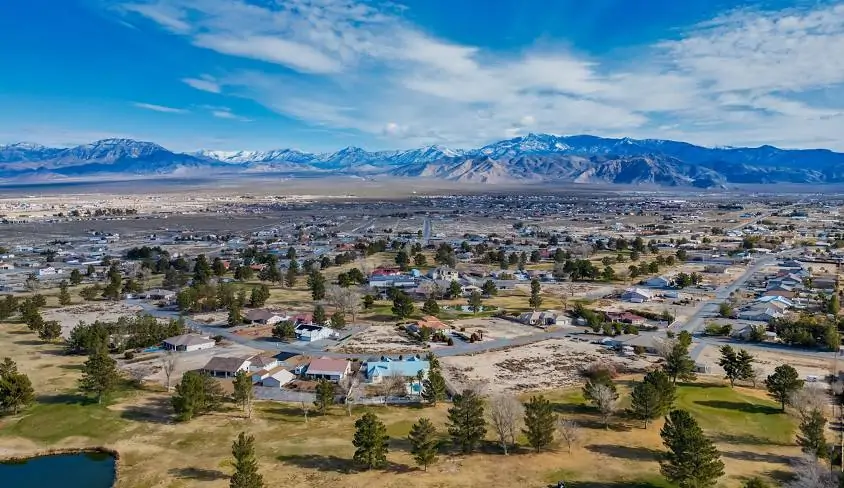
Pahrump Valley offers Las Vegas metro access at rural Nevada prices, with the Spring Mountains providing dramatic scenery and a psychological separation from the city that many residents specifically value
2026 Economic Outlook
- Las Vegas metro price escalation continuing to drive Pahrump overflow demand
- Remote work enabling true rural residence without daily commute for growing workforce segment
- Death Valley National Park tourism supporting local economy year-round
- Solar energy development creating technical employment in Nye County region
- Pahrump Valley Winery and ag-tourism growing as destination
- Nye County infrastructure investment improving community services
The Las Vegas Overflow Thesis
Understanding Pahrump’s investment case requires understanding the Las Vegas metro affordability trajectory. Las Vegas has averaged 8 to 12 percent annual appreciation for the past decade. Henderson has exceeded that. North Las Vegas, while more affordable, still requires $340,000 for a median purchase. This price escalation has priced a growing segment of the Las Vegas workforce out of the metro permanently, creating a population overflow pattern that consistently flows toward the nearest affordable alternative.
Pahrump captures this overflow uniquely among Nevada communities because:
- Highway access: NV-160 connects Pahrump directly to the Las Vegas valley; the drive through Mountain Springs summit at 5,500 feet is scenic but well-maintained and year-round viable
- Price gap: Pahrump’s median price of $308,000 vs. Las Vegas’s $430,000 represents a $122,000 gap that funds the commute cost for years and still delivers substantial net savings
- Character differentiation: Pahrump offers what Las Vegas suburbs cannot: rural Nevada character, large lots, minimal HOA, space, and a fundamentally different lifestyle. This character differentiation attracts residents who actively want rural life, not just affordable urban life, creating stronger resident commitment than pure price-driven moves
- Remote work amplification: Every Las Vegas worker who can work remotely 2 to 3 days per week dramatically improves the Pahrump commute calculation. A 3-day commute instead of 5 is a genuinely different lifestyle tradeoff that many households now accept
Historical Performance
| Period | Market Driver | Avg Annual Appreciation | Key Event |
|---|---|---|---|
| 2010-2016 | Post-recession recovery; limited Las Vegas overflow | 3-6% | Market recovering from 2008 lows; population growing steadily |
| 2017-2019 | Las Vegas price growth beginning to push overflow | 6-9% | Las Vegas prices crossing $280,000 made Pahrump’s price gap visible to commuter demographics |
| 2020-2022 | Remote work surge, Las Vegas price explosion, COVID migration | 20-30% | Remote work made rural Pahrump genuinely viable; Las Vegas surge made it financially urgent for many households |
| 2023-2024 | Rate normalization, stabilization | 4-6% | Market cooled; Pahrump held value better than many markets due to affordability floor |
| 2025-2026 | Rate stabilization, continued Las Vegas overflow, remote work maturation | 6-9% (projected) | Las Vegas prices stabilizing at high levels maintaining Pahrump gap; remote work normalized as permanent option |
Pahrump vs. Las Vegas Metro: The Price Gap That Drives Investment
| Market | Median Price | 3BR Rent | Gross Yield | Distance from Las Vegas |
|---|---|---|---|---|
| Pahrump | $308K | $1,550/mo | 7-9% | 60 miles (1 hr) |
| North Las Vegas | $340K | $1,750/mo | 6.2% | Within metro |
| Las Vegas | $415K | $1,950/mo | 5.5% | Within metro |
| Henderson | $455K | $2,200/mo | 5.0% | Within metro |
Pahrump offers yields 1.5 to 4 percentage points above the Las Vegas metro while prices are $30,000 to $150,000 below. The yield advantage reflects the commute discount; the price gap drives the tenant demand. These two forces together create Pahrump’s investment case.
📚 New to real estate investing? Master the fundamentals with our professional course Learn more →
2. Neighborhood Hotspots
📍 Pahrump Neighborhood Note: Unlike incorporated Nevada cities, Pahrump is an unincorporated community spread across a wide valley without formal neighborhood delineations. Investment zones are typically described by corridor or quadrant rather than named neighborhoods. The key distinctions are: proximity to the commercial corridor (Homestead and Bell Vista roads), distance from the Las Vegas highway (NV-160), lot size and rural character, and whether the property is a standard site-built home or manufactured home on acreage.
Pahrump Investment Zone Map
Interactive map of Pahrump investment zones and key landmarks. Green stars show top investment areas, blue circles mark established zones, and orange circles highlight emerging corridors.
Core Investment Neighborhoods
| Zone | Price Range | Cap Rate | Property Character | Best Strategy |
|---|---|---|---|---|
| Mountain Falls Golf | $320K-$480K | 5.5-7.0% | Master-planned, golf adjacent | Premium retiree, appreciation |
| Central / Homestead | $250K-$380K | 7.0-8.5% | Established SFH, community infrastructure | Balanced, most accessible management |
| South / Calvada | $260K-$380K | 7.0-8.5% | Established subdivisions, community feel | Balanced, established character |
| NW / Bell Vista | $280K-$400K | 7.0-8.0% | Newer construction, commuter oriented | Commuter focus, newer homes |
| East Pahrump / Rural | $180K-$280K | 8.0-10.0% | Acreage lots, rural character, older homes | Maximum yields, experienced landlords |
| North Pahrump / Rural | $200K-$320K | 7.5-9.5% | Large lots, rural lifestyle, growth corridor | Rural lifestyle play, long-term hold |
Expert Insight: “The investors who do best in Pahrump are the ones who understand they’re investing in Las Vegas metro overflow, not in Pahrump’s local economy. The local economy is modest: county government, a hospital, two small casinos, and services. What’s growing is the population of people who work in Las Vegas and commute, or who retire there because it’s half the price of Henderson. If you invest with that understanding, you underwrite correctly: you target the commuter or retiree who chose Pahrump intentionally, you price rents at what that demographic can sustain, and you buy properties with well and septic rather than municipal utilities where possible to keep operating costs down. The investors who struggle are the ones who think they’re investing in a standalone market and don’t account for the Las Vegas dependence.” – David Torres, Pahrump Real Estate Group
3. Property Types
⚠️ Pahrump Property Type Note: Pahrump has a significantly higher proportion of manufactured homes and homes on private wells and septic systems than any other Nevada market in this series. This affects financing (manufactured homes on leased land cannot be conventionally financed), operating costs (well maintenance and septic pumping are owner expenses), and tenant demographics (rural lifestyle tenants have different characteristics than urban suburban tenants). Understand these distinctions before investing.
Our Complete Renovation & Remodeling Cost Guide covers 400+ pages of project-by-project breakdowns with real contractor pricing ranges.
4. Cost Analysis
Sample Cash Flow Analysis: Central Pahrump Site-Built Home
| Item | Monthly | Annual | Notes |
|---|---|---|---|
| Gross Rent | $1,550 | $18,600 | 3BR, central Pahrump, site-built, Las Vegas commuter or retiree tenant |
| Less Vacancy (6%) | -$93 | -$1,116 | Pahrump vacancy; commuter tenants more mobile than retirees; 6% realistic for mixed demographic |
| Property Taxes | -$178 | -$2,135 | ~0.68% of $314K assessed (Nye County rate; slightly below Clark County) |
| Insurance | -$85 | -$1,020 | Desert climate; no flood risk; Nevada rural rates favorable |
| Property Management (10%) | -$155 | -$1,860 | Pahrump PM market smaller than Las Vegas; 10% reflects distance management overhead |
| Maintenance + CapEx (11%) | -$171 | -$2,046 | Desert heat adjustment (11%); well/septic cost addition if applicable ($800-$1,500/year) |
| Net Operating Income | $868 | $10,423 | Before mortgage; strong for rural affordable market |
| Mortgage ($300K purchase, 25% down, 6.75%, 30yr) | -$729 | -$8,748 | Principal and interest on $225,000 loan; significantly lower than any Las Vegas metro market |
| CASH FLOW | +$139 | +$1,675 | Positive cash flow with a $75,000 down payment entry; accessible for Nevada investors at any stage |
| Cash-on-Cash Return | 2.2% ($1,675 / $75,000 + closing) | Modest leverage return; total return story compelling when appreciation added | |
| Total Return (7% appreciation) | ~31% | Including appreciation, equity, principal paydown on 25% down; early-stage market premium |
Pahrump’s financial profile reflects its early-stage market character: cash-on-cash returns are modest on leverage but total returns including appreciation are competitive, and the low entry capital ($75,000 to $85,000 total) makes Pahrump accessible to investors who cannot qualify for a Henderson or Reno purchase. The key to Pahrump underwriting is correctly modeling the Las Vegas overflow appreciation story, which is structural and growing, rather than the local economy, which is modest.
Pahrump-Specific Operating Cost Considerations
| Cost Item | Standard Property | Well and Septic Addition | Notes |
|---|---|---|---|
| HVAC | Same desert heat as Las Vegas; annual service; 10-14 year replacement cycle in Pahrump’s heat | N/A (HVAC same) | Pahrump heat comparable to Las Vegas; slightly less extreme than Laughlin |
| Well Maintenance | N/A (municipal water) | $400-$900/year for testing and pump maintenance; $3,000-$8,000 for pump replacement | Many Pahrump properties use private wells; factor into annual CapEx budget |
| Septic System | N/A (municipal sewer) | $250-$500/year for pumping; $4,000-$12,000 for replacement | Typical rural Nevada rural expense; most Pahrump properties outside municipal sewer area |
| Lot Maintenance | Standard desert landscaping | $100-$250/month for acreage properties needing grading or vegetation management | Acreage properties require more lot maintenance than urban suburban properties |
| Propane (if applicable) | N/A (natural gas areas) | $600-$1,500/year if property uses propane for heating or cooking | Rural Pahrump properties may use propane; verify before purchase; this is a tenant or owner cost depending on lease terms |
Expert Insight: “The biggest mistake out-of-area investors make in Pahrump is applying Las Vegas or Henderson operating cost templates to Pahrump properties. In Las Vegas, you have municipal water, municipal sewer, HOA exterior maintenance, and urban contractor access. In Pahrump, you may have a private well, a septic system, no HOA, and a much smaller contractor market. I always add $1,500 to $2,500 annually to my CapEx budget for well and septic on any Pahrump property with those systems. And I add 10 percent to all contractor costs because the trade pool is smaller and travel time is real. Model correctly and the numbers work. Model incorrectly and you’ll be frustrated.” – David Torres, Pahrump Real Estate Group
5. Legal Framework
✅ Pahrump Operates Under Nevada’s Landlord-Favorable Law With Minimal Additional Regulation
Pahrump is an unincorporated community in Nye County, operating under Nevada Revised Statutes Chapter 118A and Nye County regulations. There is no city government, which means no city business license (only Nye County), no city zoning beyond county standards, and no city STR ordinance (Nye County rules apply). This is the least-regulated landlord environment of any Nevada community in this guide series. Nevada’s statewide landlord-favorable law applies fully with essentially no additional local regulatory burden.
Nevada State Law: Key Provisions
- No Rent Control: Nevada prohibits local rent control statewide. Nye County cannot implement it either. Pahrump landlords may raise rents with 45 days notice, unlimited in amount or frequency.
- No Just Cause Eviction: At lease end, non-renewal requires no justification. Month-to-month tenants can be terminated with 30 days notice without cause.
- 5-Day Pay or Quit: Non-payment begins with 5-day notice; uncontested cases resolve in 3 to 5 weeks. Nye County Justice Court handles Pahrump evictions.
- Security Deposits: Maximum 3 months rent; return with itemized deductions within 30 days.
- Cooling Habitability: Functional air conditioning legally required. Pahrump summer temperatures regularly exceed 110 degrees; desert cooling obligation same as Las Vegas.
- Manufactured Home Tenants: Additional protections apply to manufactured home park residents under NRS Chapter 118B; different from standard residential rental law.
Pahrump-Specific Regulatory Environment
- No City Business License: Unlike all incorporated Nevada cities in this series, Pahrump has no city government and therefore no city business license requirement. Nye County may have a county business license requirement; verify with Nye County.
- Nye County STR Rules: Nye County has STR regulations governing short-term rentals in unincorporated areas including Pahrump. Verify current requirements before purchasing for STR purposes; Nye County’s rules are less developed than Clark County’s but are evolving.
- Well and Water Rights: Properties on private wells require understanding of Nevada water rights law. Nye County records contain well permit information. Verify well condition, water right standing, and annual production rate before purchasing acreage properties with wells.
- Septic Permits: Septic systems require Nye County permits. Verify existing septic has proper permitting and has been recently inspected before purchase.
- Manufactured Home Parks: NRS Chapter 118B governs manufactured home park tenancies with different tenant rights than standard residential rental. If investing in park-owned land manufactured homes, understand Chapter 118B before proceeding.
Pahrump Key Resources
- Nye County Assessor: nyecounty.gov/assessor
- Nye County Building: 775-751-4249
- Nevada NRS Chapter 118A: leg.state.nv.us
- Nye County Well Permits: Nye County recorder
| Issue | Pahrump / Nevada Rule | Investor Impact |
|---|---|---|
| Rent Control | Prohibited statewide; Nye County cannot add any | Unlimited rent increases with 45 days notice; capture Pahrump’s 5-7% annual rent growth fully |
| Business License | No city license required; verify Nye County requirements | Least regulated environment in this guide series; minimal administrative overhead |
| Well and Septic | Nye County permits required; water rights law applies | Inspect both systems before purchase; verify permits; add to CapEx budget |
| Manufactured Homes | NRS 118B governs park tenant rights; different from standard residential law | Additional tenant protections; review 118B before investing in manufactured home parks |
| Cooling Habitability | Functional A/C legally required; desert summer emergency obligation | Service HVAC annually in spring; establish emergency contractor; summer failure is habitability emergency |
| State Income Tax | None on rental income | Same Nevada advantage; particularly meaningful for California-based investors |
6. Step-by-Step Pahrump Investment Playbook
Choose Your Pahrump Strategy
Las Vegas Overflow Commuter
Buy a site-built 3-bedroom home in central or southwest Pahrump. Target Las Vegas commuter households specifically. Accept Las Vegas metro market risk (if Las Vegas economy softens, commuter demand softens) in exchange for affordable entry, strong yields, and the structural Las Vegas overflow appreciation story.
Rural Lifestyle Acreage
Buy a site-built home on 2 to 5 acres targeting rural lifestyle tenants who specifically want space. Less Las Vegas-dependent because rural lifestyle tenants value the location for its character, not just its commute. More unique inventory; tenants who find the right acreage property tend to stay 3 to 5 years.
Maximum Cash Flow (Rural)
Buy older site-built home or value-add acreage property at $180,000 to $260,000. Accept higher management intensity for 8 to 10 percent gross yields. Best for experienced Nevada rural landlords who want maximum income from a low-capital position. Rural tenant market requires more active management than central Pahrump.
Mountain Falls Premium Play
Buy in Mountain Falls golf community at $320,000 to $460,000. Accept lower yields (5.5 to 7 percent) for significantly lower management intensity from the retiree demographic. Comparable to a Mesquite investment with Pahrump entry prices. Best for investors who want Pahrump’s appreciation story with the least management burden.
Build Your Pahrump Team
- Pahrump Specialist Agent: Pahrump requires genuine local knowledge: understanding of well and septic systems, Nye County permits, rural lot characteristics, and the specific Pahrump market dynamics. A Las Vegas or Henderson agent who will “cover” Pahrump is not sufficient. Ask specifically: “How many Pahrump investment properties have you sold in the past 18 months and how many had wells and septic?”
- Pahrump-Based Property Manager: Non-negotiable for out-of-area investors. Pahrump has a small but functional PM market. A PM who manages from Las Vegas without local Pahrump presence will consistently underperform on maintenance response times and local contractor relationships. Verify they have physical Pahrump presence, not just Las Vegas coverage extended to Pahrump.
- Well and Septic Inspector: For any Pahrump property with well and septic, engage a specialized inspector with Nye County experience before purchase. This is separate from the general home inspection and specifically tests water quality, flow rate, and septic capacity. Cost of $300 to $600; essential on all acreage properties.
- Local Handyman and Contractor Network: Pahrump has a limited contractor market. Your PM should have established relationships with HVAC, plumbing, electrical, and well service contractors. Ask for their contractor list specifically before hiring.
- Nevada LLC or Nye County Setup: Same Nevada LLC structure applies. Pahrump and Clark County properties can coexist in one Nevada LLC. Nye County registration instead of Clark County for Pahrump properties specifically.
Las Vegas Commuter Marketing: When listing Pahrump properties targeting Las Vegas commuters, include: savings vs. Las Vegas rent or mortgage (quantify: “rent here and save $600/month vs. equivalent Las Vegas property”), drive time from specific Las Vegas employment areas (the Las Vegas Strip is 65 minutes vs. Henderson is 75 minutes for some Pahrump routes), rural lifestyle benefits (space, no HOA, large lot), and remote work suitability (fast internet availability, home office space). Las Vegas commuters who choose Pahrump make a deliberate lifestyle and financial choice; market to that choice directly. Also post in Las Vegas-specific Facebook housing groups with explicit mention of the Pahrump option.
Pahrump-Specific Due Diligence
Physical Due Diligence
- HVAC age and condition: Desert heat same obligation as Las Vegas
- Well inspection and water quality test: Mandatory for all properties with wells; test for bacteria, minerals, arsenic (Pahrump area geology includes naturally occurring arsenic in some areas)
- Septic inspection: Load test, condition assessment, capacity for property use
- Roof condition; desert UV deterioration
- Electrical panel age and capacity; older rural properties may have undersized panels
- Propane tank ownership (owned vs. leased from propane company) if applicable
- Road access: is the property on a maintained county road or private/unmaintained road?
- Internet availability: fiber or fixed wireless available at the specific address (essential for remote worker tenants)
Legal and Regulatory Due Diligence
- Verify Nye County water right record for the property’s well permit
- Confirm existing septic permit is current and system is not in violation
- For manufactured homes: verify whether on owned lot or park-leased land; confirm financing eligibility before purchase
- Verify property is accessible via maintained county road (not private road without easement)
- Check Nye County for any code violations or unpermitted additions
- Verify internet service availability at the specific property address; call providers directly
- For Mountain Falls: review HOA CC&Rs and rental policy; verify age restriction and rental frequency requirements if any
Managing Effectively in Pahrump
- HVAC preparation is critical: Same desert cooling obligation as Las Vegas. Service every spring before heat season. Pahrump summers regularly exceed 110 degrees; a summer HVAC failure is a habitability emergency. Well-serviced HVAC is the single most important operational item in any desert Nevada rental.
- Well and septic annual maintenance: For properties with private systems, establish an annual inspection and maintenance schedule with a local Pahrump service provider. Annual septic pumping (every 3 to 5 years for most households), annual well pump inspection, and water quality testing prevent the large unexpected replacement costs that catch underprepared investors off-guard.
- Target Las Vegas commuters who have already committed to the commute: The ideal Pahrump tenant is someone who has already worked in Las Vegas and made a deliberate decision to commute from Pahrump, not someone who is considering it theoretically. Tenants who have already run the financial math and lifestyle calculation and chosen Pahrump stay significantly longer than tenants who try it and discover the commute is harder than they anticipated.
- Internet verification is essential for remote worker tenants: Verify at the specific property address that reliable high-speed internet is available (fiber, cable, or fixed wireless at minimum 25 Mbps) before advertising the property to remote workers. Pahrump has expanded internet infrastructure significantly but coverage is not uniform across the valley. A remote worker who cannot reliably connect from your property will not renew their lease.
- Raise rents annually: Nevada’s no-rent-control environment and Pahrump’s 5 to 7 percent annual rent growth means consistent annual increases at lease renewal. Las Vegas commuter tenants who have committed to Pahrump understand that rents move with the market and will accept market-rate increases when given proper notice and handled professionally.
7. Financing Options for Pahrump
| Loan Type | Down Payment | Rate Premium | Pahrump Note |
|---|---|---|---|
| Conventional Investment | 25% | +0.5-0.75% | Standard site-built homes on residential lots qualify normally. Rural properties may require appraisal addendum for well and septic. Verify lender covers Nye County/Pahrump before signing purchase contract; some lenders exclude rural Nevada properties. |
| USDA Rural Development | 0% (owner-occupant) | Standard + guarantee fee | Pahrump qualifies as a USDA-eligible rural area for owner-occupants. Not applicable for pure investment properties but useful for investors who will initially owner-occupy before converting to rental. Rare advantage unavailable in any Las Vegas metro market. |
| DSCR Loan | 25-30% | +1-2% | Pahrump site-built homes typically qualify. Rural properties with wells may face additional underwriting requirements. Verify DSCR lender approves Nye County specifically; some have geographic restrictions on rural Nevada properties. |
| Manufactured Home (Chattel) | 10-20% | Higher; chattel rates are specialty | For manufactured homes on leased land only; limited lender options; higher rates. Manufactured homes on owned land may qualify for conventional if properly titled as real property. Distinguish carefully before purchasing. |
| Portfolio / Rural Lender | 20-30% | +0.75-1.5% | Local Nevada community banks and agricultural lenders familiar with rural Nye County are often the most reliable for Pahrump acreage properties. They are experienced with well and septic properties and do not have urban geographic approval requirements. |
| FHA (Owner-Occupant) | 3.5% | Standard + MIP | Owner-occupant investors can use FHA for initial purchase; convert to rental after 12-month occupancy requirement. FHA works in Pahrump on qualifying site-built homes. Good entry for investors relocating to Pahrump. |
USDA Rural Advantage: Pahrump is one of the only investment markets in the Las Vegas metro-adjacent area that qualifies for USDA Rural Development financing (zero-down for owner-occupants). For investors who are willing to owner-occupy a Pahrump property for 12 months before converting to rental, USDA financing provides an entry path that requires zero or near-zero down payment, dramatically reducing required capital. After the occupancy period, refinance to an investment loan and rent the property. This strategy is not available in any Clark County market covered in this series because urban Las Vegas, Henderson, and North Las Vegas do not qualify for USDA rural designation.
8. Frequently Asked Questions

Knowledge Quiz: Pahrump Real Estate Investment
Open Quiz
5 quick questions on what you just learned about Pahrump investing
1) What does the guide identify as Pahrump’s primary investment thesis and why is it described as structural?
Answer: B
The guide’s entire market overview is built around the Las Vegas overflow thesis. The comparative table shows Pahrump at $308K median vs. Las Vegas $415K and Henderson $455K, with Pahrump offering 7 to 9 percent gross yields vs. 5 to 5.5 percent in the Las Vegas metro. The thesis is described as “structural” because Las Vegas continues appreciating every year, and as it does, Pahrump’s relative value proposition improves proportionally. The guide describes Pahrump as “Las Vegas in 2012” in the FAQ section, capturing the early-stage market positioning.
2) What is Pahrump’s unique financing advantage compared to all other Nevada cities in this guide series?
Answer: C
The guide specifically calls out USDA Rural Development financing as a “Rare advantage unavailable in any Las Vegas metro market” in the financing section. Because Pahrump is unincorporated Nye County rather than a Clark County incorporated city, it qualifies for USDA rural designation. Owner-occupants can purchase with zero down, occupy for the required period, then refinance to investment status and rent the property. The guide notes this strategy is “not available in Clark County” where all other Southern Nevada cities in this series are located.
3) What does the guide say investors must specifically check about Pahrump properties with private wells that is unique to this market?
Answer: D
The guide’s FAQ on wells and septic specifically mentions that “Pahrump area geology includes naturally occurring arsenic in some groundwater areas” and that a water quality test at purchase is mandatory. The guide also explains Nevada water rights law: each property’s well is tied to a water right issued by the Nevada State Engineer that must be verified as current and sufficient. The guide also details the due diligence checklist requiring “Verify the water right is current and sufficient for residential use” as a specific step. This arsenic and water rights issue is unique to rural Nevada markets and unknown to most urban-market investors.
4) According to the guide’s commute analysis, which types of Las Vegas workers are BETTER candidates for the Pahrump commute, and which are worse?
Answer: A
The guide’s FAQ on commute feasibility specifically lists better and worse candidates. Better: healthcare workers (12-hour shifts, 3 days per week), hospitality workers on non-standard schedules, tradespeople who go directly to job sites, and remote workers commuting 2 to 3 days per week. The guide gives a specific screening advice: “ask specifically about their work schedule and commute plan. Tenants with non-traditional schedules are better candidates than standard 9-to-5 office workers commuting to the east side.” The guide identifies “tenant who underestimated the commute and breaks their lease at 4 to 6 months” as the most common Pahrump tenancy failure mode, which the commute screening question prevents.
5) How does remote work specifically change the Pahrump investment case according to the guide?
Answer: C
The guide’s FAQ on remote work explains that before 2020, standard office workers essentially could not choose Pahrump. Remote work at 2 to 3 days per week per week reduces the weekly commute burden by 40 to 60 percent, making the Pahrump calculation work for many more households. The guide specifically warns that “internet service verification is essential” and that coverage is not uniform across the valley. It identifies the premium remote-work-enabled tenant profile as “younger (30s to 40s), higher income, value rural lifestyle for lifestyle reasons” and notes these properties “command rent premiums of 10 to 15 percent and have significantly lower vacancy.”
Work With a Local Expert in Pahrump
We are building a verified network of real estate professionals across every market we cover.

About Our Expert Network
Pahrump-specific expertise requires knowledge of well and septic systems, Nye County permits, rural property characteristics, Las Vegas overflow market dynamics, and the specific challenges of managing properties in an unincorporated rural community.
- Deep knowledge of Pahrump’s Las Vegas overflow dynamics and commuter tenant market
- Experience with well and septic inspection, water rights, and Nye County permits
- Mountain Falls golf community expertise and rural acreage investment guidance
- Remote worker tenant targeting and internet connectivity due diligence
- USDA Rural Development financing guidance for owner-occupant investors
Services Covered
- Property sourcing and acquisition
- Well and septic due diligence
- Las Vegas commuter tenant targeting
- Rural acreage investment strategy
- Death Valley STR guidance
- USDA financing coordination
- Lender referrals for Nye County
- Property management referrals
- Well service contractor referrals
- Nye County permit guidance
- LLC setup coordination
- Exit strategy planning
Get Connected or Join Our Network
Looking for a Pahrump investment expert? We will connect you with the right professional for your strategy.
Contact us at support@buildsandbuys.com
Find Specialized Pahrump Real Estate Professionals
Ready to Invest in Pahrump?
Pahrump is Nevada’s hidden early-stage market: affordable enough to capture cash flow, positioned to benefit from Las Vegas metro appreciation, and growing fast enough that investors who enter now are buying into a story that has years of runway remaining. The well and septic due diligence, commuter tenant screening, and rural property management requirements separate Pahrump from standard suburban investment, but investors who master these specifics access returns unavailable in any incorporated Nevada city at similar capital requirements. Pahrump rewards preparation, punishes assumptions, and delivers for investors who understand what they are buying.
Continue Your Research
Las Vegas Guide
Compare Pahrump’s affordability to the Las Vegas metro that drives its growth story.
Nevada State Guide
See how Pahrump fits within Nevada’s full investment landscape from Laughlin to Elko.
144-Lesson Course
University-level real estate education covering financing, law, strategy, and management.
For further guidance, explore our State-by-State Investor guides, browse our expert articles, or follow our Step-by-Step Investment Guide.