
Laughlin Real Estate Investment Guide For 2026
A comprehensive resource for investors targeting Nevada’s most affordable casino resort market, where Colorado River frontage, Arizona and California day-tripper tourism, and median home prices under $280,000 combine to create Nevada’s highest rental yields and most accessible entry points
Quick answers: Top 5 most searched Laughlin investment questions ▼
Who lives here: The Laughlin resident and tenant profile ▼
1. Laughlin Market Overview
⚠️ Know Before You Invest
Laughlin is Nevada’s highest-yield investment market and also its most operationally demanding. Summer temperatures regularly reach 115 to 120 degrees, which accelerates HVAC failure, exterior deterioration, and all maintenance cycles. The economy is almost entirely casino-dependent, creating a single-industry concentration risk. The tenant pool is primarily casino and hospitality workers at modest income levels. Investors who understand these characteristics and price their underwriting accordingly generate exceptional cash-on-cash returns. Investors who apply standard Nevada market assumptions without adjusting for Laughlin’s extreme climate and economy almost always underperform projections.
Market Fundamentals
Laughlin occupies the southernmost tip of Nevada where the Colorado River separates the state from both Arizona and California. Founded in the 1960s by Don Laughlin who built the town’s first casino, Laughlin developed into a budget-oriented casino resort town targeting visitors from Phoenix and Southern California who want Las Vegas-style gaming and entertainment at significantly lower prices. Today nine major casinos line the Nevada riverfront, and the permanent community of approximately 10,000 residents lives largely in the inland residential neighborhoods east and north of the casino strip.
Key characteristics defining Laughlin’s investment case:
- Population: ~10,000 full-time residents; substantially larger seasonal visitor population
- Major Employers: Don Laughlin’s Riverside Resort, Golden Nugget Laughlin, Harrah’s Laughlin, Aquarius Casino Resort, Edgewater Hotel and Casino, and six other riverfront casinos
- Median Household Income: $48,000; the lowest median income of any Nevada city in this series
- Median Home Price: $255,000; the lowest of any Nevada city in this series
- Gross Rental Yields: 7 to 10 percent; the highest of any Nevada city in this series
- Climate: Extreme desert heat; average July highs of 113 degrees; regularly reaching 120 degrees
- Location: Tri-state corner of Nevada, Arizona, and California; 90 miles south of Las Vegas; 180 miles from Phoenix
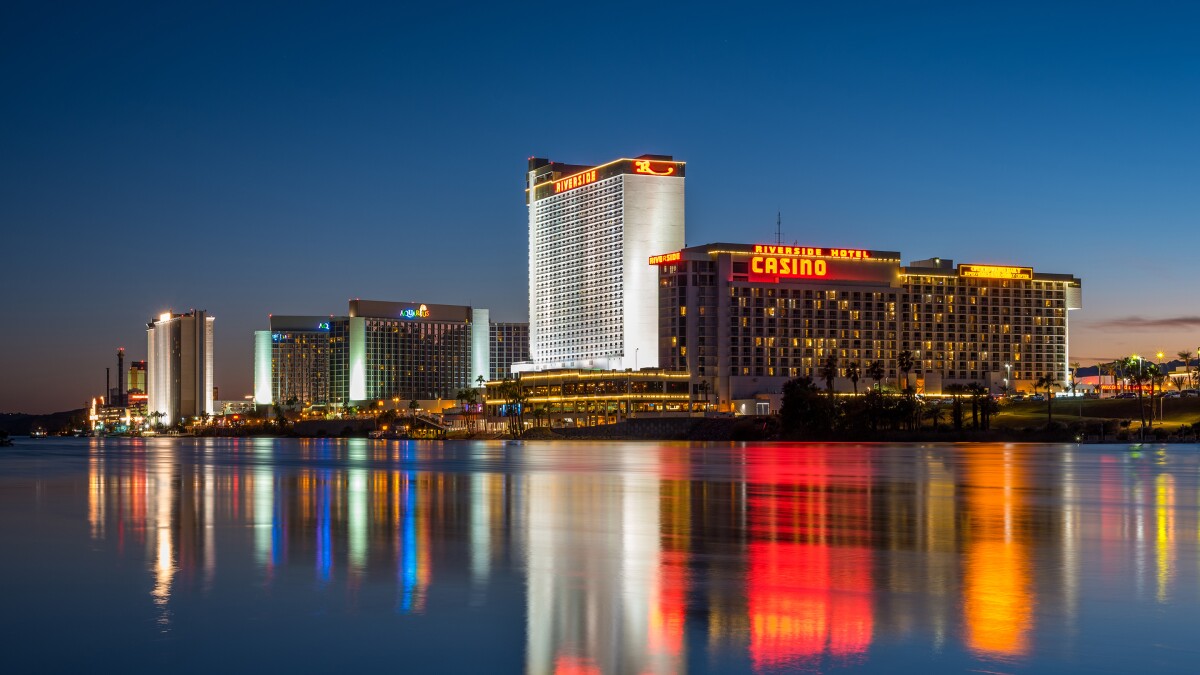
Laughlin’s Colorado River casino strip draws millions of visitors annually from Arizona and California, supporting a permanent workforce whose housing needs create Nevada’s most accessible investment entry points
2026 Economic Outlook
- Casino tourism from Arizona and Southern California markets remaining stable
- Colorado River recreation (boating, fishing, jet skiing) continuing to grow
- Bullhead City, Arizona residential growth creating cross-river spillover demand
- Retirement community growth as California retirees discover Laughlin affordability
- Motorcycle events (Laughlin River Run) and seasonal events driving STR demand
- Possible casino renovation activity maintaining employment stability
The Laughlin Investment Thesis
Laughlin is the purest cash flow play in Nevada. The arithmetic is simple: properties that cost $200,000 to $280,000 generate rents of $1,300 to $1,800 per month, producing gross yields of 7 to 10 percent that simply cannot be achieved in Henderson, Las Vegas, Reno, or Sparks at current price levels. For investors who want maximum income from Nevada investment and are willing to manage a market with specific operational challenges, Laughlin delivers returns unavailable anywhere else in the state.
The case for Laughlin is built on three structural factors:
- Price to rent ratio: The fundamental metric. Laughlin’s low prices and serviceable rents create the most favorable price-to-rent ratio in Nevada, generating yields that justify the operational work required.
- Tri-state demand pool: Laughlin draws tenants and buyers from Nevada, Arizona, and California. Bullhead City, Arizona directly across the Colorado River is a growing community whose residents frequently choose Laughlin housing for Nevada tax advantages while maintaining easy cross-river access. This tri-state demand broadens the tenant pool beyond the city’s small permanent population.
- Tourism economy stability: Casino tourism to Laughlin is not luxury tourism susceptible to discretionary spending cuts. Laughlin serves the budget end of the gaming market with visitors who choose it specifically because it is cheaper than Las Vegas. This demographic is more recession-resistant than Las Vegas Strip visitors because they are already the value-seeking segment.
Historical Performance
| Period | Market Driver | Avg Annual Appreciation | Key Event |
|---|---|---|---|
| 2009-2013 | Post-recession recovery | 1-4% | Declined significantly in recession; cash-flow investors entered at historic lows |
| 2014-2019 | Casino employment stability, Arizona growth spillover | 4-7% | Bullhead City growth strengthened cross-river demand; casino refurbishment cycles maintained employment |
| 2020-2022 | Post-COVID rebound, outdoor recreation surge | 12-18% | COVID closed casinos temporarily; strong rebound as pent-up demand returned; Colorado River recreation grew |
| 2023-2024 | Rate normalization, stabilization | 2-4% | Higher rates slowed buyer activity; investor cash flow buyers remained active |
| 2025-2026 | Rate stabilization, Arizona growth, retirement inflow | 4-6% (projected) | Bullhead City continued growth; California retiree discovery of Laughlin affordability |
Laughlin vs. the Rest of Nevada: Yield Comparison
| City | Median Price | Typical 3BR Rent | Gross Yield | Management Intensity |
|---|---|---|---|---|
| Laughlin | $255K | $1,500/mo | 7.1-10% | High (heat, casino workforce) |
| North Las Vegas | $340K | $1,750/mo | 6.2% | High |
| Carson City | $420K | $2,050/mo | 5.7% | Low |
| Sparks | $430K | $2,100/mo | 5.5% | Medium |
| Henderson | $455K | $2,200/mo | 5.0% | Low-Medium |
Laughlin’s gross yield advantage of 1.5 to 5 percentage points over every other Nevada market is real and persistent. Net yield after the higher operating cost adjustment for extreme heat is approximately 6 to 7.5 percent, still well above any other Nevada market.
📚 New to real estate investing? Master the fundamentals with our professional course Learn more →
2. Neighborhood Hotspots
Laughlin Investment Neighborhood Map
Interactive map of Laughlin investment neighborhoods. Green stars show top hotspots, blue circles mark established markets, and orange circles highlight emerging areas.
Core Investment Neighborhoods
Detailed Submarket Analysis
| Area | Price Range | Cap Rate | Primary Tenant | Best Strategy |
|---|---|---|---|---|
| Casino Strip Adjacent | $180K-$260K | 8.0-10.0% | Casino workers | Maximum cash flow |
| Colorado River / Marina | $220K-$380K | 6.5-8.5% | Retirees, STR, recreation enthusiasts | Balanced, STR premium |
| Central / Civic Area | $170K-$250K | 7.0-8.5% | Mixed workers and retirees | Balanced, stable demographics |
| North Laughlin | $180K-$270K | 6.5-8.0% | Workers, newer residents | Newer construction, lower maintenance |
| Bullhead Crossover Area | $175K-$260K | 7.0-8.5% | Cross-river Arizona workers | Arizona spillover play |
| Far North / Avi Area | $120K-$200K | 8.0-10.0% | Recreation users, very budget tenants | Highest yields, most active management |
Expert Insight: “Laughlin is a market where the numbers work if you know what you’re buying into. I’ve seen California investors buy here excited about the cap rates, then call me six months later frustrated because the HVAC needed replacing and the tenant gave 10 days notice. That’s Laughlin. The answer is not to avoid the market; it’s to buy with the right underwriting. If you assume 11 percent for maintenance and CapEx, budget for HVAC replacement every 10 years in the desert heat, and target casino workers who have steady year-round employment rather than seasonal tourism workers, the returns are real and consistent. The investors I see do well here are cash buyers or low-leverage buyers who need the income more than the appreciation. The investors I see struggle are the ones who financed at 25 percent down and needed 10 percent appreciation to make their spreadsheet work.” – Maria Santos, Laughlin Valley Real Estate
3. Property Types
Our Complete Renovation & Remodeling Cost Guide covers 400+ pages of project-by-project breakdowns with real contractor pricing ranges.
4. Cost Analysis
⚠️ Extreme Heat CapEx Adjustment: All Laughlin cash flow models use 11 to 13 percent for maintenance and capital expenditure reserves rather than the 8 to 9 percent used in Reno, Sparks, and Carson City. This higher reserve reflects Laughlin’s extreme heat (regularly 115 to 120 degrees), which accelerates HVAC replacement cycles to every 8 to 12 years vs. 15 to 20 years in moderate climates, accelerates roof and exterior deterioration, and significantly increases landscaping and cooling costs. Investors who use standard CapEx assumptions on Laughlin properties consistently underperform their projections.
Sample Cash Flow Analysis: Strip-Adjacent Single-Family Home
| Item | Monthly | Annual | Notes |
|---|---|---|---|
| Gross Rent | $1,500 | $18,000 | 3BR, strip-adjacent, casino worker tenant |
| Less Vacancy (6%) | -$90 | -$1,080 | Casino workforce turnover higher than suburban markets; realistic 6% vs. 3% for government markets |
| Property Taxes | -$133 | -$1,596 | ~0.69% of $231K assessed (Clark County on $220K purchase) |
| Insurance | -$75 | -$900 | Desert climate; no flood risk; lower values = lower premiums |
| Property Management (10%) | -$150 | -$1,800 | Laughlin PM market; some managers charge 10-11% due to market size |
| Maintenance + CapEx (12%) | -$180 | -$2,160 | Extreme heat adjustment: 12% vs. 8-9% in Reno; HVAC, roof, exterior accelerated deterioration |
| Net Operating Income | $872 | $10,464 | Before mortgage; strong NOI relative to purchase price |
| Mortgage ($220K purchase, 25% down, 6.75%, 30yr) | -$536 | -$6,432 | Principal and interest on $165,000 loan |
| CASH FLOW | +$336 | +$4,032 | Strong positive cash flow even with extreme heat adjustments and 10% PM fee |
| Cap Rate | 4.76% (NOI / Purchase Price) | Best net cap rate of any Nevada market in this series after extreme heat adjustment | |
| Cash-on-Cash Return | 7.3% ($4,032 / $55,000 down + costs) | Best cash-on-cash of any Nevada market in this series |
This is why Laughlin attracts cash flow investors: a $55,000 total investment generating $4,032 annually is a 7.3 percent cash-on-cash return, compared to approximately 1 to 2 percent cash-on-cash for a Carson City or Empire Ranch equivalent at higher prices. The tradeoff is real: higher vacancy, higher CapEx, more active management. But the income math is genuinely compelling for investors who approach it correctly.
Laughlin Extreme Heat Operating Cost Guide
| Component | Replacement Cycle in Laughlin | vs. Moderate Climate | Typical Cost |
|---|---|---|---|
| Central A/C System | 8-12 years | 15-20 years | $5,500-$9,000 |
| Roof (Flat/Low Slope) | 12-18 years | 20-30 years | $4,000-$9,000 |
| Exterior Paint | 4-6 years | 7-10 years | $1,500-$3,500 |
| Water Heater | 6-9 years | 10-13 years | $700-$1,400 |
| Desert Landscaping Maintenance | Ongoing; $75-$125/month | N/A (no grass in Laughlin) | $900-$1,500/year |
| Evaporative Cooler (if present) | Annual media and pad replacement | N/A | $150-$400/year |
Cash Buyer Advantage: Laughlin is one of the few Nevada markets where all-cash purchase is frequently the right decision rather than just an option. At $180,000 to $240,000, many investors can purchase outright, eliminating the $500 to $600 monthly mortgage payment and immediately achieving $700 to $900 monthly positive cash flow. Cash-on-cash returns for all-cash Laughlin purchases of 8 to 10 percent are available with the right properties. For investors who have capital looking for income rather than leverage, Laughlin’s price point makes full-cash investment genuinely viable in a way that $400,000 to $550,000 Reno or Carson City properties do not.
5. Legal Framework
✅ Laughlin Operates Under Nevada’s Landlord-Favorable Law
Laughlin is an unincorporated community in Clark County, Nevada. As such it operates under Nevada Revised Statutes Chapter 118A and Clark County regulations, not a city government. This actually simplifies some regulatory requirements: there is no city business license requirement (only Clark County registration), no city-level STR ordinance (Clark County STR rules apply), and no city building code beyond county standards. Nevada’s landlord-favorable statewide law applies fully: no rent control, no just cause eviction, and fast eviction processes. The unincorporated status is generally favorable for investors versus incorporated cities.
Nevada State Law: Key Provisions
- No Rent Control: Nevada prohibits local rent control statewide; Clark County cannot implement it. Laughlin landlords may raise rents with 45 days notice, unlimited in amount.
- No Just Cause Eviction: At lease end, non-renewal requires no justification. Month-to-month tenants can be given 30 days notice without cause.
- 5-Day Pay or Quit: Non-payment process begins with 5-day notice; uncontested cases resolve in 3 to 5 weeks.
- Security Deposits: Maximum 3 months rent; returned with itemized deductions within 30 days.
- Cooling Habitability: Functional air conditioning legally required in all Nevada rentals. A July HVAC failure in Laughlin at 118 degrees is a life-safety habitability emergency requiring immediate same-day response. More urgent than any other Nevada market in this series.
Clark County and Laughlin Specific Rules
- Clark County Business License: Clark County requires a business license for rental properties in unincorporated areas including Laughlin. This is the county-level registration, not a city license. Apply before placing tenants.
- STR Rules: Clark County’s STR ordinance applies in Laughlin. Verify current permit requirements and any restrictions before purchasing for STR purposes; Clark County STR regulations have evolved in recent years.
- Mobile Home and Manufactured Home Parks: Clark County regulates manufactured home parks and has specific rules for park rentals and tenant rights. Manufactured home investors should review these separately; they differ materially from single-family rental law.
- Water Conservation: Clark County and Southern Nevada Water Authority have active water conservation requirements. Grass installation is prohibited; existing lawns may face removal requirements. Desert landscaping is mandatory in new construction.
Laughlin Key Resources
- Clark County Business License: clarkcountynv.gov
- Clark County Building Dept: 702-455-3000
- Nevada NRS Chapter 118A: leg.state.nv.us
- Emergency HVAC in Laughlin: establish before summer
6. Step-by-Step Laughlin Investment Playbook
Choose Your Laughlin Strategy
Maximum Cash Flow
Buy strip-adjacent SFH at $180,000 to $240,000. Target casino workers and year-round employees. Accept higher turnover in exchange for maximum income. Best for investors who want Nevada income without $400,000 entry minimums.
River STR Play
Buy river-adjacent property at $240,000 to $360,000. Rent long-term in summer off-season; convert to STR for River Run event (April) and peak tourism season (Oct-May). Higher management but significant event premium.
Retiree Stability Play
Buy single-story property in established residential area targeting California and Arizona retirees. Lower yields than strip-adjacent but significantly lower management intensity. Retirees in Laughlin stay 3 to 5 years and deliver the same stability benefits seen in Carson City and Boulder City.
All-Cash Income Vehicle
Buy outright at $180,000 to $250,000 with no mortgage. Eliminate debt service and achieve $700 to $900/month positive cash flow immediately. Best for income-focused investors with capital who want yield without leverage risk in a small market.
Build Your Laughlin Team
- Laughlin Specialist Agent: Laughlin is a genuinely unusual market; find an agent who specifically sells investment property there. Laughlin agents know the casino employer landscape, understand the tri-state demand from Arizona and California, and know which properties have history of HVAC problems. Do not use a Las Vegas or Henderson agent who will cover Laughlin as an afterthought.
- Nevada LLC or Clark County Setup: Same Nevada LLC benefits apply; Laughlin properties held in Nevada LLC benefit from strong charging order protections. Unincorporated Laughlin means Clark County registration rather than city license.
- Laughlin-Based Property Manager: This is non-negotiable. Laughlin’s distance from Las Vegas (90 miles) and extreme summer heat means remote management without local representation is not viable. Your PM must be Laughlin-based or have a dedicated Laughlin operation, not just coverage as an extension of a Las Vegas office. Ask specifically how many Laughlin properties they currently manage.
- Emergency HVAC Contractor: The most important operational relationship in Laughlin. Establish before summer. When Laughlin hits 118 degrees in July and the A/C fails, your tenant cannot be in that property and you need same-day service. Your PM should already have this relationship; confirm it explicitly.
- Clark County Lender: Not all Southern Nevada mortgage lenders are familiar with Laughlin; some have explicit geographic restrictions excluding communities below a certain population threshold. Confirm your lender will close on Laughlin properties before entering a purchase contract.
Laughlin-Specific Due Diligence
Physical Due Diligence
- HVAC age and condition is the #1 item: Any unit over 10 years old needs replacement budgeted immediately; any unit over 8 years should be treated as near end-of-life in Laughlin heat
- Roof condition and remaining life; UV deterioration accelerated
- Exterior paint condition; plan for repainting within 4 to 6 years
- Water heater age; 6 to 9 year cycle in extreme heat
- Plumbing insulation for hot water lines in slab; desert heat affects exposed lines
- Window seals and integrity; heat stress cracks sealants
- Attic insulation; critically important for A/C efficiency in extreme heat
Market and Regulatory Due Diligence
- Confirm Clark County business license requirement and process
- Verify lender will finance in Laughlin (geographic approval not universal)
- For manufactured homes: confirm fee simple vs. leased land and park rental rules
- For STR plans: verify current Clark County STR ordinance requirements
- Check casino employment trends: verify the casino(s) closest to your property remain operational
- Confirm water conservation compliance; verify landscaping meets Southern Nevada Water Authority requirements
Managing Effectively in Laughlin
- Summer HVAC preparation is a life-safety obligation: Laughlin regularly hits 118 degrees. A/C failure is not a maintenance inconvenience; it is a habitability emergency that can create dangerous conditions for tenants within hours. Service every April without exception. Your PM must have an emergency HVAC contract. Budget an HVAC replacement fund from day one.
- Target casino workers with year-round employment: Not all Laughlin casino employment is equal. Dealers and pit staff typically have year-round full-time employment. Marketing and promotions staff may be seasonal. When screening, verify employment type (full-time year-round) and casino name (verify the casino is currently operating). Avoid placing seasonal tourism workers in long-term tenancies.
- Price rents correctly for the market: Laughlin rents are lower than any other Nevada city in this series. Over-pricing for what the market supports produces extended vacancy that destroys the yield advantage. Market research rents against current Laughlin listings, not against Henderson or Las Vegas comparables. Laughlin is its own distinct market.
- River Run event planning: The Laughlin River Run (typically late April) is one of the largest motorcycle events in the United States, bringing over 50,000 visitors to a town of 10,000. Plan for noise, traffic, and if applicable STR opportunities. Event weekends generate 5 to 10x normal STR demand. Long-term tenants should have lease clauses allowing temporary STR if desired.
- Cross-river Arizona tenants: A meaningful portion of Laughlin renters are actually Arizona residents who work in Laughlin casinos or choose Laughlin for Nevada tax advantages. Bullhead City, Arizona is directly across the bridge and has significantly larger population. Advertise in Bullhead City channels as well as Laughlin-specific listings.
7. Financing Options for Laughlin
⚠️ Lender Geographic Approval: Not all conventional lenders and DSCR lenders approve Laughlin as a lending area. Laughlin’s small population (under 25,000 in the surrounding area) triggers automatic exclusion in some lender geographic approval policies. Confirm your lender explicitly approves Laughlin-area Clark County properties before entering any purchase contract. This is different from all other Nevada cities in this guide series, where geographic approval is rarely an issue.
| Loan Type | Down Payment | Rate Premium | Laughlin Note |
|---|---|---|---|
| All-Cash Purchase | 100% | N/A | Best option for Laughlin in many cases. Eliminates geographic lender approval risk, achieves maximum cash flow immediately, and at $180K to $240K is genuinely feasible for investors with capital. Cash-on-cash return of 8-10% without any lender restrictions. |
| Conventional Investment | 25% | +0.5-0.75% | Verify geographic approval first. Some Fannie/Freddie approved lenders will close Laughlin; others will not. Use a Clark County-based lender or mortgage broker with Laughlin experience. |
| DSCR Loan | 25-30% | +1-2% | Many DSCR lenders have population floor requirements (25,000 minimum MSA) that exclude Laughlin. Verify specifically. Some DSCR lenders do approve Laughlin; they are worth finding for LLC-based investment. |
| Portfolio Loan (Local Lender) | 20-30% | +0.75-1.5% | Local Nevada community banks and credit unions are often the most reliable financing source for Laughlin. They hold loans in-house and do not face Fannie/Freddie geographic approval requirements. A Laughlin area credit union may be the simplest path to financing. |
| Hard Money / Private Lending | 15-25% | 9-13% | Hard money lenders cover Laughlin and are not bound by geographic approval policies. Higher cost but available. Best for short-term acquisition before seasoned refinance with conventional or portfolio lender. |
8. Frequently Asked Questions

Knowledge Quiz: Laughlin Real Estate Investment
Open Quiz
5 quick questions on what you just learned about Laughlin investing
1) Why does the guide use 12 percent for maintenance and CapEx in Laughlin vs. 8 to 9 percent in Reno or Carson City?
Answer: C
The guide has a dedicated CapEx warning box specifically explaining the extreme heat adjustment. The detailed operating cost table documents HVAC replacement at 8 to 12 years (vs. 15 to 20 in moderate climates), roof replacement at 12 to 18 years (vs. 20 to 30), and exterior paint at 4 to 6 years (vs. 7 to 10). The guide explicitly states investors who use standard Nevada CapEx assumptions on Laughlin properties consistently underperform projections. This adjustment separates investors who genuinely understand Laughlin from those who apply generic market assumptions.
2) What important financing issue is unique to Laughlin among all Nevada cities in this guide series?
Answer: A
The guide has a dedicated yellow warning box in the financing section flagging this Laughlin-specific issue: some Fannie/Freddie approved lenders and many DSCR lenders have population floor requirements (often 25,000 MSA minimum) that exclude Laughlin. The guide instructs investors to confirm geographic approval explicitly before entering any purchase contract, and recommends local Nevada community banks and credit unions as the most reliable alternative since they hold loans in-house and are not bound by Fannie/Freddie geographic policies. This issue does not arise in any other Nevada city in the series.
3) What is the Laughlin River Run and what makes it significant for STR investors?
Answer: B
The FAQ specifically documents the Laughlin River Run as one of the largest motorcycle events in the United States, bringing 50,000 to 80,000 visitors to a town of 10,000 each April. The STR revenue potential of $2,500 to $5,000 in a single week represents 3 to 5 months of equivalent normal rental income. The guide also describes an optimal hybrid STR strategy: STR during River Run and peak October-through-May months, with a long-term tenant placed during the summer off-season when desert heat suppresses tourism. This event is a Laughlin-specific investment advantage unavailable in any other Nevada city.
4) How does the guide describe the relationship between Laughlin and Bullhead City, Arizona, and why does it matter for investors?
Answer: D
The FAQ specifically notes Bullhead City has roughly 40,000 people vs. Laughlin’s 10,000, making it more than three times larger. Thousands of Bullhead City residents work in Laughlin casinos and choose Nevada-side housing to save Arizona’s income tax. This cross-river demand is a structural support for Laughlin real estate and is largely uncorrelated with Nevada-specific economic events. The guide gives the practical marketing implication: advertise Laughlin properties in Bullhead City channels and explicitly mention the Nevada tax advantage. This tri-state demand pool is a key Laughlin investment differentiator.
5) What does the guide recommend as the primary purpose for Laughlin in a diversified Nevada investment portfolio?
Answer: C
The guide’s FAQ specifically describes Laughlin as the “yield end of the Nevada portfolio spectrum” and recommends it represent no more than 20 to 25 percent of a Nevada investment portfolio due to casino concentration risk. The recommended portfolio structure combines Laughlin cash flow properties with stable appreciation holdings in Carson City, Reno, or Sparks, using Laughlin’s exceptional income returns to balance the lower-yield but more stable characteristics of those markets. This portfolio framing is consistent with how the guide treats Boulder City, Carson City, and Sparks as complementary rather than competing investments.
Work With a Local Expert in Laughlin
We are building a verified network of real estate professionals across every market we cover.

About Our Expert Network
We are finalizing partnerships with verified real estate professionals across every market. Laughlin-specific expertise requires knowledge of the casino employment landscape, Clark County unincorporated rules, extreme heat due diligence, and the Bullhead City cross-river market.
- Deep knowledge of Laughlin’s casino economy and submarket characteristics
- Experience with extreme heat CapEx underwriting and HVAC due diligence
- Laughlin STR strategy and River Run event planning
- Bullhead City cross-river market and Arizona tenant sourcing
- Clark County unincorporated licensing and regulatory requirements
Services Covered
- Property sourcing and acquisition
- Extreme heat due diligence
- Casino employment tenant targeting
- STR strategy and event planning
- Arizona market tenant sourcing
- Investment analysis and underwriting
- Lender referrals with Laughlin approval
- Property management referrals
- HVAC contractor referrals
- Clark County licensing guidance
- LLC setup coordination
- Exit strategy planning
Get Connected or Join Our Network
Looking for a Laughlin investment expert? We will connect you with the right professional.
Contact us at support@buildsandbuys.com
Find Specialized Laughlin Real Estate Professionals
Ready to Invest in Laughlin?
Laughlin is Nevada’s highest-yield investment market and its most operationally demanding. For investors who understand extreme heat CapEx requirements, verify lender geographic approval, build a genuine Laughlin-based management team, and approach the market as the cash flow engine of a diversified Nevada portfolio, the returns are real and consistent. No other Nevada market delivers 7 to 10 percent gross yields at $200,000 to $260,000 entry points. No other Nevada market combines Colorado River lifestyle, casino economy stability, and Bullhead City cross-river demand in a single investment. For the right investor with the right preparation, Laughlin delivers exactly what it promises.
Continue Your Research
Las Vegas Guide
Compare Laughlin’s high yields to Las Vegas’s larger market and more diverse economy.
Nevada State Guide
See how Laughlin fits within Nevada’s full investment landscape from Reno to Henderson.
144-Lesson Course
University-level real estate education covering financing, law, strategy, and management.
For further guidance, explore our State-by-State Investor guides, browse our expert articles, or follow our Step-by-Step Investment Guide.



