Idaho Falls Real Estate Investment Guide For 2026
A comprehensive resource for investors targeting Eastern Idaho’s economic hub, where the Idaho National Laboratory’s 5,000-plus federal workforce, affordable entry prices, and Idaho’s landlord-friendly laws combine to create the closest thing to cash-flow-positive investing available in the state
Quick answers: Top 5 most searched Idaho Falls investment questions ▼
Migration data: Where people are moving from to Idaho Falls ▼
Investment Takeaway: Idaho Falls is Idaho’s most cash-flow-accessible major market, anchored by recession-resistant federal employment at INL and a growing healthcare sector, at entry prices that are 30 to 40% below Boise while sharing the state’s overall population and income growth dynamics.
In This Guide
Click on any section to navigate directly to that content
1. Idaho Falls Market Overview
Market Fundamentals
Idaho Falls is Eastern Idaho’s largest city and economic hub, sitting at the confluence of the Snake River and Interstate 15 in Bonneville County. The city of 70,000 serves as the commercial, medical, and cultural center for a regional population exceeding 200,000 across Eastern Idaho and portions of Wyoming and Montana. What distinguishes Idaho Falls from every other major Idaho city is the presence of the Idaho National Laboratory 50 miles to the west, a federal research facility that anchors the local economy with 5,000 direct jobs averaging $85,000 to $120,000 annually, plus thousands more contractor positions.
Key fundamentals:
- Population: 70,000+ city, 120,000+ Bonneville County
- INL Employment: 5,000+ direct; 8,000+ total with contractors. Average salary $95,000+.
- Major Employers: Idaho National Laboratory, Eastern Idaho Regional Medical Center (EIRMC), Mountain View Hospital, Bonneville County, Idaho Falls School District, Amalgamated Sugar (Idaho Falls plant)
- Median Household Income: $68,000+ (above national average, driven by INL wages)
- Vacancy Rate: Under 4% for long-term rentals
- Entry Price: $375,000 median; 30 to 40% below Boise at comparable quality levels
- Regional Hub: Commercial and professional services center for eastern Idaho’s 200,000+ regional population
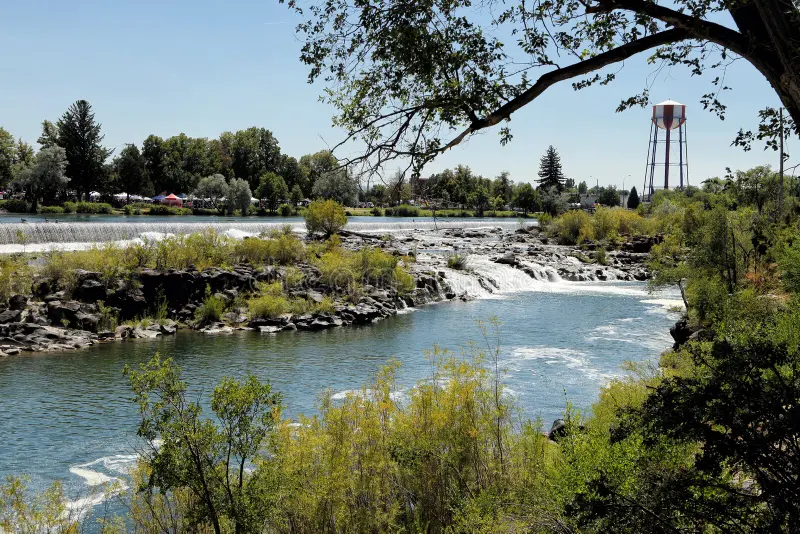
Idaho Falls’s Snake River waterfall anchors a downtown revitalization that reflects the broader economic confidence generated by INL’s expanding federal investment
2026 Economic Outlook
- INL Versatile Test Reactor (VTR) project advancing; new hiring phase beginning
- Advanced reactor programs (sodium-cooled, molten salt) adding research staff
- EIRMC expansion adding healthcare employment
- Ammon and eastern corridor new residential development absorbing growth
- Snake River Landing mixed-use district continued development
- I-15 corridor industrial and logistics expansion
The INL Economic Engine: Understanding the Investment Case
No analysis of Idaho Falls real estate is complete without understanding the Idaho National Laboratory in depth. INL is not merely a large employer. It is a Department of Energy national laboratory whose funding comes directly from the federal budget, making it structurally recession-resistant in a way that private sector employers cannot match.
Why INL Employment Is Recession-Resistant
- DOE annual budget for INL exceeds $1.5 billion and has grown every fiscal year for the past decade
- Nuclear energy research is a bipartisan federal priority; funding survived multiple administration changes
- Advanced reactor programs have 10 to 20 year research timelines; hiring commitments are long-term
- INL is the US’s primary nuclear energy research hub; no political will to reduce it exists
- During 2008 to 2012, when Boise’s real estate fell 20 to 30%, Idaho Falls declined only 8 to 12% due to INL stability
INL Growth Trajectory (2026 and Beyond)
- Versatile Test Reactor (VTR): $6B+ estimated project, creating hundreds of long-term research positions
- Advanced Test Reactor (ATR) upgrades: ongoing capital investment and staffing
- Microreactor development programs attracting private-sector nuclear company partnerships
- Nuclear cybersecurity research expansion adding new specialty hiring
- Grid-scale energy storage research growing in response to national energy policy
- Total projected INL employment growth: 8 to 12% over the next 5 years
For real estate investors, the practical implication is that Idaho Falls’s rental demand is anchored by a workforce that keeps its jobs through recessions, earns above-average incomes, and relocates to the area at a steady rate driven by federal hiring. This creates a demand profile that is both more predictable and more resilient than typical private-sector employment markets.
Historical Performance
| Period | Market Driver | Avg Annual Appreciation | Key Event |
|---|---|---|---|
| 2008-2012 | Great Recession; INL stability cushions impact | -3% to -8% | Idaho Falls outperformed Boise by 10-15 percentage points; INL maintained full staffing |
| 2013-2019 | Steady recovery; INL research expansion begins | 5-8% | Consistent modest appreciation; DOE nuclear energy investment grows |
| 2020-2022 | Pandemic migration; Idaho growth wave | 18-28% | Idaho migration surge reaches Eastern Idaho; remote workers from California and Pacific Northwest |
| 2023-2024 | Rate correction; normalization | 4-7% | Prices held; INL employment buffer supports demand floor |
| 2025-2026 | Rate stabilization; INL VTR project hiring | 7-11% (projected) | New INL program hiring cycle creating sustained in-migration demand |
Idaho Falls’s most distinctive historical characteristic is its performance during recessions. While Boise fell 20 to 30% during 2008 to 2012, Idaho Falls declined only 8 to 12%, demonstrating the stabilizing effect of federal research employment. A $200,000 Idaho Falls property purchased in 2015 would be worth approximately $440,000 to $490,000 today.
Idaho Falls vs. Boise: Understanding the Trade-Off
| Factor | Idaho Falls | Boise Metro |
|---|---|---|
| Median Home Price | $375,000 | $525,000+ |
| Typical Cap Rate (SFH) | 3.5-5.0% | 3.0-4.5% |
| Annual Appreciation | 8-10% | 10-14% |
| Recession Resilience | Very high (federal employment anchor) | Moderate (private sector and tech dependent) |
| Cash Flow | Best in Idaho for SFH; positive possible in multi-family | Negative $800-$1,500/month |
| Market Liquidity | Smaller; longer hold to find buyers | Deeper; more buyers at exit |
| Long-Term Upside | Moderate; ceiling limited by regional economy size | High; largest tech employment concentration in state |
Idaho Falls is the right market for investors who prioritize lower entry cost, better cash flow, and recession-resistant demand over maximum appreciation upside. It is not the right market for investors seeking the highest total returns; Boise’s larger and faster-growing economy produces higher appreciation over full cycles. The ideal investor profile is someone who wants to deploy $85,000 to $120,000 in capital productively, wants the monthly carry to be as low as possible, and values the INL employment anchor’s stability over the Treasure Valley’s growth story.
📚 New to real estate investing? Master the fundamentals with our professional course Learn more →
2. Neighborhood Hotspots
Idaho Falls Investment Neighborhood Map
Interactive map of Idaho Falls and surrounding area. Green stars show top investment hotspots, blue circles mark established markets, and orange circles highlight emerging areas.
Core Investment Neighborhoods
Detailed Submarket Analysis: Idaho Falls Metro
| Neighborhood | Price Range (SFH) | Cap Rate | Growth Drivers | Best Strategy |
|---|---|---|---|---|
| Ammon | $390K-$580K | 4.0-5.2% | INL families, top schools, new construction | Family buy-and-hold, INL relocation rental |
| Skyline / East IF | $350K-$520K | 4.5-5.5% | INL commute corridor, family demand | Buy-and-hold, balanced returns |
| Downtown / Snake River | $280K-$470K | 5.0-6.5% | Revitalization, Snake River Landing, young professional | Value-add, BRRRR, multi-family |
| University Place / North IF | $310K-$490K | 4.8-6.0% | University campus, student/faculty, healthcare | Student housing, balanced LT/STR |
| Sunnyside / Taylor Crossing | $320K-$510K | 4.5-6.0% | Established family area, multi-family stock | Multi-family, value-add, balanced returns |
| West IF / Tiebreaker | $290K-$440K | 5.0-6.0% | Workforce housing, affordable entry | Cash flow focus, workforce housing |
| Snake River Landing | $340K-$580K | 4.5-5.5% | Major new development, river access, urban village | Long-term appreciation, new urban |
| Shelley | $230K-$360K | 5.5-7.0% | Agricultural workforce, lowest entry, cash flow | Maximum cash flow, entry-level hold |
| Rigby / Jefferson County | $290K-$450K | 5.0-6.0% | INL overflow, family community, growth | INL spillover, long-term hold |
Expert Insight: “The most misunderstood segment in Idaho Falls is the relocation rental market. When INL hires a senior nuclear engineer from another national lab, that family typically arrives with a signed lease on a furnished short-term rental while they evaluate neighborhoods, enroll kids in school, and figure out the local market. That transition period runs 6 to 18 months, and properties in Ammon and Skyline that can serve as a quality long-term rental for a family in that situation almost never sit vacant. I have clients who have had the same INL employee household renew for 4 to 5 years before finally buying. That kind of tenant stability is exceptional.” – Patricia Chen, Eastern Idaho Investment Properties
3. Property Types
| Investment Goal | Best Property Type | Best Neighborhoods | Minimum Capital |
|---|---|---|---|
| Positive Cash Flow | Duplex or triplex | Sunnyside, Downtown, West IF | $90,000+ |
| Stable Low-Maintenance Tenant | INL relocation rental SFH | Ammon, Skyline | $100,000+ |
| Best Cash Flow SFH | Workforce housing | West IF, Downtown, Shelley | $70,000+ |
| Maximum Appreciation | New construction Ammon | Ammon, Snake River Landing | $100,000+ |
Don’t guess the costs. Our Complete Renovation & Remodeling Cost Guide covers 400+ pages of project-by-project breakdowns with real contractor pricing ranges.
4. Cost Analysis
Acquisition Cost Breakdown (Idaho Falls)
| Expense Item | Typical Cost | Example ($375,000 Property) | Notes |
|---|---|---|---|
| Down Payment | 25% (investment) | $93,750 | 20% possible with strong profile; FHA at 3.5% for house hack |
| Closing Costs | 2-3% of price | $7,500-$11,250 | Idaho closing costs are moderate; Bonneville County title companies are efficient |
| General Inspection | $325-$500 | $400 | Include radon test; Eastern Idaho is moderate radon zone |
| Irrigation System | $0-$500 | $200 | Many Idaho Falls properties have irrigation water rights; verify system function and annual assessment |
| Initial Repairs | 0-7% of price | $0-$26,250 | Older downtown homes often need mechanical updates; Ammon new construction near zero |
| Reserves (6 months) | 6 months expenses | $9,000-$12,000 | Lower than resort markets; INL employee tenants have low vacancy risk |
| TOTAL MINIMUM ENTRY | ~29-32% of value | $110,950-$143,700 | Among the most accessible entry requirements in Idaho at this property quality level |
Idaho Falls Cash Flow Comparison: Three Property Scenarios
| Item | Scenario A: Ammon SFH ($420K) | Scenario B: Downtown Duplex ($430K) | Scenario C: Workforce SFH ($295K) |
|---|---|---|---|
| Monthly Gross Rent | $1,975 (3BR INL family) | $2,950 (two 2BR units) | $1,600 (3BR workforce) |
| Operating Expenses (36%) | -$711 | -$1,062 | -$576 |
| Monthly NOI | $1,264 | $1,888 | $1,024 |
| Cap Rate | 3.61% | 5.27% | 4.16% |
| Mortgage (25% down, 6.875%) | -$2,062 ($315K loan) | -$2,113 ($322.5K loan) | -$1,452 ($221.25K loan) |
| Monthly Cash Flow | -$798 | -$225 | -$428 |
| Annual Appreciation (8.4%) | +$35,280 | +$36,120 | +$24,780 |
| Total Annual Return | +$29,700 (24.1% on $123K) | +$39,420 (36.9% on $107K) | +$19,644 (23.2% on $85K) |
Key insight from this comparison: The downtown duplex (Scenario B) produces the most attractive total return on invested capital and approaches cash-flow neutrality, demonstrating why multi-family is Idaho Falls’s most sought-after investment segment. The workforce SFH (Scenario C) requires the least capital ($85,000) making it accessible to a broader range of investors. The Ammon INL family rental (Scenario A) shows worse cash flow than the others but delivers the most stable, lowest-maintenance tenancy profile. Strategy selection depends on your capital availability and management preference.
Idaho Falls vs. Boise Cash Flow Comparison: A comparable $525,000 Boise SFH producing $2,200/month in rent shows monthly cash flow of approximately negative $1,100 to $1,400. Idaho Falls’s lower prices mean the same investor capital goes 40% further in terms of asset value, and each Idaho Falls property carries 30 to 50% less monthly negative cash flow. An investor with $325,000 can own three Idaho Falls properties or two Boise properties at similar price-to-rent metrics, with the Idaho Falls portfolio producing meaningfully better collective cash flow.
5. Legal Framework
✅ Idaho State Law: Fully Landlord-Favorable, No Local Additions
Idaho Falls and Bonneville County apply Idaho’s landlord-tenant law with zero local additions. No rent control, no just cause eviction requirements, no source of income mandates, no additional tenant screening rules, and no STR restrictions beyond standard Idaho Code 67-6539 protections. This guide’s previous markets have covered Idaho’s landlord-tenant law in detail (see the Nampa or Post Falls guides for full specifics). Below is a concise summary of the key provisions that Idaho Falls investors use most frequently.
Idaho Residential Landlord-Tenant Act: Key Points
- No Rent Control: Prohibited statewide. Idaho Falls landlords raise rents to market at any lease renewal.
- No Just Cause Eviction: Non-renewal at lease end requires no documented cause.
- 3-Day Non-Payment Notice: Fastest eviction initiation timeline in the region.
- Month-to-Month Termination: 30-day written notice, no cause required.
- Security Deposits: No statutory maximum; return within 21 days.
- Tenant Screening: Full landlord discretion within federal Fair Housing law. No first-in-time rules.
- Section 8: Not mandatory in Idaho; INL employee tenants rarely require housing assistance.
- Eviction Timeline: 3 to 5 weeks uncontested in Bonneville County Magistrate Court.
Idaho Falls-Specific Considerations
- Irrigation Water Rights: Many Idaho Falls properties have irrigation water rights for lawn and garden use. These rights have annual assessments ($50 to $200) and are conveyed with the property. Verify irrigation rights status and infrastructure before purchase.
- Wind and Hail Insurance: Eastern Idaho’s high desert climate produces significant hail events. Verify roof and siding condition and budget for hail damage insurance or roof replacement every 15 to 20 years.
- Freeze Risk: Idaho Falls winters are colder than Boise; outdoor pipes, irrigation systems, and HVAC systems need winterization. This is standard operating procedure for local property managers.
- INL Security Clearances: Some INL employees have federal security clearances that affect their financial privacy. Landlords will find that standard credit checks are complete; clearance holders are typically excellent tenants.
Useful Idaho Falls Resources
- Idaho Rental Owners Association: idahoroma.org
- Bonneville County Magistrate Court: co.bonneville.id.us
- City of Idaho Falls permits: idahofallsidaho.gov
6. Step-by-Step Idaho Falls Investment Playbook
Choose Your Idaho Falls Strategy
INL Employee Rental (Ammon/Skyline)
Target INL relocation families with quality 3 and 4-bedroom homes near top schools. Sacrifice some cash flow for exceptional tenant stability. These households stay 2 to 5+ years, have $85,000+ incomes, and create zero landlord headaches.
Multi-Family Cash Flow (Near Positive)
Buy duplexes or triplexes in Sunnyside, Downtown, or West IF. Idaho Falls’s best cash flow opportunity; can achieve positive cash flow with well-priced multi-family and good rent optimization. Best total return on invested capital in the city.
Workforce Housing Cash Flow
Buy entry-level SFH in West IF, Downtown, or Shelley. Idaho Falls’s best SFH yield. Less negative monthly carry than any other Idaho city. Tenant base of agricultural and service workers; stable, not high-income.
Value-Add / BRRRR
Acquire dated properties in Downtown or West IF at $260,000 to $360,000. Renovate to push rents 25 to 35% above unrenovated comparables. Refinance recovered equity. Eastern Idaho contractors are more affordable than Treasure Valley, improving BRRRR economics.
Tap into the INL Relocation Pipeline
Idaho Falls’s most distinctive investment advantage is its connection to INL’s ongoing relocation program. INL brings in dozens of new hires every year who need temporary housing before purchasing. Here is how to access this tenant pipeline:
- INL Relocation Coordinator Network: INL’s HR department works with approved local property managers and landlords who meet specific quality standards. Properties that are placed on the INL-approved housing list receive direct referrals from the lab’s relocation coordinator when new employees arrive. Contact INL’s HR community resources office to understand how to get on this list.
- Battelle Energy Alliance: Battelle manages INL and has its own corporate housing coordinator. Properties that meet Battelle’s guest housing standards receive short-term furnished rental referrals for relocating employees at $3,500 to $5,000 per month.
- Facebook Groups: “INL Employees Housing” and “Idaho Falls New Residents” Facebook groups are where INL new hires look for housing. Active posting in these groups generates tenant applications directly from the highest-income, most stable tenant segment in eastern Idaho.
- Ammon-specific properties: For family-oriented INL rentals, properties in Ammon’s top-rated school zones (Bonneville School District) are specifically what INL families request. Mentioning the school district in your listing is the single most effective targeting mechanism for this tenant segment.
Idaho Falls Due Diligence
Physical Due Diligence
- Full inspection including crawlspace and roof; Eastern Idaho’s hail and freeze cycles create specific wear patterns
- Radon test (Eastern Idaho moderate radon zone)
- HVAC system age and capacity; Idaho Falls winters are colder than Boise (-10°F events are common)
- Irrigation water rights and system: verify rights are conveyed with property and annual assessment amount
- Verify city water and sewer (older properties occasionally on private well/septic even within city limits)
- Electrical service adequacy (many 1960s-1980s Idaho Falls homes need service panel upgrades)
Market and Financial Due Diligence
- Verify current rent against actual rental comparables in the specific neighborhood; Ammon rents are 10 to 15% above Downtown for comparable bedrooms
- Confirm INL hiring cycle timing; new employee waves typically arrive in June through August and December through January, creating predictable seasonal rental demand peaks
- For multi-family: review existing lease terms, payment history, and any maintenance deferred by seller
- Check Bonneville County assessment for any outstanding special assessments or irrigation district fees
- Verify no flood zone designation (Snake River flood zones affect some downtown properties)
Building Your Idaho Falls Team
- Bonneville County Investor Agent: Idaho Falls is a smaller market where local relationships matter. Ask specifically: “What is your experience with INL relocation tenant placements?” An agent who has worked with INL HR’s housing referral program is worth significantly more than one who has not.
- Eastern Idaho Property Manager: Ask about their INL tenant screening process and whether they are on the INL HR approved housing list. Verify they have specific experience managing properties in Ammon’s school zones where the INL premium demand is concentrated. Management fees run 8 to 10% in Idaho Falls, competitive with Boise metro.
- Idaho Falls CPA: Idaho state income tax at 5.8% applies to rental income. An eastern Idaho CPA familiar with Bonneville County assessment appeals and irrigation water right tax treatment is valuable for portfolio optimization.
- Renovation Contractor (for BRRRR strategy): Eastern Idaho contractors are generally 15 to 25% more affordable than Treasure Valley for comparable renovation work. Bonneville County permitting is straightforward. Get 3 competitive bids on any renovation plan.
Property Management in Idaho Falls
Tenant Screening for Idaho Falls’s Market
Idaho Falls’s diverse tenant pool spans high-income federal employees to working-class agricultural workers. Screening criteria should be calibrated to the property and neighborhood:
- Ammon / Skyline (INL properties): Income 2.5 to 3x rent (easily met by INL employees), employment verification via federal contractor or DOE letter, rental history verification, credit minimum 650+
- Workforce housing (West IF / Downtown): Income 2.5x rent, employment verification via pay stubs, rental history with direct landlord contact, credit minimum 550 to 580
- Multi-family (all areas): Apply consistent criteria to each unit; Idaho’s landlord-friendly law allows full discretion. Document all screening decisions with written records.
Typical Idaho Falls Property Management Fees
- Single-family management: 8-10% of monthly collected rent
- Multi-family management: 7-9% of monthly collected rent
- Leasing fee: 50-75% of one month’s rent
- Lease renewal fee: $100-$200 per renewal
- Irrigation system winterization: $75-$150 annually (additional service)
7. Financing Options for Idaho Falls
| Loan Type | Down Payment | Rate Premium | Best For | Idaho Falls Note |
|---|---|---|---|---|
| Conventional Investment | 25% | +0.5-0.75% | Standard SFH or condo investment | All Idaho Falls properties well under conforming limit; straightforward approval process |
| FHA (House Hack) | 3.5% | Standard + MIP | Owner-occupying 2-4 unit property | Idaho Falls duplexes fit comfortably within FHA limits; best entry strategy for new investors with limited capital |
| DSCR Loan | 25-30% | +1.5-2.5% | Self-employed, rental income qualifying | Idaho Falls is the most DSCR-viable major Idaho market; lower prices and higher rents relative to value mean some properties actually qualify at 1.0x DSCR, especially duplexes |
| Portfolio Loan | 20-30% | +1-2% | Multiple properties, self-employed scaling | Idaho Central Credit Union and D.L. Evans Bank serve Bonneville County with competitive local portfolio products |
| Conventional 20% Down | 20% | +0.75-1.25% (PMI) | Capital preservation across multiple deals | Useful for investors scaling a multi-property portfolio; lower down payment frees capital for additional acquisitions |
| Hard Money (Bridge) | 15-25% | 9-13% rate | BRRRR acquisitions, value-add | Several Boise-based hard money lenders extend to Bonneville County for value-add deals |
DSCR Loan Advantage in Idaho Falls: Idaho Falls is the only major Idaho metro market where DSCR loans are broadly viable for single-family investment properties. In Boise, low cap rates mean rental income rarely covers debt service at 1.0x coverage. In Idaho Falls, the better price-to-rent ratio means some properties, particularly duplexes and entry-level SFH, can achieve DSCR qualification. This is significant for self-employed investors and those with complex income pictures who struggle with conventional income documentation requirements. Idaho Central Credit Union is the first call for any Idaho Falls investor exploring DSCR options.
8. Frequently Asked Questions

Knowledge Quiz: Idaho Falls Real Estate Investment
Open Quiz
5 quick questions on what you just learned about Idaho Falls investing
1) Why is Idaho Falls described as having more recession-resistant rental demand than Boise, and what specific historical evidence supports this?
Answer: C
The guide states that INL’s DOE funding is recession-resistant because nuclear research funding continues through economic cycles. During the 2008 to 2012 Great Recession, Idaho Falls prices declined only 8 to 12% while Boise fell 20 to 30%, a 10 to 15 percentage point outperformance directly attributable to INL maintaining full staffing. The guide also notes INL’s budget has grown every fiscal year for the past decade and that nuclear energy research has bipartisan support that insulates it from single-party funding shifts.
2) What makes Idaho Falls the most DSCR-viable major Idaho market for investment property financing?
Answer: B
The guide describes Idaho Falls as “the most DSCR-viable major Idaho market” because its better price-to-rent ratio (lower prices, proportionally strong rents) means rental income covers debt service at 1.0x coverage on some properties, particularly duplexes. DSCR loans are standard nationally but fail to qualify most properties in Boise, Coeur d’Alene, and Sun Valley because cap rates are too low relative to current mortgage rates. Idaho Falls’s stronger cap rates make DSCR qualification achievable, which is significant for self-employed investors and those with complex income situations who need no-income-documentation financing.
3) What is the INL relocation pipeline and how can investors access it to reduce vacancy?
Answer: A
The guide describes the INL relocation pipeline as a key Idaho Falls investment advantage. INL HR works with approved local property managers and landlords who meet quality standards to provide direct referrals to incoming new hires who need temporary rental housing before purchasing. The guide also mentions Battelle Energy Alliance (INL’s manager) as having its own corporate housing coordinator for furnished short-term rentals. Additionally, the “INL Employees Housing” Facebook group is identified as a direct tenant sourcing channel. Properties on Ammon’s Bonneville School District territory are specifically what INL family tenants request.
4) What is an irrigation water right and what is the practical impact on Idaho Falls rental properties?
Answer: D
The guide explains that irrigation water rights are Western property rights attached to land parcels allowing use of Snake River water for seasonal lawn and garden irrigation. Properties with irrigation rights have a secondary water line or ditch access. Tenants value these rights because they reduce water bills substantially during the growing season, allowing properties to command 3 to 5% higher rents than comparable properties without irrigation. Annual district assessments of $50 to $200 are a required operating expense. Investors must verify rights are properly conveyed with the property and that the irrigation infrastructure is functional.
5) According to the three-scenario cash flow comparison, which Idaho Falls investment approach produces the best total annual return on invested capital?
Answer: C
The guide’s cash flow comparison table shows that Scenario B (the downtown duplex at $430K) produces 36.9% total annual return on $107K invested, significantly better than Scenario A’s 24.1% or Scenario C’s 23.2%. Additionally, the duplex shows only -$225/month negative cash flow, approaching cash-flow neutrality, versus -$798/month for the Ammon SFH and -$428/month for the workforce SFH. The guide notes this is why “multi-family is Idaho Falls’s most sought-after investment segment” and that well-priced duplexes in Sunnyside or Downtown can approach or achieve positive cash flow.
Work With a Local Expert in Idaho Falls
We are building a verified network of real estate professionals across every market we cover.

About Our Expert Network
Idaho Falls specialists are selected specifically for INL relocation market knowledge, multi-family investment experience, and Bonneville County transaction history.
- INL relocation tenant pipeline connections and HR coordination experience
- Bonneville School District neighborhood expertise
- Multi-family opportunity identification in Sunnyside and Downtown
- Irrigation water rights verification and assessment analysis
- BRRRR opportunity identification in Downtown and West IF
- Property management referrals with INL tenant screening experience
Services Covered
- INL relocation rental targeting
- Investment analysis and underwriting
- Multi-family sourcing
- Buyer representation
- BRRRR opportunity identification
- Renovation guidance
- Legal and title referrals
- Eastern Idaho financing
- Property management referrals
- Insurance referrals
- 1031 exchange coordination
- Exit strategy planning
Get Connected or Join Our Network
Looking for a local expert to help with your Idaho Falls investment? We will connect you with the right professional.
Contact us at support@buildsandbuys.com
Find Specialized Idaho Falls Real Estate Professionals
Ready to Invest in Idaho Falls?
Idaho Falls is the market for investors who are done settling for deeply negative cash flow as the price of admission to Idaho’s growth story. The INL employment anchor provides recession-resistant demand from high-income, long-tenured professionals who stay in their rentals for years. The multi-family segment offers the closest thing to cash-flow-positive investing available in the state at conventional financing. Entry prices 30 to 40% below Boise mean capital goes further, portfolios scale faster, and the monthly carry is manageable. The Idaho Falls investor who understands INL’s growth trajectory, accesses the relocation pipeline, and targets the right property type for their capital can build genuine wealth with a risk profile that is simply unavailable in Idaho’s faster-moving but more volatile western markets.
Continue Your Research
For further guidance, explore our State-by-State Investor guides, browse our expert articles, or follow our Step-by-Step Investment Guide.