Boise Real Estate Investment Guide For 2026
A comprehensive resource for investors looking to capitalize on one of America’s fastest-growing mid-size cities, powered by tech migration, outdoor lifestyle appeal, and some of the most investor-friendly laws in the Western United States in 2026
Quick answers: Top 5 most searched Boise investment questions ▼
Migration data: Where people are moving from to Boise ▼
In This Guide
Click on any section to navigate directly to that content
1. Boise Market Overview
Market Fundamentals
Boise has emerged as one of America’s most watched real estate markets over the past decade, transforming from a quiet state capital into a nationally recognized tech and lifestyle destination. The city’s remarkable growth story is built on durable foundations: a diversified tech economy anchored by Micron Technology and a growing startup ecosystem, no state income tax that makes every paycheck worth more, world-class outdoor recreation within an hour of downtown, and one of the most landlord-friendly regulatory environments in the Western United States.
Key economic indicators defining Boise’s investment case:
- Population: 240,000+ city proper, 770,000+ Boise Metro
- Major Employers: Micron Technology, Hewlett Packard Enterprise, St. Luke’s Health System, St. Alphonsus, Clearwater Analytics, IDACORP, Boise State University
- Median Household Income: $70,000+ and rising with continued tech migration
- Job Growth: 3.2% annually, consistently above the national average
- No State Income Tax: Effective tax advantage of 4-9% salary premium vs California, Oregon, or Washington residents
- Vacancy Rate: Under 3% across most Boise submarkets
Boise’s economy has diversified significantly beyond its traditional agriculture and government base. Semiconductor manufacturing (Micron), enterprise software (Clearwater Analytics), healthcare systems, and a growing ecosystem of tech startups now anchor the employment base. This diversification has reduced the boom-bust cycle that characterized earlier Idaho economies and created sustained demand for quality housing across income levels.
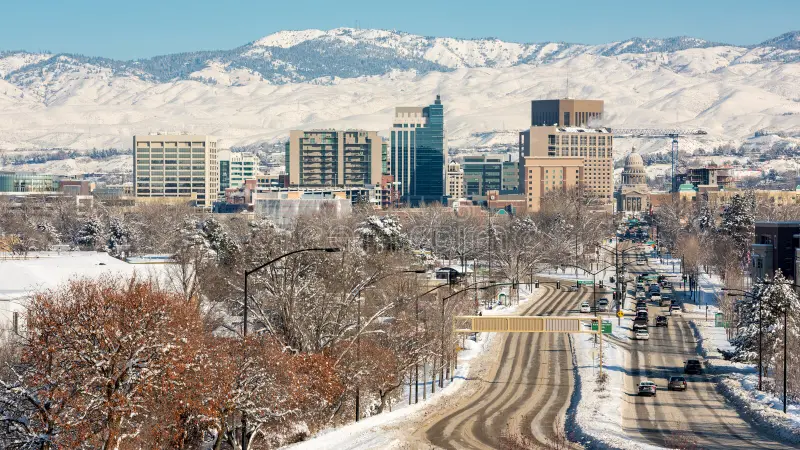
Boise’s distinctive skyline backed by the Foothills reflects a city that has grown rapidly while retaining the outdoor lifestyle appeal that drives continued in-migration
2026 Economic Outlook
- Micron Technology’s CHIPS Act-funded expansion adding high-wage semiconductor manufacturing jobs
- Amazon, Salesforce, and Workday expanding Boise office footprints
- Boise State engineering and computer science enrollment growing to feed local tech pipeline
- St. Luke’s and St. Alphonsus healthcare systems expanding capacity and hiring
- Boise Airport direct flight routes expanding, improving hybrid commuter viability to major metros
Investment Climate
Boise’s investment environment offers something increasingly rare in the Western United States: meaningful current income combined with strong appreciation potential in a genuinely investor-friendly regulatory framework. The contrast with California, Oregon, and Washington is stark and is itself a driver of investor interest:
- No rent control anywhere in Idaho, giving investors full flexibility on pricing
- Straightforward eviction process averaging 20-30 days vs 60-180+ days in West Coast markets
- No just cause eviction requirement allowing landlords to exit relationships professionally
- No security deposit cap providing stronger upfront tenant commitment
- Strong appreciation fundamentals tied to durable employment and migration drivers
- Lower entry costs than comparable quality markets in Seattle, Portland, or Bay Area
The pandemic period (2020-2022) brought extraordinary attention and price appreciation to Boise, pushing some metrics to unsustainable levels. The subsequent normalization has created a more rational entry environment. Investors who understand the difference between the frothy 2021 pricing and the current market are finding genuine opportunities, particularly in value-add Bench and North Nampa properties where pandemic-era buyers have created motivated seller situations.
Historical Performance
| Period | Market Driver | Avg Annual Appreciation | Key Event |
|---|---|---|---|
| 2010-2014 | Post-recession recovery, steady in-migration begins | 4-6% | Micron stabilizes; Boise tech ecosystem begins to form |
| 2015-2019 | Tech migration wave, national media attention begins | 8-14% | Boise named top relocation destination by multiple national surveys |
| 2020-2022 | Pandemic relocation boom, remote work unlocks migration | 18-30% | Boise briefly ranks as fastest-appreciating major U.S. market |
| 2023-2024 | Rate shock, market normalization from peak | 2-5% | Inventory rises from historic lows; market rebalances toward buyers |
| 2025-2026 | Rate stabilization, CHIPS Act investment, sustained migration | 8-12% (projected) | Micron expansion and tech hiring restart driving premium demand |
Boise’s 15-year appreciation track record, even accounting for the pandemic spike and subsequent normalization, shows average annual appreciation of approximately 9-11%. A $250,000 Boise property purchased in 2010 would typically be worth $650,000-$800,000 today. The long-term compounding driven by employment growth, migration, and geographic constraints from the Foothills to the north and Snake River to the south forms the durable investment thesis.
Demographic Trends Driving Demand
- California Tech Migration – Bay Area and LA tech workers keeping coastal salaries while eliminating state income tax create immediate premium for quality rental and purchase properties in Boise’s most desirable neighborhoods
- Micron Technology Workforce – Thousands of semiconductor manufacturing and engineering employees, many recruited nationally and internationally, creating stable high-income rental demand near the Micron campus
- Boise State University – 24,000+ students and a growing research and startup ecosystem anchor affordable rental demand in Southeast Boise and the Bench
- Healthcare System Growth – St. Luke’s and St. Alphonsus, together employing tens of thousands, create consistent mid-market rental demand from nurses, physicians, and administrative staff
- Outdoor Recreation Premium – The Boise Foothills trail system, Bogus Basin ski resort, and proximity to world-class outdoor recreation create lifestyle demand that has proven remarkably durable through rate cycles
- Geographic Constraints – Foothills to the north, Snake River Plain topography, and established city limits create meaningful supply pressure on core Boise neighborhoods that has historically supported values
📚 New to real estate investing? Master the fundamentals with our professional course Learn more →
2. Neighborhood Hotspots
Boise Investment Neighborhood Map
Interactive map of Boise Metro investment neighborhoods. Green stars show top hotspots, blue circles mark established markets, and orange circles highlight emerging areas.
Core Investment Neighborhoods
Detailed Submarket Analysis: All Boise Metro Neighborhoods
| Neighborhood | Price Range (SFH) | Cap Rate | Growth Drivers | Best Strategy |
|---|---|---|---|---|
| North End | $550K-$1.2M+ | 3.5-4.5% | Historic stock, walkability, Hyde Park, Foothills access | Appreciation, premium rental, ADU development |
| Downtown Boise | $350K-$750K | 4.0-5.5% | Tech employment, Greenbelt, entertainment, walkability | Condo appreciation, urban rental, mixed-use adjacent |
| Southeast Boise / Bown | $400K-$700K | 4.5-5.5% | Boise State, park access, Bown Crossing, Foothills | Student/faculty housing, balanced returns, SFH hold |
| Bench / Vista | $320K-$550K | 5.0-6.5% | Value-add potential, centrality, affordability, revitalization | Best city-limits cash flow, BRRRR, value-add SFH |
| West Boise / Garden City | $370K-$600K | 4.5-5.5% | Employment access, river corridor, redevelopment, mid-market | Balanced returns, family rentals, Garden City riverfront |
| Meridian | $450K-$750K | 4.5-5.5% | Top schools, Micron, new construction, family migration | Family rentals, new construction hold, stable income |
| Eagle | $600K-$1.5M+ | 3.5-4.5% | Luxury market, executive demand, golf, premium schools | Executive rentals, appreciation play, luxury hold |
| Northgate / Harris Ranch | $600K-$1.1M | 3.5-4.5% | Foothills trail access, newer construction, premium schools | Premium SFH hold, trail-access premium, outdoor enthusiast tenants |
| Nampa | $280K-$480K | 5.5-7.0% | Manufacturing, NNU, affordability, metro expansion | Best metro cash flow, workforce housing, multi-family |
| Star / Kuna | $380K-$650K | 4.0-5.5% | New construction, growth corridor, family appeal, affordability | Long-term growth play, new construction, 5+ year hold |
| Caldwell | $275K-$450K | 5.5-7.0% | Metro affordability leader, revitalization, workforce demand | Maximum metro cash flow, value-add heavy, patient hold |
Expert Insight: “The best opportunity in Boise right now that most outside investors miss is the Bench. They come to Boise expecting to buy in the North End or Meridian, but the Bench is where the actual math works in 2026. Properties that need $40,000-$80,000 in work are trading at discounts that make the total investment, including renovation, pencil at 5.5-6.5% cap rates. That doesn’t exist anywhere else in the Western U.S. at a market of this quality. And the appreciation story is real, not speculative, it’s driven by Boise’s employment growth and in-migration that has been consistent for 15 years.” – Tyler Morrison, CCIM, Intermountain Investment Properties
3. Property Types
| Investment Goal | Best Property Type | Best Neighborhoods | Minimum Capital |
|---|---|---|---|
| Maximum Appreciation | Historic SFH in supply-constrained core neighborhoods | North End, Eagle, Northgate | $150,000+ |
| Best Metro Cash Flow | Small multi-family or workforce SFH | Nampa, Caldwell, Bench | $70,000+ |
| Balanced Returns | Value-add SFH in transitional corridor | Bench, Southeast Boise, West Boise | $85,000+ |
| Lowest Management | New construction SFH or townhome | Meridian, Eagle, Star | $115,000+ |
Don’t guess the costs. Our Complete Renovation & Remodeling Cost Guide covers 400+ pages of project-by-project breakdowns with real contractor pricing ranges.
4. Cost Analysis
Acquisition Cost Breakdown (Boise)
| Expense Item | Typical Cost | Example ($525,000 Property) | Notes |
|---|---|---|---|
| Down Payment | 25% (investment) | $131,250 | Standard for investment properties; FHA with 3.5% available for house hackers |
| Closing Costs | 2-3% of price | $10,500-$15,750 | Title, escrow, lender fees; Idaho closing costs are below national average |
| General Inspection | $350-$600 | $450 | Include radon test (common in Idaho), sewer scope for older properties |
| Radon Testing | $100-$200 | $150 | Idaho has elevated radon levels in many areas; mitigation systems run $800-$2,500 |
| Sewer Scope (pre-1990 homes) | $150-$300 | $200 | Bench and older Boise homes; lateral replacements run $5K-$15K |
| Initial Repairs | 0-10% of price | $0-$52,500 | Variable; older Bench properties often need HVAC, electrical, or kitchen updates |
| Reserves (6 months) | 6 months expenses | $10,000-$15,000 | Emergency fund for vacancy and repairs |
| TOTAL MINIMUM ENTRY | ~28-32% of value | $152,550-$215,150 | Meaningfully more accessible than equivalent-quality California or Seattle markets |
Sample Cash Flow Analysis: Bench Area Single-Family + ADU
| Item | Monthly | Annual | Notes |
|---|---|---|---|
| Main House Rent | $2,100 | $25,200 | 3BR, Bench area, renovated |
| ADU Rent (garage conversion) | $1,100 | $13,200 | 1BR ADU, $145K build cost |
| Gross Income | $3,200 | $38,400 | |
| Less Vacancy (4%) | -$128 | -$1,536 | Conservative for strong Boise demand; actual vacancy often lower |
| Property Taxes | -$258 | -$3,096 | ~0.46% effective rate on $670K assessed (Idaho property taxes are low) |
| Insurance | -$130 | -$1,560 | Landlord policy; Idaho insurance rates below California/Oregon average |
| Property Management (10%) | -$320 | -$3,840 | Professional management recommended; Boise PM fees are below national average |
| Maintenance + CapEx | -$256 | -$3,072 | 8% of rent for renovated older home |
| Net Operating Income | $2,108 | $25,296 | Before mortgage |
| Mortgage ($670K total, 25% down, 6.75%, 30yr) | -$3,260 | -$39,120 | P&I on $502,500 loan |
| CASH FLOW | -$1,152 | -$13,824 | Mildly negative, far better than equivalent California markets |
| Cap Rate | 3.78% | NOI / Total Cost ($670,000) | |
| Total Return (10.5% appreciation) | ~38% | Including appreciation, principal paydown, and tax benefits vs capital invested |
This example illustrates why Boise’s value proposition is compelling for Western U.S. investors: the same $167,500 in capital invested in a Bench + ADU property delivers roughly 38% total annual return, in a market with genuinely landlord-friendly laws and far lower ongoing regulatory burden than comparable California or Washington markets. Without the ADU, the same Bench property would show approximately $800-$1,000/month deeper negative cash flow, reinforcing the ADU development thesis in Boise just as it does in the San Fernando Valley or Sherman Oaks.
Expert Insight: “Investors who compare Boise to California markets often underestimate the Idaho tax advantage when they calculate total return. An investor who moved from California to Boise and invests here is not just earning rental income, they are also saving $15,000-$40,000 annually in state income tax. That tax saving alone can absorb negative cash flow on two or three Boise investment properties. When you frame it that way, Boise is actually a cash-positive proposition for many California-income investors, the negative carry on the property is simply offset by the tax savings on their salary.” – Amanda Chen, Real Estate Portfolio Advisor, Boise Capital Group
5. Legal Framework
✅ Idaho: One of America’s Most Landlord-Friendly States
Idaho consistently ranks in the top 5 most landlord-friendly states in the United States. There is no rent control anywhere in Idaho, no just cause eviction requirement, no source-of-income protection laws, and a streamlined eviction process that typically resolves non-payment cases in 20-30 days. For investors coming from California, Oregon, or Washington, the regulatory contrast is dramatic and directly increases net operating income and reduces management risk. This guide provides an overview only. Always consult an Idaho-licensed real estate attorney for specific guidance on your investments.
Idaho Landlord-Tenant Law
Idaho’s landlord-tenant framework is defined by the Idaho Residential Landlord and Tenant Act (Idaho Code Title 6, Chapter 3) and is notable primarily for what it does NOT restrict:
- No Rent Control: Idaho state law preempts local rent control ordinances. No city or county in Idaho can impose rent stabilization or rent caps. Landlords may charge any rent amount and increase rent at any time with proper notice.
- No Just Cause Eviction: Idaho does not require documented cause to terminate a month-to-month tenancy or to decline lease renewal for a fixed-term tenant. 30-day written notice terminates a month-to-month tenancy for any reason.
- No Security Deposit Cap: Idaho does not limit the amount a landlord can collect as a security deposit. Industry convention is typically one month’s rent, but nothing prevents larger deposits for tenants with weaker credit or rental histories.
- No Source-of-Income Protection: Idaho landlords are not required to accept tenants using Section 8 vouchers or other housing assistance programs. Screening based on payment source is permitted.
- No First-in-Time Rule: Landlords may select among qualified applicants using their own criteria. There is no requirement to offer tenancy to the first qualifying applicant.
- Maintenance Requirements: Landlords must maintain fit and habitable premises. Tenants must give written notice of needed repairs; landlords have a reasonable time to respond (typically interpreted as 3 days for emergency conditions, 10 days for non-emergency).
- Security Deposit Return: Must be returned within 21 days of tenancy termination with an itemized statement of deductions.
Idaho Eviction Process
Idaho’s eviction process is among the most efficient in the United States, reflecting the state’s landlord-friendly legal philosophy:
- Non-Payment Notice: 3-day pay-or-quit notice served personally or by substituted service plus mail
- Lease Violation Notice: 3-day notice to cure or quit for material lease violations
- No-Cause Termination: 30-day written notice for month-to-month tenants (no cause required)
- File Unlawful Detainer: If tenant does not comply, file in Ada County District Court or Magistrate’s Division. Filing fee approximately $75-$155.
- Summons and Service: Typically served within 3-5 days
- Response Period: 5 business days for tenant to file a written answer
- Hearing: Typically scheduled within 7-14 days of filing if contested; default judgment if no response
- Writ of Possession: Issued by court upon judgment in landlord’s favor
- Sheriff Execution: Ada County Sheriff executes writ within 3-7 days
Total realistic timeline: 20-35 days for non-payment evictions. 35-60 days for contested lease violation cases. Compare this to 60-180+ days in California, 45-90 days in Washington, or 90-180 days in Oregon. Attorney fees for contested Idaho evictions typically run $1,000-$3,000, a fraction of West Coast equivalents.
Idaho Landlord Resources
- Idaho Landlord Association: idaholandlordassociation.com
- Idaho Code Title 6 (Landlord-Tenant): legislature.idaho.gov
- Ada County Court Self-Help: adacounty.id.gov/magistrate
- Idaho Legal Aid (tenant resources): idaholegalaid.org
| Regulation | Idaho / Boise | California | Investor Impact |
|---|---|---|---|
| Rent Control | None anywhere in Idaho | AB 1482: 5%+CPI cap; LA RSO for pre-1978 buildings | Idaho investors can raise rents to market at any time with proper notice |
| Eviction | No just cause required; 20-35 day process | Just cause required; 60-180 days typical | Idaho landlords can efficiently exit bad tenancies |
| Security Deposit | No statutory cap; 21-day return | AB 12: 1 month cap; 21-day return | Idaho investors can collect larger deposits for higher-risk tenants |
| Tenant Screening | Full landlord discretion (within fair housing) | First-in-time rule (LA City), source of income protections | Idaho landlords can select the best-qualified tenant from any applicant pool |
| Rent Increase Notice | No minimum notice period (beyond lease terms) | 30-day notice for under 10%; 90 days for 10%+ | Idaho rent adjustments can be implemented on the landlord’s schedule |
| Short-Term Rentals | Boise license required; no primary residence restriction | LA City: primary residence only; 120-day cap for investment properties | Boise investors can operate STRs on investment properties with proper licensing |
6. Step-by-Step Boise Investment Playbook
Define Your Boise Strategy
Boise accommodates multiple investment strategies simultaneously. Deciding which one you are executing before searching prevents the common mistake of applying appreciation-market logic to a cash flow opportunity or vice versa:
Premium Appreciation Play
Buy in supply-constrained historic neighborhoods. Accept neutral to mildly negative cash flow in exchange for strong and consistent appreciation driven by the durable demand from California in-migrants and tech employment growth.
Value-Add / BRRRR
Buy dated Bench or West Boise properties. Renovate to current market standards. Achieve meaningfully improved rents and ARV. Refinance out equity, repeat. Boise’s value-add math is among the strongest available in any Western city.
Cash Flow Multi-Family
Acquire duplexes and small multi-family in Nampa, Caldwell, or the Bench. Best available cash-on-cash returns in the Boise Metro. No rent control means full market-rate flexibility at every tenancy transition.
New Construction Stable Hold
Buy new construction in Meridian, Star, or Kuna. Modern systems, warranties, and current energy standards attract quality tenants with minimal maintenance surprises. Best strategy for out-of-state investors who want low management intensity.
Build Your Boise Team
Boise’s market moves quickly and rewards investors with strong local networks. Non-negotiable team members:
- Boise Investment-Specialist Agent: Must understand investor underwriting, not just residential transactions. Should have their own investment portfolio in Boise or have represented 20+ investor transactions specifically. Ask them about their view on the Bench vs North End cap rate differential.
- Idaho Real Estate Attorney: For entity setup (LLC is strongly recommended for asset protection), lease review, and understanding Idaho-specific landlord rights. Idaho’s favorable laws work best when properly structured.
- Boise Property Manager: Interview on their eviction experience, vacancy timelines, and approach to rent increases between tenancies. Good Boise PMs average 4-7% vacancy and increase rents to market at every turnover.
- Value-Add Contractor: If pursuing BRRRR, your contractor relationships determine your returns. Boise’s construction labor market has tightened; pre-qualifying contractors before purchase is essential.
- Idaho-Experienced CPA: For depreciation strategy, LLC structure, and understanding Idaho’s tax environment including the lack of state income tax on investment income for Idaho residents.
Expert Tip: The best indicator of a Boise property manager’s quality is their rent growth data. Ask: “What was the average rent increase at lease renewal for your portfolio over the past two years?” A well-run Boise PM should have been achieving 8-15% increases at turnover during the 2021-2023 period. Managers showing flat rent rolls are leaving significant income on the table given Idaho’s no-rent-control environment.
Boise-Specific Due Diligence
Physical Due Diligence
- Radon testing (Ada County has elevated radon levels; factor in mitigation costs if detected)
- HVAC condition (Boise has both summer heat and winter cold; aging systems are a landlord liability)
- Sewer scope for pre-1990 properties (clay laterals common on the Bench)
- Foundation condition for hillside North End and Foothills-adjacent properties
- Irrigation system condition (common in Boise; many properties have pressurized irrigation rights that require maintenance)
- Roof condition (Boise’s freeze-thaw cycles accelerate aging of low-quality roofing)
- Insulation quality for older homes (Boise winters require adequate insulation to maintain habitability standards)
Regulatory and Market Due Diligence
- Verify zoning for any planned conversion, ADU, or short-term rental use before purchase
- Pull permits for all improvements (unpermitted work affects financing and resale)
- Review any existing lease for term, current rent, and tenant move-in date
- Check comparable rental rates in the specific micro-neighborhood (Bench rents vary significantly by block)
- Research any planned infrastructure or zoning changes near the property through the City of Boise Planning Department
- For new construction: verify builder’s warranty coverage and HOA rules if applicable
- Confirm water rights and pressurized irrigation system status, as these are typically included in property value but require maintenance
Competing in Boise’s Market
- Move fast on Bench properties: Well-priced value-add Bench properties receive multiple offers within days in 2026. Investors with pre-approved financing, flexible closing timelines, and contractors pre-lined up consistently win over higher offers contingent on extensive due diligence.
- Pre-inspections: For properties under $600K in competitive submarkets, conducting your inspection before submitting allows clean, non-contingent offers that win against higher bids. Cost: $400-$600 without guarantee.
- Off-market sourcing: The best Bench and North End deals rarely hit Zillow. Relationships with Boise’s investment-specialist agents, direct mail to long-term owners in target zip codes, and participation in the Boise Real Estate Investors Association (BRIA) unlock inventory that never reaches the MLS.
- New construction reservations: In Meridian and Star, getting on builder waitlists before community launch often allows purchase at initial pricing before appreciation has been built in through successive phases.
- Manage renovation expectations: Boise’s construction labor market has tightened considerably. Renovation timelines and costs are higher than they were 3-4 years ago. Budget conservatively and assume at least 15-20% cost overrun contingency on any value-add project.
Property Management in Boise
Idaho’s landlord-friendly laws mean professional Boise property management delivers genuinely different results than equivalent management in California or the Pacific Northwest. Key management advantages and priorities:
Rent Optimization Strategy
Idaho’s no-rent-control environment creates full flexibility to optimize rents. A systematic approach:
- Research comparable rental rates in the specific sub-neighborhood every 6 months using Rentometer, Zillow Rent Zestimate, and direct comparable analysis
- At every lease renewal, offer a market-rate renewal or allow the tenancy to go month-to-month and re-price at the next opportunity
- When units turn vacant, list at current market rather than prior rent. Boise’s strong demand supports rapid re-tenanting at market rates
- For value-add properties, complete all planned renovations between tenancies to justify market-rate pricing from day one of the new tenancy
Typical Boise Management Fees
- Single-family management: 8-10% of monthly rent
- Multi-family management: 6-9% of monthly rent
- Leasing fee: 50-100% of first month’s rent
- Lease renewal fee: $100-$250 per renewal
- Eviction coordination: $200-$500 flat fee (not including court costs)
Note: Boise’s management fees are meaningfully below West Coast equivalents, reflecting the simpler regulatory environment and lower eviction costs that reduce management complexity and risk.
7. Financing Options for Boise
| Loan Type | Down Payment | Rate Premium | Best For | Boise Note |
|---|---|---|---|---|
| Conventional Investment | 25% | +0.5-0.75% | Strong W-2 income, good credit | Most Boise properties fall within conforming limits ($806,500); conventional financing widely available |
| DSCR Loan | 25-30% | +1.5-2.5% | Investors preferring no income verification | Boise’s cap rates of 4.5-6.5% in value-add submarkets mean many properties approach or achieve 1.0x DSCR qualification, unlike premium West Coast markets |
| FHA House Hack | 3.5% | Standard + MIP | Owner-occupying one unit of 2-4 unit property | Excellent Boise entry strategy; Bench and Nampa duplexes work well; live in one unit, rent the other, build equity with minimal capital |
| Portfolio Loan | 20-30% | +1-2% | Multiple properties, self-employed | Idaho Central Credit Union, Banner Bank, and local community banks active in Boise investor portfolios |
| Hard Money / Bridge | 15-25% | 8-12% rate | BRRRR acquisitions, value-add projects, competitive offers | Several Idaho and Pacific Northwest hard money lenders active in Boise; Bench BRRRR strategy works well with bridge financing into conventional refinance |
| Cash-Out Refinance | N/A (existing equity) | Standard investment rates | Recycling equity from appreciated California or Boise properties | Many California investors are pulling equity from appreciated CA properties to fund Boise acquisitions, effectively leveraging appreciated coastal assets to buy in a more favorable regulatory environment |
| ADU / Construction Loan | 20-25% of total | +1-2% | Building ADU post-purchase | HELOC on existing Boise equity is often the most efficient path; local credit unions competitive on ADU construction products |
Boise Financing Advantage: Unlike premium West Coast markets where most investment properties require jumbo financing and fail DSCR qualification, Boise’s more accessible price points mean conventional conforming loans are available for most acquisitions, and DSCR qualification is genuinely achievable in the value-add and multi-family submarkets. This significantly broadens the investor pool and reduces financing friction. The FHA house hack strategy, which is effectively impossible in San Francisco or LA at current prices, remains a realistic Boise entry point for investors with limited capital who want to participate in the market’s appreciation while offsetting carrying costs with rental income.
8. Frequently Asked Questions

Knowledge Quiz: Boise Real Estate Investment
Open Quiz
5 quick questions on what you just learned about Boise investing
1) What does the guide identify as Idaho’s single most significant regulatory advantage for real estate investors compared to California?
Answer: D
The guide identifies the combination of no rent control (statewide preemption), no just cause eviction requirement (landlords can terminate month-to-month tenancies with 30-day notice for any reason), and a 20-35 day eviction process for non-payment as Idaho’s core regulatory advantage. California by contrast has AB 1482 rent caps, just cause eviction requirements, and eviction timelines of 60-180+ days.
2) Which Boise neighborhood does the guide identify as offering the best combination of value-add opportunity and cash flow within the Boise city limits?
Answer: B
The guide consistently identifies the Bench and Vista area as Boise’s best value-add corridor within city limits. The 1950s-1970s housing stock offers substantial renovation upside, central location supports strong tenant demand, and cap rates of 5-6.5% are the highest available within core Boise. The expert quote in the neighborhood section specifically calls the Bench the best opportunity that outside investors typically overlook.
3) What is the primary economic driver the guide identifies as sustaining Boise’s long-term real estate demand beyond the pandemic relocation surge?
Answer: A
The guide identifies the structural combination of Idaho’s no-income-tax advantage and growing tech employment (Micron, the CHIPS Act expansion, plus Amazon, Salesforce, and others) as the durable demand drivers that extend well beyond the pandemic relocation surge. The tax advantage alone can represent $12,000-$50,000+ in annual savings for high-income tech workers, creating a permanent and compounding incentive to relocate that does not depend on remote work policies.
4) What unique Boise-specific physical due diligence item does the guide highlight that is less common in other U.S. markets?
Answer: C
The guide specifically calls out radon testing (Ada County has elevated radon levels and mitigation systems run $800-$2,500) and pressurized irrigation system condition (many Boise properties have pressurized irrigation rights that require maintenance) as Boise-specific due diligence items not typically encountered in other major investment markets. Both are relatively low-cost to address but important to identify before purchase.
5) Why does the guide say DSCR loan qualification is more achievable in Boise than in comparable California markets?
Answer: D
DSCR loans require that a property’s rental income covers its debt service at 1.0x or above. California markets with cap rates of 2.5-3.5% cannot achieve this at current interest rates. Boise’s value-add and multi-family submarkets with cap rates of 4.5-6.5% bring many properties close to or at DSCR qualification, making this no-income-verification financing option genuinely accessible to Boise investors in a way that is simply unavailable in most California markets.
Work With a Local Expert in Boise
We are building a verified network of real estate professionals across every market we cover.

About Our Expert Network
We are finalizing partnerships with verified real estate professionals across every market featured on Builds and Buys. Each expert in our network is selected for their hands-on investment experience, local market knowledge, and commitment to helping buyers and investors make sound decisions.
Our local specialists offer:
- Proven experience with investment and income-producing properties
- Deep knowledge of local pricing, rental yields, and neighborhood dynamics
- Guidance on financing, legal structure, and due diligence
- Access to off-market and pre-market opportunities
- Full transaction support from search through closing
- Ongoing portfolio and property management referrals
Services Covered
- Property sourcing and acquisition
- Investment analysis and underwriting
- Buyer representation
- Market comparables and valuations
- Short-term and long-term rental strategy
- Value-add and renovation guidance
- Legal and title referrals
- Financing and lender connections
- Property management referrals
- Insurance and inspection referrals
- 1031 exchange coordination
- Exit strategy planning
Get Connected or Join Our Network
Looking for a local expert to help with your Boise investment? Reach out and we will connect you with the right professional for your market and strategy.
Are you a real estate professional with a track record working with investors in the Boise market? We are always expanding our network of verified local experts.
Contact us at support@buildsandbuys.com
Find Specialized Boise Real Estate Professionals
Ready to Invest in Boise?
Boise is not the undiscovered secret it was in 2018. The national media, institutional investors, and a sustained wave of California and Pacific Northwest migrants have all found it. But what remains true in 2026 is that Boise’s structural investment case, growing tech employment, no state income tax, genuinely investor-friendly regulation, outdoor lifestyle appeal, and supply constraints from the surrounding topography, is more durable than the pandemic narrative that originally brought it to national attention. Investors who understand the difference between Boise’s permanent fundamentals and the speculative froth of 2021 will find a market that continues to reward patient, informed capital in ways that comparable Western U.S. cities simply cannot match from a regulatory and return perspective.
Continue Your Research
Idaho State Guide
See how Boise compares to Coeur d’Alene, Idaho Falls, Sun Valley, and other Idaho markets statewide.
Step-by-Step Invest
Complete framework for building a real estate investment strategy from scratch, market analysis through exit planning.
144-Lesson Course
University-level real estate education covering financing, law, strategy, and management from fundamentals to advanced.
For further guidance, explore our State-by-State Investor guides, browse our expert articles, or follow our Step-by-Step Investment Guide.