
Beaumont and Banning Real Estate Investment Guide For 2026
A comprehensive resource for investors targeting California’s Pass Area — where eastern Inland Empire affordability, I-10 corridor logistics growth, retirement community demand, and gateway positioning between Los Angeles and the Coachella Valley create compelling cash-flow and appreciation opportunities just 75 miles from downtown LA in 2026
Quick answers: Top 5 most searched Beaumont/Banning investment questions ▼
Migration data: Where people are moving from to the Pass Area ▼
In This Guide
Click on any section to navigate directly to that content
1. Beaumont and Banning Market Overview
Market Fundamentals
The Pass Area — the geographic corridor where the San Gorgonio Pass connects the Inland Empire to the Coachella Valley through Beaumont and Banning — is one of California’s most underappreciated investment markets. Sitting at the intersection of I-10 and Highway 60, with Palm Springs 30 minutes east and Los Angeles 75 minutes west, the Pass Area has the strategic geography of a distribution and residential crossroads that has driven consistent population growth for two decades.
Beaumont’s growth story is remarkable. The city has grown from 11,000 residents in 2000 to nearly 60,000 today — a 450% increase driven by master-planned communities, affordability relative to western IE, retirement migration, and I-10 logistics employment. Banning, older and more established, provides the area’s workforce housing floor and healthcare employment anchor.
- Population: ~58,000 Beaumont; ~32,000 Banning; ~120,000+ combined Pass Area
- Major Employers: San Gorgonio Memorial Hospital, Beaumont Unified School District, Stater Bros. (distribution), I-10 logistics corridor, Palm Springs International Airport (30 min)
- Median Household Income: ~$72,000 Beaumont; ~$55,000 Banning
- Growth Rate: Beaumont among California’s fastest-growing cities 2010–present
- Location Advantage: Gateway between LA Basin/IE and Palm Springs/Coachella Valley
- Retirement Market: The Retreat (55+), Sun Lakes Country Club — active adult communities driving demand
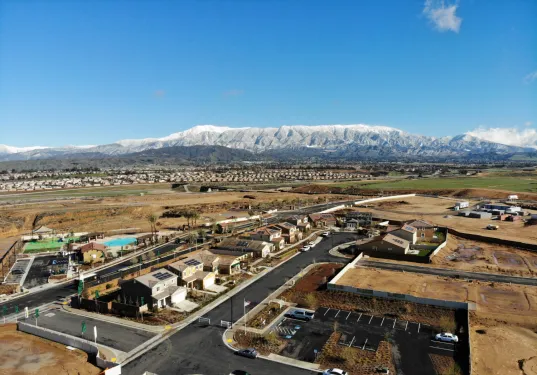
The Pass Area — California’s I-10 corridor gateway between the Inland Empire and Coachella Valley
2026 Economic Outlook
- Beaumont master-planned community Phase 4 and 5 developments continuing
- I-10 logistics corridor expanding with new distribution centers east of Beaumont
- San Gorgonio Memorial Hospital expansion adding healthcare employment
- Baby boomer retirement wave accelerating Pass Area active adult demand
- Cabazon Outlets expansion driving retail employment
- Coachella Valley spillover as Palm Springs area prices rise above $600K median
Beaumont vs. Banning: The Investor’s Framework
Beaumont
The growth market. Master-planned communities, newer construction, better schools, and stronger appreciation trajectory. Active adult communities drive unique retirement-focused demand. More passive-investor friendly. Cap rates 5–6.5% — moderate but reliable, with better long-term appreciation trajectory.
- Newer construction, lower maintenance
- Family and retirement demographics
- Better Beaumont USD schools
- Stronger appreciation trajectory
- Lower management intensity
Banning
The yield market. Older housing stock, more affordable prices ($350K–$430K), and cap rates of 6–8% attract active investors. Healthcare workforce, logistics workers, and value-add opportunity. Higher management intensity than Beaumont but meaningfully stronger cash-flow metrics.
- Lower entry prices — more accessible
- Stronger gross yields
- Value-add opportunity in dated stock
- Healthcare workforce tenant base
- More active management required
Historical Performance
| Period | Market Driver | Avg Annual Appreciation | Key Event |
|---|---|---|---|
| 2010–2015 | Post-foreclosure recovery, early master-planned growth | 5–8% | Beaumont master-planned communities resume construction; retiree demand steady |
| 2016–2019 | IE overflow, logistics expansion, retirement wave building | 7–10% | Western IE prices breach $400K; Pass Area captures affordability migration |
| 2020–2022 | Pandemic migration, remote work, record IE demand | 18–26% | Beaumont median surges from ~$340K to ~$490K; Banning from ~$260K to ~$380K |
| 2023–2024 | Rate normalization, market stabilization | 2–5% | Prices hold; rental demand stays tight; new construction continues |
| 2025–2026 | Rate stabilization, boomer retirement acceleration | 5–7% (projected) | Coachella Valley spillover; Beaumont Phase 5 communities; I-10 logistics expansion |
Demographic Trends Driving Demand
- Baby Boomer Retirement Wave — California’s largest demographic cohort is retiring in record numbers. The Pass Area — with warm, dry weather, golf courses, lower cost of living than coastal California, and proximity to LA Basin family — perfectly targets this migration. Active adult communities in Beaumont are at or near capacity and continue to expand
- Coachella Valley Spillover — Palm Springs and the greater Coachella Valley median home price has risen above $600,000. Buyers and renters who want desert lifestyle at Coachella Valley-adjacent prices are increasingly settling in Beaumont, 30 minutes from Palm Springs but at 20–30% lower prices
- I-10 Logistics Corridor — The I-10 between the LA Basin and Arizona is the nation’s busiest freight corridor. Distribution centers at Cabazon, Beaumont, and east Banning provide steady logistics employment for the Pass Area’s workforce housing rental market
- Western Inland Empire Overflow — With Riverside, Corona, and Fontana SFH now averaging $550,000–$700,000, working families are settling further east. Beaumont provides the last accessible family housing market on the western IE spectrum
- Healthcare Employment Growth — San Gorgonio Memorial Hospital serves as Banning’s largest private employer and is expanding its service capacity to meet the Pass Area’s growing population — creating stable mid-income healthcare rental demand
- Remote Work Lifestyle Migration — A growing segment of remote workers choosing the Pass Area for affordability and desert-adjacent lifestyle, with LA accessible when needed via I-10
📚 New to real estate investing? Master the fundamentals with our professional course Learn more →
2. Neighborhood Hotspots
Beaumont and Banning Investment Map
Interactive map of Pass Area investment neighborhoods. Green stars show top hotspots, blue circles mark established markets, and orange circles highlight emerging areas.
Core Investment Neighborhoods
Detailed Submarket Analysis
| Neighborhood | Price Range | Cap Rate | Growth Drivers | Best Strategy |
|---|---|---|---|---|
| Beaumont Master-Planned | $460K–$620K | 5.0–6.2% | Growth corridor, family demand, new amenities | Passive buy-and-hold |
| The Retreat (55+) | $420K–$580K | 4.8–5.8% | Boomer retirement wave, gated community, stability | Long-term hold, retirement tenants |
| Banning Healthcare Corridor | $330K–$470K | 6.5–8.0% | Healthcare workforce, logistics, value-add | Cash flow, value-add, BRRRR |
| Cherry Valley | $380K–$560K | 4.8–6.0% | Rural lifestyle, remote workers, larger lots | Lifestyle rentals, remote worker tenants |
| Beaumont Noble Creek / Sundance | $430K–$570K | 5.0–6.2% | Established, family demand, schools | Balanced buy-and-hold |
| Banning West / Highway 243 | $360K–$490K | 6.0–7.2% | Affordability, family demand, retirement adjacency | Cash flow, value-add |
| Cabazon / East Pass | $300K–$430K | 6.0–7.5% | I-10 logistics, Coachella spillover, affordability | Highest yield, workforce housing |
Expert Insight: “The retirement tenant segment in the Pass Area is chronically underserved and almost completely ignored by investor marketing. Most landlords are chasing young families or working professionals. But a well-maintained 2-bedroom in The Retreat or a comparable active adult community, marketed properly to 55+ tenants, will sit vacant for less than two weeks, rent for $2,100–$2,300/month, and stay occupied for 3–5 years with tenants who treat the property like their own home. The management burden is a fraction of a typical family rental. Once you understand the retirement tenant demographic, it’s hard to go back to anything else in this market.” — Patricia Nguyen, Property Manager, Pass Area Rental Group
3. Property Types
| Investment Goal | Best Property Type | Best Areas | Min Capital |
|---|---|---|---|
| Best Passive Investment | Newer SFH in master-planned community | Tournament Hills, Noble Creek, Retreat | $130,000+ |
| Lowest Vacancy / Best Stability | 55+ active adult SFH | The Retreat, Sun Lakes area | $120,000+ |
| Maximum Cash Flow | Small multifamily or value-add Banning SFH | Banning central, Cabazon | $95,000+ |
| Best Value-Add | Dated Banning SFH needing renovation | Banning central and west | $85,000+ |
Don’t guess the costs. Our Complete Renovation & Remodeling Cost Guide covers 400+ pages of project-by-project breakdowns with real contractor pricing ranges.
4. Cost Analysis
Acquisition Cost Breakdown (Pass Area)
| Expense Item | Typical Cost | Example ($470,000 Property) | Notes |
|---|---|---|---|
| Down Payment | 25% | $117,500 | Standard investment property; all Pass Area properties under conforming limit |
| Closing Costs | 2–3% | $9,400–$14,100 | Title, escrow, lender fees; Riverside County documentary transfer tax applies |
| Home Inspection | $400–$600 | $500 | Include HVAC assessment; desert climate is hard on AC systems |
| Mello-Roos Check | Free | $0 | Always pull full tax bill; many Beaumont developments have Mello-Roos adding $1,500–$3,500/year |
| Initial Renovation | 0–6% of price | $0–$28,200 | Newer Beaumont homes need minimal work; older Banning stock often needs kitchen/bath update |
| HOA Setup | $300–$600 | $400 | Most Beaumont master-planned communities have HOAs; confirm rental rules |
| Reserves | $8,000–$16,000 | $12,000 | HVAC is primary capital risk; budget for desert climate system aging |
| TOTAL MINIMUM ENTRY | ~30–38% of value | $139,800–$190,700 | Accessible for most qualified investors; under conforming limit throughout |
Sample Cash Flow Analysis: Beaumont Master-Planned 3BR SFH
| Item | Monthly | Annual | Notes |
|---|---|---|---|
| Gross Rent | $2,450 | $29,400 | 3BR Beaumont master-planned, family tenant |
| Less Vacancy (4%) | -$98 | -$1,176 | Beaumont master-planned vacancy is very low; 4% is conservative |
| Property Taxes (incl. Mello-Roos) | -$580 | -$6,960 | 1.05% base ($412/mo) + $2,200/yr Mello-Roos ($183/mo) — always verify actual bill |
| HOA | -$180 | -$2,160 | Typical Beaumont master-planned HOA; varies by community |
| Insurance | -$130 | -$1,560 | Landlord policy; verify fire zone status |
| Property Management (9%) | -$221 | -$2,646 | Several Pass Area PM firms serve both Beaumont and Banning |
| Maintenance + CapEx (7%) | -$172 | -$2,058 | Newer homes need less; HVAC is primary desert climate risk |
| Net Operating Income | $1,069 | $12,840 | Before mortgage; note Mello-Roos impact on NOI vs. non-Mello-Roos properties |
| Mortgage ($470K, 25% down, 6.5%, 30yr) | -$2,233 | -$26,796 | $352,500 loan at 6.5%; conventional — no jumbo required |
| NET CASH FLOW | -$1,164 | -$13,956 | Negative — Mello-Roos significantly affects; non-Mello-Roos property would show -$800/month |
| Banning Comparison (no Mello-Roos, $390K, $2,100 rent) | -$350 | -$4,200 | Near breakeven; Banning’s lower price and no Mello-Roos significantly improves cash flow |
| Total Return (6% appreciation) | ~18% | Including equity, appreciation, principal paydown |
The Mello-Roos lesson: This analysis clearly shows why verifying Mello-Roos before purchase is critical. A $2,200/year Mello-Roos assessment adds $183/month to effective costs — the difference between -$800/month and -$1,164/month negative carry. When comparing Beaumont and Banning properties, always use the full tax burden, not just the base 1% rate. A Banning property with no Mello-Roos at $390,000 often produces better cash flow than a seemingly comparable $470,000 Beaumont property with Mello-Roos, even though Beaumont has stronger appreciation trajectory.
Expert Insight: “The investors who do best in the Pass Area understand the Mello-Roos landscape cold. They know which Beaumont developments have it, which have paid it off, and which Banning corridors have none at all. A savvy investor can buy a Banning property at $380,000 with no Mello-Roos generating $2,050/month rent and get to near-breakeven cash flow today — while waiting for the appreciation that comes with Beaumont’s ongoing growth story. Both approaches work; knowing the tax situation is what separates good deals from bad ones.” — Jason Morales, Investment Advisor, Inland Empire Capital Group
5. Legal Framework
⚠️ California Landlord-Tenant Law Notice
Both Beaumont and Banning are incorporated cities in Riverside County governed by California statewide landlord-tenant law. The Tenant Protection Act of 2019 (AB 1482) applies to qualifying properties. As of 2026, neither Beaumont nor Banning has enacted additional local rent control beyond California state law — an important advantage for investors. Always consult a California-licensed real estate attorney before acquiring rental properties and verify current ordinances.
California AB 1482 in the Pass Area
- Rent Caps: For covered properties, annual increases capped at 5% plus local CPI or 10% total. Riverside County CPI typically runs 3–4%, so effective caps are 8–9% for covered units.
- Just Cause Eviction: After 12 months of tenancy in qualifying units, landlords must document just cause. Non-payment, material violations, criminal activity, owner/family move-in, substantial renovation are acceptable causes.
- SFH Exemption: Individually owned (not corporate) SFH and condos are exempt from AB 1482 if the proper written exemption notice is served at lease signing and each renewal. Critical for Beaumont SFH investors repositioning rents after renovation or new tenancy.
- New Construction Exemption: Properties built within the last 15 years are exempt. Much of Beaumont’s newer stock qualifies.
- No Additional Local Control: Beaumont and Banning have not enacted local rent control beyond AB 1482 — favorable compared to many California markets.
Pass Area-Specific Considerations
- HOA Rental Rules: Most Beaumont master-planned communities have HOAs. Some have rental approval requirements, minimum lease terms (typically 30 days), caps on percentage of rentals, or other restrictions. Always review CC&Rs before purchasing a property intended for rental in an HOA community.
- Active Adult (55+) Restrictions: Properties in 55+ communities have legal requirements for qualified occupancy (at least one resident must be 55+). Violating age restrictions exposes owners to HOA fines and potential legal liability. Confirm 55+ occupancy verification procedures before operating rentals in these communities.
- Mello-Roos Disclosure: Sellers must disclose Mello-Roos CFD taxes. Always pull the complete tax bill independently; rely on a preliminary title report showing all special assessments rather than seller representations alone.
- HVAC Habitability: California Civil Code requires habitable temperatures. The Pass Area’s 100°F+ summer temperatures make AC maintenance a legal obligation, not just a quality-of-life amenity.
- AB 12 Security Deposits: Maximum one month’s rent for most residential properties (effective 2024). Careful tenant screening is more important than ever given the reduced deposit protection.
Key Resources
- City of Beaumont: ci.beaumont.ca.us
- City of Banning: ci.banning.ca.us
- Riverside County Housing: rivco.org/housing
- California Apartment Association: caanet.org
| Regulation | Requirement | Investor Impact | Strategy Response |
|---|---|---|---|
| AB 1482 Rent Cap | 5%+CPI / 10% max on covered units | Limits rent increases on older covered buildings | Buy newer construction (exempt) or serve SFH exemption notices |
| Just Cause Eviction | After 12 months tenancy | Can’t remove good-standing tenants without cause | Screen rigorously; document violations from day one |
| HOA Rental Restrictions | Varies by community CC&Rs | Some communities limit rental percentage or require approval | Always review CC&Rs before purchase in any HOA community |
| 55+ Occupancy Rules | At least one 55+ occupant required | Cannot rent to all-under-55 household | Verify occupant age at lease signing; maintain records |
| Mello-Roos Disclosure | Must be disclosed by seller | Significant cash flow impact if overlooked | Pull full tax bill independently; don’t rely on listing information alone |
| AB 12 Deposits | Max 1 month rent | Less upfront protection | More rigorous upfront screening; verify employment and rental history thoroughly |
6. Step-by-Step Pass Area Investment Playbook
Choose Your Pass Area Strategy
Beaumont Family Passive
Buy quality SFH in Beaumont master-planned community. Target families and commuters. Use professional PM. Accept slightly negative cash flow in exchange for excellent tenant quality, low vacancy, and strong appreciation trajectory.
Retirement Tenant Strategy
Buy in or near The Retreat or other active adult communities. Target retiring baby boomers. Accept 4.8–5.8% cap rates for the lowest vacancy, longest tenancies, and simplest management available in the Pass Area.
Banning Cash Flow
Buy affordable SFH or duplex in Banning healthcare/central corridor. Target healthcare workers and logistics employees. Accept higher management intensity for 6.5–8% cap rates and near-breakeven or positive cash flow.
Banning Value-Add BRRRR
Acquire dated Banning properties. Renovate to modern standard. Force equity and rent increase of 20–30%. Refinance equity. Repeat. Best execution is in central Banning where renovation premiums are widest.
Mello-Roos and HOA Due Diligence — Non-Negotiable
The two financial landmines unique to Beaumont investing. Every single Beaumont acquisition must include these steps before offer submission:
- Request the full property tax bill — not just the base rate. The preliminary title report or escrow company can pull this. Add up every line item: base 1%, school bonds, water bonds, CFD (Mello-Roos), street lighting, parks, etc. The total effective rate in some Beaumont communities is 1.65–1.90% of assessed value — nearly double the nominal rate.
- Review HOA CC&Rs for rental restrictions — specifically: Is rental allowed? Is there a minimum lease term? Is there a rental cap (limit on percentage of units that can be rented)? Is there a waiting list or approval process? Some Beaumont HOAs have pause periods between purchase and rental start.
- Verify 55+ community rules if buying near or in active adult areas — occupancy age verification requirements, lease form requirements, community manager consent procedures.
- Run your numbers with full tax burden — never model a Pass Area investment using just the 1% base rate. The Mello-Roos difference between a $2,200/year and zero Mello-Roos property is $183/month — enough to shift a deal from attractive to unattractive.
Build Your Pass Area Team
- Pass Area-Specialist Agent: Must understand Mello-Roos landscape across different Beaumont communities, HOA rental policies, Banning submarket dynamics, and 55+ community restrictions. This is a market with significant fine-print that requires local expertise.
- Property Management Company: Both Beaumont and Banning have PM firms. Verify they have experience managing HOA-governed communities and 55+ community rules if relevant to your target properties.
- Contractor (Desert-Experienced): HVAC specialists critical. Beaumont and Banning share the same desert climate maintenance demands as Victorville and the High Desert — budget for HVAC as the primary capital risk.
- California Real Estate Attorney: For AB 1482 exemption notices, HOA CC&R interpretation, 55+ community compliance guidance, and any eviction proceedings through Riverside County Superior Court.
- Riverside County CPA: For Mello-Roos tax treatment, depreciation strategy, and HOA fee deductibility analysis.
Marketing to the Retirement Tenant Demographic
If pursuing the retirement tenant strategy, your marketing must be specifically designed for this demographic:
- List on senior-specific platforms: Senior Housing Net, 55Places.com, and AARP real estate listings reach the 55+ demographic that mainstream rental platforms underserve.
- Emphasize community amenities in listings: Golf, pools, community center, walking paths, and security features are the selling points for retirement tenants — not proximity to nightlife or WeWork offices.
- Single-story preference: Retirement-age tenants strongly prefer single-story homes without stairs. Properties without step-over entry thresholds, with wider doorways, and with step-in showers command meaningful premiums from this demographic.
- Healthcare proximity: List proximity to San Gorgonio Memorial Hospital, Beaumont health clinics, and urgent care facilities. This is a genuine amenity for the 55+ demographic.
- Lease terms: Offer 12–24 month lease options. Retirement tenants often prefer 24-month leases for security — and this is excellent for investors who want 24 months of reliable, low-management occupancy.
7. Financing Options for Beaumont and Banning
| Loan Type | Down Payment | Rate Premium | Best For | Pass Area Note |
|---|---|---|---|---|
| Conventional Investment | 25% | +0.5–0.75% | Strong income, good credit | All Pass Area properties under conforming limit — accessible conventional rates for all acquisitions |
| DSCR Loan | 25–30% | +1.5–2.5% | Self-employed, no income verification | Banning multifamily and higher-yield SFH can reach 1.0x DSCR; Beaumont with Mello-Roos often cannot — know your numbers before applying |
| FHA (House Hacking) | 3.5% | Standard + MIP | First-time investors, owner-occupants | Excellent entry point — 3.5% down on a $390K Banning duplex is ~$13,650 out of pocket |
| Portfolio Loan | 20–25% | +1–2% | Multiple properties, complex income | Pacific Premier, Arrowhead Credit Union, and Riverside County community banks offer portfolio products |
| Hard Money (Bridge) | 20–30% | 8–12% | BRRRR, value-add Banning | Active Riverside County hard money market; use for Banning value-add; refi to conventional post-renovation |
| New Construction (Builder) | 5–20% | Below market (buydowns) | New Beaumont developments | Builders offering 2–1 or permanent rate buydowns; can significantly improve year-one cash flow on new builds |
Mello-Roos and DSCR Warning: DSCR lenders calculate debt service coverage using only the mortgage payment vs. rental income. They typically do not include Mello-Roos, HOA, or property taxes in their coverage calculation — but you absolutely must include them in your personal analysis. A property that appears to qualify at 1.05x DSCR may actually generate deeply negative real cash flow once you account for $180/month Mello-Roos and $180/month HOA. Always run your complete expense stack before assuming a Pass Area property qualifies for DSCR financing on favorable terms.
8. Frequently Asked Questions

Knowledge Quiz: Beaumont and Banning Investment
Open Quiz
5 quick questions on what you just learned about Pass Area investing
1) What is the most unique investment demand driver in Beaumont that distinguishes it from most other Inland Empire markets?
Answer: C
Beaumont’s active adult communities — particularly The Retreat gated 55+ community — represent a unique investment niche that is largely ignored by most investors. Retiring baby boomers seeking affordable desert-adjacent living near LA Basin family create a growing, stable tenant demographic that produces some of the lowest vacancy rates and longest tenancies available anywhere in Riverside County.
2) Why is Mello-Roos particularly critical to verify before buying any Beaumont investment property?
Answer: A
The guide’s cash flow analysis demonstrates this clearly: a Beaumont property that appears to generate -$800/month negative carry without Mello-Roos shows -$1,164/month once a typical $2,200/year Mello-Roos assessment is included. This is a $364/month difference that can make the difference between an acceptable and unacceptable investment. Always pull the full tax bill — not just the base 1% rate — before running numbers on any Beaumont property.
3) Which investor profile does the guide recommend for Banning vs. Beaumont?
Answer: D
The guide explicitly frames the two cities as serving different investor profiles. Beaumont’s newer master-planned communities, better schools, and retirement communities make it ideal for passive investors seeking lower management intensity and stronger appreciation. Banning’s older housing stock, healthcare workforce, and logistics employment make it better suited for active investors comfortable with higher management demands in exchange for 6.5–8% cap rates and value-add BRRRR execution.
4) What key legal requirement must landlords comply with when renting to tenants in 55+ communities like The Retreat?
Answer: B
Under the federal Housing for Older Persons Act (HOPA), for a community to maintain its 55+ qualifying status (and its exemption from Fair Housing familial status protections), at least 80% of occupied units must have at least one resident age 55 or older. As a landlord, you must verify this with government-issued ID documentation at lease signing and maintain records. Violating this can result in HOA fines and potential legal liability.
5) What structural driver ensures Beaumont will continue attracting buyers and renters from the western Inland Empire for years to come?
Answer: C
The guide identifies the geographic price differential as structural and permanent — not cyclical. Beaumont is always further from LA than western IE cities and will therefore always price below them. As long as California’s housing affordability crisis keeps western IE prices elevated (which supply constraints guarantee), Beaumont captures the families and workers who cannot afford to live closer. This mechanism has run continuously for 20+ years and shows no signs of reversing.
Work With a Local Expert in the Pass Area
We are building a verified network of real estate professionals across every market we cover.

About Our Expert Network
We are finalizing partnerships with verified real estate professionals across every market on Builds and Buys. Each expert is selected for hands-on investment experience, local market knowledge, and commitment to helping investors make sound decisions.
- Experience with Beaumont and Banning investment properties
- Mello-Roos verification and full tax burden analysis expertise
- HOA CC&R review and 55+ community compliance guidance
- Retirement tenant marketing strategy and active adult community knowledge
- Access to off-market and value-add opportunities
- ADU permitting and development guidance
Services Covered
- Property sourcing and acquisition
- Investment analysis and underwriting
- Buyer representation
- Mello-Roos and HOA analysis
- 55+ community compliance
- Value-add renovation guidance
- Legal and title referrals
- Property management referrals
- Insurance referrals
- Contractor referrals
- ADU permitting guidance
- Exit strategy planning
Get Connected or Join Our Network
Looking for a local expert for your Pass Area investment? We will connect you with the right professional.
Contact us at support@buildsandbuys.com
Find Specialized Pass Area Real Estate Professionals
Ready to Invest in the Pass Area?
Beaumont and Banning offer something genuinely rare in Southern California: multiple independent demand drivers converging in a single affordable market. Retiring baby boomers. Growing logistics employment. Inland Empire affordability overflow. Coachella Valley gateway positioning. Healthcare workforce demand. Each of these would support a rental market on its own; together they create one of Riverside County’s most durable investment environments. For investors who master the Mello-Roos landscape, understand the retirement tenant opportunity, and pick the right submarket for their strategy, the Pass Area delivers returns that are difficult to find anywhere else this close to the Los Angeles Basin.
Continue Your Research
For further guidance, explore our State-by-State Investor guides, browse our expert articles, or follow our Step-by-Step Investment Guide.



