
Merced Real Estate Investment Guide For 2026
A comprehensive resource for investors targeting one of California’s most affordable university markets, anchored by UC Merced’s continued expansion and strong Central Valley cash flow fundamentals in 2026
Quick answers: Top 5 most searched Merced investment questions ▼
Migration data: Where people are moving from to Merced ▼
In This Guide
Click on any section to navigate directly to that content
1. Merced Market Overview
Market Fundamentals
Merced stands as one of California’s most compelling small-city investment opportunities, anchored by a singular growth engine that most Central Valley cities lack: the University of California, Merced. As the newest UC campus and the only one built in the 21st century, UC Merced’s expansion trajectory is still in its early chapters. The university enrolled its first students in 2005 with 875 students. It now houses over 9,000 and has a formal target of 25,000 students — a nearly threefold increase from current enrollment that will reshape the local housing market for the next two decades.
Key economic indicators that define Merced’s investment case:
- Population: 90,000+ city, 285,000+ Merced County
- Major Employers: UC Merced (4,000+ employees), Dignity Health/Mercy Medical, Golden Valley Health Centers, County of Merced, agriculture sector
- Median Household Income: $52,000 (city); UC proximity driving upward pressure
- UC Merced Student Enrollment: 9,200+ with 25,000 target by 2030
- On-Campus Housing Capacity: Covers only 35–40% of students, creating persistent off-campus demand
- Rental Vacancy Rate: 4–5% citywide, under 3% within 2 miles of UC Merced
Merced’s economy is diversifying beyond its agricultural base, with healthcare expansion, university growth, logistics activity along Highway 99, and growing remote worker interest all contributing to demand. The city benefits from its position midway between San Francisco (2 hours) and Los Angeles (4 hours), and serves as a gateway to Yosemite National Park.
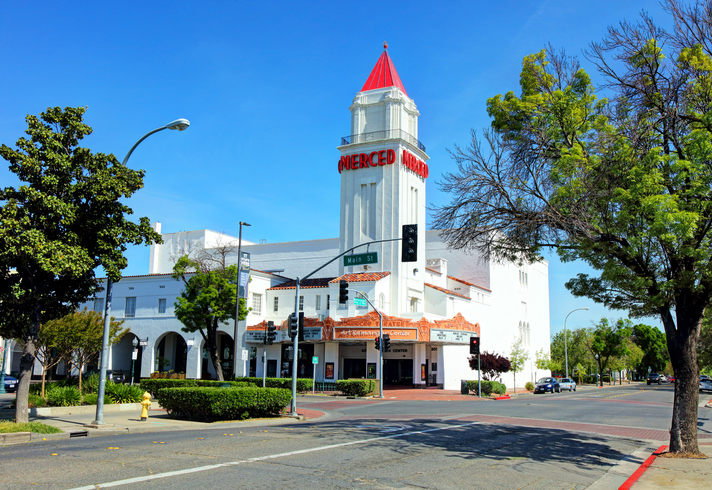
Merced’s UC campus expansion makes it one of California’s most predictable long-term growth stories
2026 Economic Outlook
- UC Merced enrollment growth adding 500–800 students annually
- UCSF/UC Merced medical school partnership expanding graduate student demand
- New campus facilities and student housing units under construction (but off-campus shortage persists)
- California High-Speed Rail alignment through Merced creating long-term connectivity upside
- Healthcare sector expansion as UC Health scales its regional presence
Investment Climate
Merced sits in a different category from most California investment markets. Rather than the appreciation-first, cash-flow-negative profile that defines coastal cities, Merced offers something rare in California: genuine cash flow at accessible entry prices. A well-selected property in the right Merced submarket can generate $200–$600/month positive cash flow using conventional financing — a profile that is essentially unavailable anywhere in the Bay Area or coastal Southern California. Key characteristics:
- Dual return profile — cash flow and appreciation, rather than the coastal California trade-off of sacrificing one for the other
- Predictable demand driver — university enrollment growth is the most visible, plannable demand signal available in real estate investing
- Low entry capital — 25% down on a $340,000 property requires $85,000, versus $250,000+ for a comparable strategy in Sacramento or $400,000+ in San Diego
- Student housing premium — room-by-room leasing near campus can increase gross income by 30–50% compared to standard family leasing
- California legal framework — statewide tenant protections apply, requiring the same compliance discipline as any other California market
Historical Performance
| Period | Market Driver | Avg Annual Appreciation | Key Event |
|---|---|---|---|
| 2010–2015 | Post-recession recovery, UC Merced early growth | 4–6% | Campus enrollment passes 5,000 students |
| 2016–2019 | Bay Area spillover, campus expansion Phase 2 | 6–9% | $1.3B 2020 Project doubles campus capacity |
| 2020–2022 | Remote work migration, pandemic housing demand | 15–22% | Bay Area families discover Merced affordability; bidding wars emerge |
| 2023–2024 | Rate normalization, market cooling | 2–4% | Inventory rose slightly; UC demand held rental market firm |
| 2025–2026 | UC enrollment growth, medical school expansion | 5–7% (projected) | UCSF medical partnership driving graduate student demand |
Merced’s long-term appreciation has averaged 5–7% annually over the past 15 years, with the sharpest gains clustered near the UC campus. A $200,000 property purchased near the university in 2010 would be worth approximately $450,000–$520,000 today. As enrollment approaches 25,000, the compounding effect of this demand driver becomes more significant relative to the city’s housing stock.
Demographic Trends Driving Demand
- UC Merced Enrollment Growth — The university’s official long-term enrollment target is 25,000 students, nearly tripling from current levels, with structured annual growth adding hundreds of new renters per year
- Medical School Expansion — The UC San Francisco/UC Merced collaborative medical education program is bringing graduate students, residents, and faculty with higher incomes and longer stays than undergraduates
- Bay Area Price Migration — Families relocating from the Bay Area for homeownership are driving up the upper range of Merced’s rental market as they transition from renting to buying
- Healthcare Workforce Growth — Dignity Health and expanding UC Health facilities are creating stable, year-round professional rental demand not dependent on the academic calendar
- High-Speed Rail Anticipation — California’s planned HSR line runs through Merced, and long-term connectivity to San Jose and Los Angeles will materially improve the market’s attractiveness to commuters
- Yosemite Gateway — Merced serves as the primary gateway city for Yosemite National Park, supporting tourism infrastructure and some short-term rental activity
📚 New to real estate investing? Master the fundamentals with our professional course Learn more →
2. Neighborhood Hotspots
Merced Investment Neighborhood Map
Interactive map of Merced’s investment neighborhoods. Green stars show top hotspots, blue circles mark established markets, and orange circles highlight emerging areas.
Core Investment Neighborhoods
Detailed Submarket Analysis: All Merced Neighborhoods
| Neighborhood | Price Range (SFH) | Cap Rate | Growth Drivers | Best Strategy |
|---|---|---|---|---|
| UC Merced Corridor | $320K–$480K | 6.0–8.0% | Student demand, housing shortage, enrollment growth | Student room rental, buy-and-hold |
| Downtown Merced | $240K–$380K | 5.8–7.5% | Revitalization, transit, diverse demand | Value-add, BRRRR, multifamily |
| Bellevue Ranch | $380K–$520K | 5.0–6.5% | Family demand, quality schools, healthcare workers | Long-term hold, professional tenants |
| Mission Hills / East Merced | $330K–$460K | 5.2–6.5% | Stable mid-market demand, UC/healthcare proximity | Buy-and-hold, stable rental |
| Applegate Park / Central | $300K–$430K | 5.5–6.8% | Parks, central location, family demographics | Balanced cash flow, duplex opportunities |
| Merced College District | $290K–$420K | 5.8–7.2% | Dual student + healthcare worker demand | Student rental, emerging zone |
| South Merced / Fahrens Park | $240K–$340K | 6.5–8.5% | Workforce housing, affordability, logistics demand | Cash flow focus, workforce housing |
| West Merced Corridor | $250K–$370K | 6.0–8.0% | Transitional zone, corridor investment, affordability | Value-add, emerging appreciation play |
Expert Insight: “The most misunderstood thing about Merced is that people look at it as a cheap Central Valley town. What they’re missing is that the UC campus is essentially a $2 billion infrastructure investment that gets bigger every year. Properties near the campus aren’t just cheap — they’re underpriced relative to what happens when enrollment doubles. We’re advising clients to buy within a 2-mile radius of the main gate now, before the next enrollment surge makes it obvious to everyone.” — Marcus Chen, Principal, Central Valley Investment Group
3. Property Types
| Investment Goal | Best Property Type | Best Neighborhoods | Minimum Capital |
|---|---|---|---|
| Maximum Cash Flow | Student room rental or small multifamily | UC Corridor, South Merced | $70,000+ |
| Best Appreciation | SFH near UC Merced campus | UC Corridor, North Merced | $85,000+ |
| Balanced Returns | Standard 3BR SFH rental | Bellevue Ranch, East Merced | $90,000+ |
| Lowest Entry Cost | Workforce or value-add SFH | South Merced, West Corridor | $60,000+ |
| Lowest Management | Newer construction SFH | Bellevue Ranch, Mission Hills | $100,000+ |
Don’t guess the costs. Our Complete Renovation & Remodeling Cost Guide covers 400+ pages of project-by-project breakdowns with real contractor pricing ranges.
4. Cost Analysis
Acquisition Cost Breakdown (Merced)
| Expense Item | Typical Cost | Example ($360,000 Property) | Notes |
|---|---|---|---|
| Down Payment | 25% (investment) | $90,000 | Standard investment property; 20% possible with strong credit |
| Closing Costs | 2–3% of price | $7,200–$10,800 | Title, escrow, lender fees, recording — lower than coastal CA |
| General Inspection | $350–$550 | $450 | Older Central Valley homes often need HVAC and roof attention |
| Pest / Termite Inspection | $150–$300 | $200 | Required by most lenders; common in older Merced housing stock |
| Initial Repairs / Make-Ready | $3,000–$20,000 | $5,000–$15,000 | Older homes may need paint, flooring, kitchen updates to rent at market |
| Property Management Setup | First month + leasing fee | $1,800–$3,600 | Leasing fee often equals 50–100% of one month’s rent |
| Reserves (6 months) | 6 months expenses | $8,000–$12,000 | Emergency fund covering vacancy, HVAC, and unexpected repairs |
| TOTAL MINIMUM ENTRY | ~30–36% of value | $112,450–$152,150 | Significantly lower than coastal CA markets; accessible for many investors |
Sample Cash Flow Analysis: 4BR Student Rental Near UC Merced
| Item | Monthly | Annual | Notes |
|---|---|---|---|
| Gross Rent (4 rooms × $675) | $2,700 | $32,400 | 4BR within 2 miles of UC Merced; room-by-room lease |
| Less Vacancy (4%) | -$108 | -$1,296 | Low vacancy near UC; students typically commit year-round |
| Property Taxes | -$375 | -$4,500 | ~1.25% of $360K assessed value (CA Prop 13 base) |
| Insurance | -$130 | -$1,560 | Landlord policy; student tenant use may slightly increase premium |
| Property Management (10%) | -$270 | -$3,240 | Recommended for room-rental management; some PMs charge more |
| Maintenance + CapEx (10%) | -$270 | -$3,240 | Student wear-and-tear; budget conservatively |
| Net Operating Income | $1,547 | $18,564 | Before mortgage; cap rate = 5.16% on $360K |
| Mortgage ($270K loan, 7.0%, 30yr) | -$1,797 | -$21,564 | 25% down on $360K purchase; principal and interest |
| CASH FLOW | -$250 | -$3,000 | Near breakeven; improves significantly as rents grow with enrollment |
| Cap Rate | 5.16% | NOI / Purchase Price — improves materially with rent growth | |
| Total Return (6% appreciation + principal paydown) | ~24% | Equity + appreciation on $90K invested capital |
Alternative scenario — South Merced workforce rental ($275,000 purchase, 3BR): At $1,650/month rent, the same financing model produces approximately $280–$380/month positive cash flow — one of the few California markets where this is achievable. The trade-off is less appreciation upside and a different tenant demographic. Smart investors often hold both types: a UC corridor property for growth and a South Merced property for immediate cash yield.
Expert Insight: “People focus on the cap rate and miss the bigger picture. In Merced, you’re betting on a university that has an explicit mandate to triple in size. Every time enrollment grows by 1,000 students and on-campus housing doesn’t keep pace, that’s 600–700 new renters added to the off-campus market. We’ve watched rents in the UC corridor increase 4–6% annually for the past eight years and I don’t see any reason that slows down. At these entry prices, the math works even if you’re conservative.” — Diana Vega, Broker, Central California Investment Properties
5. Legal Framework
⚠️ California Statewide Tenant Protection Notice
Merced rental properties are governed by California state law, which includes significant tenant protections under AB 1482 (the Tenant Protection Act of 2019). While Merced does not layer on city-specific ordinances as aggressively as Los Angeles, San Francisco, or Oakland, the statewide framework is substantial. Always consult a California-licensed real estate attorney before acquiring rental properties. This guide provides an overview only and is not legal advice.
California Statewide Regulations
Key California laws affecting Merced investors:
- AB 1482 (Rent Cap + Just Cause): Applies to most residential properties built before January 1, 2005. Limits annual rent increases to 5% plus local CPI, capped at 10% total. Requires “just cause” for eviction after tenant has occupied for 12+ months. Single-family homes and condos owned by individual landlords are exempt if proper notice is given to tenants.
- SB 567 (2024 Updates): Strengthened just cause eviction provisions and relocation assistance requirements. Owner move-in evictions now carry stricter documentation requirements and penalties for abuse.
- Security Deposit Cap (AB 12, 2024): Effective July 2024, security deposits are capped at one month’s rent for most residential properties, regardless of furnished/unfurnished status.
- Source of Income Protections: California law prohibits discrimination against Section 8/housing voucher holders. Investors must evaluate qualified voucher applicants on the same terms as market-rate applicants.
- Habitability Standards: California’s implied warranty of habitability is strictly enforced. Properties must maintain heat, plumbing, electrical, weatherproofing, and pest control. Response time requirements are legally enforceable.
- Prop 13 Property Tax: California’s Proposition 13 limits property tax increases to 2% annually after purchase, providing excellent tax cost predictability for long-hold investors.
Student Rental Compliance
Room-by-room student leasing introduces additional legal considerations:
- Individual Room Leases: Each room should have a separate lease agreement to preserve the landlord’s flexibility to address individual problem tenants without affecting all occupants.
- House Rules Addendum: Student rentals require comprehensive house rules covering noise, guests, parking, common area responsibility, and cleanliness. Must be incorporated by reference into each lease.
- Parental Co-Signers: Many students lack rental history or income. Requiring a parental co-signer on every room lease is standard practice and legally enforceable in California.
- Summer Lease Strategy: UC Merced’s academic calendar means summer occupancy requires active management. Options include: (a) require 12-month leases (best), (b) offer discounted summer rates to retain existing tenants, (c) pivot to travel nurses or short-term visitors in summer months where local ordinances allow.
- Common Area Management: California law requires landlords to maintain common areas. In a shared house, clear lease language defining tenant vs. landlord responsibility for common areas is essential.
- AB 1482 Exemptions: Single-family homes with proper written notice to tenants that the property is exempt from AB 1482 rent caps are not subject to the annual rent increase limits. This is critical documentation for Merced SFH investors.
Useful Merced Resources
- California DRE: dre.ca.gov
- Merced City Code Enforcement: cityofmerced.org
- California Courts Self-Help (Evictions): courts.ca.gov
- California Landlord/Tenant Guide: dca.ca.gov
| Regulation | California Requirement | Merced-Specific Note | Investor Impact |
|---|---|---|---|
| Rent Increases | 5% + CPI, max 10% (AB 1482 properties) | SFH exempt with written notice to tenant | Most Merced SFH investors should serve AB 1482 exemption notice at lease signing |
| Eviction (Just Cause) | Required after 12 months occupancy for AB 1482 properties | Student turnover often natural; just cause less of an issue | Document lease violations carefully; serve proper notices |
| Security Deposits | Capped at 1 month’s rent (AB 12, July 2024) | Parental co-signers help offset reduced deposit protection | Significantly reduces upfront protection; co-signers essential for student rentals |
| Section 8 / Vouchers | Must accept qualified voucher applicants | Merced Housing Authority administers local vouchers | Voucher rents are competitive; reduces vacancy risk for willing investors |
| Habitability Repairs | Heat, plumbing, electrical, weatherproofing required | Central Valley heat means functional A/C is practically required | Budget for A/C maintenance in older Merced housing stock; summer heat is extreme |
| Smoke / CO Detectors | Required in all units | Landlord responsible for installation and documentation | Low-cost compliance item; document at every move-in |
6. Step-by-Step Merced Investment Playbook
Define Your Merced Strategy
Merced is unusual in California because investors have a genuine choice between multiple viable strategies rather than being forced into an appreciation-only play. The strategy you choose determines everything — which neighborhoods to target, what property attributes to prioritize, and what tenant profile to court.
UC Merced Growth Play
Buy near campus and ride enrollment growth. As the university adds thousands of students and the on-campus housing shortage grows, off-campus rents rise and property values follow. Best long-term appreciation in Merced but requires understanding student tenant management.
Cash Flow / Workforce Housing
Buy in South Merced or West Merced at the lowest price points in California outside of the most distressed markets. Generate positive cash flow from day one with workforce and Section 8 tenants. Lower appreciation, but immediate income and very low entry cost.
Value-Add / BRRRR
Buy distressed properties in transitional neighborhoods, renovate to current standards, achieve above-market rents, refinance to pull equity, repeat. Merced’s lower renovation costs relative to coastal CA make the BRRRR math more favorable here than almost anywhere else in the state.
Balanced Professional Rental
Buy in Bellevue Ranch or East Merced targeting healthcare workers, university staff, and Bay Area transplants. Less work than student rentals, better tenant quality, and modest appreciation. Best for investors who want hands-off ownership with decent returns.
Build Your Merced Team
Merced is a smaller market. The pool of experienced investment-focused professionals is narrower than in major cities, which makes finding the right people more important, not less. Your non-negotiable team members:
- Merced Investment Agent: Must have specific experience with investor clients, not just owner-occupant transactions. Should know current room rental rates near UC, understand which streets have student demand, and be connected to off-market opportunities in the UC corridor.
- California Real Estate Attorney: For AB 1482 exemption notices, lease review, and entity structuring. Does not need to be Merced-based but must be California-licensed and familiar with current tenant protection law.
- Property Manager with Student Rental Experience: Critical for UC corridor properties. Ask specifically about their process for room-by-room leasing, summer tenant management, and parental co-signer enforcement. General residential PMs often lack the systems for student rentals.
- Local Contractor: Central Valley contractors are significantly more affordable than Bay Area or coastal CA. Develop a relationship with a Merced-based GC or handyman for ongoing maintenance and value-add projects.
- Real Estate CPA: Depreciation planning, entity structuring, and 1031 exchange preparation. Should understand California-specific property tax rules and Prop 13 implications.
Expert Tip: Contact the UC Merced Off-Campus Housing office. They maintain a landlord registry and actively refer students to listed properties. Getting listed is free and puts your property in front of the largest pool of prospective tenants in the market. It also signals that your property meets basic habitability standards — landlords with code violations or property management issues lose their listing.
Merced-Specific Due Diligence
Standard due diligence applies plus these Merced-critical checks:
Physical Due Diligence
- HVAC system condition — Merced summer temperatures regularly exceed 100°F; non-functional A/C is a habitability violation and immediate lease risk
- Roof and insulation — Central Valley heat cycling causes accelerated wear on roofing materials and HVAC ductwork
- Foundation drainage — Agricultural area soils can shift; older Merced homes may have foundation settling issues
- Plumbing age — Pre-1980 homes may have galvanized steel pipes nearing end of life
- Electrical panel capacity — Student rentals with multiple occupants need adequate panel capacity for modern appliance loads
- Pest inspection — Rodent and insect pressure from surrounding agricultural land is higher than urban markets
Regulatory and Market Due Diligence
- Confirm AB 1482 applicability — properties built after January 1, 2005 are exempt from rent caps; verify build date
- Check for code violations with Merced City Code Enforcement before closing
- Verify zoning for intended use — confirm rooming house or multi-tenant use is permitted in the specific zone
- Research actual room rental rates in the specific street or block — rents vary meaningfully by proximity to campus and transit routes
- Verify parking availability — student tenants often have vehicles; insufficient parking is a competitive disadvantage
- Review any HOA rules if applicable for rental restrictions
Student Rental Operations
If pursuing the UC Merced strategy, these operational practices separate successful student landlords from those who burn out within two years:
- Lease timing: Begin marketing rooms in February–March for August occupancy. UC students sign early when good options are available. Late marketing means picking from the remaining pool.
- 12-month leases only: Requiring 12-month leases (rather than 9-month academic year) significantly simplifies turnover and maintains income through summer. Students who need to break a lease pay two months’ rent in California — budget for this as a realistic scenario.
- Parental co-signer on every room: With the security deposit now capped at one month’s rent, a parental co-signer is your primary financial protection against property damage. Make it non-negotiable.
- Move-in documentation: Photograph every room and common area in detail at every move-in. This is your legal protection for any security deposit deduction claims.
- Utility structure: Most successful Merced student landlords include utilities in rent at a flat rate per room (approximately $100–$150/room) rather than billing individually. Simplifies management and avoids disputes; pad the room rate to cover average utility cost.
- Internet provision: A fast, reliable WiFi network is essentially a requirement for student tenants and costs $80–$120/month. Include it in the room rate. Students will not seriously consider properties without it.
7. Financing Options for Merced
| Loan Type | Down Payment | Rate Premium | Best For | Merced Note |
|---|---|---|---|---|
| Conventional Investment | 25% | +0.5–0.75% | Strong W-2 income, good credit | Most Merced properties fall well within conventional loan limits ($806,500); no jumbo required |
| DSCR Loan | 25–30% | +1.5–2.5% | Self-employed, no income verification | Unlike coastal CA, Merced rents often support 1.0x+ DSCR — especially student rentals. One of the few CA markets where DSCR loans actually qualify. |
| FHA Owner-Occupant (House Hack) | 3.5% | Standard + MIP | First investment via owner-occupancy of duplex | Powerful entry strategy: buy a duplex near UC Merced, occupy one unit, rent the other to students at room rates for near-zero housing cost |
| Portfolio Loan | 20–30% | +1–2% | Multiple properties, self-employed investors | Local Central Valley banks and credit unions often offer portfolio products for investors with 3+ properties |
| Hard Money / Bridge | 15–25% | 9–13% rate | BRRRR acquisitions needing fast close or renovation financing | Lower total loan amounts than coastal CA means hard money fees are more manageable; short-term bridge costs are proportionally lower |
| HELOC on Existing Property | N/A (equity draw) | Prime + 0.5–1% | Investors with equity in primary residence or other properties | Bay Area homeowners with large equity can often fund a Merced acquisition entirely from existing HELOC at much lower effective cost than investment loans |
Merced Financing Advantage: Merced is one of the few California markets where DSCR loans frequently qualify. A $360,000 property generating $2,700/month in gross rent (student room rental) with expenses of ~$1,150/month produces NOI of ~$1,550/month. At a 7.5% DSCR rate on a $270,000 loan, the monthly payment is roughly $1,890 — yielding a 0.82x DSCR. This is close enough that a slightly higher rent or a 20% down payment scenario pushes it over the 1.0x threshold most DSCR lenders require. This flexibility is essentially unavailable in any coastal California market at current cap rates.
8. Frequently Asked Questions

Knowledge Quiz: Merced Real Estate Investment
Open Quiz
5 quick questions on what you just learned about Merced investing
1) What is UC Merced’s long-term official enrollment target, and why does it matter for investors?
Answer: C
UC Merced’s official target is 25,000 students, nearly triple the current enrollment of approximately 9,200. Since on-campus housing covers only 35–40% of students, this growth directly expands the off-campus rental demand year by year — the core investment thesis for the UC corridor strategy.
2) Why is room-by-room student leasing more financially attractive than a standard family lease in Merced?
Answer: B
A 4-bedroom home near UC Merced might rent as a unit to a family for $1,900–$2,100/month. Room-by-room to students at $650–$700/room generates $2,600–$2,800/month — a 30–50% premium on the same property. This income uplift is the primary reason the UC corridor strategy is compelling for Merced investors.
3) What is the security deposit cap that California implemented in July 2024 under AB 12, and what does Merced investors need to do to compensate?
Answer: D
AB 12, effective July 2024, caps security deposits at one month’s rent for most residential properties. This significantly reduces the financial buffer against property damage. For student rentals specifically, requiring a parental co-signer on every individual room lease is the primary way to maintain financial protection — co-signers are personally liable for damages beyond the deposit.
4) Which Merced neighborhood does the guide identify as offering the highest cash flow yields but the lowest appreciation potential?
Answer: A
South Merced and Fahrens Park offer Merced’s highest cash flow yields (6.5–8.5% cap rates) and lowest entry prices ($240,000–$340,000) serving workforce housing demand from agricultural, logistics, and service sector workers. The guide notes this as one of the few California submarkets generating $300–$700/month positive cash flow on conventional financing, but with less appreciation upside than the UC corridor.
5) How does California’s AB 1482 rent cap interact with single-family homes in Merced, and what must investors do to benefit from the exemption?
Answer: C
Single-family homes and condos owned by individual landlords are exempt from AB 1482’s rent cap (5% + CPI, max 10%) — but only if the landlord provides written notice to the tenant in the lease stating the property is not subject to the act. Without this notice, the cap applies by default. Including the correct exemption language in every lease is essential for Merced SFH investors who want to price to market at renewals.
Work With a Local Expert in Merced
We are building a verified network of real estate professionals across every market we cover.

About Our Expert Network
We are finalizing partnerships with verified real estate professionals across every market featured on Builds and Buys. Each expert in our network is selected for their hands-on investment experience, local market knowledge, and commitment to helping buyers and investors make sound decisions.
Our local specialists offer:
- Proven experience with investment and income-producing properties
- Deep knowledge of local pricing, rental yields, and neighborhood dynamics
- Guidance on financing, legal structure, and due diligence
- Access to off-market and pre-market opportunities
- Full transaction support from search through closing
- Ongoing portfolio and property management referrals
Services Covered
- Property sourcing and acquisition
- Investment analysis and underwriting
- Buyer representation
- Market comparables and valuations
- Student rental strategy and setup
- Value-add and renovation guidance
- Legal and title referrals
- Financing and lender connections
- Property management referrals
- Insurance and inspection referrals
- 1031 exchange coordination
- Exit strategy planning
Get Connected or Join Our Network
Looking for a local expert to help with your investment? Reach out and we will connect you with the right professional for your market and strategy.
Are you a real estate professional with a track record working with investors? We are always expanding our network of verified local experts.
Contact us at support@buildsandbuys.com
Find Specialized Merced Real Estate Professionals
Ready to Invest in Merced?
Merced is one of California’s most underappreciated investment markets. Where most of the state forces investors to choose between cash flow and appreciation, Merced offers both — backed by one of the most predictable demand drivers in real estate: a public university with a mandate to nearly triple its enrollment over the next decade. Accessible entry prices, genuine cash flow potential, and the UC Merced growth engine make this a market that rewards investors who do their homework and commit early.
Continue Your Research
California State Guide
See how Merced compares to Fresno, Bakersfield, Stockton, and other Central Valley markets.
Step-by-Step Invest
Complete framework for building a real estate investment strategy from scratch.
144-Lesson Course
University-level real estate education covering financing, law, strategy, and management.
For further guidance, explore our State-by-State Investor guides, browse our expert articles, or follow our Step-by-Step Investment Guide.



