
Long Beach Real Estate Investment Guide For 2026
A comprehensive resource for investors looking to capitalize on one of Southern California’s most undervalued port cities, where beach access, economic diversity, and relative affordability converge in 2026
Quick answers: Top 5 most searched Long Beach investment questions ▼
Migration data: Where people are moving from to Long Beach ▼
In This Guide
Click on any section to navigate directly to that content
1. Long Beach Market Overview
Market Fundamentals
Long Beach stands as one of Southern California’s most strategically compelling investment markets, anchored by the Port of Long Beach (the second-busiest container port in the United States), a large public university, a thriving healthcare sector, and an urban revitalization story that has been reshaping the downtown core for over a decade. As the fifth-largest city in California with a population exceeding 470,000, Long Beach combines the amenities and diversity of a major urban center with home prices that remain meaningfully below comparable LA neighborhoods.
Key economic indicators defining Long Beach’s investment case:
- Population: 470,000+ city proper, part of the 13M+ Greater LA metro
- Major Employers: Port of Long Beach, Cal State Long Beach, MemorialCare Health System, Boeing, Amazon, Molina Healthcare, Long Beach Unified School District
- Median Household Income: $66,000+ citywide, $95,000+ in coastal and north neighborhoods
- Job Growth: 2.4% annually, led by logistics, healthcare, and education
- Port Economy: Generates 1.5M+ jobs across the region and $200B+ in trade annually
- Vacancy Rate: Under 4.5% citywide, under 3.5% in coastal neighborhoods
Long Beach’s economic foundation is notably more diverse than single-industry cities. The port anchors logistics and trade employment, CSULB’s 37,000+ students sustain student and young-professional rental demand, and a growing healthcare cluster around MemorialCare and St. Mary Medical Center creates a stable middle-income renter base that persists through economic cycles.
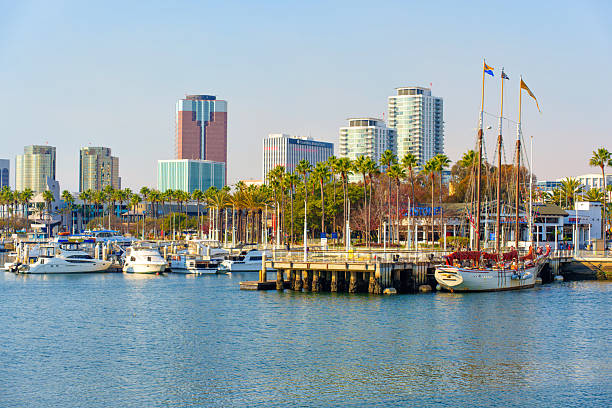
Long Beach’s skyline reflects a city powered by trade, education, and an emerging urban revival
2026 Economic Outlook
- Port of Long Beach expansion driving sustained logistics employment growth
- Downtown Long Beach revitalization attracting new retail, restaurant, and residential investment
- Cal State Long Beach enrollment growth expanding student and staff rental demand
- Healthcare sector expansion at MemorialCare and Dignity Health campuses
- LA Metro and Long Beach Transit corridor improvements enhancing connectivity to LA job centers
Investment Climate
Long Beach’s investment environment is defined by better-than-average Southern California cash flow potential, complex California and local rent control regulations, and a diverse tenant pool that ranges from port workers and students to healthcare professionals and creative-industry workers. Successful Long Beach investors typically share these characteristics:
- Regulatory literacy, understanding the dual-layer of state AB 1482 and Long Beach’s local ordinance and which properties are exempt
- Neighborhood-specific analysis, since cap rates and appreciation trajectories vary dramatically across the city’s 34 distinct neighborhoods
- ADU awareness, as California’s ADU reforms have been aggressively adopted in Long Beach, often transforming single-family cash flow from negative to neutral or positive
- Value-add competency, since North Long Beach and transitional neighborhoods offer the best entry points for investors willing to renovate
- Long-term orientation, accepting that California’s regulatory environment favors patient investors over short-term flippers
Unlike many coastal California markets, Long Beach has genuine cash-flow-positive opportunities available in its transitional and inland neighborhoods, making it one of the few Southern California cities where a BRRRR or buy-and-hold cash flow strategy is genuinely executable with careful property selection.
Historical Performance
| Period | Market Driver | Avg Annual Appreciation | Key Event |
|---|---|---|---|
| 2010-2014 | Post-recession recovery, port expansion | 4-6% | Downtown Long Beach begins urban revitalization push |
| 2015-2019 | LA tech and creative economy spillover, housing shortage | 8-12% | Belmont Shore and Bixby Knolls emerge as investment hotspots |
| 2020-2022 | Pandemic-era migration, remote work premium, port demand surge | 12-18% | Port supply chain congestion drives record port employment; inventory hits historic lows |
| 2023-2024 | Rate shock, market normalization | 2-4% | Sales volume drops sharply; values hold as inventory remains constrained |
| 2025-2026 | Rate stabilization, downtown recovery | 6-9% (projected) | Downtown Long Beach mixed-use projects and new transit investment create new demand corridors |
Long Beach’s 20-year appreciation track record averages 6-8% annually, slightly below the broader LA Basin due to its more working-class demographic base but consistently above the national average. A $400,000 Long Beach property purchased in 2005 would be worth approximately $950,000 to $1,150,000 today after market cycles, demonstrating the compounding power of patient ownership in this market.
Demographic Trends Driving Demand
- Port of Long Beach Workforce – 37,000+ direct port employees and 1.5M+ regional jobs tied to port activity create a massive, stable working-class renter base that occupies Long Beach’s most affordable housing stock year after year
- Cal State Long Beach – 37,000+ students and 4,000+ faculty and staff sustain strong rental demand in east and north Long Beach neighborhoods within commuting distance of campus
- LA Affordability Migration – Renters and buyers priced out of Santa Monica, Culver City, and West LA continue to discover Long Beach as a credible alternative at 20-30% lower price points
- Healthcare Sector Growth – MemorialCare Long Beach Medical Center, St. Mary Medical Center, and numerous specialty clinics collectively employ thousands of nurses, technicians, and administrators who form a stable middle-income renter demographic
- Creative and Arts Community – The East Village Arts District and downtown revitalization have attracted a growing creative economy workforce that prefers renting in walkable urban environments
- Diverse International Community – Long Beach hosts one of the largest Cambodian communities in the U.S. and major Latino and Filipino populations, creating deeply rooted neighborhood cultures with very low vacancy and high tenant retention
📚 New to real estate investing? Master the fundamentals with our professional course Learn more →
2. Neighborhood Hotspots
Long Beach Investment Neighborhood Map
Interactive map of Long Beach’s investment neighborhoods. Green stars show top hotspots, blue circles mark established markets, and orange circles highlight emerging areas.
Core Investment Neighborhoods
Detailed Submarket Analysis: Long Beach Neighborhoods
| Neighborhood | Price Range (SFH) | Cap Rate | Growth Drivers | Best Strategy |
|---|---|---|---|---|
| Belmont Shore | $750K-$1.4M | 3.5-4.5% | Beach access, walkability, 2nd Street corridor | Appreciation, premium coastal rental |
| Naples Island | $900K-$2.0M | 2.5-3.5% | Canal waterfront, luxury demographic, limited supply | Pure appreciation, luxury rental |
| Bixby Knolls | $700K-$1.0M | 4.0-5.5% | Arts revival, craftsman homes, restaurant scene growth | Value-add SFH, ADU, long-term hold |
| Downtown Long Beach | $450K-$900K | 4.0-5.0% | Urban revitalization, transit, port proximity | Condo appreciation, urban rental, mixed-use |
| Signal Hill | $650K-$950K | 4.0-5.5% | Panoramic views, independent city, limited supply | Long-term hold, SFH appreciation |
| Los Cerritos / VA Country Club | $800K-$1.3M | 3.0-4.0% | Established prestige, family demand, low turnover | Stable appreciation, family rental |
| East Long Beach / Los Altos | $750K-$1.1M | 3.5-4.5% | CSULB proximity, family stability, good schools | Buy-and-hold SFH, low management intensity |
| Wrigley | $600K-$850K | 4.5-5.5% | Improving amenities, central location, gentrification spillover | Value-add, transitional hold |
| North Long Beach | $500K-$750K | 5.0-6.5% | Port worker demand, affordability, value-add inventory | BRRRR, cash flow, small multi-family |
| West Long Beach / Westside | $500K-$700K | 5.5-7.0% | Port employment, lowest prices, industrial transition | Best cash flow, value-add, long-term hold |
Expert Insight: “The most overlooked opportunity in Long Beach right now is the duplex and triplex market in Wrigley and North Long Beach. These properties often have one or two long-term tenants paying below-market rents, which scares off retail buyers, but for experienced investors they represent an opportunity to acquire at a discount and gradually improve to market rents through legal compliance with California’s vacancy decontrol rules. A well-executed turnover strategy can increase NOI by 30-50% over a 3-5 year hold without any physical renovation.” – Maria Reyes, Principal, Pacific Coast Investment Properties
3. Property Types
| Investment Goal | Best Property Type | Best Neighborhoods | Minimum Capital |
|---|---|---|---|
| Maximum Appreciation | Coastal SFH or condo in constrained location | Belmont Shore, Naples Island, Signal Hill | $225,000+ |
| Best Cash Flow in Long Beach | Duplex or triplex, value-add | North Long Beach, West Long Beach, Wrigley | $150,000+ |
| Balanced Returns | Value-add SFH with ADU development | Bixby Knolls, Wrigley, Signal Hill | $175,000+ |
| Lowest Management | New townhome or post-2007 condo (AB 1482 exempt) | Downtown, near transit corridors | $162,500+ |
Don’t guess the costs. Our Complete Renovation & Remodeling Cost Guide covers 400+ pages of project-by-project breakdowns with real contractor pricing ranges.
4. Cost Analysis
Acquisition Cost Breakdown (Long Beach)
| Expense Item | Typical Cost | Example ($765,000 Property) | Notes |
|---|---|---|---|
| Down Payment | 25% (investment) | $191,250 | Standard for investment properties in California |
| Closing Costs | 2-3% of price | $15,300-$22,950 | Title, escrow, lender fees, transfer tax |
| California Transfer Tax | $1.10 per $1,000 | ~$842 | Typically split between buyer and seller by negotiation |
| General Inspection | $450-$700 | $550 | Full inspection including roof, foundation, systems |
| Sewer Lateral Inspection | $200-$400 | $300 | Essential for pre-1980 properties. Repairs can run $5,000-$15,000. |
| Lead/Asbestos Testing | $300-$600 | $400 | Common in pre-1978 Long Beach housing stock. Mandatory disclosure. |
| Initial Repairs / Deferred Maintenance | 0-8% of price | $0-$61,200 | Highly variable. Older Long Beach homes often need deferred maintenance. |
| Reserves (6 months) | 6 months operating expenses | $12,000-$18,000 | Emergency fund for vacancy, repairs, and legal compliance costs |
| TOTAL MINIMUM ENTRY | ~27-31% of value | $220,000-$295,000 | Substantial capital required for typical Long Beach investment purchase |
Sample Cash Flow Analysis: Bixby Knolls Single-Family + ADU
| Item | Monthly | Annual | Notes |
|---|---|---|---|
| Main House Rent | $2,700 | $32,400 | 3BR Bixby Knolls, updated condition |
| ADU Rent (garage conversion) | $1,600 | $19,200 | Studio ADU, $150K build cost |
| Gross Income | $4,300 | $51,600 | |
| Less Vacancy (5%) | -$215 | -$2,580 | Conservative estimate for Long Beach market |
| Property Taxes | -$762 | -$9,150 | ~1.05% of $870K assessed value (purchase + ADU improvement) |
| Insurance | -$175 | -$2,100 | Landlord policy, earthquake rider recommended |
| Property Management (10%) | -$430 | -$5,160 | Strongly recommended given California regulations |
| Maintenance + CapEx | -$430 | -$5,160 | ~10% of rent for mid-age Long Beach SFH |
| Net Operating Income | $2,288 | $27,450 | Before mortgage |
| Mortgage ($870K total cost, 25% down, 6.75%, 30yr) | -$4,243 | -$50,916 | Principal and interest only on $652,500 loan |
| CASH FLOW | -$1,955 | -$23,466 | Negative but significantly better than SFH alone |
| Cap Rate | 3.15% | NOI / Total Cost | |
| Total Return (8% appreciation) | ~22% | Including equity, appreciation, principal paydown, tax benefits |
This example highlights why ADU development is the most popular strategy among sophisticated Long Beach investors. The ADU adds $1,600/month in rent, reduces the negative carry by roughly $1,400/month, and adds $220,000-$350,000 in property value at the time of completion. Without the ADU, the same Bixby Knolls SFH would typically show $3,000-$3,500/month in negative cash flow, making the return profile far less attractive even with strong appreciation.
Expert Insight: “Long Beach offers something genuinely rare in coastal California: a path to positive or near-neutral cash flow through the ADU strategy combined with the right entry price point. Investors who buy a dated duplex in Wrigley or North Long Beach for $650,000-$750,000, renovate it to raise rents on vacant units to market, and add a garage ADU on the rear of the lot can build a $1.1-$1.3M property producing $4,500-$5,500/month gross with a total all-in cost of $900,000-$1,050,000. That math is nearly impossible to replicate in Santa Monica or Culver City at any entry price.” – David Chang, CRE Advisor, SoCal Capital Partners
5. Legal Framework
⚠️ Critical Long Beach Compliance Notice
Long Beach operates under a dual-layer regulatory framework, combining California statewide tenant protections (AB 1482, SB 91) with its own local Rent Control Ordinance. The interaction between these layers is complex, and which layer applies depends on the specific property’s age, unit count, and ownership structure. Penalties for non-compliance range from rent rollback orders to civil lawsuits. Always consult a California-licensed real estate attorney specializing in landlord-tenant law before acquiring Long Beach rental properties, and use a property management company with documented local regulatory expertise.
California Statewide Protections (AB 1482)
California’s Tenant Protection Act of 2019 applies broadly and creates significant operating constraints for landlords:
- Rent Increase Cap: Annual increases limited to 5% + local CPI, with a hard ceiling of 10% per year regardless of CPI. Applies to most multi-family properties constructed before January 1, 2007.
- Just Cause Eviction: After 12 months of tenancy, landlords must have just cause to evict. At-fault reasons include non-payment, lease violation, criminal activity. No-fault reasons (owner move-in, demolition, substantial renovation) require significant relocation assistance payments.
- Relocation Assistance: For no-fault evictions, landlords must pay one month’s rent as relocation assistance before tenant vacates.
- Exemptions: Single-family homes and condos where the owner is not a REIT or LLC (with proper notice), properties built within the last 15 years, and owner-occupied properties with 2 or fewer units.
- Vacancy Decontrol: When a unit voluntarily vacates, rent can be reset to market rate for the new tenancy. This is the primary rent recovery mechanism for landlords.
Long Beach Local Rent Control Ordinance
Long Beach’s local ordinance adds additional protections for specific property categories:
- Coverage: Applies to rental units in buildings with 2 or more units constructed before July 1, 1978.
- Annual Allowable Increase: Tied to local CPI, typically 3-6% per year. Landlords must petition the Rent Control Board for increases above the allowable amount.
- Just Cause Eviction: Just cause requirements under the local ordinance are at least as strict as AB 1482 and may be more restrictive in certain circumstances.
- Registration Requirement: All covered units must be registered with the Long Beach Rent Control Board annually.
- Petition Process: Landlords seeking above-guideline increases must demonstrate capital improvement costs, increased operating expenses, or inadequate return on investment through a formal petition process.
- Tenant Rights Hotline: Long Beach has an active tenant rights infrastructure that advises tenants on ordinance violations, making compliance non-optional.
Key Long Beach Resources
- Long Beach Rent Control Board: longbeach.gov/rentcontrol
- California Apartment Association: caanet.org
- Long Beach Housing Authority: longbeach.gov/lbcd/housing
- Long Beach City Attorney: 562-570-2200
| Regulation | Long Beach Local Ordinance | California AB 1482 | Investor Impact |
|---|---|---|---|
| Rent Cap | CPI-based (typically 3-6%) | 5% + CPI, max 10% | Pre-1978 buildings get the more restrictive of the two caps |
| Just Cause Eviction | Required from day 1 (local ordinance) | Required after 12 months | Pre-1978 covered units: just cause required immediately |
| Vacancy Decontrol | Yes, units reset to market on voluntary vacancy | Yes, units reset to market on voluntary vacancy | Primary rent recovery mechanism; natural turnover is key |
| Relocation Assistance | Required for no-fault evictions | 1 month’s rent minimum | Owner move-ins and renovations are expensive to execute |
| Unit Registration | Annual registration with Rent Control Board required | No statewide registration | Annual compliance filing mandatory for all covered units |
| Exemptions | Buildings post-1978, single-family homes, new construction | Post-2007, SFH/condo with notice, new construction | Strategic property selection can minimize regulatory burden |
6. Step-by-Step Long Beach Investment Playbook
Define Your Long Beach Strategy
Long Beach offers a broader range of viable investment strategies than most coastal California markets. Before buying, be clear on which approach you are executing:
Coastal Appreciation Play
Buy in Belmont Shore, Naples Island, or Signal Hill. Accept negative cash flow in exchange for strong long-term appreciation. Requires substantial income and 7+ year horizon. Most appropriate for investors who also intend to eventually owner-occupy.
ADU Development Strategy
Buy a SFH with ADU potential in Bixby Knolls, Wrigley, or Signal Hill. Build ADU within 12-18 months. Significantly improve income, property value, and eventual sale price. Most popular strategy among Long Beach’s sophisticated investor community.
Value-Add / BRRRR
Buy dated properties in North Long Beach or Wrigley. Renovate to increase rents and ARV. Refinance out equity once rents are stabilized at market. Works best when acquiring properties with long-term below-market tenants who vacate naturally during or after renovation.
Multi-Family Buy-and-Hold
Acquire 2-4 unit properties in North Long Beach or Cambodia Town. Best cash flow available in the city. Pre-1978 buildings subject to local rent control, but vacancy decontrol gradually normalizes rents over time. Longest timeline to full market-rate income but strongest NOI once achieved.
Build Your Long Beach Team
California’s regulatory environment makes your professional team as important as the property itself. Non-negotiable team members:
- Long Beach Investor-Focused Real Estate Agent: Must have specific experience with investment properties in Long Beach proper. Should understand which properties fall under local vs. state rent control, ADU feasibility analysis, and multi-family underwriting.
- California Landlord-Tenant Attorney: Essential for entity setup, lease compliance review, and navigating the interaction between AB 1482 and the local ordinance. Do not use a general practice attorney for this.
- Long Beach-Licensed Property Manager: Verify they are members of the California Apartment Association and can demonstrate specific Long Beach Rent Control Board compliance experience, including the annual registration process.
- ADU-Experienced General Contractor: If pursuing ADU strategy, your contractor needs specific permit-pull experience with the City of Long Beach Development Services Department. ADU permitting in Long Beach has improved significantly since 2021 but still requires local process knowledge.
- Real Estate CPA familiar with California law: For depreciation strategy, entity structuring, Prop 13 reassessment implications, and annual rent control registration requirements.
Expert Tip: When interviewing Long Beach property managers, ask specifically: “If I purchase a pre-1978 duplex with one long-term tenant at significantly below-market rent, what is our legal strategy to reach market rents over a 3-5 year horizon?” and “Walk me through your Long Beach Rent Control Board annual registration process.” Managers who can answer these questions fluently have the expertise your investment demands.
Long Beach Specific Due Diligence
Standard due diligence items plus these Long Beach critical checks:
Physical Due Diligence
- Sewer lateral inspection (critical for pre-1980 properties with clay pipe systems)
- Lead paint and asbestos testing for all pre-1978 properties (mandatory disclosure)
- Foundation evaluation for liquefaction-zone properties (extensive in Long Beach)
- Roof condition and HVAC age given Southern California heat loads
- Electrical panel capacity assessment for any ADU development plans
- Unpermitted addition identification (common in older Long Beach neighborhoods)
Regulatory Due Diligence
- Confirm whether property falls under Long Beach local ordinance or AB 1482 only
- Verify current rent control registration status with the Rent Control Board
- Pull permits for all improvements (unpermitted conversions are very common)
- Confirm zoning for ADU eligibility and any overlay restrictions
- Review all current lease agreements for term, rent amount, and any rent control history
- Confirm STR permit status if any short-term rental use is planned
- Check for any outstanding code violations with the City of Long Beach
Competing in the Long Beach Market
Long Beach is a competitive market, especially for properties under $800,000. Strategies that win:
- Pre-inspections: Conduct your inspection before submitting an offer on desirable properties. Costs $450-$700 without guarantee of purchase but allows clean, non-contingent offers that sellers prefer strongly in competitive situations.
- Occupied investment properties as opportunity: Sellers dealing with problem tenants or below-market rents often discount 8-15% below comparable vacant properties. For investors comfortable with California’s tenancy management process, this creates meaningful acquisition advantages.
- Off-market focus in North Long Beach: Long-term homeowners in North Long Beach often prefer a quiet sale over an open market process. Direct mail to owners who have held for 15+ years can uncover motivated sellers before properties hit the MLS.
- Probate and estate sales: Long Beach’s older neighborhoods have substantial probate inventory that often comes with below-market pricing due to estate settlement urgency. Building relationships with probate attorneys and estate sale companies is a legitimate sourcing advantage.
- Escalation clauses with discipline: In Bixby Knolls and Belmont Shore, multiple offers are common on well-priced properties. Set your ceiling based on your underwriting, not competitive emotion.
7. Financing Options for Long Beach
| Loan Type | Down Payment | Rate Premium | Best For | Long Beach Note |
|---|---|---|---|---|
| Conventional Investment | 25% | +0.5-0.75% | Strong W-2 income, good credit, 1-4 unit properties | Conforming limit is $806,500 in LA County; most Long Beach SFH purchases stay under this |
| Jumbo Investment | 25-30% | +0.75-1.25% | Properties above $806,500, Belmont Shore and Naples Island | Required for Belmont Shore and Naples Island acquisitions at typical price points |
| FHA House Hack (3.5% down) | 3.5% | Standard + MIP | Owner-occupying one unit of a 2-4 unit property | Best entry point strategy in Long Beach for capital-constrained first-time investors |
| Portfolio Loan | 20-30% | +1-2% | Multiple properties, self-employed investors | Available from local lenders including East West Bank, Hanmi Bank, and California community banks |
| DSCR Loan | 25-30% | +1.5-2.5% | No income documentation requirement | Better qualified in Long Beach than LA proper due to higher cap rates; still challenging in coastal sub-markets |
| ADU / Construction Loan | 20-25% of total | +1-2% | Building ADU post-purchase | HELOC on existing equity or cash-out refinance after 12 months is typically the lowest-cost ADU financing path |
| Hard Money / Bridge | 15-25% | 8-12% rate | BRRRR acquisitions, value-add plays requiring speed | Multiple Southern California hard money lenders active in Long Beach; useful for estate sales and distressed acquisitions |
Long Beach Financing Reality: Long Beach is one of the few coastal California markets where DSCR loans can qualify in certain sub-markets, particularly for multi-family properties in North Long Beach and Wrigley where cap rates reach 5-6.5%. For conventional financing, LA County’s conforming limit of $806,500 covers most Long Beach acquisitions in non-coastal neighborhoods, making standard investment financing accessible without jumping to jumbo products. For house hackers buying a duplex or triplex as owner-occupants, FHA financing at 3.5% down is the most capital-efficient entry strategy available anywhere in Southern California.
8. Frequently Asked Questions

Knowledge Quiz: Long Beach Real Estate Investment
Open Quiz
5 quick questions on what you just learned about Long Beach investing
1) What is vacancy decontrol and why is it the most important concept for Long Beach multi-family investors?
Answer: B
Vacancy decontrol allows landlords to reset rents to full current market rates whenever a tenant voluntarily leaves. This is why below-market-rent properties are often underpriced opportunities rather than liabilities. A patient investor who acquires a duplex with one tenant at 1990s rates knows that natural turnover will eventually reset that unit to full market, dramatically improving the income stream without any capital investment.
2) Which Long Beach neighborhood does the guide identify as offering the best cash flow for investors?
Answer: C
North Long Beach and West Long Beach offer cap rates of 5.0-6.5% and 5.5-7.0% respectively, the highest in the city. They have the lowest entry prices ($500K-$750K), a large stable port-worker and working-class renter base, and significant value-add inventory. These are the neighborhoods where cash-flow-positive investing is genuinely executable in Southern California.
3) What is the key advantage of purchasing a property built after January 1, 2007 in Long Beach?
Answer: A
California AB 1482 exempts properties built within the last 15 years from its rent increase caps. This means a 2007-built property is still exempt in 2022, and a property built in 2020 remains exempt until 2035. This gives investors in new construction and post-2007 properties significantly more flexibility to raise rents compared to the pre-2007 inventory that makes up most of Long Beach’s housing stock.
4) What makes the FHA house hack strategy particularly powerful in Long Beach?
Answer: D
The FHA house hack is the most capital-efficient Long Beach entry strategy because of three combined advantages: only 3.5% down payment required, LA County FHA limits cover most Long Beach duplexes and triplexes, and owner-occupying one unit of a 2-unit property exempts both units from AB 1482 rent caps. This combination dramatically lowers the capital barrier and improves operating flexibility compared to purchasing as a pure investor.
5) How does Proposition 13 create a compounding advantage for long-term Long Beach property owners?
Answer: B
Under Prop 13, a Long Beach property purchased for $765,000 in 2026 will be taxed on $765,000 + 2% annually forever, regardless of how much the property appreciates. If the property doubles in value to $1,530,000 over 15 years but the assessed value only grows to approximately $1,030,000, the investor’s effective tax rate as a percentage of actual value has essentially been cut in half. As rents grow but the tax bill only grows at 2%/year, the property’s net operating income improves at a faster rate than gross income alone would suggest.
Work With a Local Expert in Long Beach
We are building a verified network of real estate professionals across every market we cover.

About Our Expert Network
We are finalizing partnerships with verified real estate professionals across every market featured on Builds and Buys. Each expert in our network is selected for their hands-on investment experience, local market knowledge, and commitment to helping buyers and investors make sound decisions.
Our local specialists offer:
- Proven experience with investment and income-producing properties in Long Beach
- Deep knowledge of local pricing, rental yields, and neighborhood dynamics
- Guidance on California rent control compliance, AB 1482, and local ordinance navigation
- ADU feasibility analysis and development coordination
- Access to off-market and pre-market opportunities
- Full transaction support from search through closing
Services Covered
- Property sourcing and acquisition
- Investment analysis and underwriting
- Buyer representation
- Market comparables and valuations
- Short-term and long-term rental strategy
- Value-add and ADU guidance
- Legal and title referrals
- Financing and lender connections
- Property management referrals
- Insurance and inspection referrals
- 1031 exchange coordination
- Exit strategy planning
Get Connected or Join Our Network
Looking for a local expert to help with your Long Beach investment? Reach out and we will connect you with the right professional for your market and strategy.
Are you a real estate professional with a track record working with Long Beach investors? We are always expanding our network of verified local experts.
Contact us at support@buildsandbuys.com
Find Specialized Long Beach Real Estate Professionals
Ready to Invest in Long Beach?
Long Beach is not the flashiest market in Southern California, and that is precisely what makes it compelling. Where Santa Monica and Culver City demand premium pricing with negligible cash flow, Long Beach offers genuine investment optionality: appreciation-focused plays in Belmont Shore, balanced ADU strategies in Bixby Knolls, and rare cash-flow-positive opportunities in North Long Beach. The port economy, Cal State Long Beach, and healthcare sector create an economic diversity that weathers cycles better than single-industry cities. For investors willing to master California’s regulatory environment and commit to a long-term strategy, Long Beach consistently delivers among the strongest risk-adjusted total returns available in coastal Southern California.
Continue Your Research
California State Guide
See how Long Beach compares to Los Angeles, San Diego, San Francisco, and other California markets.
Step-by-Step Invest
Complete framework for building a real estate investment strategy from scratch.
144-Lesson Course
University-level real estate education covering financing, law, strategy, and management.
For further guidance, explore our State-by-State Investor guides, browse our expert articles, or follow our Step-by-Step Investment Guide.



