Corvallis Oregon Real Estate Investment Guide For 2026
A comprehensive resource for investors looking to capitalize on Oregon’s premier university market, a supply-constrained college town with one of the lowest vacancy rates in the Pacific Northwest
Quick answers: Top 5 most searched Corvallis investment questions ▼
Migration data: Where people are moving from to Corvallis ▼
In This Guide
Click on any section to navigate directly to that content
1. Corvallis Market Overview
Market Fundamentals
Corvallis is Oregon’s premier university investment market, anchored by Oregon State University’s 32,000-plus enrollment and a diversified employer base that creates rental demand well beyond the student population. Located in the heart of the Willamette Valley, Corvallis sits at the intersection of agriculture, technology, healthcare, and higher education, giving investors a resilience that purely student-dependent markets often lack.
Key economic indicators that define Corvallis’s investment case:
- Population: 62,000+ city, 135,000+ Benton County
- Major Employers: Oregon State University, HP (Corvallis R&D campus), Samaritan Health Services, Linn-Benton Community College, Oregon Department of Agriculture
- Median Household Income: $52,000 citywide (significantly higher for non-student households at $68,000+)
- Job Growth: 2.1% annually, led by university expansion and healthcare hiring
- Vacancy Rate: Under 3% during academic year (September through June)
- OSU Enrollment Growth: 8% increase over five years, with graduate and international student programs expanding fastest
Corvallis is consistently ranked among Oregon’s most livable cities and one of the nation’s most educated communities, with over 56 percent of residents holding college degrees. This demographic creates a renter pool with strong rent payment histories and pride in their living environment.
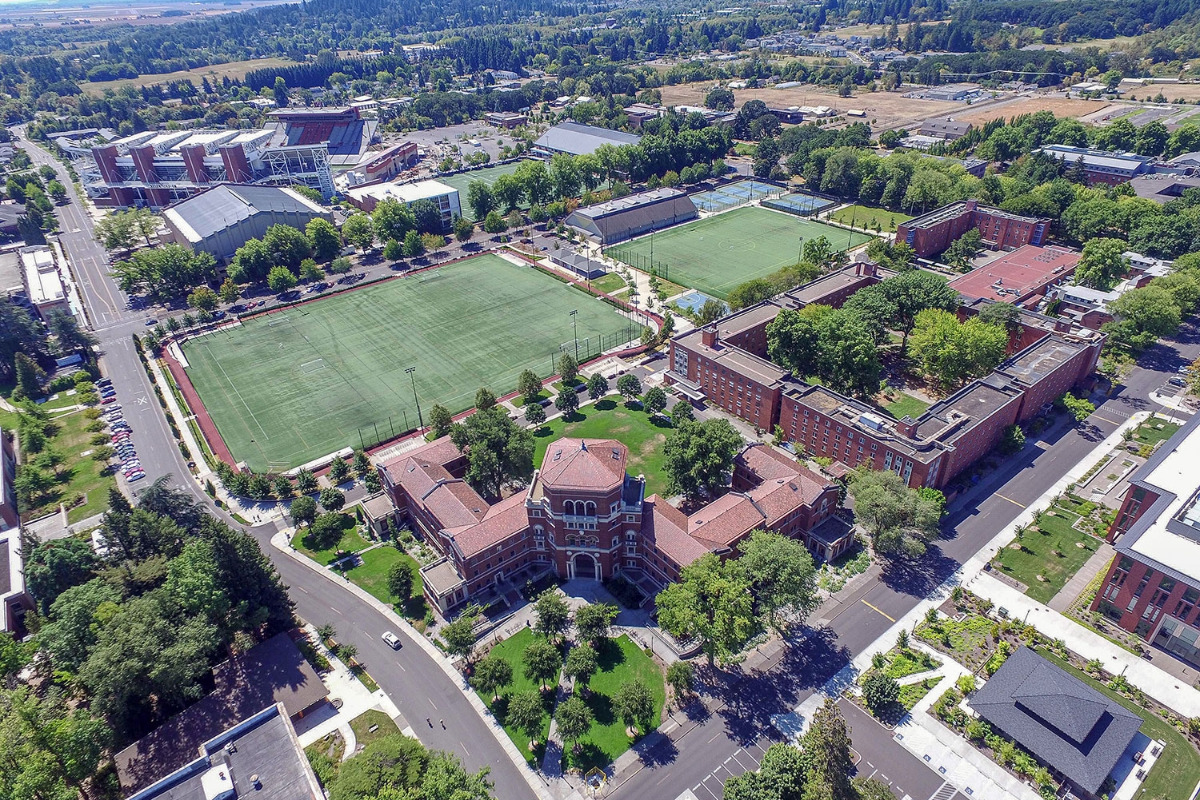
Corvallis combines Oregon State University’s research economy with a growing tech and healthcare employment base
2026 Economic Outlook
- OSU’s College of Engineering and Computer Science expanding enrollment 12% through 2028
- HP Corvallis pivoting to advanced printing and manufacturing R&D with new hiring
- Samaritan Health Services opening a $120M facility expansion adding 300+ jobs
- OSU’s AgriScience Research Park attracting agricultural technology startups
- Remote work enabling Portland-priced workers to relocate to Corvallis’s more affordable market
Investment Climate
Corvallis offers something increasingly rare in Oregon: genuine cash flow potential. While Portland and Eugene have seen cap rates compress to 3 to 4 percent, Corvallis properties near OSU regularly achieve 5.5 to 8.5 percent depending on strategy. The market rewards investors who understand the university cycle, take advantage of by-the-room rental structures, and build portfolios that balance student-facing properties with professional tenants for year-round stability.
- Cash flow orientation is realistic here, unlike most Oregon markets where negative carry is standard
- Low entry point compared to Portland or Bend, with a median of $438,000 versus $520,000+ in competing markets
- Oregon rent stabilization applies, limiting annual increases to roughly 7 to 10 percent but providing predictability for long-term hold calculations
- New construction exemption gives investors in recently built properties full rent-setting flexibility for the first 15 years
- Strong tenant pool from a highly educated, rent-obligated workforce with low default rates
The main investment risk in Corvallis is overexposure to a single institution. Investors who diversify across neighborhoods and tenant types, balancing student rentals with professional and family housing, consistently outperform those with all-student portfolios.
Historical Performance
| Period | Market Driver | Avg Annual Appreciation | Key Event |
|---|---|---|---|
| 2010-2014 | OSU enrollment growth, HP stabilization | 3-5% | Corvallis outperformed Oregon average through recession |
| 2015-2019 | Oregon housing shortage, Willamette Valley growth | 6-9% | Oregon passes SB 608 (statewide rent stabilization) in 2019 |
| 2020-2022 | Remote work migration, pandemic demand | 10-15% | Corvallis attracted Portland remote workers seeking space and affordability |
| 2023-2024 | Rate normalization, return to university fundamentals | 3-5% | Market held steady with OSU enrollment continuing to grow |
| 2025-2026 | Rate stabilization, OSU expansion, healthcare growth | 4-7% (projected) | Samaritan expansion and OSU College of Engineering growth driving new demand |
Corvallis has never experienced the sharp price corrections seen in speculative markets. The university anchor creates a floor under demand that has kept the market steady through multiple national cycles. A $300,000 property purchased in 2010 would be worth approximately $580,000 to $640,000 today, representing a 5 to 6 percent compound annual return, with strong rental income throughout the holding period.
Demographic Trends Driving Demand
- OSU Enrollment Expansion – Graduate programs in engineering, agriculture, and environmental science growing faster than undergraduate enrollment, creating demand for longer-tenancy renters
- International Students – OSU’s international student population exceeds 3,500, with students from China, India, South Korea, and Saudi Arabia concentrated in graduate programs that run year-round
- Healthcare Employment Growth – Samaritan Health Services is the second-largest employer in Benton County and continues to grow, drawing nurses, physicians, and allied health workers who rent for 2 to 5 years
- Remote Work Migration – Portland and Bay Area remote workers permanently relocating to Corvallis, stretching their savings further while maintaining tech-sector incomes
- Young Professional Retention – OSU graduates with HP and research employment increasingly choosing to stay in Corvallis rather than relocate to metro markets
- Supply Constraint – Corvallis has limited land for expansion due to the urban growth boundary and surrounding agricultural zones, keeping supply tight and supporting rents
📚 New to real estate investing? Master the fundamentals with our professional course Learn more →
2. Neighborhood Hotspots
Corvallis Investment Neighborhood Map
Interactive map of Corvallis investment neighborhoods. Green stars show top hotspots, blue circles mark established markets, and orange circles highlight emerging areas.
Core Investment Neighborhoods
Detailed Submarket Analysis: All Corvallis Neighborhoods
| Neighborhood | Price Range (SFH) | Cap Rate | Growth Drivers | Best Strategy |
|---|---|---|---|---|
| University District / Monroe Ave | $390K-$520K | 6.5-8.5% | OSU walkability, by-the-room premium | By-the-room, small multi-family |
| South Corvallis / Avery Park | $420K-$580K | 4.5-5.5% | Professional tenants, park proximity, low turnover | Long-term SFH hold, family rentals |
| Downtown Corvallis | $350K-$500K | 5.0-6.5% | Walkability, graduate students, revitalization | Mixed-use, condos, furnished rentals |
| North Corvallis / Circle Blvd | $430K-$600K | 4.5-5.5% | HP campus, healthcare employment, modern stock | Professional tenants, low-maintenance hold |
| West Corvallis / Orchard District | $400K-$520K | 5.5-7.0% | Bike path to OSU, mixed student and professional | Balanced returns, duplex, buy-and-hold |
| Crystal Lake / SE Corvallis | $380K-$480K | 5.0-6.0% | Affordability, working-class stability, improving retail | Value-add, cash flow focus |
| Philomath | $290K-$400K | 6.0-8.0% | Lowest entry, OSU demand zone, growth | Best cash flow in market, value-add |
| OSU Research District | $420K-$560K | 5.5-7.5% | Research park, academic long-stays, furnished premium | Furnished corporate/academic rentals |
Expert Insight: “The most consistent outperformers I see in Corvallis are investors who buy 4 and 5 bedroom homes within a 15-minute bike ride of the OSU Quad and lease by the room. A $460,000 house renting for $2,800 as a whole unit becomes a $3,200 to $3,600 per month asset when leased room by room. That gap is the entire investment thesis for this market. Students and graduate students will pay $650 to $750 for their own room and shared common areas, and they do not care about yard maintenance or kitchen upgrades.” – David Park, Principal, Willamette Valley Investment Group
3. Property Types
| Investment Goal | Best Property Type | Best Neighborhoods | Minimum Capital |
|---|---|---|---|
| Maximum Cash Flow | By-the-room student house | University District, Philomath | $75,000+ |
| Lowest Management | Professional tenant SFH | South Corvallis, North Corvallis | $105,000+ |
| Balanced Returns | Duplex or triplex | University District, West Corvallis | $140,000+ |
| Rent Stabilization Exempt | New construction (under 15 years) | North Corvallis, NW Corvallis | $120,000+ |
Don’t guess the costs. Our Complete Renovation & Remodeling Cost Guide covers 400+ pages of project-by-project breakdowns with real contractor pricing ranges.
4. Cost Analysis
Acquisition Cost Breakdown (Corvallis)
| Expense Item | Typical Cost | Example ($438,000 Property) | Notes |
|---|---|---|---|
| Down Payment | 25% (investment) | $109,500 | Standard for investment properties in Oregon |
| Closing Costs | 2-3% of price | $8,760-$13,140 | Title, escrow, lender fees, recording (Oregon uses escrow-based closings) |
| General Inspection | $400-$600 | $500 | Moisture inspection important given Willamette Valley rainfall |
| Sewer Scope Inspection | $200-$350 | $275 | Strongly recommended for pre-1990 Corvallis homes |
| Radon Test | $150-$250 | $175 | Benton County has elevated radon levels; mitigation runs $1,200-$2,500 |
| Initial Repairs / Make Ready | 0-8% of price | $0-$35,000 | Student-facing properties often need paint, flooring, appliance updates |
| Reserves (6 months) | 6 months expenses | $10,000-$15,000 | Summer vacancy buffer especially important for student-facing properties |
| TOTAL MINIMUM ENTRY | ~28-33% of value | $129,210-$174,090 | Far more accessible than Portland or Bend markets |
Sample Cash Flow Analysis: 4-Bedroom University District House (By-the-Room)
| Item | Monthly | Annual | Notes |
|---|---|---|---|
| Room 1 Rent | $680 | $8,160 | Graduate student, 12-month lease |
| Room 2 Rent | $650 | $7,800 | Undergraduate, 12-month lease |
| Room 3 Rent | $650 | $7,800 | Undergraduate, 12-month lease |
| Room 4 Rent | $620 | $7,440 | Smaller room, undergraduate |
| Gross Income | $2,600 | $31,200 | |
| Less Vacancy (6%) | -$156 | -$1,872 | Conservative given annual room turnover |
| Property Taxes | -$315 | -$3,780 | ~0.86% of $440K assessed value |
| Insurance | -$120 | -$1,440 | Landlord policy with liability umbrella |
| Property Management (10%) | -$260 | -$3,120 | Recommended even for local investors with student tenants |
| Maintenance + CapEx | -$260 | -$3,120 | Budget higher for student properties due to wear |
| Net Operating Income | $1,489 | $17,868 | Before mortgage |
| Mortgage ($460K purchase, 25% down, 6.75%, 30yr) | -$2,232 | -$26,784 | Principal and interest only |
| CASH FLOW | -$743 | -$8,916 | Manageable negative carry; whole-unit would be -$1,400/month |
| Cap Rate | 3.9% (at purchase price) | NOI / Purchase Price; rises significantly as rents grow | |
| Total Return (5% appreciation) | ~18% | Including equity, appreciation, principal paydown on $115K invested |
This example shows a manageable negative carry position that improves significantly each year as rents rise under Oregon’s stabilization cap of 7 percent plus CPI. Investors who can structure 12-month leases starting in August, aligned with the academic calendar, substantially reduce vacancy. Adding a fifth bedroom through a permitted conversion can push gross income to $3,100 to $3,250 per month, turning the property cash flow positive.
Expert Insight: “Investors who buy in Philomath at $320,000 and lease by the room generate better cash-on-cash returns than investors who buy near OSU at $480,000 and rent whole-unit. The $160,000 price difference more than offsets the slightly lower rents. I advise first-time Corvallis investors to start in Philomath, build cash flow, and refinance equity into a second University District property. It is the most reliable path to a positive cash flow portfolio in this market.” – Sarah Chen, Corvallis Investment Properties Group
5. Legal Framework
⚠️ Oregon Statewide Rent Stabilization Applies to Corvallis
Oregon was the first U.S. state to pass statewide rent stabilization legislation (SB 608, effective 2019). This law applies to all Corvallis rental units in buildings more than 15 years old. Annual rent increases are capped at 7 percent plus CPI (with a hard ceiling near 10 percent), and just cause eviction is required after 12 months of tenancy. However, Oregon law also preempts local jurisdictions from enacting stricter rent control, meaning Corvallis cannot add additional restrictions beyond the state baseline. This creates a more predictable regulatory environment than cities like Portland with multiple layers of regulation. Always consult an Oregon-licensed landlord-tenant attorney before acquiring rental properties.
Oregon Statewide Landlord-Tenant Law (Applies in Corvallis)
- Rent Stabilization (SB 608): Annual increases capped at 7% plus CPI, not to exceed approximately 10%. Applies to all rentals in buildings over 15 years old. New construction exempt for 15 years from certificate of occupancy.
- Just Cause Eviction: After 12 months of continuous tenancy, landlords must have documented just cause to terminate a tenancy. Valid causes include non-payment, material lease violation, damage, criminal activity, owner move-in, or demolition. 90-day written notice required for most no-fault terminations.
- Notice Requirements: 72-hour notice to pay or vacate for non-payment. 30-day notice for other lease violations (first offense). 10-day notice for repeat violations within 6 months.
- Security Deposits: No statutory cap in Oregon, but deposits must be returned within 31 days of move-out with itemized accounting. Interest on deposits not required.
- Habitability Standards: Landlords must maintain working heat (at least 68°F when outside temps are below 35°F), plumbing, electrical, weatherproofing, and structural integrity.
- Smoke and Carbon Monoxide Detectors: Required in all residential rentals; landlord responsible for installation, tenant responsible for battery replacement.
Corvallis-Specific Considerations
Corvallis does not have its own landlord-tenant ordinances beyond Oregon state law, which is an advantage compared to Portland. Key local factors:
- No Local Rent Control: Oregon’s preemption law means Corvallis cannot enact stricter local rent restrictions. This is a significant landlord advantage compared to out-of-state markets.
- Student Tenant Dynamics: By-the-room leases with individual lease agreements per tenant can provide more flexibility than whole-unit leases. Each individual lease is treated as a separate tenancy under Oregon law.
- Urban Growth Boundary: Corvallis’s UGB limits outward expansion, keeping the city compact and rental demand concentrated. Investors benefit from the supply constraint this creates.
- OSU Off-Campus Housing Requirements: OSU does not require off-campus housing registration but encourages landlords to list on the OSU off-campus housing board, a valuable free marketing channel for university-adjacent investors.
- Benton County Property Taxes: Effective rate approximately 0.86% of assessed value. Oregon’s property tax system limits increases to 3% per year on assessed value, capped below market value for long-held properties.
- Short-Term Rentals: Corvallis follows Oregon state STR framework. Short-term rentals require a city license and compliance with Benton County health and safety codes. No hard prohibition on investment property STRs unlike some Oregon cities.
Useful Corvallis and Oregon Resources
- Oregon Rental Housing Association: oregonrha.com
- Oregon Dept of Consumer and Business Services: oregon.gov/dcbs
- Corvallis City Planning: corvallisoregon.gov/planning
- Oregon Landlord-Tenant Hotline: 503-646-9160
| Regulation | Oregon / Corvallis Requirement | National Average | Investor Impact |
|---|---|---|---|
| Rent Increases | Capped at 7% + CPI (max ~10%) for buildings 15+ years old | Most states have no cap | Limits upside but provides predictability; new builds fully exempt |
| Eviction (after 12 months) | Just cause required; 90-day notice for no-fault | Many states allow 30-day no-cause eviction | Makes tenant selection critical; eviction process longer |
| Security Deposits | No cap; 31-day return window | Many states cap at 2 months rent | More flexibility for upfront protection vs. student tenants |
| Notice to Vacate | 72 hours for non-payment; 30 days other violations | 3-7 days non-payment in most states | Longer lead time means earlier action on late payments essential |
| New Construction Exemption | 15 years from certificate of occupancy | Most states have no rent stabilization at all | Significant advantage for investors buying new or recent builds |
| Local Preemption | State law preempts stricter local ordinances | Many states allow cities to add their own rules | Corvallis cannot add Portland-style additional restrictions |
6. Step-by-Step Corvallis Investment Playbook
Define Your Corvallis Strategy
Corvallis rewards investors who align their strategy with the university calendar and tenant demographics. The four dominant strategies:
By-the-Room Student Rentals
Maximum yield strategy. Buy 3 to 5 bedroom homes near OSU, lease each room individually at $600 to $750 per month. Requires higher management attention but generates 30 to 50 percent more gross income than whole-unit leasing.
Professional Tenant Buy-and-Hold
Stable, low-management strategy targeting OSU faculty, HP employees, and Samaritan Health staff. Longer tenancies, lower wear, and predictable income. Best for investors who want to minimize hands-on involvement.
Philomath Value-Add BRRRR
Buy dated properties in Philomath at $290,000 to $380,000. Renovate to increase rents and value. Refinance equity and repeat. Best entry point for new Oregon investors with limited capital who want to scale.
New Construction / Rent-Exempt Play
Buy properties under 15 years old that are exempt from Oregon’s rent stabilization. Set and raise rents freely as the market grows. Best suited for investors who value regulatory simplicity and intend to hold long-term.
Build Your Corvallis Team
Corvallis is a small market. The agent, attorney, and property management ecosystem is tighter than in Portland or Eugene. Building the right team early is critical:
- Corvallis-Specialist Real Estate Agent: Must have a track record with investor clients specifically. Ask how many investment purchases they handled in the last 12 months and whether they understand by-the-room vs. whole-unit return calculations.
- Oregon Landlord-Tenant Attorney: Critical for structuring by-the-room leases correctly under SB 608. A single lease agreement error can expose you to just-cause eviction complications.
- OSU-Familiar Property Manager: Look for a Corvallis property manager who actively manages student properties and understands the August lease cycle. The Oregon Rental Housing Association directory is a good starting point.
- Philomath or Benton County Contractor: If pursuing value-add, a contractor with Benton County permit experience will save significant time. Philomath and Corvallis have separate permit departments.
- Oregon Real Estate CPA: Oregon has state income tax, which applies to rental income. Proper depreciation scheduling and cost segregation can significantly reduce your Oregon and federal tax liability.
Expert Tip: Listing your rental on the OSU Off-Campus Housing portal (studentlife.oregonstate.edu/housing/off-campus-housing) is free and generates direct inquiries from students and faculty. Properties listed there rent 2 to 4 weeks faster than those relying only on Zillow or Craigslist, meaningfully reducing vacancy costs.
Corvallis-Specific Due Diligence
Physical Due Diligence
- Radon test (Benton County is an elevated radon zone; mitigation is straightforward but adds $1,200 to $2,500)
- Moisture and mold inspection given the Willamette Valley’s 50-plus inches of annual rainfall
- Sewer scope for pre-1990 homes
- Roof condition and moss treatment (moss growth is endemic in Oregon; annual treatment is a real operating cost)
- Crawl space condition and vapor barrier status
- Check for unpermitted garage conversions or added bedrooms, common in student-adjacent properties
- HVAC age and condition (Corvallis summers can reach 100°F; AC is increasingly expected by tenants)
Regulatory and Market Due Diligence
- Verify construction date to confirm rent stabilization status (15-year exemption applies to buildings certificated after 2009 as of 2024)
- Pull all permits on the property; unpermitted work in Corvallis must be disclosed and can complicate financing
- Confirm zoning for your intended use, including by-the-room leasing in residential zones
- Review current lease agreements and existing tenant rights if purchasing occupied
- Verify bike path and transit proximity (walk/bike score dramatically affects rental demand near OSU)
- Check if the property is within the OSU 15-minute walk zone (maps available from Benton County GIS)
- Confirm short-term rental licensing if that strategy is planned
Mastering the Corvallis Leasing Calendar
Timing is everything in a university market. Investors who align with the OSU leasing cycle consistently achieve lower vacancy than those who do not:
- January to February: Begin advertising for August move-in. Graduate students sign leases 6 to 9 months in advance. Properties listed in February lease faster and attract higher-quality tenants than those listed in June.
- March to April: Peak leasing season. By April 1, most well-priced University District properties are already leased for the following fall. Investors who miss this window often face summer availability.
- May to July: Secondary leasing season for properties near HP or Samaritan. Professional tenants lease year-round and are less calendar-driven.
- August to September: Move-in season. Have properties ready 2 weeks before OSU’s fall term start (typically late September). Early move-ins are common and generate bonus rent.
- October to December: Stable occupancy. Use this period to schedule non-urgent maintenance, budget reserves, and identify properties for spring acquisition.
Key Insight: Offering 12-month leases beginning August 1, aligned with OSU’s fall start, dramatically reduces the summer vacancy risk that concerns many prospective Corvallis investors. Students and graduate students strongly prefer 12-month over 9-month leases because they need housing during the summer for internships, research, and employment.
Property Management in Corvallis
The decision between self-management and professional management depends heavily on your strategy and proximity to the market:
Student Property Management Considerations
- Annual lease rollovers require re-marketing every spring with tight turnaround timelines
- By-the-room properties need individual lease agreements per Oregon law; using an attorney-reviewed template is essential
- Student tenants call more frequently for minor issues; budget management time accordingly
- Move-out inspections must be thorough and documented with photos; security deposit disputes are common
- OSU’s Off-Campus Housing listing service is free and highly effective for finding qualified applicants quickly
Typical Corvallis Management Fees
- Single-family management: 8-10% of monthly rent
- Multi-unit or student property management: 10-12% of monthly rent
- Leasing fee: 50-75% of one month’s rent
- Lease renewal fee: $150-$300 per renewal
- By-the-room properties often add 1-2% premium due to higher management intensity
7. Financing Options for Corvallis
| Loan Type | Down Payment | Rate Premium | Best For | Corvallis Note |
|---|---|---|---|---|
| Conventional Investment | 25% | +0.5-0.75% | Strong W-2 income, good credit, standard properties | Most Corvallis properties qualify as conforming loans (under $806,500) |
| House Hacking (FHA) | 3.5% | Standard + MIP | Owner-occupying one unit of a 2-4 unit property | Best entry strategy for new investors; duplexes near OSU qualify |
| DSCR Loan | 25-30% | +1.5-2.5% | Investors without W-2 income documentation | Corvallis cap rates of 5.5-7%+ often qualify at 1.0x coverage, unlike Portland |
| Portfolio Loan | 20-30% | +1-2% | Multiple properties, self-employed investors | Oregon community banks and credit unions active in Corvallis investor market |
| Hard Money (Bridge) | 15-25% | 8-12% rate | BRRRR acquisitions, renovation projects | Oregon-based hard money lenders active in Willamette Valley; Philomath deals common |
| HELOC on Primary | N/A (equity draw) | Prime + 0.5-1% | Experienced investors with home equity | Effectively 100% financing for Philomath deals; cash flow covers HELOC payments |
| Oregon Housing and Community Services | 5-10% | Below market | Owner-occupant first-time buyers with income limits | OHCS programs available for qualifying owner-occupant investors; income limits apply |
Corvallis Financing Advantage: Unlike Portland or Bend, Corvallis properties at 5.5 to 7 percent cap rates often qualify for DSCR loans, making them accessible to investors who cannot or prefer not to use income documentation. A $440,000 property with $24,000 in annual NOI generates a DSCR of approximately 1.07 at a 6.75 percent rate, meeting most lenders’ 1.0x threshold. This gives Corvallis investors more financing flexibility than nearly any other Oregon market.
8. Frequently Asked Questions

Knowledge Quiz: Corvallis Oregon Real Estate Investment
Open Quiz
5 quick questions on what you just learned about Corvallis investing
1) What is the key advantage of the by-the-room rental strategy in the Corvallis University District?
Answer: B
The guide shows that a 4-bedroom University District house renting at $650 per room generates $2,600 per month versus $2,000 to $2,200 as a whole-unit lease. This 30 to 50 percent gross income premium is the core investment thesis for the by-the-room strategy in Corvallis. It comes with higher management intensity but delivers cap rates of 6.5 to 8.5 percent, the best in the Oregon market.
2) How long are newly constructed properties exempt from Oregon’s rent stabilization law?
Answer: D
Oregon’s SB 608 exempts new construction from rent stabilization for 15 years from the certificate of occupancy. This is a significant investor advantage, allowing freely set rents during the property’s most active appreciation period. Investors targeting this exemption should verify construction dates carefully and understand when their specific property’s exemption window closes.
3) Why does the guide recommend Philomath as an excellent starting point for new Corvallis area investors?
Answer: A
Philomath is five minutes west of OSU and draws from the same student and professional rental demand as Corvallis. Entry prices of $290,000 to $400,000 compared to $390,000 to $520,000 near OSU mean significantly better cash flow and cash-on-cash returns. The guide suggests starting in Philomath for cash flow, then using refinanced equity to buy a University District property as a second acquisition.
4) What is the critical due diligence inspection specifically flagged for Benton County properties?
Answer: C
The guide specifically flags Benton County as an elevated radon zone and recommends a radon test for all Corvallis and Philomath purchases. Radon mitigation is straightforward and costs $1,200 to $2,500 but must be factored into acquisition due diligence. This is a Corvallis-specific risk not common to all Oregon markets.
5) When should Corvallis investors begin marketing University District student rentals for the upcoming academic year?
Answer: B
The guide’s leasing calendar section explains that by April 1, most well-priced University District properties are already leased for the following fall. Graduate students sign leases 6 to 9 months in advance. Investors who begin marketing in January and February consistently achieve lower vacancy and attract higher-quality tenants than those who wait until summer.
Work With a Local Expert in Corvallis
We are building a verified network of real estate professionals across every market we cover.

About Our Expert Network
We are finalizing partnerships with verified real estate professionals across every market featured on Builds and Buys. Each expert in our network is selected for their hands-on investment experience, local market knowledge, and commitment to helping buyers and investors make sound decisions.
Our local specialists offer:
- Proven experience with investment and income-producing properties
- Deep knowledge of local pricing, rental yields, and neighborhood dynamics
- Guidance on financing, legal structure, and due diligence
- Access to off-market and pre-market opportunities
- Full transaction support from search through closing
- Ongoing portfolio and property management referrals
Services Covered
- Property sourcing and acquisition
- Investment analysis and underwriting
- Buyer representation
- Market comparables and valuations
- Student and professional rental strategy
- Value-add and renovation guidance
- Legal and title referrals
- Financing and lender connections
- Property management referrals
- Insurance and inspection referrals
- 1031 exchange coordination
- Exit strategy planning
Get Connected or Join Our Network
Looking for a local expert to help with your Corvallis investment? Reach out and we will connect you with the right professional for your market and strategy.
Are you a real estate professional with a track record working with investors in the Willamette Valley? We are always expanding our network of verified local experts.
Contact us at support@buildsandbuys.com
Find Specialized Corvallis Real Estate Professionals
Ready to Invest in Corvallis?
Corvallis is one of Oregon’s most overlooked real estate investment markets. The combination of Oregon State University’s 32,000-plus enrollment, a diversified employer base anchored by HP and Samaritan Health, Oregon’s most investor-friendly regulatory framework outside of rural markets, and cap rates that actually support cash flow makes this a compelling market for investors of every experience level. From the high-yield by-the-room university corridor to the accessible entry points of Philomath, Corvallis rewards investors who understand the university cycle and build portfolios for the long term.
Continue Your Research
Oregon State Guide
See how Corvallis compares to Portland, Eugene, Bend, Salem, and other Oregon markets.
Step-by-Step Invest
Complete framework for building a real estate investment strategy from scratch.
144-Lesson Course
University-level real estate education covering financing, law, strategy, and management.
For further guidance, explore our State-by-State Investor guides, browse our expert articles, or follow our Step-by-Step Investment Guide.