Spokane Real Estate Investment Guide For 2026
A comprehensive resource for investors targeting Eastern Washington’s largest city, where genuine cash-flow-positive investing is still achievable, Gonzaga University and Fairchild Air Force Base anchor multi-demographic rental demand, and post-pandemic appreciation has created one of the Pacific Northwest’s most compelling value propositions in 2026
Quick answers: Top 5 most searched Spokane investment questions ▼
Migration data: Where people are moving from to Spokane ▼
In This Guide
Click on any section to navigate directly to that content
1. Spokane Market Overview
Market Fundamentals
Spokane occupies a unique position in the Pacific Northwest real estate landscape: it is large enough to have genuine economic depth and growing employer diversity, yet affordable enough that real positive cash flow remains achievable for investors using conventional financing. Eastern Washington’s largest city, Spokane sits at the convergence of the Gonzaga University student rental ecosystem, Fairchild Air Force Base military tenant demand, a rapidly expanding healthcare sector, and a sustained post-pandemic migration wave from California and western Washington. The result is a market that combines western Washington appreciation fundamentals with eastern Washington cash flow math.
Key economic indicators defining Spokane’s investment case:
- Population: 230,000+ city proper, 580,000+ greater Spokane County metro
- Major Employers: Providence Health System (8,000+), Fairchild Air Force Base (6,500+), MultiCare/Deaconess, VA Medical Center, Amazon Fulfillment, Numerica Credit Union, Itron, Clearwater Paper
- Universities: Gonzaga University (9,500 students), Washington State University Health Sciences campus, Whitworth University, Eastern Washington University (Cheney, 12,000 students)
- Median Household Income: $55,000 and growing at 3 to 4% annually
- No State Income Tax: Washington state benefit; particularly meaningful for California migrants comparing total cost of living
- Vacancy Rate: Under 4% citywide, under 2% near Gonzaga and Fairchild
Spokane’s economy has diversified meaningfully since its industrial and timber roots. Healthcare now employs approximately 15 percent of the metropolitan workforce. The WSU medical school campus is producing a steady pipeline of healthcare professionals who prefer Spokane’s cost of living over Seattle. Amazon’s Spokane Valley fulfillment center added thousands of jobs. The Idaho border economy (Coeur d’Alene is 30 miles east) contributes cross-border retail and service employment that supports housing demand on both sides of the state line.
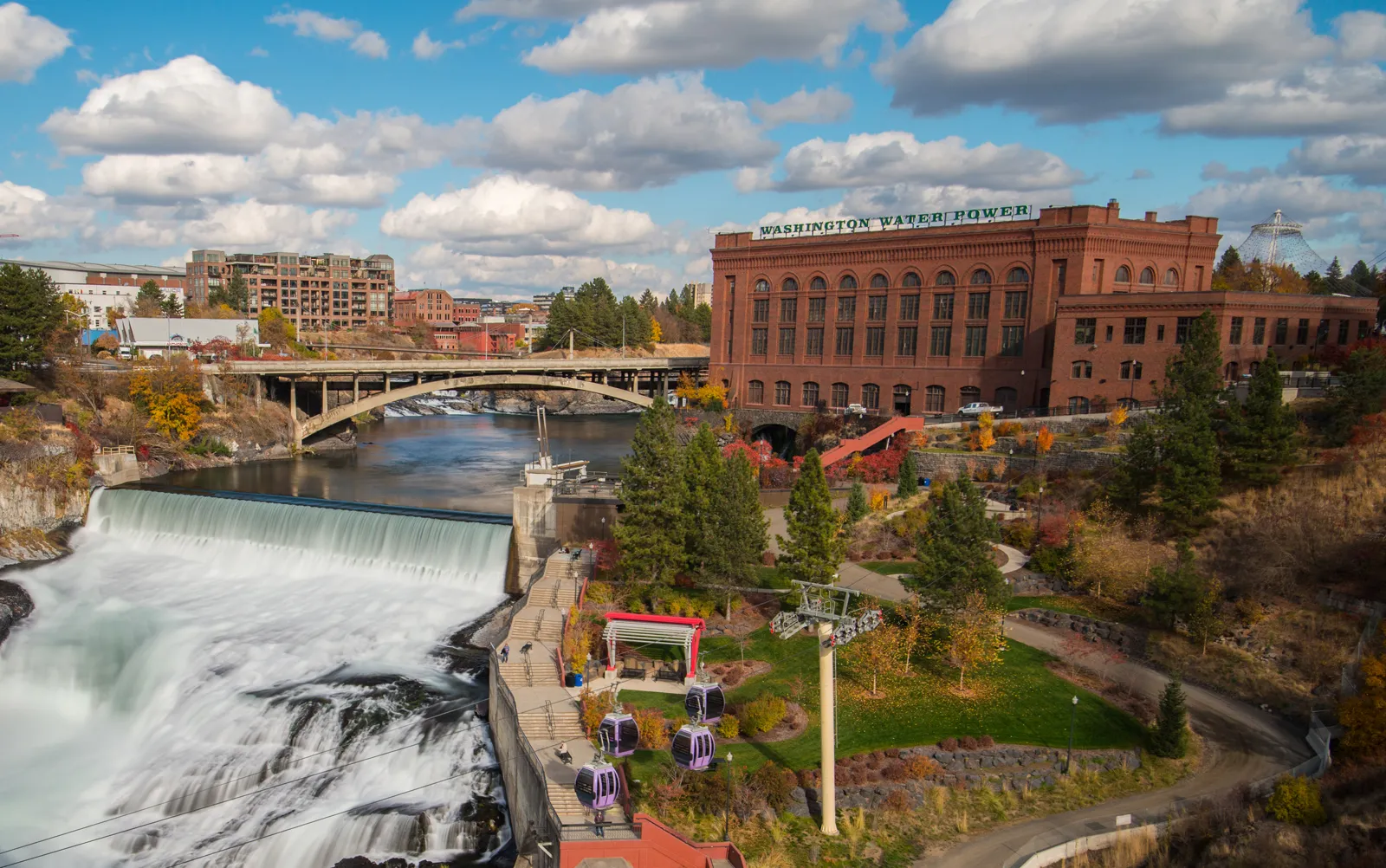
Spokane’s revitalized downtown and Riverfront Park reflect a city experiencing confident transformation, anchored by healthcare, education, and military employment
2026 Economic Outlook
- WSU medical school continued expansion adding graduate student and faculty rental demand near downtown
- Fairchild AFB KC-46 Pegasus tanker mission expansion adding active duty personnel through 2027
- Providence and MultiCare healthcare system expansions adding 1,000+ jobs annually
- Amazon Spokane Valley fulfillment center full capacity, supporting workforce housing demand
- Sustained California and western WA migration at 5,000 to 8,000 net new residents per year
Investment Climate
Spokane’s investment environment is defined by something increasingly rare in the Pacific Northwest: genuine cash flow potential, a highly landlord-friendly regulatory environment, and multiple distinct tenant demand ecosystems that operate largely independently of each other. When tech sector hiring slows in Seattle, Spokane’s healthcare employment keeps renting. When healthcare is stable, Gonzaga fills rooms every September regardless of the economy. When those two stabilize, Fairchild’s constant PCS cycle creates its own perpetual vacancy-filling mechanism. Successful Spokane investors tend to share these characteristics:
- Cash flow orientation with genuine expectation of positive or near-break-even monthly returns from day one in most duplex and student rental configurations
- University market expertise understanding the by-the-room leasing strategy, academic calendar timing, and parental co-signer requirements that make student rentals work
- Value-add focus in transitional neighborhoods like Perry District, where 1920s to 1940s Craftsman homes can be renovated to capture the incoming professional demographic attracted by the neighborhood’s cultural identity
- Military market awareness including Fairchild BAH rates, PCS cycle timing, and SCRA lease termination planning that mirrors the JBLM strategy in Tacoma but at lower price points
- Short-term rental opportunism in the downtown and Riverfront Park corridor, where Spokane’s growing sports tourism, convention business, and outdoor recreation appeal create viable STR yields
Historical Performance
| Period | Market Driver | Avg Annual Appreciation | Key Event |
|---|---|---|---|
| 2010-2014 | Slow recovery, healthcare stability, Gonzaga Final Four prominence | 2-4% | Gonzaga basketball brings national attention; downtown revitalization begins |
| 2015-2019 | Healthcare expansion, WSU medical school launch, early migration | 5-8% | WSU Elson Floyd College of Medicine opens; Perry District begins transformation |
| 2020-2022 | Pandemic migration wave, remote work discovery, California influx | 22-30% | Spokane named one of top 10 U.S. cities for remote workers; bidding wars on every listing; median price rose from $215K to $360K+ |
| 2023-2024 | Rate shock, mild correction, stabilization | -3% to +2% | Prices pulled back 5 to 10 percent from peak; rental market held firm as ownership became less affordable; vacancy remained low |
| 2025-2026 | Rate stabilization, sustained migration, healthcare growth | 5-8% (projected) | Market re-accelerating from fair-value base; cash flow math improved as prices stabilized while rents held |
Spokane’s pandemic-era appreciation of 60 to 75 percent in two years was extraordinary and unsustainable. The 2023 to 2024 correction brought prices back to a level consistent with Spokane’s income fundamentals and rental yields. For investors entering in 2026, this means buying near fair value rather than at peak froth, with rents that held through the correction now generating better cap rates than were available at 2022 peak prices. The entry conditions are genuinely favorable.
Demographic Trends Driving Demand
- California Migration Continuation – Sustained at lower but durable levels post-pandemic. Spokane’s combination of outdoor recreation (skiing, lakes, hiking), no state income tax, and home prices 60 to 70 percent below comparable California cities continues attracting remote workers and retirees
- Healthcare Employment Expansion – Providence, MultiCare/Deaconess, and the VA Medical Center are the city’s most stable employment anchors, collectively employing 20,000+ workers. Healthcare wages support $1,400 to $2,000/month rents without strain
- Gonzaga University Stability – One of the most nationally recognized universities per enrollment in the country. Academic calendar creates predictable rental demand with annual September move-in regardless of economic conditions
- Fairchild AFB Steady State – The base’s KC-46 tanker mission expansion adds personnel through 2027. Military tenants with BAH provide recession-proof rental income in the Airway Heights and West Plains corridors
- WSU Medical School Growth – The Elson Floyd College of Medicine opened in 2017 and continues expanding enrollment. Medical students and residents are high-quality tenants concentrated near the Health Sciences building downtown
- Idaho Border Draw – Coeur d’Alene’s growth and Spokane’s position as the regional shopping, entertainment, and medical center for north Idaho creates a cross-border employment draw that supports housing demand broadly
📚 New to real estate investing? Master the fundamentals with our professional course Learn more →
2. Neighborhood Hotspots
Spokane Investment Neighborhood Map
Interactive map of Spokane’s investment neighborhoods. Green stars show top hotspots, blue circles mark established markets, and orange circles highlight emerging areas.
Core Investment Neighborhoods
Detailed Submarket Analysis: All Spokane Neighborhoods
| Neighborhood | Price Range | Cap Rate | Growth Drivers | Best Strategy |
|---|---|---|---|---|
| University District (Gonzaga) | $240K-$380K | 8.0-11.0% (by-room) | Gonzaga enrollment, by-room premium, parental co-signers | Student by-room rental, 4+ BR SFH |
| South Hill | $350K-$650K | 5.0-6.5% | Premium demographics, Manito Park, top schools, healthcare professionals | Premium appreciation hold, professional tenant focus |
| Perry District | $220K-$350K | 6.5-8.5% | Gentrification momentum, cultural identity, young professional demand | Value-add BRRRR, renovation appreciation play |
| Browne’s Addition | $280K-$480K | 5.5-7.0% | Historic character, downtown adjacency, limited supply, river views | Premium hold, historic renovation, appreciation |
| Airway Heights / Fairchild | $200K-$340K | 7.5-9.5% | BAH military demand, Fairchild expansion, near-zero vacancy | Military BAH cash flow, duplex hold |
| North Spokane | $180K-$290K | 7.5-9.5% | Most affordable entry, workforce housing demand, duplex availability | Highest cash flow, duplex, multi-family |
| Spokane Valley | $250K-$400K | 6.0-7.5% | Amazon fulfillment, suburban family demand, newer construction | Family SFH, balanced cash flow and appreciation |
| Downtown / Riverfront | $150K-$320K | 6.5-9.0% (STR); 5.0-6.5% (conventional) | STR sports/event tourism, convention center, urban revitalization | Short-term rental, urban condo, revitalization play |
| Logan (Near Gonzaga) | $200K-$310K | 7.0-9.5% | Gonzaga adjacency, below-market entry for student rental, renovation upside | Student rental, value-add, transitional neighborhood hold |
| Cheney / EWU | $160K-$270K | 9.0-13.0% (by-room) | EWU 12,000 students, lowest entry prices, highest gross yields | Highest-yield student rental; Spokane-area minimum entry |
| Hillyard | $150K-$240K | 8.0-11.0% | Absolute lowest Spokane entry, workforce demand, patient gentrification play | Maximum cash flow, long-term patient hold, BRRRR |
Expert Insight: “Perry District is where we’re telling clients to buy right now if they’re looking for capital appreciation with a value-add component. Three years ago you could buy a 1930s bungalow on Perry for $165,000 and rent it for $1,100. Today that same house is $270,000 and renting for $1,550. In three more years it’s going to be $380,000 and renting for $1,900. The coffee shops are there, the galleries are there, the food scene is there. What’s missing is the housing stock catching up to what the neighborhood has become. That gap is the investment thesis.” – Kevin Walsh, Managing Broker, Spokane Investment Properties
3. Property Types
| Investment Goal | Best Property Type | Best Neighborhoods | Minimum Capital |
|---|---|---|---|
| Maximum Gross Yield | 4+ BR student rental by-the-room | Cheney/EWU (highest), Gonzaga University District | $45,000+ |
| Best Monthly Cash Flow | Duplex or military SFH | Airway Heights, North Spokane, Medical Lake | $55,000+ |
| Best Total Return (Balanced) | Value-add Craftsman with renovation upside | Perry District, Logan, Hillyard | $60,000+ |
| Maximum Appreciation | Premium SFH in established neighborhood | South Hill, Browne’s Addition, Indian Trail | $90,000+ |
Don’t guess the costs. Our Complete Renovation & Remodeling Cost Guide covers 400+ pages of project-by-project breakdowns with real contractor pricing ranges.
4. Cost Analysis
Acquisition Cost Breakdown (Spokane)
| Expense Item | Typical Cost | Example ($310,000 Perry District SFH) | Notes |
|---|---|---|---|
| Down Payment | 25% (investment) | $77,500 | Standard for investment; Spokane’s lower prices mean significantly less capital required than western WA |
| Closing Costs | 2-3% of price | $6,200-$9,300 | Title, escrow, lender fees; Spokane County rates are lower in absolute dollars than King County |
| Sewer Scope Inspection | $175-$300 | $225 | Essential for all pre-1990 homes; Spokane has aging clay and concrete laterals throughout older neighborhoods |
| Asbestos / Lead Test | $250-$500 | $350 | Pre-1978 homes; Spokane’s Craftsman stock frequently contains both; abatement must be budgeted before renovation |
| General Inspection | $350-$550 | $425 | Foundation and basement moisture critical in Spokane’s freeze-thaw climate; chimney condition for older homes with wood heat |
| Radon Test | $100-$200 | $150 | Eastern Washington has elevated radon levels; Spokane County is a high-radon area; mitigation costs $800 to $2,500 if needed |
| Initial Repairs / Renovation | 0-15% of price | $0-$46,500 | Spokane Craftsman stock often needs kitchen, bath, and mechanical updates; labor costs 30-40% below western WA |
| Reserves (6 months) | 6 months expenses | $7,000-$10,000 | Emergency fund; student rental annual lease-up gaps in May/August require reserve buffer |
| TOTAL MINIMUM ENTRY | ~28-35% of value | $91,850-$144,000 | Approximately 40-60% of the capital required for a comparable Seattle or Tacoma purchase |
Three-Way Cash Flow Comparison: The Same $95,000 Down Payment in Spokane’s Three Core Strategies
| Item | Military SFH (Airway Heights, $280K) | Student Rental 4BR (Near Gonzaga, $310K) | Duplex (North Spokane, $310K) |
|---|---|---|---|
| Down Payment | $70,000 (25%) | $77,500 (25%) | $77,500 (25%) |
| Gross Monthly Rent | $1,900 (BAH 3BR) | $3,000 (4 x $750/room) | $2,400 (2 x $1,200/door) |
| Vacancy | -$38 (2%) | -$300 (10% summer gap) | -$120 (5%) |
| Property Taxes (~1% Spokane County) | -$233 | -$258 | -$258 |
| Insurance | -$100 | -$130 | -$130 |
| Property Management (9%) | -$171 | -$270 | -$216 |
| Maintenance / CapEx | -$190 | -$300 | -$240 |
| Net Operating Income | $1,168 | $1,742 | $1,436 |
| Mortgage (25% down, 6.5%, 30yr) | -$1,327 | -$1,464 | -$1,464 |
| Monthly Cash Flow | -$159 | +$278 | -$28 |
| Cap Rate | 5.00% | 6.74% | 5.56% |
| Total Return (7% appreciation) | ~22% | ~30% | ~25% |
This comparison demonstrates what makes Spokane genuinely exceptional in the Pacific Northwest context. The duplex is at near-break-even with 25% down and current rates, the military SFH is mildly negative with strong total return, and the student rental is actually cash-flow positive right now. In Seattle, all three configurations would be negative by $2,000 to $3,500 per month. In Tacoma, the duplex and military SFH configurations are the only ones approaching break-even. In Spokane, the student rental produces positive income from day one. This is the defining Spokane investment advantage.
Expert Insight: “I show clients from Seattle and California one simple spreadsheet when they ask about Spokane. Same $80,000 down payment: in Seattle you’re negative $2,800 per month. In Tacoma you’re negative $700 per month. In Spokane near Gonzaga, you’re positive $280 per month. Same capital, same down payment percentage. They usually book a flight to Spokane within a week.” – Sarah Lindquist, Investment Advisor, Pacific Northwest Capital Advisors
5. Legal Framework
✅ Most Landlord-Friendly Major Washington City
Spokane operates under Washington state landlord-tenant law with no additional city-specific ordinances that restrict landlord operations. There is no just-cause eviction requirement beyond Washington’s 2021 statewide SB 5160 framework, no first-in-time applicant rule, no 180-day rent increase notice, no rental registration or inspection program, and no city-specific move-in fee caps. Spokane County courts process unlawful detainer actions efficiently. Of all major Washington cities, Spokane offers the most operationally straightforward landlord environment. This five-star landlord-friendliness rating reflects the absence of the regulatory layers that burden Seattle and Tacoma investors.
Washington State Law (Applies Throughout Spokane)
The Residential Landlord-Tenant Act (RCW 59.18) governs all Spokane rentals. Key provisions every landlord must know:
- Just Cause Eviction (SB 5160, 2021): Washington state requires just cause for eviction of tenants who have occupied a unit for 20 or more days. Qualifying grounds include non-payment of rent, material lease violation, damage beyond normal wear, criminal activity, owner move-in, demolition, or property sale. No just-cause is required for lease non-renewal with proper advance notice when the tenancy has not extended into month-to-month status.
- Rent Increases: 60 days written notice required for any rent increase. No state or city cap on the amount of the increase. Far simpler than Seattle’s 180-day CPI-indexed requirement.
- Month-to-Month Termination: Either party may terminate a month-to-month tenancy with 20 days written notice. No just-cause requirement for non-renewal beyond the state SB 5160 provisions.
- Security Deposits: Must be returned within 21 days with itemized deductions. No state cap on deposit amount. Spokane landlords commonly collect one month’s rent as deposit.
- Habitability: Properties must meet minimum habitability standards. Landlords must respond to heating and hot water issues within 72 hours. Spokane’s cold winters make functioning heating systems a genuine liability issue.
- Source of Income: Cannot discriminate based on lawful source of income including Section 8 and military BAH; applies statewide.
Spokane-Specific Considerations
While Spokane follows state law only at the city level, these market-specific factors matter for local operations:
- Student Lease Practices: Academic-year leases (August to July) are standard near Gonzaga and EWU. Parental co-signers are expected and should be required. Confirm your lease template addresses joint and several liability for all student tenants before any student rental is executed.
- Military SCRA Compliance: Near Fairchild, all leases must accommodate the Servicemembers Civil Relief Act’s 30-day termination right upon presentation of PCS or deployment orders. Build a 3 to 4 week vacancy buffer into your financial model for SCRA terminations.
- STR Permit Requirements: The City of Spokane requires a short-term rental permit and business license for any STR operation. Verify current permit requirements at my.spokanecity.org before purchasing any property with an STR strategy. Permit caps or restrictions may have changed since this guide was written.
- Spokane County Court Efficiency: Unlawful detainer actions in Spokane County Superior Court are generally processed in 25 to 40 days for non-contested cases, similar to Pierce County and faster than King County.
- Winterization Obligations: Spokane’s hard winters create specific winterization obligations. Frozen pipe damage from landlord failure to maintain adequate heat is a liability exposure. Address winterization explicitly in all lease agreements.
Key Resources
- Washington State AG Landlord-Tenant: atg.wa.gov
- Spokane City Permits / STR: my.spokanecity.org
- Spokane County Assessor: spokanecounty.org/assessor
- Rental Housing Association WA: RHAwa.com
- Gonzaga Off-Campus Housing: gonzaga.edu/offcampushousing
- Fairchild AFB Housing Office: fairchild.af.mil
| Regulation | Spokane | Seattle | Investor Impact |
|---|---|---|---|
| Just Cause Eviction | State law only (SB 5160) | City ordinance, more prescriptive | Spokane significantly less complex; no city layer |
| Tenant Screening | No first-in-time rule; full landlord discretion | First-in-time ordinance; fines up to $11,000 | Spokane landlords can choose best-qualified applicant |
| Rent Increase Notice | 60 days (state standard) | 180 days for CPI-exceeding increases | Spokane far more operationally flexible |
| Rental Registration | No city program; STR permit only | RRIO mandatory for all rentals | No ongoing registration burden in Spokane |
| Security Deposits | 21-day return; no city cap | 21-day return; move-in fee limits | Standard practices fully available |
| Short-Term Rentals | City STR permit required; no primary-residence-only rule | Primary residence requirement; 120-day cap for others | Spokane investment STRs permitted with permit; verify current rules |
6. Step-by-Step Spokane Investment Playbook
Choose Your Spokane Strategy
Spokane supports more genuinely distinct investment strategies than any other Pacific Northwest city at its price point. Select before buying:
Gonzaga / EWU Student Rental (Highest Yield)
Buy a 4 to 6 bedroom home within 10 to 20 minutes of campus. Lease by the room to students with parental co-signers on individual room leases or a master lease with all tenants. Execute August to July academic leases timed to campus housing move-out. The yield premium over conventional rentals is 60 to 90 percent with parental co-signers substantially reducing default exposure.
Fairchild AFB Military Cash Flow
Buy 3 to 4 bedroom SFH or duplexes in Airway Heights, Medical Lake, or West Plains. Target E-4 through E-7 military tenants with BAH entitlements of $1,620 to $2,180+. Near-zero vacancy from constant PCS cycles. Include SCRA addendum. Register with Fairchild housing referral office for preferential placement.
Perry District / Value-Add BRRRR
Buy 1920s to 1940s Craftsman bungalows in Perry District or Logan at $180,000 to $280,000. Renovate kitchens, baths, and exteriors to reach $280,000 to $420,000+ ARV. Refinance out equity and repeat. Renovation labor in Spokane runs 30 to 40 percent below western Washington, making BRRRR math substantially better.
North Spokane / Valley Duplex Cash Flow
Buy duplexes in North Spokane or Spokane Valley at $260,000 to $350,000. Rent to workforce housing tenants (Amazon, healthcare, service sector employees) at $1,100 to $1,300 per door. Achieve near-break-even or modest positive cash flow with significant appreciation upside as the California migration wave continues to push Spokane prices toward western Washington parity over a 10 to 15 year horizon.
Build Your Spokane Team
- Spokane Investment-Specialist Agent: Must understand the University District by-the-room premium dynamics, Perry District gentrification trajectory, and the Fairchild BAH market. Ask: “What is the current by-the-room rent range near Gonzaga and what cap rate does that produce on a $310,000 4-bedroom home?” If they cannot answer fluently, they lack the investment expertise you need.
- Student Rental Property Manager: For Gonzaga and EWU properties, find a PM who specializes in student rentals, has existing relationships with the Gonzaga off-campus housing office, and understands academic calendar lease timing. Generic PMs frequently mismanage the by-the-room strategy’s summer lease-up period.
- Fairchild-Experienced Property Manager: Near the base, find a PM registered with the Fairchild housing referral office. Their placement on the base referral list dramatically reduces vacancy between military tenant rotations.
- Spokane Craftsman Renovation Contractor: For Perry District and Logan value-add plays, find a contractor with specific experience in 1910 to 1950 Craftsman renovation including lead and asbestos abatement, original fir floor restoration, and foundation drainage in Spokane’s freeze-thaw climate.
- Spokane County CPA: For entity structuring (LLC recommended even at Spokane price points), depreciation strategy, and Spokane County property tax appeal procedures. Eastern Washington property tax appeals have a strong track record of success.
Expert Tip: Gonzaga’s off-campus housing office maintains a landlord listing at gonzaga.edu/offcampushousing. Getting your property listed there costs nothing and puts you in front of every Gonzaga student searching for off-campus housing, including parents looking on behalf of students. Ask any prospective student rental PM: “Is our property listed on Gonzaga’s official off-campus housing directory?” and “What is your August lease-up rate for student properties in the University District?” These two questions reveal whether they understand the student rental market or are just representing it incidentally.
Spokane-Specific Due Diligence
Physical Due Diligence (Spokane-Specific)
- Radon test for all properties, especially basements; Spokane County is a high-radon zone and mitigation is common
- Asbestos and lead paint survey for all pre-1978 construction; budget abatement before any renovation plan
- Sewer scope for all pre-1990 homes; Spokane has aging clay tile laterals throughout older neighborhoods
- Foundation and crawlspace assessment for freeze-thaw damage; Spokane’s cold winters create specific frost heave risk
- Chimney and wood-burning appliance inspection; many older Spokane homes still rely on wood or pellet heat
- Electrical panel capacity; many Craftsmans have original or 60-amp panels insufficient for modern loads
- Roof condition; Spokane’s snow load and temperature cycling creates specific shingle and flashing wear patterns
Market and Strategy Due Diligence
- Confirm walking distance and route to Gonzaga or EWU campus using actual walk time, not straight-line distance
- Verify current Fairchild BAH rates for your target rank/dependency status at the Defense Travel Management website before running pro forma
- Check Gonzaga off-campus housing directory listing status for University District properties
- Pull permits for all improvements; Spokane has significant unpermitted addition history in older neighborhoods
- Verify STR permit availability and current cap status for downtown and Browne’s Addition properties
- Review Spokane County assessor records for assessment vs. purchase price gap; appeal success rate is strong
- For Perry District and Logan: confirm specific block position relative to the commercial corridor; one block makes a significant difference in tenant demand
Competing in Spokane’s Market
Spokane is competitive for well-priced properties in desirable neighborhoods but far less frenzied than western Washington markets at current rates. Effective strategies:
- Academic calendar timing for University District: The best time to purchase near Gonzaga is October through February, when student rental properties sit vacant between academic years and sellers are motivated. Avoid competing in August when investor demand peaks as the new academic year begins.
- Fairchild PCS off-season: Military PCS moves peak May through August. Purchasing Airway Heights and West Plains properties in October through March avoids competition and frequently surfaces motivated sellers whose tenants just PCS’d out.
- Perry District direct outreach: Many Perry District homeowners have held their properties for decades and have not listed because they have not been approached. Direct mail to long-term owners in specific target blocks has surfaced pre-market opportunities for informed investors.
- Out-of-state seller identification: The pandemic migration wave brought California buyers who purchased remotely and are now open to selling. Identifying absentee landlords through property records and contacting them directly can yield motivated sellers at reasonable prices.
- Gonzaga parent network: Parents of Gonzaga students who purchased rental properties while their child attended are often ready to sell when the child graduates. This creates a predictable 4-year ownership cycle that experienced local agents can help time.
Property Management in Spokane
Spokane’s management landscape reflects the city’s diverse investment strategies. Match your management approach to your specific strategy:
Student Rental Management Protocol
The by-the-room student strategy has unique management requirements not covered by generic PM firms:
- Lease structure choice: individual room leases (higher risk, higher flexibility) vs. master lease to one tenant group (lower risk, parental co-signers on full amount). Master lease with joint and several liability is typically preferred.
- Parental co-signer requirement: require one parent or guardian to co-sign as guarantor on the lease. Standard practice near Gonzaga; parents expect it and it dramatically reduces default exposure.
- August move-in timing: align lease start to August 15 to 20 to capture the pre-semester rush. Properties available September 1 compete with on-campus housing availability.
- Summer sublet policy: clarify lease terms for summer sublets. Many student leases allow sublets to other students; this maintains occupancy during the gap period.
- Property condition documentation: perform a rigorous move-in walkthrough with photos and a detailed inventory. Student occupancy produces above-average wear; documentation is essential for deposit deductions.
Typical Spokane Management Fees
- Single-family management: 8-10% of monthly rent
- Student rental management: 10-12% (higher for academic calendar complexity)
- Multi-family management: 7-9% of monthly rent
- Leasing fee: 50-75% of one month’s rent
- Lease renewal fee: $150-$250 per renewal
- Fairchild/military specialists: sometimes flat-fee structures; compare total annual cost
7. Financing Options for Spokane
| Loan Type | Down Payment | Rate Premium | Best For | Spokane Note |
|---|---|---|---|---|
| Conventional Investment (Conforming) | 25% | +0.5-0.75% | Most Spokane properties; all under $806,500 | Virtually every Spokane investment property qualifies for conforming loan limits; no jumbo premium ever required. Best available investment loan rates. |
| DSCR Loan | 25-30% | +1.5-2.5% | Self-employed investors; no income verification | Many Spokane properties, especially duplexes near Fairchild and student rentals by the room, qualify at DSCR 1.0x or above. Genuinely viable here unlike western WA. |
| House Hacking (FHA) | 3.5% | Standard + MIP | Owner-occupying one unit of a 2-4 unit property | Spokane’s abundant duplexes at $260,000 to $360,000 make FHA house hacking extremely accessible. A first-time investor can enter Spokane real estate with $10,000 to $15,000 down. |
| Portfolio Loan | 20-30% | +1-2% | Multiple properties; self-employed | Numerica Credit Union, Washington Trust Bank, and Spokane-area community banks are active in portfolio lending with local relationship advantages. |
| Hard Money / Bridge (BRRRR) | 15-25% | 9-12% rate | Value-add BRRRR acquisitions in Perry District, Logan, Hillyard | Several Spokane and Tri-Cities based hard money lenders active in Eastern Washington value-add; shorter hold periods than western WA make bridge financing math work. |
| Renovation Loan (203k / HomeStyle) | 3.5-5% | Standard + fees | Value-add Craftsman purchases with owner-occupy | Spokane’s abundant Craftsman stock at affordable prices is ideal for FHA 203k; the renovation-included financing approach works particularly well at Spokane’s price points. |
| VA Loan (Owner-Occupy) | 0% down | Below conventional | Veterans and active duty at Fairchild purchasing primary residence | Fairchild’s large active duty population creates strong VA loan volume in Spokane. Properties must meet VA appraisal standards; many older Craftsmans have condition items that require attention before VA appraisal. |
Spokane Financing Advantage: Spokane is one of very few Pacific Northwest markets where DSCR loans are genuinely viable for investors without W-2 income verification. A duplex in North Spokane at $300,000, rented at $1,200 per door, generates $2,400 gross monthly income against a DSCR loan payment of approximately $1,800 to $1,900 at 25% down, clearing the 1.0x DSCR threshold. A by-the-room student rental at $310,000 generating $3,000 gross monthly income clears it comfortably. Self-employed investors, business owners, and real estate professionals who cannot use W-2 income to qualify have access to the full Spokane opportunity set in a way they do not in Seattle or Bellevue.
8. Frequently Asked Questions

Knowledge Quiz: Spokane Real Estate Investment
Open Quiz
5 quick questions on what you just learned about Spokane investing
1) What makes the by-the-room student rental strategy near Gonzaga University so much more profitable than conventional rentals?
Answer: C
A 4-bedroom home near Gonzaga leased to four students at $750 per room generates $3,000 per month. The same home as a conventional rental would achieve $1,700 to $1,900 per month. This 60 to 90 percent yield premium, combined with parental co-signers who virtually eliminate default risk and predictable annual September demand, makes the by-the-room student rental the highest-yield strategy in the Spokane market.
2) What critical physical inspection is unique to Spokane that does not apply with the same urgency to western Washington properties?
Answer: A
Spokane County is an EPA Zone 1 high-radon designation, the highest risk category. Average indoor radon levels are predicted to exceed 4 pCi/L, the EPA’s action level, making radon testing a non-negotiable step for every Spokane investment property purchase. Mitigation costs $800 to $2,500 and is highly effective. Failure to test and disclose known elevated radon creates legal liability under Washington state law.
3) Why is Spokane described as having five-star landlord friendliness, the highest rating in the Washington city guides?
Answer: D
Spokane operates entirely under Washington state law without additional city-specific regulations that burden Seattle (first-in-time, RRIO registration, 180-day rent increase notice) or even Tacoma (local just-cause ordinance). Of all major Washington cities, Spokane has the most operationally straightforward landlord environment. This does not mean no rules apply, but the regulatory burden is substantially lower than any other major Washington market covered in this guide series.
4) What feature of Spokane’s market makes DSCR loans viable here when they are not in Seattle or Bellevue?
Answer: B
DSCR loans require rental income to cover debt service at 1.0x or above. Seattle’s cap rates of 3 to 4.5% mean conventional rent cannot clear this bar. Spokane’s cap rates of 6.5 to 9.5% on duplexes and 8 to 11% on student rentals frequently generate enough rental income to clear 1.0x DSCR at current interest rates. A North Spokane duplex at $300,000 generating $2,400 gross monthly rent against a $1,800 DSCR loan payment qualifies cleanly.
5) What is the key operational requirement that separates a successful Gonzaga student rental from one that underperforms?
Answer: C
Two operational factors define the difference between successful and underperforming student rentals near Gonzaga. First, parental co-signers are the most powerful risk mitigation tool in student rental: parents who are guarantors on a lease ensure payment is maintained because students are typically motivated not to jeopardize their relationship with parents covering their housing. Second, listing in March to May for August move-in captures the students who are planning ahead and finding their housing early, dramatically increasing the quality of applicants and reducing the summer vacancy gap.
Work With a Local Expert in Spokane
We are building a verified network of real estate professionals across every market we cover.

About Our Expert Network
We are finalizing partnerships with verified real estate professionals across every market featured on Builds and Buys. Each expert in our network is selected for their hands-on investment experience, local market knowledge, and commitment to helping buyers and investors make sound decisions.
Our Spokane local specialists offer:
- Proven experience with student rental, Fairchild military tenant, and value-add investment properties
- Deep knowledge of by-the-room lease structures, academic calendar timing, and parental co-signer practices
- Guidance on Fairchild BAH rates, SCRA compliance, and military housing referral office relationships
- Access to off-market Perry District and University District opportunities
- Full transaction support from search through closing
- Student rental and military property management referrals
Services Covered
- Property sourcing and acquisition
- Student rental strategy setup
- Buyer representation
- Market comparables and valuations
- Fairchild AFB tenant strategy
- Value-add and BRRRR guidance
- Legal and title referrals
- Financing connections
- Property management referrals
- Insurance and inspection referrals
- 1031 exchange coordination
- Exit strategy planning
Get Connected or Join Our Network
Looking for a local Spokane expert to help with your investment? Reach out and we will connect you with the right professional for your market and strategy.
Are you a Spokane real estate professional with a track record working with investors, particularly in student rentals or military housing? We are always expanding our verified local expert network.
Contact us at support@buildsandbuys.com
Find Specialized Spokane Real Estate Professionals
Ready to Invest in Spokane?
Spokane offers something the rest of the Pacific Northwest has lost: the genuine possibility of investing in real estate without losing money every month. The student rental ecosystem near Gonzaga, the military tenant stability at Fairchild, the gentrification momentum in Perry District, and the duplex cash flow in North Spokane and the Valley together create a market with more distinct viable investment strategies than any other city in Washington state. The regulatory environment is the most landlord-friendly in the state. The entry capital requirements are 40 to 60 percent below western Washington. The cash flow math is the only one in the Pacific Northwest where positive returns are achievable from day one with the right strategy. For investors who understand what they are buying and match their strategy to their capital and skills, Spokane is simply the best risk-adjusted real estate market in the Pacific Northwest.
Continue Your Research
Washington State Guide
Compare Spokane to Seattle, Tacoma, Bellevue, and other Washington markets.
Step-by-Step Invest
Complete framework for building a real estate investment strategy from scratch.
144-Lesson Course
University-level real estate education covering financing, law, strategy, and management.
For further guidance, explore our State-by-State Investor guides, browse our expert articles, or follow our Step-by-Step Investment Guide.