
Wheatland Wyoming Real Estate Investment Guide For 2026
A comprehensive resource for investors targeting Wyoming’s I-25 corridor agricultural hub, where strategic location between Denver and Cheyenne, Laramie Peak outdoor access, growing retiree in-migration, and some of Wyoming’s most affordable acquisition prices create a genuine cash flow opportunity in 2026
Quick answers: Top 5 most searched Wheatland investment questions ▼
Migration data: Where people are moving from to Wheatland ▼
In This Guide
Click on any section to navigate directly to that content
1. Wheatland Market Overview
Market Fundamentals
Wheatland is Platte County’s county seat and the smallest significant investment market on Wyoming’s I-25 corridor. With approximately 3,600 residents, it occupies a strategic geographic position that its modest size belies: halfway between Cheyenne and Casper, with direct interstate access and a surrounding agricultural economy that has supported the community for over a century.
Key economic indicators defining Wheatland’s investment case:
- Population: 3,600 city, 8,700 Platte County
- I-25 Position: 75 miles north of Cheyenne, 90 miles south of Casper; direct corridor access
- Agriculture: Platte County irrigated farming, primarily wheat, sugar beets, and livestock
- Wind Energy: Laramie Peak wind corridor development adding construction and operations employment
- Laramie Peak: Eastern Wyoming’s most prominent peak providing outdoor recreation access
- No State Income Tax: Full Wyoming advantage; meaningful for retirees and remote workers
Wheatland’s investment story is honest and specific: it is Wyoming’s most affordable I-25 corridor market, with a genuine multi-sector tenant base and cash flow characteristics that work from day one on conventionally financed acquisitions. It is not an appreciation market or an outdoor lifestyle market, though both elements are beginning to emerge. It is a cash flow market with corridor advantages.
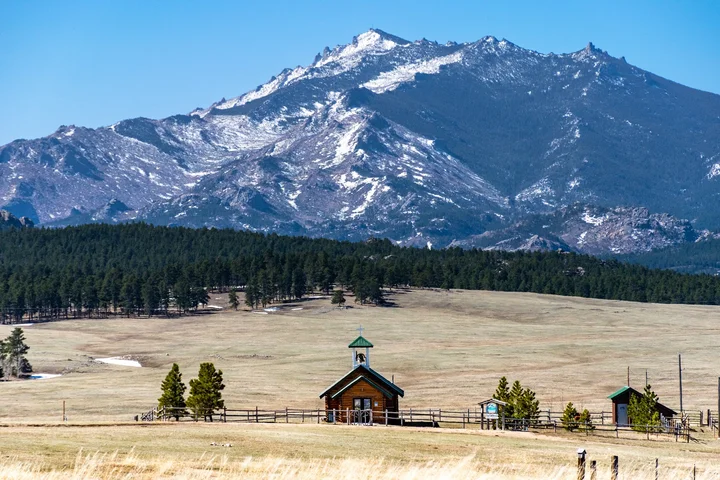
Laramie Peak dominates the western horizon from Wheatland, providing hiking and outdoor recreation access that is attracting retirees and remote workers to Platte County
2026 Economic Outlook
- Laramie Peak wind energy corridor development ongoing
- Retiree in-migration from Colorado Front Range accelerating
- Guernsey and Glendo reservoir recreation investment growing
- Remote worker broadband infrastructure improving
- I-25 corridor commercial and logistics growth creating service employment
The Wheatland Investment Thesis
Wheatland’s investment case is built on three legs that interact to create more stability than a pure agricultural or pure energy town could claim:
- The corridor position. I-25 runs directly through Wheatland, creating a stream of corridor workers, truck drivers, construction crews, and industrial employees who need housing along this stretch of Wyoming’s main north-south artery. This is entirely independent of Platte County agricultural conditions or energy prices. A new wind energy project, a highway infrastructure project, or a pipeline maintenance contract all generate temporary worker housing demand that supplements the permanent resident base.
- The retiree migration. Wheatland is discovering its moment as Colorado Front Range retirees seek dramatically lower housing costs, no state income tax on retirement income, and outdoor access that remains genuinely available at a fraction of Colorado prices. A Fort Collins retiree can sell a $550,000 house and buy a comparable Wheatland home for $265,000, banking $285,000 while eliminating state income tax on Social Security and investment income. This math is compelling and the migration is accelerating.
- The agricultural stability floor. Platte County’s irrigated agriculture has sustained Wheatland through every energy boom and bust, every recession, and every national disruption for over 100 years. Farm operators, agricultural service workers, and county government employees provide a stable, year-round employment base that prevents the sharp vacancy spikes seen in pure energy towns during downturns.
Historical Performance
| Period | Market Driver | Avg Annual Appreciation | Key Event |
|---|---|---|---|
| 2010-2018 | Steady agricultural economy, limited external demand | 1-3% | Stable but slow; Wheatland largely unknown to outside investors |
| 2019-2021 | Early Colorado migration, wind energy construction | 4-7% | Laramie Peak wind projects beginning; Colorado retirees discovering Wheatland |
| 2022-2023 | Pandemic migration, affordability premium | 8-12% | Prices rose from $195,000 to $260,000; Colorado retirees arrived in meaningful numbers |
| 2024-2025 | Sustained retiree migration, corridor worker demand | 4-7% | Market stabilizing at new higher level; demand consistently exceeds limited supply |
| 2026 | Retiree wave, wind energy, corridor growth | 4-6% (projected) | Multiple demand sectors converging; steady appreciation with strong cash flow fundamentals |
Wheatland’s 36% appreciation from 2020 to 2026 is meaningful but more modest than the dramatic cycles seen in outdoor lifestyle markets like Lander and Buffalo. This is actually a feature for cash flow investors: Wheatland’s appreciation reflects genuine demand rather than speculative framing, making the gains more durable and the fundamentals more reliable for long-term hold strategies.
Demand Drivers in Detail
- Colorado Retiree In-Migration – Colorado Front Range retirees, particularly from Fort Collins, Loveland, Greeley, and Pueblo, are the fastest-growing demand segment. The math is compelling: comparable housing costs $265,000 in Wheatland versus $500,000 to $650,000 in northern Colorado, and Wyoming eliminates state income tax on retirement income entirely. These retirees become stable, long-term renters or buyers who inject significant capital into the local economy.
- I-25 Corridor Workers – Construction crews, truck drivers, pipeline workers, and wind energy technicians all use Wheatland as a base for I-25 corridor work. These are typically well-paid skilled tradespeople who rent for 6 to 18 months and pay consistently. Properties near the I-25 interchange specifically attract this demographic.
- Wind Energy Employment – The Laramie Peak wind corridor is among Wyoming’s most productive wind energy zones. Construction and ongoing operations create employment that supplements agricultural sector jobs and insulates Wheatland from pure commodity price dependence.
- Agricultural Services Hub – Platte County agriculture generates significant professional services demand: agribusiness consultants, equipment dealers, financial advisors, and veterinarians all maintain Wheatland addresses as the county seat. These professionals are stable, creditworthy tenants.
- Government and County Services – As county seat, Wheatland hosts full county government, court system, health department, and regional services. These stable government positions anchor year-round tenant demand regardless of private sector fluctuations.
- Guernsey and Glendo Recreation – Guernsey State Park and Glendo State Park reservoirs to the north provide boating, fishing, and camping that draws visitors and generates modest short-term rental demand. These recreation assets support Wheatland’s outdoor lifestyle positioning with Colorado retirees.
📚 New to real estate investing? Master the fundamentals with our professional course Learn more →
2. Neighborhood Hotspots
Wheatland Investment Neighborhood Map
Interactive map of Wheatland’s investment neighborhoods. Green stars mark top hotspots, blue circles show established markets, and orange circles highlight emerging areas.
Core Investment Neighborhoods
Detailed Submarket Analysis: Wheatland
| Neighborhood | Price Range (SFH) | Cap Rate | Growth Drivers | Best Strategy |
|---|---|---|---|---|
| Downtown / Historic Core | $220K to $310K | 7 to 8.5% | Retiree migration, walkability, county services, character housing | Buy-and-hold, retiree-focused rentals |
| Established North Residential | $230K to $315K | 6.5 to 8% | Government workers, agricultural services, stable long-term demand | Stable buy-and-hold, quality long-term tenants |
| I-25 Access Corridor | $210K to $285K | 7.5 to 9% | Corridor workers, wind energy, transient workforce | Maximum yield, workforce housing, higher turnover |
| East Side Residential | $240K to $340K | 6 to 7.5% | Newer construction, family demand, lower maintenance | Remote investor preferred, family rentals |
| Hospital Area | $235K to $320K | 6.5 to 7.5% | Healthcare workers, stable employment | Healthcare worker focus, low turnover |
| Guernsey Corridor (Rural) | $180K to $350K | 5 to 9% (mixed) | Guernsey State Park, recreation, STR demand | STR, vacation rental, outdoor recreation positioning |
Expert Insight: “The Colorado retiree story in Wheatland is real and it is growing. I had eight transactions in 2024 with buyers from Fort Collins and Loveland alone. They sell $550,000 houses in Colorado, buy comparable homes here for $260,000 to $280,000, and put the difference in their retirement account while eliminating state income tax. Some of them become long-term owners; others become renters while they decide. Either way they bring stable, creditworthy demand to a market that has always been undervalued. For investors the timing is good but the window will not stay open indefinitely.” – Carol Ostrowski, Platte County Real Estate
3. Property Types
| Investment Goal | Best Property Type | Best Location | Minimum Capital |
|---|---|---|---|
| Maximum Cash Flow | I-25 workforce housing or value-add | I-25 Corridor, Downtown BRRRR | $53,000 to $75,000 |
| Best Tenant Quality | Retiree-targeted single-story SFH | Downtown, north residential | $58,000 to $80,000 |
| Lowest Management Burden | Newer east side SFH | East Side Residential | $62,000 to $88,000 |
| BRRRR / Forced Equity | Dated downtown renovation | Downtown historic core | $55,000 to $80,000 (incl. reno) |
Don’t guess the costs. Our Complete Renovation & Remodeling Cost Guide covers 400+ pages of project-by-project breakdowns with real contractor pricing ranges.
4. Cost Analysis
Acquisition Cost Breakdown (Wheatland)
| Expense Item | Typical Cost | Example ($265,000 Property) | Notes |
|---|---|---|---|
| Down Payment | 25% (investment) | $66,250 | Standard for investment; 20% possible with strong credit |
| Closing Costs | 2 to 3% | $5,300 to $7,950 | Wyoming’s lean closing structure; Platte County title fees are modest |
| General Inspection | $300 to $450 | $375 | Focus on HVAC, roof, and foundation; older homes need thorough review |
| Radon Test | $150 to $250 | $175 | Wyoming elevated radon; test every property |
| Initial Repairs | 0 to 8% | $0 to $21,200 | Older Wheatland homes often need HVAC, roofing, and plumbing updates |
| Reserves (6 months) | 6 months expenses | $6,000 to $9,000 | Very small market; maintain 12-month reserves for energy cycle protection |
| TOTAL MINIMUM ENTRY | ~30 to 35% | $78,100 to $105,000 | Wyoming’s lowest I-25 corridor investment entry point |
Sample Cash Flow Analysis: Downtown Wheatland 3-Bedroom SFH (Colorado Retiree Tenant)
| Item | Monthly | Annual | Notes |
|---|---|---|---|
| Gross Rent | $1,250 | $15,000 | 3BR, downtown area, clean and functional |
| Less Vacancy (9%) | -$113 | -$1,350 | Conservative for very small market; retiree tenant reduces to 5% |
| Property Taxes | -$133 | -$1,590 | ~0.6% of $265,000; Wyoming’s lowest effective rate |
| Insurance | -$92 | -$1,104 | Landlord policy; Wyoming wind coverage important |
| Property Management (10%) | -$125 | -$1,500 | Local Wheatland manager; many investors self-manage |
| Maintenance + CapEx (8%) | -$100 | -$1,200 | Older home reserve; HVAC and roof priority |
| Net Operating Income | $687 | $8,256 | Before mortgage; cap rate 3.12% on $265K purchase |
| Mortgage ($198,750 at 7%, 30yr) | -$1,323 | -$15,876 | 25% down conventional investment loan |
| CASH FLOW (managed, 9% vacancy) | -$636 | -$7,620 | Negative with full professional management at current rates |
| CASH FLOW (self-managed, 5% vacancy, retiree tenant) | +$254 | +$3,048 | Genuine positive cash flow with quality tenant and self-management |
| Cap Rate (purchase price) | 7.2% | NOI without management fee / purchase price | |
| Total Return (5% appreciation) | ~12 to 14% | Including equity, appreciation, principal paydown |
Wheatland’s cash flow profile is identical to Douglas, Riverton, and Worland: slightly negative with full professional management at current interest rates, but genuinely positive for self-managing investors with quality retiree or stable long-term tenants. The Colorado retiree tenant demographic is particularly valuable here because these tenants typically stay 4 to 7 years, dramatically improving the annual return picture by eliminating the turnover and vacancy costs that dominate the math on shorter-stay tenants.
Expert Insight: “Wheatland is where I tell investors to start if they cannot yet afford Douglas or Riverton prices. You can buy a clean 3-bedroom here for $240,000 to $260,000, put a Colorado retiree in it at $1,250 a month, and that tenant will be there for five years paying on time every single month. Meanwhile you collect Wyoming tax advantages and modest appreciation. It is not exciting but it is a real business that makes real money. I have clients who started in Wheatland and used the equity to buy in Cheyenne three years later. That is how the Wyoming ladder works.” – Brett Hanson, I-25 Corridor Properties
5. Legal Framework
Wyoming: Full Landlord Advantage, Lowest Overhead in the West
Wheatland and Platte County operate under Wyoming’s straightforward landlord-tenant law with no local overlays of any kind. No rent control, no just cause eviction requirement, no rental registration, no source of income protections, and no STR ordinances. This is Wyoming’s most straightforward small-market legal environment, creating zero compliance overhead for investors.
Wyoming Landlord-Tenant Essentials
- No Rent Control: Wyoming prohibits rent control statewide. Wheatland landlords raise rents freely with proper notice as the Colorado retiree demand drives market rates upward.
- Eviction (Non-Payment): 3-day notice to pay or quit. File unlawful detainer after 3 days. Platte County courts process cases promptly. Full eviction in 3 to 6 weeks from initial notice.
- No Just Cause: Month-to-month tenancies can be ended with 30-day notice, no cause required. Critical flexibility for managing corridor worker tenants who may complete contracts unexpectedly.
- Security Deposits: Maximum 1.5 months rent for unfurnished units. Return within 30 days with itemized deductions.
- Tenant Screening: Full landlord discretion subject to federal Fair Housing. No source-of-income protections in Wyoming.
Wheatland-Specific Considerations
- No Rental Registration: The City of Wheatland does not require landlord registration or rental operating licenses. Zero compliance overhead.
- No STR Ordinance: No specific short-term rental regulations in Wheatland as of 2026. Wyoming lodging tax (4%) applies to stays under 30 days. Register with Wyoming Department of Revenue before operating Guernsey or Glendo area STRs.
- Wind Energy Access Agreements: Some Platte County rural properties may have wind energy access easements from Laramie Peak corridor development. Review title commitment for any wind energy company easements before rural acquisitions.
- Irrigation Ditch Access: Older Platte County properties may have irrigation water rights and associated ditch access agreements. Verify with a Wyoming water law attorney for any agricultural-adjacent properties.
- Property Taxes: Platte County effective rate approximately 0.6% of assessed value; Wyoming’s standard low rate applies fully.
Useful Wheatland Resources
- City of Wheatland: wheatlandwy.gov
- Platte County Assessor: plattecountywy.gov
- Wyoming DOR (STR Tax): revenue.wyo.gov
- Wyoming Attorney General Landlord Guide: ag.wyo.gov
| Regulation | Wyoming / Wheatland Rule | Investor Impact |
|---|---|---|
| Eviction Speed | 3-day notice, 3 to 6 weeks total | Fastest eviction timeline nationally; retiree tenants rarely trigger it |
| Rent Increases | Any amount; 30-day notice | Full flexibility; raise rents as Colorado retiree demand pushes market rates |
| Wind Energy Easements | May exist on rural Platte County properties | Review title commitment for any wind energy company access agreements before rural purchase |
| Short-Term Rentals | No local ordinance; Wyoming lodging tax applies | Permitted with tax compliance; Guernsey and Glendo STRs viable |
| Rental Registration | Not required in Wheatland | Zero compliance cost; no inspections or licensing overhead |
6. Step-by-Step Wheatland Investment Playbook
Choose Your Wheatland Strategy
Colorado Retiree Anchor Rental
Acquire a single-story home in the downtown or north residential area. Update for accessibility: walk-in shower, no-step entry, low-maintenance landscaping. Market specifically to Colorado Front Range retirees through Colorado senior housing resources, Facebook groups for Wyoming retiree communities, and Realtor networks in Fort Collins and Loveland. Lock in a 4 to 7 year retiree who pays consistently and cares for the property.
I-25 Corridor Maximum Yield
Buy an affordable property near the I-25 interchange. Target wind energy technicians, construction workers, and trucking professionals. Accept higher turnover in exchange for higher gross yield. Furnish modestly and price at the workforce daily or weekly rate during active projects; return to monthly for between-project periods.
BRRRR Downtown Value-Add
Buy a dated downtown craftsman or bungalow at deep discount. Renovate respecting the original character that Colorado retirees specifically seek. Refinance at improved ARV. Repeat in Douglas, Riverton, or Worland with recycled capital. Wheatland’s low prices mean renovation budgets are modest and returns are real.
Wyoming I-25 Corridor Portfolio
Build a multi-city corridor portfolio: one property each in Wheatland, Douglas, and Casper. The three cities share I-25 corridor fundamentals but have different demand profiles and sizes. This corridor diversification spreads vacancy risk across three markets while keeping management geography tight along a single highway.
Build Your Wheatland Team
- Local Real Estate Agent: Wheatland has a very small active agent community. Find one who specifically works with out-of-state investors and understands the Colorado retiree migration that is reshaping the market. Ask about their experience with investor versus owner-occupant transactions in the past 12 months.
- Property Manager: Essential for remote investors. Wheatland’s property management market is developing as the investor community grows. Interview managers specifically about their Colorado retiree tenant placement experience and their process for marketing properties to this demographic.
- Contractor: Wheatland has a limited contractor pool, smaller than Douglas or Riverton. Establish the relationship before making your first offer. Your property manager’s maintenance contractor contacts are the best starting point.
- Wind Energy Company Contacts: If pursuing I-25 corridor workforce strategy, reach out to the HR departments at wind energy operators active in the Laramie Peak corridor. Similar to the trona company relationships in Rock Springs, wind energy operators value approved landlords who can house their workers efficiently.
- Wyoming Attorney: For any rural Platte County properties, use a Wyoming attorney familiar with Platte County water rights and wind energy easement issues.
Wheatland-Specific Due Diligence
Physical Due Diligence
- Radon test: Wyoming elevated; test every property
- Heating: Wyoming winters are severe on the eastern plains; inspect furnace condition
- Roof and windows: Eastern Wyoming wind is significant; inspect for wind damage and energy efficiency
- Foundation: Eastern Wyoming soils can shift; inspect for cracking and settling
- Accessibility for retiree targeting: Single-story layout, step count at entries, bathroom configuration
- Irrigation rights: Some Platte County in-town properties have irrigation water rights; verify with title company
Market and Legal Due Diligence
- Verify rental comps through local property manager; Wheatland MLS rental data is minimal
- Confirm wind energy easement status for rural Platte County properties
- Check broadband availability for remote worker targeting
- Verify Platte County Assessor records for any unpermitted improvements
- Model base case at 9 to 10% vacancy; stress case at 15% for agricultural downturn
- Research Colorado retiree migration patterns through local agent: which Colorado zip codes are most active
Marketing to Colorado Retirees
The Colorado retiree demographic is Wheatland’s best long-term tenant and the most underserved by standard rental marketing. Reaching them requires specific channels:
- Colorado senior housing Facebook groups: Groups focused on “affordable Wyoming retirement,” “retiring to Wyoming,” and similar themes are where this demographic gathers online. Properties offered here with clear Wyoming tax advantage messaging generate inquiries from qualified buyers and renters.
- Northern Colorado Realtor networks: Fort Collins, Loveland, and Greeley agents who represent downsizing or relocating clients know Wheatland’s value proposition. Offering a referral fee for successful relocating tenant placements builds a pipeline of pre-screened Colorado clients.
- The tax savings narrative: Always lead with the math: Wyoming has no state income tax on Social Security, pension, or investment income. For a retiree with $50,000 in annual retirement income, this saves $2,000 to $4,000 per year versus Colorado. This is a compelling, specific message that motivates action.
- Property-level accessibility messaging: List your property’s accessibility features explicitly in all marketing: single-story, walk-in shower, no-step entry, one-floor living. Retirees screen listings for these features before anything else.
7. Financing Options for Wheatland
| Loan Type | Down Payment | Rate Premium | Best For | Wheatland Note |
|---|---|---|---|---|
| Conventional Investment | 25% | +0.5 to 0.75% | W-2 income, strong credit | All Wheatland properties within conforming limits; standard access; most common approach |
| DSCR Loan | 25 to 30% | +1.5 to 2.5% | Self-employed, portfolio builders | Wheatland’s 7 to 8.5% cap rates support DSCR viability; verify with lender on very small market comfort |
| Community Bank Portfolio | 20 to 25% | +0.75 to 1.5% | Local investors, relationship banking | Platte County banks understand local market and Colorado retiree demand better than national lenders |
| Hard Money (Bridge) | 15 to 25% | 9 to 12% rate | BRRRR acquisitions, renovation projects | Wyoming and Colorado hard money lenders serve Wheatland; Cheyenne-based lenders most familiar with Platte County |
| USDA Rural Loan | 0% (owner-occupied) | Standard + guarantee fee | Owner-occupants in eligible rural areas | Wheatland itself and many surrounding areas qualify for USDA; verify at usda.gov |
| HELOC on Existing Property | Equity-based | Prime + 1 to 2% | Investors leveraging existing equity | Wheatland’s low prices mean small HELOC draws cover full renovation budgets |
Wheatland Financing Note: Wheatland offers the same DSCR loan viability as Worland and Riverton: cap rates of 7 to 8.5% on $265,000 properties can support 1.0x debt service coverage at current rates in many scenarios, making self-employed investors and portfolio builders more financeable here than in lower-cap-rate Wyoming markets. However, some national DSCR lenders are uncomfortable with cities under 5,000 population. Verify lender small-market comfort before going under contract. Platte County community banks are often the best financing source for first-time Wheatland investors, as they understand local appraisal dynamics in a way that out-of-state institutional lenders typically do not.
8. Frequently Asked Questions

Knowledge Quiz: Wheatland, Wyoming Real Estate Investment
Open Quiz
5 quick questions on what you just learned about investing in Wheatland
1) What three economic pillars create Wheatland’s multi-sector stability as an investment market?
Answer: B
Wheatland’s stability comes from three non-correlated demand sources: I-25 corridor workers who need housing regardless of agricultural or energy conditions, Colorado retirees making economic migrations driven by tax advantages and affordability, and the agricultural employment floor of Platte County’s irrigated farming that has sustained the community for over 100 years.
2) What specific financial calculation drives Colorado Front Range retirees to choose Wheatland over staying in Colorado?
Answer: C
The math is compelling: a $550,000 Fort Collins home sells and replaces a comparable Wheatland home at $265,000, leaving $285,000 in retirement savings. Additionally, Wyoming has no state income tax on any retirement income, saving $2,500 to $4,500 annually for a retiree with $60,000 in Social Security and investment income. This specific combination of capital release plus ongoing tax savings is what drives the accelerating retiree migration from northern Colorado to Wheatland.
3) What property features generate the highest rent premium among Colorado retiree tenants in Wheatland?
Answer: A
Colorado retirees screen rental listings specifically for accessibility features because these directly impact daily quality of life as they age. Single-story layout, walk-in shower or roll-in shower, no-step entries, and low-maintenance yards are the features retirees prioritize above all else. Properties with these features command 10 to 15% rent premiums and experience dramatically lower turnover than standard market properties, as retirees typically stay 4 to 7 years once settled.
4) What is the “Wyoming I-25 corridor portfolio” strategy described in the guide?
Answer: D
The Wyoming I-25 corridor portfolio places one property each in Wheatland (highest yield, smallest market), Douglas (balanced, midsize), and Casper (most liquid, largest market). The three cities are within 165 miles on I-25, making management practical. Demand diversification means when one market softens the others often hold steady. The liquidity ladder means Casper properties sell in 30 to 60 days while Wheatland properties take 90 to 150 days, giving the investor options if capital is needed.
5) What due diligence item is unique to rural Platte County properties that does not apply to standard in-town Wheatland acquisitions?
Answer: C
Wind energy projects in the Laramie Peak corridor have created easements on rural Platte County land granting wind energy companies access for turbine siting, access roads, and transmission lines. These easements can appear on title commitments for rural properties and may restrict certain land uses or require allowing company vehicles and personnel on the property. Standard in-town Wheatland properties are not affected by these easements, but any rural Platte County purchase should have the title commitment reviewed for wind energy company agreements.
Work With a Local Expert in Wheatland
We are building a verified network of real estate professionals across every market we cover.

About Our Expert Network
We are finalizing partnerships with verified real estate professionals across every market featured on Builds and Buys. Each expert in our network is selected for their hands-on investment experience, local market knowledge, and commitment to helping buyers and investors make sound decisions.
- Proven experience with investment and income-producing properties
- Deep knowledge of local pricing, rental yields, and neighborhood dynamics
- Guidance on financing, legal structure, and due diligence
- Access to off-market and pre-market opportunities
- Full transaction support from search through closing
- Ongoing portfolio and property management referrals
Services Covered
- Property sourcing and acquisition
- Investment analysis and underwriting
- Buyer representation
- Market comparables and valuations
- Short-term and long-term rental strategy
- Value-add and renovation guidance
- Legal and title referrals
- Financing and lender connections
- Property management referrals
- Insurance and inspection referrals
- 1031 exchange coordination
- Exit strategy planning
Get Connected or Join Our Network
Looking for a local expert in Wheatland? Reach out and we will connect you with the right professional for your market and strategy.
Are you a real estate professional experienced in the Platte County I-25 corridor market? We are always expanding our expert network.
Contact us at support@buildsandbuys.com
Find Specialized Wyoming Real Estate Professionals
Ready to Invest in Wheatland?
Wheatland is Wyoming’s most straightforward value proposition: the I-25 corridor’s lowest prices, genuine multi-sector demand, a landlord-friendly legal environment that has no parallel in the western United States, and an accelerating Colorado retiree migration that is transforming a quiet agricultural town into a destination for buyers seeking something increasingly rare: authentically affordable small-town life with outdoor access, no state income tax, and the dignity of owning rather than renting. For investors who model conservatively, build local relationships, and hold with patience, Wheatland delivers on its promise every time.
Continue Your Research
Wyoming State Guide
See how Wheatland compares to Douglas, Casper, and other Wyoming I-25 corridor markets.
Douglas Guide
Explore the next step up the I-25 corridor for a slightly larger, more liquid market.
144-Lesson Course
University-level real estate education covering financing, law, strategy, and management.
For further guidance, explore our State-by-State Investor guides, browse our expert articles, or follow our Step-by-Step Investment Guide.



