
Temple Real Estate Investment Guide For 2026
A comprehensive resource for investors looking to capitalize on a three-pillar institutional economy of healthcare, military, and infrastructure demand in Central Texas in 2026
Quick answers: Top 5 most searched Temple investment questions ▼
Migration data: Where renters and buyers are coming from in Temple ▼
In This Guide
Click on any section to navigate directly to that content
1. Temple Market Overview
Market Fundamentals
Temple’s investment case rests on a genuinely distinct foundation from the rest of this Texas series: three institutional demand pillars, healthcare, military, and infrastructure construction, that together insulate the local economy from the boom-bust cycles that have hit Austin and Dallas. Baylor Scott & White Health’s Level I trauma center anchors the city with more than 8,800 employees. Fort Hood, roughly 30-45 minutes away, supplies a steady stream of BAH-anchored military renters and VA loan buyers. And a $700 million-plus data center construction project is currently reshaping South Temple’s employment base.
Key economic indicators that define Temple’s investment case:
- Population: approximately 90,000 city proper, part of the broader Killeen-Temple metro area
- Major Employers: Baylor Scott & White Health, Fort Hood (via the Belton-Temple commuter corridor), Extraco Banks, McLane Children’s
- Median Sale Price: approximately $265,000-$275,000, down roughly 4.2% year over year
- Cost of Living: approximately 13% below the national average
- I-35 Corridor Position: roughly 45 minutes north of Austin without Austin-metro pricing
- Physician Mortgage Access: 0% down, no PMI loans available for BSW-affiliated medical professionals
Temple is currently in a genuine buyer’s market, with 5.3 to 6.9 months of supply depending on the specific data source and month, and median prices down from a $276,500 Q1 2025 figure to roughly $264,990 in Q1 2026. This is not framed as a crash but as a correction toward buyer-friendly pricing following the 2021-2023 run-up, and the current window is being actively described by local agents as the best buying opportunity since 2019.
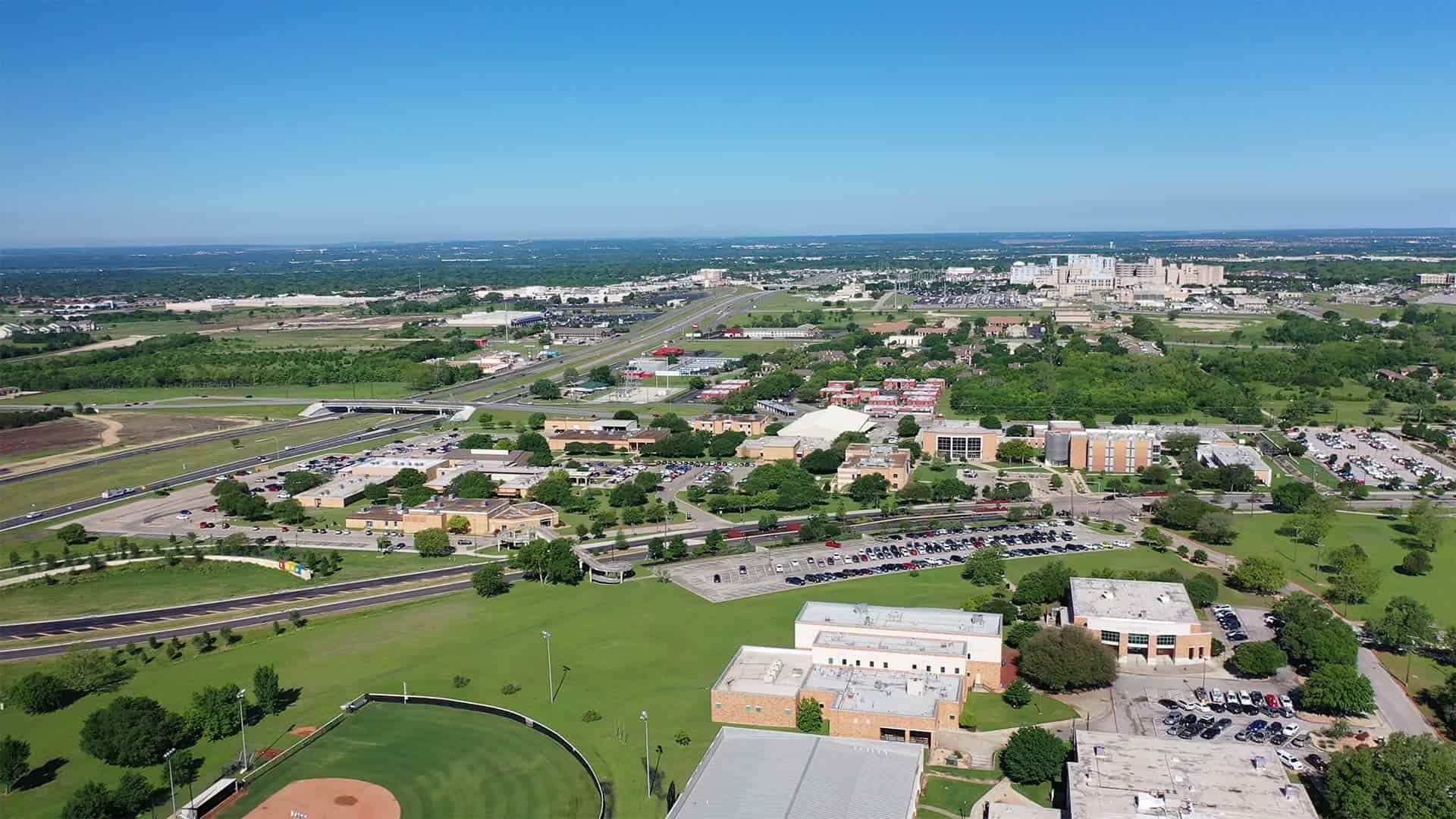
Temple’s economy is anchored by Baylor Scott & White’s Level I trauma center, Fort Hood’s military renter base, and new data center construction
2026 Economic Outlook
- Rowan Data Center’s $700 million-plus buildout continuing through 2026 and beyond
- Texas school homestead exemption increase approved November 2025, improving buyer affordability
- Mortgage rates easing into the high 5% to low 6% range by early 2026
- Continued Austin-overflow migration seeking 30-40% more housing value per dollar
- Builder incentives, including 3-2-1 rate buydowns, active across new construction communities
Investment Climate
Temple rewards investors who understand its layered tax and school district geography as much as its broader economic fundamentals. Successful Temple investors tend to share a few characteristics:
- MUD/PID tax literacy given the meaningful combined tax rate difference between MUD-free established neighborhoods and newer growth-corridor subdivisions
- School district precision given the genuine value of the Belton ISD overlap zone and the risk of relying on MLS descriptions alone
- Institutional tenant targeting toward BSW commuters, Fort Hood BAH families, or a diversified mix of both
- Buyer’s market patience given current elevated inventory and builder incentive competition
- Realistic BAH-vs-rent math when underwriting military tenant demand in premium school zones
Texas’s landlord-friendly statewide framework and no state income tax apply fully in Temple, and the city’s institutional anchors provide a genuinely different risk profile than population-growth-driven suburbs elsewhere in this series. The tradeoff is a currently softening price environment that investors should underwrite honestly rather than assume an immediate rebound.
Historical Performance
| Period | Market Driver | Avg Annual Change | Key Event |
|---|---|---|---|
| 2015-2019 | Steady healthcare and military-driven growth | 3-5% | Prior “best buying window” cited by local agents |
| 2021-2023 | Pandemic-era run-up, Austin-overflow migration | 8-12% | Meaningful price appreciation across new construction corridors |
| 2024-2025 | Rate shock, inventory build | -2 to -4% | Median falls from a Q1 2025 peak of $276,500 |
| 2026 | Continued correction, buyer’s market conditions | -4.2% (Q1 2026 YoY) | Rowan Data Center construction begins reshaping South Temple demand |
Temple’s honest recent history shows a real, if less dramatic, version of the pattern seen elsewhere in Central Texas: a pandemic-era run-up followed by a genuine give-back as rates rose. Local agents describe the current trailing-12-month median decline of 2.2%, accelerating to 4.2% in the most recent quarter, as a real acceleration in softening rather than pure seasonal noise. The honest framing for investors: this looks like a legitimate correction creating a genuine entry opportunity, not a market in structural decline, but the exact bottom is not yet confirmed.
Demographic Trends Driving Demand
- Baylor Scott & White Health Employment – 8,800-plus employees at the Level I trauma center and main campus, anchoring commute-driven housing demand
- Fort Hood Military Families – 45,000-plus personnel supporting a genuine BAH-backed renter and VA-loan buyer pool in the Belton-Temple corridor
- Rowan Data Center Construction – A $700 million-plus project introducing a new, non-healthcare, non-military demand driver to South Temple
- Austin-Overflow Remote Workers – Buyers and renters seeking 30-40% more housing value per dollar than equivalent Austin metro budgets
- Physician Relocation – 0% down, no-PMI physician mortgage loans drawing medical professionals from across the country to BSW-affiliated roles
- School-District-First Families – A distinct buyer segment willing to pay a genuine premium for Belton ISD access via the overlap zone or direct Belton purchases
📚 New to real estate investing? Master the fundamentals with our professional course Learn more →
2. Neighborhood Hotspots
Temple Investment Neighborhood Map
Interactive map of Temple’s investment neighborhoods. Green stars show top hotspots, blue circles mark established markets, and orange circles highlight emerging areas.
Core Investment Neighborhoods
Detailed Submarket Analysis: All Temple Neighborhoods
| Neighborhood | Price Range (SFH) | Cap Rate | Growth Drivers | Best Strategy |
|---|---|---|---|---|
| Canyon Creek | $240K-$999K | 5.5-7.0% | BSW commute, Temple ISD, wide price ladder | Healthcare-commuter buy-and-hold |
| Western Hills | $200K-$280K | 6.5-7.5% | Affordable BSW access, BAH tenant fit | Cash flow buy-and-hold |
| Prairie Ridge | $220K-$260K | 6.0-7.0% | Lowest new-build entry, data center proximity | New-construction buy-and-hold |
| South Pointe | $225K-$309K | 5.5-6.5% | Under-$300K new construction, growth corridor | New-construction appreciation play |
| Lake Pointe | $280K-$380K | 5.0-6.0% | Belton ISD access at Temple pricing | School-priority family rental |
| Legacy Ranch | $400K-$650K | 4.0-5.0% | Belton ISD, short BSW commute, premium construction | Premium long-term hold |
| The Cliffs of Canyon Creek | $250K-$999K | 4.0-5.5% | Low flood risk, no MUD/PID, custom architecture | Premium appreciation hold |
| Three Creeks | $279K-$499K | 4.5-5.5% | Belton ISD, workable Fort Hood commute | Family buy-and-hold |
| Historic District / 76501 East Temple | $120K-$220K | 6.5-8.0% | Lowest citywide entry, deep value-add potential | Value-add, BAH cash flow rental |
Expert Insight: “The mistake I see most out-of-state buyers make in Temple is picking the house before pinning down two things: how close it actually needs to be to BSW, and whether it sits in the Belton ISD overlap zone. Those two decisions drive almost everything else, the tax rate, the tenant pool, the resale liquidity. Everything past that is negotiable.” – Taylor Dasch, EG Realty, Temple TX
3. Property Types
| Investment Goal | Best Property Type | Best Neighborhoods | Minimum Capital |
|---|---|---|---|
| Maximum Cash Flow | BAH-optimized value-add SFH | Western Hills, Historic District | $45,000+ |
| Stable High-Income Tenants | BSW-commuter SFH | Canyon Creek, Western Hills | $60,000+ |
| Low Maintenance | New construction under $300K | Prairie Ridge, South Pointe | $55,000+ |
| School-Priority Renters | Overlap-zone SFH | Lake Pointe | $70,000+ |
Don’t guess the costs. Our Complete Renovation & Remodeling Cost Guide covers 400+ pages of project-by-project breakdowns with real contractor pricing ranges.
4. Cost Analysis
Acquisition Cost Breakdown (Temple)
| Expense Item | Typical Cost | Example ($265,000 Property) | Notes |
|---|---|---|---|
| Down Payment | 25% (investment) | $66,250 | Standard for investment properties statewide |
| Closing Costs | 2-3% of price | $5,300-$7,950 | Title, escrow, lender fees, recording |
| MUD/PID Verification | $0 (verification, not a fee) | $0 | Essential step; can shift effective tax rate by 0.5-1.0% of assessed value annually |
| General Inspection | $350-$550 | $450 | More critical for pre-1990 Historic District and 76501 inventory |
| Initial Repairs | 0-15% of price | $0-$39,750 | Highly variable by neighborhood and property age |
| Reserves (6 months) | 6 months expenses | $7,500-$10,500 | Elevated given current 7.2% citywide vacancy rate |
| TOTAL MINIMUM ENTRY | ~30-40% of value | $79,050-$106,700 | Meaningfully lower than equivalent Austin metro entry cost per the guide’s 30-40% affordability comparison |
Sample Cash Flow Analysis: Western Hills BAH-Optimized Rental
| Item | Monthly | Annual | Notes |
|---|---|---|---|
| Gross Rent | $1,550 | $18,600 | 3BR home, Western Hills, aligned with typical E-6 BAH allowance |
| Less Vacancy (7%) | -$109 | -$1,302 | Reflects current citywide 7.2% vacancy rate |
| Property Taxes | -$390 | -$4,680 | ~1.77% effective rate; Western Hills carries no MUD/PID assessment |
| Insurance | -$120 | -$1,440 | Standard landlord policy; low flood exposure in this submarket |
| Property Management (9%) | -$140 | -$1,680 | Local Bell County managers commonly experienced with military tenant paperwork |
| Maintenance + CapEx | -$116 | -$1,392 | 7.5% of rent for an established, moderately aged home |
| Net Operating Income | $675 | $8,100 | Before mortgage |
| Mortgage ($240K, 25% down, 6.75%, 30yr) | -$1,168 | -$14,016 | Principal and interest only |
| CASH FLOW | -$493 | -$5,916 | Negative with standard financing; a larger down payment or cash purchase materially improves this |
| Cap Rate | 3.4% | NOI / Purchase Price at this financed scenario | |
| Cap Rate (all-cash purchase) | ~7.0% | Reflects the guide’s stated 6.5-7.5% typical Western Hills cap rate range |
This example illustrates why local agents specifically recommend picking a single, clear strategy in Temple. Financed at standard 25% down, this Western Hills property runs negative, but its underlying cap rate of roughly 7% on an unleveraged basis is genuinely strong for the metro. Investors buying with more cash down, or targeting the Historic District’s lower entry prices with similar rents, can push closer to positive leveraged cash flow while retaining a comparable BAH-anchored tenant pool.
Expert Insight: “I want cash flow AND appreciation AND passive AND no money down does not exist in Temple in 2026, and it never really has. Pick one of three lanes: buy under $200K in south Temple, do a light rehab, and rent to military families at price-to-rent ratios that actually work; buy within 10 minutes of BSW and run furnished mid-term rentals; or buy new construction in Bella Terra or Legacy Ranch and play the long-term appreciation game with a premium tenant. Trying to do all four at once is how new investors talk themselves into a bad deal.” – Taylor Dasch, EG Realty, Temple TX
5. Legal Framework
⚠️ Critical Temple Compliance Notice
Texas’s statewide landlord-friendly framework applies fully in Temple, and Bell County adds minimal local layering on tenant law. The real compliance and cost considerations here are MUD/PID tax district verification and school district boundary confirmation, both of which vary meaningfully by exact address rather than by neighborhood name. This guide provides an overview only. Always consult a Texas-licensed real estate attorney before acquiring rental properties, and verify current tax district and school assignment independently for any specific parcel.
Texas and Temple-Specific Regulations
Temple operates under Texas’s statewide landlord-tenant framework (Texas Property Code Chapter 92) with a few locally significant tax and district considerations:
- No Rent Control: Texas prohibits municipal rent control outright.
- MUD/PID Tax Districts: Newer subdivisions in the growth corridors frequently carry Municipal Utility District or Public Improvement District assessments adding 0.485% to 0.95% to the base property tax rate; these decline over time as bonds are paid down but must be verified before purchase.
- Combined Effective Tax Rates: Range from approximately 1.74% in pure Belton ISD, MUD-free zones to approximately 2.40% in the Temple-address-with-Belton-ISD overlap zone.
- Security Deposit Return: Must be returned within 30 days of move-out under Texas Property Code Section 92.103.
- School District Verification: Must be confirmed by exact address via the Bell County Appraisal District or Belton ISD’s InfoFinder tool, not assumed from MLS descriptions or mailing city.
- 2025 Homestead Exemption Increase: Texas voters approved an increased school homestead exemption in November 2025, reducing taxable value for owner-occupants, though this generally does not apply to non-homestead investment properties.
Compliance Best Practices
Successfully operating Temple rental properties requires disciplined tax and district verification:
- MUD/PID Search: Search the specific parcel through the Bell County Appraisal District before making an offer; do not rely on neighborhood reputation alone, since MUD status can vary within a single subdivision’s phases.
- School District Confirmation: Verify Temple ISD versus Belton ISD assignment by exact address, particularly for any property near the western overlap zone boundary.
- Flood Zone Check: Confirm FEMA flood designation for creek-backing lots, particularly in premium subdivisions like the Cliffs of Canyon Creek, where interior lots carry low risk but rear acreage may fall in a Special Flood Hazard Area.
- Military Tenant Documentation: Familiarize your lease and screening process with standard military clause requirements (SCRA lease termination rights for deploying service members).
- Lease Compliance Review: Use current Texas Association of Realtors lease templates with appropriate military and BAH-related addenda where relevant.
- Local Property Management: Confirm specific experience with either the BSW-commuter tenant profile or the Fort Hood BAH tenant profile, as underwriting and screening approaches differ.
Useful Temple Resources
- Bell County Appraisal District: bellcad.org
- Belton ISD InfoFinder: beltonisd.net
- City of Temple Planning: templetx.gov
- Texas Property Code Chapter 92: statutes.capitol.texas.gov
| Regulation | Temple Requirement | Texas Statewide | Investor Impact |
|---|---|---|---|
| Eviction | No local add-on; standard state process | 3-day notice to vacate, then eviction filing | Among the fastest eviction timelines nationally |
| Property Tax Rate | 1.74%-2.40% combined effective rate depending on MUD/PID and district | No statewide flat rate; varies by locality | Meaningfully impacts net cash flow; verify before every offer |
| Security Deposits | Must return within 30 days | 30 days statewide | Standard, low administrative burden |
| Military Tenant Rights | No local add-on | Federal SCRA lease termination protections apply | Meaningful given the sizable Fort Hood tenant pool |
| Rent Increases | No local cap | No statewide cap or rent control | Full pricing flexibility, though current buyer’s market may limit what rents the market bears |
6. Step-by-Step Temple Investment Playbook
Define Your Temple Strategy
Temple rewards investors who pick one clear lane rather than chasing every advantage simultaneously. Choose from these proven strategies:
BAH Cash Flow Rental
Buy below $220,000 in south Temple or the Historic District, complete a light cosmetic rehab, and rent to Fort Hood military families at price-to-rent ratios that work on a leveraged basis.
BSW Mid-Term Furnished Rental
Buy within 10 minutes of BSW Main Campus and run furnished mid-term rentals for traveling nurses, locum physicians, and relocating families on Furnished Finder-style platforms.
New Construction Appreciation Play
Buy new construction in Legacy Ranch, Prairie Ridge, or comparable growth-corridor communities and play the long-term appreciation game with a premium, low-maintenance tenant.
Belton ISD Overlap Zone Rental
Buy in Lake Pointe or a verified western overlap-zone address to capture Belton ISD demand at Temple pricing, targeting school-priority family tenants willing to pay a rent premium.
Build Your Temple Team
Given Temple’s layered tax district and school boundary complexity, local expertise is essential. Non-negotiable team members:
- Temple-Specialist Real Estate Agent: Should be fluent in MUD/PID verification, Belton ISD overlap zone boundaries, and current buyer’s market negotiating leverage.
- Bell County Appraisal District Familiarity: Either through your agent or directly, confirm tax district and assessed value before every offer.
- Property Manager with Military Tenant Experience: Should understand SCRA lease provisions and BAH-based rent qualification.
- Texas Real Estate CPA: For entity structuring and depreciation strategy, particularly relevant given the current price correction may support favorable tax appeal opportunities.
- Local General Contractor: Essential for Historic District and older 76501 inventory given genuine inspection-critical condition issues.
Expert Tip: Ask any prospective agent directly: “Is this specific address in a MUD or PID district, and what is the combined effective tax rate?” An agent who can answer immediately with a parcel-level lookup, rather than a neighborhood-level guess, understands Temple’s real cost structure.
Temple-Specific Due Diligence
Standard due diligence items plus these Temple-critical checks:
Physical Due Diligence
- Foundation inspection given Blackland Prairie clay soil movement common in Bell County
- Flood zone check for any creek-backing lot, even in premium subdivisions
- Roof and HVAC condition given Central Texas heat exposure
- Age-appropriate inspection depth for Historic District and 76501 properties given older systems
Regulatory and Financial Due Diligence
- Confirm MUD/PID district status and current assessment via Bell County Appraisal District
- Verify exact school district assignment via Belton ISD InfoFinder, not MLS description
- Pull the last 60-90 days of comparable sales given the ongoing price correction
- Confirm builder incentive terms carefully if purchasing new construction, since standing inventory competition affects resale liquidity
Competing in Temple’s Market
Temple is currently a genuine buyer’s market. Strategies that work:
- Anchor to trailing 90-day comps, not last spring’s peak: A neighbor’s May 2025 sale price is not this year’s value; local agents note the underlying trend has settled into a materially lower range.
- Negotiate below list as standard practice: Current sale-to-list ratios sit around 96.7%, meaning real negotiating room exists on most listings.
- Compare builder incentives against resale carefully: New construction communities are offering meaningful rate buydowns and closing cost credits that can outweigh a resale property’s lower sticker price.
- Target properties over 70 days on market: These represent the strongest negotiating opportunities in a market currently averaging 69-103 days to sell.
- Use physician or VA loan programs where eligible: Both offer meaningful capital efficiency advantages for qualifying buyers in this market.
Property Management in Temple
Temple’s mixed institutional tenant base requires management tailored to each specific renter profile. Key management focuses:
Military Tenant Protocol
Properties leased to Fort Hood-affiliated tenants require awareness of several distinct considerations:
- Understand SCRA lease termination rights for tenants receiving deployment or permanent change of station orders
- Verify BAH-based income qualification rather than standard pay stub review alone
- Anticipate move-out timing clustered around PCS cycles, typically summer months
- Budget for potentially faster turnover than the civilian tenant average given military reassignment cycles
Typical Temple Management Fees
- Single-family management: 8-10% of monthly rent
- Mid-term furnished rental management: Often 15-20% given active booking and turnover management
- Leasing fee: 50-100% of one month’s rent
- Lease renewal fee: $150-$300 per renewal
7. Financing Options for Temple
| Loan Type | Down Payment | Current Rate Range | Best For | Temple Note |
|---|---|---|---|---|
| Conventional Investment | 25% | 7.00%-7.30% | Strong W-2 income, good credit | Most Temple properties fall well under conforming loan limits |
| DSCR Loan | 20-25% | 6.50%-8.50% | Investors who want no income verification | Temple’s higher-cap-rate submarkets like Western Hills often clear 1.0x DSCR coverage more easily than premium districts |
| Physician Mortgage Loan | 0% | Standard + no PMI | MDs, DOs, PharmDs, CRNAs, PAs affiliated with BSW | Extraco Banks, headquartered in Temple, offers among the broadest eligibility |
| VA Loan | 0% | 6.25%-6.50% | Eligible military and veteran buyers | A genuine share of Temple’s owner-occupant purchase activity given Fort Hood proximity |
| FHA | 3.5% | 5.91% | First-time buyers, house hackers | Strong fit for the under-$275K tier representing 42% of Bell County closings |
| New Construction Builder Financing | Varies | Often includes 3-2-1 rate buydowns | Buyers in Prairie Ridge, South Pointe, Legacy Ranch | Actively marketed given current elevated builder standing inventory |
Temple Financing Reality: As of May 2026, conventional investment financing runs 7.00-7.30%, DSCR loans run 6.50-8.50% depending on coverage ratio, and both VA and FHA options remain meaningfully cheaper for eligible buyers. Given Temple’s genuinely wide cap rate range across submarkets, the right loan product depends heavily on which of the guide’s four investment lanes, BAH cash flow, BSW furnished rental, new construction appreciation, or overlap-zone school rental, you are pursuing.
8. Frequently Asked Questions

Knowledge Quiz: Temple Real Estate Investment
Open Quiz
5 quick questions on what you just learned about Temple investing
1) What are the three institutional demand pillars the guide identifies for Temple’s economy?
Answer: B
The guide is explicit that Temple’s rental and buyer demand rests on Baylor Scott & White Health’s 8,800-plus employees, Fort Hood’s BAH-anchored military renter and VA-buyer base, and the ongoing $700 million-plus Rowan Data Center construction, together insulating the local economy from boom-bust cycles.
2) What is a MUD tax, and what does it typically add to a Temple property’s effective tax rate?
Answer: C
MUD taxes fund the infrastructure debt for newer subdivisions and typically add 0.485% to 0.95% on top of the base combined tax rate, pushing some Temple growth-corridor properties to a 2.3-2.4% combined effective rate versus roughly 1.74-2.01% in MUD-free established neighborhoods.
3) What is the “Belton ISD overlap zone” as described in the guide?
Answer: A
Certain western and southwestern Temple addresses feed into the A-rated Belton ISD despite a Temple mailing address, letting buyers capture stronger schools at Temple-level pricing, though at the cost of the highest combined tax rate in Bell County. Always verify by exact address, not MLS description.
4) According to the guide, roughly how much has Temple’s median sale price declined year over year as of Q1 2026?
Answer: D
Local MLS data cited in the guide shows the Q1 2026 median sold price at approximately $264,990, down 4.2% from $276,500 in Q1 2025, representing an acceleration from the trailing 12-month decline of 2.2%.
5) Why does the guide caution against underwriting the “cash flow AND appreciation AND passive AND no money down” combination in Temple?
Answer: B
The guide quotes a local agent directly on this point: wanting cash flow, appreciation, passivity, and no money down simultaneously does not exist in Temple’s 2026 market, and investors should instead choose one of the guide’s four defined strategic lanes based on their capital and risk tolerance.
Work With a Local Expert in Temple
We are building a verified network of real estate professionals across every market we cover.

About Our Expert Network
We are finalizing partnerships with verified real estate professionals across every market featured on Builds and Buys. Each expert in our network is selected for their hands-on investment experience, local market knowledge, and commitment to helping buyers and investors make sound decisions.
Our local specialists offer:
- Proven experience with investment and income-producing properties
- Deep knowledge of local pricing, rental yields, and neighborhood dynamics
- Guidance on financing, legal structure, and due diligence
- Access to off-market and pre-market opportunities
- Full transaction support from search through closing
- Ongoing portfolio and property management referrals
Services Covered
- Property sourcing and acquisition
- Investment analysis and underwriting
- Buyer representation
- Market comparables and valuations
- Short-term and long-term rental strategy
- Value-add and renovation guidance
- Legal and title referrals
- Financing and lender connections
- Property management referrals
- Insurance and inspection referrals
- 1031 exchange coordination
- Exit strategy planning
Get Connected or Join Our Network
Looking for a local expert to help with your investment? Reach out and we will connect you with the right professional for your market and strategy.
Are you a real estate professional with a track record working with investors? We are always expanding our network of verified local experts.
Contact us at support@buildsandbuys.com
Find Specialized Temple Real Estate Professionals
Ready to Invest in Temple?
Temple will not reward investors chasing generic Texas growth headlines. It will reward investors who understand its three-pillar institutional economy, verify MUD and school district status parcel by parcel, and pick one clear strategic lane rather than trying to capture every advantage at once. With genuine cost-of-living and price advantages over Austin, a currently favorable buyer’s market, and demand anchored by healthcare, military, and infrastructure investment rather than speculation, Temple offers a legitimate, if unglamorous, opportunity for disciplined investors.
Continue Your Research
Texas State Guide
See how Temple compares to Austin, Killeen, and other Central Texas markets.
Step-by-Step Invest
Complete framework for building a real estate investment strategy from scratch.
144-Lesson Course
University-level real estate education covering financing, law, strategy, and management.
For further guidance, explore our State-by-State Investor guides, browse our expert articles, or follow our Step-by-Step Investment Guide.



