Sisters Oregon Real Estate Investment Guide For 2026
A comprehensive resource for investors targeting one of Oregon’s most supply-constrained and lifestyle-premium markets, where a Western-themed historic downtown, Three Sisters Wilderness access, world-class outdoor recreation, and extremely limited developable land create a rare combination of strong appreciation and viable STR economics that few Oregon towns can match
Quick answers: Top 5 most searched Sisters investment questions ▼
Migration data: Where people are moving from to Sisters ▼
In This Guide
Click on any section to navigate directly to that content
1. Sisters Market Overview
Market Fundamentals
Sisters is a genuinely rare real estate market in the Pacific Northwest: a small Western-themed town of approximately 4,000 residents nestled against the Cascade Mountains with a cultural identity so specific and authentic that no other Oregon community can replicate it. Named for the three volcanic peaks visible from its downtown — North Sister, Middle Sister, and South Sister — Sisters has cultivated an arts, equestrian, and outdoor recreation community that attracts a disproportionately high-income and lifestyle-motivated resident and visitor base.
Key market fundamentals:
- Population: 4,000+ city, 15,000+ Sisters area and surrounding Deschutes County rural
- Median Home Price: $620,000 (city), $750,000+ (Black Butte Ranch and premium rural)
- Median Household Income: $75,000+ (higher in rural and Black Butte areas)
- Annual Events: Sisters Outdoor Quilt Show (world’s largest, July), Sisters Folk Festival, Sisters Rodeo, and multiple gallery events drawing tens of thousands of visitors annually
- Bend Proximity: 20 miles east on Hwy 20, approximately 25-30 minutes to Bend’s full employment and commercial base
- Vacancy Rate: Under 3%, one of Oregon’s tightest markets due to permanent supply constraints
Sisters investment is fundamentally about scarcity and lifestyle premium. There is a fixed and very limited supply of real estate within the Sisters city limits and the surrounding desirable areas. Demand from a high-income migration pool continues to grow as Sisters’ reputation expands. This supply-demand imbalance has driven consistent appreciation and will continue to do so as long as Sisters maintains its unique character and natural setting.
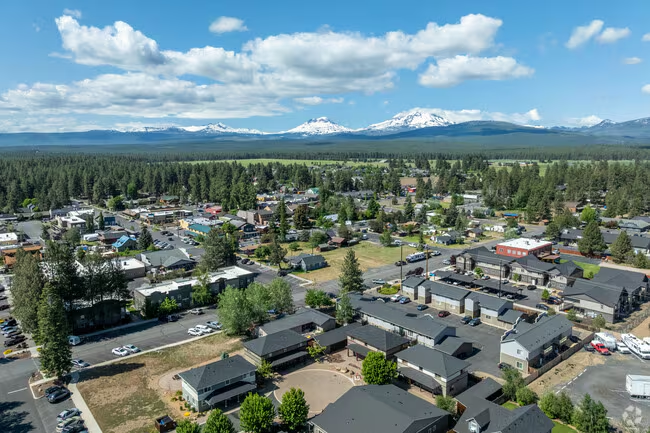
Sisters’ Western-themed downtown, iconic Three Sisters volcanic peaks, and permanent National Forest boundaries create one of Oregon’s most unique and supply-constrained investment markets
2026 Economic Outlook
- Remote work migration continuing to bring high-income households to Sisters
- Sisters Outdoor Quilt Show growing international reputation driving STR demand
- Black Butte Ranch expansion and renovation improving resort community premium
- Cascade recreation tourism growth (Three Sisters Wilderness, Metolius River) increasing visitor numbers
- Sisters School District’s strong reputation attracting families to the area
The Supply Constraint Thesis — Why Sisters Is Permanently Scarce
Understanding Sisters investment requires understanding why supply is permanently and structurally constrained in a way that few Oregon markets share:
- Deschutes National Forest on three sides: The city is literally bounded by National Forest land to the north, west, and south. Federal forest land cannot be purchased, developed, or rezoned regardless of demand. This is a permanent physical boundary, not a policy that could change.
- Oregon Urban Growth Boundary: Oregon’s stringent land use planning system establishes a strict Urban Growth Boundary for Sisters that limits the city’s developable footprint. Expansions to the UGB are rare, contested, and very limited in scope.
- Community character preservation: Sisters has strict architectural design standards that maintain the Western commercial character of the downtown. New construction must conform to these standards, limiting the type and scale of development that can occur.
- Small lot availability: Within the UGB, much of the land is already developed or in public ownership. Infill opportunities are limited and expensive. New lots that do come available often sell before reaching the MLS.
- The investment implication: Every house you buy in Sisters has fewer comparable properties being added to the market than any other Oregon city of similar appeal. The appreciation mathematics of a fixed supply market experiencing growing demand are consistently favorable over long hold periods.
The Cultural Identity Premium
Sisters has built a genuine and defensible cultural identity that drives both residential demand and visitor traffic in ways that purpose-built resort communities cannot replicate:
- Western architectural standards: All commercial buildings in Sisters must conform to Western frontier architectural standards, creating a cohesive aesthetic that feels authentic rather than manufactured. This is among the strictest small-town design standards in the Pacific Northwest.
- Sisters Outdoor Quilt Show: Every July, the world’s largest outdoor quilt show draws 20,000-30,000 visitors to Sisters in a single day, with hundreds of quilts displayed on downtown building facades. This event alone drives significant STR demand and has made Sisters internationally known in the quilting community.
- Sisters Folk Festival: A premier regional music and arts festival that draws national performers and a culturally engaged audience that overlaps well with the Sisters LTR demographic.
- Equestrian community: Sisters has a significant equestrian tradition with horse properties, boarding facilities, and equestrian events that attract a specific and affluent demographic year-round.
- Gallery and arts community: Sisters has an unusually high concentration of galleries, studios, and working artists for a town of its size, creating an arts tourism draw that complements outdoor recreation.
Historical Performance
| Period | Market Driver | Avg Annual Appreciation | Key Event |
|---|---|---|---|
| 2010-2014 | Post-recession recovery, lifestyle market stability | 4-6% | Sisters recovers well as lifestyle and arts community insulates from worst recession effects |
| 2015-2019 | Bend overflow, lifestyle migration, quilt show recognition | 7-12% | Sisters gains wider Pacific Northwest recognition as premium lifestyle alternative to Bend |
| 2020-2022 | Remote work executive migration, inventory shortage | 18-28% | Bay Area executives with Pacific Northwest salaries choose Sisters for authentic small-town lifestyle |
| 2023-2024 | Rate normalization, luxury lifestyle market adjustment | 3-6% | Market pauses but supply constraint prevents significant correction; near-zero inventory supports values |
| 2025-2026 | Rate stabilization, continued lifestyle migration, growing events reputation | 5-9% (projected) | Sustained remote work demand, growing STR visitor base, permanent supply constraint |
📚 New to real estate investing? Master the fundamentals with our professional course Learn more →
2. Neighborhood Hotspots
Sisters Investment Neighborhood Map
Interactive map of Sisters and surrounding areas. Green stars show top investment hotspots, blue circles mark established markets, and orange circles highlight emerging or specialty areas.
Core Investment Neighborhoods
Detailed Submarket Analysis: Sisters and Surrounding Area
| Neighborhood | Price Range | Cap Rate | Growth Drivers | Best Strategy |
|---|---|---|---|---|
| Historic Downtown Core | $550K-$900K | 4.5-7.5% | Events, arts, scarcest inventory, appreciation | STR + LTR hybrid, peak appreciation hold |
| Tollgate / East Sisters | $580K-$950K | 4.0-6.0% | Larger lots, newer stock, equestrian, Bend commute | Family LTR, equestrian lifestyle, professional tenants |
| Black Butte Ranch | $550K-$1.5M+ | 5.5-8.5% | Resort amenities, golf, wilderness access, STR | Premier Central Oregon STR via resort program |
| South Sisters / Cascade Views | $560K-$1.0M | 5.0-8.0% | Three Sisters views, wilderness, outdoor recreation | STR wilderness retreat, view premium, four-season |
| Camp Sherman / Metolius | $450K-$900K | 6.0-9.0% | Metolius fly-fishing, irreplaceable water access | Highest-yield niche STR, fishing season premium |
| Sisters Residential Core / N | $500K-$780K | 4.0-5.5% | Year-round community, school district, LTR demand | Primary LTR, remote worker tenants, stable hold |
| Hoodoo / Lake Creek Adj. | $480K-$820K | 5.0-8.5% | Hoodoo Ski Bowl, mountain setting, winter STR supplement | Seasonal STR, winter recreation supplement |
Expert Insight: “The Metolius River corridor near Camp Sherman is the most misunderstood STR market in Central Oregon. Investors focus on Bend and Eagle Crest and completely overlook the Metolius, where a rustic cabin with river access can generate $280-$380/night during the spring and summer fishing season from clients who fly in specifically for the fly-fishing. That is a guest demographic with a very specific and very strong motivation to stay near the river. The supply of river-access properties is essentially fixed — the riparian protection zones and Forest Service ownership prevent new development. What exists is what there will ever be.” – Tom Finley, Fly-Fishing Guide and Property Manager, Camp Sherman
3. Property Types
| Investment Goal | Best Property Type | Best Location | Minimum Capital |
|---|---|---|---|
| Maximum STR Revenue | Black Butte Ranch resort property | Black Butte Ranch | $145,000+ |
| Most Unique STR Niche | Metolius River cabin | Camp Sherman | $115,000+ |
| Best Long-Term Appreciation | Historic downtown core SFH | Sisters Downtown | $140,000+ |
| Lowest Management Burden | Sisters residential LTR for remote workers | Sisters Residential Core | $125,000+ |
Don’t guess the costs. Our Complete Renovation & Remodeling Cost Guide covers 400+ pages of project-by-project breakdowns with real contractor pricing ranges.
4. Cost Analysis
Acquisition Cost Breakdown (Sisters City — LTR Property)
| Expense Item | Typical Cost | Example ($620,000 Property) | Notes |
|---|---|---|---|
| Down Payment | 25% (investment) | $155,000 | Some Sisters properties may approach or exceed conforming limit; jumbo may apply |
| Closing Costs | 2-3% of price | $12,400-$18,600 | Title, escrow, lender fees, recording |
| Home Inspection | $400-$600 | $500 | Central Oregon inspectors; older downtown homes need thorough inspection |
| Radon Testing | $150-$300 | $200 | Mandatory for all Central Oregon properties — same volcanic geology radon risk as Redmond and Bend |
| Well / Septic (rural) | $400-$900 | $650 (rural only) | Camp Sherman, Tollgate, and rural areas typically on well and septic |
| STR Setup (if applicable) | $8,000-$25,000 | $15,000 | Furnishing, staging, photography; Sisters STR guests expect high quality presentation |
| Wildfire Insurance Premium | $300-$700 above base | $500 additional/yr | Sisters and surrounding areas face elevated wildfire risk; verify insurer availability for rural properties |
| Reserves (8 months) | 8 months expenses | $18,000-$25,000 | STR investors need larger reserves for seasonal income variation and off-season negative carry |
| TOTAL MINIMUM ENTRY (STR) | ~30-38% of value | $201,750-$235,550 | Significant entry capital required; this is a premium market |
Sample Cash Flow: Sisters Downtown 3BR LTR — Remote Worker / Lifestyle Tenant
| Item | Monthly | Annual | Notes |
|---|---|---|---|
| Gross Rent | $2,600 | $31,200 | 3BR Sisters downtown, remote worker tenant, updated interior |
| Vacancy (3%) | -$78 | -$936 | Lifestyle tenants stay 2-4 years; near-zero vacancy in Sisters |
| Property Taxes | -$434 | -$5,208 | ~0.84% of $620K (Deschutes County) |
| Insurance | -$175 | -$2,100 | Landlord policy including wildfire zone premium |
| Property Management (9%) | -$234 | -$2,808 | Sisters-area property manager; Oregon SB 608 compliant |
| Maintenance + CapEx (8%) | -$208 | -$2,496 | 8% for quality Sisters stock; lifestyle tenants maintain properties well |
| Net Operating Income | $1,471 | $17,652 | Before mortgage |
| Mortgage ($620K, 25% down, 6.5%, 30yr) | -$2,945 | -$35,340 | P&I on $465,000 loan |
| CASH FLOW (LTR) | -$1,474 | -$17,688 | Significant negative carry; managed by 7% appreciation on $620K asset |
| STR Scenario (same property, peak seasons) | $38,000-$52,000 gross | Downtown STR at 50-60% occupancy at $200-$320/night average | |
| Total Return (7% appreciation) | ~22% (STR scenario) | Including equity, appreciation on $620K, principal paydown; STR scenario significantly improves total return |
The STR scenario dramatically changes the economics. A downtown Sisters property at $620,000 operating as STR during peak season (Quilt Show, Folk Festival, summer) and LTR during off-season can generate $38,000-$52,000 in gross annual revenue, reducing negative carry from $17,688 to near neutral or modestly positive. The STR strategy in Sisters is not just viable — for downtown-adjacent properties, it is the correct primary strategy with LTR as a seasonal supplement or fallback.
The Sisters Outdoor Quilt Show Revenue Model
The Sisters Outdoor Quilt Show (held annually in July) is a unique and powerful revenue event for Sisters STR investors. Here is how the economics work:
| Scenario | Location Relative to Downtown | Quilt Show Week Nightly Rate | 7-Day Revenue |
|---|---|---|---|
| Premium | Walking distance (<5 min) | $380-$480/night | $2,660-$3,360 |
| Good | Close to downtown (5-15 min walk) | $280-$380/night | $1,960-$2,660 |
| Standard | Sisters area (driving distance) | $200-$280/night | $1,400-$1,960 |
The Quilt Show week generates a revenue spike that must be captured in advance booking. Experienced Sisters STR operators open Quilt Show week bookings 11-12 months in advance and fill the week within days. Investors who acquire Sisters properties specifically for the Quilt Show STR economics should budget for the first year to be partially lost while they establish the booking history needed to capture peak pricing in advance.
⚠️ Wildfire Risk: Sisters and the surrounding Deschutes National Forest interface carry elevated wildfire risk. Confirm wildfire risk zone designation before purchase, particularly for rural properties. Some insurers have reduced coverage availability in high-risk zones. Budget additional insurance premiums and plan for defensible space maintenance as an ongoing landlord cost. Radon testing is also mandatory for all Sisters and Central Oregon properties.
5. Legal Framework
⚠️ Oregon Statewide Compliance Notice — Plus STR Permit Requirements
Oregon SB 608 rent control and just-cause eviction requirements apply in Sisters. Sisters city and Deschutes County have STR permit requirements for any short-term rental operation. Always verify current STR permit requirements directly with the City of Sisters and Deschutes County before any STR-focused acquisition. Black Butte Ranch has its own HOA and resort management requirements that govern STR participation. Always consult an Oregon-licensed attorney before purchase.
Oregon Statewide Law (Applies in Sisters)
- SB 608 Rent Control: Annual LTR increases capped at 7% plus prior year CPI. New construction within 15 years of certificate of occupancy is fully exempt. New DADUs receive their own 15-year clock.
- Just Cause Eviction (after 12 months): Documented cause required after one year of tenancy.
- Relocation Assistance (State): One month’s rent in certain qualifying no-cause termination scenarios.
- Security Deposit Return: 31 days from move-out with itemized accounting.
- Habitability: 24-hour response for heat and water failures. High desert climate creates extreme temperature events — HVAC system quality is critical for Sisters landlords.
- No Portland City Ordinances: Sisters is not subject to Portland’s first-in-time rule, 2-month relocation assistance, or RRIO registration requirements.
Sisters-Specific Legal Considerations
- City of Sisters STR Permits: STR operation within Sisters city limits requires a city-issued permit. Confirm current application process, fees, and any caps directly with City Hall before any STR acquisition.
- Deschutes County STR Rules: Properties outside Sisters city limits (Camp Sherman, Black Butte Ranch rural properties, Three Rivers Road, Tollgate) are subject to Deschutes County STR regulations rather than city rules.
- Black Butte Ranch HOA: Black Butte Ranch’s HOA governs STR participation through a resort management program. Investors must participate in this program to legally operate STR within Black Butte Ranch. Confirm current requirements, management fees, and any restrictions with the HOA before purchase.
- Architectural Design Standards: Sisters has strict Western architectural design standards for commercial properties and some residential areas. Any exterior modification to Sisters properties may require design review board approval. Research applicable standards before any renovation plan.
- Deschutes County Circuit Court: All Sisters legal matters (evictions, contract disputes) are filed in Deschutes County Circuit Court in Bend.
- Wildfire Defensible Space: Oregon law requires defensible space around structures in wildfire risk zones. Both city and rural Sisters properties may be subject to annual vegetation management requirements.
6. Step-by-Step Sisters Investment Playbook
Choose Your Sisters Strategy
Downtown STR + LTR Hybrid
Buy within walking distance of the Western downtown. Operate as STR during Quilt Show, Folk Festival, and peak summer/fall seasons. Transition to LTR or keep as STR during shoulder months. Best revenue optimization for the Sisters market from a single property.
Black Butte Ranch Resort STR
Buy within Black Butte Ranch and participate in the resort management program. Most passive Sisters area STR. Resort amenities (golf, pools, Cascade views) justify premium nightly rates. High HOA fees must be modeled carefully before the numbers work.
Metolius River / Camp Sherman Fishing STR
Buy near Camp Sherman on the Metolius River. Target the fly-fishing and nature photography demographic with a specific and highly motivated guest base. Irreplaceable location, growing international reputation, limited competing properties. Requires patience — properties in this corridor are genuinely rare.
Sisters Remote Worker / Lifestyle LTR
Buy in the Sisters residential core and target the remote worker and retiree demographic who specifically chose Sisters for its community, arts, and outdoor recreation character. Long tenancy, excellent tenant quality, low management burden. Pure appreciation play with supplementary rental income.
Build Your Sisters Team
- Sisters-Specialist Agent: This market is small enough that agent knowledge of individual properties, ownership history, and off-market opportunities is critical. An agent who works exclusively in Sisters (or splits time between Sisters and Bend) will know about properties before they hit MLS, which in a sub-100-unit annual transaction market can be decisive.
- STR-Experienced Oregon Attorney: For STR-focused acquisitions, verify both Oregon SB 608 knowledge (for LTR fallback) and current Sisters city or Deschutes County STR permit knowledge. STR permit requirements can change, and having counsel who monitors these is valuable in a market where STR income is central to the investment thesis.
- Sisters-Area STR Manager: For Quilt Show optimization, Camp Sherman fly-fishing season management, and Black Butte Ranch HOA compliance, use a property manager with specific Sisters experience. A generic Bend STR manager may not understand the Quilt Show advance booking dynamics or the Metolius fishing demographic.
- Event-Savvy STR Setup Specialist: For downtown properties specifically, invest in interior design and photography that positions the property for the arts and culture visitor demographic. Western authenticity, artisan furnishings, and gallery-quality photography significantly outperform generic vacation rental staging in the Sisters market.
- Black Butte Ranch HOA Contact (if purchasing there): Before any BBR acquisition, speak directly with the HOA management about current STR program terms, any changes under consideration, and the reserve fund status. BBR HOA decisions directly affect your investment economics.
Expert Tip: For Sisters downtown STR properties, invest in getting the property listed and earning reviews before the Quilt Show registration opens. Airbnb’s algorithm surfaces properties with booking history and reviews. A property with 10-15 positive reviews and a proven booking track record will appear significantly higher in Quilt Show search results than a new listing with no history, directly impacting your ability to capture peak-event pricing.
Sisters-Specific Due Diligence
Physical Due Diligence
- Radon testing (mandatory — same Central Oregon volcanic geology risk as Redmond and Bend)
- Wildfire risk zone verification for all properties, with particular attention to National Forest interface parcels
- Well and septic testing for Camp Sherman, Tollgate, and rural Sisters area properties
- Insurer availability confirmation before purchase — some wildfire zone properties have limited insurer options
- HVAC system quality: Sisters temperature extremes (-10°F to 100°F+) make reliable HVAC essential
- For older downtown Sisters homes: structural assessment, sewer line check, and electrical panel review
STR and Regulatory Due Diligence
- Confirm current City of Sisters STR permit status and application process directly with City Hall
- For rural properties, confirm Deschutes County STR rules separately from city rules
- For Black Butte Ranch: review HOA documents, confirm STR program current terms, fee levels, and reserve fund status
- For Camp Sherman: confirm Deschutes County rules and any riparian zone restrictions on the specific parcel
- Review Sisters architectural design standards for any planned renovation or exterior improvement
- Verify Oregon SB 608 new construction exemption status for newer Sisters properties
Competing for Sisters Properties
- Speed is essential: Sisters has sub-100 annual residential transactions in most years. Quality properties in the downtown core and Black Butte Ranch do not sit. Having financing pre-approved and an agent monitoring the market daily is not optional.
- Off-market outreach: Many of Sisters’ best properties change hands before reaching MLS. Long-term homeowner outreach through direct mail, the Sisters community network, and relationships with Sisters-specialist agents produces off-market opportunities unavailable to out-of-area investors relying on Zillow.
- Accept that the entry price is non-negotiable: Sisters sellers know their market. Deep discounting strategies that work in Eugene or Salem do not work in Sisters. Sellers understand the supply constraint and will wait for a buyer at or near asking rather than accepting a significant discount.
- Time acquisitions to fall and winter: Sisters’ transaction volume is lowest in November through February, when summer visitors are gone and the market is quieter. Competition from lifestyle buyers who need to be settled before summer is lower during this window, occasionally creating modestly better negotiating positions.
- Quilt Show STR income projections in your offer: When purchasing a downtown Sisters property with STR income projections, include an AirDNA or comparable market data analysis showing historical STR performance for comparable properties. This helps justify purchase prices to lenders evaluating DSCR financing.
Managing Sisters Properties
STR Calendar Management — The Sisters Annual Event Cycle
- July (Quilt Show): Open bookings 11-12 months in advance. Price at maximum — this week is your annual revenue peak. Minimum 3-night stay typical for this period. Fill the calendar before any other marketing activity.
- August (Sisters Rodeo adjacent, summer peak): Strong demand from general Central Oregon summer tourism. Price at 85-90% of Quilt Show peak rate.
- September-October (Fall foliage, hiking season): Strong demand from outdoor recreation visitors. Price at 75-85% of peak. Cross-country ski season begins at Hoodoo in November.
- November-February (Low season): Use for LTR or price STR aggressively for ski visitors. Some operators close for 6-8 weeks and use for personal use without disrupting annual economics significantly.
- March-June (Spring climbing and wildflower season): Rebuilding demand. Market to cyclists, hikers, and the arts community. Price at 65-75% of peak.
Sisters STR Management Fees
- Full-service Sisters STR management: 20-28% (higher for full-service including linens, cleaning coordination, and guest communication)
- For Camp Sherman properties, expect to add travel time premium to standard management fees
- Black Butte Ranch resort program fees: embedded in program terms; confirm total management cost including HOA and resort program fees combined
7. Financing Options for Sisters
| Loan Type | Down Payment | Rate Premium | Best For | Sisters Note |
|---|---|---|---|---|
| Conventional Investment | 25% | +0.5-0.75% | Most Sisters city properties below $806,500 | Primary tool for Sisters city LTR and hybrid properties; most Sisters city properties under the conforming limit |
| Jumbo Investment | 25-30% | +0.75-1.25% | Black Butte Ranch and premium Sisters rural above $806,500 | Required for most Black Butte Ranch properties and premium rural Sisters; strong income documentation needed |
| DSCR Loan (STR) | 20-30% | +2.0-3.0% | STR investors; STR income used to underwrite | AirDNA STR income projections for Quilt Show market used by DSCR lenders; Sisters’ strong peak-season rates can support coverage; verify Metolius River and Black Butte Ranch properties are accepted by specific lenders |
| Portfolio Loan | 20-30% | +1-2% | Multiple properties, self-employed, complex income | Umpqua Bank, Oregon community banks, and Pacific Northwest portfolio lenders active in Deschutes County |
| Hard Money (Bridge) | 20-30% | 9-12% rate | Quick-close competitive situations in scarce market | Sisters’ low-inventory market can create situations where bridge financing to secure a property then refinance conventionally makes sense |
Sisters Financing Reality: Most Sisters city properties fall under the $806,500 conforming limit, but Black Butte Ranch and premium rural properties often require jumbo financing. The STR DSCR loan product is increasingly relevant in Sisters because Quilt Show and peak-season STR income projections from AirDNA are strong enough to support 1.0x DSCR coverage for many Sisters properties — a tool that helps investors who lack W-2 income to document. Have financing committed before making any offer in this low-inventory market.
8. Frequently Asked Questions

Knowledge Quiz: Sisters Oregon Real Estate Investment
Open Quiz
5 quick questions on what you just learned about investing in Sisters Oregon
1) Why does the guide describe Sisters as one of Oregon’s most permanently supply-constrained markets?
Answer: C
The guide devotes an entire section to the supply constraint thesis, identifying three permanent factors: National Forest land on three sides (federal land that cannot be purchased, developed, or rezoned), Oregon’s Urban Growth Boundary (which strictly limits Sisters’ developable footprint), and community character preservation through architectural standards and development resistance. The guide emphasizes that these are not policies that could change — the National Forest boundaries are physically and legally permanent, creating what the guide calls one of the most supply-constrained investment markets in Oregon.
2) What is the Sisters Outdoor Quilt Show and why does it matter for STR investors?
Answer: B
The guide identifies the Sisters Outdoor Quilt Show as one of the most important events for STR investors in Oregon. Held annually on the second Saturday of July, it draws 20,000-30,000 visitors to a town of only 4,000 residents — a demand concentration that exhausts the limited hotel inventory and makes STR properties essential infrastructure. The guide’s revenue table shows premium downtown properties generating $380-$480/night during Quilt Show week, producing $2,660-$3,360 for the seven-day window. The guide also notes that experienced operators open bookings 11-12 months in advance and fill the week within days, requiring established booking history before the first Quilt Show season.
3) What makes the Metolius River at Camp Sherman unique as a fly-fishing STR investment?
Answer: A
The guide’s Camp Sherman FAQ provides a detailed explanation of the Metolius River’s unique characteristics. It is one of the few major spring-fed rivers in the Pacific Northwest, emerging fully-formed at a constant 48°F from springs at Black Butte’s base. This creates year-round ideal fishing conditions that are extraordinarily rare globally. The riparian protection zones and Forest Service ownership prevent any new development near the river, meaning existing Camp Sherman river-access properties are permanently irreplaceable. The guide notes that the guest demographic — fly-fishing guides and clients, nature photographers, wildflower enthusiasts — pays peak rates of $280-$420/night during the season.
4) What is the single most important financial consideration for Black Butte Ranch STR investors that the guide warns must be carefully modeled?
Answer: D
The guide’s Black Butte Ranch FAQ is explicit about this risk. HOA fees at BBR are $600-$1,200+/month, significantly higher than non-resort properties. The resort management program then charges 35-45% of gross STR revenue, higher than the 20-28% typical for independent Central Oregon STR management. These two fee structures combine to take a substantial portion of gross revenue before the investor sees any return. The guide advises modeling gross revenue at 50% occupancy before assuming positive cash flow, and confirms that the economics are viable but only with careful analysis of the all-in cost structure.
5) Why does the guide suggest Sisters is typically not the right first investment for new investors?
Answer: C
The guide directly addresses this question in a FAQ called “Is Sisters viable for a first-time investor or is it too specialized?” The three factors the guide identifies are: high capital requirements ($175,000-$225,000+ in available capital for even the most accessible Sisters properties), STR management complexity (the event-driven revenue model with Quilt Show advance bookings, seasonal peaks, and guest demographic targeting is not passive), and local knowledge premium (Sisters is small enough that knowing individual blocks and property characteristics significantly affects returns). The guide suggests that investors who want Central Oregon exposure but lack Sisters-level capital consider starting with a Redmond investment and using the equity growth to position for Sisters in 5-7 years.
Work With a Local Expert in Sisters, Oregon
We are building a verified network of real estate professionals across every market we cover.

About Our Expert Network
We are finalizing partnerships with verified real estate professionals across every market featured on Builds and Buys. Each expert in our Sisters network is selected for their deep Sisters-specific knowledge, including individual neighborhood characteristics, Quilt Show STR optimization experience, Black Butte Ranch HOA expertise, and Camp Sherman/Metolius River corridor knowledge that out-of-area agents cannot replicate.
- Sisters city and surrounding area investment property experience
- Quilt Show STR calendar optimization and advance booking strategy
- Black Butte Ranch HOA and resort management program expertise
- Camp Sherman and Metolius River property knowledge
- Sisters STR permit process navigation and current compliance guidance
Services Covered
- Sisters off-market property sourcing
- Quilt Show STR positioning
- BBR HOA analysis
- Metolius fishing STR strategy
- STR permit navigation
- Wildfire risk assessment support
- Legal and title referrals
- Financing and lender connections
- Sisters STR management referrals
- Insurance and inspection referrals
- 1031 exchange coordination
- Exit strategy planning
Get Connected or Join Our Network
Looking for a Sisters expert to help with your investment? Reach out and we will connect you with the right professional.
Contact us at support@buildsandbuys.com
Find Specialized Sisters Oregon Real Estate Professionals
Ready to Invest in Sisters, Oregon?
Sisters is not a market for every investor. The entry bar is high, the cash flow is negative on LTR, and the market is small enough that bad decisions cannot be averaged away. But for investors who fit the profile — sufficient capital, long hold horizon, tolerance for negative carry, and an appreciation for what makes Sisters genuinely irreplaceable — the investment case is exceptional. A permanently supply-constrained market with growing demand from a high-income migration pool, an internationally recognized events calendar that drives STR demand, three distinct specialty niches (Quilt Show, Black Butte Ranch, Metolius River) with no direct competitors in Oregon, and 6-9% historical annual appreciation is a rare combination. When it presents itself in a small market with a genuine cultural identity that cannot be replicated, patient investors who recognize it and act tend to be rewarded substantially over time.
Continue Your Research
Oregon State Guide
See how Sisters compares to Bend, Redmond, Portland, Eugene, and other Oregon markets.
Step-by-Step Invest
Complete framework for building a real estate investment strategy from scratch.
144-Lesson Course
University-level real estate education covering financing, law, strategy, and management.
For further guidance, explore our State-by-State Investor guides, browse our expert articles, or follow our Step-by-Step Investment Guide.