
San Marcos Real Estate Investment Guide For 2026
A comprehensive resource for investors looking to capitalize on a genuine price correction in the Austin-San Antonio Innovation Corridor’s dual student and commuter market in 2026
Quick answers: Top 5 most searched San Marcos investment questions ▼
Migration data: Where renters and buyers are coming from in San Marcos ▼
In This Guide
Click on any section to navigate directly to that content
1. San Marcos Market Overview
Market Fundamentals
San Marcos occupies a genuinely unusual position in this Texas series: it is the one city where the honest 2026 headline is a price correction rather than a boom. After peaking with a full-year median sale price of roughly $384,000 in 2024, San Marcos has fallen to approximately $305,000 to $320,000 through 2026, a real, multi-year decline rather than a single soft month. For investors willing to underwrite that softness rather than avoid it, the combination of a 38,000-plus student university, an I-35 corridor location between Austin and San Antonio, and a genuine outlet-mall tourism economy creates a legitimate long-term case.
Key economic indicators that define San Marcos’s investment case:
- Population: approximately 75,000 city proper, situated directly on the I-35 corridor between Austin and San Antonio
- Texas State University: 38,000-plus students, one of the largest universities in the state
- Major Employers: Texas State University, Hays County government, Amazon, San Marcos Premium Outlets and Tanger Outlets
- Renter Share: approximately 71% of housing units are renter-occupied, among the highest in this series
- No State Income Tax: standard Texas advantage supporting both investor and tenant economics
- Retail Tourism: the combined outlet centers draw more than 14 million visitors annually
Unlike the Austin-suburb cities in this series that are still appreciating on population growth, San Marcos in 2026 is a market correcting from a pandemic-era peak. Buyers are negotiating an average of 7.3% below asking price, and the city carries 4.9 to 7.6 months of supply depending on the specific month and price range, putting it in genuine buyer’s market territory. This is the honest starting point for any San Marcos investment analysis.
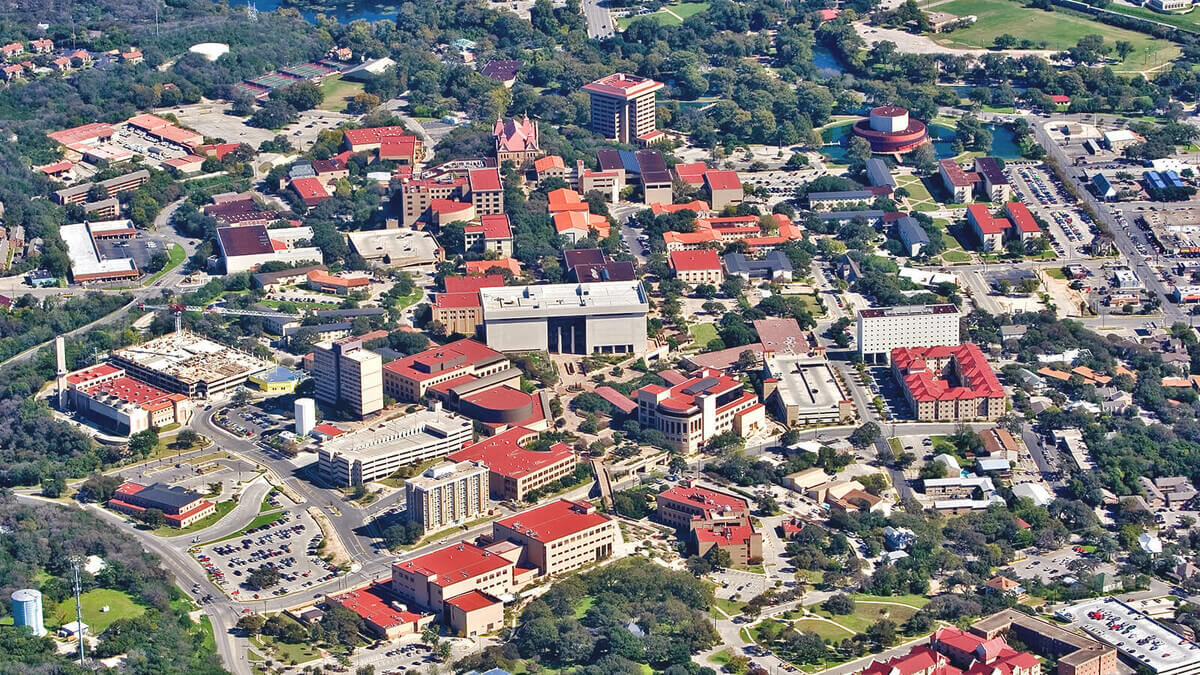
San Marcos sits on the I-35 corridor between Austin and San Antonio, anchored by Texas State University and the San Marcos River
2026 Economic Outlook
- Continued Texas State University enrollment growth supporting rental demand
- Ongoing I-35 corridor retail and commercial development
- New purpose-built student housing supply continuing to compete with individually owned rentals
- Buyer’s market conditions expected to persist through 2026 given elevated months of supply
- Long-term positioning benefits from the “Innovation Corridor” narrative linking Austin and San Antonio’s tech and medical economies
Investment Climate
San Marcos’s investment environment currently rewards patience and pricing discipline over urgency. Successful San Marcos investors in this cycle tend to share a few characteristics:
- Below-list offer discipline given buyers are closing an average of 7.3% below original asking price
- Dual-market clarity about whether a given property serves the student rental economy or the permanent resident economy, since the two have very different tenant profiles and risk factors
- Realistic student housing occupancy assumptions given meaningful new purpose-built supply competing for the same renter pool
- Flood zone diligence given the San Marcos River’s documented flood history
- Long hold horizon comfort given the current correction means near-term appreciation is not guaranteed
Texas’s landlord-friendly statewide framework, no state income tax, and San Marcos’s position directly between two of the state’s largest and fastest growing metro economies support a long-term bull case even as short-term price data looks soft. Investors buying now are effectively betting that today’s correction is a buying opportunity within a structurally sound corridor location, not a sign of permanent decline.
Historical Performance
| Period | Market Driver | Avg Annual Change | Key Event |
|---|---|---|---|
| 2015-2019 | Steady I-35 corridor growth, university expansion | 4-7% | 2015 Memorial Day flood highlighted river flood risk citywide |
| 2020-2022 | Pandemic-era migration, Austin spillover demand | 12-18% | Priced-out Austin buyers pushed south along I-35 |
| 2023-2024 | Peak pricing, rate shock begins | 0-3% | Full-year 2024 median peaks near $384,000 |
| 2025 | Correction begins, inventory builds | -5% | Full-year 2025 median falls to approximately $365,000 |
| 2026 | Continued correction, buyer’s market conditions | -3 to -19% (varies by data source and month) | Year-to-date median around $305,000; 4.9-7.6 months of supply |
The honest read on San Marcos’s recent history is a sharp pandemic-era run-up followed by a genuine multi-year give-back. A property purchased at the 2024 peak may currently show a paper loss, but a property purchased today, at the corrected price, is entering at a meaningfully better basis than a buyer two years ago. Whether this is the bottom of the cycle or a market still finding its floor is a legitimate open question, and investors should treat it as such rather than assume an immediate rebound.
Demographic Trends Driving Demand
- Texas State University Enrollment – 38,000-plus students create a massive, renewing rental base independent of the broader housing cycle
- I-35 Corridor Commuters – Roughly 30 minutes from both downtown Austin and San Antonio, drawing workers priced out of either core metro
- Outlet Mall Retail Workforce – The San Marcos Premium Outlets and Tanger Outlets combined support a genuine non-university retail and hospitality job base
- Amazon and Hays County Employment – Anchor employers providing stable, non-cyclical local jobs
- River Tourism – The San Marcos River and its second-largest-in-Texas spring system draw recreational tourism supporting seasonal STR demand
- Purpose-Built Student Housing Competition – Significant new supply of modern student apartment communities has changed the competitive landscape for individually owned student rentals since the pandemic era
📚 New to real estate investing? Master the fundamentals with our professional course Learn more →
2. Neighborhood Hotspots
San Marcos Investment Neighborhood Map
Interactive map of San Marcos’s investment neighborhoods. Green stars show top hotspots, blue circles mark established markets, and orange circles highlight emerging areas.
Core Investment Neighborhoods
Detailed Submarket Analysis: All San Marcos Neighborhoods
| Neighborhood | Price Range (SFH) | Cap Rate | Growth Drivers | Best Strategy |
|---|---|---|---|---|
| Blanco Vista | $275K-$400K | 4.5-5.5% | Family demand, newer construction, commuter access | Family buy-and-hold |
| Sessom Creek | $260K-$380K | 5.5-6.5% | Campus walkability, faculty and grad student demand | Balanced buy-and-hold |
| Forest Hills | $240K-$360K | 6.0-7.5% | Closest campus access, strong per-bedroom rent | Room-by-room student rental |
| Western San Marcos | $260K-$390K | 5.0-6.0% | Established infrastructure, moderate competition | Turnkey buy-and-hold |
| Downtown / The Square | $280K-$420K | 5.0-6.5% | Tourism, walkability, mixed tenant demand | Mixed STR / long-term rental |
| Spring Lake Hills | $250K-$370K | 5.5-6.5% | Stable mixed tenant base | Balanced buy-and-hold |
| Cottonwood Creek | $290K-$420K | 4.5-5.5% | Premium rent positioning, professional tenants | Long-term hold |
| University Heights / Belvin Street | $230K-$340K | 5.5-7.0% | Dense student demand, meaningful new supply competition | Student rental, conservative occupancy modeling |
| Millview East / West | $220K-$310K | 5.5-6.5% | Below-median entry price, value-add potential | Value-add buy-and-hold |
Expert Insight: “The mistake I see out-of-town investors make in San Marcos right now is treating every property as a student rental. The market has genuinely split in two: Blanco Vista and the western neighborhoods are commuter and family housing that happens to sit near a university, while Forest Hills and University Heights are true student product now competing against brand-new purpose-built apartments. Know which market you’re buying into before you underwrite the rent.” – Ana Villareal, Broker, Hill Country Corridor Realty
3. Property Types
| Investment Goal | Best Property Type | Best Neighborhoods | Minimum Capital |
|---|---|---|---|
| Tenant Stability | Family SFH | Blanco Vista, Franklin Square | $275,000+ |
| Maximum Rent Multiple | Room-by-room student rental | Forest Hills, University Heights | $230,000+ |
| Flexibility | Mixed STR/long-term | Downtown / The Square | $280,000+ |
| Lowest Entry Price | Value-add SFH | Millview East/West, Eastern San Marcos | $220,000+ |
Don’t guess the costs. Our Complete Renovation & Remodeling Cost Guide covers 400+ pages of project-by-project breakdowns with real contractor pricing ranges.
4. Cost Analysis
Acquisition Cost Breakdown (San Marcos)
| Expense Item | Typical Cost | Example ($310,000 Property) | Notes |
|---|---|---|---|
| Down Payment | 25% (investment) | $77,500 | Standard for investment properties statewide |
| Closing Costs | 2-3% of price | $6,200-$9,300 | Title, escrow, lender fees, recording |
| Flood Zone Determination | $150-$400 | $250 | Essential given roughly 25% of San Marcos properties carry major flood risk over 30 years |
| General Inspection | $400-$600 | $500 | Foundation checks important given Hill Country clay soils |
| Initial Repairs | 0-10% of price | $0-$31,000 | Highly variable by neighborhood and property age |
| Reserves (6 months) | 6 months expenses | $9,000-$12,000 | Elevated vacancy risk given current buyer’s market and student housing supply competition warrants a fuller reserve |
| TOTAL MINIMUM ENTRY | ~30-42% of value | $93,100-$130,000 | Meaningfully lower than the 2024 peak-price entry cost for the same property |
Sample Cash Flow Analysis: Blanco Vista Family Single-Family Home
| Item | Monthly | Annual | Notes |
|---|---|---|---|
| Gross Rent | $1,850 | $22,200 | 3BR newer-construction home, Blanco Vista |
| Less Vacancy (6%) | -$111 | -$1,332 | Family submarket has lower turnover than student-adjacent neighborhoods |
| Property Taxes | -$650 | -$7,800 | ~2.5% effective rate on $310K assessed value, typical for Hays County |
| Insurance | -$140 | -$1,680 | Standard landlord policy; flood coverage adds meaningfully more for river-adjacent properties |
| Property Management (9%) | -$167 | -$2,004 | Both national and local Austin-San Antonio corridor managers operate here |
| Maintenance + CapEx | -$130 | -$1,560 | 7% of rent for newer construction with lower deferred maintenance |
| Net Operating Income | $652 | $7,824 | Before mortgage |
| Mortgage ($310K, 25% down, 6.75%, 30yr) | -$1,509 | -$18,108 | Principal and interest only |
| CASH FLOW | -$857 | -$10,284 | Negative with standard financing; a larger down payment materially improves this |
| Cap Rate | 2.5% | NOI / Purchase Price; below the metro’s headline range for this premium family-oriented submarket | |
| Cash-on-Cash Return (40% down scenario) | ~1.5% | Modest; this property is primarily an appreciation-recovery bet, not a cash flow play |
This example is intentionally conservative and reflects a premium family-oriented Blanco Vista property. Forest Hills or University Heights properties purchased at $250,000 to $300,000 and leased room-by-room to students at $650 to $900 per bedroom routinely produce cap rates of 6.5% to 8% given the stronger aggregate rent multiple, though investors should model realistic occupancy given new purpose-built student housing competition rather than assuming full annual occupancy at premium per-bedroom rates.
Expert Insight: “San Marcos right now is genuinely two different underwriting exercises depending on which submarket you’re in. Blanco Vista is a bet that the I-35 corridor recovers and this correction proves temporary, so you underwrite it on appreciation recovery with modest current cash flow. Forest Hills is a bet on Texas State’s enrollment holding steady against new supply, so you underwrite it on rent multiple with conservative occupancy. Don’t confuse the two theses when running your numbers.” – Ana Villareal, Broker, Hill Country Corridor Realty
5. Legal Framework
⚠️ Critical San Marcos Compliance Notice
Texas’s statewide landlord-friendly framework applies fully in San Marcos, and Hays County adds minimal local layering. The real compliance considerations here are flood zone disclosure and, for student rentals, occupancy limit ordinances common in university towns. This guide provides an overview only. Always consult a Texas-licensed real estate attorney before acquiring rental properties, and verify current occupancy and flood rules independently for any specific parcel.
Texas and San Marcos-Specific Regulations
San Marcos operates under Texas’s statewide landlord-tenant framework (Texas Property Code Chapter 92) with a few university-town specific considerations:
- No Rent Control: Texas prohibits municipal rent control outright.
- Occupancy Limit Ordinances: Like many university towns, San Marcos has historically enforced occupancy limits on single-family zoned properties to manage student housing density; verify current occupancy caps before planning a room-by-room student rental strategy.
- Security Deposit Return: Must be returned within 30 days of move-out under Texas Property Code Section 92.103.
- Seller’s Disclosure of Flood History: Texas requires sellers to disclose whether a property has flooded and whether it lies in a FEMA-designated floodplain, a meaningful disclosure given San Marcos’s documented 2015 Memorial Day flood event.
- No Statewide Source-of-Income Protection: Texas landlords may decline Section 8 vouchers unless a specific local ordinance says otherwise.
- Hays County Property Tax: Effective rates run approximately 2.3-2.7% of assessed value, moderate for the Austin-San Antonio corridor.
- Short-Term Rental Registration: Verify current City of San Marcos STR permitting requirements, which have evolved as the tourism and outlet mall visitor economy has grown.
Compliance Best Practices
Successfully operating San Marcos rental properties requires attention to both flood exposure and student housing density rules:
- Flood Zone Verification: Pull the FEMA flood map designation for every property near the San Marcos River or Purgatory Creek before making an offer.
- Occupancy Ordinance Compliance: Confirm the current single-family zoning occupancy cap before advertising a property for room-by-room student leasing, as violations can result in fines and forced lease restructuring.
- Realistic Rent Comp Pulls: Given the current price correction, pull rent comps specific to the last 60-90 days rather than relying on year-old data, since the market has moved meaningfully.
- Lease Compliance Review: Use current Texas Association of Realtors lease templates, with specific addenda for occupancy limits if leasing to students.
- STR Permit Verification: Confirm current City of San Marcos short-term rental registration requirements directly before listing a property on Airbnb or VRBO.
- Local Property Management: Verify specific experience managing either the student rental submarket or the family/commuter submarket, as the two require different skill sets.
Useful San Marcos Resources
- City of San Marcos Planning and Development: sanmarcostx.gov
- Hays Central Appraisal District: hayscad.com
- Texas State University Off-Campus Housing: offcampushousing.txstate.edu
- Texas Property Code Chapter 92: statutes.capitol.texas.gov
| Regulation | San Marcos Requirement | Texas Statewide | Investor Impact |
|---|---|---|---|
| Eviction | No local add-on; standard state process | 3-day notice to vacate, then eviction filing | Among the fastest eviction timelines nationally |
| Occupancy Limits | Historically enforced on single-family zoned lots near campus | Left to municipalities | Verify before planning a multi-tenant student rental |
| Flood Disclosure | No additional city requirement | Seller must disclose flood history and floodplain status | Verify independently given the 2015 flood event’s local significance |
| Rent Increases | No local cap | No statewide cap or rent control | Full pricing flexibility, though current buyer’s market conditions may limit what the market bears |
| Short-Term Rentals | Registration and permitting requirements have evolved with the tourism economy; verify current rules | Regulation left to municipalities | Confirm directly with the city before listing a property |
6. Step-by-Step San Marcos Investment Playbook
Define Your San Marcos Strategy
San Marcos requires investors to pick a lane before buying. Be clear on which of these strategies you are executing:
Buy-the-Correction Family Hold
Buy a newer-construction family home in Blanco Vista at today’s corrected price, betting the I-35 corridor’s long-term fundamentals reassert themselves over a 7-10 year hold.
Room-by-Room Student Rental
Buy near-campus properties in Forest Hills or University Heights and lease room-by-room. Requires active management and conservative occupancy assumptions given new purpose-built competition.
Mixed STR/Long-Term Downtown
Buy a walkable Downtown or Uptown property and flex between short-term tourism rental and long-term professional leasing based on seasonal demand.
Value-Add in the Correction
Buy below-median older housing in Millview or Eastern San Marcos while prices are soft, renovate over the next 12-18 months, and hold for whichever comes first, market recovery or stabilized cash flow.
Build Your San Marcos Team
Given the market’s dual-thesis structure and current correction, local expertise matters more than usual. Non-negotiable team members:
- San Marcos-Specialist Real Estate Agent: Should be explicit about which submarket, student or family, a given property serves, and current comparable pricing given the correction.
- Independent Insurance Agent with Flood Expertise: Essential for any property near the San Marcos River or Purgatory Creek.
- Property Manager with Student Housing Experience (if applicable): Should understand occupancy ordinance compliance and current purpose-built competitive supply.
- Local General Contractor Familiar with Hill Country Construction: Should understand clay soil foundation considerations specific to Central Texas.
- Texas Real Estate CPA: For entity structuring, depreciation strategy, and Hays County property tax appeal procedures, particularly relevant given the recent price correction may support a lower current assessed value appeal.
Expert Tip: Ask any prospective agent directly: “What percentage of your recent San Marcos closings sold below original list price, and by how much?” An agent who can answer this precisely, rather than deflecting, understands the current market’s real negotiating dynamics.
San Marcos-Specific Due Diligence
Standard due diligence items plus these San Marcos-critical checks:
Physical Due Diligence
- Pull FEMA flood zone designation for any property near the San Marcos River or Purgatory Creek
- Verify prior flood claim history through the required seller’s disclosure
- Foundation inspection given Hill Country clay soil movement
- Roof and HVAC condition given Central Texas heat exposure
- Verify property is not affected by wildfire risk overlays given elevated regional exposure
Regulatory and Market Due Diligence
- Confirm current occupancy limit ordinance status if planning a student rental
- Pull the last 60-90 days of comparable sales, not year-old data, given the ongoing price correction
- Research current purpose-built student housing supply pipeline near any near-campus property
- Confirm current Hays Central Appraisal District assessed value versus offer price
- Verify current STR permitting requirements if planning short-term rental use
Competing in San Marcos’s Market
San Marcos is currently a genuine buyer’s market. Strategies that work:
- Offer meaningfully below list: Current data shows buyers closing an average of 7.3% below original asking price; don’t anchor to the seller’s list price.
- Target listings over 60 days on market: The guide’s own market data flags these as the strongest negotiating opportunities, since sellers of overpriced or stale listings are typically more motivated.
- New construction incentives: Builders in growth corridors like Blanco Vista often offer rate buydowns or closing cost credits that can improve first-year cash flow meaningfully.
- Patient timing: With 4.9 to 7.6 months of supply, there is no urgency to compete aggressively; disciplined, below-list offers are working in this market.
- Direct student housing landlord networks: Established individual student rental owners are a genuine source of off-market portfolio opportunities as some exit given new competing supply.
Property Management in San Marcos
San Marcos’s dual-market structure means management needs vary significantly by submarket. Key management focuses:
Student Turnover Protocol (If Applicable)
Properties leased to students require a distinct annual management rhythm:
- Begin re-leasing marketing in December/January for the following August move-in, well ahead of the peak leasing season
- Budget for a full annual turnover, deep clean, and minor refresh between leases given the shorter average tenancy
- Verify occupancy limit compliance with every new lease signing
- Benchmark rent against current purpose-built student housing pricing, not just other individually owned units
Typical San Marcos Management Fees
- Single-family management: 8-10% of monthly rent
- Student rental management: Often 10-12% given higher turnover and per-bedroom leasing complexity
- Leasing fee: 50-100% of one month’s rent
- Lease renewal fee: $150-$300 per renewal
- Short-term rental management: Typically 20-25% given active seasonal booking management
7. Financing Options for San Marcos
| Loan Type | Down Payment | Rate Premium | Best For | San Marcos Note |
|---|---|---|---|---|
| Conventional Investment | 25% | +0.5-0.75% | Strong W-2 income, good credit | Most San Marcos properties fall well under conforming loan limits |
| DSCR Loan | 25-30% | +1.5-2.5% | Investors who want no income verification | Note: family-submarket cap rates often don’t clear 1.0x DSCR at current rates; student-adjacent properties qualify more easily |
| Portfolio Loan | 20-25% | +0.75-1.5% | Multiple properties, self-employed | Local Central Texas community banks are often familiar with the student rental model here |
| House Hacking (FHA) | 3.5% | Standard + MIP | Owner-occupying one unit of 2-4 unit property | Popular near campus given genuine multi-unit inventory in University Heights |
| New Construction Builder Financing | Varies | Often subsidized rate buydowns | Buyers in Blanco Vista and other new-construction corridors | Builder incentives are currently meaningful given the softer market; compare against resale carefully |
| Hard Money (Bridge) | 15-25% | 9-13% rate | Value-add acquisitions in Millview, Eastern San Marcos | Austin-based hard money lenders commonly extend into the San Marcos corridor |
San Marcos Financing Reality: The current price correction cuts both ways for financing. Lower purchase prices reduce the absolute capital required, but lenders may apply extra scrutiny to appraisals in a market with recent, documented price declines. Get a recent, well-supported appraisal and expect some lenders to request additional comparable sales justification given the correction, particularly for family-submarket properties where DSCR coverage is tighter than in the student-adjacent submarket.
8. Frequently Asked Questions

Knowledge Quiz: San Marcos Real Estate Investment
Open Quiz
5 quick questions on what you just learned about San Marcos investing
1) What is the honest 2026 headline the guide identifies for San Marcos’s home prices?
Answer: C
The guide is explicit that San Marcos’s median sale price fell from a full-year 2024 peak of roughly $384,000 to approximately $305,000-$320,000 through 2026, a genuine multi-year correction rather than a single soft month, driven by a give-back of an unusually sharp pandemic-era run-up.
2) What does the guide mean by San Marcos being a “dual-market” city?
Answer: B
Roughly 71% of San Marcos housing is renter-occupied, reflecting the combined weight of a student rental submarket near campus (Forest Hills, University Heights) and a permanent resident submarket further out (Blanco Vista, Western San Marcos), each requiring a different underwriting approach.
3) What percentage of San Marcos properties does the guide say carry major flood risk over a 30 year horizon?
Answer: D
Independent flood modeling cited in the guide estimates roughly 25% of San Marcos properties carry major flood risk over the next 30 years, concentrated around the San Marcos River and Purgatory Creek, with the 2015 Memorial Day flood cited as the relevant historical event.
4) Why does the guide caution against assuming automatic full occupancy for near-campus student rentals?
Answer: A
The guide notes meaningful new purpose-built student apartment communities have entered the market and now compete directly with individually owned single-family and duplex rentals near campus, which is why it recommends modeling occupancy conservatively rather than assuming full occupancy every year.
5) According to the guide, roughly how far below asking price are San Marcos buyers currently closing on average?
Answer: C
Current market data cited in the guide shows closings coming in at 7.3% below asking price on average, reflecting the genuine buyer’s market conditions and negotiating leverage available in San Marcos right now.
Work With a Local Expert in San Marcos
We are building a verified network of real estate professionals across every market we cover.

About Our Expert Network
We are finalizing partnerships with verified real estate professionals across every market featured on Builds and Buys. Each expert in our network is selected for their hands-on investment experience, local market knowledge, and commitment to helping buyers and investors make sound decisions.
Our local specialists offer:
- Proven experience with investment and income-producing properties
- Deep knowledge of local pricing, rental yields, and neighborhood dynamics
- Guidance on financing, legal structure, and due diligence
- Access to off-market and pre-market opportunities
- Full transaction support from search through closing
- Ongoing portfolio and property management referrals
Services Covered
- Property sourcing and acquisition
- Investment analysis and underwriting
- Buyer representation
- Market comparables and valuations
- Short-term and long-term rental strategy
- Value-add and renovation guidance
- Legal and title referrals
- Financing and lender connections
- Property management referrals
- Insurance and inspection referrals
- 1031 exchange coordination
- Exit strategy planning
Get Connected or Join Our Network
Looking for a local expert to help with your investment? Reach out and we will connect you with the right professional for your market and strategy.
Are you a real estate professional with a track record working with investors? We are always expanding our network of verified local experts.
Contact us at support@buildsandbuys.com
Find Specialized San Marcos Real Estate Professionals
Ready to Invest in San Marcos?
San Marcos will not reward investors looking for a straightforward growth story. It will reward investors willing to underwrite an honest price correction, choose clearly between the student rental and permanent resident submarkets, and price in genuine flood exposure rather than ignore it. With a 38,000-plus student university, a position directly on the Austin-San Antonio Innovation Corridor, and entry prices now meaningfully below their 2024 peak, San Marcos offers a legitimate contrarian opportunity for investors who do the underwriting carefully.
Continue Your Research
Texas State Guide
See how San Marcos compares to Austin, San Antonio, and other Texas markets.
Step-by-Step Invest
Complete framework for building a real estate investment strategy from scratch.
144-Lesson Course
University-level real estate education covering financing, law, strategy, and management.
For further guidance, explore our State-by-State Investor guides, browse our expert articles, or follow our Step-by-Step Investment Guide.



