
Salt Lake City Real Estate Investment Guide For 2026
A comprehensive resource for investors looking to capitalize on one of America’s fastest-growing, most supply-constrained, and tech-driven urban property markets in 2026
Quick answers: Top 5 most searched Salt Lake City investment questions ▼
Migration data: Where people are moving from to Salt Lake City ▼
In This Guide
Click on any section to navigate directly to that content
1. Salt Lake City Market Overview
Market Fundamentals
Salt Lake City has emerged as one of the most compelling real estate investment stories in the western United States, anchored by the explosive growth of the Silicon Slopes tech corridor, a geographic supply constraint that rivals coastal markets, and the youngest major metropolitan population in the country. From the walkable urban corridors of Sugar House and the 9th and 9th neighborhood to the booming master-planned communities of South Jordan and Herriman, SLC offers diverse entry points and strategies across a wide range of price points.
Key economic indicators that define Salt Lake City’s investment case:
- Population: 220,000 city proper, 1.25M metro, 2.6M Wasatch Front
- Major Employers: Adobe, Qualtrics, Overstock, Goldman Sachs, University of Utah, Intermountain Health, Hill Air Force Base, Microsoft, Amazon
- Median Household Income: $72,000 metro, $90,000+ in Silicon Slopes corridor
- Job Growth: 3.1% annually, among the highest in the nation
- Median Age: 31 (youngest of any top-50 U.S. metro)
- Vacancy Rate: Under 4.5% across most submarkets
Utah’s economy is anchored by technology but meaningfully diversified across healthcare, finance, defense, tourism, and higher education. The University of Utah, Brigham Young University, Utah Valley University, and Weber State collectively enroll over 130,000 students, creating stable housing demand across the Wasatch Front that persists through economic cycles.
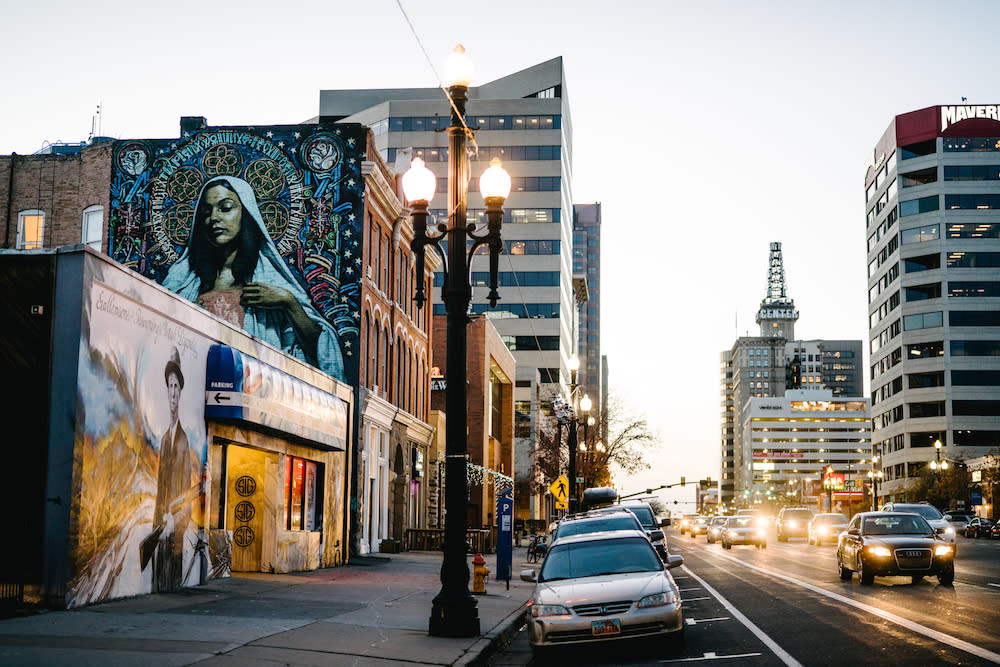
Salt Lake City’s skyline reflects a city defined by tech growth, mountain geography, and one of America’s youngest workforces
2026 Economic Outlook
- Silicon Slopes tech corridor continuing to attract major employer expansions
- University of Utah Research Park driving biotech and life sciences growth
- TRAX light rail expansion creating new transit-oriented development corridors
- Goldman Sachs and financial services sector expanding SLC operations
- Remote work migration from California maintaining strong in-migration numbers
Investment Climate
Salt Lake City’s investment environment is defined by a genuinely favorable combination of factors that sets it apart from most western markets: strong appreciation backed by structural demand, cap rates that allow positive or near-neutral cash flow in many submarkets, and a landlord-friendly legal framework that dramatically reduces regulatory risk. Successful SLC investors tend to share a few characteristics:
- Growth-oriented outlook with hold periods of 5 to 10 years to capture full appreciation cycles
- Submarket selectivity matching property type to the specific demographic driving each neighborhood
- Cash flow awareness understanding which areas support positive returns versus appreciation-first strategies
- Population trend focus tracking where the next wave of tech employers and master-planned communities is heading
- ADU and accessory dwelling awareness as Utah has been expanding ADU permissions statewide
Utah’s lack of rent control, straightforward eviction process, and consistently pro-business political environment make it one of the most investable regulatory environments in the country. Combined with appreciation rates that have ranked Utah among the top five fastest-appreciating states for the past decade, this creates a rare opportunity where both strong growth and a manageable operating environment converge.
Historical Performance
| Period | Market Driver | Avg Annual Appreciation | Key Event |
|---|---|---|---|
| 2010-2014 | Post-recession recovery, early tech corridor growth | 4-6% | Adobe and other Silicon Slopes anchors establish Utah presence |
| 2015-2019 | Tech hiring boom, California in-migration begins | 8-12% | Qualtrics, Domo, and dozens of tech unicorns scale in Lehi and Provo |
| 2020-2022 | Remote work migration, pandemic premium, record low inventory | 20-28% | Utah became one of the nation’s hottest markets; median prices surged 50%+ in 24 months |
| 2023-2024 | Rate shock, normalization, inventory recovery | 3-7% | Market absorbed correction while maintaining stronger fundamentals than coastal peers |
| 2025-2026 | Rate stabilization, continued in-migration, TRAX expansion | 10-15% (projected) | Silicon Slopes second-generation buildout, new master-planned communities opening statewide |
Salt Lake City’s 15-year track record shows average annual appreciation of 9 to 12 percent, placing it consistently among the top 10 appreciating U.S. metros. A $350,000 SLC property purchased in 2010 would be worth approximately $1.1 to $1.3 million today after market cycles. The 2020 to 2022 surge was exceptional and not expected to repeat at that magnitude, but structural demand drivers remain firmly in place.
Demographic Trends Driving Demand
- Silicon Slopes Expansion – Adobe, Qualtrics, Microsoft, Goldman Sachs, and hundreds of growing tech companies continue aggressive hiring, bringing high-income workers who need housing immediately upon relocation
- California Migration – Professionals stretching Bay Area savings in a market that is 40 to 50 percent cheaper, often purchasing within their first year of arrival
- Utah Birth Rate – Utah has the highest birth rate in the nation, creating sustained household formation demand that insulates the housing market during economic downturns
- University System – Over 130,000 students at University of Utah, BYU, UVU, and Weber State create a permanent class of renter-age young adults across the Wasatch Front
- LDS Mission Returns – Tens of thousands of young adults returning from missions each year form households and seek rentals, creating a consistent first-renter demographic unique to Utah
- Geographic Lock-in – Wasatch Mountains to the east, Great Salt Lake to the northwest, and desert terrain to the south and west constrain developable land and support long-term price appreciation
📚 New to real estate investing? Master the fundamentals with our professional course Learn more →
2. Neighborhood Hotspots
Salt Lake City Investment Neighborhood Map
Interactive map of Salt Lake City’s investment neighborhoods. Green stars show top hotspots, blue circles mark established markets, and orange circles highlight emerging areas.
Core Investment Neighborhoods
Detailed Submarket Analysis: Salt Lake City Neighborhoods
| Neighborhood | Price Range (SFH) | Cap Rate | Growth Drivers | Best Strategy |
|---|---|---|---|---|
| Sugar House / Millcreek | $500K-$900K | 4.0-5.0% | Urban renewal, walkability, dining, young professionals | Long-term appreciation, duplex/triplex, value-add bungalow |
| 9th and 9th / East Bench | $600K-$1.1M | 3.5-4.5% | Urban village, top schools, high-income tenants | Pure appreciation, luxury rental, minimal vacancy |
| Ballpark / Liberty Wells | $400K-$650K | 5.0-6.5% | TRAX access, urban renewal, downtown proximity | Value-add, BRRRR, duplex conversion |
| Rose Park / Fairpark | $350K-$550K | 6.0-7.5% | Gentrification pressure, affordability, transit | Best cash flow SLC proper, value-add, multi-family |
| South Jordan / Daybreak | $450K-$700K | 5.0-6.0% | TRAX, master-planned community, new development | Cash flowing new construction, townhome buy-and-hold |
| Sandy / Draper | $500K-$800K | 4.5-5.5% | Tech corridor, retail centers, family demographics | Balanced returns, newer properties, professional tenants |
| Cottonwood Heights / Holladay | $600K-$1.2M | 3.5-4.5% | Canyon access, top schools, affluent demographics | Luxury rental, pure appreciation play |
| West Valley City | $350K-$500K | 6.0-7.5% | Affordability, diverse demand, logistics employment | High cash flow, value-add, working-class rentals |
| Murray / Midvale | $400K-$600K | 5.0-6.0% | Central location, TRAX access, improving amenities | Balanced hold, TRAX-oriented, SFH and small multi-family |
| Herriman / Riverton | $450K-$650K | 5.0-6.0% | New developments, family demographics, mountain views | New construction, family rentals, long-term appreciation |
Expert Insight: “The most overlooked opportunity in Salt Lake City right now is the TRAX corridor south from downtown through Ballpark and into South Jordan. Properties within half a mile of a TRAX station in Ballpark and Liberty Wells are trading at 25 to 35 percent below equivalent properties in Sugar House, yet the transit access and downtown commute time are almost identical. As these neighborhoods complete their commercial improvement cycle over the next three to five years, that gap should compress significantly. Investors buying now are getting the Sugar House thesis at Liberty Wells pricing.” – Jennifer Pace, Principal, Wasatch Real Estate Advisors
3. Property Types
| Investment Goal | Best Property Type | Best Neighborhoods | Minimum Capital |
|---|---|---|---|
| Maximum Appreciation | SFH in supply-constrained urban neighborhoods | 9th and 9th, Cottonwood Heights, Sugar House | $175,000+ |
| Best Cash Flow | Small multi-family or SFH in affordable corridors | Rose Park, West Valley City, Kearns | $100,000+ |
| Balanced Returns | New construction townhome or value-add SFH | South Jordan, Ballpark, Murray | $125,000+ |
| Lowest Management | New townhome or modern condo | South Jordan, Sandy, Herriman | $115,000+ |
Don’t guess the costs. Our Complete Renovation & Remodeling Cost Guide covers 400+ pages of project-by-project breakdowns with real contractor pricing ranges.
4. Cost Analysis
Acquisition Cost Breakdown (Salt Lake City)
| Expense Item | Typical Cost | Example ($550,000 Property) | Notes |
|---|---|---|---|
| Down Payment | 25% (investment) | $137,500 | Standard for investment properties; 20% possible with strong credit |
| Closing Costs | 2-3% of price | $11,000-$16,500 | Title, escrow, lender fees, recording. Utah closing costs are lower than most western states. |
| General Inspection | $350-$550 | $450 | Radon testing strongly recommended given Utah’s elevated radon levels |
| Radon Test | $150-$250 | $200 | Utah has one of the highest radon concentrations in the U.S. Mitigation runs $800 to $2,500. |
| Sewer Scope | $200-$350 | $275 | Recommended for pre-1980 properties. Replacement can reach $8,000 to $18,000. |
| Initial Repairs | 0-8% of price | $0-$44,000 | Highly variable. SLC’s older bungalow stock often needs plumbing and electrical updates. |
| Reserves (6 months) | 6 months expenses | $10,000-$15,000 | Emergency fund for vacancy and major repairs |
| TOTAL MINIMUM ENTRY | ~28-30% of value | $159,425-$213,925 | More accessible than most western markets at comparable price-to-income ratios |
Sample Cash Flow Analysis: South Jordan Townhome Buy-and-Hold
| Item | Monthly | Annual | Notes |
|---|---|---|---|
| Rent (3BR townhome) | $2,200 | $26,400 | 3BR, South Jordan, Daybreak area, near TRAX |
| Less Vacancy (5%) | -$110 | -$1,320 | Conservative estimate; actual vacancy often under 3% in this area |
| Property Taxes | -$385 | -$4,620 | ~0.7% of $660K assessed value. Utah property taxes are among the lowest in the west. |
| Insurance | -$120 | -$1,440 | Landlord policy; lower than coastal markets |
| HOA Fees | -$150 | -$1,800 | Typical for Daybreak master-planned community |
| Property Management (9%) | -$198 | -$2,376 | Reasonable for SLC; lower than Seattle or Portland managers |
| Maintenance + CapEx | -$165 | -$1,980 | Lower for new construction; 7.5% of rent |
| Net Operating Income | $1,072 | $12,864 | Before mortgage |
| Mortgage ($580K purchase, 25% down, 6.5%, 30yr) | -$2,745 | -$32,940 | Principal and interest on $435K loan |
| CASH FLOW | -$1,673 | -$20,076 | Negative but far better than comparable Seattle or Denver scenarios |
| Cap Rate | 2.2% | NOI / Purchase Price (appreciation-only scenario) | |
| Total Return (12% appreciation) | ~28% | Including equity growth, appreciation, and principal paydown |
Cash Flow Scenario: Rose Park Value-Add Single-Family. A $420,000 purchase in Rose Park, renovated for $60,000 to a total cost of $480,000, can generate $1,900/month rent on a 3-bedroom. With 25 percent down on the purchase and renovation financed through a HELOC, the same analysis shows $350/month positive cash flow, a 5.8% cap rate on the renovated value, and a total return of 20 to 25 percent including appreciation. The value-add strategy can meaningfully improve returns in SLC’s more affordable corridors.
Expert Insight: “Salt Lake City is one of the few western markets where you can actually build a real estate investment business rather than just a collection of appreciation plays. The combination of landlord-friendly law, sub-5 percent vacancy, and meaningful cap rates in the right submarkets means you can construct a portfolio that generates real cash flow while capturing above-average appreciation. Our best-performing clients are targeting the TRAX corridor south of downtown and older stock in Rose Park and Glendale while also holding newer properties in South Jordan for the appreciation and easy management combination.” – David Sorensen, CRE Advisor, Salt Lake Investment Properties
5. Legal Framework
✅ Utah is One of America’s Most Landlord-Friendly States
Unlike Seattle, Portland, or California markets, Utah has no rent control, no just-cause eviction requirement beyond proper notice procedures, and a streamlined court system that resolves most evictions within 30 to 45 days. Utah Code Title 57 governs landlord-tenant relationships with a balance that protects both parties while keeping the legal process manageable. Salt Lake City has introduced some additional tenant protections but nothing approaching the complexity of coastal markets. This legal environment is a meaningful competitive advantage for SLC investors compared to other western tech markets.
Utah State Landlord-Tenant Law
Utah’s landlord-tenant framework under Utah Code Title 57 establishes clear rights and obligations:
- No Rent Control: Utah state law preempts any local rent control ordinances. Rent can be increased with proper notice at any time.
- Notice Requirements: Month-to-month tenancies require 15 days written notice to terminate. Fixed-term leases expire naturally at the lease end date.
- Eviction Timeline: Non-payment of rent triggers a 3-day pay or vacate notice. Court filing can occur on day four. Most uncontested evictions are resolved in 30 to 45 days total.
- Security Deposits: No statutory limit on deposit amount. Must be returned within 30 days of lease end with an itemized accounting of any deductions.
- Habitability Standards: Landlords must maintain heating, plumbing, and structural safety. 24-hour notice is required before entry except in emergencies.
- Repair and Deduct: Tenants may not repair and deduct in Utah. All repair requests must go through the landlord, who has a reasonable time to respond.
Salt Lake City Additional Regulations
Salt Lake City has added some protections beyond state minimums:
- Anti-Discrimination Ordinance: SLC prohibits discrimination based on sexual orientation and gender identity in housing, broader than federal protections.
- Short-Term Rental Permits: STRs require a business license and are limited to owner-occupied primary residences in most zones. Investment property STRs face significant restrictions.
- Building Code Compliance: Rental units must pass periodic inspections in designated neighborhoods. Ensure any property passes or has a clear remediation path before purchase.
- ADU Regulations: SLC and many Salt Lake County municipalities are expanding ADU permissions as part of the state’s housing affordability push. Check current zoning for specific addresses.
Useful Utah Resources
- Utah Apartment Association: uaahq.org
- Utah Division of Real Estate: realestate.utah.gov
- SLC Building Services: slc.gov/building-services
- Utah Courts (evictions): utcourts.gov
| Regulation | Utah / SLC Requirement | Comparison (Seattle) | Investor Impact |
|---|---|---|---|
| Eviction | 3-day notice for non-payment; 15-day no-cause | Just cause required; 90-180 day typical timeline | Dramatically faster and less costly in Utah |
| Rent Increases | 15 days notice for month-to-month increases | 180 days for large increases | Full flexibility to adjust rents to market |
| Rent Control | State law prohibits rent control statewide | No formal rent control but heavy de facto restrictions | Rents can track market without legislative risk |
| Security Deposits | No statutory cap; 30 days to return | Move-in fees capped; 21 days to return | Landlord has more flexibility in Utah |
| Tenant Screening | Landlord discretion within fair housing limits | First-in-time rule restricts selection | Utah landlords choose the best qualified applicant |
| STR Regulations | SLC requires permit, primarily owner-occupied | Primary residence only, 120-day annual cap | Similar restrictions; resort markets (Park City, Moab) more permissive |
6. Step-by-Step Salt Lake City Investment Playbook
Define Your Salt Lake City Strategy
SLC offers four distinct investor profiles, each with different neighborhoods, property types, and capital requirements. Define your strategy before you start underwriting properties.
Appreciation-First Strategy
Buy in supply-constrained urban neighborhoods near employment, amenities, and transit. Accept modest negative cash flow in exchange for equity compounding. Requires stable income and a 7-plus year hold horizon.
Cash Flow Strategy
Target affordable west-side and south-valley corridors with genuine positive cash flow. Accept lower appreciation rates in exchange for monthly income and a more manageable operating statement.
Value-Add / BRRRR Strategy
Buy distressed or dated properties in improving neighborhoods. Renovate to increase rents and value. Refinance out as much equity as possible and repeat. Works best in transitional SLC corridors with strong underlying demand.
Balanced New Construction Strategy
Buy new construction townhomes or single-family homes in master-planned communities. Near-neutral to slightly positive cash flow with strong appreciation. Easiest management profile and best for out-of-state investors.
Build Your Salt Lake City Team
Utah’s landlord-friendly environment reduces your need for expensive legal counsel compared to markets like Seattle, but a solid team still separates good investors from great ones:
- Utah-Licensed Investment Real Estate Agent: Must understand cap rate analysis, cash-on-cash returns, and the specific submarkets relevant to your strategy. Ask for their track record with investor clients specifically.
- Utah Real Estate Attorney: Entity structuring (LLC is strongly recommended for SLC rentals), lease drafting, and title review. Less urgently needed than in a regulatory market like Seattle but still important for asset protection.
- Local Property Manager: Even in a landlord-friendly state, professional management improves tenant quality, reduces vacancy, and handles the administrative burden. Look for managers who are Utah Apartment Association members.
- Real Estate CPA familiar with Utah law: Utah-specific depreciation strategy, property tax appeal procedures (useful given rapid appreciation), and entity structuring for multi-property portfolios.
- Renovation-Experienced General Contractor: For value-add strategies, a contractor who knows SLC’s older housing stock is essential. Older bungalows frequently have knob-and-tube wiring, galvanized plumbing, and inadequate insulation that must be budgeted.
Expert Tip: Interview property management companies by asking: “What is your average days-on-market for vacant units across your current portfolio?” and “Walk me through your process for handling a tenant who stops paying rent in month three of a lease.” Companies with clear, systematic answers have the operational maturity to protect your investment.
Salt Lake City-Specific Due Diligence
Standard due diligence items plus these SLC-specific checks:
Physical Due Diligence
- Radon test (mandatory for all pre-2000 homes in Utah)
- Sewer scope for pre-1980 construction
- Seismic risk assessment for properties on the Wasatch Fault zone (especially east bench properties)
- Inversion zone air quality awareness for tenant appeal (SLC winter inversions are a real marketing consideration)
- Evaporative cooler condition and conversion potential for hot summer rental demand
- Roof condition given heavy snow load requirements
- Basement waterproofing and foundation condition in older bungalows near the Jordan River
Market and Regulatory Due Diligence
- Verify current zoning for ADU eligibility if that is part of your strategy
- Check for any open building permits or code violations from prior owners
- Confirm HOA rules for rental permissions if applicable
- Verify current tenant lease terms, rent amount, and any history of late payment
- Check for any active STR permits if short-term rental is part of your plan
- Research planned development and zoning changes in the immediate area using the SLC planning department portal
- Confirm TRAX or FrontRunner access radius for transit-dependent tenants
Competing in Salt Lake City’s Market
SLC is competitive for well-priced properties in desirable areas. Strategies that work:
- Pre-inspections: Conduct your inspection before submitting an offer on properties priced to move. Allows you to submit clean non-contingent offers that win competitive situations.
- New construction relationships: Establish direct relationships with Daybreak, Ivory Homes, and other major Utah builders to get first access to investor-eligible inventory before public release.
- Off-market outreach: Direct mail to long-term homeowners in Rose Park, Glendale, and West Valley City who may be ready to sell but haven’t listed yet. These sellers often prefer a quick cash or pre-approved buyer over a listed sale.
- Occupied properties with tenant issues: Sellers dealing with difficult tenants often discount meaningfully. Utah’s fast eviction timeline means a problem tenant situation can typically be resolved within 60 days by an informed investor.
- Estate sales and probate: Utah’s estate sale market generates regular below-market opportunities in older neighborhoods like Rose Park and Glendale where long-term owners pass properties to heirs who prefer liquidity.
7. Financing Options for Salt Lake City
| Loan Type | Down Payment | Rate Premium | Best For | SLC Note |
|---|---|---|---|---|
| Conventional Investment | 25% | +0.5-0.75% | Strong W-2 income, good credit | Most SLC properties fall within conforming loan limits; conventional pricing available on most purchases |
| DSCR Loan | 25-30% | +1.5-2.5% | Self-employed investors, portfolio builders | Unlike Seattle, many SLC properties in affordable corridors can qualify at 1.0x DSCR given better cap rates |
| FHA House Hack | 3.5% | Standard + MIP | Owner-occupying one unit of 2-4 unit property | Best low-capital entry point; SLC has many existing duplexes and triplexes in Capitol Hill and the Avenues that qualify |
| Portfolio Loan | 20-30% | +1-2% | Multiple properties, self-employed | Celtic Bank, Zions Bank, and several Utah-based community lenders offer competitive portfolio products |
| Hard Money (Bridge) | 15-25% | 8-12% rate | BRRRR acquisitions, value-add deals | Active hard money lending community in SLC; several Utah-focused lenders know the market well |
| VA Loan (House Hack) | 0% | Standard VA rates | Veterans and active military | Hill AFB proximity makes this relevant; VA loans on 2-4 unit properties while owner-occupying one unit is an excellent entry strategy |
| New Construction Builder Financing | 10-20% | Variable (often below market) | Buying new construction in master-planned communities | Daybreak and other major Utah builders have preferred lender programs with rate buydowns that can meaningfully improve initial cash flow |
SLC Financing Advantage: Unlike Seattle or San Francisco, many Salt Lake City properties in the $350,000 to $500,000 range can actually qualify for DSCR loans at 1.0x coverage, particularly in West Valley City, Rose Park, and Tooele. This opens the market to self-employed investors and those building portfolios who cannot document W-2 income. Utah’s lower property tax rate (averaging 0.6 to 0.8 percent versus 0.85 to 1.0 percent in Seattle) also meaningfully improves DSCR calculations and overall cash flow in every scenario.
8. Frequently Asked Questions

Knowledge Quiz: Salt Lake City Real Estate Investment
Open Quiz
5 quick questions on what you just learned about Salt Lake City investing
1) What makes Utah one of the most landlord-friendly states in the western U.S.?
Answer: B
Utah state law prohibits rent control statewide, does not require just cause for eviction (only proper notice), and the court process for non-payment cases typically runs 25 to 45 days. This compares very favorably to Seattle’s 90 to 180 day eviction timelines and is a core competitive advantage of the SLC market for investors.
2) What is Silicon Slopes and why does it matter for Salt Lake City real estate investors?
Answer: C
Silicon Slopes is the tech corridor stretching from Salt Lake City south through Draper, Lehi, American Fork, and Provo. Adobe, Qualtrics, Goldman Sachs, and thousands of other tech companies are based there. For investors, it creates a concentrated pool of high-income young professionals who are new to Utah and renting before buying, making Lehi, Sandy, and South Jordan among the state’s strongest rental markets.
3) Which neighborhood does the guide identify as offering the best near-term appreciation momentum in Salt Lake City proper?
Answer: A
The guide highlights Ballpark and Liberty Wells as SLC’s fastest-improving urban corridor. Properties there trade 25 to 35 percent below Sugar House despite similar TRAX access and downtown commute times. The guide explicitly draws a parallel to what Sugar House was 15 years ago, making it the top near-term appreciation pick in the city proper for value-add investors.
4) What critical physical inspection does the guide say is mandatory for all pre-2000 Salt Lake City homes?
Answer: D
Utah has one of the highest natural radon concentrations in the United States due to its geology. The guide calls radon testing mandatory for all pre-2000 homes. Mitigation systems run $800 to $2,500 and are a material consideration in purchase negotiations. Failing to test and disclose can create liability issues when you eventually sell the property.
5) Why can more SLC properties qualify for DSCR loans compared to Seattle properties?
Answer: B
Seattle’s cap rates of 3 to 4.5 percent combined with current interest rates mean most Seattle properties generate NOI well below their debt service, making DSCR qualification nearly impossible. SLC’s cap rates of 4 to 7.5 percent in affordable corridors (West Valley City, Rose Park, Tooele), combined with Utah’s lower property tax rate of 0.6 to 0.8 percent, means the math often works at 1.0x DSCR, opening the SLC market to investors who cannot document W-2 income.
Work With a Local Expert in Salt Lake City
We are building a verified network of real estate professionals across every market we cover.

About Our Expert Network
We are finalizing partnerships with verified real estate professionals across every market featured on Builds and Buys. Each expert in our network is selected for their hands-on investment experience, local market knowledge, and commitment to helping buyers and investors make sound decisions.
Our local specialists offer:
- Proven experience with investment and income-producing properties
- Deep knowledge of local pricing, rental yields, and neighborhood dynamics
- Guidance on financing, legal structure, and due diligence
- Access to off-market and pre-market opportunities
- Full transaction support from search through closing
- Ongoing portfolio and property management referrals
Services Covered
- Property sourcing and acquisition
- Investment analysis and underwriting
- Buyer representation
- Market comparables and valuations
- Short-term and long-term rental strategy
- Value-add and renovation guidance
- Legal and title referrals
- Financing and lender connections
- Property management referrals
- Insurance and inspection referrals
- 1031 exchange coordination
- Exit strategy planning
Get Connected or Join Our Network
Looking for a local expert to help with your investment? Reach out and we will connect you with the right professional for your market and strategy.
Are you a real estate professional with a track record working with investors in Salt Lake City? We are always expanding our network of verified local experts.
Contact us at support@buildsandbuys.com
Find Specialized Salt Lake City Real Estate Professionals
Ready to Invest in Salt Lake City?
Salt Lake City is one of the most well-rounded investment opportunities in the western United States. Unlike purely appreciation-driven markets such as Seattle and San Francisco, SLC offers genuine cash flow in its affordable corridors, a landlord-friendly legal environment, and appreciation rates that rank among the nation’s highest. The combination of Silicon Slopes tech growth, the youngest major metro population in the country, geographic supply constraints, and a pro-business regulatory environment creates an investment case that is both accessible and compelling for a wide range of investor profiles and capital levels.
Continue Your Research
Utah State Guide
See how Salt Lake City compares to Provo, St. George, Ogden, Park City, and other Utah markets.
Step-by-Step Invest
Complete framework for building a real estate investment strategy from scratch.
144-Lesson Course
University-level real estate education covering financing, law, strategy, and management.
For further guidance, explore our State-by-State Investor guides, browse our expert articles, or follow our Step-by-Step Investment Guide.



