
Prescott Valley Arizona Real Estate Investment Guide For 2026
A comprehensive resource for investors targeting Arizona’s fastest-growing mountain corridor community, where newer housing stock, Prescott spillover demand, strong family rental appeal, and some of the most accessible positive cash flow in northern Arizona converge
Quick answers: Top 5 most searched Prescott Valley investment questions ▼
Migration data: Where people are moving from to Prescott Valley ▼
In This Guide
Click on any section to navigate directly to that content
1. Prescott Valley Market Overview
Market Fundamentals
Prescott Valley is one of Arizona’s most consistently growing communities and the more affordable companion to historic Prescott, sitting just a few miles to the east at 5,100 feet elevation in Yavapai County. While Prescott captures the tourism, arts, and heritage tourism market, Prescott Valley captures the growth: newer master-planned communities, expanding commercial retail, and a steady stream of retirees, families, and remote workers who want the Prescott area lifestyle at lower cost.
Key fundamentals defining Prescott Valley’s investment case:
- Population: 50,000+ and among fastest-growing communities in Yavapai County
- Elevation: 5,100 feet, providing cool summers versus Phoenix heat
- Major Employers: Yavapai Regional Medical Center, Prescott area school districts, Embry-Riddle Aeronautical University (nearby), retail and healthcare sector
- Median Home Price: $420,000 (versus $475,000+ in Prescott proper)
- Cap Rates: 5 to 7 percent for long-term rentals
- Housing Stock: Primarily post-2000 construction, offering newer systems and layouts
Prescott Valley’s investment thesis is straightforward: it is the more affordable option in Arizona’s most desirable mountain corridor for retirees and quality-of-life migrants. As Prescott’s prices have risen over the past decade, Prescott Valley has absorbed a growing share of the regional demand, and as Prescott Valley’s own infrastructure and commercial amenities continue developing, its price gap with Prescott is gradually compressing.
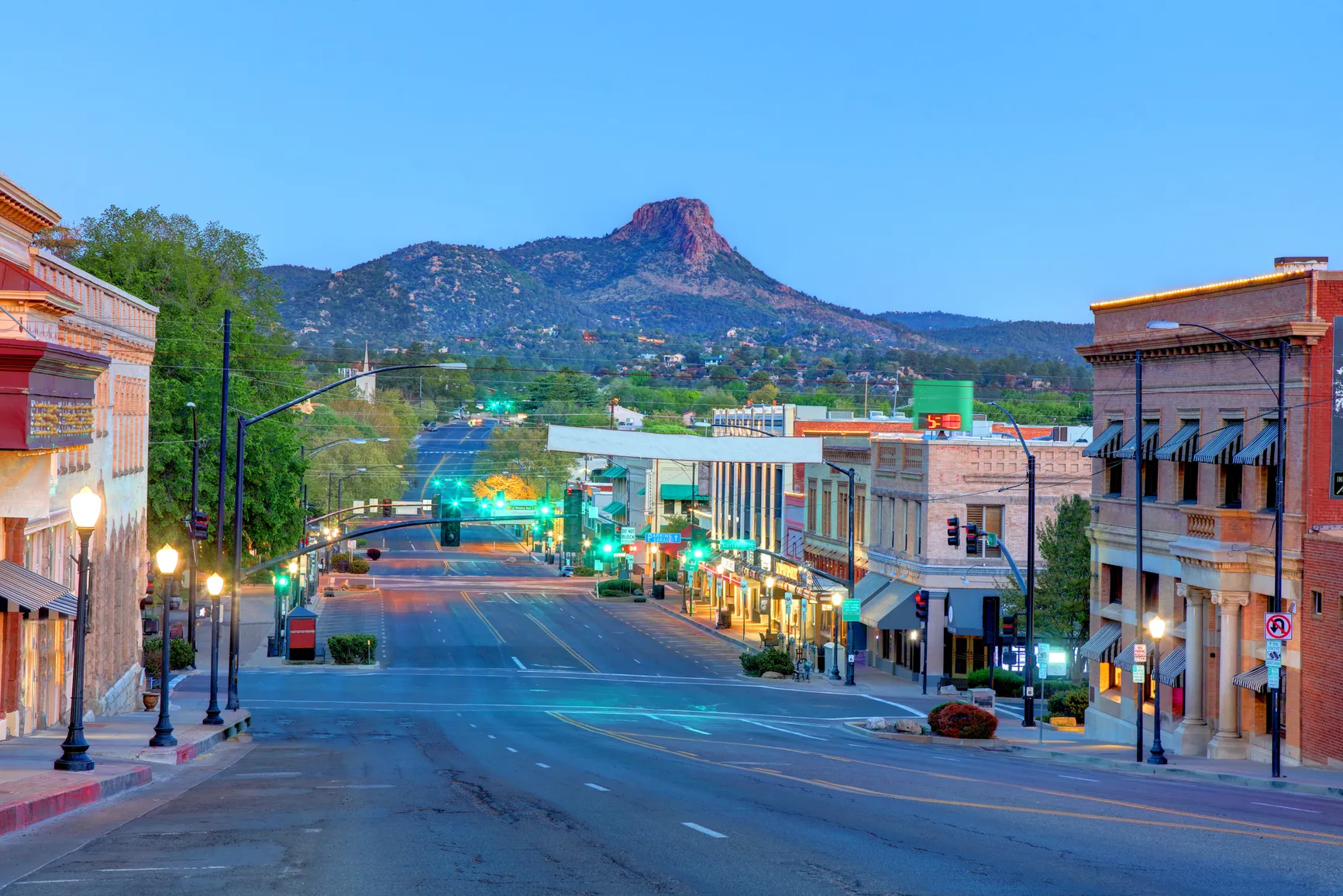
Prescott Valley’s mile-high location provides four distinct seasons and relief from Phoenix’s summer heat, drawing a steady stream of retirees and quality-of-life migrants
2026 Economic Outlook
- Yavapai Regional Medical Center expansion adding healthcare jobs
- Commercial retail corridor growth following residential population
- Prescott price appreciation continuing to push demand toward Prescott Valley
- Remote worker migration from Phoenix and California sustaining demand
- Highway 69 corridor infrastructure supporting continued growth
Investment Climate
Prescott Valley’s investment environment is defined by positive cash flow potential, stable demand, and Arizona’s landlord-friendly legal framework. The market does not offer Sedona’s STR premiums or Chandler’s semiconductor-driven appreciation, but it provides something increasingly rare in Arizona: genuine positive cash flow from conventional investment financing in a growing community with strong long-term fundamentals. Investors who succeed here share several characteristics:
- Cash flow orientation prioritizing the positive monthly income that Prescott Valley’s price-to-rent ratio allows
- Long-term patience understanding that appreciation here is steady rather than dramatic, rewarding 7 to 15 year holds
- Tenant diversity awareness recognizing that the retiree, family, and remote worker rental segments have different needs and the best properties serve multiple potential tenant types
- New construction appreciation for the lower maintenance cost advantage that Prescott Valley’s newer housing stock provides versus older Arizona communities
Historical Performance
| Period | Market Driver | Avg Annual Appreciation | Key Event |
|---|---|---|---|
| 2010-2016 | Recovery, new community development | 3-6% | Steady growth as Prescott Valley commercial corridor develops |
| 2017-2019 | Prescott spillover, retiree migration growth | 6-9% | Prescott prices rise, directing more buyers to PV; community matures |
| 2020-2022 | Pandemic migration, remote workers | 18-26% | Phoenix and California remote workers discover Prescott area; inventory at historic lows |
| 2023-2024 | Rate normalization, stable migration | 4-7% | Market moderates from peak; Prescott area migration demand sustains baseline |
| 2025-2026 | Continued migration, commercial maturation | 7-10% (projected) | Commercial retail growth attracting more services; Prescott spillover continues |
Demand Drivers Unique to Prescott Valley
- Prescott Price Spillover – As Prescott’s median home price continues rising, buyers who want the Prescott area lifestyle but cannot afford Prescott proper naturally arrive in Prescott Valley. This creates a structural demand floor that rises with Prescott’s appreciation
- Retirement Destination – Prescott Valley’s mile-high elevation, four-season climate, accessible outdoor recreation, and strong healthcare infrastructure through Yavapai Regional Medical Center make it a top retirement destination for Phoenix and California retirees
- Embry-Riddle Aeronautical University – Located minutes away in Prescott proper, ERAU draws faculty, staff, and graduate students who frequently choose Prescott Valley for its more affordable housing. This creates consistent demand from educated, employed renters
- New Housing Stock – Prescott Valley’s post-2000 housing stock means lower maintenance costs, modern energy efficiency, and layouts that appeal to contemporary family and retiree tenants. This new construction advantage distinguishes it from older Arizona communities
- Healthcare Employment – Yavapai Regional Medical Center is one of the region’s largest employers, creating stable healthcare worker housing demand that is recession-resistant
- Remote Worker Appeal – The quality of life at 5,100 feet elevation with four seasons and outdoor recreation access appeals to remote workers seeking alternatives to Phoenix or California at meaningfully lower costs
📚 New to real estate investing? Master the fundamentals with our professional course Learn more →
2. Neighborhood Hotspots
Prescott Valley Investment Neighborhood Map
Interactive map of Prescott Valley’s investment neighborhoods. Green stars show top hotspots, blue circles mark established markets, and orange circles highlight emerging areas.
Core Investment Neighborhoods
Detailed Submarket Analysis: Prescott Valley Neighborhoods
| Neighborhood | Price Range | Cap Rate | Growth Drivers | Best Strategy |
|---|---|---|---|---|
| Glassford Hill / Viewpoint | $400K-$620K | 5-6.5% | Views, established area, commercial access | Long-term hold, family and retiree rentals |
| Stoneridge | $380K-$580K | 5-6.5% | Master-planned amenities, newer stock, family appeal | Passive hold, low maintenance, stable income |
| Central Prescott Valley | $340K-$490K | 5.5-7% | Healthcare employment, established area, affordability | Cash flow focus, value-add, workforce rentals |
| Granville / North PV | $380K-$570K | 5-6.5% | Newer stock, mountain proximity, family demand | Buy-and-hold, family rentals, new construction |
| Eastern Growth Edge | $320K-$460K | 5.5-7% | New construction, affordability, long-term growth | Lowest entry, growth play, patient investors |
| PV / Prescott Boundary | $400K-$620K | 5-6.5% | Dual-market demand, ERAU proximity, best of both | Premium hold, dual-market appeal, appreciation focus |
Expert Insight: “The best Prescott Valley investment play that most out-of-state investors miss is a 3-bedroom home in the central or Glassford Hill area targeted specifically to the retiree rental market. Retirees renting in Prescott Valley are often people who sold California or Phoenix homes, have substantial savings, and choose to rent while deciding whether to stay permanently. These tenants pay reliably, maintain properties impeccably, and sign 2 to 3 year leases. On a $420,000 property, having a retiree couple paying $2,200 per month on a 3-year lease is genuinely superior to any short-term rental strategy in this market.” – Patricia Chen, Prescott Area Investment Properties
3. Property Types
| Investment Goal | Best Property Type | Best Location | Minimum Capital |
|---|---|---|---|
| Maximum Stability | Retiree long-term rental SFH | Glassford Hill, Stoneridge | $95,000-$145,000 |
| Best Cash Flow | Workforce rental or value-add | Central PV, older neighborhoods | $80,000-$125,000 |
| Lowest Maintenance | New construction buy-and-hold | Stoneridge, Granville, growth edge | $98,000-$145,000 |
| Best BRRRR | Value-add renovation | Central PV, older 1990s-2000s stock | $75,000-$115,000 |
Don’t guess the costs. Our Complete Renovation & Remodeling Cost Guide covers 400+ pages of project-by-project breakdowns with real contractor pricing ranges.
4. Cost Analysis
Acquisition Cost Breakdown (Prescott Valley)
| Expense Item | Typical Cost | Example ($430,000 Property) | Notes |
|---|---|---|---|
| Down Payment | 25% (investment) | $107,500 | 20% available with strong credit; most PV properties under conforming limit |
| Closing Costs | 2-3% of price | $8,600-$12,900 | Title, escrow, lender fees; Yavapai County recording |
| General Inspection | $300-$500 | $400 | HVAC and roof condition critical; check for wildfire insurance before committing |
| Insurance Quote Verification | N/A (due diligence step) | Obtain before closing | Wildfire proximity affects insurance availability and cost; verify before purchase |
| Initial Repairs | 0-5% of price | $0-$21,500 | Lower for newer construction; older 1990s-2000s homes may need updates |
| Reserves (6 months) | 6 months expenses | $11,000-$16,000 | Positive cash flow properties require smaller reserves than negative carry investments |
| TOTAL MINIMUM ENTRY | ~30-35% of value | $127,500-$158,300 | Accessible relative to Scottsdale or Sedona; more capital than Casa Grande |
Sample Cash Flow Analysis: Glassford Hill 3BR Long-Term Rental
| Item | Monthly | Annual | Notes |
|---|---|---|---|
| Gross Rent | $2,200 | $26,400 | 3BR Glassford Hill area, updated, good condition |
| Less Vacancy (4%) | -$88 | -$1,056 | Low vacancy due to retiree and long-term tenant profile |
| Property Taxes | -$260 | -$3,120 | Yavapai County rate approximately 0.7% of assessed value |
| Insurance | -$145 | -$1,740 | Landlord policy; wildfire risk factor may increase premiums slightly |
| Property Management (9%) | -$198 | -$2,376 | Prescott area management rates competitive |
| Maintenance + CapEx | -$220 | -$2,640 | 10% of rent; lower for newer construction; higher for older homes |
| Net Operating Income | $1,289 | $15,468 | Before mortgage |
| Mortgage ($450K purchase, 25% down, 7.0%, 30yr) | -$2,243 | -$26,916 | On $337,500 loan balance |
| CASH FLOW | -$954 | -$11,448 | Negative at 7%; positive at 6.0-6.5% rate or 20% down |
| Cap Rate | 3.44% | NOI / Purchase Price at Glassford Hill premium end | |
| Central PV Scenario ($380K, $2,050 rent) | -$530 | -$6,360 | Better cash flow in central PV; positive at 6.5% or lower rate |
The rate sensitivity reality: Prescott Valley sits at the threshold between negative and positive cash flow depending on financing terms. At 7 percent rates with 25 percent down, most properties are modestly negative. At 6.5 percent, breakeven or slight positive is achievable. At 6.0 percent or with 30 percent down, meaningful positive cash flow emerges. Central PV properties priced at $340,000 to $400,000 consistently produce better cash flow metrics than premium Glassford Hill properties. Investors who need positive cash flow should target lower-priced central PV and older neighborhoods rather than premium areas, and consider how to structure their financing to minimize carrying costs.
Expert Insight: “Prescott Valley is one of Arizona’s most misunderstood investment markets. Investors from Phoenix who run the numbers at today’s rates and see negative cash flow often dismiss it as not worth the complexity. What they are missing is the durability of the demand base. I have not had a vacancy of more than 30 days on a Prescott Valley property in six years. The retiree and quality-of-life tenant pool signs long leases, maintains properties carefully, and simply does not leave unless they buy. That consistency changes the effective return calculation dramatically when you account for avoided vacancy costs over a 10-year hold.” – Thomas Walsh, Yavapai Investment Group
5. Legal Framework
✅ Prescott Valley Operates Under Arizona’s Landlord-Friendly State Law
Prescott Valley and Yavapai County operate under Arizona’s Residential Landlord and Tenant Act with no additional local restrictions beyond state requirements. No rent control, no just cause eviction requirement, efficient Yavapai County Justice Courts for any proceedings, and Arizona’s standard 5-day pay-or-quit notice process. The regulatory environment is as straightforward and investor-friendly as any market in Arizona.
Arizona Landlord-Tenant Law in Prescott Valley
Standard Arizona state law applies through Yavapai County Justice Court:
- Non-Payment Eviction: 5-day pay-or-quit notice. File in Yavapai County Justice Court on day 6. Hearing within 2 to 3 weeks. Total 25 to 35 days from notice to execution.
- Lease Violation: 10-day notice to cure or vacate for material violations.
- Month-to-Month Termination: 30-day notice, no cause required.
- Security Deposit: Maximum 1.5 months rent. Return within 14 business days with itemized statement.
- Rent Control: Prohibited statewide. Prescott Valley cannot impose any rent restrictions.
- HVAC Habitability: Landlord must maintain working heating and cooling. High elevation winters mean heating is critical; failure is an emergency maintenance obligation.
- No STR Complications: Prescott Valley does not have Sedona’s active STR regulatory environment; standard Arizona state STR protections apply.
Prescott Valley-Specific Compliance Considerations
- Wildfire Insurance: Properties in wildland-urban interface areas may face limited insurance options. Verify insurance availability and cost during due diligence before closing on any Prescott area property. Arizona Fair Access to Insurance (FAIR) plan exists as a backstop but at higher rates.
- HOA Rules: Many Prescott Valley communities, particularly newer master-planned developments, have HOAs. Review CC&Rs for rental restrictions before purchasing in any HOA community.
- Entity Structure: LLC ownership recommended for liability protection. Arizona single-member LLCs are inexpensive and straightforward to maintain.
- Winter Habitability: At 5,100 feet elevation, heating failure is a genuine emergency in winter. Ensure heating systems are properly maintained and budget for heating system reserves.
- Well and Septic: Some rural Prescott Valley perimeter properties use well water and septic systems. Verify utilities before purchase for accurate operating cost planning.
Key Resources
- Yavapai County Justice Court: yavapaiaz.gov
- Arizona Residential Landlord-Tenant Act: azleg.gov
- Town of Prescott Valley: pvaz.gov
- Arizona Department of Insurance: insurance.az.gov
6. Step-by-Step Prescott Valley Investment Playbook
Choose Your Prescott Valley Strategy
Retiree Rental Specialist
Buy single-level 3-bedroom homes in Glassford Hill or Stoneridge specifically positioned for the retiree rental market. Single-level floor plans, accessibility features, and proximity to healthcare are key. These tenants sign long leases and create the most passive ownership experience in the market.
Cash Flow Focus (Central PV)
Buy more affordable homes in central Prescott Valley in the $340,000 to $420,000 range. Target healthcare workers, school employees, and working families. Best cash flow metrics in the market. Slightly more management than premium areas but produces the closest to positive monthly income.
New Construction Buy-and-Hold
Buy new construction in Stoneridge, Granville, or eastern growth communities. Pay slight premium for builder warranties, energy efficiency, and minimal early maintenance. Target remote workers and quality-conscious families who prefer newer construction. Best for out-of-state passive investors.
BRRRR Value-Add
Buy 1990s to 2000s homes in central PV or older neighborhoods at $300,000 to $380,000. Update kitchens, bathrooms, and systems. Rent at improved rates and refinance equity. Prescott Valley’s modest positive cash flow environment makes BRRRR viable with manageable post-refinance returns.
Build Your Prescott Valley Team
- Prescott Area Investment Agent: Must understand both Prescott Valley and Prescott proper markets to advise accurately on which offers better returns for specific strategies. Ask about their investor transaction volume specifically in Prescott Valley.
- Arizona Real Estate Attorney: For LLC setup and lease template review. HOA document review important for any community purchase.
- Prescott Area Property Manager: Local knowledge of the Prescott Valley tenant pool is important. Ask specifically about their experience with retiree and remote worker tenant segments, which are distinct from standard residential management.
- Insurance Broker Familiar with Prescott Area: Wildfire risk makes finding appropriate insurance coverage at reasonable cost a distinct step in Prescott Valley. Your insurance broker should understand the local risk environment and available carriers.
- Arizona Investment CPA: For entity structure and depreciation strategy.
Expert Tip: Before making an offer on any Prescott Valley property, call at least two insurance brokers and get quotes. Wildfire proximity can cause significant variation in insurance cost and availability across seemingly similar properties. An extra $1,200 per year in insurance premium on a $420,000 property meaningfully impacts your cap rate and should be factored into your purchase price analysis.
Prescott Valley-Specific Due Diligence
Physical Due Diligence
- HVAC heating system condition (critical at 5,100 ft elevation; winter failure is emergency)
- Roof condition and remaining life
- Attic insulation adequacy for four-season climate
- Wildfire-resistant landscaping and defensible space compliance
- Well and septic inspection for non-city properties
- Foundation and drainage for higher-elevation clay soils
- Fireplace and wood stove compliance if present
Market and Insurance Due Diligence
- Insurance quotes from minimum 2 brokers before making offer
- FEMA flood zone check for any creek or drainage-adjacent properties
- HOA CC&R review for rental restrictions
- Verify actual rental comps from property manager data
- Confirm school district and proximity for family-targeted properties
- Check walkability to commercial corridor for retiree appeal analysis
- Research any planned development that could affect views or neighborhood character
Operate Successfully in Prescott Valley
- Single-level design premium: Retirees strongly prefer single-level homes. A single-level 3-bedroom in Prescott Valley commands a meaningful rent premium over a two-story home at the same price. If choosing between similar-priced properties, the single-level almost always produces better retiree tenant economics.
- Accessibility features add value: Wide doorways, step-free entries, and walk-in showers appeal strongly to the Prescott Valley retiree market and command premium rents from this segment without being exclusive of family or remote worker tenants.
- Maintain heating systems proactively: Prescott Valley’s elevation means cold winters. An annual heating system service ($150 to $250) is non-negotiable. Heating failure in January is an emergency maintenance call and a tenant relations crisis that can be avoided with basic preventive maintenance.
- Target remote worker market actively: Listing properties with “dedicated home office” and “fiber internet available” in the listing description attracts the higher-income remote worker segment. These tenants pay $150 to $300 more per month than comparable local-worker tenants for the same property and stay longer.
7. Financing Options for Prescott Valley
| Loan Type | Down Payment | Rate Premium | Best For | Prescott Valley Note |
|---|---|---|---|---|
| Conventional Investment | 20-25% | +0.5-0.75% | Standard investment properties | Most PV properties well under conforming limit; straightforward approval |
| DSCR Loan | 20-25% | +1.5-2.5% | Self-employed investors | Borderline DSCR qualification possible in central PV at lower price points |
| House Hacking (FHA) | 3.5% | Standard + MIP | Owner-occupants; first investment | Good entry for first-time investors who relocate to PV area |
| Portfolio / Local Bank | 20-30% | +1-2% | Multiple properties; local lender relationship | Yavapai Federal Credit Union and local community banks active in market |
| Hard Money / Bridge | 15-25% | 8-12% rate | BRRRR value-add acquisitions | Arizona hard money lenders active; Prescott area BRRRR cycle straightforward |
| Cash Purchase | 100% | None | Maximum income; competitive offers | 7-9% unlevered yield achievable in central PV; attractive for income investors |
Prescott Valley Financing Note: Prescott Valley properties are almost universally below the conventional conforming loan limit, making standard investment property financing straightforward. The rate sensitivity of the cash flow analysis means investors who can reduce their financing rate by 0.5 to 1.0 percent, whether through better credit, larger down payment, or portfolio loan terms, can meaningfully shift a borderline property from negative to positive monthly cash flow. Investors who specifically want positive cash flow should model their returns at 6.0 to 6.5 percent rather than assuming current peak rates will persist, since rate improvements directly translate to improved cash flow in this market.
8. Frequently Asked Questions

Knowledge Quiz: Prescott Valley Real Estate Investment
Open Quiz
5 quick questions on what you just learned about Prescott Valley investing
1) What makes the retiree rental segment particularly valuable for Prescott Valley investors?
Answer: B
The guide explains that retirees in Prescott Valley are often people who sold California or Phoenix homes, have substantial savings from those sales, and choose to rent while evaluating permanent residence. The expert insight notes they “pay reliably, maintain properties impeccably, and sign 2 to 3 year leases,” with stay periods of 3 to 7 years. The guide calls this “genuinely superior to any short-term rental strategy in this market.”
2) What is the most important due diligence step specific to Prescott Valley that differs from Phoenix?
Answer: C
The guide specifically warns that wildfire proximity can cause major variation in insurance cost and availability. It states directly: “Before making an offer on any Prescott Valley property, call at least two insurance brokers and get quotes.” The guide notes that an extra $1,200 per year in insurance premium on a $420,000 property “meaningfully impacts your cap rate and should be factored into your purchase price analysis.”
3) How does Prescott Valley’s cash flow compare to Phoenix at current 7% mortgage rates?
Answer: A
The guide’s cash flow table shows a $450,000 Glassford Hill property producing negative $954 per month at 7 percent rates with 25 percent down. The guide notes this property reaches “positive at 6.0-6.5% rate or 20% down” and that central PV properties at lower prices produce better metrics. This is significantly better than Phoenix East Valley properties which are typically negative $500 to $1,500 per month even in favorable scenarios.
4) What property feature creates the highest rent premium in the Prescott Valley retiree rental market?
Answer: D
The guide states: “Retirees strongly prefer single-level homes. A single-level 3-bedroom in Prescott Valley commands a meaningful rent premium over a two-story home at the same price.” The guide specifically advises that when choosing between similar-priced properties, the single-level “almost always produces better retiree tenant economics.” Accessibility features like wide doorways and walk-in showers also add value in this segment.
5) For which investor goal does the guide say Prescott proper is better than Prescott Valley?
Answer: B
The guide directly states: “Prescott Valley for long-term rental cash flow; Prescott proper for STR income potential and premium appreciation.” It explains that Prescott has “significantly stronger STR potential due to its historic downtown, Whiskey Row entertainment district, Embry-Riddle proximity, and event-driven tourism” while Prescott Valley has “minimal STR infrastructure.” For long-term rental cash flow, Prescott Valley wins; for STR income, Prescott proper is clearly better.
Work With a Local Expert in Prescott Valley
We are building a verified network of real estate professionals across every market we cover.

About Our Expert Network
We are finalizing partnerships with verified real estate professionals specializing in the Prescott Valley market, including retiree rental investment, new construction buy-and-hold strategies, and cross-market analysis comparing Prescott Valley and Prescott proper.
- Retiree rental market expertise and tenant segment knowledge
- Insurance broker referrals familiar with Prescott area wildfire risk
- New construction and master-planned community knowledge
- Prescott/Prescott Valley cross-market investment analysis
- Full transaction support from search through closing
Services Covered
- Investment property sourcing
- Retiree rental market analysis
- New construction guidance
- Buyer representation
- Value-add renovation guidance
- Insurance referrals
- Legal and title referrals
- Property management referrals
- Financing connections
- 1031 exchange coordination
- Exit strategy planning
- Portfolio growth strategy
Get Connected or Join Our Network
Looking for a Prescott Valley investment specialist? Reach out and we will connect you with the right professional.
Contact us at support@buildsandbuys.com
Find Specialized Prescott Valley Real Estate Professionals
Ready to Invest in Prescott Valley?
Prescott Valley is one of Arizona’s most consistent and accessible mountain corridor investment markets. The combination of steady Prescott spillover demand, strong retiree migration, healthcare and education employment anchors, newer housing stock, and Arizona’s landlord-friendly legal framework creates a market where patient investors with modest capital requirements can build long-term wealth through a combination of stable income and appreciation. It is not Arizona’s most glamorous market, but it is one of the most dependable, and in real estate, dependability over 10 to 15 years creates outcomes that the exciting volatile markets frequently do not deliver.
Continue Your Research
Arizona State Guide
See how Prescott Valley compares to Flagstaff, Sedona, and all other Arizona markets.
Prescott Guide
Explore Prescott proper’s STR potential and historic character market 5 miles west.
144-Lesson Course
University-level real estate education covering financing, law, strategy, and management.
For further guidance, explore our State-by-State Investor guides, browse our expert articles, or follow our Step-by-Step Investment Guide.



