
Plano Real Estate Investment Guide For 2026
A comprehensive resource for investors looking to capitalize on North Texas’s premier corporate suburb, anchored by Fortune 500 headquarters and consistently top-rated schools
Quick answers: Top 5 most searched Plano investment questions ▼
Migration data: Where people are moving from to Plano ▼
In This Guide
Click on any section to navigate directly to that content
1. Plano Market Overview
Market Fundamentals
Plano occupies a genuinely different tier from every other city in this Texas guide series: North Texas’s premier corporate suburb, home to Toyota Motor North America, Frito-Lay, JCPenney, and dozens of other Fortune 500 and Forbes Global 2000 headquarters. From the polished corporate corridor of Legacy West to the value-priced 1970s-1990s neighborhoods of Central and East Plano, this is fundamentally an appreciation and stability market rather than a cash flow play.
Key economic indicators that define Plano’s investment case:
- Population: 285,000+ at the 2020 census, the ninth most populous city in Texas, the largest city in Collin County
- Major Employers: Toyota Motor North America, Frito-Lay/PepsiCo Foods North America, JCPenney, Pizza Hut/KFC, JPMorgan Chase, Capital One Finance, Boeing Global Services, Ericsson, FedEx regional operations
- Median Household Income: exceeding $100,000 across Collin County
- No State Income Tax: standard Texas advantage, compounding Plano’s appeal for relocating corporate professionals
- Median Sale Price: approximately $490,000-$540,000, sitting 37% above the DFW metro median of roughly $393,410
- Months of Inventory: approximately 2.9-3.2, tightening through 2026 after an earlier-year buyer-favorable stretch
Plano’s genuine distinguishing feature among Texas cities is corporate headquarters density: over 70 Forbes Global 2000 companies maintain headquarters or major regional operations here, concentrated along the Legacy Drive corridor in ZIP code 75024. This employment base is fundamentally different in character from Houston’s energy sector or San Antonio’s military anchor, sustaining a genuinely high-income, corporate-relocation-driven rental and ownership market.
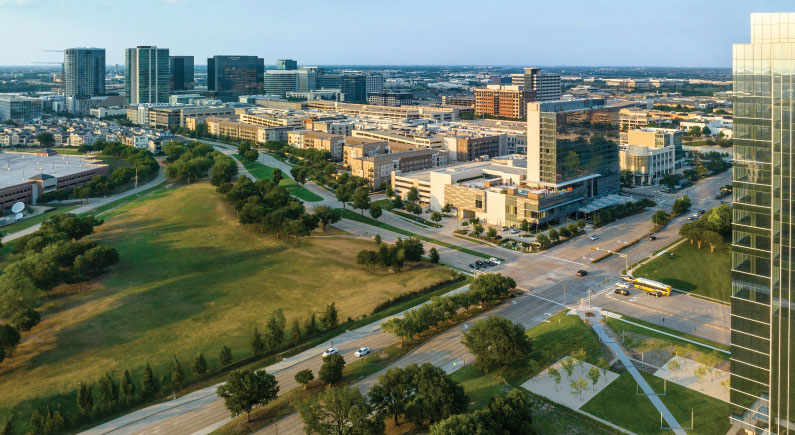
Plano’s Legacy West district reflects a polished corporate suburb built on genuine Fortune 500 employment density
2026 Economic Outlook
- May 2026 data shows 19.7% inventory contraction alongside a 10.8% sales volume increase, conditions consistent with renewed price appreciation ahead
- Plano’s median price has grown 84% since 2015, spanning a complete market cycle without a severe crash
- City council evaluating a potential sports and entertainment district around The Shops at Willow Bend, with a possible November 2026 venue tax election
- Plano ISD closed two middle schools and two elementary schools for 2025-2026, reflecting a maturing, largely built-out city rather than a growth corridor
- Sold-to-list ratio remains stable around 97-98%, indicating homes reaching contract are still transacting near asking price
Investment Climate
Plano’s investment environment in 2026 rewards patient, appreciation-focused capital rather than cash flow chasers. Successful Plano investors tend to share a few characteristics:
- Realistic yield expectations given cap rates of 2.5-4.5%, meaningfully lower than every other Texas metro in this guide series
- ZIP code precision since Plano’s tax bill can vary from 1.14% in 75025 to 1.22% in 75024 within the same city
- Value-add awareness given the city’s 35-year median home age, meaning HVAC, plumbing, and roofing systems in much of the existing stock are past the halfway mark of their typical lifespan
- School district precision recognizing that Plano ISD feeder patterns (particularly Plano West Senior High) command genuine, measurable price premiums
- Long-term hold orientation given the market’s 84% price growth since 2015 through a complete cycle, without the sharper corrections seen in Austin or the builder-driven oversupply in Dallas
Plano’s local market description of “consolidating at a price level supported by strong employment fundamentals and persistent inventory constraints” is precisely the profile that distinguishes it from the more visibly correcting or oversupplied metros elsewhere in this series. Investors here are buying genuine, durable demand at a premium price, not a discount.
Historical Performance
| Period | Market Driver | Avg Annual Change | Key Event |
|---|---|---|---|
| 2015-2019 | Corporate-relocation-driven growth | +6-9% | Toyota Motor North America relocates HQ to Plano (announced 2014) |
| 2020-2021 | Pandemic surge, record-low rates | +12-18% | Genuine appreciation acceleration during the low-rate era |
| 2022-2023 | Rate shock correction | -3 to -5% | Modest pullback from pandemic-era peak pricing |
| 2024-2025 | New equilibrium, market consolidation | +0.4% | 2025 finished with a modest +0.4% year-over-year gain at $540,000 median |
| 2026 (current) | Inventory contraction, stabilizing pricing | -1.6 to -5.5% (varies by period), stabilizing | 19.7% inventory contraction in May 2026 suggests conditions for renewed appreciation |
Plano median prices have grown 84% since 2015, from $292,700 to $540,000, spanning a complete market cycle: steady corporate-relocation-driven growth through 2019, a pandemic surge in 2020-2021, a rate-shock correction in 2022-2023, and a new equilibrium in 2024-2025. Local analysts describe the current market as “not declining, but consolidating at a price level supported by strong employment fundamentals,” a genuinely different characterization than the sharper corrections described for Austin or the builder-driven oversupply story in Dallas.
Demographic Trends Driving Demand
- Toyota Motor North America Headquarters – the automaker’s U.S. headquarters relocation to Plano (announced 2014) remains one of the most significant corporate relocations in North Texas history
- Legacy Drive Corporate Corridor – dense corporate campus development between Preston Road and the Dallas North Tollway anchors much of the city’s premium employment base
- JPMorgan Chase and Capital One Finance – major financial services regional operations sustaining high-income professional rental demand
- Plano ISD School Quality – a 93% graduation rate, 18 percentage points above Dallas ISD, drives measurable price premiums in specific feeder zones, particularly Plano West Senior High
- Legacy West Retail and Dining District – genuine urban-style amenity development anchoring the city’s social and lifestyle appeal for young professionals
- Aging Housing Stock Renovation Demand – the city’s 35-year median home age creates genuine value-add and renovation opportunity in central and east Plano
📚 New to real estate investing? Master the fundamentals with our professional course Learn more →
2. Neighborhood Hotspots
Plano Investment Neighborhood Map
Interactive map of Plano’s investment neighborhoods. Green stars show top hotspots, blue circles mark established markets, and orange circles highlight emerging areas.
Core Investment Neighborhoods
Detailed Submarket Analysis: All Plano Neighborhoods
| Neighborhood | Price Range (SFH) | Cap Rate | Growth Drivers | Best Strategy |
|---|---|---|---|---|
| Southeast Plano | $250K-$370K | 4.5-6.0% | Deepest value entry, Dallas border spillover | Best cash flow in the metro, value-add |
| East Plano (75075) | $270K-$390K | 4.0-5.5% | Renovation potential, accessible entry | Value-add, BRRRR |
| Central Plano (75074) | $280K-$400K | 4.0-5.5% | Central location, renovation upside | Value-add, cash flow focus |
| Downtown Plano / Historic District | $320K-$500K | 3.5-4.5% | Historic character, walkability | Balanced returns, professional rental |
| Willow Bend Area | $380K-$600K | 3.0-4.0% | Retail proximity, entertainment district potential | Long-term appreciation |
| North Plano (Frisco border) | $500K-$750K | 3.0-4.0% | Newer construction, Frisco growth spillover | Long-term appreciation, family rental |
| Plano West Senior High Zone | $450K-$800K | 2.5-3.5% | Top schools, strongest family demand | Long-term appreciation, low turnover |
| Legacy West / West Plano | $500K-$1M+ | 2.5-3.5% | Corporate proximity, premium appreciation | Executive corporate rental, appreciation |
Expert Insight: “Plano’s genuine investment opportunity is in the 75074 and 75075 ZIP codes, the older central and east corridors built in the 1970s through 1990s. These homes have systems approaching or past the halfway mark of their typical lifespan, meaning a smart renovation can capture real forced appreciation while still landing in one of the strongest school districts and job markets in North Texas. You won’t find cash flow chasing the Legacy West corridor, but you will find genuine long-term wealth building if you buy right and hold.” – Rachel Kimura, Senior Advisor, Collin County Investment Partners
3. Property Types
| Investment Goal | Best Property Type | Best Neighborhoods | Minimum Capital |
|---|---|---|---|
| Best Available Cash Flow | SFH in value corridors | Southeast Plano, East Plano | $70,000+ |
| Value-Add / Renovation | Dated SFH needing system updates | Central Plano, East Plano | $75,000+ |
| Long-Term Appreciation | SFH in top school district zone | Plano West Senior High feeder zone | $115,000+ |
| Executive Corporate Rental | Premium SFH or townhome | Legacy West, West Plano | $130,000+ |
Don’t guess the costs. Our Complete Renovation & Remodeling Cost Guide covers 400+ pages of project-by-project breakdowns with real contractor pricing ranges.
4. Cost Analysis
Acquisition Cost Breakdown (Plano)
| Expense Item | Typical Cost | Example ($500,000 Property) | Notes |
|---|---|---|---|
| Down Payment | 25% (investment) | $125,000 | Standard for investment properties in Texas; genuinely the highest absolute figure in this guide series |
| Closing Costs | 2-3% of price | $10,000-$15,000 | Title, escrow, lender fees, recording. No state transfer tax in Texas. |
| General Inspection | $450-$700 | $575 | Include HVAC, plumbing, and roof system age assessment given Plano’s 35-year median home age |
| ZIP Code Tax Rate Verification | Free (CCAD lookup) | N/A | Important given rates vary from roughly 1.14% (75025) to 1.22% (75024) within the same city |
| Initial Repairs | 0-8% of price | $0-$40,000 | Higher end likely in older Central and East Plano stock given aging systems |
| Reserves (6 months) | 6 months expenses | $14,000-$20,000 | Emergency fund for vacancy and repairs |
| TOTAL MINIMUM ENTRY | ~30-33% of value | $149,000-$165,575 | The highest absolute capital requirement of any Texas metro in this guide series |
Sample Cash Flow Analysis: Central Plano (75074) Single-Family Home
| Item | Monthly | Annual | Notes |
|---|---|---|---|
| Gross Rent | $2,400 | $28,800 | 3BR/2BA, Central Plano, renovated kitchen and bath |
| Less Vacancy (5%) | -$120 | -$1,440 | Conservative estimate given consistent corporate-driven rental demand |
| Property Taxes | -$484 | -$5,814 | ~1.71% combined effective rate on $340,000 purchase price, no homestead exemption (investment property) |
| Insurance | -$155 | -$1,860 | Landlord policy reflecting Texas’s rising storm-related insurance costs and North Texas hail exposure |
| Property Management (9%) | -$216 | -$2,592 | Standard Plano single-family management fee |
| Maintenance + CapEx | -$216 | -$2,592 | 9% of rent, elevated reserve given the property’s age and system life stage |
| Net Operating Income | $1,209 | $14,502 | Before mortgage |
| Mortgage ($340,000, 25% down, 6.5%, 30yr) | -$1,612 | -$19,344 | Principal and interest only |
| CASH FLOW | -$403 | -$4,842 | Negative on 25% down; approaching neutral only with 40%+ down or an all-cash purchase |
| Cap Rate | 4.26% | NOI / Purchase Price, above the citywide average given this value-corridor example | |
| Total Return (3% appreciation) | ~9% | Including appreciation and principal paydown on leveraged purchase |
This example uses a value-corridor Central Plano property, genuinely the strongest cash flow segment available in the city; premium neighborhoods like Legacy West or the Plano West feeder zone would show cap rates closer to 2.5-3.5% on comparable underwriting assumptions. Investors should approach Plano explicitly as a total-return, appreciation-driven market rather than expecting the cash flow economics available in Houston, San Antonio, or El Paso.
Expert Insight: “Plano investors need to be honest with themselves about what kind of return they’re actually buying. This is not a cash flow city, and pretending otherwise leads to disappointment. What you’re buying is genuine, durable appreciation backed by Fortune 500 corporate employment and some of the strongest schools in Texas. If you need positive day-one cash flow, this isn’t your market. If you can hold for 7 to 10 years and want the most defensible long-term equity story in North Texas, Plano delivers.” – Rachel Kimura, Senior Advisor, Collin County Investment Partners
5. Legal Framework
⚠️ Compliance Notice
Plano follows the same statewide landlord-tenant law as the rest of Texas (Property Code Chapters 91-94), which remains broadly landlord friendly. This guide provides an overview only. Always consult a Texas-licensed real estate attorney before acquiring rental properties, and verify current Collin Central Appraisal District (CCAD) figures directly for any specific property.
Plano-Specific Regulations
Landlord-tenant law itself is governed statewide, but Plano’s Collin County tax structure carries a genuinely relevant local advantage:
- No Rent Control: The Texas Constitution (Article XI, Section 18) preempts local rent control entirely.
- No Statutory Deposit Cap: Landlords may charge any security deposit amount, subject to the 30-day return and itemization requirement under Tex. Prop. Code § 92.103.
- 3-Day Minimum Eviction Notice: The same statewide standard applies, per Tex. Prop. Code § 24.005.
- Collin County Has No Hospital District: A genuine rarity among Texas’s largest counties, this is a key reason Collin County’s combined property tax rate (roughly 1.71% for a typical Plano homeowner) runs meaningfully lower than Dallas or Tarrant County.
- ZIP Code Rate Variation: Combined effective rates range from roughly 1.14% in 75025 to 1.22% in 75024 within Plano, driven by different school district boundaries and local assessment districts.
- Homestead Exemptions: $100,000-$140,000 school district exemption available to owner-occupants under the 2025 statewide increase (SB 4 / Proposition 13); not available to investment properties.
- Annual Reappraisal: The Collin Central Appraisal District revalues all properties annually, with a May 15 (or 30 days after notice) protest deadline.
Compliance Best Practices
Systematic compliance protects Plano investors from costly disputes even in a broadly landlord-friendly framework:
- Written Lease Requirement: Use a written lease specifying entry notice, late fees, and deposit terms explicitly, since Texas law leaves several areas to the lease itself rather than statute.
- Move-In Documentation: Photograph and date every room at move-in, with particular attention to HVAC, plumbing fixtures, and roof condition given the city’s aging housing stock.
- Annual Property Tax Protest: Given CCAD’s active annual reassessment and Plano’s high median home values, protesting annually can meaningfully reduce a bill that runs well above the national median even at Collin County’s comparatively favorable rate.
- Verify HOA Rules Carefully: Many Plano neighborhoods, particularly newer developments near Legacy West, carry HOA rental restrictions and fees that should be confirmed before purchase.
- System Age Disclosure: Given the 35-year median home age, obtain documentation of HVAC, water heater, and roof age and condition at purchase to support both insurance underwriting and future maintenance budgeting.
- Professional Management: For any out-of-state investor, professional management with specific Plano school-zone and corporate-tenant experience is valuable given the market’s premium positioning.
Useful Plano Resources
- Collin Central Appraisal District: collincad.org
- City of Plano Property Taxes: plano.gov/property-taxes
- Texas Attorney General Renter’s Rights: texasattorneygeneral.gov
- Collin County Association of Realtors: ccar.net
| Regulation | Plano Requirement | Compare: Dallas | Investor Impact |
|---|---|---|---|
| Property Tax Burden | Combined effective rate ~1.71%, no hospital district in Collin County | Combined effective rate ~2.22%, includes Parkland Hospital District | Plano carries a genuinely lower percentage rate than Dallas, though higher home values mean larger absolute tax bills |
| Eviction Notice | 3 days minimum (statewide) | Same statewide standard | Identical eviction process and timeline across both cities |
| Rent Control | Constitutionally preempted statewide | Same statewide preemption | No risk of local rent control in either city |
| Median Home Values | ~$490,000-$540,000, 37% above the DFW metro median | ~$400,000-$415,000, closer to the metro median | Plano requires meaningfully more capital per deal than Dallas |
6. Step-by-Step Plano Investment Playbook
Define Your Plano Strategy
Plano’s premium pricing requires genuine clarity about which strategy you’re executing, since this is the only city in this guide series where positive day-one cash flow is genuinely difficult at conventional leverage. Before buying, be clear on which of these strategies you are executing:
Value Corridor Cash Flow
Buy in Southeast or East Plano at the metro’s lowest relative entry prices, capturing the strongest cap rates available in the city while still benefiting from Plano ISD schools and job proximity.
Central Plano Value-Add
Buy dated properties needing HVAC, plumbing, or roof updates given the city’s aging housing stock. Renovate to command genuine rent premiums and capture forced appreciation.
School District Long-Term Hold
Buy in the Plano West Senior High feeder zone for the strongest, most durable appreciation in the city, accepting negative near-term cash flow in exchange for genuine long-term equity building.
Corporate Executive Rental
Acquire premium property near Legacy West and rent to relocating executives and professionals employed by Toyota, JPMorgan Chase, Capital One, or other headquartered employers.
Build Your Plano Team
Plano’s premium pricing and school-zone precision make specific local expertise particularly valuable. Non-negotiable team members:
- Plano-Specialist Real Estate Agent: Must understand the genuine ZIP-code-level tax rate variation and specific Plano ISD feeder pattern boundaries, since these materially affect both tenant demand and resale value.
- Insurance Broker with North Texas Storm Expertise: Get a real written quote before waiving your inspection contingency given rising hail and storm-related insurance costs.
- Systems-Focused Home Inspector: Given the city’s 35-year median home age, your inspector needs specific experience evaluating HVAC, plumbing, and roofing systems approaching end-of-life.
- Plano-Licensed Property Manager: Verify experience managing premium-tenant expectations, since Plano renters typically expect a higher standard of finish and responsiveness than value-market tenants elsewhere in Texas.
- Real Estate CPA familiar with the Texas market: For depreciation strategy, entity structuring, and Collin Central Appraisal District protest procedures.
Expert Tip: Ask any Plano agent directly: “What is the actual combined tax rate for this specific ZIP code, and which senior high school does this address feed into?” A 0.08 percentage point tax rate spread and a school district boundary line can each independently shift your underwriting math meaningfully in a market where every basis point matters given the high purchase price.
Plano-Specific Due Diligence
Standard due diligence items plus these Plano-critical checks:
Physical Due Diligence
- HVAC system age and remaining service life, particularly critical given the city’s 35-year median home age
- Roof condition and age given North Texas hail exposure
- Plumbing material and age, especially in pre-1990s construction
- Foundation inspection given North Texas clay soil movement
Regulatory and Market Due Diligence
- Verify the exact combined tax rate for the specific ZIP code, since rates vary meaningfully within Plano
- Confirm the specific Plano ISD senior high feeder zone, since this materially affects both tenant demand and resale value
- Review HOA rules and fees for rental restrictions, particularly in newer developments near Legacy West
- Confirm current Collin Central Appraisal District appraised value versus purchase price and evaluate protest potential
Negotiating in Plano’s Tightening Market
With inventory contracting 19.7% year over year by May 2026 and homes selling near 96.5-98.4% of list price, Plano offers less negotiating leverage than most other cities in this guide series. Strategies that work:
- Buy during August to December: Local market data identifies this window as the best time to buy given higher supply and lower demand, versus the tighter spring market.
- Target listings with price reductions already applied: With over a third of listings showing price drops historically, these sellers have already signaled realistic pricing expectations.
- Move decisively on well-priced inventory: With homes selling in as few as 21-37 days on average and a meaningful share selling above asking price, Plano rewards prepared, pre-approved buyers over aggressive negotiators.
- Request seller-funded rate buydowns: With rates in the 6-7% range, a funded buydown can materially improve first-year cash flow without requiring a price reduction.
Property Management in Plano
Plano’s premium tenant base and aging housing stock make specific management focuses particularly important in 2026. Key management focuses:
Managing Premium-Expectation Tenants
Given Plano’s genuinely high-income tenant base, management approaches differ from value-market Texas cities:
- Budget for a higher standard of maintenance responsiveness given tenant income levels and expectations
- Anticipate longer average tenancy from family-oriented, school-driven tenants in the Plano West feeder zone specifically
- Plan proactive system replacement (HVAC, water heater) before failure, given the city’s aging housing stock, to avoid costly emergency repairs and tenant dissatisfaction
- Verify corporate relocation packages and employer-sponsored housing allowances when screening executive tenants near Legacy West
Typical Plano Management Fees
- Single-family management: 8-10% of monthly rent
- Multi-family management: 7-9% of monthly rent
- Leasing fee: 50-100% of one month’s rent
- Lease renewal fee: $150-$350 per renewal
- Premium/executive rental management: Often slightly higher given elevated service expectations
7. Financing Options for Plano
| Loan Type | Down Payment | Rate Premium | Best For | Plano Note |
|---|---|---|---|---|
| Conventional Investment | 20-25% | +0.5-0.75% | Strong W-2 income, good credit | Genuinely the most common financing path given Plano’s price point, though the highest tier can approach jumbo territory |
| Jumbo Investment | 25-30% | +0.75-1.25% | Legacy West and Plano West feeder zone purchases | Premium properties in these areas frequently exceed conforming loan limits |
| DSCR Loan | 25-30% | +1.5-2.5% | Investors who want no income verification | Plano’s 2.5-4.5% cap rates struggle to clear 1.0x DSCR at current rates in most submarkets, similar to Seattle’s dynamic; verify carefully before relying on this financing path |
| Portfolio Loan | 20-25% | +1-1.75% | Multiple properties, self-employed | Deep regional and community bank presence given Collin County’s high-income client base |
| Renovation Loan (203k/HomeStyle) | 3.5-15% | +0.5-1% | Value-add purchases in Central/East Plano needing system updates | Strong fit for the city’s aging 1970s-1990s housing stock |
| House Hacking (FHA) | 3.5% | Standard + MIP | Owner-occupying a lower-cost Plano property while renting a room or ADU | Limited multi-unit inventory in Plano makes classic 2-4 unit house hacking less common than in other Texas cities |
Plano Financing Reality: Like Seattle and Austin, Plano’s compressed cap rates at current price levels mean most properties will not clear a 1.0x DSCR threshold on standard leverage. Most Plano investors need full income documentation loans or should plan to inject additional capital (35-40%+ down) to reach neutral leveraged cash flow. This is fundamentally a market for investors with strong W-2 or self-employment income seeking long-term appreciation, not a leverage-driven cash flow strategy.
8. Frequently Asked Questions

Knowledge Quiz: Plano Real Estate Investment
Open Quiz
5 quick questions on what you just learned about Plano investing
1) Why is Plano genuinely more expensive than every other Texas city in this guide series?
Answer: C
Plano’s genuine corporate headquarters density and top-rated Plano ISD schools drive a median price 37% above the DFW metro median, reflecting a fundamentally different economic base than the value-oriented Texas metros elsewhere in this series.
2) What is the standout characteristic of Plano’s cap rate environment compared to Houston or San Antonio?
Answer: B
Plano’s premium pricing produces cap rates of 2.5-4.5%, meaningfully lower than Houston, San Antonio, or El Paso, confirming Plano is fundamentally an appreciation and stability market rather than a cash flow market.
3) Why does Collin County’s property tax rate run genuinely lower than Dallas County’s, per the guide?
Answer: A
Collin County’s lack of a hospital district, unusual among Texas’s largest counties, is a key reason the typical Plano homeowner’s combined effective rate (~1.71%) runs meaningfully lower than Dallas County’s (~2.22%).
4) What genuine renovation opportunity does the guide identify in Central and East Plano?
Answer: D
Plano’s 35-year median home age creates genuine value-add and BRRRR upside in Central (75074) and East (75075) Plano, where aging systems approaching end-of-life can be renovated to capture forced appreciation.
5) Should an investor expect positive day-one cash flow in Plano with conventional 25% down financing, per the guide?
Answer: C
The guide is explicit that Plano is not a cash flow market at conventional leverage; even value-corridor properties in Southeast or Central Plano typically require substantial additional capital (35-40%+ down) to reach neutral or positive cash flow.
Work With a Local Expert in Plano
We are building a verified network of real estate professionals across every market we cover.

About Our Expert Network
We are finalizing partnerships with verified real estate professionals across every market featured on Builds and Buys. Each expert in our network is selected for their hands-on investment experience, local market knowledge, and commitment to helping buyers and investors make sound decisions.
Our local specialists offer:
- Proven experience with investment and income-producing properties
- Deep knowledge of local pricing, rental yields, and neighborhood dynamics
- Guidance on financing, legal structure, and due diligence
- Access to off-market and pre-market opportunities
- Full transaction support from search through closing
- Ongoing portfolio and property management referrals
Services Covered
- Property sourcing and acquisition
- Investment analysis and underwriting
- Buyer representation
- Market comparables and valuations
- Short-term and long-term rental strategy
- Value-add and renovation guidance
- Legal and title referrals
- Financing and lender connections
- Property management referrals
- Insurance and inspection referrals
- 1031 exchange coordination
- Exit strategy planning
Get Connected or Join Our Network
Looking for a local expert to help with your investment? Reach out and we will connect you with the right professional for your market and strategy.
Are you a real estate professional with a track record working with investors? We are always expanding our network of verified local experts.
Contact us at support@buildsandbuys.com
Find Specialized Plano Real Estate Professionals
Ready to Invest in Plano?
Plano offers the most defensible long-term appreciation story in North Texas: genuine Fortune 500 corporate headquarters density, consistently top-rated schools, and a market that has grown 84% since 2015 through a complete cycle without a severe or lasting correction. This is not a cash flow city, and investors should approach it with realistic expectations about near-term returns. Those who bring the right capital, target the value corridors in Central and East Plano, and commit to a genuine 7 to 10 year hold will find one of the most durable equity-building opportunities in Texas.
Continue Your Research
Texas State Guide
See how Plano compares to Dallas, Fort Worth, Arlington, and other Texas markets.
Step-by-Step Invest
Complete framework for building a real estate investment strategy from scratch.
144-Lesson Course
University-level real estate education covering financing, law, strategy, and management.
For further guidance, explore our State-by-State Investor guides, browse our expert articles, or follow our Step-by-Step Investment Guide.



