
Olathe Real Estate Investment Guide For 2026
A comprehensive resource for investors looking to capitalize on Johnson County’s most attainable market, where a global technology headquarters, the county seat, and a transformational industrial project to the west are reshaping the west side of the Kansas City metro
Quick answers: Top 5 most searched Olathe investment questions ▼
Migration data: Where people are moving from to Olathe ▼
In This Guide
Click on any section to navigate directly to that content
1. Olathe Market Overview
Market Fundamentals
Olathe is the county seat of Johnson County and the fourth largest city in Kansas. It sits on the western side of the county along the I-35, K-7, and K-10 corridors, which makes it the practical gateway between the dense Johnson County suburbs to the east and the rapidly developing western edge of the metro. That position defines the investment case. Olathe gives you the same school quality, income levels, and appreciation profile that make Johnson County attractive, at a median price roughly $35,000 below Overland Park.
Key economic indicators that define the Olathe investment case:
- Population: approximately 145,000, the fourth largest city in Kansas
- Major Employers: Garmin International world headquarters, Olathe Public Schools USD 233, Johnson County government, the University of Kansas Health System Olathe facilities, Terracon, Farmers Insurance operations, Husqvarna, Grundfos, MidAmerica Nazarene University
- Median Household Income: roughly $105,000
- Median Home Price: approximately $375,000
- Vacancy Rate: approximately 4 to 6 percent
- Household Profile: heavily family oriented with a high share of households with children
Two structural features matter more than anything else here. The first is Garmin, whose world headquarters campus sits in northeast Olathe and anchors a genuine technology and engineering employment base rather than a branch office. The second is the county seat function, which puts the Johnson County courthouse, the district court, and county administration inside city limits. That is a permanent, recession resistant employment floor that most suburbs of this size do not have.
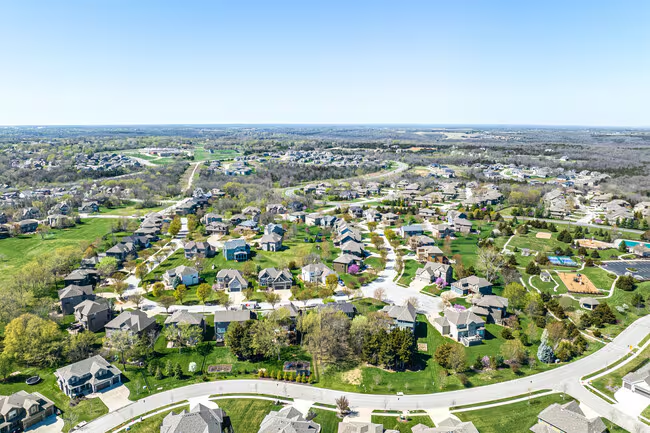
Olathe combines Johnson County schools and incomes with the most attainable entry price in the county
2026 Economic Outlook
- The Panasonic battery manufacturing project in nearby De Soto reshaping western Johnson County employment and housing demand
- Garmin’s Olathe campus continuing as the technology anchor of the western metro
- Johnson County government and court functions providing a stable public employment base
- University of Kansas Health System integration of the former Olathe Health facilities expanding clinical employment
- Downtown Olathe revitalization around the historic square and courthouse district
- Continued residential development pushing south of 151st Street and west along the K-7 corridor
Investment Climate
Olathe occupies a genuinely useful middle ground in the Kansas market. It is not a cash flow market in the way Wichita is, but it is meaningfully less punishing than Overland Park. Successful Olathe investors tend to share these characteristics:
- Balanced expectations understanding this is a modest negative carry market at 25 percent down that turns positive around 35 percent
- Renovation capability because Olathe’s large 1970s through 1990s housing cohort is now old enough that updating it genuinely pays
- School boundary literacy since the city is mostly one district but the edges bleed into five others in ways that are not intuitive
- HOA discipline as Johnson County subdivisions frequently carry rental caps and restrictions that can make a property unrentable
- Medium term horizons of seven to twelve years, since appreciation rather than cash flow drives most of the return
- Awareness of the western corridor and how the De Soto industrial project may reshape demand patterns over the next decade
The market’s principal risk is employer concentration at the top end. Garmin is a genuinely large presence in a city of this size, and a significant contraction there would be felt. The offsetting factors are real though: county government, a major health system, the school district itself as a large employer, and a diverse Kansas City metro job market within a thirty minute commute in every direction.
The secondary consideration is that Olathe is a family market almost to the exclusion of everything else. There is very little young professional or student rental demand here compared to Lawrence or the urban core. That is a strength for tenancy length and a limitation on strategy variety. If your model depends on short term rentals, by the room leasing, or urban professional tenants, Olathe is the wrong city.
Historical Performance
| Period | Market Driver | Avg Annual Appreciation | Key Event |
|---|---|---|---|
| 2010-2014 | Post recession recovery, subdivision buildout resumes | 3-5% | Stalled developments restart as Johnson County recovers |
| 2015-2019 | Technology employment growth, family in migration | 5-7% | Garmin campus expansion, southward residential push past 151st Street |
| 2020-2022 | Remote work migration, record low inventory, cheap debt | 11-16% | Buyers priced out of eastern Johnson County move west into Olathe |
| 2023-2024 | Rate shock, inventory lock in, western corridor investment announced | 3-5% | Major industrial development announced in nearby De Soto reshapes western county outlook |
| 2025-2026 | Normalization plus western corridor employment growth | 5-7% (projected) | Industrial ramp up in the west supporting demand across Olathe, Gardner, and De Soto |
Over a 20 year window Olathe has produced roughly 5 to 6.5 percent average annual appreciation, close behind Overland Park and well ahead of most of Kansas. A $185,000 house purchased in 2006 is worth roughly $410,000 to $460,000 today. The pattern to notice is that Olathe tracks Overland Park closely but from a lower base, which means the percentage returns are comparable while the capital required per property is meaningfully smaller. For an investor building a portfolio rather than buying a single trophy asset, that difference compounds.
Demographic Trends Driving Demand
- Priced Out Johnson County Households – The largest single flow. Families who want Johnson County schools but cannot reach Overland Park or Leawood pricing move west into Olathe
- Technology and Engineering Employment – Garmin’s world headquarters plus the broader metro engineering base creating stable, well paid households
- County Government and Courts – The county seat function providing recession resistant public sector employment inside city limits
- Healthcare Expansion – Hospital and clinical employment growing as the health system integrates and expands its Olathe presence
- Western Corridor Industrial Growth – The De Soto manufacturing project drawing skilled trades and supplier employment into western Johnson County
- Family Household Formation – A younger median age than the county average and a high share of households with children, which drives sustained three and four bedroom demand
📚 New to real estate investing? Master the fundamentals with our professional course Learn more →
2. Neighborhood Hotspots
Olathe Investment Neighborhood Map
Interactive map of Olathe’s investment areas. Green stars show top hotspots, blue circles mark established markets, and orange circles highlight emerging areas across the city.
Core Investment Neighborhoods
Detailed Submarket Analysis: All Olathe Areas
| Area | Price Range | Cap Rate | Housing Era | Best Strategy |
|---|---|---|---|---|
| Havencroft / Central Olathe | $265K-$340K | 5.5-6.5% | Mid 1970s-1980s | Value add, BRRRR, best available cash flow |
| Brougham and Persimmon Hill | $260K-$345K | 5.5-6.5% | 1970s-early 1980s | Most affordable entry, value add, portfolio building |
| Downtown / Historic Square | $255K-$425K | 4.8-5.8% | Pre war-1960s | Appreciation, historic renovation, walkable niche |
| Lake Olathe / Central West | $290K-$425K | 5.0-6.0% | 1980s-1990s | Value add with amenity anchor, balanced returns |
| Mur-Len Corridor | $300K-$450K | 5.0-6.0% | 1980s-2000s | Selective buying, mixed stock, moderate value add |
| Northeast / Garmin Corridor | $330K-$500K | 4.8-5.8% | 1990s-2010s | Turnkey hold, professional tenant, low maintenance |
| K-7 Corridor / West Olathe | $310K-$520K | 4.8-5.8% | Mixed, some acreage | Forward positioning on western industrial growth |
| Prairie Center / Northwest | $330K-$490K | 4.8-5.6% | 1990s-2010s | Balanced buy and hold, park adjacency |
| Northwest / Woodland Road | $340K-$520K | 4.6-5.6% | 1990s-2020s | Commuter access, district verification essential |
| Black Bob Corridor / East | $340K-$480K | 4.8-5.6% | 1990s | Family rental, Overland Park adjacency, verify district |
| Stonebridge / South Olathe | $425K-$700K | 4.2-5.0% | 2000s-2020s | Turnkey hold, long tenancies, low maintenance |
| South Olathe / 159th and Ridgeview | $440K-$750K | 4.0-4.8% | New construction | Appreciation runway, newest inventory |
| Cedar Creek / Far West | $500K-$900K | 4.0-4.8% | 1990s-2020s | Executive rental, premium hold, strongest resale |
Expert Insight: “Olathe has something Overland Park largely ran out of, which is a big stock of houses built in the late seventies and eighties that have never been touched. Original oak cabinets, laminate counters, brass fixtures, carpet over hardwood. Those houses are structurally fine and they sit on good lots in a district families want, and almost nobody is renovating them for rent. When you put a proper kitchen and bath in one of them you are competing against a field of tired builder grade rentals, and you get a premium and a faster lease every time. That inventory is the whole reason to work Olathe instead of chasing something newer for a hundred thousand more.” – Trevor Landis, Investment Broker, Olathe Property Partners
3. Property Types
| Investment Goal | Best Property Type | Best Neighborhoods | Minimum Capital |
|---|---|---|---|
| Best Available Cash Flow | Renovated 1970s or 1980s single family | Havencroft, Brougham, Persimmon Hill | $70,000+ |
| Best Total Return | Value add with full systems update | Havencroft, Lake Olathe, Mur-Len corridor | $100,000+ |
| Maximum Appreciation | Downtown historic or newer south Olathe | Historic square, Stonebridge, 159th corridor | $120,000+ |
| Lowest Entry Cost | Townhome or villa, or FHA owner occupied entry | Mur-Len corridor, Prairie Center, downtown infill | $65,000+ |
| Lowest Management Burden | Newer single family or villa | Garmin corridor, Stonebridge, Cedar Creek | $110,000+ |
Don’t guess the costs. Our Complete Renovation & Remodeling Cost Guide covers 400+ pages of project-by-project breakdowns with real contractor pricing ranges.
4. Cost Analysis
Acquisition Cost Breakdown (Olathe)
| Expense Item | Typical Cost | Example ($375,000 Property) | Notes |
|---|---|---|---|
| Down Payment | 25% standard, 35% for positive carry | $93,750-$131,250 | 25% is modestly negative. 35% turns most Olathe deals positive, better than Overland Park’s 40%. |
| Closing Costs | 2-3% of price | $7,500-$11,250 | Title, escrow, lender fees, recording. Kansas closings handled by title companies. |
| General Inspection | $425-$625 | $500 | Non negotiable on the 1970s and 1980s inventory that makes this market work |
| Radon Test | $125-$200 | $150 | Johnson County has among the highest radon readings in the country. Mitigation runs $900-$2,000. |
| Plumbing Material Identification | Included in inspection | $0 | Critical in Olathe. Polybutylene is common in the late 1970s through early 1990s stock and a full repipe runs $6,000-$15,000. |
| Basement and Moisture Evaluation | Included or $200-$400 | $250 | Nearly universal here. Waterproofing and drainage remediation runs $5,000-$20,000. |
| Roof and Hail Damage Assessment | $0-$250 | $150 | The Kansas City metro takes regular hail. Roof age is the largest single insurance variable. |
| Sewer Scope | $200-$350 | $250 | Essential downtown and in the oldest central subdivisions |
| HOA Document Review | $0-$400 | $0-$400 | Rental caps are common across Johnson County. Read the covenants before removing contingencies. |
| School District Verification | $0 | $0 | Free and essential, especially on the city edges where five other districts reach into Olathe |
| Initial Repairs | 0-18% of price | $0-$67,500 | Near zero on newer south Olathe stock, substantial on central 1970s and 1980s inventory |
| Reserves (6 months) | 6 months expenses plus negative carry | $12,000-$18,000 | Must cover a percentage based hail deductible and any negative carry |
| TOTAL MINIMUM ENTRY | ~30-61% of value | $113,600-$229,400 | The high end reflects a 35% down value add. Meaningfully less capital than Overland Park requires. |
Property tax note: Kansas assesses residential property at 11.5 percent of appraised value, and the combined Johnson County mill levy from county, city, school district, and state puts the effective rate at roughly 1.3 to 1.45 percent of market value in Olathe. On a $375,000 home that is $4,900 to $5,400 per year. The Olathe USD 233 levy is a meaningful component, so the rate here differs slightly from Overland Park’s. Two things matter as always in Johnson County: the valuation resets to your purchase price on sale, so the seller’s bill is not your bill, and the county appeal process is active and worth using when an assessment overshoots.
Sample Cash Flow Analysis: Central Olathe 1980s Value Add
Deal structure: $285,000 purchase, $28,000 renovation (kitchen, two baths, flooring, paint, polybutylene repipe, heating and cooling replacement, radon mitigation), $7,000 closing. Total basis $320,000. After repair value approximately $360,000. Rented at $2,200 per month. Olathe USD 233.
| Item | Monthly | Annual | Notes |
|---|---|---|---|
| Gross Rent | $2,200 | $26,400 | 3BR fully renovated, well above typical local rental condition |
| Less Vacancy (5%) | -$110 | -$1,320 | Renovated family homes in USD 233 lease quickly |
| Property Taxes | -$405 | -$4,860 | ~1.35% effective on the post renovation value. 18% of gross rent. |
| Insurance | -$200 | -$2,400 | Landlord policy on ~$365,000 replacement cost with a 2% wind and hail deductible |
| Maintenance + CapEx (9%) | -$198 | -$2,376 | Appropriate given the repipe and system replacements are already done |
| Net Operating Income (self managed) | $1,287 | $15,444 | Before mortgage |
| Property Management (8%) | -$176 | -$2,112 | Optional. Drops NOI to $1,111/month or $13,332/year. |
| Mortgage ($213,750 at 7.0%, 30yr, 25% down) | -$1,422 | -$17,064 | Principal and interest only |
| CASH FLOW (self managed, 25% down) | -$135 | -$1,620 | Modestly negative, notably better than the Overland Park equivalent |
| CASH FLOW (self managed, 35% down) | +$54 | +$648 | $185,250 loan at 7.0% is $1,233/month. Olathe reaches positive carry at 35%, not 40%. |
| Cap Rate | 4.8% self managed / 4.2% managed | NOI divided by total basis of $320,000 | |
| Total Return Year One (25% down, self managed) | ~21% | Negative $1,620 cash flow plus $2,166 principal paydown plus 6.0% appreciation on $360,000, on $106,250 invested | |
| Immediate Forced Equity | $40,000 | $360,000 ARV less $320,000 total basis, realized at refinance |
Compare this directly against the Overland Park equivalent and the case for Olathe becomes clear. That deal required $115,500 of capital and ran $179 per month negative. This one requires $106,250 and runs $135 negative, on a property with a similar total return profile. The gap is not enormous on a single house, but across a five property portfolio it is roughly $46,000 less capital tied up and $2,600 less annual carry, in a city with the same schools, the same county, and nearly the same appreciation record.
Expert Insight: “Investors treat Johnson County as one market and it is not. The tax rates differ by city and school district, the price points differ substantially, and the down payment required to reach positive carry differs by a full five percentage points between Olathe and Overland Park. If you are buying one property for the address, buy in Overland Park. If you are building a portfolio and every dollar of down payment has to work, run the numbers in Olathe first. Same county, same appreciation story, meaningfully less capital per door.” – Reid Callahan, CPA, Kansas Real Estate Advisory
5. Legal Framework
⚠️ Olathe Compliance Notice
Kansas state landlord law is moderately favorable and applies uniformly statewide. In Olathe, as across Johnson County, the binding constraint is usually private rather than public: homeowners association covenants that cap or prohibit rentals. One genuine convenience of investing here is that the Johnson County District Court sits in downtown Olathe, so any eviction you file is heard in your own city. This guide provides an overview as of 2026 only. Always confirm current requirements with a licensed Kansas real estate attorney and with the City of Olathe before acquiring rental property.
Kansas and Olathe Regulations
The governing statute is the Kansas Residential Landlord and Tenant Act, codified at K.S.A. 58-2540 and following:
- Nonpayment of Rent: 3 day written notice to pay or vacate, among the shortest notice periods in the country.
- Lease Violations: 14 day written notice to cure, with termination effective 30 days from notice if the breach is not remedied.
- Month to Month Termination: 30 days written notice by either party.
- Security Deposits: Capped at one month’s rent unfurnished, one and a half months furnished, plus an additional half month permitted for pets. Return due within 30 days with an itemized statement.
- Landlord Entry: Reasonable notice required, generally interpreted as 24 hours, at reasonable times except in emergency.
- No Rent Control: Kansas law preempts municipal rent control.
- Self Help Eviction Prohibited: Changing locks, removing doors, or shutting off utilities exposes you to damages and attorney fees.
- No Source of Income Protection: Kansas does not require landlords to accept housing choice vouchers.
- Court Venue: Johnson County District Court sits in downtown Olathe. Filings, hearings, and writs all happen inside the city, which is a real practical advantage over managing property in a county where you must travel to court.
- HOA Covenants: As across Johnson County, private covenants frequently cap rentals, impose minimum lease terms, or require board approval of tenants. These are enforceable regardless of what state or city law permits.
- City Codes: Olathe enforces property maintenance, occupancy, and nuisance codes. Confirm current registration and inspection requirements directly with the city.
Compliance Best Practices
Olathe operating risk is concentrated in private restrictions and in the age of the housing stock:
- Read the CCRs Before Removing Contingencies. Rental caps, waiting lists, minimum lease terms, and board approval requirements. Call the management company directly and get the answer in writing.
- Verify the School District on the Parcel Record. Olathe is mostly USD 233, but the edges reach into De Soto, Blue Valley, Shawnee Mission, Spring Hill, and Gardner Edgerton. The mailing address tells you nothing.
- Document the Plumbing Material. If you buy 1970s through early 1990s stock, know whether you have polybutylene before you close. Insurers ask, and a failure floods the house.
- Respect the Deposit Cap. One month unfurnished. Use a co signer for higher risk applicants rather than a larger deposit, which Kansas law does not permit.
- Never Attempt Self Help. The formal process is fast and the court is fifteen minutes away. There is no reason to risk it.
- Use a Kansas Specific Lease reviewed once by Johnson County counsel, then reused.
- File Property Tax Appeals when the assessment overshoots your purchase price or the property’s actual condition.
Useful Olathe and Johnson County Resources
- City of Olathe: olatheks.org
- Johnson County Appraiser for parcel, valuation, and school district data
- Johnson County District Court in downtown Olathe for eviction filings
- Johnson County Register of Deeds for deeds, liens, and recorded covenants
- Kansas Statutes K.S.A. 58-2540 for the Residential Landlord and Tenant Act
- Kansas Department of Health and Environment for radon information
| Regulation | Olathe / Kansas | Typical Tenant Protective State | Investor Impact |
|---|---|---|---|
| Eviction for Nonpayment | 3 day notice, filed and heard in Olathe | 14-30 day notice, 2-6 month court timeline | Short notice period plus a courthouse inside city limits |
| Rental Restrictions | No public restriction, but HOA covenants routinely cap rentals | Public permit caps and registration schemes | The binding constraint is private. Read the covenants. |
| Rent Control | Prohibited statewide by preemption | Permitted or mandated locally | Rents adjust to market with only standard notice |
| Security Deposit Cap | Capped at 1 month unfurnished, 1.5 furnished, plus 0.5 for pets | Often capped at 1 month, 14-21 day return | Cannot size the deposit to risk. Screen harder instead. |
| Source of Income Protection | Not required | Voucher acceptance mandatory | Voucher participation is a business choice, not an obligation |
| Property Tax Burden | ~1.3-1.45% effective, resets on sale | Varies widely, often capped or assessed below market | The largest operating expense at 18% of gross rent. Appeal when it overshoots. |
6. Step-by-Step Olathe Investment Playbook
Define Your Olathe Strategy
Olathe supports fewer strategies than Wichita but executes the ones it does support very well. Be clear which one you are running:
Central Olathe Value Add
Buy an untouched 1970s or 1980s house at $265,000 to $320,000, complete a full kitchen, bath, systems, and finish renovation including the repipe, and lease well above the tired competition. The highest return strategy in the city.
Employment Adjacent Turnkey
Acquire a newer home near the Garmin campus or the county government district. Lower renovation upside but the strongest tenant credit quality in Olathe and the lowest management burden available.
Western Corridor Positioning
Acquire along the K-7 corridor in western Olathe, closest to the industrial development underway in De Soto. A deliberate bet that western Johnson County employment growth pulls housing demand this direction over the next decade.
Townhome Entry Position
Acquire a townhome or villa as a first Johnson County purchase. Lowest capital requirement in the county, closest to breakeven cash flow, and the lightest ownership burden. Demands rigorous HOA due diligence.
Build Your Olathe Team
You have the full Johnson County professional bench available here. Vet specifically for investor experience and for familiarity with the 1980s housing stock:
- Agent Who Understands the District Edges: Ask a prospective agent which parts of Olathe are not in USD 233. If they say all of Olathe is USD 233, keep interviewing.
- Contractor Experienced With Polybutylene Repipes: Specific and important. A repipe on 1980s stock is a $6,000 to $15,000 line item and doing it well matters. Get references from two completed jobs.
- Real Estate Attorney for CCR Review: Worth paying for on your first few purchases until you can read covenants confidently yourself.
- Independent Insurance Agent: The metro takes regular hail and carriers price on replacement cost. Shop at least four carriers.
- Property Manager or a Decision to Self Manage: An 8 percent fee is $176 a month at these rent levels, which is more than the entire cash flow on a 25 percent down deal. Understand that tradeoff explicitly.
- Real Estate CPA: For depreciation, entity structure, and Johnson County valuation appeals.
Expert Tip: When you interview contractors in Olathe, ask what they charge to renovate a 1980s split level for rent rather than for resale. Those are different jobs with different specifications, and a contractor who only does homeowner remodels will over specify finishes and blow your budget. You want durable and clean, not high end. A contractor who understands rental grade will save you $8,000 on a typical scope without the tenant ever noticing.
Olathe Specific Due Diligence
Standard due diligence items plus these Olathe critical checks:
Physical Due Diligence
- Plumbing supply material. The most Olathe specific item on this list given how much of the city was built between 1975 and 1992. Polybutylene fails, insurers ask about it, and it is the single most common expensive surprise in this housing stock.
- Radon testing. Johnson County records among the highest radon levels in the country and basements are nearly universal. Test every property.
- Basement condition and water management. Wall staining, efflorescence, sump pump function, exterior grading.
- Roof age, layer count, and hail claim history.
- Electrical panel and branch wiring, including aluminum branch wiring in the oldest 1970s examples.
- Heating and cooling system age. Original 1980s systems are well past end of life.
- Sewer lateral scope downtown and in the oldest central subdivisions.
- Foundation and basement wall movement in expansive clay soils.
Title, HOA, and Regulatory
- HOA covenants and rental restrictions. Rental caps, waiting lists, minimum lease terms, and board approval requirements. Call the management company directly.
- School district on the parcel record. Olathe is mostly USD 233, but De Soto, Blue Valley, Shawnee Mission, Spring Hill, and Gardner Edgerton all reach into parts of the city. Verify with the Johnson County Appraiser.
- HOA financial health. Reserve study, special assessment history, pending capital projects.
- Current valuation and appeal history, since your tax basis resets on sale.
- Johnson County Register of Deeds search for liens, judgments, and easements.
- Open code enforcement cases with the City of Olathe.
- Permit history for basement finishes, additions, and deck construction.
- Flood zone determination near Cedar Creek, Indian Creek, and the Kill Creek drainages.
Sourcing Deals in Olathe
Olathe is competitive but less so than the eastern Johnson County cities. Channels that work:
- Target original condition houses in 1970s and 1980s subdivisions. Owner occupants in Johnson County overwhelmingly want move in ready. An untouched 1984 kitchen removes most of your competition and is exactly what you are looking for.
- Estate sales and original owner turnover. Central Olathe subdivisions have a large cohort of original owners now aging out. Build relationships with estate attorneys and senior move managers.
- Investor focused agent relationships. Give your criteria in writing, including the district requirement and the plumbing material question.
- Direct mail to long tenured owners. Pull the Johnson County Appraiser list for owners of 25 plus years in the central subdivisions.
- Non warrantable condo and townhome projects. Projects failing conventional financing standards trade at a discount to cash buyers.
- Have financing fully underwritten before you look. Not pre qualified, underwritten. Well priced Olathe inventory moves in days.
Property Management in Olathe
Olathe rent levels put management fees at $150 to $250 per month, which on a 25 percent down deal is more than the entire cash flow. The offsetting factor is that the Olathe tenant pool is genuinely low maintenance:
Tenant Screening Protocol
Kansas caps your deposit at one month, so screening is your protection. Olathe’s family oriented applicant pool is strong. Apply consistently to every applicant:
- Verifiable gross income of at least 3 times monthly rent, which at these rent levels means $79,000 or more annually
- Direct employer verification, noting whether the household is a corporate relocation on a defined assignment
- Two prior landlord references, contacting the landlord before the current one
- Full credit and eviction records search including Johnson County and the Missouri side of the metro
- Written, posted criteria applied identically to every applicant under federal fair housing law
- For higher risk applicants use a co signer rather than a larger deposit, which Kansas law does not permit
Typical Olathe Management Fees
- Single family management: 8-10% of monthly rent
- Townhome and villa management: 8-10% of monthly rent
- Leasing fee: 50-100% of one month’s rent
- Lease renewal fee: $125-$300 per renewal
- Flat fee management: $110-$180 per door per month, often better economics at Olathe rent levels
- HOA liaison and compliance handling: sometimes billed separately, so confirm before signing
- Maintenance coordination markup: typically 10% on vendor invoices
7. Financing Options for Olathe
| Loan Type | Down Payment | Rate Premium | Best For | Olathe Note |
|---|---|---|---|---|
| Conventional Investment | 25% | +0.5-0.75% | Strong W-2 income, good credit | The default. Produces a modest negative carry of roughly $100 to $200 per month on typical deals. |
| Conventional at 35% Down | 35% | +0.25-0.5% | Investors who require positive carry | This is the level that flips an Olathe deal positive, five points less than Overland Park requires. |
| DSCR Loan | 25-35% | +1.5-2.5% | Investors avoiding income documentation | Marginal at 25% down given Johnson County taxes. Often works at 30-35% down on central Olathe value add deals. |
| FHA 203(k) Renovation | 3.5% | Standard + MIP | Owner occupants buying dated central Olathe homes | Exceptionally well matched to this market. Rolls the kitchen, baths, repipe, and systems into the loan on exactly the inventory investors want. |
| House Hacking (FHA) | 3.5% | Standard + MIP | Owner occupying while renting rooms or a finished basement | Small multi-family is scarce in Olathe, so the room or basement suite version is the realistic path here. |
| Portfolio / Community Bank | 25-30% | +0.5-1.5% | Multiple properties, self employed, non warrantable condos | Johnson County has a deep community bank bench that will lend on local rental portfolios |
| HELOC on Existing Equity | N/A | Variable | Funding renovations or larger down payments | Common strategy given the equity Johnson County owners have accumulated since 2019 |
| Hard Money (Bridge) | 15-25% | 10-13% rate | Value add acquisitions, competitive clean offers | Active Kansas City metro lender presence. Well suited to the central Olathe BRRRR strategy. |
Olathe Financing Reality: The most underused tool in this market is the FHA 203(k) renovation loan. Olathe’s defining opportunity is a large stock of structurally sound 1970s and 1980s houses that need a kitchen, baths, a repipe, and new systems. That is precisely what a 203(k) is built for, and it lets an owner occupant do at 3.5 percent down what an investor needs $95,000 to do. If you are willing to live in the property for a year or two, this is the single most capital efficient way into Johnson County real estate that exists. For pure investors, expect conventional financing with full documentation, and plan on 35 percent down if positive monthly carry matters to you.
8. Frequently Asked Questions

Knowledge Quiz: Olathe Real Estate Investment
Open Quiz
5 quick questions on what you just learned about Olathe investing
1) What down payment flips a typical Olathe deal to positive cash flow, and how does that compare to Overland Park?
Answer: B
The sample Olathe deal runs negative $135 per month at 25 percent down and turns positive at about 35 percent. The comparable Overland Park deal needs roughly 40 percent. That five point gap is one of the clearest practical reasons an investor building a portfolio works Olathe first.
2) What is the defining physical due diligence issue in Olathe’s 1970s and 1980s housing stock?
Answer: C
Olathe built out heavily during exactly the window when polybutylene was standard, roughly the late 1970s through the mid 1990s. It degrades at the fittings and fails without warning, and many carriers ask about it directly. A full repipe runs $6,000 to $15,000, which is very manageable inside a renovation budget, and a documented repipe becomes a selling point at refinance.
3) Which statement about Olathe school districts is accurate?
Answer: A
The confusion runs both directions. Olathe USD 233 serves portions of Overland Park, Lenexa, and Shawnee, while De Soto, Blue Valley, Shawnee Mission, Spring Hill, and Gardner Edgerton districts all reach into parts of Olathe depending on the edge. Verify on the Johnson County Appraiser parcel record, never from the mailing address.
4) How does the guide recommend underwriting the De Soto battery plant’s effect on Olathe?
Answer: D
It is a genuinely large project and Olathe is the nearest major housing market, but employment levels and build out phases have moved since the original announcement. The disciplined approach is to verify current figures yourself, buy properties that pencil on current fundamentals, and treat western corridor growth as optionality. That is the difference between positioning and speculating.
5) Where does the guide say Olathe’s best investment opportunity lives?
Answer: B
Central Olathe holds a large stock of structurally sound houses from the mid 1970s through the 1980s that have never been updated. They sit on mature lots in a district families want, and almost nobody renovates them for rent. A properly renovated house there competes against a field of tired builder grade rentals and earns both a rent premium and a strong refinance appraisal. Cap rates run 5.5 to 6.5 percent, the best in the city.
Work With a Local Expert in Olathe
We are building a verified network of real estate professionals across every market we cover.

About Our Expert Network
We are finalizing partnerships with verified real estate professionals across every market featured on Builds and Buys. Each expert in our network is selected for their hands-on investment experience, local market knowledge, and commitment to helping buyers and investors make sound decisions.
Our local specialists offer:
- Proven experience with investment and income-producing properties
- Deep knowledge of local pricing, rental yields, and neighborhood dynamics
- Guidance on financing, legal structure, and due diligence
- Access to off-market and pre-market opportunities
- Full transaction support from search through closing
- Ongoing portfolio and property management referrals
Services Covered
- Property sourcing and acquisition
- Investment analysis and underwriting
- Buyer representation
- Market comparables and valuations
- Short-term and long-term rental strategy
- Value-add and renovation guidance
- Legal and title referrals
- Financing and lender connections
- Property management referrals
- Insurance and inspection referrals
- 1031 exchange coordination
- Exit strategy planning
Get Connected or Join Our Network
Looking for a local expert to help with your investment? Reach out and we will connect you with the right professional for your market and strategy.
Are you a real estate professional with a track record working with investors? We are always expanding our network of verified local experts.
Contact us at support@buildsandbuys.com
Find Specialized Olathe Real Estate Professionals
Ready to Invest in Olathe?
Olathe is the most practical way into Johnson County. You get the same schools, the same incomes, and nearly the same appreciation record as Overland Park, at a median $35,000 lower, with better yields and a down payment to breakeven that is five percentage points friendlier. More than that, Olathe still has something the eastern suburbs largely ran out of: a deep stock of structurally sound 1970s and 1980s houses that nobody has renovated for rent. That is where the returns are. Buy in central Olathe, check the plumbing material before you close, test for radon, read the covenants, verify the district on the parcel record, and keep an eye on what is happening to the west. Do that and this city will build you a portfolio rather than a single trophy.
Continue Your Research
Kansas State Guide
See how Olathe compares to Overland Park, Wichita, Lawrence, Topeka, and other Kansas markets.
Step-by-Step Invest
Complete framework for building a real estate investment strategy from scratch.
144-Lesson Course
University-level real estate education covering financing, law, strategy, and management.
For further guidance, explore our State-by-State Investor guides, browse our expert articles, or follow our Step-by-Step Investment Guide.



