
Newcastle Wyoming Real Estate Investment Guide For 2026
A comprehensive guide for investors targeting northeast Wyoming’s Black Hills gateway, where South Dakota border proximity, energy sector diversification, Thunder Basin National Grassland access, and some of Wyoming’s absolute lowest acquisition prices combine to create a cash flow investment for patient, well-capitalized investors in 2026
Quick answers: Top 5 most searched Newcastle investment questions ▼
Migration data: Where people are moving from to Newcastle ▼
1. Newcastle Market Overview
Market Fundamentals
Newcastle is Wyoming’s easternmost significant investment market and the most overlooked by outside investors. Weston County’s county seat of 3,200 residents sits at the convergence of three demand streams that distinguish it from other very small Wyoming towns: a multi-sector energy economy anchored by the underappreciated stability of bentonite mining, South Dakota border proximity that creates cross-border tenant demand, and growing Black Hills recreation traffic that is gradually building an outdoor lifestyle economy alongside the industrial base.
- Population: 3,200 city, 6,700 Weston County
- Bentonite Mining: Weston County is a major Wyoming bentonite producing region; Wyoming produces ~70% of the world’s supply
- Oil and Gas: Weston County oil production; supplemental energy employment
- Coal Sector: Thunder Basin and nearby coal operations
- South Dakota Border: 30 miles to SD border, 90 miles to Rapid City
- Thunder Basin: National Grassland directly accessible from Newcastle
Newcastle is Wyoming’s maximum-yield small market. The cap rates are genuine, the demand is multi-sector, and the prices are the lowest of any Wyoming city with an investable housing market. The trade-off is extreme illiquidity and a tenant pool that requires patient, skilled management.
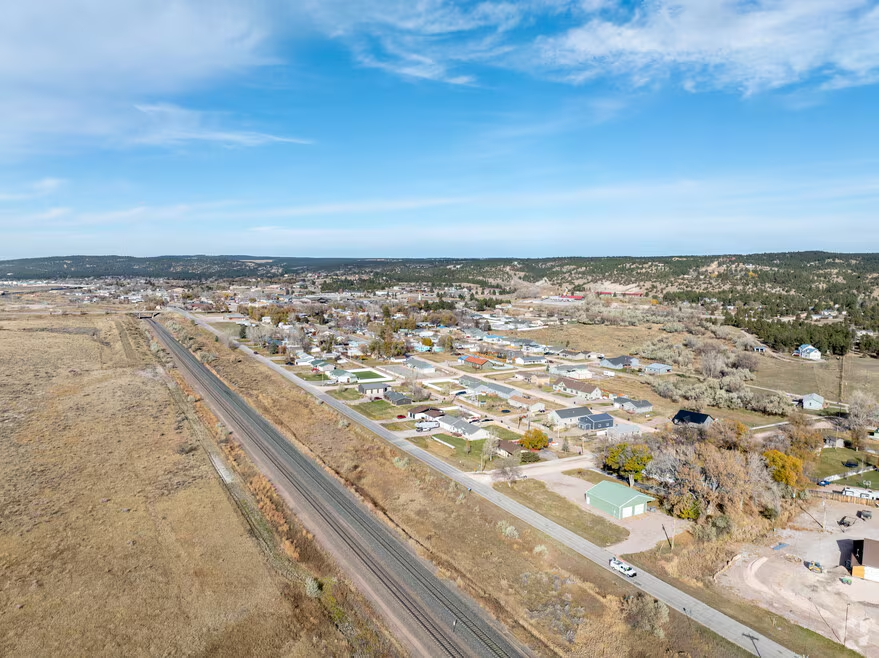
Newcastle sits between Wyoming’s Thunder Basin National Grassland and the Black Hills of South Dakota, giving it an outdoor access story unlike any other Wyoming border city
2026 Economic Outlook
- Bentonite mining demand stable; global industrial demand growing
- Oil market recovery adding Weston County employment
- Black Hills tourism growing; Newcastle positioned as affordable gateway
- South Dakota border cross-commute demand increasing
- Thunder Basin grassland recreation investment growing
The Newcastle Investment Thesis: Wyoming’s Black Hills Gateway
- The bentonite stability factor. Bentonite clay is used in drilling mud, cat litter, wine clarification, pharmaceuticals, and dozens of industrial processes. Wyoming produces approximately 70% of the world’s bentonite supply. Unlike oil and gas, bentonite demand tracks global industrial and consumer production rather than energy commodity prices. This means Weston County’s bentonite mining employment persists through energy downturns, providing Newcastle with a stability floor comparable to what trona provides Rock Springs.
- The South Dakota border dynamic. Newcastle is 30 miles from the Wyoming-South Dakota border and 90 miles from Rapid City. Workers employed in South Dakota who prefer Wyoming residency for cost or tax reasons, Black Hills area residents priced out of the booming Black Hills market, and cross-border commuters all create a demand stream with no parallel in other Wyoming cities.
- The Black Hills recreation gateway. Newcastle is the most affordable base for Black Hills National Forest, Mount Rushmore, Custer State Park, and Badlands National Park visitors who prefer home-based accommodation over Rapid City hotels. As the Black Hills tourism market grows, Newcastle’s role as an affordable gateway is developing slowly but genuinely.
- Absolute lowest Wyoming prices. At a median of $225,000, Newcastle offers Wyoming’s lowest prices in an incorporated city with meaningful rental demand. The price-to-rent ratio produces cap rates of 8 to 10% that are achievable with conventional financing, making Newcastle the only Wyoming market where positive cash flow from day one is realistic even with professional management.
Historical Performance
| Period | Driver | Avg Appreciation | Key Event |
|---|---|---|---|
| 2010-2018 | Steady energy and bentonite | 1-3% | Stable but slow; bentonite held the market through oil downturns |
| 2019-2021 | Early SD border migration | 4-6% | South Dakota border demand begins; Black Hills prices rise driving Newcastle interest |
| 2022-2023 | Pandemic migration, energy recovery | 8-12% | Prices rose from $175K to $220K; Black Hills overflow demand reaching Newcastle |
| 2024-2025 | Sustained multi-sector demand | 4-7% | Market stabilizing at new level; bentonite and oil holding employment |
| 2026 | Bentonite, SD border, Black Hills | 4-6% projected | Multiple demand sectors; steady appreciation with highest cash flow in Wyoming |
📚 New to real estate investing? Master the fundamentals with our professional course Learn more →
2. Neighborhood Hotspots
| Neighborhood | Price Range | Cap Rate | Key Driver | Best Strategy |
|---|---|---|---|---|
| Downtown / Historic Core | $175K to $260K | 8.5 to 10% | County government, retirees, long-term residents | Best tenant quality for Newcastle; stable hold |
| Established North | $185K to $270K | 8 to 9.5% | Energy and bentonite workers, stable employment | Energy sector workforce, buy-and-hold |
| US-16 / SD Corridor | $170K to $250K | 9 to 11% | Cross-border commuters, Black Hills visitors | Maximum yield; higher turnover management |
| West Side Residential | $185K to $265K | 7.5 to 9% | Agricultural services, county government | Stable family rental, lower turnover |
| Hospital Area | $180K to $260K | 8 to 9% | Healthcare workers, stable year-round | Healthcare worker focus, quality tenants |
| Thunder Basin Corridor (Rural) | $120K to $350K | 5 to 10% mixed | Hunting, grassland recreation, rural lifestyle | STR hunting season, rural hold strategy |
Expert Insight: “Newcastle gets dismissed because investors see the population number and stop thinking. But the bentonite story changes everything. I have a rental on the north side that has been occupied by the same bentonite mining supervisor for six years. His company operates regardless of oil prices, so when Gillette was feeling the coal downturn and Casper was soft on gas, my Newcastle property was collecting rent on time every month. The cap rate was 9.2% at purchase. I have not had a vacancy. That is the Newcastle story that the yield-on-paper investors are missing.” – Dave Harrington, Weston County Investment Properties
3. Property Types
Single-Family Homes (Primary Strategy)
Newcastle’s investment market is almost entirely single-family. The housing stock spans 1920s to 1940s downtown era homes through 1960s and 1970s ranch homes to modest 1990s construction. All segments deliver genuine positive cash flow at current prices with 25% down conventional financing, a distinction that separates Newcastle from every other Wyoming market with comparable outdoor positioning.
Bentonite and Energy Worker Housing
Properties positioned for mining and energy sector workers offer Newcastle’s most stable long-term tenancies. Bentonite mining supervisors and experienced equipment operators earn $70,000 to $95,000 annually, pay rent consistently, and stay for multi-year periods. Similar to Rock Springs’s trona miner anchor strategy but at dramatically lower price points.
Thunder Basin Hunting / Recreation STR
Rural properties near Thunder Basin National Grassland or the Black Hills access corridor can capture significant hunting season revenue. Wyoming pronghorn, elk, and deer hunting seasons generate concentrated demand for home-based accommodation in the fall. Properties near Thunder Basin are also positioned for growing grassland and birding recreation.
Cross-Border Worker Housing
Properties near US-16 East toward the South Dakota border target workers who commute between Wyoming and South Dakota. This is Newcastle’s most unique demand segment and the one least served by standard property marketing. Wyoming’s lower costs and no state income tax motivate South Dakota workers to base in Newcastle.
Value-Add BRRRR
Newcastle’s older housing stock offers BRRRR opportunities at price points that make renovation budgets modest. A $180,000 home needing $30,000 in renovation can appraise at $240,000 to $260,000 post-renovation, creating meaningful forced equity while delivering post-renovation cap rates approaching 10 to 12%. Newcastle’s renovation BRRRR requires contractor relationships in a very small market.
Retiree Target Properties
Similar to Wheatland’s Colorado retiree strategy but drawing from South Dakota rather than Colorado. Rapid City area retirees priced out of the Black Hills can access Newcastle’s affordability while maintaining proximity to the Black Hills recreation they love. Single-story accessible homes in the downtown area are the target property type.
Our Complete Renovation & Remodeling Cost Guide covers 400+ pages of real contractor pricing ranges.
4. Cost Analysis
Acquisition Cost Breakdown ($225,000 Property)
| Item | Typical Cost | Example | Notes |
|---|---|---|---|
| Down Payment (25%) | 25% | $56,250 | Standard investment; 20% possible with strong credit |
| Closing Costs | 2 to 3% | $4,500 to $6,750 | Wyoming lean closing; Weston County fees very modest |
| Inspection + Radon | $450 to $650 | $550 | Wyoming elevated radon; older homes need full inspection |
| Initial Repairs | 0 to 10% | $0 to $22,500 | Older Newcastle homes need HVAC, roof, and electrical updates |
| Reserves (12 months) | 12 months expenses | $11,000 to $15,000 | Very small market; 12-month reserves essential; do not budget less |
| TOTAL MINIMUM ENTRY | ~35 to 40% | $72,300 to $101,050 | Wyoming’s lowest dollar entry point for a cash flow investment with genuine multi-sector demand |
Sample Cash Flow: North Residential 3BR SFH (Bentonite Miner Tenant)
| Item | Monthly | Annual | Notes |
|---|---|---|---|
| Gross Rent | $1,100 | $13,200 | 3BR, north side, clean and functional, bentonite miner tenant |
| Less Vacancy (10%) | -$110 | -$1,320 | Conservative for very small market; bentonite tenant reduces to 5% |
| Property Taxes | -$113 | -$1,350 | ~0.6% of $225,000; Wyoming’s lowest effective rate |
| Insurance | -$78 | -$936 | Landlord policy; Wyoming wind coverage important |
| Property Management (10%) | -$110 | -$1,320 | Newcastle property management market very limited; most investors self-manage |
| Maintenance + CapEx (9%) | -$99 | -$1,188 | Older home reserve; HVAC and roof the primary costs |
| Net Operating Income | $590 | $7,086 | Before mortgage; cap rate 3.15% on $225K price (full management) |
| Mortgage ($168,750 at 7%, 30yr) | -$1,124 | -$13,488 | 25% down conventional investment loan |
| Cash Flow (managed, 10% vacancy) | -$534 | -$6,402 | Negative with full professional management at current rates |
| Cash Flow (self-managed, 5% vacancy) | +$131 | +$1,572 | Genuine positive cash flow with bentonite miner and self-management |
| Cap Rate (full NOI / purchase) | 8.7% | NOI without management / purchase price; among Wyoming’s highest | |
| Total Return (5% appreciation) | ~12 to 15% | Including equity, appreciation, principal paydown |
Newcastle is the one Wyoming market where self-managing investors genuinely reach positive monthly cash flow from day one on a conventionally financed acquisition with a quality tenant. The bentonite miner tenant profile, at $80,000 to $95,000 annual income, is creditworthy, stable, and pays consistently through energy downturns. Managing the property directly removes the 10% management fee that flips the math from positive to negative. For investors who can manage a Newcastle property from a distance, the combination of Wyoming’s lowest prices and multi-sector tenant demand is genuinely compelling.
5. Legal Framework
Wyoming’s Full Landlord Advantage: No Overlays, No Complications
Newcastle and Weston County operate under Wyoming’s landlord-tenant framework with absolutely no local overlays. No rent control, no just cause eviction requirement, no rental registration, no STR ordinance, and no source-of-income protections. Wyoming’s legal environment is the most landlord-favorable in the western United States, and Newcastle applies it without exception.
Wyoming Landlord-Tenant Essentials
- No Rent Control: Wyoming prohibits rent control statewide. Newcastle landlords raise rents freely with proper notice.
- Eviction: 3-day notice to pay or quit. File unlawful detainer after 3 days. Weston County courts process efficiently. Full eviction in 3 to 6 weeks.
- No Just Cause: Month-to-month tenancies ended with 30-day notice, no cause required.
- Security Deposits: Maximum 1.5 months rent. Return within 30 days with itemized deductions.
- Tenant Screening: Full landlord discretion subject to federal Fair Housing.
Newcastle-Specific Considerations
- No Rental Registration: City of Newcastle does not require landlord registration or operating licenses. Zero overhead.
- No STR Ordinance: No specific short-term rental regulations as of 2026. Wyoming lodging tax (4%) applies to stays under 30 days. Register with Wyoming DOR before operating any Thunder Basin hunting or Black Hills STR.
- Coal and Oil Surface Rights: Some Weston County rural properties have split surface and mineral rights with legacy coal or oil access agreements. Verify with Weston County title company for any rural acquisitions.
- Property Taxes: Weston County effective rate approximately 0.6% of assessed value; Wyoming’s standard low rate.
Useful Resources
- City of Newcastle: newcastlewy.com
- Weston County Assessor: westoncountywy.gov
- Wyoming DOR (STR): revenue.wyo.gov
- Wyoming AG Landlord Guide: ag.wyo.gov
6. Step-by-Step Newcastle Investment Playbook
Choose Your Newcastle Strategy
Bentonite Miner Anchor Rental
Acquire a quality north residential home. Contact major bentonite operators’ HR departments to register as an approved landlord. Lock in a bentonite mining employee at $1,050 to $1,200 per month. The tenant stays for years. This is Newcastle’s equivalent of Rock Springs’s trona miner strategy: same stability logic at lower prices.
Maximum Yield US-16 Corridor
Buy near US-16 East toward South Dakota. Target cross-border commuters and Black Hills workers priced out of the Black Hills market. Higher turnover than north residential but Newcastle’s highest gross yields, reaching 9 to 11% cap rates on well-selected properties.
Thunder Basin Hunting STR
Rural property near Thunder Basin National Grassland or the Black Hills access corridor. Wyoming pronghorn, elk, and deer hunting seasons generate peak STR demand at $100 to $200 per night. Long-term tenant in the off-season provides baseline income. Requires active management and hunting community marketing.
Downtown BRRRR Value-Add
Buy dated downtown home at below-market. Renovate maintaining original character. Refinance at ARV. Rent to SD retiree or long-term Newcastle resident at above-market rate. Recycle capital into a second Newcastle or Douglas property. Newcastle’s very low prices make renovation budgets unusually manageable.
Build Your Newcastle Team
- Bentonite Operator HR Contact: Contact the HR departments at major Weston County bentonite operators directly. Like Rock Springs’s trona corporate housing, these operators value reliable local landlords who can house incoming employees efficiently.
- Local Agent: Newcastle has a very small agent community. Find one with investor-specific experience who understands the bentonite versus oil employment distinction and the South Dakota border demand dynamic.
- Self-Management Commitment: Newcastle’s property management market is extremely limited. The most successful Newcastle investors either self-manage or partner with a trusted local contact for maintenance coordination. Factor this into your investment decision before buying.
- Contractor: Newcastle has a limited contractor pool even by Wyoming small market standards. Establish contractor relationships before making an offer. Ask your local agent for their maintenance contractor contacts as a starting point.
- South Dakota Realtor Network: For cross-border tenant marketing, connecting with Rapid City agents whose clients are relocating can generate pre-screened referrals at modest placement fees.
Newcastle-Specific Due Diligence
Physical Due Diligence
- Radon test: Wyoming elevated; test every property without exception
- Heating: Northeast Wyoming winters are severe; inspect furnace and insulation carefully
- Roof: Wind and hail common in northeast Wyoming; inspect for damage
- Electrical: Many older Newcastle homes have dated wiring; budget for panel if needed
- For rural: well and septic condition are primary physical risks
- Mineral rights: Verify surface vs. mineral rights split for any rural Weston County property
Market Due Diligence
- Verify tenant’s industry before finalizing: bentonite is stable; oil is cyclical
- Model base case at 10 to 12% vacancy; stress case at 18% for energy downturn
- Confirm rental comps through local agent; Newcastle MLS data is minimal
- Verify broadband availability for remote worker targeting
- Establish 12-month expense reserves before closing; non-negotiable for this market
- Plan for 90 to 180-day marketing periods if ever selling
7. Financing Options for Newcastle
| Loan Type | Down Payment | Rate Premium | Best For | Newcastle Note |
|---|---|---|---|---|
| Conventional Investment | 25% | +0.5 to 0.75% | W-2 income, strong credit | All Newcastle residential properties within conforming limits; most common approach |
| DSCR Loan | 25 to 30% | +1.5 to 2.5% | Self-employed, portfolio builders | Newcastle’s 8 to 11% cap rates strongly support DSCR; however some lenders refuse cities under 3,500 population; verify before going under contract |
| Community Bank Portfolio | 20 to 25% | +0.75 to 1.5% | Local investors, relationship banking | Weston County banks understand local market; best source for first-time Newcastle investors |
| Hard Money (Bridge) | 15 to 25% | 9 to 12% rate | BRRRR acquisitions | Wyoming and South Dakota hard money lenders serve Newcastle; Gillette and Rapid City lenders most common |
| USDA Rural Loan | 0% (owner-occupied) | Standard + fee | Owner-occupants | Newcastle and surrounding areas qualify for USDA; verify at usda.gov |
Newcastle Financing Note: Newcastle’s 8 to 11% cap rates are among the best DSCR loan candidates in Wyoming on paper; the numbers support 1.0x or better debt service coverage at current rates in most scenarios. The challenge is population size: some national DSCR lenders have minimum population requirements of 5,000 or 10,000 that disqualify Newcastle at 3,200. Weston County community banks are the most reliable financing source. Alternatively, investors with strong W-2 income who can qualify conventionally will find Newcastle’s low prices mean the total debt is modest, making conventional financing very straightforward.
8. Frequently Asked Questions

Knowledge Quiz: Newcastle, Wyoming Real Estate Investment
Open Quiz
5 quick questions on what you just learned about investing in Newcastle
1) Why is bentonite mining more stable than oil and gas as a housing demand driver in Newcastle?
Answer: B
Bentonite’s multiple end-market applications, from cat litter to pharmaceutical additives to civil engineering sealing applications, mean that demand does not collapse when oil prices fall. While the drilling mud application is cyclical, the other uses provide a stable baseline. This is Newcastle’s equivalent of Rock Springs’s trona stability: an industrial mineral with diversified demand that persists through energy sector downturns.
2) What unique demand dynamic does Newcastle’s South Dakota border proximity create?
Answer: C
South Dakota also has no state income tax, so the driver is housing cost rather than tax savings. Rapid City suburbs average $320,000 to $400,000 versus Newcastle’s $225,000 median. Workers in the southern Black Hills, cross-border commuters, and Black Hills visitors who want affordable home-based accommodation rather than expensive Rapid City hotels all create demand that is entirely unique to Newcastle among Wyoming investment markets.
3) What is Newcastle’s most important management requirement that differs from other Wyoming small markets?
Answer: A
Newcastle’s extremely small size means there is essentially no professional property management industry available. Investors who are not prepared to self-manage, or who cannot establish a reliable local contact for maintenance coordination, should not invest in Newcastle regardless of the yield numbers. The cash flow math assumes self-management; with professional management, the returns compress significantly and may become negative. This is the single most important operational distinction between Newcastle and other Wyoming markets.
4) At what vacancy rate does a Newcastle 3BR rental become cash flow positive with self-management at 25% down?
Answer: D
At 5% vacancy with self-management and a bentonite miner tenant paying $1,100 per month, the cash flow analysis in this guide shows approximately $131 positive monthly cash flow. At 10% vacancy with professional management, the same property produces approximately negative $534 per month. Newcastle is the one Wyoming market where the self-management versus professional management decision most dramatically changes the investment outcome. The bentonite miner’s stability is what makes the 5% vacancy assumption defensible.
5) What is the minimum reserve requirement for a Newcastle investment and why is it higher than other Wyoming markets?
Answer: C
Newcastle’s 12-month reserve requirement reflects two compounding risks that other Wyoming markets face in moderated form but Newcastle faces in extreme form: first, a vacancy in a 3,200-person city can take 6 to 12 weeks to fill, much longer than in Cheyenne or Casper; second, the limited contractor pool means a heating system failure or roof emergency may take weeks to address. If both happen simultaneously, an investor with only 6 months of reserves may be financially strained. 12 months provides meaningful cushion for the realistic worst-case scenario.
Work With a Local Expert in Newcastle
We are building a verified network of real estate professionals across every market we cover.

About Our Expert Network
We are finalizing partnerships with verified real estate professionals across every market on Builds and Buys. Each expert is selected for their investment experience, local knowledge, and commitment to sound decisions.
- Experience with investment and income-producing properties in very small markets
- Deep knowledge of Weston County energy sector and bentonite employment
- Understanding of South Dakota border demand dynamic
- Full transaction support from search through closing
Get Connected or Join Our Network
Looking for a local expert in Newcastle? We will connect you with the right professional for this unique market.
Contact us at support@buildsandbuys.com
Find Specialized Wyoming Real Estate Professionals
Ready to Invest in Newcastle?
Newcastle is Wyoming’s most demanding and most rewarding small market. The yields are genuine, the bentonite stability is real, the South Dakota border demand is structural, and the Black Hills gateway positioning is growing year by year. The investors who succeed here are the ones who go in clear-eyed about the small market realities, build their bentonite operator relationships before buying, commit to self-management or a trusted local contact, and hold for the full horizon with adequate reserves. The cash flow is there. The demand is multi-sector. Wyoming’s legal environment is the best in the country. Newcastle asks only that you respect its scale and invest accordingly.
Continue Your Research
Wyoming State Guide
See how Newcastle compares to Gillette and other northeast Wyoming markets.
Step-by-Step Invest Guide
Complete framework for building a real estate investment strategy from scratch.
144-Lesson Course
University-level real estate education covering financing, law, strategy, and management.
For further guidance, explore our State-by-State Investor guides, browse our expert articles, or follow our Step-by-Step Investment Guide.



