
Mesa Arizona Real Estate Investment Guide For 2026
A comprehensive resource for investors looking to capitalize on Arizona’s third-largest city, where aerospace, education, and downtown revitalization are driving one of the Phoenix metro’s most compelling value plays in 2026
Quick answers: Top 5 most searched Mesa investment questions ▼
Migration data: Where people are moving from to Mesa ▼
In This Guide
Click on any section to navigate directly to that content
1. Mesa Market Overview
Market Fundamentals
Mesa is Arizona’s third-largest city and one of the Phoenix metro’s most compelling real estate investment markets for 2026. With over 520,000 residents and a diverse economic base spanning aerospace, healthcare, education, and a rapidly growing downtown, Mesa offers something increasingly rare in the suburban Southwest: genuine urban revitalization at price points that still make sense for individual investors.
Key economic indicators defining Mesa’s investment case:
- Population: 520,000+ city proper, part of 4.8M greater Phoenix metro
- Major Employers: Boeing (2,500+ aerospace jobs), Banner Health, Mesa Public Schools, Chandler-Gilbert Community College, Apple (data center), Amazon (fulfillment and logistics)
- Median Household Income: $68,000+ and rising with professional in-migration
- Job Growth: 3.1% annually, driven by aerospace, logistics, and healthcare expansion
- Arizona Income Tax: Flat 2.5% rate as of 2023, among the lowest in the nation
- Vacancy Rate: Under 5% citywide, under 4% in downtown and light rail corridor
Mesa’s economy has diversified significantly over the past decade. The city was once known primarily as a retirement community and bedroom suburb. Today it anchors a genuine aerospace corridor, has invested over $1 billion in downtown infrastructure since 2015, and hosts a growing arts and entertainment district that is attracting young professionals who previously would have defaulted to Tempe or Scottsdale.
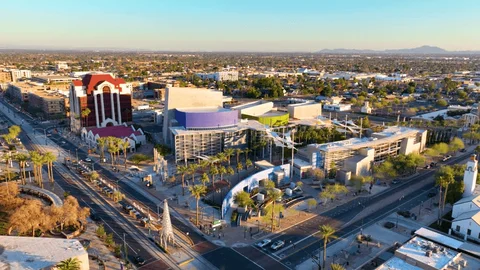
Mesa combines the scale of a major city with price points that still reward individual investors in 2026
2026 Economic Outlook
- Boeing Apache helicopter production expansion at Mesa facility
- Williams Gateway Airport growing as regional aviation and cargo hub
- Downtown Mesa light rail investment driving condo and mixed-use development
- Apple and Google data center operations adding technology employment base
- Banner Health system expansion with new medical campus developments
Investment Climate
Mesa’s investment environment is defined by a compelling combination: better cash flow than Scottsdale and Chandler, genuine appreciation upside tied to downtown revitalization, and Arizona’s landlord-friendly legal framework. Successful Mesa investors tend to share these characteristics:
- Value orientation recognizing the pricing gap between Mesa and neighboring suburbs has historically compressed as revitalization matures
- Neighborhood timing identifying which corridors are in early, mid, or late stage gentrification and positioning accordingly
- Multi-family focus leveraging Mesa’s strong small multi-family market for cash flow that is harder to achieve in Scottsdale
- Long-term hold mentality with 5 to 10 year horizons capturing both appreciation and the rental income growth that comes with downtown maturation
- Workforce tenant expertise understanding that Mesa’s Boeing and healthcare workers make excellent long-term tenants with stable income
Arizona’s landlord-friendly legal environment is a major structural advantage for Mesa investors compared to markets like Seattle or Denver. Arizona has no rent control, efficient eviction processes (typically 3 to 5 weeks), and no just-cause eviction requirements. This allows investors to price risk more accurately and maintain operational flexibility that Western metros simply do not offer.
Historical Performance
| Period | Market Driver | Avg Annual Appreciation | Key Event |
|---|---|---|---|
| 2010-2014 | Post-recession recovery, Boeing expansion | 4-7% | Light rail opens through downtown Mesa |
| 2015-2019 | Downtown investment, Phoenix metro boom | 7-10% | Mesa Arts District transformation, major corporate relocations to metro |
| 2020-2022 | Pandemic migration, remote work, supply shortage | 18-28% | Phoenix metro among fastest appreciating U.S. markets nationally |
| 2023-2024 | Rate normalization, digestion of gains | 2-5% | Inventory rose modestly but fundamentals remained strong |
| 2025-2026 | Rate stabilization, downtown maturation | 8-12% (projected) | Williams Gateway expansion, downtown condo pipeline delivering |
Mesa’s 15-year track record shows average annual appreciation of 7 to 9%, with the 2020 to 2022 surge bringing significant equity gains for early investors. A $300,000 Mesa property purchased in 2015 would be worth approximately $550,000 to $620,000 today after market cycles. The revitalization story continues to play out, suggesting the next 5 to 7 years remain compelling for investors entering now.
Demographic Trends Driving Demand
- Boeing Aerospace Workforce – Apache helicopter production creates a stable, high-earning blue-collar and engineering workforce that prefers renting near the facility in southeast Mesa
- California Migration Wave – Professionals exiting California’s high taxes and costs, often with tech salaries, rent in Mesa before buying as they establish Arizona roots
- Healthcare Sector Growth – Banner Health’s continued system expansion brings medical professionals seeking quality rentals near hospital campuses
- College Student Population – Mesa Community College and Chandler-Gilbert CC serve 50,000+ students creating consistent affordable rental demand near campuses
- Downtown Young Professional Influx – Mesa Arts Center and restaurant scene attracting 25 to 38 year olds who want urban lifestyle at non-Scottsdale prices
- Snowbird and Retiree Market – 15,000+ seasonal residents from Canada and the Midwest create winter short-term rental opportunity in older established neighborhoods
📚 New to real estate investing? Master the fundamentals with our professional course Learn more →
2. Neighborhood Hotspots
Mesa Investment Neighborhood Map
Interactive map of Mesa’s investment neighborhoods. Green stars show top hotspots, blue circles mark established markets, and orange circles highlight emerging areas.
Core Investment Neighborhoods
Detailed Submarket Analysis: All Mesa Neighborhoods
| Neighborhood | Price Range (SFH) | Cap Rate | Growth Drivers | Best Strategy |
|---|---|---|---|---|
| Downtown Mesa / Arts District | $320K-$550K | 4.5-5.5% | Light rail, arts district, $1B+ investment, urban renewal | Appreciation, condo, value-add renovation |
| Eastmark / Power Road | $400K-$620K | 4.5-5.5% | Top schools, Boeing proximity, master-planned community | Long-term family SFH, buy-and-hold |
| Red Mountain / Superstition | $300K-$460K | 5.5-7.0% | Aerospace workforce, recreation, affordability, logistics | Cash flow SFH, BRRRR, small multi-family |
| Dobson Ranch / South Mesa | $350K-$520K | 5.0-6.0% | Established lakes community, Chandler employment proximity | Balanced returns, quality long-term tenants |
| Williams Gateway / SE Mesa | $350K-$520K | 5.5-6.5% | Airport employment hub, logistics growth, new development | Workforce housing, early appreciation stage |
| Riverview / Northwest Mesa | $380K-$560K | 4.5-5.5% | Riverview Park, freeway access, Tempe proximity | SFH buy-and-hold, young professional tenants |
| Fiesta District / Mesa Drive | $300K-$450K | 5.5-6.5% | Light rail proximity, Fiesta Mall redevelopment, affordability | Value-add, BRRRR, redevelopment opportunity |
| Elliot / Baseline Corridor | $290K-$420K | 6.0-7.5% | Chandler employment access, affordability, workforce demand | Highest cash flow in Mesa, value-add |
| Main Street Arts Corridor | $280K-$420K | 5.5-7.0% | Downtown adjacency, arts scene, gentrification momentum | Value-add renovation, hold for gentrification premium |
| Superstition Springs Area | $340K-$500K | 5.0-6.0% | Eastern Mesa growth, retail redevelopment, new construction | Balanced returns, newer housing, family rentals |
Expert Insight: “The most overlooked opportunity in Mesa right now is the Main Street corridor immediately adjacent to the Arts District. Properties within a 5-minute walk of the light rail stations on Main Street are trading at 30 to 40% below equivalent Tempe properties with the same transit access. As the downtown Mesa story fully matures over the next 5 years, that gap should compress significantly. We are advising investors to acquire in that corridor now while the perception discount still exists.” – David Reyes, Principal, Mesa Urban Investment Group
3. Property Types
| Investment Goal | Best Property Type | Best Neighborhoods | Minimum Capital |
|---|---|---|---|
| Maximum Appreciation | Condo or SFH in revitalization zone | Downtown Mesa, Arts District, Main Street | $70,000+ |
| Best Cash Flow in Mesa | Small multi-family or value-add SFH | Red Mountain, Elliot, Fiesta District | $80,000+ |
| Balanced Returns | SFH in established family market | Dobson Ranch, Eastmark, Riverview | $90,000+ |
| Lowest Management | New construction SFH | Eastmark, Williams Gateway, Power Road | $100,000+ |
Don’t guess the costs. Our Complete Renovation & Remodeling Cost Guide covers 400+ pages of project-by-project breakdowns with real contractor pricing ranges.
4. Cost Analysis
Acquisition Cost Breakdown (Mesa)
| Expense Item | Typical Cost | Example ($430,000 Property) | Notes |
|---|---|---|---|
| Down Payment | 25% (investment) | $107,500 | Standard for investment properties in Arizona |
| Closing Costs | 2-3% of price | $8,600-$12,900 | Title, escrow, lender fees, recording. Arizona is relatively low-cost for closings. |
| Home Inspection | $350-$550 | $450 | Include roof, HVAC, and pool inspection if applicable |
| Pool Inspection | $150-$300 | $200 | Many Mesa properties have pools. Equipment replacement runs $3,000-$8,000. |
| HVAC Inspection | $100-$200 | $150 | Critical in Arizona. AC units run hard and full replacement costs $5,000-$12,000. |
| Initial Repairs / Turnover | 0-5% of price | $0-$21,500 | Older Mesa homes often need paint, flooring, and minor system work |
| Reserves (6 months) | 6 months expenses | $8,000-$12,000 | Emergency fund for vacancy and major repairs |
| TOTAL MINIMUM ENTRY | ~29-32% of value | $124,700-$154,000 | Very accessible compared to West Coast or even North Scottsdale |
Sample Cash Flow Analysis: Red Mountain Area Single-Family Home
| Item | Monthly | Annual | Notes |
|---|---|---|---|
| Gross Rent | $1,900 | $22,800 | 3BR, 2BA, updated Red Mountain area home |
| Less Vacancy (5%) | -$95 | -$1,140 | Conservative estimate for Mesa market |
| Property Taxes | -$120 | -$1,440 | ~0.8% of $180K assessed value (AZ assesses at ~45% of market) |
| Insurance | -$110 | -$1,320 | Landlord policy, Arizona rates are very competitive |
| Property Management (9%) | -$171 | -$2,052 | Recommended for out-of-state investors |
| Pool Service (if applicable) | -$100 | -$1,200 | Standard in Mesa. Can be passed to tenant in lease. |
| Maintenance + CapEx | -$150 | -$1,800 | 8% of rent for mid-vintage Mesa home |
| Net Operating Income | $1,154 | $13,848 | Before mortgage |
| Mortgage ($390K, 25% down, 6.75%, 30yr) | -$1,895 | -$22,740 | Principal and interest on $292,500 loan |
| CASH FLOW | -$741 | -$8,892 | Slight negative, typical for current rate environment |
| Cap Rate | 3.22% | NOI / Purchase Price | |
| Total Return (9% appreciation) | ~25% | Including equity, appreciation, principal paydown vs. cash invested |
Note on Cash Flow: A value-add purchase at $360,000 with $35,000 in renovations pushing rent to $2,100/month would generate approximately $150/month positive cash flow on the same financing, showing how BRRRR and value-add strategies materially improve Mesa’s return profile. The Red Mountain corridor specifically offers enough affordable entry that experienced investors can still manufacture positive cash flow through strategic renovation and rent optimization.
Expert Insight: “Mesa is the only Phoenix metro market where individual investors can still find genuine value-add opportunities at scale. In Scottsdale and Chandler, you are paying for fully realized value. In Mesa, you are paying for where the market is today, not where it will be in 5 years. The downtown corridor in particular still has enormous pricing upside as the revitalization story fully matures. Our clients who bought in 2019 and 2020 are already sitting on 35 to 45% appreciation with strong rental income, and the underlying fundamentals are still strengthening.” – Sarah Chen, Senior Investment Advisor, Arizona Realty Capital
5. Legal Framework
✅ Arizona: One of America’s Most Landlord-Friendly States
Arizona’s landlord-tenant laws are consistently ranked among the most investor-friendly in the United States. No rent control, efficient eviction processes, no just-cause eviction requirements, and state preemption of local STR bans make Arizona, and Mesa specifically, an excellent legal environment for property investors compared to most major markets.
Arizona Landlord-Tenant Law Basics
Arizona’s Residential Landlord and Tenant Act (ARS Title 33) governs most landlord-tenant relationships:
- No Rent Control: Arizona state law expressly prohibits rent control ordinances. Landlords have full discretion to set rents at market rate with proper notice.
- Rent Increase Notice: 30 days written notice required for month-to-month tenancies. No notice required during a fixed-term lease beyond what the lease specifies.
- Security Deposits: No statutory cap on security deposit amount. Must return within 14 business days of move-out with itemized deductions.
- Eviction Timeline: Non-payment of rent triggers a 5-day pay-or-quit notice. If not cured, file for eviction. Hearing typically scheduled within 3 to 7 days. Full process typically 3 to 5 weeks, among the fastest in the nation.
- No Just Cause Required: Landlords can choose not to renew a lease without providing cause at the end of the lease term.
- Habitability Standard: Landlords must maintain properties in habitable condition. In Arizona’s heat, functional air conditioning is legally required.
Mesa-Specific Regulations
Mesa layers some additional local requirements on top of Arizona state law:
- Short-Term Rental Registration: Mesa requires STR operators to obtain a Transaction Privilege Tax (TPT) license and a city STR permit. Annual renewal required. Fee is minimal.
- STR Neighborhood Notification: Mesa requires notification to adjacent neighbors upon STR permit application. No approval required but notification must be documented.
- Pool Safety: Mesa enforces Maricopa County pool barrier requirements. All pools must be fenced with self-closing, self-latching gates. Non-compliance can result in fines and liability exposure.
- Property Maintenance Code: Mesa enforces minimum property maintenance standards for rental units. Regular city inspection program for rental properties.
- TPT (Sales Tax): Arizona’s Transaction Privilege Tax applies to rental income. Residential long-term rentals (30+ days) are exempt. STRs (under 30 days) are subject to TPT. Register with Arizona Department of Revenue.
Useful Mesa Resources
- Mesa Short-Term Rental Info: mesaaz.gov/residents/str
- Arizona Dept. of Revenue (TPT): azdor.gov
- Arizona Landlord-Tenant Act: azleg.gov/ARS/33
- Mesa Code Enforcement: 480-644-3241
| Regulation | Mesa / Arizona Requirement | National Average | Investor Impact |
|---|---|---|---|
| Eviction Speed | 3 to 5 weeks typical | 6 to 12 weeks | Dramatically reduces non-payment exposure |
| Rent Control | Banned by state law | Varies, many cities have it | Full market rate pricing always permitted |
| STR Regulation | Registration required, no bans permitted | Many cities restrict or ban STRs | Arizona’s STR preemption law creates stable STR environment |
| Security Deposit | No cap, 14 business days return | Most states cap at 1 to 2 months | Greater flexibility in protecting against tenant damage |
| Just Cause Eviction | Not required | Required in many markets | Full discretion not to renew at lease expiration |
| Rent Increase Notice | 30 days (month-to-month) | 30 to 90 days | Market adjustments can be implemented relatively quickly |
6. Step-by-Step Mesa Investment Playbook
Choose Your Mesa Strategy
Mesa supports multiple investment strategies simultaneously. Before buying, commit clearly to one primary strategy:
Downtown Appreciation Play
Buy in the revitalization zone. Accept minimal initial cash flow in exchange for outsized appreciation as downtown Mesa continues its transformation. Best total return strategy for 7 to 10 year holds.
Cash Flow Focus (BRRRR)
Buy undervalued older homes in Red Mountain, Elliot, or Fiesta District. Renovate to force equity and increase rents. Refinance to recycle capital. Best for investors who want to build a portfolio faster.
Family Rental Buy-and-Hold
Acquire quality SFH in Eastmark, Dobson Ranch, or Riverview. Target long-term professional and aerospace families. Minimal management intensity with stable occupancy and 7 to 12 year holds.
Seasonal STR Strategy
Target older established neighborhoods popular with snowbirds. Operate as STR from October through April (high season), rent long-term May through September. Hybrid model can produce 9 to 14% gross yields.
Build Your Mesa Team
Mesa’s favorable legal environment makes team assembly easier than most markets, but local expertise still matters enormously. Core team requirements:
- Mesa-Experienced Investment Agent: Should specialize in income property and know the difference between the downtown corridor and Eastmark from an investor perspective. Ask specifically about their recent investment transaction history.
- Arizona Real Estate Attorney: For entity structuring (LLC is standard for Arizona investors) and lease review. Given the favorable legal environment, this is primarily a setup cost rather than ongoing compliance burden.
- Arizona-Licensed Property Manager: The Phoenix metro has excellent property management options at 8 to 10% monthly rates, among the lowest in the country for a major market. Verify they manage specifically in Mesa and understand STR requirements if applicable.
- HVAC-Savvy General Contractor: AC failure in Arizona summer is a habitability emergency. Have a contractor relationship established before your first tenant call on a 115-degree day.
- Arizona Real Estate CPA: Arizona’s flat income tax and TPT requirements for STRs create specific tax planning needs distinct from other states.
Expert Tip: Ask any Mesa property management company specifically: “What is your emergency HVAC protocol during summer?” and “How do you handle STR turnovers during spring training season?” Companies that answer these Mesa-specific questions with detail and confidence have genuine local operational experience.
Mesa-Specific Due Diligence
Physical Due Diligence
- HVAC age and condition (critical in Arizona summer. Units over 12 years old are near end of life)
- Roof condition (flat roofs common in Mesa, lifespan 15 to 20 years)
- Pool equipment age and condition if property has a pool
- Stucco condition and moisture intrusion points
- Water heater age (hard water accelerates degradation in Arizona)
- Electrical panel capacity (older homes may have 100-amp panels inadequate for modern AC demands)
- Desert landscaping condition and irrigation system function
Market and Regulatory Due Diligence
- Confirm HOA rental restrictions if property is in an HOA (many Mesa communities are)
- Verify STR permitting eligibility and HOA STR rules if short-term rental is planned
- Check Mesa code enforcement history for the property
- Confirm pool barrier compliance for any property with a pool
- Review comparable rental rates in immediate micro-neighborhood, not just city-wide averages
- Confirm any outstanding city liens or violations
- Verify TPT registration requirements if STR use is intended
Acquiring and Managing Mesa Properties
Mesa is competitive but not as aggressive as Scottsdale or North Phoenix. Strategies that work:
- Off-market sourcing: Mesa has a large stock of long-term landlords who have owned since the 1980s and 1990s. Direct mail to absentee owners in target neighborhoods can surface deals before they reach the MLS.
- Builder incentives: In Eastmark and Williams Gateway, builders frequently offer interest rate buy-downs and closing cost contributions on new construction. In 2026, these incentives are effectively transferable for investment properties with the right loan structure.
- Estate and probate properties: Mesa’s older demographic means estate sales are common. Heirs often want quick, clean transactions and will accept below-market pricing for certainty.
- Pre-listing agent relationships: Build relationships with Mesa agents who specialize in neighborhoods you target. Many investment-grade properties trade before hitting the MLS through agent networks.
- Pool as selling point: Unlike Northern states, pools in Mesa are an amenity that commands rent premiums of $150 to $250/month in summer and supports STR pricing in winter. Properties with pools should be evaluated on gross return including the pool premium, not avoided due to maintenance cost alone.
7. Financing Options for Mesa
| Loan Type | Down Payment | Rate Premium | Best For | Mesa Note |
|---|---|---|---|---|
| Conventional Investment | 25% | +0.5-0.75% | Strong W-2 income, good credit | Most Mesa SFH and condos fall under conforming loan limits |
| DSCR Loan | 25-30% | +1.0-1.75% | Self-employed, portfolio investors, no income verification | Mesa’s higher cap rates than Scottsdale mean DSCR can qualify on many properties here |
| FHA (House Hack) | 3.5% | Standard + MIP | Owner-occupying one unit of a 2 to 4 unit property | Mesa has a good supply of duplexes and triplexes for house hacking |
| Portfolio Loan | 20-25% | +0.75-1.5% | Multiple properties, investors with 4+ financed loans | Arizona-based lenders like Western Alliance and Pinnacle Bank offer portfolio products |
| Hard Money (BRRRR) | 10-20% | 9-13% rate | Value-add acquisitions requiring renovation | Very active hard money market in Phoenix metro, competitive rates |
| Builder Financing | 5-20% (varies) | Often below market with incentives | New construction in Eastmark and Williams Gateway | Builder rate buy-downs in 2026 can produce below-market effective rates. Ask every builder. |
| Cash-Out Refinance | N/A (existing equity) | Standard investment rate | Investors with existing Phoenix metro equity to recycle | Arizona’s appreciation since 2020 has created significant refinanceable equity for early buyers |
Mesa Financing Advantage: Unlike Seattle or even North Scottsdale, many Mesa investment properties can qualify for DSCR loans because the cap rates are high enough relative to current interest rates to produce coverage ratios at or above 1.0x. This gives self-employed and portfolio investors a financing path that simply does not exist in lower-cap-rate Phoenix metro markets. Run the DSCR calculation on any Mesa property before defaulting to conventional financing, as the DSCR route eliminates income documentation requirements and simplifies the closing process significantly.
8. Frequently Asked Questions

Knowledge Quiz: Mesa Arizona Real Estate Investment
Open Quiz
5 quick questions on what you just learned about Mesa investing
1) What is the primary reason the guide identifies Mesa as a value play compared to Chandler and Scottsdale?
Answer: B
The guide consistently highlights that Mesa’s pricing sits 20 to 30% below Chandler and Scottsdale for comparable properties while offering access to the same Phoenix metro employers, infrastructure, and appreciation drivers. This pricing gap, combined with downtown revitalization still underway, creates the value investment thesis.
2) What makes Arizona’s legal environment significantly better for landlords than most major U.S. markets?
Answer: C
The guide details Arizona’s landlord-friendly framework: state law bans rent control, eviction processes typically complete in 3 to 5 weeks (vs. 6 to 12 nationally), no just-cause requirement at lease end, and state preemption prevents local STR bans. This combination makes Arizona one of the best legal environments for property investors in the nation.
3) Which Mesa neighborhood does the guide identify as offering the best cash flow for investors in 2026?
Answer: D
The guide identifies the Red Mountain and Superstition Corridor as offering cap rates of 5.5 to 7.0%, the highest in Mesa. Workforce tenant demand from Boeing, logistics companies, and recreation users combined with the area’s lower price points create the best pure cash flow opportunity in the city.
4) Why does the guide say DSCR loans can work in Mesa when they often fail in Scottsdale?
Answer: A
DSCR loans require that rental income covers debt service at a ratio of 1.0x or higher. Scottsdale’s low cap rates (3.5 to 4.5%) mean properties there rarely generate enough NOI to hit the threshold at current interest rates. Mesa’s 5.0 to 6.5% cap rates give many properties enough NOI to qualify, opening the DSCR financing path for self-employed and portfolio investors.
5) What is Arizona’s unique STR (short-term rental) protection that makes Mesa different from cities like Seattle or Denver?
Answer: C
Arizona is one of only a handful of states with state-level STR preemption, meaning local governments cannot ban short-term rentals outright. Mesa can regulate and require permits but cannot eliminate STR operation. This is a major structural difference from markets like Seattle (which heavily restricts STRs to primary residences) and creates a more stable long-term environment for Arizona STR investors.
Work With a Local Expert in Mesa
We are building a verified network of real estate professionals across every market we cover.

About Our Expert Network
We are finalizing partnerships with verified real estate professionals across every market featured on Builds and Buys. Each expert in our network is selected for their hands-on investment experience, local market knowledge, and commitment to helping buyers and investors make sound decisions.
Our local specialists offer:
- Proven experience with investment and income-producing properties
- Deep knowledge of local pricing, rental yields, and neighborhood dynamics
- Guidance on financing, legal structure, and due diligence
- Access to off-market and pre-market opportunities
- Full transaction support from search through closing
- Ongoing portfolio and property management referrals
Services Covered
- Property sourcing and acquisition
- Investment analysis and underwriting
- Buyer representation
- Market comparables and valuations
- Short-term and long-term rental strategy
- Value-add and renovation guidance
- Legal and title referrals
- Financing and lender connections
- Property management referrals
- Insurance and inspection referrals
- 1031 exchange coordination
- Exit strategy planning
Get Connected or Join Our Network
Looking for a local expert to help with your Mesa investment? Reach out and we will connect you with the right professional for your market and strategy.
Are you a real estate professional with a track record working with investors in Mesa or the Phoenix metro? We are always expanding our network of verified local experts.
Contact us at support@buildsandbuys.com
Find Specialized Mesa Real Estate Professionals
Ready to Invest in Mesa?
Mesa is not a perfect market. HVAC costs are real, HOA rental restrictions require diligence, and the downtown revitalization story requires patience. But for investors who do their homework, build the right local team, and commit to a clear strategy, Mesa delivers something increasingly rare: genuine value in a major metro market. The pricing gap versus Scottsdale and Chandler still exists. The downtown transformation is still maturing. Arizona’s landlord-friendly laws are still in place. The window to buy ahead of full price discovery is still open in 2026, but it will not stay open indefinitely.
Continue Your Research
Arizona State Guide
See how Mesa compares to Scottsdale, Tempe, Chandler, Flagstaff, and other Arizona markets.
Step-by-Step Invest
Complete framework for building a real estate investment strategy from scratch.
144-Lesson Course
University-level real estate education covering financing, law, strategy, and management.
For further guidance, explore our State-by-State Investor guides, browse our expert articles, or follow our Step-by-Step Investment Guide.



