
Medford / Ashland Oregon Real Estate Investment Guide For 2026
A comprehensive resource for investors targeting southern Oregon’s dominant metro market, a dual-city corridor where Medford’s commercial strength and Ashland’s cultural prestige combine to create one of Oregon’s most compelling and weather-distinct investment environments in 2026
Quick answers: Top 5 most searched Medford/Ashland investment questions ▼
Migration data: Where people are moving from to Jackson County ▼
In This Guide
Click on any section to navigate directly to that content
1. Medford / Ashland Market Overview
Market Fundamentals
Medford and Ashland form the urban core of Jackson County and southern Oregon’s dominant metro area, situated in the Rogue Valley between the Siskiyou and Cascades mountain ranges along Interstate 5. The corridor is unique in the Pacific Northwest: it enjoys a semi-arid Mediterranean-influenced climate with over 300 sunny days per year, placing it climatically closer to northern California than to Portland or Eugene. This climate distinction is not a footnote. It is a primary driver of the migration, tourism, and lifestyle demand that defines both cities’ real estate markets.
Key economic indicators defining the corridor investment case:
- Medford Population: 85,000+ and the largest city in southern Oregon
- Ashland Population: 22,000+ with significant seasonal visitor overlay
- Major Employers: Asante Health System, Providence Medford Medical Center, Harry and David, Lithia Motors (HQ), Southern Oregon University, Crater Lake National Park administration
- Oregon Shakespeare Festival: 100,000+ annual visitors to Ashland, a city of 22,000, generating enormous STR and hospitality demand
- Medford Airport: Rogue Valley International-Medford serves the entire region and reflects the area’s status as a genuine regional hub
- Vacancy Rate: Under 3.5% across the corridor, one of the tightest in Oregon
The investment case for the Medford-Ashland corridor is built on four structural pillars: California migration pressure from the south, healthcare regional dominance creating stable professional employment, Ashland’s cultural economy generating unmatched STR demand, and a post-Almeda Fire supply deficit that is still working through the market years after the disaster. Each of these operates independently, meaning the corridor has multiple demand redundancies that most small Oregon metros lack.
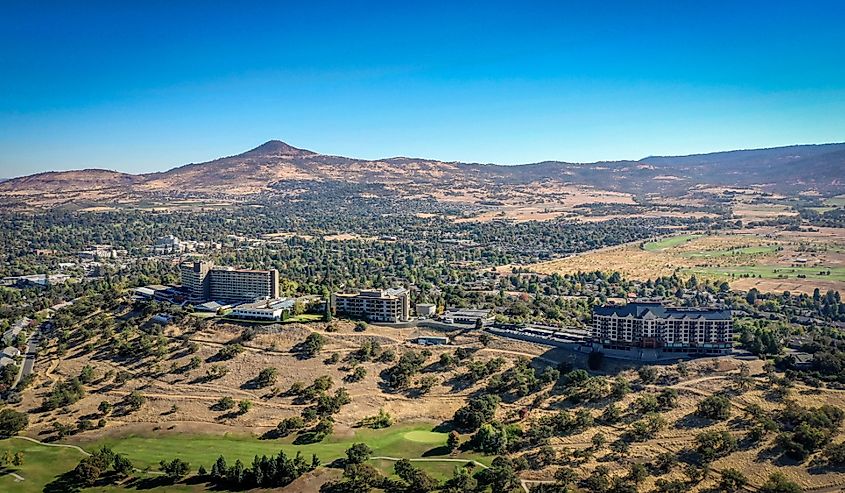
The Rogue Valley’s exceptional climate, California proximity, and cultural economy create a uniquely multi-layered investment market
2026 Economic Outlook
- Asante Health System expansion adding new facilities and healthcare employment
- Lithia Motors corporate headquarters anchoring high-income professional demand in East Medford
- Oregon Shakespeare Festival rebuilding its audience post-pandemic toward pre-2020 attendance records
- Southern Oregon University stabilizing enrollment after a challenging post-pandemic period
- Continued California remote worker and retiree migration sustained by I-5 corridor access
- Post-Almeda reconstruction completing in Talent and Phoenix, reducing displacement pressure slightly
The Wildfire Risk Reality
⚠️ Wildfire is not a hypothetical risk in Jackson County. It is a documented, recurring, and material investment consideration. The 2020 Almeda Fire was not an outlier. Southern Oregon’s fire seasons have intensified and the landscape between Medford and Ashland saw direct destruction. Investors must treat wildfire as a first-order due diligence and ongoing management issue, not a footnote.
Despite this risk, the investment case for the corridor remains compelling because:
- Urban core properties in Medford and Ashland proper carry substantially lower fire risk than rural and suburban fringe locations. The Almeda Fire was a wind-driven event that followed a specific geographic corridor. Much of core Medford was unaffected.
- Post-fire reconstruction has actually tightened the rental market by removing thousands of units and not replacing them at the same pace, driving rents higher across the corridor.
- Insurance is available but must be actively sourced. Several major carriers have limited or exited the Oregon market, but specialty insurers, surplus lines carriers, and some regional companies continue to underwrite Jackson County properties. Budget $2,500 to $6,000 annually for landlord policies on properties with elevated fire risk designations.
- FHSZ zoning varies dramatically by address. A property one mile from a high-hazard parcel may carry normal insurance rates. Always verify the specific fire hazard severity zone for any property under consideration.
Historical Performance
| Period | Market Driver | Avg Annual Appreciation | Key Event |
|---|---|---|---|
| 2010-2015 | Post-recession recovery, California migration building | 3-5% | Lithia Motors expansion in Medford; SOU enrollment growth |
| 2016-2019 | Accelerating California migration, tight inventory | 7-11% | Oregon SB 608 enacted; Ashland STR market matures |
| 2020-2022 | Almeda Fire displacement + remote work migration | 15-22% | Almeda Fire destroys 2,500+ structures; supply shock drives record appreciation |
| 2023-2024 | Rate correction, insurance market disruption | 2-5% | Insurance challenges creating price headwind in high-risk zones |
| 2025-2026 | Rate stabilization, continued migration, OSF recovery | 4-8% (projected) | OSF audience returning; reconstruction completing in Talent/Phoenix |
A $280,000 Medford property purchased in 2015 would be worth approximately $490,000 to $550,000 today, representing cumulative appreciation of 75 to 96 percent over 10 years. The Almeda Fire, counterintuitively, acted as an accelerant for property values across the unburned corridor by removing thousands of units from the rental supply simultaneously.
Demographic Trends Driving Demand
- California Retiree Migration: Bay Area and Sacramento-area retirees are arriving with significant equity, purchasing in Ashland and East Medford at or above asking price, compressing available inventory
- Healthcare Professional Workforce: Asante and Providence together employ thousands of physicians, nurses, and healthcare administrators who predominantly rent or purchase in North and East Medford
- Shakespeare Festival Visitors and Arts Community: The OSF brings 100,000 visitors annually to a 22,000-person city, supporting an entire Airbnb and B&B economy that generates STR yields unique in Oregon
- Southern Oregon University: 6,000+ students in Ashland provide durable enrollment-driven rental demand in the Hill neighborhoods and downtown fringe
- Remote California Workers: Professionals earning Bay Area salaries while living in Medford enjoy a 40 to 60 percent cost-of-living reduction while remaining 5 hours from the Bay by car or a 90-minute flight
- Post-Almeda Structural Supply Deficit: The 2020 fire removed roughly 2,500 housing units from the market. Even with active reconstruction in Talent and Phoenix, the regional housing deficit continues to support rents and values across the corridor
📚 New to real estate investing? Master the fundamentals with our professional course Learn more →
2. Neighborhood Hotspots
Medford / Ashland Investment Neighborhood Map
Interactive map spanning Medford, Ashland, and the surrounding Rogue Valley corridor including Talent, Phoenix, Jacksonville, and Central Point. Green stars show top investment hotspots, blue circles mark established markets, and orange circles highlight emerging areas.
Core Investment Neighborhoods
Detailed Submarket Analysis: Rogue Valley Investment Areas
| Neighborhood / Area | Price Range | Cap Rate | Growth Drivers | Best Strategy |
|---|---|---|---|---|
| East Medford / Table Rock | $410K-$560K | 4.5-6.0% | Lithia HQ, professional demand, fastest appreciation | Appreciation play, professional rental |
| North Medford / Asante | $380K-$500K | 5.0-6.5% | Healthcare workforce, travel nurse demand, stable occupancy | Mid-term furnished rental, long-term professional |
| South Medford / Airport | $340K-$440K | 5.5-7.5% | Workforce demand, distribution employment, affordable entry | Cash flow, workforce rental, value-add |
| West Medford | $320K-$430K | 5.0-6.5% | Value-add stock, central Medford, diverse demand | Value-add BRRRR, long-term hold |
| Ashland Downtown / Plaza | $535K-$800K | 7-11% (STR) | Oregon Shakespeare Festival, walkability, arts community | Premium STR, hybrid seasonal |
| Ashland Hills / SOU Area | $460K-$650K | 5.0-7.5% | SOU enrollment, faculty housing, STR-eligible | Student rental, STR, buy-and-hold |
| Phoenix / Talent (Rebuild) | $310K-$440K | 5.5-7.5% | Post-fire rebuild, 15-yr rent control exemption, below-market entry | New construction, long-term hold with rent flexibility |
| Jacksonville | $470K-$700K | 6-10% (STR) | Britt Festivals, historic charm, limited supply | STR, premium hold |
| Central Point | $355K-$470K | 4.5-6.0% | Medford commute, new development, I-5 access | Workforce rental, new construction hold |
| White City / Eagle Point | $280K-$380K | 6.0-8.0% | Most affordable metro entry, industrial workforce, rural appeal | Cash flow focus, value-add |
Expert Insight: “The most misunderstood opportunity in the Rogue Valley right now is the Phoenix and Talent rebuild zone. Investors hear ‘Almeda Fire’ and run. What they miss is that new construction in those cities has a full 15-year Oregon rent control exemption from the certificate of occupancy date, meaning you can raise rent freely for 15 years while every other Oregon landlord is capped at 7 percent plus CPI. You are buying at a 10 to 15 percent discount to comparable Medford properties and getting the best regulatory position available in Oregon real estate. That combination will not last.” – Karen Fitzgerald, Rogue Valley Investment Properties
3. Property Types
| Investment Goal | Best Property Type | Best Location | Minimum Capital |
|---|---|---|---|
| Highest Yield in Corridor | Ashland STR near Oregon Shakespeare Festival | Ashland Downtown / Plaza | $140,000+ |
| Best Regulatory Position | New construction in Phoenix or Talent | Phoenix, Talent post-Almeda rebuild | $90,000+ |
| Most Stable Occupancy | Mid-term furnished rental near Asante | North Medford | $100,000+ |
| Best Appreciation Play | SFH in East Medford or Ashland Hills | East Medford, Ashland | $110,000+ |
Don’t guess the costs. Our Complete Renovation & Remodeling Cost Guide covers 400+ pages of project-by-project breakdowns with real contractor pricing ranges.
4. Cost Analysis
Acquisition Cost Breakdown (Medford / Ashland)
| Expense Item | Typical Cost | Example ($415,000 Medford Property) | Notes |
|---|---|---|---|
| Down Payment | 25% (investment) | $103,750 | Standard for investment properties; 20% possible with strong profile |
| Closing Costs | 2-3% of price | $8,300-$12,450 | Title, escrow, lender fees, Jackson County recording |
| Fire Hazard Insurance | $1,800-$6,000/yr | $2,400-$4,800 | Critical: Obtain quotes from 3+ carriers before closing. Varies dramatically by FHSZ zone. |
| Home Inspection | $400-$600 | $500 | Include roof, HVAC, and foundation components |
| FHSZ Verification | $0-$300 | $150 | Confirm Oregon State Fire Marshal FHSZ designation; free online or via consultant |
| Initial Repairs | 0-8% of price | $0-$33,200 | Highly variable; older Medford stock often needs deferred maintenance |
| Reserves (6 months) | 6 months expenses | $10,000-$14,000 | Higher reserve recommended given wildfire insurance cost volatility |
| TOTAL MINIMUM ENTRY | ~28-36% of value | $125,050-$168,850 | Fire insurance is a unique and material cost component not present in other Oregon markets |
Sample Cash Flow Analysis: North Medford 3BR SFH (Long-Term Rental)
| Item | Monthly | Annual | Notes |
|---|---|---|---|
| Gross Rent | $1,875 | $22,500 | 3BR North Medford, renovated, professional tenant |
| Less Vacancy (4%) | -$75 | -$900 | Low near Asante Medical; conservative estimate |
| Property Taxes | -$295 | -$3,540 | ~0.85% of $415K assessed value; Jackson County |
| Insurance (fire risk zone) | -$230 | -$2,760 | Higher than other Oregon markets; accounts for Jackson County fire risk premium |
| Property Management (9%) | -$169 | -$2,025 | Oregon SB 608 compliance management recommended |
| Maintenance + CapEx (8%) | -$150 | -$1,800 | Includes defensible space maintenance as operating cost |
| Net Operating Income | $956 | $11,475 | Before mortgage |
| Mortgage ($415K purchase, 25% down, 6.75%, 30yr) | -$2,010 | -$24,120 | P&I on $311,250 loan |
| CASH FLOW | -$1,054 | -$12,645 | Negative; improved significantly with mid-term rental strategy (see below) |
| Cap Rate | 2.76% | Reflects Medford’s above-average fire insurance cost impact on NOI | |
| Total Return (6% appreciation) | ~17% | Including appreciation and principal paydown on leveraged capital |
Sample Cash Flow Analysis: Ashland Downtown STR (Oregon Shakespeare Festival Market)
| Item | Monthly (Avg) | Annual | Notes |
|---|---|---|---|
| STR Revenue (72% occupancy) | $4,860 | $58,320 | $280 ADR blended across season; 15.7 nights/month average |
| Platform Fees (15%) | -$729 | -$8,748 | Airbnb/VRBO service and host fees combined |
| Cleaning and Turnover | -$490 | -$5,880 | $165/clean x 2.97 turns per month average |
| STR Management (18%) | -$746 | -$8,928 | Local Ashland STR operator with OSF booking expertise |
| Property Taxes | -$450 | -$5,400 | ~0.85% of $635K assessed value |
| Insurance (STR / fire zone) | -$320 | -$3,840 | STR commercial policy with fire risk premium in Ashland |
| Supplies, Maintenance, CapEx | -$380 | -$4,560 | Higher consumables for frequent turnovers; guest supplies |
| Net Operating Income | $1,745 | $20,964 | Before mortgage |
| Mortgage ($620K purchase, 25% down, 6.75%, 30yr) | -$3,001 | -$36,012 | P&I on $465,000 loan |
| CASH FLOW | -$1,256 | -$15,048 | Negative at 72% occupancy; breaks even at approximately 82% occupancy |
| Cap Rate (STR NOI basis) | 3.38% | STR NOI / Purchase price; top STR operators achieve 4.5-5.5% | |
| Total Return (8% appreciation) | ~24% | Including strong Ashland appreciation, STR NOI, and principal paydown |
The Ashland STR analysis shows why management quality is the defining variable in this market. The difference between a 72 percent occupancy property running at negative $1,256 per month and an 82 percent occupancy property at break-even is almost entirely driven by listing quality, pricing strategy, and operator expertise during the shoulder season (February through April and October through November). An experienced local Ashland STR manager who knows the OSF calendar pays for themselves many times over in this market.
Expert Insight: “The mid-term travel nurse strategy near Asante is the most underutilized high-return approach in the Medford market. Everyone focuses on Ashland STR, which is real but requires active management and has insurance complexity. A furnished 2-bedroom in North Medford renting to travel nurses at $2,500 per month on 13-week contracts, renewed two or three times per year, generates $30,000 in annual gross income on a $420,000 property with barely any management needed. That is a 7-plus percent gross yield with a professional, income-verified tenant. Medford investors who discover this strategy rarely go back to traditional long-term rental.” – Tom Wakefield, Southern Oregon Investor Network
5. Legal Framework
⚠️ Oregon Rent Control, Wildfire Insurance, and STR Permitting
The Medford-Ashland corridor has three distinct legal and compliance layers that investors must navigate: Oregon’s statewide SB 608 rent control, Jackson County and city-specific STR permitting, and wildfire insurance regulatory requirements. None of these can be ignored. This section is an overview only. Always consult a Jackson County licensed real estate attorney before acquiring rental properties, and confirm current regulations given ongoing Oregon legislative activity.
Oregon Statewide Requirements (SB 608)
- Rent Control Cap: Annual increases on existing tenants capped at 7% plus CPI. Resets to market at voluntary tenant turnover. Apply annual maximums consistently and document everything.
- Just Cause Eviction (after 12 months): Documented just cause required after 12 months of occupancy. Grounds include non-payment, material lease violation, damage, criminal activity, owner move-in.
- Relocation Assistance: One month’s rent required for no-fault terminations. Budget when purchasing properties with long-term tenants.
- New Construction Exemption: Properties under 15 years old exempt from rent control. Post-Almeda rebuild properties qualify from certificate of occupancy date, creating a uniquely attractive entry point.
- 90-Day Notice: Increases exceeding 10% require 90 days written notice.
- Security Deposit Return: 31 days with itemized accounting. Document move-in and move-out conditions with timestamped photos.
- 24-Hour Entry Notice: Required for all non-emergency landlord entry.
Jackson County and City-Specific Rules
- Medford STR Permitting: Medford requires a business license for STR operation within city limits. Contact Medford Planning (541-774-2380) for current requirements and zoning confirmation before purchase.
- Ashland STR Permitting: Ashland has established STR regulations that require a city license and compliance with specific operational standards. Given the STR market’s importance to Ashland’s economy, the permitting process is functional but must be completed before operating. Contact Ashland Planning (541-488-5305).
- Oregon Transient Lodging Tax: All STR operators must collect and remit Oregon’s 1.8% transient lodging tax plus any local city or county lodging taxes. Ashland imposes additional local tax.
- Wildfire Insurance Requirement: Oregon’s Division of Financial Regulation has issued guidance on fire insurance in high-hazard zones. Lenders may require verified insurability before closing. Obtain insurance quotes from at least three carriers as a due diligence condition.
- Defensible Space Requirements: Oregon ORS 477.015 requires owners of structures in certain fire risk areas to maintain defensible space. Ongoing maintenance cost is a real operating expense for rural-adjacent properties.
- Jackson County Property Tax: Effective rate approximately 0.80 to 0.95% of assessed value. Oregon compression system limits assessment growth.
Key Local Resources
- Oregon Rental Housing Association: orha.com
- City of Medford Planning: medfordoregon.gov/planning
- City of Ashland Planning: ashland.or.us/planning
- Oregon State Fire Marshal FHSZ map: oregon.gov/osfm
- Jackson County Assessor: jacksoncountyor.gov/assessor
| Regulation | Requirement | Investor Impact | Planning Action |
|---|---|---|---|
| Rent Control (SB 608) | 7% + CPI cap on existing tenants | Cannot close large gaps mid-tenancy | Apply maximum increase annually; price correctly at lease-up |
| New Construction Exemption | 15-year rent control exemption | Full rent flexibility on post-Almeda rebuild properties | Target Phoenix/Talent new builds for best regulatory position |
| Wildfire Insurance | Required; cost varies by FHSZ | $1,800-$6,000/yr operating cost | Obtain 3+ quotes before closing; factor into NOI |
| STR Permitting (Medford) | City business license required | Cannot legally STR without permit | Confirm zoning and apply for license before closing |
| STR Permitting (Ashland) | City license with operational standards | Manageable but must be completed | Contact Ashland Planning before purchase; confirm eligibility |
| Defensible Space | Required in fire risk areas | Ongoing maintenance cost; tenant safety obligation | Budget $500-$2,000/yr for defensible space maintenance on rural-adjacent properties |
6. Step-by-Step Medford / Ashland Investment Playbook
Choose Your Medford-Ashland Strategy
The Rogue Valley offers more distinct investment strategies than most Oregon markets. Clarity on your objective before you begin searching will save weeks of time and prevent costly mismatches between property and plan.
Ashland STR Strategy
Buy within walking distance of the Ashland Plaza and Oregon Shakespeare Festival. Invest heavily in property quality, photography, and guest experience. Target OSF season (Feb-Nov) at $200 to $450 per night with off-season MTR backup. This is the highest-yield strategy in the corridor and the most operationally demanding.
Travel Nurse Mid-Term Strategy
Buy a quality 1 to 2 bedroom in North Medford within 10 minutes of Asante. Furnish well. List on Furnished Finder and healthcare travel platforms targeting 13-week assignment nurses. Renew 2 to 3 times annually at $2,200 to $3,200 per month. Lower management intensity than STR with significantly above-market returns.
Post-Almeda New Construction
Purchase newly built or under-construction replacement housing in Phoenix or Talent. Benefit from 15-year rent control exemption, below-market purchase price relative to Medford, and the ability to raise rent freely as the neighborhood recovers. Best regulatory position in Oregon real estate today.
Medford Workforce Long-Term Hold
Buy a quality 3-bedroom SFH in North or East Medford. Target healthcare, corporate, and professional tenants. Accept modest negative carry in exchange for 5 to 8 percent annual appreciation driven by California migration and healthcare sector growth. Lowest management intensity in the corridor.
Wildfire Insurance: Your First Due Diligence Task
Before you spend significant time evaluating any specific property in Jackson County, confirm that it is insurable at a cost that makes the investment viable. This is non-negotiable due diligence in this market.
Insurance Due Diligence Checklist
- Look up the property’s Oregon Fire Hazard Severity Zone (FHSZ) designation at oregon.gov/osfm before scheduling any showing.
- If the property is in a High or Very High FHSZ zone, contact at least three insurance carriers or brokers for quotes before making an offer. Do this before the inspection period begins.
- Budget for insurance costs as a hard line in your NOI analysis. A $4,000 annual insurance premium is a $333 monthly operating cost that materially changes your cash flow.
- Confirm that your lender will accept the available insurance options. Some lenders have minimum coverage requirements that surplus lines policies may not satisfy.
- For STR properties, verify that your STR commercial or hybrid policy includes both short-term occupancy coverage and fire damage coverage at replacement cost value.
- Consider defensible space inspection as part of your due diligence. A property that requires $5,000 to $15,000 in vegetation removal to meet defensible space requirements is a purchase price negotiation point.
Expert Tip: Urban core Medford and Ashland proper have substantially lower fire risk than their surrounding hills and rural fringe. If insurance costs are prohibitive for a specific property, shifting your search to within the established urban grid of either city will typically resolve the issue. Do not let fire risk concern push you to avoid the entire market. The key is address-specific verification, not market-level avoidance.
Build Your Rogue Valley Team
The Medford-Ashland corridor has a distinct and active investor community. The right team members here know this market specifically, not just Oregon broadly.
- Jackson County Investment Agent: Must have specific Rogue Valley investor experience. Understanding of post-Almeda rebuild opportunities, Ashland STR market dynamics, and Medford’s submarket differences is essential. Portland agents are frequently not the right fit.
- Oregon Landlord-Tenant Attorney: Jackson County court practices and SB 608 application require local legal expertise. Critical for Ashland STR compliance review and post-Almeda rebuild lease structures.
- Ashland-Specific STR Manager (if applicable): The OSF calendar, Ashland’s specific guest demographic, and off-season occupancy strategy require a local operator who manages Ashland properties specifically, not just general Oregon STR.
- Jackson County Property Manager (LTR): Oregon Rental Housing Association membership and active mid-valley management portfolio. Rogue Valley management norms differ from Portland.
- Fire Insurance Specialist Broker: An independent broker with access to multiple carriers including surplus lines is essential for any property with elevated FHSZ designation. This is a unique team requirement of this specific market.
- Oregon Real Estate CPA: Depreciation strategy, SB 608 planning, and STR tax treatment (Section 199A, hospitality vs passive income classification) require a CPA with Oregon residential investment specialization.
Rogue Valley Specific Due Diligence
Physical Due Diligence
- FHSZ zone verification as first step, before any other due diligence
- Defensible space assessment on any property within 300 feet of vegetation
- Roof condition and fire-resistant roofing materials assessment
- HVAC condition (Medford summer temperatures exceed 100°F, making air conditioning a tenant retention necessity, not optional)
- Seismic evaluation on older masonry construction (Cascadia subduction zone proximity)
- Water rights verification on rural or semi-rural properties
- Smoke and air quality damage assessment on any property within one mile of Almeda Fire perimeter
Regulatory Due Diligence
- STR permit eligibility confirmed with city before purchase if STR strategy is planned
- Current tenant lease terms and rent history review for SB 608 compliance status
- All building permits pulled and verified for any improvements
- Flood zone status for properties near Bear Creek or Rogue River tributaries
- Ashland historic district designation check if purchasing older downtown property
- Confirm certificate of occupancy date for any post-2020 construction in Phoenix or Talent
- HOA rules review for any planned development properties with rental restrictions
7. Financing Options for Medford / Ashland
| Loan Type | Down Payment | Rate Premium | Best For | Rogue Valley Note |
|---|---|---|---|---|
| Conventional Investment | 25% | +0.5-0.75% | W-2 income, good credit, LTR properties | Most Medford properties under conforming limits; Ashland may require jumbo depending on price |
| STR DSCR Loan | 25-30% | +1.5-2.5% | Ashland STR properties using projected STR income | Several lenders accept AirDNA or Rabbu projections; OSF market well-documented for underwriters |
| Portfolio Loan | 20-30% | +1-2% | Multiple properties, self-employed investors | Umpqua Bank, Banner Bank, and local Rogue Valley credit unions offer portfolio products |
| House Hacking (FHA) | 3.5% | Standard + MIP | Owner-occupying one unit of 2-4 unit property | Best low-capital entry; South Medford duplexes near airport are ideal candidates |
| Jumbo Investment | 25-30% | +0.75-1.25% | Premium Ashland STR and East Medford properties | Some Ashland properties above $806,500 conforming limit require jumbo financing |
| DSCR Loan (LTR) | 25-30% | +1-2% | Investors wanting no income verification | Works on South Medford duplexes and multi-family where cap rates support 1.0x+ DSCR |
| Hard Money (Bridge) | 15-25% | 8-12% rate | BRRRR acquisitions, quick closes, value-add | Southern Oregon hard money lenders active; fire-affected properties may face lower LTV limits |
Rogue Valley Financing Reality: Fire insurance is a financing variable unique to this market. Some conventional lenders require a minimum coverage amount and will not accept all insurance policies available in Jackson County’s distressed insurance market. Before locking in a lender, confirm that they will accept the specific insurance policy you have secured for the property. Surprises at closing are common when investors secure insurance late in the transaction. Get insurance lined up in the inspection period, not the week before closing.
8. Frequently Asked Questions

Knowledge Quiz: Medford / Ashland Real Estate Investment
Open Quiz
5 quick questions on what you just learned about Rogue Valley investing
1) What is the primary investment advantage of purchasing newly constructed replacement housing in Phoenix or Talent post-Almeda?
Answer: C
Oregon’s statewide rent control exemption applies to all new construction for 15 years from the certificate of occupancy. Post-Almeda rebuild properties in Phoenix and Talent benefit from this exemption, allowing landlords to raise rents freely for 15 years while every other Oregon landlord is capped at 7% plus CPI. Combined with entry prices 10 to 15% below comparable Medford properties, this creates an unusually attractive regulatory and financial position.
2) What must an investor do regarding fire insurance before closing on any Jackson County investment property?
Answer: B
The guide treats fire insurance verification as the first due diligence task in Jackson County, not the last. Investors must check the Oregon State Fire Marshal’s FHSZ zone designation for the specific address, then obtain quotes from multiple carriers including surplus lines insurers before making an offer. Surprises at closing are common when insurance is left until the final week. Some properties in High or Very High FHSZ zones carry annual premiums of $3,000 to $6,000 that materially change cash flow analysis.
3) What is the travel nurse mid-term rental strategy and why does the guide recommend it for North Medford?
Answer: D
The mid-term furnished rental strategy targets travel nurses on 13-week contract assignments at Asante Rogue Regional and Providence Medford Medical Centers. Units are furnished and listed on platforms like Furnished Finder at 30-plus day minimums. Rates of $2,200 to $3,200 per month represent 35 to 55% premiums over long-term unfurnished rental rates, with far lower management intensity than nightly STR operation. The guide’s expert calls it the most underutilized high-return strategy in the Medford market.
4) How many months per year does the Oregon Shakespeare Festival run, and why does this matter for Ashland STR investors?
Answer: A
The Oregon Shakespeare Festival runs from late February through early November, giving Ashland STR properties approximately 9 months of festival-driven peak demand. This is significantly longer than most vacation rental markets where peak seasons run 3 to 5 months. The extended season dramatically reduces off-season vacancy risk and is one of the core reasons Ashland STR yields are achievable at 7 to 11 percent when managed well.
5) What physical due diligence item is unique to Medford’s climate and is described as a tenant retention necessity?
Answer: C
Unlike most Oregon cities where air conditioning is optional, Medford’s semi-arid climate produces summer temperatures that regularly exceed 100°F. The guide specifically calls working air conditioning a tenant retention necessity, not optional. Investors evaluating older Medford properties must assess the HVAC system and budget for upgrades or replacement if the existing system is inadequate. A rental property without functional air conditioning in Medford will struggle to retain tenants through summer regardless of other amenities.
Work With a Local Expert in Medford / Ashland
We are building a verified network of real estate professionals across every market we cover.

About Our Expert Network
We are finalizing partnerships with verified real estate professionals across every market featured on Builds and Buys. Each expert is selected for hands-on investment experience, local market knowledge, and commitment to helping investors make sound decisions.
- Proven experience with Ashland STR, travel nurse rentals, and Medford investment properties
- Deep knowledge of Jackson County fire hazard zones, insurance sourcing, and post-Almeda rebuild opportunities
- Guidance on Oregon SB 608 compliance, STR permitting, and wildfire due diligence
- Access to off-market and pre-market opportunities across the Rogue Valley
- Full transaction support from search through closing
- Ongoing portfolio and property management referrals
Services Covered
- Property sourcing and acquisition
- Investment analysis and underwriting
- Buyer representation
- STR market analysis and setup
- Fire hazard zone assessment guidance
- Insurance specialist referrals
- Legal and title referrals
- Financing and lender connections
- STR and property management referrals
- Post-Almeda rebuild property sourcing
- 1031 exchange coordination
- Exit strategy planning
Get Connected or Join Our Network
Looking for a local expert in Medford, Ashland, or the surrounding Rogue Valley? Reach out and we will connect you with the right professional for your market and strategy.
Are you a real estate professional with a track record in Jackson County? We are expanding our verified expert network.
Contact us at support@buildsandbuys.com
Find Specialized Real Estate Professionals for the Rogue Valley
Ready to Invest in Medford / Ashland?
The Medford-Ashland corridor is Oregon’s most complex investment market, and also one of its most rewarding for investors who do the work. Wildfire due diligence, insurance sourcing, STR permitting, and Oregon rent control all require attention. But the investor who navigates these correctly finds a market with California-scale lifestyle appeal, a uniquely multi-layered demand economy anchored by the OSF, a regional healthcare monopoly, and an I-5 corridor that funnels California migration directly to the valley. The post-Almeda rebuild opportunity, the travel nurse rental strategy, and the Ashland STR market are each compelling in their own right. Together, they make the Rogue Valley one of the most versatile investment corridors in the Pacific Northwest.
Continue Your Research
Oregon State Guide
See how Medford and Ashland compare to Portland, Bend, Eugene, and other Oregon markets.
Step-by-Step Invest
Complete framework for building a real estate investment strategy from scratch.
144-Lesson Course
University-level real estate education covering financing, law, strategy, and management.
For further guidance, explore our State-by-State Investor guides, browse our expert articles, or follow our Step-by-Step Investment Guide.



