
Lawrence Real Estate Investment Guide For 2026
A comprehensive resource for investors looking at the University of Kansas market, where by the room student leasing produces the only reliably positive leveraged cash flow in eastern Kansas, and where a rental licensing regime and occupancy limits mean the rules matter more than anywhere else in the state
Quick answers: Top 5 most searched Lawrence investment questions ▼
Migration data: Where people are moving from to Lawrence ▼
Why three stars rather than four: Kansas state landlord law is identical here to the rest of the state and remains favorable. Lawrence earns a lower score because it layers a rental registration and inspection framework plus occupancy limits on top of that state law, which is more municipal regulation than any other Kansas city in this series. That is not a reason to avoid Lawrence. It is a reason to read Section 5 carefully before you buy.
In This Guide
Click on any section to navigate directly to that content
1. Lawrence Market Overview
Market Fundamentals
Lawrence sits in Douglas County between Topeka and the Kansas City metro, roughly forty minutes from Johnson County along the K-10 corridor. It was founded in 1854 by anti slavery settlers and carries more genuine history than any other city in this Kansas series. Today it is defined by the University of Kansas, which sits on Mount Oread overlooking the city and shapes everything about how this market works.
Key economic indicators that define the Lawrence investment case:
- Population: approximately 95,000, the sixth largest city in Kansas
- Major Employers: the University of Kansas, LMH Health, Lawrence Public Schools USD 497, Douglas County and City of Lawrence government, plus a genuine manufacturing and industrial base including operations at the East Hills Business Park and VenturePark
- Student Population: roughly 28,000 at KU, plus Haskell Indian Nations University
- Median Household Income: roughly $62,000, held down by the large student population
- Median Home Price: approximately $340,000
- Renter Households: roughly half of all households, among the highest shares in Kansas
Two features shape investing here more than anything else. The first is by the room student leasing, which produces gross yields no other Kansas market can match and is the reason Lawrence is the only eastern Kansas city where a leveraged deal reliably cash flows positive. The second is that Lawrence regulates rental housing more actively than any other city in this series, through a registration and inspection framework and through occupancy limits on unrelated persons. Those two facts are directly connected, and you cannot pursue the first without understanding the second.
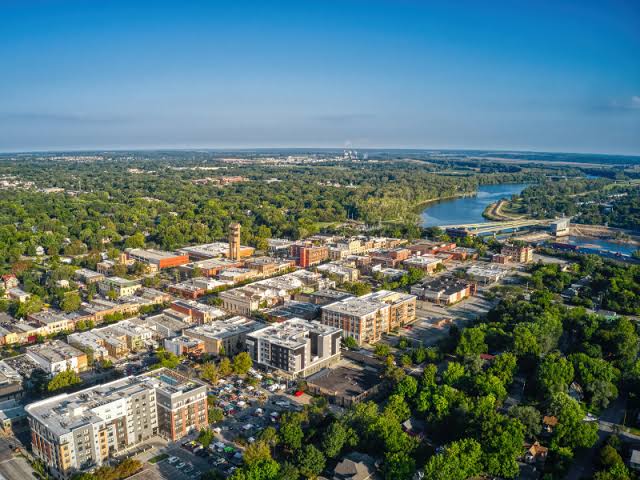
Lawrence combines a major university, a celebrated downtown, and the highest rental yields in eastern Kansas
2026 Economic Outlook
- University of Kansas enrollment remaining the single most important variable for the student rental market
- LMH Health and the broader clinical sector supporting stable non academic employment
- K-10 corridor commuter demand growing as Johnson County housing costs continue rising
- Spillover interest from the major industrial development underway to the east in De Soto, roughly twenty minutes along K-10
- Downtown Massachusetts Street remaining the cultural and retail anchor of the region
- Continued residential development pushing west and southwest as the historic core intensifies
Investment Climate
Lawrence rewards a different investor than Johnson County does. The returns arrive monthly rather than through appreciation, and the operational demands are higher. Successful Lawrence investors tend to share these characteristics:
- Regulatory literacy because rental registration, inspection standards, and occupancy limits govern what you can actually do with a property
- Comfort with the academic calendar since leases are signed months in advance for August starts and the leasing window is unforgiving if you miss it
- Tolerance for higher turnover and wear as student properties cycle annually and take more abuse than family rentals
- Active management capability or a manager who genuinely specializes in student housing, because generalist managers handle it poorly
- Awareness of enrollment trends which are the leading indicator for this entire market
- Renovation capability given that much of the campus adjacent stock is old and hard used
The market’s principal advantage is straightforward and rare in eastern Kansas: it pays you. A properly configured five bedroom near campus produces positive monthly cash flow at conventional leverage, which no city in Johnson County does at any price point. For an investor who needs income rather than equity growth, that is a meaningful difference.
The principal risk is concentration in a single institution. KU enrollment drives the rental market, and enrollment at American universities has become genuinely variable. A sustained decline would hit campus adjacent property values and rents harder than anything else in this market. That is not a reason to avoid Lawrence, but it is a reason to watch enrollment reporting the way a Wichita investor watches aerospace production rates.
Historical Performance
| Period | Market Driver | Avg Annual Appreciation | Key Event |
|---|---|---|---|
| 2010-2014 | Post recession recovery, steady enrollment | 2-4% | Purpose built student housing begins competing with traditional house rentals |
| 2015-2019 | K-10 commuter growth, downtown investment | 4-6% | Johnson County price pressure sends commuters west along the corridor |
| 2020-2022 | Remote work migration, record low inventory | 11-16% | Pandemic disruption to campus life followed by sharp recovery in demand |
| 2023-2024 | Rate shock, enrollment uncertainty across higher education | 3-5% | Investors begin distinguishing more carefully between campus adjacent and family submarkets |
| 2025-2026 | Normalization, western corridor employment growth | 5-6% (projected) | K-10 corridor industrial development supporting non student housing demand |
Over a 20 year window Lawrence has produced roughly 4 to 5.5 percent average annual appreciation, below Johnson County but well above most of Kansas. A $175,000 house purchased in 2006 is worth roughly $355,000 to $400,000 today. The important distinction is that Lawrence returns come substantially from cash flow rather than appreciation, which is the reverse of the Johnson County pattern. Over a ten year hold a Lawrence student rental will have paid you meaningful income along the way, where a Leawood property will have cost you money every month and returned everything at sale.
Demographic Trends Driving Demand
- University Enrollment – Roughly 28,000 students at KU, the overwhelming driver of rental demand and the number to watch above all others
- Graduate and Professional Students – An older, quieter, longer tenured tenant segment that many investors underweight and that often makes better tenants than undergraduates
- Faculty and University Staff – A stable, well educated employment base that rents and buys across the west and central neighborhoods
- Healthcare Employment – Clinical and support staff providing demand that does not track the academic calendar at all
- K-10 Corridor Commuters – Households working in Johnson County but buying in Lawrence for the price difference, a growing and underappreciated segment
- Haskell Indian Nations University – A smaller but historically significant institution contributing to the student rental base in south central Lawrence
📚 New to real estate investing? Master the fundamentals with our professional course Learn more →
2. Neighborhood Hotspots
Lawrence Investment Neighborhood Map
Interactive map of Lawrence’s investment neighborhoods. Green stars show top hotspots, blue circles mark established markets, and orange circles highlight emerging areas across the city.
Core Investment Neighborhoods
Detailed Submarket Analysis: All Lawrence Neighborhoods
| Neighborhood | Price Range | Cap Rate | Primary Tenant | Best Strategy |
|---|---|---|---|---|
| Oread / KU Campus | $270K-$450K | 6.5-7.5% | Undergraduate students | By the room leasing, highest yields, verify occupancy limits |
| North Lawrence | $180K-$300K | 6.2-7.2% | Workforce, mixed | Lowest entry price, value add, verify flood zone |
| East Lawrence | $230K-$390K | 5.8-7.0% | Mixed students and professionals | Value add, BRRRR, lower vacancy volatility |
| Barker / South of Downtown | $235K-$375K | 5.8-6.8% | Graduate students, staff | Graduate rental, value add, balanced returns |
| Pinckney / Northwest Central | $225K-$370K | 5.8-6.8% | Mixed students and families | Value add, historic character, attainable entry |
| Downtown / Massachusetts St | $250K-$550K | 5.4-6.4% | Young professionals | Loft and mixed use, walkability premium |
| Schwegler / South Central | $265K-$420K | 5.4-6.4% | Families, staff, graduates | Balanced buy and hold, overlooked submarket |
| Old West Lawrence | $300K-$625K | 5.2-6.2% | Professionals, faculty | Historic renovation, best Lawrence appreciation |
| Deerfield / Northwest | $300K-$500K | 4.9-5.8% | Families, faculty | Family rental, low turnover, stable occupancy |
| Prairie Park / Southeast | $310K-$480K | 4.9-5.8% | Families, K-10 commuters | Commuter rental, family hold, newer stock |
| Southwest / 31st and Iowa | $320K-$525K | 4.7-5.6% | Families, professionals | Newest inventory, low maintenance hold |
| Rock Chalk Park / Far NW | $340K-$600K | 4.7-5.6% | Families, professionals | Growth edge positioning, appreciation runway |
| West Lawrence / Alvamar | $340K-$650K | 4.6-5.5% | Families, faculty | Longest tenancies, lowest friction, family hold |
Expert Insight: “Everybody who calls me about Lawrence wants a house in Oread because they have seen the per bed math. Fair enough, the yields are real. But the properties I actually steer people toward are in East Lawrence and Barker, because the tenant pool there is mixed. If enrollment softens, or if the university adds another purpose built housing project, an Oread house has exactly one customer and you find out in June. An East Lawrence house rents to a graduate student, a nurse, a couple who work downtown, or a family. You give up maybe a point of yield and you buy yourself a completely different risk profile. In a one industry town, that trade is worth making.” – Bree Halloran, Investment Broker, Massachusetts Street Property Group
3. Property Types
| Investment Goal | Best Property Type | Best Neighborhoods | Minimum Capital |
|---|---|---|---|
| Maximum Cash Flow | Multi bedroom student house, by the room | Oread, campus adjacent, upper Barker | $95,000+ |
| Best Risk Adjusted Return | Renovated bungalow with a mixed tenant pool | East Lawrence, Barker, Pinckney | $80,000+ |
| Maximum Appreciation | Victorian or Craftsman historic home | Old West Lawrence | $110,000+ |
| Lowest Operational Burden | West Lawrence family home | West Lawrence, Deerfield, Prairie Park | $100,000+ |
| Lowest Entry Cost | North Lawrence value add, or FHA duplex house hack | North Lawrence, campus fringe, East Lawrence | $55,000+ |
Don’t guess the costs. Our Complete Renovation & Remodeling Cost Guide covers 400+ pages of project-by-project breakdowns with real contractor pricing ranges.
4. Cost Analysis
Acquisition Cost Breakdown (Lawrence)
| Expense Item | Typical Cost | Example ($340,000 Property) | Notes |
|---|---|---|---|
| Down Payment | 20-25% (investment) | $68,000-$85,000 | Unlike Johnson County, 25% down produces positive cash flow on properly configured student properties. |
| Closing Costs | 2-3% of price | $6,800-$10,200 | Title, escrow, lender fees, recording |
| Occupancy and Zoning Verification | $0 | $0 | The most important free step in Lawrence. Confirm with the city how many unrelated occupants are permitted at that address before you underwrite by the room income. |
| Rental Licensing and Inspection | Varies by program | Confirm with the city | Lawrence operates a rental registration and inspection framework. Budget both the fee and the cost of any work required to pass. |
| General Inspection | $425-$650 | $525 | Budget the upper range on the older campus adjacent and East Lawrence stock |
| Electrical Evaluation | $0-$400 | $0-$400 | Important on pre 1950 stock. Knob and tube and undersized panels appear in the historic neighborhoods. |
| Sewer Scope | $200-$350 | $250 | Essential in East Lawrence, Old West Lawrence, Pinckney, and North Lawrence |
| Flood Zone Determination | $0-$150 | $0-$150 | Critical in North Lawrence and anywhere near the Kansas River or Wakarusa drainages |
| Radon Test | $125-$200 | $150 | Eastern Kansas records elevated radon levels. Mitigation runs $900-$2,000. |
| Initial Repairs | 0-20% of price | $0-$68,000 | Higher on campus adjacent stock, which has been hard used for decades |
| Reserves (6 months) | 6 months expenses plus a summer gap | $11,000-$16,000 | Student properties need reserves that cover a potential summer vacancy, not just standard turnover |
| TOTAL MINIMUM ENTRY | ~26-52% of value | $87,000-$177,000 | Meaningfully less capital than any Johnson County city, and it produces positive carry |
Property tax note: Kansas assesses residential property at 11.5 percent of appraised value, and the combined Douglas County, City of Lawrence, and USD 497 mill levy puts the effective rate at roughly 1.45 to 1.6 percent of market value. That is higher than Johnson County and among the higher rates in Kansas. On a $340,000 home it runs $4,900 to $5,400 annually. The valuation resets to your purchase price on sale and the Douglas County appeal process is worth using when an assessment overshoots.
Sample Cash Flow Analysis: Campus Adjacent 5 Bedroom Student Rental
Deal structure: $310,000 purchase, $35,000 renovation (kitchen, two baths, flooring, paint, panel upgrade, heating and cooling replacement, durable finishes throughout), $8,000 closing. Total basis $353,000. After repair value approximately $395,000. Leased by the room at $625 per bedroom across five bedrooms, $3,125 per month. Confirm the permitted occupancy at that specific address with the City of Lawrence before underwriting this configuration.
| Item | Monthly | Annual | Notes |
|---|---|---|---|
| Gross Rent | $3,125 | $37,500 | 5 bedrooms at $625 each, walking distance to campus |
| Less Vacancy (8%) | -$250 | -$3,000 | Higher than a family rental. Student properties carry summer gap risk and per bed turnover. |
| Property Taxes | -$494 | -$5,928 | ~1.5% effective on the post renovation value. 16% of gross rent. Higher rate than Johnson County. |
| Insurance | -$208 | -$2,496 | Landlord policy. Confirm your carrier accepts by the room student occupancy, as some do not. |
| Maintenance + CapEx (11%) | -$344 | -$4,128 | Higher than the 9% used elsewhere in this series. Student properties take genuinely more wear. |
| Net Operating Income (self managed) | $1,829 | $21,948 | Before mortgage |
| Property Management (10%) | -$313 | -$3,756 | Student management runs higher than standard. Drops NOI to $1,516/month or $18,192/year. |
| Mortgage ($232,500 at 7.0%, 30yr, 25% down) | -$1,547 | -$18,564 | Principal and interest only |
| CASH FLOW (self managed, 25% down) | +$282 | +$3,384 | Positive at standard leverage. No Johnson County city does this at any price point. |
| CASH FLOW (professionally managed) | -$31 | -$372 | Essentially breakeven. Management is the difference between positive and flat here. |
| Cap Rate | 6.2% self managed / 5.2% managed | NOI divided by total basis of $353,000 | |
| Total Return Year One (self managed) | ~23% | Positive $3,384 cash flow plus $2,357 principal paydown plus 5.5% appreciation on $395,000, on $120,500 invested | |
| Immediate Forced Equity | $42,000 | $395,000 ARV less $353,000 total basis, realized at refinance |
This is the number that makes Lawrence worth understanding. Positive $282 per month at 25 percent down, on $120,500 invested, with a 23 percent total return. Compare that to Shawnee, the best cash flow city in Johnson County, which runs negative $83 on $101,500. Or Leawood, which bleeds $622 a month on $199,250. Lawrence is the only market in eastern Kansas where a conventionally financed property actually pays you while you own it. The cost of that is real: municipal regulation, an academic leasing calendar, higher wear, summer vacancy exposure, and dependence on a single university’s enrollment.
Expert Insight: “The mistake I see constantly with Lawrence student properties is people running the per bed math before they confirm the occupancy limit. They find a five bedroom house, multiply by six hundred and change, get excited, and then discover the zoning at that address permits fewer unrelated occupants than they planned to house. Now they own a five bedroom rental they can only lease to three people, and the whole model collapses. Call the city, give them the address, ask what is permitted. It takes one phone call and it is the difference between the deal you underwrote and a completely different deal.” – Reid Callahan, CPA, Kansas Real Estate Advisory
5. Legal Framework
⚠️ Lawrence Compliance Notice, and Read This One Carefully
This section matters more in Lawrence than in any other city in this Kansas series. Kansas state landlord law is identical here and remains favorable, but Lawrence layers municipal regulation on top of it in two ways that directly affect your investment: a rental registration and inspection framework, and occupancy limits governing how many unrelated people may occupy a dwelling in certain zoning districts. The second of those determines whether a by the room strategy is legally possible at a given address. Municipal programs change, and details vary by property type and zoning district. Confirm current registration requirements, inspection standards, and permitted occupancy directly with the City of Lawrence before you make an offer. Do not rely on this or any other published summary, and do not rely on what the seller tells you.
Kansas and Lawrence Regulations
The governing state statute is the Kansas Residential Landlord and Tenant Act, codified at K.S.A. 58-2540 and following:
- Nonpayment of Rent: 3 day written notice to pay or vacate, among the shortest notice periods in the country.
- Lease Violations: 14 day written notice to cure, with termination effective 30 days from notice if the breach is not remedied.
- Month to Month Termination: 30 days written notice by either party.
- Security Deposits: Capped at one month’s rent unfurnished, one and a half months furnished, plus an additional half month permitted for pets. Return due within 30 days with an itemized statement.
- Landlord Entry: Reasonable notice required, generally interpreted as 24 hours, except in emergency.
- No Rent Control: Kansas law preempts municipal rent control.
- Self Help Eviction Prohibited: Changing locks, removing doors, or shutting off utilities exposes you to damages and attorney fees.
- Court Venue: Evictions are filed in Douglas County District Court in Lawrence, which is convenient for local landlords.
- Rental Registration and Inspection, the Lawrence layer: The city operates a framework requiring residential rental property to be registered, with inspections against maintenance and safety standards. Confirm scope, fees, cycle, and current standards with the city.
- Occupancy Limits: Lawrence restricts the number of unrelated persons who may occupy a dwelling in certain zoning districts. This directly governs by the room strategies and varies by district. Verify per address.
- Historic District Requirements may apply to exterior work in Old West Lawrence and other designated areas.
Compliance Best Practices
Lawrence rewards investors who treat compliance as part of underwriting rather than an afterthought:
- Verify Permitted Occupancy Before You Offer. Call the city with the specific address and ask how many unrelated occupants are permitted. This single call determines whether your by the room income model is legal. Get the answer before removing contingencies.
- Budget for Registration and Inspection. Both the fee and, more importantly, the cost of bringing the property up to inspection standard. On older campus adjacent stock that can be a meaningful number.
- Confirm Your Insurance Carrier Accepts Student Occupancy. Some carriers decline by the room student rentals or price them punitively. Establish this before closing, not at binding.
- Use Leases Written for Per Bed Arrangements. Individual leases per bedroom with clearly defined common area rules, or joint and several liability, are different documents. Have Douglas County counsel prepare the template.
- Respect the Deposit Cap at one month unfurnished. With five separate tenants that is administratively involved, so document carefully.
- Never Attempt Self Help. The formal process is fast and the court is in Lawrence.
- Check Historic District Status before planning exterior work in Old West Lawrence and surrounding designated areas.
- Verify Flood Zone in North Lawrence and near the river and Wakarusa drainages, which affects both insurance and financing.
Useful Lawrence and Douglas County Resources
- City of Lawrence: lawrenceks.org
- City of Lawrence planning and development services for zoning, occupancy, and rental registration
- Douglas County Appraiser for parcel and valuation data
- Douglas County District Court in Lawrence for eviction filings
- Douglas County Register of Deeds for deeds, liens, and easements
- Kansas Statutes K.S.A. 58-2540 for the Residential Landlord and Tenant Act
| Regulation | Lawrence | Rest of Kansas | Investor Impact |
|---|---|---|---|
| Rental Registration | City framework with inspection requirements | Generally none in the cities covered in this series | The primary reason Lawrence scores lower on landlord friendliness |
| Occupancy Limits | Restrictions on unrelated occupants by zoning district | Varies, generally lighter | Directly determines whether a by the room strategy is legal at a given address |
| Eviction for Nonpayment | 3 day notice, filed in Douglas County District Court | Identical statewide | Among the shortest notice periods in the United States |
| Rent Control | Prohibited by state preemption | Identical statewide | Rents adjust to market with only standard notice |
| Security Deposit Cap | 1 month unfurnished, 1.5 furnished, plus 0.5 for pets | Identical statewide | Administratively involved with multiple per bed tenants |
| Property Tax Burden | ~1.45-1.6% effective | ~1.25-1.5% in Johnson County | Higher rate than Johnson County, though on lower values |
6. Step-by-Step Lawrence Investment Playbook
Define Your Lawrence Strategy
Lawrence supports genuinely different strategies with very different risk profiles. Choose deliberately:
By the Room Student Rental
Acquire a four to six bedroom house near campus and lease per bedroom. The highest yields in Kansas and the only eastern Kansas strategy that produces positive leveraged cash flow. Requires occupancy verification before you buy.
Mixed Tenant Value Add
Buy and renovate a bungalow in East Lawrence, Barker, or Pinckney and lease to whoever the best applicant is, whether graduate student, professional, or family. Slightly lower yield, materially lower concentration risk.
Small Multi Family Hold
Acquire a duplex or fourplex near the campus fringe. Per unit leasing avoids much of the by the room complexity while retaining most of the yield, and one roof over multiple rent streams is efficient at Douglas County tax rates.
West Lawrence Family Hold
Acquire newer family housing in the west or southwest. Lowest yields in Lawrence and modest negative carry, but no academic calendar dependency, no occupancy complexity, and the longest tenancies in the city.
Build Your Lawrence Team
The most important members of a Lawrence team are the ones who understand municipal regulation and the student leasing cycle:
- Agent Who Knows Occupancy Zoning. The single most valuable qualification here. Ask a prospective agent how occupancy limits work in Lawrence and how they vary by district. If they cannot answer, they will cost you a deal.
- Douglas County Real Estate Attorney. For per bed lease templates, joint and several liability provisions, and any question about registration or occupancy compliance.
- Property Manager Who Specialises in Student Housing. Generalist managers handle student properties badly. You need someone who understands the leasing calendar, per bed turnover, and parent guarantors.
- Contractor Who Builds for Durability. Student rentals need finishes chosen for abuse resistance, not aesthetics. A contractor who over specifies will blow your budget on materials that will not survive.
- Insurance Agent Who Writes Student Occupancy. Not all carriers will. Establish this before you go under contract.
- Real Estate CPA for depreciation, entity structure, and Douglas County valuation appeals.
Expert Tip: Ask any prospective property manager one question: when do you start leasing for the following August? If the answer is anything later than the previous autumn, keep looking. Lawrence student leases are signed months ahead, and a manager who starts marketing in May is competing for the students nobody else wanted. Missing the leasing window does not mean a slow lease up, it means a vacant house for an entire academic year.
Lawrence Specific Due Diligence
Standard due diligence items plus these Lawrence critical checks:
Regulatory Due Diligence
- Permitted occupancy at that specific address. The most important item on this entire page. Call the city, give them the address, ask how many unrelated occupants are permitted. Your entire income model depends on the answer.
- Rental registration status and inspection history. Confirm whether the property is currently registered, what the inspection cycle is, and whether there are outstanding items.
- Zoning district and any nonconforming use status. Some older campus properties operate under legal nonconforming status that may not survive a change in use or a lapse in occupancy.
- Historic district designation if you are buying in Old West Lawrence or nearby, which affects exterior work.
- Parking requirements for the permitted occupancy, which are a genuine constraint on campus adjacent properties.
- Open code enforcement cases with the City of Lawrence.
- Flood zone determination, critical in North Lawrence and near the river.
Physical Due Diligence
- Electrical panel and wiring type. Knob and tube and undersized panels appear across the pre 1950 stock. A five bedroom student house with a 100 amp panel is a genuine problem.
- Sewer lateral scope. Cast iron and clay throughout the historic neighborhoods.
- Condition relative to inspection standards rather than just to general habitability, since the city sets the bar you have to clear.
- Radon testing, since eastern Kansas records elevated levels.
- Supply plumbing material, with galvanized common in older stock.
- Basement condition and water management.
- Roof age and hail claim history.
- Realistic assessment of accumulated student wear, which is heavier than a normal inspection report conveys on a long term student property.
Operating on the Academic Calendar
Lawrence student rentals run on a rhythm that has nothing to do with how the rest of the rental world works. Getting this wrong costs a full year:
- Leasing starts roughly a year ahead. Students sign for the following August during the preceding autumn and winter. If you take possession in April and start marketing, you have already missed the market.
- Nearly all leases start and end in August. That concentrates turnover into a few weeks, which means your make ready work is compressed and contractors are in heavy demand at exactly that moment.
- Budget the summer gap honestly. Some students sublet, many do not. An eight percent vacancy assumption reflects reality better than the five percent used for family rentals.
- Consider twelve month leases at a modest discount. A slightly lower per bed rate for a full year lease often produces better annual revenue than a higher rate with a summer hole.
- Parent guarantors are standard. Most students cannot qualify on their own income. A guarantor with verified income is the norm and should be part of your written criteria.
- Time your acquisition. Buying a student property in autumn with leases already signed for the following year is a completely different risk than buying in May with nothing signed.
Property Management in Lawrence
Management fees are higher here than elsewhere in Kansas because student properties are genuinely more work. On the sample deal a 10 percent fee is $313 per month and it is the difference between positive $282 and negative $31:
Tenant Screening Protocol
Student screening works differently than standard residential screening, and the deposit cap makes written criteria essential:
- Parent or third party guarantor with verified income of at least 3 times the per bed rent, which is the practical standard for undergraduates
- Verification of enrollment status for student applicants
- Credit check on the guarantor, since most undergraduates have thin files rather than bad ones
- Prior landlord reference where one exists, recognising that first year renters will not have one
- Written, posted criteria applied identically to every applicant under federal fair housing law, which matters particularly in a market with a large international student population
- Clear decision on joint and several liability versus individual per bed leases, documented consistently across the property
Typical Lawrence Management Fees
- Standard single family management: 8-10% of monthly rent
- Student and by the room management: 10-12%, reflecting the per bed complexity
- Leasing fee: 50-100% of one month’s rent, sometimes charged per bed
- Lease renewal fee: $100-$250 per renewal
- Flat fee management: $110-$180 per door per month for standard rentals
- Turnover and make ready coordination: often billed separately given the compressed August window
- Maintenance coordination markup: typically 10% on vendor invoices, and student properties generate more invoices
7. Financing Options for Lawrence
| Loan Type | Down Payment | Rate Premium | Best For | Lawrence Note |
|---|---|---|---|---|
| Conventional Investment | 20-25% | +0.5-0.75% | Strong income, good credit | The default, and it produces positive cash flow here, which it does not anywhere in Johnson County. |
| DSCR Loan | 20-25% | +1.5-2.5% | Investors avoiding income documentation | Works genuinely well here. Lawrence yields clear coverage ratios that Johnson County properties cannot. Confirm how the lender treats per bed income. |
| House Hacking (FHA) | 3.5% | Standard + MIP | Owner occupying a 2-4 unit or renting rooms | Exceptionally strong in Lawrence. A graduate student or young professional buying a duplex near campus has one of the best entry paths in Kansas. |
| FHA 203(k) Renovation | 3.5% | Standard + MIP | Owner occupants buying older Lawrence homes | Well matched to the East Lawrence and Pinckney inventory, which needs panels, systems, and finishes |
| Portfolio / Community Bank | 20-30% | +0.5-1.5% | Multiple properties, student portfolios | Local banks understand the student rental model better than national lenders do. A genuine advantage in this market. |
| Small Multi Family Financing | 20-25% | +0.5-1% | Duplexes and fourplexes near campus | Lawrence has more genuine small multi family than most Kansas cities, and it finances conventionally |
| Blanket Portfolio Loan | 25-35% | +1-2% | Packaging 5+ student doors | Common among established Lawrence student housing operators |
| Hard Money (Bridge) | 15-25% | 10-13% rate | Value add acquisitions, heavy renovations | Useful for properties that will not pass a conventional appraisal in current condition, common in the campus adjacent stock |
Lawrence Financing Reality: This is the one Kansas market in this series where DSCR lending genuinely works at standard leverage, because the yields actually clear the coverage ratios. That is a direct consequence of by the room income, and it opens the market to investors who cannot or do not want to document personal income. Two cautions. First, ask any DSCR lender specifically how they underwrite per bed income, because treatment varies and some will only count a portion. Second, local community banks understand this market better than national lenders do, and a relationship with one is worth building if you intend to hold more than a property or two here. For anyone willing to occupy, FHA house hacking on a campus adjacent duplex is among the strongest entry paths available anywhere in Kansas.
8. Frequently Asked Questions

Knowledge Quiz: Lawrence Real Estate Investment
Open Quiz
5 quick questions on what you just learned about Lawrence investing
1) What is the single most important due diligence step before buying a Lawrence student rental?
Answer: C
Lawrence limits how many unrelated persons may occupy a dwelling, and the limit varies by zoning district. A five bedroom house is not automatically a house you may rent to five unrelated students. If permitted occupancy is lower than your bedroom count, your entire income model collapses. Existing use is not proof of compliant use, so asking the seller is not sufficient.
2) Why does Lawrence produce positive cash flow at 25 percent down when no Johnson County city does?
Answer: A
The sample Lawrence property has a higher basis than the Shawnee comparison at $353,000 against $304,000, yet produces 45 percent more rent because five bedrooms leased individually generate $3,125 rather than a single family lease around $2,150. Lawrence actually has higher property taxes at roughly 1.5 percent, higher maintenance at 11 percent, and higher vacancy at 8 percent. The leasing model overcomes all three.
3) Why does Lawrence score three stars on landlord friendliness when the rest of Kansas scores four?
Answer: D
Kansas state law is identical in Lawrence and remains favorable, with 3 day nonpayment notice, no rent control, and the same deposit caps. The lower score reflects municipal regulation that no other city in this Kansas series imposes: a rental registration and inspection framework, and occupancy limits on unrelated persons that directly constrain by the room strategies.
4) What does the guide recommend for most Lawrence investors rather than pure Oread student exposure?
Answer: B
An Oread house has essentially one customer, and if enrollment softens you find out in June. A renovated bungalow in East Lawrence rents to a graduate student, a nurse, a young couple, or a family, whoever is the strongest applicant that year. At 5.8 to 7.0 percent cap rates against 6.5 to 7.5 percent in Oread, the yield sacrifice is modest and the concentration risk reduction is substantial in a city with one dominant employer.
5) When are Lawrence student leases typically signed?
Answer: C
This is why timing matters so much here. Closing in April and starting to market means you have already missed the leasing window, and the consequence is not a slow lease up but a vacant house for a full academic year. It is also why the guide suggests asking any prospective property manager when they begin leasing for the following August. Anything later than the previous autumn is a warning sign.
Work With a Local Expert in Lawrence
We are building a verified network of real estate professionals across every market we cover.

About Our Expert Network
We are finalizing partnerships with verified real estate professionals across every market featured on Builds and Buys. Each expert in our network is selected for their hands-on investment experience, local market knowledge, and commitment to helping buyers and investors make sound decisions.
Our local specialists offer:
- Proven experience with investment and income-producing properties
- Deep knowledge of local pricing, rental yields, and neighborhood dynamics
- Guidance on financing, legal structure, and due diligence
- Access to off-market and pre-market opportunities
- Full transaction support from search through closing
- Ongoing portfolio and property management referrals
Services Covered
- Property sourcing and acquisition
- Investment analysis and underwriting
- Buyer representation
- Market comparables and valuations
- Short-term and long-term rental strategy
- Value-add and renovation guidance
- Legal and title referrals
- Financing and lender connections
- Property management referrals
- Insurance and inspection referrals
- 1031 exchange coordination
- Exit strategy planning
Get Connected or Join Our Network
Looking for a local expert to help with your investment? Reach out and we will connect you with the right professional for your market and strategy.
Are you a real estate professional with a track record working with investors? We are always expanding our network of verified local experts.
Contact us at support@buildsandbuys.com
Find Specialized Lawrence Real Estate Professionals
Ready to Invest in Lawrence?
Lawrence is the one market in eastern Kansas where a conventionally financed rental property actually pays you while you own it, and by the room student leasing is the reason. That advantage comes with real obligations. Confirm permitted occupancy with the city before you remove a contingency, understand the rental registration framework, respect a leasing calendar that runs a year ahead, and watch university enrollment the way any investor should watch their market’s dominant employer. For most investors the smartest position here is not pure Oread exposure but a well renovated house in East Lawrence, Barker, or Pinckney, where the tenant pool is genuinely mixed and the yield is only marginally lower. That is a durable position in a city that has been growing steadily since 1854.
Continue Your Research
Kansas State Guide
See how Lawrence compares to Wichita, Overland Park, and the rest of Kansas.
Step-by-Step Invest
Complete framework for building a real estate investment strategy from scratch.
144-Lesson Course
University-level real estate education covering financing, law, strategy, and management.
For further guidance, explore our State-by-State Investor guides, browse our expert articles, or follow our Step-by-Step Investment Guide.



