
Garland Real Estate Investment Guide For 2026
A comprehensive resource for investors looking to capitalize on one of DFW’s most balanced, affordable submarkets, with genuine DART rail access and proximity to the North Dallas job corridor
Quick answers: Top 5 most searched Garland investment questions ▼
Migration data: Where people are moving from to Garland ▼
In This Guide
Click on any section to navigate directly to that content
1. Garland Market Overview
Market Fundamentals
Garland is a genuinely balanced DFW submarket: the 13th-most populous city in Texas and the third-largest in Dallas County, offering real DART Blue Line rail access to Downtown Dallas at pricing meaningfully below Plano, Richardson, or North Dallas proper. From the newer, family-oriented Firewheel district to the more affordable, established Duck Creek and Embassy Trails neighborhoods, Garland’s 2026 market is best described by multiple sources as reaching genuine equilibrium.
Key economic indicators that define Garland’s investment case:
- Population: 246,018 at the 2020 census, the 13th-most populous city in Texas, with portions extending into Collin and Rockwall counties
- Major Employers: ABB and Sasol anchor a strong local economic base, alongside proximity to the broader North Dallas telecom and corporate corridor
- DART Access: two DART Blue Line stations connect Garland directly to Downtown Dallas, a genuinely rare amenity among DFW suburbs
- No State Income Tax: standard Texas advantage, compounding Garland’s relative affordability within the Metroplex
- Median Sale Price: reported figures range meaningfully by source, from approximately $287,000 (Redfin) to $319,250 (Movoto) and $348,000-$365,000 (HAR and other sources)
- Months of Inventory: approximately 3.4, described by multiple 2026 sources as genuine market equilibrium
Garland’s genuine distinguishing feature among DFW suburbs is its combination of affordability, rail access, and highway connectivity via I-30 and the President George Bush Turnpike. The city’s own 2026 market data explicitly rejects the idea of either a boom or a correction, describing balanced conditions with sale-to-list ratios around 96.6% and forecasts of modest, sustainable 2-4% appreciation.
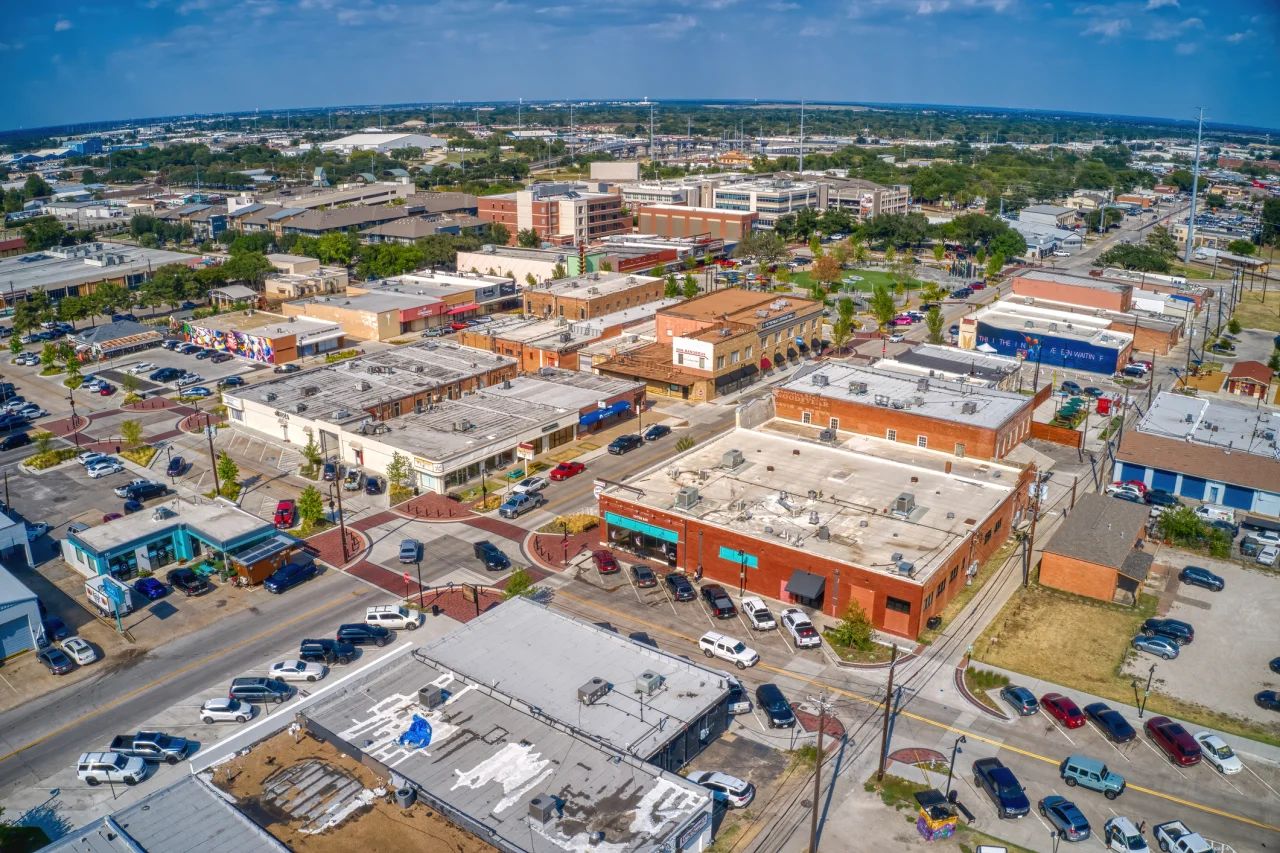
Garland’s Firewheel Town Center anchors the city’s newer, family-oriented growth corridor
2026 Economic Outlook
- Garland hosted 2026 FIFA World Cup matches in North Texas, drawing visitors and international attention to the city
- City planning its Fiscal Year 2026-27 operating budget, with council considering various facility and service adjustments
- Industry analysts cited by multiple 2026 sources agree a housing market crash is unlikely, describing current conditions as normalization rather than a bubble
- 16.23% of homes sold above asking price in March 2026, down from 21.71% the prior year, reflecting a genuine cooling from peak competitive conditions
- Existing home sales projected to increase 2-14% in 2026 depending on interest rate movements, per industry analyst consensus
Investment Climate
Garland’s investment environment in 2026 rewards investors who prioritize genuine, predictable balance over maximum upside. Successful Garland investors tend to share a few characteristics:
- ZIP code tax verification discipline given the genuine spread in median property tax bills, from $3,505 in 75041 to $5,104 in 75044
- Data source verification given the meaningful spread in reported median prices across national data providers
- Commute-corridor awareness recognizing that proximity to I-30 and the PGBT genuinely matters for tenant demand tied to Dallas and North Dallas employment
- School zone precision since Garland ISD’s large footprint spans many campuses with varying attendance zone desirability
- Realistic yield expectations given cap rates of 5.0-7.0%, solidly workable but not the highest in the DFW submarket set
Garland’s local market description of genuine equilibrium, neither favoring buyers nor sellers extremely, is precisely the profile of a mature, stable DFW suburb rather than a speculative growth story, a meaningfully different characterization than the sharper corrections or oversupply dynamics documented in some other Texas metros in this guide series.
Historical Performance
| Period | Market Driver | Avg Annual Change | Key Event |
|---|---|---|---|
| 2015-2019 | Steady value-seeking DFW spillover growth | +4-6% | Continued Firewheel-area development anchors steady demand |
| 2020-2021 | Pandemic-era appreciation, national low-rate environment | +10-15% | Genuine appreciation acceleration during the low-rate era |
| 2022-2024 | Rate normalization | +1-4% | Rapid prior appreciation moderates into steady, sustainable gains |
| 2025-2026 | Genuine market equilibrium | -4.3% to +0% (source-dependent) | Sources show modest, mixed year-over-year figures, none indicating a severe correction |
| 2026 (forecast) | Continued balanced conditions | +2-4% | Multiple 2026 sources forecast modest, sustainable appreciation with improved inventory |
Garland’s price history reflects a genuinely mature, stable DFW suburb rather than a speculative growth story: steady value-driven appreciation through the late 2010s, a pandemic-era surge, and a 2022-2026 normalization period that multiple sources explicitly describe as balanced rather than corrective. This is a meaningfully different characterization than the sharper corrections documented in Austin or the builder-driven oversupply story in Dallas proper elsewhere in this guide series.
Demographic Trends Driving Demand
- Firewheel Town Center – a Main Street-style outdoor mall with over 100 businesses and an AMC theater, anchoring the city’s newer, family-oriented growth corridor
- DART Blue Line Rail Access – two stations connecting Garland directly to Downtown Dallas, a genuinely rare amenity among DFW suburbs
- 5th Street Crossing – a mixed-use, transit-oriented development completed via public-private partnership, featuring 189 residential units, retail, and live-work units adjacent to the Downtown Garland DART station
- ABB and Sasol Employment – major employers anchoring a genuinely strong local economic base independent of the broader Dallas corporate corridor
- I-30 and PGBT Highway Access – vital commuter corridors connecting Garland to Dallas and the broader Metroplex job market
- Garland ISD School Quality Variation – a large district spanning many campuses, with attendance zone precision mattering meaningfully for family-tenant demand
📚 New to real estate investing? Master the fundamentals with our professional course Learn more →
2. Neighborhood Hotspots
Garland Investment Neighborhood Map
Interactive map of Garland’s investment neighborhoods. Green stars show top hotspots, blue circles mark established markets, and orange circles highlight emerging areas.
Core Investment Neighborhoods
Detailed Submarket Analysis: All Garland Neighborhoods
| Neighborhood | Price Range | Cap Rate | Growth Drivers | Best Strategy |
|---|---|---|---|---|
| South Garland | $200K-$300K | 6.0-7.5% | Deepest value entry, strongest cap rates | Best cash flow in the metro |
| Duck Creek / Embassy Trails | $220K-$340K | 5.5-7.0% | Affordability, larger lots | Cash flow focus, value-add |
| West Garland | $230K-$340K | 5.0-6.5% | I-30 proximity, established community | Balanced returns, accessible entry |
| Downtown Garland | $200K-$320K | 5.5-7.5% | DART access, walkability | DART-adjacent rental, urban infill |
| East Garland (Rockwall border) | $240K-$360K | 4.5-6.0% | Growth corridor, Rockwall spillover | Long-term appreciation |
| North Garland | $260K-$380K | 5.0-6.5% | Job corridor proximity | Balanced returns |
| Lakeside / Lake Ray Hubbard | $280K-$420K | 4.5-5.5% | Lake proximity, recreational amenities | Long-term appreciation, lifestyle rental |
| Firewheel | $320K-$500K | 4.5-6.0% | Newer construction, top schools | Family buy-and-hold, appreciation |
Expert Insight: “Garland’s genuine advantage over other affordable DFW suburbs is that you don’t have to sacrifice transit access to get the lower price point. Two DART Blue Line stations mean a South Garland or Duck Creek rental genuinely appeals to commuters who’d otherwise be looking in Dallas proper at double the price. Pair that with the highway access via I-30 and PGBT, and you have a genuinely durable, dual-pronged demand base for tenants.” – Marcus Chen, Principal, North Texas Value Investment Group
3. Property Types
| Investment Goal | Best Property Type | Best Neighborhoods | Minimum Capital |
|---|---|---|---|
| Best Cash Flow | SFH in value corridors | South Garland, Duck Creek | $50,000+ |
| Transit-Dependent Tenant Demand | Apartment/condo near DART | Downtown Garland | $50,000+ |
| Lowest Management | New construction suburban SFH | Firewheel | $80,000+ |
| Best Appreciation | SFH in top school zone | Firewheel, East Garland | $80,000+ |
Don’t guess the costs. Our Complete Renovation & Remodeling Cost Guide covers 400+ pages of project-by-project breakdowns with real contractor pricing ranges.
4. Cost Analysis
Acquisition Cost Breakdown (Garland)
| Expense Item | Typical Cost | Example ($320,000 Property) | Notes |
|---|---|---|---|
| Down Payment | 25% (investment) | $80,000 | Standard for investment properties in Texas |
| Closing Costs | 2-3% of price | $6,400-$9,600 | Title, escrow, lender fees, recording. No state transfer tax in Texas. |
| General Inspection | $400-$600 | $500 | Include roof and wind exposure assessment given North Texas storm risk |
| ZIP Code Tax Rate Verification | Free (Dallas Central Appraisal District lookup) | N/A | Important given median tax bills range from $3,505 (75041) to $5,104 (75044) within the city |
| Initial Repairs | 0-6% of price | $0-$19,200 | Higher end likely in older Duck Creek and South Garland stock |
| Reserves (6 months) | 6 months expenses | $9,000-$13,000 | Emergency fund for vacancy and repairs |
| TOTAL MINIMUM ENTRY | ~30-33% of value | $95,400-$106,300 | Moderate capital requirement typical of a balanced DFW submarket |
Sample Cash Flow Analysis: South Garland Single-Family Home
| Item | Monthly | Annual | Notes |
|---|---|---|---|
| Gross Rent | $1,850 | $22,200 | 3BR/2BA, South Garland |
| Less Vacancy (5%) | -$93 | -$1,116 | Conservative estimate given genuine, consistent demand from commuter tenants |
| Property Taxes | -$400 | -$4,800 | Estimated near the ZIP 75041 median tax bill of $3,505, adjusted upward for a $260,000 purchase price without homestead exemption |
| Insurance | -$135 | -$1,620 | Landlord policy reflecting North Texas hail and severe wind exposure |
| Property Management (9%) | -$167 | -$2,004 | Standard Garland single-family management fee |
| Maintenance + CapEx | -$148 | -$1,776 | 8% of rent, moderate reserve |
| Net Operating Income | $907 | $10,884 | Before mortgage |
| Mortgage ($260,000, 25% down, 6.5%, 30yr) | -$1,232 | -$14,784 | Principal and interest only |
| CASH FLOW | -$325 | -$3,900 | Modestly negative on 25% down; positive with 32-35%+ down or an all-cash purchase |
| Cap Rate | 4.19% | NOI / Purchase Price | |
| Total Return (2.5% appreciation) | ~8% | Including appreciation and principal paydown on leveraged purchase |
This South Garland example reflects a genuinely representative value-corridor property; Duck Creek and Embassy Trails properties would show similar or slightly stronger cap rates, while Firewheel properties would show meaningfully lower unleveraged cash flow but stronger appreciation potential.
Expert Insight: “The ZIP code tax spread in Garland is genuinely significant, nearly $1,600 a year between 75041 and 75044 at the median. That’s real money on a property that’s already producing modest cash flow. Before you make an offer, pull the actual combined rate for that specific ZIP code and factor it into your underwriting rather than assuming a citywide average.” – Marcus Chen, Principal, North Texas Value Investment Group
5. Legal Framework
⚠️ Compliance Notice
Garland follows the same statewide landlord-tenant law as the rest of Texas (Property Code Chapters 91-94), which remains broadly landlord friendly. This guide provides an overview only. Always consult a Texas-licensed real estate attorney before acquiring rental properties, and verify current Dallas Central Appraisal District figures directly for any specific property.
Garland-Specific Regulations
Landlord-tenant law itself is governed statewide, but Garland’s tax structure carries genuinely significant ZIP-code-level variation worth understanding:
- No Rent Control: The Texas Constitution (Article XI, Section 18) preempts local rent control entirely.
- No Statutory Deposit Cap: Landlords may charge any security deposit amount, subject to the 30-day return and itemization requirement under Tex. Prop. Code § 92.103.
- 3-Day Minimum Eviction Notice: The same statewide standard applies, per Tex. Prop. Code § 24.005.
- ZIP Code Tax Variation: Median property tax bills range genuinely from $3,505 in ZIP 75041 to $5,104 in ZIP 75044, a significant spread within one city that meaningfully affects underwriting.
- Multi-County Footprint: Garland extends into Dallas, Collin, and Rockwall counties, meaning the specific taxing jurisdiction can vary even within the city depending on the address.
- Homestead Exemptions: $100,000-$140,000 school district exemption available to owner-occupants under the 2025 statewide increase (SB 4 / Proposition 13); not available to investment properties.
- Annual Protest Deadline: The Dallas Central Appraisal District’s formal appeal deadline is typically May 15 each year, a genuinely worthwhile exercise given Garland’s above-national-median tax bills.
Compliance Best Practices
Systematic compliance protects Garland investors from costly disputes even in a broadly landlord-friendly framework:
- Written Lease Requirement: Use a written lease specifying entry notice, late fees, and deposit terms explicitly, since Texas law leaves several areas to the lease itself rather than statute.
- Move-In Documentation: Photograph and date every room at move-in, since Texas does not require a joint walk-through.
- Annual Property Tax Protest: Given Garland’s above-national-median tax bills in several ZIP codes, protesting annually through the Dallas Central Appraisal District (or the applicable Collin or Rockwall County district, depending on address) can meaningfully reduce the bill.
- Residential Service Contract Awareness: It’s common for Garland sellers to provide a Residential Service Contract (RSC) offering limited repair coverage for major systems after closing; investors should review these terms carefully during due diligence.
- Weather-Related Documentation: Given genuine North Texas hail and severe wind exposure, maintain thorough documentation of roof condition and any storm-related claims history.
- Professional Management: For any out-of-state investor, professional management with specific Garland submarket experience, particularly regarding ZIP-code-level tax and school variation, is a genuine advantage.
Useful Garland Resources
- Dallas Central Appraisal District: dallascad.org
- City of Garland Tax Rates: garlandtx.gov/1910/Tax-Rates
- Texas Attorney General Renter’s Rights: texasattorneygeneral.gov
- Garland Association of Realtors (via NTREIS/local MLS boards)
| Regulation | Garland Requirement | Compare: Irving | Investor Impact |
|---|---|---|---|
| Median Property Tax Bill | $3,505-$5,104 depending on ZIP code | Varies by DCURD status and school district | Both cities require genuine ZIP-code-level verification rather than a citywide assumption |
| Transit Access | Two DART Blue Line stations | DART Orange and Blue Line, five Las Colinas stations | Both offer genuinely rare DFW rail access, though Irving’s is more concentrated around its corporate core |
| Eviction Notice | 3 days minimum (statewide) | Same statewide standard | Identical eviction process and timeline across both cities |
| Median Home Values | ~$287,000-$365,000 depending on source | ~$341,000-$420,000 depending on source | Garland offers meaningfully lower entry prices for comparable transit access |
6. Step-by-Step Garland Investment Playbook
Define Your Garland Strategy
Garland’s genuine balance between affordability and transit access supports several distinct strategies. Before buying, be clear on which of these strategies you are executing:
Value Corridor Cash Flow
Buy in South Garland or Duck Creek at the metro’s lowest entry prices, capturing the strongest cap rates available in the city.
DART Commuter Rental
Acquire an apartment or condo near Downtown Garland’s DART station, targeting genuine, transit-dependent commuter demand.
Firewheel Family Hold
Acquire newer single-family homes in Firewheel for the strongest family demand and top Garland ISD attendance zones, accepting a lower cap rate for lower management intensity.
Value-Add BRRRR
Buy dated properties needing cosmetic and system updates in Duck Creek or South Garland, capturing forced appreciation given the accessible acquisition basis and larger lots.
Build Your Garland Team
Garland’s genuine ZIP-code-level tax and multi-county complexity make specific local expertise particularly valuable. Non-negotiable team members:
- Garland-Specialist Real Estate Agent: Must understand the genuine tax and school variation across the city’s ZIP codes and its Dallas/Collin/Rockwall county footprint.
- Local Appraiser Relationship: Given the genuine spread in reported median prices, a working relationship with a Garland-based appraiser helps verify accurate comps.
- Garland-Licensed Property Manager: Verify specific experience with the tenant profile you’re targeting, whether commuter renters near DART or family tenants in Firewheel.
- Storm-Experienced Inspector: Given the December 2015 EF4 tornado history in southeast Garland, a roof and structural assessment with genuine storm-damage experience is valuable.
- Real Estate CPA familiar with the Texas market: For depreciation strategy, entity structuring, and Dallas Central Appraisal District protest procedures.
Expert Tip: Ask any Garland agent directly: “What is the actual combined tax rate for this specific ZIP code, and which county’s appraisal district does it fall under?” Given the roughly $1,600 median spread between the city’s lowest and highest ZIP codes, and its multi-county footprint, this single question can materially affect your underwriting.
Garland-Specific Due Diligence
Standard due diligence items plus these Garland-critical checks:
Physical Due Diligence
- Roof condition and age given genuine North Texas hail exposure
- Severe wind and tornado risk review, given the city’s documented 2015 EF4 tornado history
- HVAC efficiency given rising extreme heat days projected for the region
- Foundation inspection given North Texas clay soil movement
Regulatory and Market Due Diligence
- Verify the exact combined tax rate for the specific ZIP code and applicable county appraisal district
- Confirm the specific Garland ISD attendance zone, since school quality varies meaningfully across the district’s large footprint
- Review any Residential Service Contract offered by the seller for coverage terms and limitations
- Pull actual comparable sales directly given the genuine spread across national data providers
Negotiating in Garland’s Balanced 2026 Market
With 3.4 months of inventory and a 96.6% sale-to-list ratio, Garland’s own 2026 data describes genuine equilibrium rather than a buyer’s or seller’s market. Strategies that work:
- Target listings with recent price reductions: With 33.14% of homes showing price reductions (down slightly from 37.06% the prior year), these sellers have signaled realistic pricing expectations.
- Secure financing pre-approval before shopping: Local market reports specifically emphasize pre-approval as a way to strengthen offers in Garland’s genuinely competitive-but-balanced environment.
- Use verified local comps as leverage: Given the genuine spread across national data providers, bringing your own verified comp analysis is a real advantage in negotiations.
- Move decisively on well-priced Firewheel or DART-adjacent inventory: These segments see more consistent demand than the broader citywide average suggests.
Property Management in Garland
Garland’s genuinely diverse tenant base, from DART commuters to Firewheel families, makes specific management focuses particularly important in 2026. Key management focuses:
Managing Across Garland’s Diverse Tenant Segments
Garland’s genuine mix of value-corridor, transit-oriented, and family-oriented submarkets calls for tailored management approaches:
- For DART-adjacent rentals, emphasize proximity to the Downtown Garland station and 5th Street Crossing amenities in marketing
- For Firewheel-area properties, verify the specific Garland ISD attendance zone when screening family tenants
- For value-corridor properties in South Garland or Duck Creek, budget realistically for maintenance given older housing stock
- Verify whether the property carries an active Residential Service Contract that could affect maintenance response protocols
Typical Garland Management Fees
- Single-family management: 8-10% of monthly rent
- Multi-family management: 7-9% of monthly rent
- Leasing fee: 50-100% of one month’s rent
- Lease renewal fee: $125-$275 per renewal
7. Financing Options for Garland
| Loan Type | Down Payment | Rate Premium | Best For | Garland Note |
|---|---|---|---|---|
| Conventional Investment | 20-25% | +0.5-0.75% | Strong W-2 income, good credit | Garland’s affordability keeps nearly all properties comfortably under conforming loan limits |
| DSCR Loan | 20-25% | +1-2% | Investors who want no income verification | South Garland and Duck Creek’s 5.5-7.5% cap rates generally support DSCR qualification well; Firewheel properties may qualify less easily |
| Portfolio Loan | 20-25% | +1-1.75% | Multiple properties, self-employed | Regional and community banks with genuine DFW suburban lending experience are active in this market |
| Renovation Loan (203k/HomeStyle) | 3.5-15% | +0.5-1% | Value-add purchases in Duck Creek/South Garland needing updates | Strong fit for the city’s older housing stock in established neighborhoods |
| House Hacking (FHA) | 3.5% | Standard + MIP | Owner-occupying a lower-cost Garland property while renting a room or unit | Genuinely accessible given the metro’s affordability relative to other DFW submarkets |
Garland Financing Reality: Garland’s genuine affordability relative to Plano, Richardson, or North Dallas means most conventional and DSCR financing paths work comfortably for value-corridor properties. Given the market’s genuine data variance across sources and ZIP-code-level tax complexity, lenders and appraisers may request additional local comp documentation, so building a relationship with a Garland-based lender familiar with the local market’s nuances is a genuine advantage.
8. Frequently Asked Questions

Knowledge Quiz: Garland Real Estate Investment
Open Quiz
5 quick questions on what you just learned about Garland investing
1) What genuine transit advantage does Garland offer among affordable DFW suburbs?
Answer: C
Garland’s two DART Blue Line stations connect directly to Downtown Dallas, a genuinely rare amenity among comparably-priced DFW suburbs, anchoring transit-dependent commuter demand.
2) How much does Garland’s median property tax bill vary by ZIP code, per the guide?
Answer: D
Garland’s median property tax bill ranges genuinely from $3,505 in ZIP 75041 to $5,104 in ZIP 75044, a significant spread within one city that meaningfully affects underwriting.
3) What do multiple 2026 sources say about Garland’s current housing market conditions?
Answer: B
Multiple 2026 sources describe Garland’s conditions as genuine equilibrium, with industry analysts explicitly rejecting the idea of an imminent crash and forecasting modest 2-4% appreciation instead.
4) Which neighborhood does the guide identify as the city’s newer, growth-oriented family district?
Answer: A
Firewheel, anchored by Firewheel Town Center, is Garland’s newer, growth-oriented family district, offering 1990s-2010s construction and highly-rated Garland ISD attendance zones.
5) What eviction process applies in Garland, per the guide?
Answer: C
Garland’s eviction process is governed by the same statewide Texas Property Code Chapter 24 as every other Texas city covered in this series, with a 3-day minimum notice and a realistic 3-6 week total timeline for an uncontested case.
Work With a Local Expert in Garland
We are building a verified network of real estate professionals across every market we cover.

About Our Expert Network
We are finalizing partnerships with verified real estate professionals across every market featured on Builds and Buys. Each expert in our network is selected for their hands-on investment experience, local market knowledge, and commitment to helping buyers and investors make sound decisions.
Our local specialists offer:
- Proven experience with investment and income-producing properties
- Deep knowledge of local pricing, rental yields, and neighborhood dynamics
- Guidance on financing, legal structure, and due diligence
- Access to off-market and pre-market opportunities
- Full transaction support from search through closing
- Ongoing portfolio and property management referrals
Services Covered
- Property sourcing and acquisition
- Investment analysis and underwriting
- Buyer representation
- Market comparables and valuations
- Short-term and long-term rental strategy
- Value-add and renovation guidance
- Legal and title referrals
- Financing and lender connections
- Property management referrals
- Insurance and inspection referrals
- 1031 exchange coordination
- Exit strategy planning
Get Connected or Join Our Network
Looking for a local expert to help with your investment? Reach out and we will connect you with the right professional for your market and strategy.
Are you a real estate professional with a track record working with investors? We are always expanding our network of verified local experts.
Contact us at support@buildsandbuys.com
Find Specialized Garland Real Estate Professionals
Ready to Invest in Garland?
Garland offers a genuinely balanced DFW investment case: real DART rail access, proximity to the North Dallas job corridor, and pricing meaningfully below Plano or Richardson. The market’s own 2026 data describes genuine equilibrium rather than either a boom or a correction, making it a reasonable choice for investors who prioritize steady, predictable conditions. Investors who verify ZIP-code-level tax rates and school zones carefully, whether cash flow in South Garland or family appreciation in Firewheel, will find a genuinely durable, well-rounded market.
Continue Your Research
For further guidance, explore our State-by-State Investor guides, browse our expert articles, or follow our Step-by-Step Investment Guide.



