
Bullhead City Arizona Real Estate Investment Guide For 2026
A comprehensive resource for investors targeting Arizona’s Colorado River corridor, where Laughlin Nevada casino employment, water recreation tourism, strong workforce housing demand, and Arizona’s most affordable single-family homes near a major entertainment destination combine to create a compelling cash flow investment opportunity
Quick answers: Top 5 most searched Bullhead City investment questions ▼
Migration data: Where people are moving from to Bullhead City ▼
In This Guide
Click on any section to navigate directly to that content
1. Bullhead City Market Overview
Market Fundamentals
Bullhead City occupies one of the most strategically unusual investment positions in Arizona real estate. It sits on the Arizona side of the Colorado River directly across from Laughlin, Nevada’s casino and entertainment strip, providing the primary workforce housing market for an entertainment economy of 5,000 to 8,000 workers who choose lower-cost Arizona housing over Nevada alternatives. This cross-state employment dynamic, combined with Colorado River water recreation tourism, creates Arizona’s highest cap rates in an employment-anchored market.
Key fundamentals defining Bullhead City’s investment case:
- Population: 42,000+ city proper; 100,000+ Tri-State area (BHC, Laughlin NV, Needles CA)
- Primary Employment: Laughlin’s 9 casinos and supporting hospitality economy across the river
- Secondary Employment: Mohave Valley USD, healthcare sector, local retail and services
- Median Home Price: $265,000 (among Arizona’s most affordable inhabited cities)
- Cap Rates: 7 to 10 percent for long-term workforce rentals
- Climate Challenge: 115 to 120+ degrees Fahrenheit in summer; extreme heat is the primary operational risk
The investment case for Bullhead City is straightforward but requires honest eyes-open acknowledgment of its challenges. The cap rates are genuinely exceptional for a market with stable employment anchoring. The heat is genuinely extreme and affects AC costs, tenant comfort, and summer vacancy more than any other Arizona investment market. Investors who understand both sides and plan accordingly can access returns unavailable anywhere else in Arizona at comparable property quality.
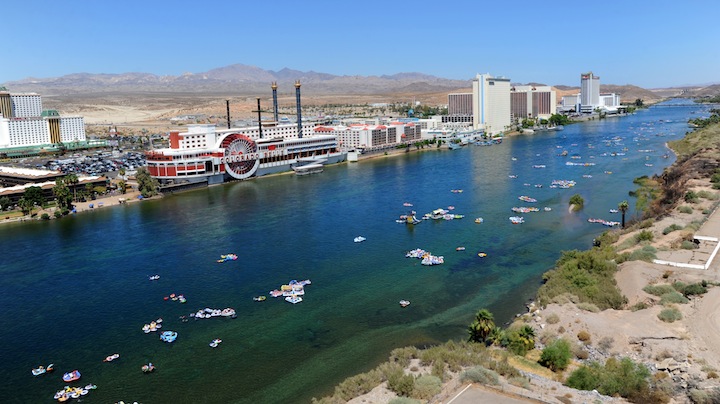
Bullhead City’s Colorado River location directly across from Laughlin’s casino strip creates a unique cross-state workforce housing dynamic unlike any other Arizona market
2026 Economic Outlook
- Laughlin casino operations continuing with stable regional visitor base
- Colorado River recreation tourism sustaining spring and fall peak seasons
- Snowbird winter rental demand from cold-state retirees arriving October
- Don Laughlin Riverside Resort expansion adding employment
- I-40 corridor growth in adjacent Kingman adding regional employment options
The Laughlin Casino Employment Dynamic
Understanding the Laughlin employment dynamic is essential to understanding why Bullhead City works as an investment. Laughlin, Nevada has nine major casinos including Don Laughlin’s Riverside Resort, the Golden Nugget, Harrah’s, and several others. These operations collectively employ thousands of workers in jobs that range from casino dealers and pit bosses to hotel housekeeping, restaurant staff, security, maintenance, and management.
The key insight is this: Nevada housing costs, even in Laughlin itself, are meaningfully higher than comparable Arizona housing in Bullhead City. Workers who earn $35,000 to $65,000 annually in casino service roles consistently choose to live in Bullhead City and commute across the Colorado River bridge rather than pay Nevada housing costs. This cross-state workforce dynamic has been stable for decades. It is not a new development or a trend; it is the permanent structural reality of the Laughlin-Bullhead City labor market.
For investors, this means:
- A large, stable workforce of employed renters with predictable incomes who cannot afford to buy at Arizona prices yet and choose Bullhead City over Nevada options
- Consistently low vacancy in mid-range workforce rental properties because the employment base provides steady demand
- Rents that are supported by casino wages even though those wages are moderate, because the alternative (Nevada housing) is more expensive
Historical Performance
| Period | Market Driver | Avg Annual Appreciation | Key Event |
|---|---|---|---|
| 2010-2016 | Recovery, casino workforce stable | 2-4% | Laughlin casino employment stabilizes post-recession; BHC workforce housing demand consistent |
| 2017-2019 | River tourism growth, workforce steady | 4-7% | Colorado River recreation tourism growing; Arizona affordability attracting Phoenix retirees |
| 2020-2022 | Pandemic outdoor recreation surge | 20-30% | Outdoor recreation boom drives Colorado River demand; affordability discovery by Phoenix buyers |
| 2023-2024 | Rate normalization, casino recovery | 3-6% | Market moderates from peak; casino tourism recovering post-pandemic; workforce demand stable |
| 2025-2026 | Stable casino workforce, river tourism | 5-8% (projected) | Arizona affordability advantage sustaining cross-river workforce housing demand |
📚 New to real estate investing? Master the fundamentals with our professional course Learn more →
2. Neighborhood Hotspots
Bullhead City Investment Neighborhood Map
Interactive map of Bullhead City’s investment neighborhoods. Green stars show top hotspots, blue circles mark established markets, and orange circles highlight emerging areas.
Core Investment Neighborhoods
Detailed Submarket Analysis
| Area | Price Range | Cap Rate | Primary Demand | Best Strategy |
|---|---|---|---|---|
| Central BHC (Bridge area) | $220K-$330K | 8-10% | Casino workforce, shift workers | Maximum cash flow, workforce housing |
| Riviera / River Access | $280K-$550K | 7-12% | STR river tourism, casino workers | Dual LTR/STR, river recreation |
| Laughlin Ranch / Adobe Hills | $260K-$400K | 7-9% | Quality workforce, local employers | Quality hold, lower maintenance |
| Bullhead City North | $200K-$290K | 7-9% | Retirees, broad workforce | Lower entry, retiree rental |
| Fort Mohave | $240K-$360K | 7-8.5% | Families, newer construction | Family rental, newer stock |
| Golden Valley / I-40 | $160K-$260K | 8-11% | Dual BHC/Kingman workers | Ultra-low entry, highest yield |
Expert Insight: “Bullhead City is one of those markets that investors from Phoenix or Scottsdale dismiss because they associate it with extreme heat and casino workers. That dismissal is exactly why the returns exist. The casino economy here is as stable as any employer-based rental market I have worked in. The Golden Nugget is not going anywhere. Harrah’s is not going anywhere. Thousands of workers cross that bridge every day and live on this side because Arizona housing is cheaper. That dynamic does not change. What you have to accept is that your AC units will work harder here than anywhere else in Arizona, your maintenance budget needs to reflect that, and you will not see the appreciation that Scottsdale investors brag about. But you will cash flow positively from day one on well-selected central BHC properties, and that is increasingly rare in this state.” – James Kowalski, Colorado River Investment Group
3. Property Types
| Investment Goal | Best Property Type | Best Location | Minimum Capital |
|---|---|---|---|
| Maximum Cash Flow | Casino workforce LTR or multi-family | Central BHC, Golden Valley | $40,000-$75,000 |
| STR + Seasonal | River-adjacent STR property | Riviera, Colorado River corridor | $75,000-$140,000 |
| Quality Hold | Suburban quality LTR | Laughlin Ranch, Adobe Hills | $65,000-$100,000 |
| Lowest Entry | Golden Valley affordable SFH | Golden Valley I-40 corridor | $40,000-$65,000 |
Don’t guess the costs. Our Complete Renovation & Remodeling Cost Guide covers 400+ pages of project-by-project breakdowns with real contractor pricing ranges.
4. Cost Analysis
⚠️ Critical Bullhead City Cost Note: AC replacement costs in Bullhead City are the highest in Arizona due to extreme summer heat. Units working continuously at 115 to 120+ degrees have significantly shorter lifespans than in Phoenix or Tucson. Budget $7,000 to $14,000 for AC replacement (more than in most Arizona markets) and plan for 8 to 12 year replacement cycles rather than 12 to 15 years. This capital expense must be factored into every Bullhead City investment analysis. Failure to account for elevated AC costs is the most common error investors make in this market.
Sample Cash Flow Analysis: Central Bullhead City 3BR Casino Workforce Rental
| Item | Monthly | Annual | Notes |
|---|---|---|---|
| Gross Rent | $1,600 | $19,200 | 3BR central BHC, near bridge, good condition |
| Less Vacancy (6%) | -$96 | -$1,152 | Slightly higher than Tucson metro; some summer tenant transitions |
| Property Taxes | -$170 | -$2,040 | Mohave County rate approximately 0.7% on lower assessed values |
| Insurance | -$100 | -$1,200 | Landlord policy; rates reasonable; no wildfire or flood premium for most BHC properties |
| Property Management (10%) | -$160 | -$1,920 | Local Bullhead City management; 10% reflects slightly higher management complexity |
| Maintenance + CapEx (elevated) | -$275 | -$3,300 | Higher than Tucson: 17% of rent to account for accelerated AC replacement and extreme heat wear |
| Net Operating Income | $799 | $9,588 | Before mortgage; 4.0% cap rate on $265K property but higher NOI than most AZ suburban markets |
| Mortgage ($265K purchase, 25% down, 7.0%, 30yr) | -$1,321 | -$15,852 | On $198,750 loan balance |
| CASH FLOW | -$522 | -$6,264 | Negative at 7% due to elevated CapEx; positive at 6.5%; strongly positive at 6.0% |
| Cash Purchase Scenario | +$799 | +$9,588 | 3.6% unlevered yield; strong for no-debt cash flow |
| Golden Valley ($200K, $1,350 rent, 20% down) | +$198 | +$2,376 | Positive cash flow at 7% on lower price with proportionate rent |
The BHC cash flow reality: Bullhead City’s elevated CapEx requirement due to extreme heat means the simple headline cap rate (8 to 10 percent gross) overstates returns somewhat. When elevated AC replacement costs are properly accounted for, the net effective return is lower than the gross headline suggests. However, Bullhead City still delivers better cash flow metrics than Phoenix suburbs or northern Arizona appreciation markets. The Golden Valley scenario shows that at lower price points, genuine positive cash flow at 7 percent rates is achievable. Cash purchase investors earn 3.6 percent unlevered yields on central BHC properties, with no debt service to manage.
Expert Insight: “Every investor who calls me about Bullhead City asks why the numbers are not as good as they expected when they first heard ‘8 to 10 percent cap rates in Arizona.’ The reason is the heat. I set up a higher CapEx reserve here than anywhere else I manage. Plan for your AC to be replaced every 8 to 10 years, not 12 to 15. Plan for roof and exterior wear that happens faster at 120 degrees than it does at 105 degrees. Plan for higher vacancy in July and August when some tenants simply cannot tolerate the heat and leave. Budget for all of that honestly and the numbers still work, but they are not the outsized cash flow miracle that the gross headline suggests.” – Lisa Fontaine, Bullhead City Property Management
5. Legal Framework
✅ Full Arizona Landlord-Friendly Framework
Bullhead City and Mohave County operate under Arizona state landlord-tenant law with no local rent control, no just cause eviction requirements, and Mohave County Justice Court proceedings. The standard Arizona 5-day pay-or-quit, 25 to 35 day total eviction timeline applies fully. Arizona’s landlord-friendly framework is one of the key reasons investors choose BHC over comparable markets in California (Needles is minutes away but operates under California’s landlord restrictions) and Nevada (Laughlin has its own regulatory requirements).
Arizona Landlord Law in Bullhead City
- Non-Payment Eviction: 5-day pay-or-quit notice. File Mohave County Justice Court on day 6. Hearing within 2 to 3 weeks. Total 25 to 35 days.
- Lease Violation: 10-day notice to cure for material violations.
- Month-to-Month: 30-day notice, no cause required.
- Security Deposit: Maximum 1.5 months rent.
- Rent Control: Prohibited statewide. Bullhead City cannot impose any restrictions.
- HVAC Habitability: AC maintenance an absolute emergency in Bullhead City’s 115 to 120+ degree climate. Cooling failure is a life safety issue at these temperatures, not merely a comfort issue. Response within hours is legally required and morally essential.
- Arizona vs. California Advantage: Properties just across the river in Needles, California operate under California’s more restrictive landlord-tenant laws. Arizona’s framework is dramatically more investor-friendly, which is a genuine competitive advantage for BHC over the California alternative.
Bullhead City-Specific Compliance
- STR Registration: City of Bullhead City requires STR registration and compliance. Arizona state STR rights protected. Simpler requirements than Sedona.
- Arizona TPT for STR: Collect and remit Arizona TPT at approximately 13 to 15 percent combined if operating STR. Most major platforms handle collection automatically.
- Flood Zone: Some Colorado River-adjacent properties are in FEMA flood zones. Verify flood zone status and flood insurance requirements before purchasing any river-adjacent property. Flood insurance adds meaningful cost.
- No HOA Prevalence: Unlike Marana or Gladden Farms, most central BHC properties are not in HOA communities. Lower HOA compliance complexity, but also no HOA maintenance standards enforcement helping property condition.
Key Resources
- City of Bullhead City: bullheadcity.com
- Mohave County Justice Court: mohavecourts.com
- Arizona Landlord-Tenant Act: azleg.gov
- FEMA Flood Map: msc.fema.gov
6. Step-by-Step Bullhead City Investment Playbook
Choose Your Bullhead City Strategy
Casino Workforce Cash Flow
Buy central BHC homes near the bridge for maximum casino worker demand. Rent to casino workers at $1,400 to $1,750 per month. Highest cap rates in Arizona for employment-anchored properties. Accept the heat challenge in exchange for the yield.
River STR + Snowbird Dual Strategy
Buy a river-adjacent property and operate STR in spring and fall for recreation tourists, furnish for snowbird winter rentals at $1,800 to $2,800 per month, and convert to long-term casino worker rental in summer to maintain occupancy during the hot slow STR season.
Ultra-Low Entry Golden Valley
Buy Golden Valley or Mohave Valley properties at $160,000 to $240,000 for the lowest absolute capital requirement and highest cash-on-cash returns. Genuine positive cash flow at 7 percent rates. Best entry point for first-time investors or those with limited capital seeking maximum returns on available funds.
Quality Suburban Hold
Buy Laughlin Ranch or Fort Mohave homes for better property quality, lower maintenance costs, and quality tenant profiles. Accept slightly lower cap rates in exchange for reduced management complexity and better long-term appreciation. Best for investors prioritizing passive income over maximum yield.
Build Your Bullhead City Team
- Bullhead City-Specific Investment Agent: Must understand the casino workforce market, river STR dynamics, and the specific neighborhoods near the Laughlin Bridge that command maximum demand. A general Arizona agent who occasionally sells in BHC will not have this granular knowledge.
- Local Bullhead City Property Manager: Essential for out-of-state investors. The casino workforce tenant pool has specific characteristics (shift work schedules, varying income stability, heat intolerance) that a local manager who specifically manages BHC properties understands. Ask for their current vacancy rate and their approach to summer AC emergencies.
- HVAC Contractor Relationship: More critical in BHC than anywhere else in Arizona. At 120 degrees, AC failure is potentially dangerous for tenants. Having a local HVAC contractor who will prioritize your property for emergency service is not optional; it is a life safety requirement. Establish the relationship before you need it.
- Flood Zone Specialist (if buying river-adjacent): If purchasing any Colorado River-adjacent property, work with an insurance agent familiar with FEMA flood zone determinations and flood insurance requirements in the BHC area. Flood insurance on a river-adjacent property can add $1,000 to $3,000+ annually to your costs.
Bullhead City Due Diligence
Physical Inspection Priorities
- AC system SEER rating and age (replace units over 10 years old before renting)
- Roof condition (extreme heat degrades roofing materials faster)
- Exterior paint and stucco condition
- Evaporative cooler vs. refrigerated AC (evaporative coolers are insufficient at BHC temperatures)
- Pool equipment condition if present
- Flood zone verification for river-adjacent properties
- Foundation inspection (desert caliche soil requires specific assessment)
Market Due Diligence
- Verify actual Laughlin bridge commute time from the specific property
- Research casino employment levels and any major Laughlin changes
- Obtain actual rental comps from local property managers for specific street
- Verify flood zone status (FEMA Map) for river-adjacent properties
- Check STR comparable revenue data for river properties (AirDNA)
- Research any planned Laughlin development or casino changes
- Verify city business license requirements for rental operation
Operate Successfully in Bullhead City
- AC is a life safety system, not a comfort amenity: At 115 to 120+ degrees, AC failure can be dangerous within hours for elderly tenants, children, and pets. Respond to AC failures within 4 hours, not 24 to 48 hours. Budget $500 to $1,000 for an annual refrigerated AC service contract with a local HVAC provider who guarantees same-day emergency response during summer months. This is the highest-return maintenance investment in your BHC portfolio.
- Replace evaporative coolers with refrigerated AC: Some older BHC properties use evaporative coolers, which are inadequate at 115+ degree temperatures. An evaporative cooler property will suffer excessive summer vacancy from heat-intolerant tenants. Upgrading to refrigerated AC before renting ($4,000 to $8,000) converts the property to a year-round rental asset and may improve rent by $100 to $200 per month.
- Casino shift work scheduling requires flexible communication: Casino workers work rotating shifts (days, swings, graves) that do not conform to typical 9-to-5 rental management schedules. Your property manager must be accessible and responsive at varied hours. Standard 9-to-5 management companies that do not accommodate shift work communication patterns will frustrate casino worker tenants and increase turnover.
- Market dual strategy properties across both STR and LTR channels year-round: River-adjacent properties should always have a long-term rental backup strategy for summer when STR demand drops. Transitioning to a casino worker LTR in July and August when STR is slow ensures you are not carrying the property vacant during the lowest-demand STR months.
7. Financing Options for Bullhead City
| Loan Type | Down Payment | Rate Premium | Best For | Bullhead City Note |
|---|---|---|---|---|
| Conventional Investment | 20-25% | +0.5-0.75% | Standard investment purchases | All BHC properties well under conforming limit; very straightforward qualification |
| Cash Purchase | 100% | None | Maximum income; competitive offers | Excellent unlevered yields; cash buyers have significant negotiating advantage in BHC |
| DSCR Loan | 20-25% | +1.5-2.5% | Self-employed investors | BHC low prices mean DSCR qualification is generally achievable; some central BHC properties meet 1.0x |
| Portfolio / Local Bank | 20-30% | +1-2% | Multiple properties, BHC-familiar lenders | Arizona BHC community banks familiar with casino workforce market |
| Hard Money / Bridge | 15-25% | 8-12% | Fixer-uppers, quick closes | Arizona hard money lenders active; very fast closings possible in BHC market |
| Home Equity / HELOC | Equity-based | Prime rate +0-1% | Using existing equity for BHC down payment | BHC’s low prices mean a small HELOC against a primary residence can fund multiple BHC properties |
BHC Financing Leverage Note: Bullhead City’s very low purchase prices create a unique leverage dynamic that few Arizona investors fully appreciate. A $200,000 Golden Valley property requires only $40,000 to $50,000 down with conventional financing, producing a leveraged cash-on-cash return that is exceptional even at 7 percent rates. For investors with $150,000 to $200,000 in available capital, it is possible to acquire 3 to 4 Golden Valley or central BHC properties rather than 1 Scottsdale or Marana property, dramatically diversifying employment and vacancy risk while maintaining or improving total portfolio cash flow. Portfolio diversification through BHC’s low price points is a legitimate strategy that investors from higher-priced markets often overlook.
8. Frequently Asked Questions

Knowledge Quiz: Bullhead City Real Estate Investment
Open Quiz
5 quick questions on what you just learned about Bullhead City investing
1) What is the primary reason Laughlin casino workers choose to live in Bullhead City rather than Laughlin Nevada itself?
Answer: C
The guide explains this directly: “Workers who earn $35,000 to $65,000 annually in casino service roles consistently choose to live in Bullhead City and commute across the Colorado River bridge rather than pay Nevada housing costs.” The cross-state affordability arbitrage is the structural driver of BHC’s workforce housing demand. The guide notes this dynamic “has been stable for decades” and is “the permanent structural reality of the Laughlin-Bullhead City labor market.”
2) Why does the guide emphasize that the gross headline cap rate of 8-10% overstates actual returns in Bullhead City?
Answer: A
The guide’s critical cost note states: “AC replacement costs in Bullhead City are the highest in Arizona due to extreme summer heat. Units working continuously at 115 to 120+ degrees have significantly shorter lifespans.” The expert insight reinforces this: “Plan for your AC to be replaced every 8 to 10 years, not 12 to 15. Plan for roof and exterior wear that happens faster at 120 degrees than it does at 105 degrees. Plan for higher vacancy in July and August.” The cash flow table uses a 17% CapEx reserve versus 10% for Tucson markets to reflect this elevated cost.
3) What is the optimal seasonal management strategy for river-adjacent STR properties in Bullhead City?
Answer: D
The guide describes this three-part rotation: “Spring and fall STR for recreation tourists, winter snowbird rental at $1,800 to $2,800 per month, and convert to long-term casino worker rental in summer to maintain occupancy during the hot slow STR season.” The guide also states: “River-adjacent properties should always have a long-term rental backup strategy for summer when STR demand drops. Transitioning to a casino worker LTR in July and August ensures you are not carrying the property vacant.”
4) What makes AC failure in Bullhead City a different order of emergency compared to Phoenix or Tucson?
Answer: B
The guide states directly: “AC failure is a life safety issue at these temperatures, not merely a comfort issue.” The operations section says: “When the temperature is 118 degrees and AC fails, you cannot tell a tenant to wait 24 to 48 hours for a technician. The Arizona habitability standard makes immediate AC repair legally required, and at BHC temperatures it is genuinely a safety issue.” The guide recommends a same-day emergency response HVAC service contract as non-optional.
5) Why does the guide call Bullhead City a “higher-risk, higher-reward” market and who is the appropriate investor?
Answer: C
The guide’s risks FAQ identifies the specific risks as: casino employment concentration (if Laughlin declines, BHC demand falls), extreme heat operational costs (underestimating CapEx is “the most common error”), summer vacancy (7-10% planning assumption vs. 4-5% in Tucson), limited appreciation ceiling, and small/illiquid market. The guide frames the appropriate investor as someone who “understands both sides and plans accordingly” to access “returns unavailable anywhere else in Arizona at comparable property quality.”
Work With a Local Expert in Bullhead City
We are building a verified network of real estate professionals across every market we cover.

About Our Expert Network
We are finalizing partnerships with verified real estate professionals specializing in the Bullhead City and Laughlin tri-state area, including casino workforce housing strategy, Colorado River STR investment, snowbird rental management, and dual-strategy property optimization.
- Casino workforce housing expertise and tenant market knowledge
- Colorado River STR seasonal management and revenue optimization
- Snowbird rental market and furnished rental expertise
- Flood zone analysis for river-adjacent property purchases
- Full transaction support from search through closing
Services Covered
- Casino workforce housing
- River STR properties
- Snowbird rental setup
- Buyer representation
- Multi-family sourcing
- Golden Valley entry
- Legal and title referrals
- Property management referrals
- HVAC contractor referrals
- Flood insurance guidance
- Exit strategy planning
- Portfolio growth strategy
Get Connected or Join Our Network
Looking for a Bullhead City investment specialist? Reach out and we will connect you with the right professional.
Contact us at support@buildsandbuys.com
Find Specialized Bullhead City Real Estate Professionals
Ready to Invest in Bullhead City?
Bullhead City is not Arizona’s most glamorous investment market, and it does not pretend to be. What it offers instead is something genuinely rare: Arizona’s highest employment-anchored cap rates, driven by the permanent structural reality of thousands of casino workers crossing the Colorado River daily to live in more affordable Arizona housing. For investors who understand the heat challenge, build the elevated AC and maintenance reserves into their analysis honestly, and approach this market with eyes open to both its exceptional returns and its specific risks, Bullhead City delivers a cash flow investment opportunity that simply does not exist at this quality level anywhere else in the state.
Continue Your Research
Arizona State Guide
See how Bullhead City compares to Lake Havasu City, Yuma, Kingman, and all other Arizona markets.
Lake Havasu City Guide
Compare BHC’s casino workforce model to Lake Havasu’s stronger STR and tourism market.
144-Lesson Course
University-level real estate education covering financing, law, strategy, and management.
For further guidance, explore our State-by-State Investor guides, browse our expert articles, or follow our Step-by-Step Investment Guide.



